12 Principles for Raising and Homeschooling a Child with ADHD

TL;DR – Quick Answer:
Raising a child with ADHD requires a neurodiversity-affirming approach that prioritizes connection over correction. Key principles include using micro-burst learning, embracing movement as a neurological need, externalizing executive function with visual aids, and focusing on interest-led hyperfocus to drive engagement and academic success.

Raising a neurodivergent child is a journey filled with incredible highs and unique, daily challenges. For parents raising a child with ADHD (Attention-Deficit/Hyperactivity Disorder), the traditional approaches to parenting and education often fall completely flat. When those approaches are applied to schooling, the result is frequently frustration, burnout, and a strained parent-child relationship. If you have been searching for “12 principles for raising a child with adhd” because you feel overwhelmed by the daily struggles, you are not alone.

Homeschooling offers a powerful alternative to the rigid structures of the public school system, but it requires a fundamental shift in how we view learning and behavior. You cannot simply replicate a traditional classroom at home and expect a different result. Instead, you must build an environment that honors your child’s unique neurological wiring.

Understanding the ADHD Brain

Before diving into the principles of homeschooling, it is critical to understand that ADHD is not a deficit of attention, but rather a challenge in regulating it. Children with ADHD often suffer from executive dysfunction, which impacts their working memory, impulse control, and ability to start or transition between tasks. According to experts at Understood.org, recognizing that these behaviors are neurologically based—not willful defiance—is the first step in creating a supportive learning environment.

When a child’s environment demands extended periods of sitting still, listening to passive instruction, and suppressing their natural need for movement, their nervous system goes into overdrive. This is why the traditional 7-hour school day is profoundly incompatible with the ADHD brain.

Core Principles for Homeschooling ADHD

Transitioning to a homeschool model allows you to rewrite the rules. Here are the core principles to guide your journey in raising and educating a child with ADHD.

1. Connection Before Correction

The foundation of any successful educational experience is a strong, safe relationship. Children with ADHD receive disproportionately more negative feedback than their neurotypical peers. Prioritize building connection and trust. If your child is dysregulated, focus on calming their nervous system before attempting to correct academic mistakes.

2. Embrace Micro-Bursts of Learning

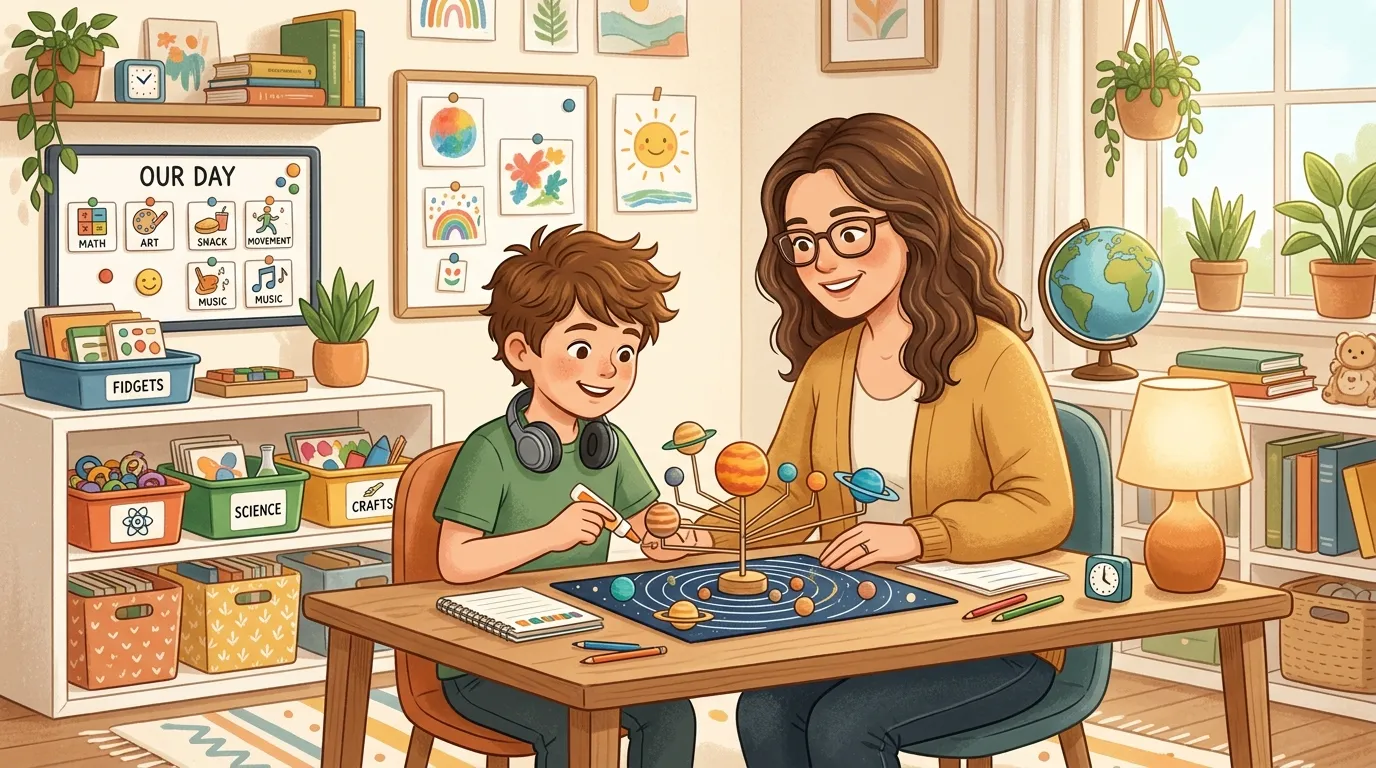
Do not expect your child to focus on a math worksheet for 45 minutes. Break lessons into 10-to-15-minute “micro-bursts” of high-intensity learning. Short, focused sessions followed by immediate movement breaks will yield far better retention and significantly less resistance.

3. Movement is a Need, Not a Privilege

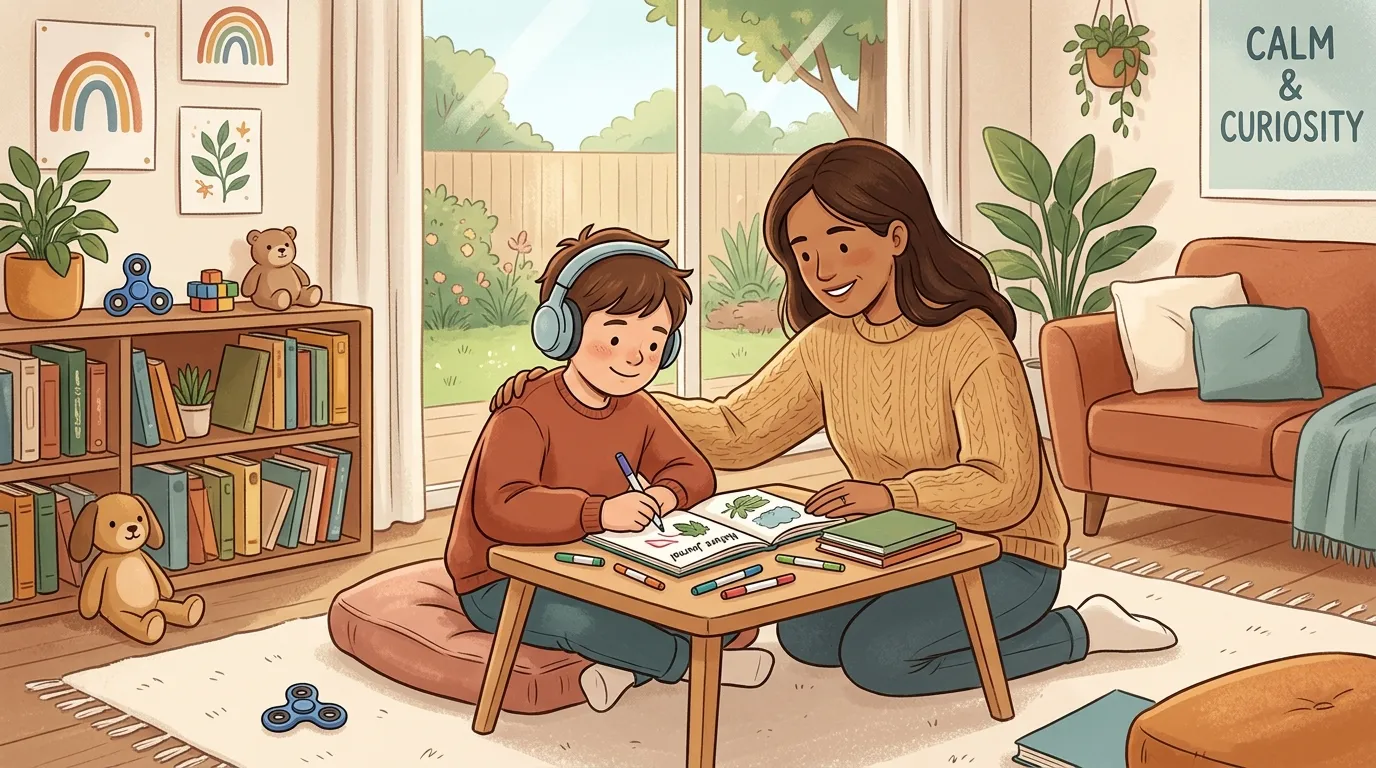
Movement helps the ADHD brain focus. Do not force your child to sit perfectly still at a desk. Allow them to stand, use a wobble board, bounce on a yoga ball, or pace the room while reciting facts. Kinesthetic learning is incredibly effective for neurodivergent students.

4. Provide Immediate Feedback

The ADHD brain struggles with delayed gratification. Immediate, positive reinforcement is crucial for building momentum. Celebrate small wins instantly rather than waiting for the end of a long assignment or the end of the week.

5. Prioritize Deschooling

If you have recently pulled your child from the public school system due to burnout, do not rush into academics. We highly recommend reading our guide on The Mid-Year Crisis Pull: Deschooling and Finding Peace to understand why a period of rest and unlearning is mandatory for recovery.

6. Use an Open-and-Go Curriculum

Parents of ADHD children are already managing a heavy cognitive load. You do not have the energy to spend your weekends planning elaborate lesson structures. Use an open-and-go curriculum that provides clear, scripted lessons. Our comprehensive Academics programs are designed specifically to be flexible and easy to use without extensive prep.

7. Capitalize on Hyperfocus

When a child with ADHD finds a topic that sparks their interest, they can hyperfocus on it for hours. Use this to your advantage. If they love dinosaurs, weave reading, math, and science lessons around that theme. Interest-led learning is the ultimate hack for engagement.

8. Gamify the Mundane

Tasks that lack intrinsic motivation (like memorizing multiplication tables) are agonizing for the ADHD brain. Turn them into games, challenges, or races against the clock to manufacture the dopamine required to complete the task.

9. Externalize Executive Function

Because working memory is impaired, you must provide external supports. Use visual timers, color-coded schedules, checklists, and sticky notes. Do not rely on them to “just remember” what needs to be done.

10. Flexibility Over Rigidity

Some days, the ADHD brain simply cannot compute complex tasks. Be willing to pivot. If math is causing a meltdown, switch to a hands-on science experiment or an educational documentary. Adhering stubbornly to a schedule will only guarantee a ruined day.

11. Protect Their Self-Esteem

The constant struggle to meet neurotypical standards can deeply impact a child’s self-worth. Remind them daily of their strengths—their creativity, their out-of-the-box thinking, and their energy. They are not broken; they are just wired differently.

12. Choose Accessibility

Financial and logistical stress adds to parental burnout. Ensure that the educational tools you choose are sustainable for your family. You can explore our flexible Pricing Plans to find digital and print solutions that fit your budget and lifestyle.

“When we force an ADHD child into a rigid, seated, seven-hour school day, we aren’t testing their intelligence—we are testing their endurance. Homeschooling gives parents the radical freedom to stop fighting their child’s neurology and start working with it.”
— Sathish Bala, CEO of Schoolio

A Path Forward

Raising and educating a child with ADHD requires profound patience, empathy, and a willingness to discard conventional wisdom. By implementing these 12 principles, you can transform your home into a sanctuary where your child’s unique mind is not just accommodated, but celebrated.

Remember that you are not on this journey alone. Equip yourself with the right tools, lean into your child’s natural curiosity, and watch them thrive in an environment designed just for them.
Worldschooling: Turning the Globe into Your Child’s Classroom

Why confine learning to a desk when the world can be your curriculum? Worldschooling is a rapidly growing movement of families who travel and learn simultaneously, breaking free from the rigid 7-hour public school workday. Whether you are living in an RV traversing national parks, operating as digital nomads across Europe, or simply taking extended family trips during the traditional academic year, learning doesn’t have to stop when you leave your house. In fact, that’s precisely when the most impactful learning begins.

The concept of worldschooling is beautifully simple but profoundly transformative: the world itself is the classroom. Every museum, every hiking trail, every interaction at a local market becomes a tangible lesson in history, science, geography, or economics. If you have been feeling the burnout of standard education or seeking a way to merge family travel with academic excellence, the worldschooling lifestyle might be the perfect fit.

The Philosophy Behind Worldschooling

Traditional schooling requires strict adherence to a specific location, a standardized timetable, and an inflexible curriculum. Worldschooling flips this paradigm completely on its head. Instead of reading about the Colosseum in a dry textbook, a worldschooling child walks its ancient steps and touches the stone. Instead of memorizing biology facts from a whiteboard, they explore tide pools in Costa Rica, observe ecosystems firsthand, or track animal footprints in the Rocky Mountains. Education becomes a living, breathing experience.

This experiential learning cements knowledge far deeper than rote memorization ever could. According to resources on neurodevelopment and learning, such as the Child Mind Institute, hands-on, multisensory learning experiences significantly improve retention and engagement, particularly for neurodivergent children. When a child can see, touch, and experience the subject matter, the abstract becomes concrete.

Micro-Bursts and the End of the 7-Hour Grind

A common fear among prospective traveling families is how to fit “school” into a busy travel itinerary. “How will we have time to explore if we have to do school for 7 hours a day?” The secret lies in abandoning the 7-hour public school model altogether. When you remove classroom management, roll call, transitions, cafeteria time, and busywork, a child’s core academic needs—math, reading, and writing—can often be completed in about two hours.

By utilizing 15-minute micro-bursts of high-intensity learning, a child can complete their math lesson while waiting for a train, read their language arts passage at a café, or practice phonics on a long car ride. The rest of the day is spent immersed in the culture and environment around them. This approach prevents burnout and preserves the joy of exploration, ensuring that learning remains a seamless part of the day rather than a tedious chore.

Logistics: How to Manage Curriculum on the Road

Carrying heavy textbooks, workbooks, and binders across international borders or in a cramped RV is simply not feasible. Baggage limits and space constraints make physical curriculum a logistical nightmare. This is where a robust digital platform becomes the worldschooler’s best friend.

Schoolio’s digital platform is built exactly for this kind of extreme flexibility. Because our platform tracks progress automatically, parents don’t need to worry about losing paperwork, grading quizzes manually, or carrying heavy teacher guides. Your child logs in, completes their daily core subjects, and logs off. It’s truly open-and-go from anywhere with a Wi-Fi connection.

If you want to review what subjects are covered, you can explore Schoolio’s comprehensive Academics to see how our curriculum scales from Kindergarten through Grade 8, no matter where in the world you are located.

The Ultimate Form of Socialization

One of the most persistent questions any homeschooling family faces is, “But what about socialization?” Critics often assume that learning outside a traditional classroom leads to isolation. In reality, worldschooling provides the ultimate socialization.

Children learn to interact with people of all ages, cultures, and backgrounds. They aren’t limited to socializing only with peers born in the exact same twelve-month window. They learn to navigate language barriers, understand diverse cultural norms, and engage with the world confidently. They develop empathy, global awareness, and adaptability—critical soft skills that are essential for success in the modern world but are rarely taught in a traditional classroom setting.

Navigating Costs and Accessibility

Many families assume that worldschooling requires a massive trust fund or lottery win. While travel certainly involves costs, blending education and lifestyle often allows families to embrace geographic arbitrage—living in areas where the cost of living is significantly lower than their home country.

When it comes to the educational materials themselves, flexibility shouldn’t break the bank. You can check out Schoolio’s flexible Pricing Plans to see how an all-in-one digital solution can replace thousands of dollars worth of physical textbooks and supplementary tutors.

Ready to Pack Your Bags?

Worldschooling is more than an educational choice; it is a lifestyle commitment. It demands flexibility, curiosity, and a willingness to step outside the conventional boundaries of what “school” looks like. But for the families who embrace it, the rewards are immeasurable. A child raised as a global citizen possesses a breadth of knowledge and a depth of character that will serve them for a lifetime.

If you are ready to take the leap, equip yourself with the right tools. An open-and-go curriculum paired with a sense of adventure is all you really need to turn the entire globe into your child’s classroom.


“Education shouldn’t be confined to four walls and a rigid bell schedule. By abandoning the 7-hour grind and embracing micro-bursts of learning, worldschooling families are proving that the most profound education happens out in the real world.”
— Lindsey Casselman, Co-Founder of Schoolio

Related Reading: Homeschool Travel: A New Way to Learn Beyond the Classroom | Embracing the Nomadic Lifestyle: A Conversation with Megan

The Mid-Year Crisis Pull: Deschooling and Finding Peace

Every year, as the calendar flips to April and May, a distinct phenomenon sweeps through families with school-aged children. We call it the ‘Mid-Year Crisis Pull.’ It is the exact moment when the accumulated weight of failing IEPs, the daily cycle of after-school restraint collapse, the chronic school refusal, and the exhausted meetings with administrators finally become too much to bear. If you are reading this, you probably didn’t plan to homeschool this year. In fact, it might be the very last thing you ever thought you would do. But staying in the traditional public school system is simply no longer a viable option for your child’s mental health or your family’s overall peace.

Making the decision to pull your child out of school mid-year can feel terrifying. You might feel a mix of profound relief and overwhelming anxiety. “What do I do now?” “How do I catch them up?” “Am I going to ruin their education?” Take a deep breath. You are not going to ruin them. The most important thing you can do right now is not to panic-buy a curriculum and force them back into a rigid learning environment. The first step is healing.

The First Step: Deschooling is Mandatory

If you have just pulled your child out of school under crisis conditions, hear this loud and clear: your first step is not academics. Your first step is deschooling and nervous system regulation. Deschooling is the vital adjustment period required for both the parent and the child to decompress from the intense stresses of traditional school. It is a period of unlearning the rigid rules, the institutionalized expectations, and the anxiety associated with performance.

A general rule of thumb in the broader homeschool community is to allow one month of deschooling for every year the child was enrolled in traditional school. For a child who has been in school for five years, that means you might spend up to five months simply existing, healing, and rediscovering what it means to learn without pressure.

What Deschooling Looks Like in Practice

During the deschooling phase, do not try to replicate the classroom at home. Do not set an alarm for 7:30 AM. Do not purchase a rigid, 6-hour-a-day curriculum and force them to sit at the kitchen table. Instead, let them sleep. Sleep is when the brain heals and processes trauma. Let them play video games. Go for walks outside. Watch documentaries together. Your primary goal right now is to rebuild your relationship with your child, which has likely been severely strained by months or years of homework battles and morning rush anxiety.

According to research from the Child Mind Institute, children experiencing chronic stress or burnout require significant downtime to regulate their nervous systems. Their “fight or flight” response has been running on overdrive. You cannot teach a child who is in survival mode. The brain simply will not absorb new academic information until it feels physically and emotionally safe.

“When a child is burnt out from the system, our job isn’t to force them back into the mold that broke them in the first place. Homeschooling is healing, not fixing. You are not trying to ‘fix’ your neurodivergent child so they can fit back into a standardized box; you are changing their environment so they can thrive exactly as they are.” — Lindsey Casselman, Co-Founder of Schoolio

Transitioning to Academics: Slow and Steady

When you both feel the nervous system has reset—when the meltdowns have decreased, the sleep schedule has normalized, and a sense of calm has returned to your household—you can begin introducing academics. Start incredibly small. We recommend starting with just 10 minutes of math and 15 minutes of reading per day. Do not worry about what ‘grade’ they are supposed to be in.

Use gentle, low-pressure placement tests to find their actual operational level. It is incredibly common for a 5th grader experiencing extreme burnout to need 3rd-grade math to rebuild their foundational skills and confidence without triggering frustration intolerance. If you are struggling with the idea of “falling behind,” we highly recommend reading our post on When Grade-Level Tests Make Homeschool Parents Feel Like Failures to help reframe your perspective on academic timelines.

Choosing the Right Tools for Healing

You already have enough stress on your plate. Do not buy a complicated, multi-volume curriculum that requires you to read a massive teacher’s manual every Sunday night just to prepare for the week. You are in recovery mode too. Choose an open-and-go curriculum that allows you to sit down, open the lesson, and learn right alongside your child in a low-pressure way.

Schoolio’s Academics program is designed specifically to be open-and-go, allowing parents to facilitate learning without a teaching degree or hours of prep work. You can explore our Pricing Plans to find a digital or print option that fits your family’s immediate needs.

Remember, slow is not falling behind—especially for neurodivergent kids. Slow is how you build a lasting, stable foundation. Healing takes time, but the peace that comes when your child rediscovers their natural love of learning is worth every second of the journey. If you need more support during this transition, consider reading our guide on From Survival Mode to Success: How Homeschooling Helps Kids Recover from Public School Burnout.

Next Steps for Your Family

If you have just made the “Crisis Pull,” know that you are not alone. Thousands of families make this exact same choice every spring. Take a deep breath, close the laptops, and focus on peace.

The Hidden Costs of Public School (And Why Homeschooling is Actually Cheaper)

One of the biggest hesitations parents have about leaving the public school system is the cost. “Public school is free,” the saying goes. But when you start adding up the hidden expenses, the reality of public school vs homeschooling costs looks very different.

The True Cost of “Free” Education

Between mandatory school supply lists, uniform or clothing expectations, constant fundraisers, field trip fees, busing or gas for the commute, and the inevitable before-or-after school care, the costs of public school pile up quickly. Many families find they are spending thousands of dollars a year on a system that isn’t even working for their child.

How Homeschooling Saves Money

Homeschooling allows you to control your budget. You don’t need expensive designer clothes to learn at the kitchen table. You don’t have to pay for daily transportation. And with affordable, comprehensive curriculum options like Schoolio, your entire year of core subjects (Math, Language Arts, Science, and Social Studies) can cost less than what you’d spend on a month of after-school care.

Furthermore, many US states now offer ESA (Education Savings Account) programs that allow you to use public funds to purchase secular homeschool curriculums like Schoolio through platforms like ClassWallet.

Start Your Homeschool Journey Today

Starter Bundle

New Homeschooler Starter Bundle
A complete “open and go” curriculum bundle with 4 core subjects perfectly curated for families transitioning out of public school.

Social Emotional Learning

Social Emotional Learning Bundles
Help your child understand their feelings, build resilience, and navigate social situations with confidence.

Free Printable Samples

Try it For Free Today
Download full unit samples and worksheets from Grade 1 through 8 to experience the “open and go” difference before you buy.

Homeschooling an ADHD Child in Public School: Why the IEP Isn’t Enough

For parents of neurodivergent children, securing an Individualized Education Program (IEP) feels like a massive victory. But what happens when the IEP isn’t enough? Homeschooling an ADHD child in public school often becomes an endless cycle of meetings, missed accommodations, and daily frustration.

The Limits of Public School Accommodations

Public schools try their best, but a classroom of 30 students simply cannot bend to the unique sensory and pacing needs of a child with ADHD. Even with a 504 plan or an IEP, your child is still subjected to rigid bells, prolonged sitting, and standardized expectations that conflict with how their brain operates.

Why Homeschooling Changes the Game

By bringing education home, you don’t need to fight for accommodations—the entire day becomes the accommodation. You can incorporate frequent movement breaks, eliminate visual clutter, and let your child learn in the environment that suits them best. At Schoolio, our curriculum is designed specifically for neurodivergent learners. We remove grade-level markers from the pages to reduce anxiety and use short, bite-sized lessons that cater to shorter attention spans.

Start Your Homeschool Journey Today

Starter Bundle

New Homeschooler Starter Bundle
A complete “open and go” curriculum bundle with 4 core subjects perfectly curated for families transitioning out of public school.

Social Emotional Learning

Social Emotional Learning Bundles
Help your child understand their feelings, build resilience, and navigate social situations with confidence.

Free Printable Samples

Try it For Free Today
Download full unit samples and worksheets from Grade 1 through 8 to experience the “open and go” difference before you buy.

Signs Your Child Needs to Be Homeschooled: Recognizing Public School Burnout

As the school year pushes into the spring, many families hit a breaking point. What started as typical back-to-school jitters in September has morphed into deep, chronic exhaustion by April.

If your mornings are a battleground and your afternoons end in meltdowns, you aren’t alone. You are likely witnessing public school burnout.

Here are the three undeniable signs your child needs to be homeschooled, and how taking control of their education can restore peace to your household.

1. Severe After-School Restraint Collapse

Does your child hold it together perfectly all day for their teachers, only to completely fall apart the minute they get in the car or walk through the front door? This is called “after-school restraint collapse.” The sensory overload, social masking, and rigid demands of the public school system drain their nervous system. When they finally reach their safe space (you), the dam breaks. Homeschooling eliminates this exhaustion by allowing them to learn in an environment calibrated to their sensory needs.

2. The “Sunday Scaries” Have Become Daily Terror

It is normal for kids to groan about Monday morning. It is not normal for a child to experience severe anxiety, stomach aches, or panic attacks every single night before school. If your child’s mental health is rapidly deteriorating due to academic pressure or bullying, pulling them out isn’t “giving up”—it is rescuing them.

3. Their Spark for Learning is Gone

Every child is born curious. If the standardized testing, relentless quizzing, and strict pacing of the public school system have convinced your bright child that they “hate learning” or “aren’t smart,” the system is failing them. Homeschooling allows you to pivot to an interest-led, adaptive approach. If they love dinosaurs but hate reading, you can teach them reading through dinosaurs.

The Transition Doesn’t Have to Be Hard

Many parents recognize the signs but hesitate because they think they don’t have the time, patience, or qualifications to teach. The truth? You don’t need a teaching degree to rescue your child’s love of learning. With an open-and-go curriculum like Schoolio, the lesson planning is already done for you. You just open the book and learn alongside them.

Start Your Homeschool Journey Today

Starter Bundle

New Homeschooler Starter Bundle
A complete “open and go” curriculum bundle with 4 core subjects perfectly curated for families transitioning out of public school.

Social Emotional Learning

Social Emotional Learning Bundles
Help your child understand their feelings, build resilience, and navigate social situations with confidence.

Free Printable Samples

Try it For Free Today
Download full unit samples and worksheets from Grade 1 through 8 to experience the “open and go” difference before you buy.

World Autism Acceptance Day: Why Homeschooling is a Game-Changer for Autistic Children

April 2nd marks World Autism Acceptance Day—a day dedicated not just to awareness, but to true acceptance, inclusion, and celebrating the unique ways neurodivergent minds experience the world.

For many parents of autistic children, the traditional education system can feel like trying to fit a square peg into a round hole. Bright fluorescent lights, chaotic hallways, rigid schedules, and a one-size-fits-all curriculum often lead to sensory overload and burnout.

This is exactly why a growing number of families are turning to homeschooling. Here is how taking control of your child’s educational environment can change everything.

1. Complete Control Over the Sensory Environment

Traditional classrooms are sensory minefields. When you homeschool, you dictate the environment. Does your child need to learn in a dim room with noise-canceling headphones? Can they focus better while sitting on a yoga ball or swinging in a hammock? Homeschooling allows you to completely eliminate the sensory friction that prevents learning.

2. Learning at Their Own Pace

Autistic children often have “spiky” cognitive profiles—they might read at a 6th-grade level but need 2nd-grade math support. Traditional schools struggle to accommodate this. Homeschooling allows you to mix-and-match grade levels per subject so your child is perfectly challenged, never bored, and never left behind.

3. Leaning Into Special Interests

Autistic children often have deep, passionate interests. Homeschooling gives you the freedom to weave those interests directly into their education. If your child loves trains, you can learn about the history of locomotives for Social Studies, calculate the speed of trains for Math, and read stories about train conductors for Language Arts.

Real Parents, Real Results

We don’t just build curriculum; we listen to the families using it. The relief parents feel when they finally find a system that works for their neurodivergent child is exactly why we do what we do:

“I wish there was more material like this. I recently discovered Schoolio. I have been homeschooling 2 neuro diverse children for years and it has been such a struggle. I love this curriculum.”Liane Sabatino

“You’ve made homeschooling so much easier and stress free than I could have imagined. I’m doing grade 2 with my daughter who is a bit behind developmentally and has CP and she’s finally understanding things with the one on one and your lessons. I couldn’t be happier.”Holly

“My gr. 6er is dyslexic and is having an easy time with the instructions and able to follow along.”Leanne Smith

Schoolio’s Commitment to Neurodivergent Learners

At Schoolio, we believe that every child deserves to learn in a way that makes sense to their brain. That’s why our curriculum is built from the ground up to be neurodivergent-friendly:

  • No Grade Levels on the Pages: We remove the stigma. Kids just see the work, not a grade number telling them they are “behind.”
  • Clean, Uncluttered Design: We intentionally limit distracting graphics and busy pages to reduce visual overwhelm.
  • Bite-Sized Lessons: Short, focused lessons that are perfectly suited for shorter attention spans and frequent sensory breaks.

This World Autism Acceptance Day, let’s commit to building educational environments that don’t ask our children to change who they are, but instead change to support how they learn.

Tools Designed for Neurodivergent Minds

If you’re looking for a place to start your homeschooling journey, Schoolio offers several resources built specifically with neurodivergent learners in mind. These programs focus on emotional regulation, self-paced learning, and sensory-friendly design.

Neurodivergent Homeschool Program

The Schoolio Neurodivergent Program
A complete, flexible approach to K-8 education that strips away the pressure of “grade levels” and lets your child learn exactly how their brain works best.

Social Emotional Learning

Social Emotional Learning (SEL) Bundles
From Pre-K all the way to Grade 8, these dedicated units help children understand their feelings, build resilience, and navigate social situations with confidence.

Thoughts & Feelings

Thoughts & Feelings Unit
A specialized workbook designed to help kids identify, process, and manage complex emotions in a healthy, structured way.

What (and Why) to Teach in Social Studies in K–8

What (and Why) to Teach in Social Studies in K–8


When most parents hear “Social Studies,” they think:

History.

Geography.

Maybe a few maps.

And then they wonder…

How much does this really matter in elementary school?

But Social Studies is so much bigger than memorizing dates and capitals.

It’s not just about the past.

It’s about people.

It’s about identity.

It’s about belonging.

And when we teach it well in the early years, we aren’t just building knowledge — we’re building citizens.


Social Studies Is More Than History and Maps

In K–8, Social Studies is an umbrella.

And under that umbrella, we’re teaching multiple big ideas:

  • History and Geography, yes.

But also,

  • People
  • Communities
  • Cultures
  • Heritage
  • Identity
  • Citizenship

Let’s break that down.


Geography: People, Communities, and Cultures

Yes, geography includes landforms and continents.

But in the early grades, it starts much closer to home.

A kindergartener doesn’t need to memorize world capitals.

They need to understand:

Who are the people in my community?

What jobs do they do?

How do we help one another?

A first grader can learn:

What is a community?

Why do we have libraries, fire stations, parks?

Who makes our town function?

As they grow, geography expands:

How do people live in different parts of the world?

What do families look like in different cultures?

What traditions do people celebrate?

When kids learn about different family structures, religions, foods, and customs, they are building empathy.

They are learning tolerance.

They are widening their worldview.

And that matters just as much as knowing where France is on a map.


History: Story Before Timeline

History in the early years isn’t about memorizing wars.

It’s about story.

It starts with:

What is “the past”?

What was my family like before I was born?

Where did my grandparents grow up?

Children can explore their own heritage:

Where did our family come from?

Why did they immigrate?

What traditions have we kept?

Understanding personal history builds identity.

Later, that expands into:

Major events.

Important figures.

How societies changed over time.

But when we start with personal connection, history feels human — not just a list of facts.


Heritage and Identity

When kids explore their heritage, they begin to see themselves as part of a bigger story.

That’s powerful.

It gives them roots.

It gives them context.

It teaches them that their family’s journey — whether recent immigration or generations in one place — is part of the fabric of society.

And when they understand their own story, they’re more open to respecting someone else’s.


Citizenship: It Starts So Small

Citizenship doesn’t begin in middle school with a textbook on government.

It begins in first grade.

It begins when a child learns to:

Pick up trash in the park.

Hold the door open.

Follow shared rules at the library.

Understand fairness.

Those small acts are the foundation of civic responsibility.

By grade 5 or 6, we can expand into:

What is local government?

What does a mayor do?

What are the levels of government?

Why do we vote?

But those bigger ideas only land when kids understand that they are part of a community.

Citizenship is belonging plus responsibility.

And it builds year by year.


Why This Matters in K–8

If we reduce Social Studies to “history and geography facts,” we miss the point.

Social Studies is where we teach kids:

How to see others.

How to understand systems.

How to think critically about fairness.

How to participate in their community.

How to value diversity.

How to understand where they come from.

In a world that feels increasingly divided, those skills are not optional.

They are foundational.


It’s Not Extra — It’s Essential

In the early years especially, Social Studies isn’t separate from real life.

It is real life.

It’s conversations at the dinner table.

It’s noticing the helpers in your town.

It’s asking where your family’s traditions came from.

It’s learning why we follow rules.

It’s understanding that different doesn’t mean wrong.

From a first grader learning to care for their local park…

to a sixth grader learning how government works…

It all builds.

And when we teach Social Studies with intention, we aren’t just raising students.

We’re raising thoughtful, informed, empathetic humans.

?

Lindsey

certified special-ed educator, homeschooling mom, & co-founder of Schoolio

Self-Regulation Over Bans

Self-Regulation Over Bans

This has been on my mind today…

I keep seeing the same debate come up in different forms. Ban the phones. Lock them away. Remove the distraction.

And I understand the instinct.

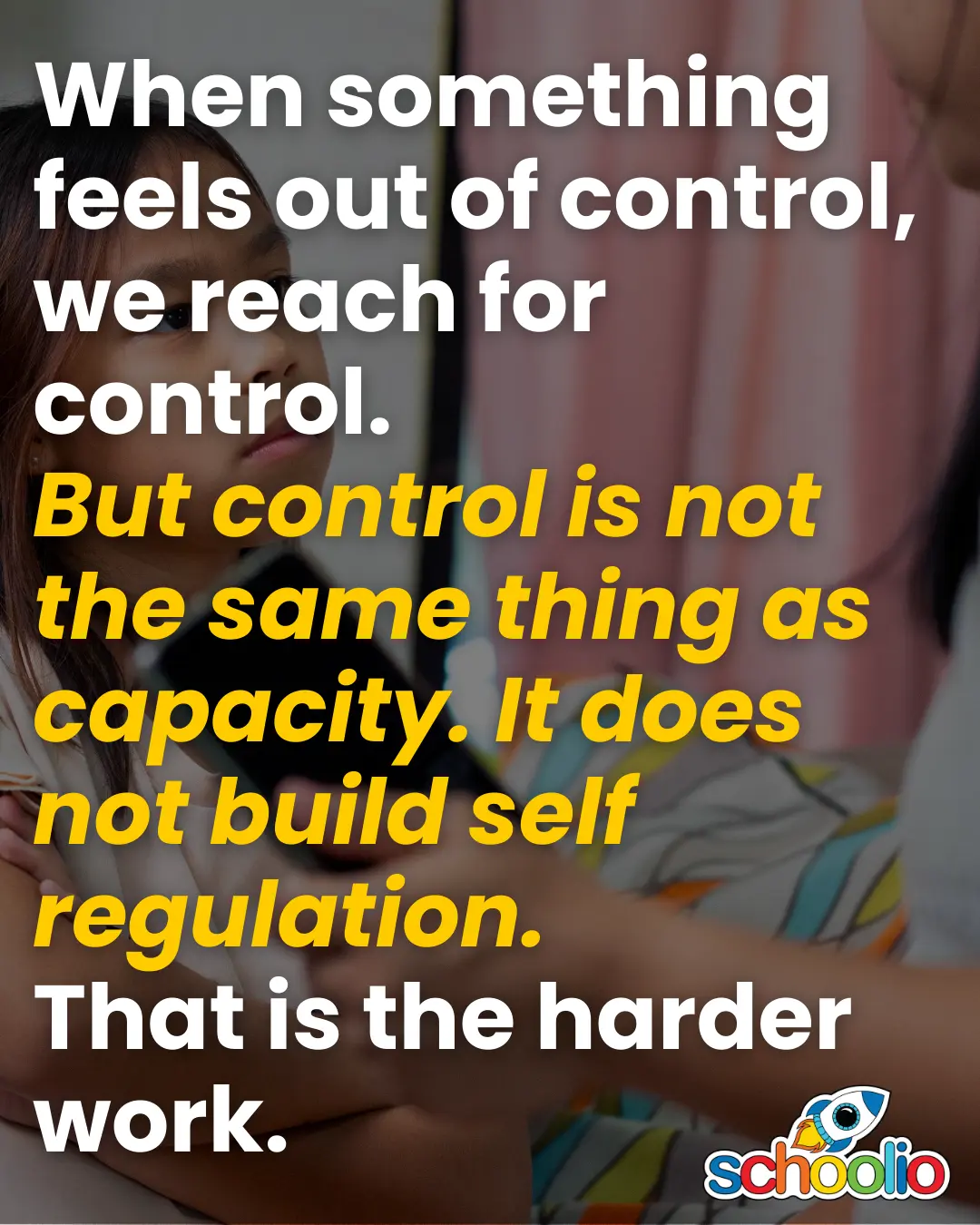
When something feels out of control, we reach for control.

But I am not sure control is the same thing as capacity.

As parents, especially homeschooling parents, we are not just trying to create quiet rooms. We are trying to raise children who can function in a loud world. And the world they are growing into is not analog. It is always on. Always connected. Always competing for attention.

Banning a device can create temporary calm. But it does not automatically build self regulation.

That is the harder work.

The truth is, the system most of us grew up in was not designed for devices in every pocket. Technology was layered on top of a structure that was built for scarcity of information. So of course there is friction.

But pretending devices are purely harmful ignores reality. This generation learns, connects, creates, and even earns through digital tools. The issue is not technology itself. It is distraction. It is design. It is intention.

There is a difference between a child using a math app for 20 focused minutes and scrolling an algorithm built to hijack attention.

One builds skill.

The other fragments it.

In a homeschool setting, we have something powerful that traditional systems often lack. Flexibility. We can decide not just if a device is used, but how and why.

Instead of asking, “How do I eliminate screens?” maybe the better question is, “How do I teach my child to manage them?”

That might look like:

Clear time boundaries.

Purpose driven usage.

Conversations about how algorithms work.

Practicing focus in short, intentional blocks.

Because self regulation is not learned in isolation. It is learned in context.

The real goal is not to control every input. It is to build internal strength. If our kids are going to function in a digital world, they have to practice focus within it, not be shielded from it entirely.

That takes nuance. It takes patience. And it takes modeling the habits we want them to build.

Homeschooling gives us the space to rethink these patterns instead of reacting to them.

And maybe that is the opportunity. Not panic. Not total bans. But thoughtful capacity building in a world that is not slowing down.

Sathish

still learning, still unlearning

The Hidden Cost of Neurodivergent Parenting: Hyper-Vigilance

The Hidden Cost of Neurodivergent Parenting: Hyper-Vigilance


This has been sitting heavy on my heart lately.

There’s something we don’t talk about enough in neurodivergent parenting.

The constant scanning.

The quiet predicting.

The 24/7 “what might happen next?” running in the background of your brain.

If you’re raising an autistic, ADHD, AuDHD, PDA, dyslexic, anxious, or otherwise neurodivergent child, you are rarely fully “off.”

You are watching the environment.

You’re clocking the noise level in the room.

You’re noticing the shift in tone in someone’s voice.

You’re tracking how long it’s been since your child ate.

You’re calculating whether that field trip will tip them into overload.

You’re rehearsing explanations in case someone misunderstands them.

You’re preparing to advocate before anyone even says anything.

That’s hyper-vigilance.

And it’s exhausting.


The 24/7 “Yellow Alert” Zone

Hyper-vigilance is what happens when your nervous system never fully stands down.

It’s anticipatory anxiety.

It’s living in a constant low hum of cortisol because your brain is always asking:

“What could go wrong?”

“How can I prevent it?”

“How do I protect them?”

You’re not dramatic.

You’re not overreacting.

You’ve just learned that small things can escalate quickly.

So you stay ready.

Ready to redirect.

Ready to soothe.

Ready to explain.

Ready to shield.

Even when nothing is happening.

Especially when nothing is happening.

Because that’s when you’re bracing.

No wonder you’re tired.


The Emotional Labor No One Sees

From the outside, it might look like:

“You’re just at home.”

“You just planned a playdate.”

“You just left the party early.”

“You just adjusted the schedule.”

But what people don’t see is the mental math behind every decision.

Is the lighting too bright?

Will there be safe food?

How long before sensory fatigue sets in?

Will there be an adult who understands?

What’s our exit plan?

You are constantly predicting triggers, preventing meltdowns, and advocating — often before the first sign of distress appears.

That is invisible labor.

And it adds up.


Your Tiredness Is Earned

If you feel bone-deep exhausted…

If you sometimes fantasize about not having to think for one full day…

If you love your child fiercely but still feel wrung out…

That doesn’t make you weak.

It makes you human.

You are doing high-level emotional regulation work all day long — for yourself and for your child.

You are absorbing dysregulation.

You are translating a world that doesn’t always make sense to them.

You are adjusting systems.

You are buffering friction.

That is hard work.

Your tiredness is not a failure of resilience.

It is evidence of effort.


A Gentle Reminder

Hyper-vigilance is a protective response.

It grew because you care.

But you deserve moments where you don’t have to be on guard.

Where you can exhale.

Where you can lower your shoulders.

Where you can let someone else hold the scanning for a while.

If you are homeschooling a neurodivergent child, part of the gift is this:

You can design days that reduce the need for constant alertness.

Fewer transitions.

Fewer unpredictable environments.

More regulation.

More rhythm.

Not because your child is fragile.

But because nervous systems deserve safety.

And so do you.


If no one has told you lately:

This is hard work.

You are not imagining the weight of it.

And the exhaustion you feel?

It’s earned.

?

Lindsey

certified special-ed educator & co-founder, Schoolio

When Kids Solve Real Problems, Something Shifts

When Kids Solve Real Problems, Something Shifts


This has been on my mind today…

When kids solve real problems, something shifts.

Not on a report card.

Not in a percentage.

In themselves.

When they fix something broken.

When they build something useful.

When they grow something and watch it thrive.

They begin to believe they can solve bigger problems.

They start to see themselves as capable.

And that belief is not graded. It is felt.

I think this is where many kids quietly disconnect from school.

Not because they are lazy.

Not because they are incapable.

But because so much of what they are asked to do feels disconnected from their living reality.

Pages of theory.

Lessons without context.

Concepts without application.

When learning does not connect to life, it starts to feel performative. Do this to get the mark. Memorize this to pass the test. Complete this because it is assigned.

But this generation is different.

More than ever, they want to know why first.

Why are we learning this?

Where does this show up in the real world?

How does this matter?

If that question is not answered, attention drifts. Motivation fades. Learning becomes compliance instead of curiosity.

We have designed school for efficiency. For scale. For managing large groups. That worked when information was scarce and the classroom was the gateway.

But now information is everywhere.

What is scarce is meaning.

When a child can see how math helps them measure wood for a project, it sticks. When writing helps them communicate an idea they care about, it matters. When science explains something they experience, it connects.

Real work grounds learning in purpose.

And purpose fuels effort.

When kids experience that connection, they do not just complete assignments. They engage. They take ownership. They ask better questions.

Because they are no longer learning for the grade.

They are learning because it makes sense.

If we want more engagement, we cannot just adjust the curriculum. We have to reconnect learning to life.

Because when kids solve real problems, they begin to believe they can solve bigger ones.

And that belief might be the most important outcome of education.


Sathish

still learning, still unlearning


What Is “Math Anxiety” — And How Can You Help Your Child Overcome It?

What Is “Math Anxiety” — And How Can You Help Your Child Overcome It?

If your child melts down at the sight of a math worksheet…

If they freeze when you ask them a basic fact…

If they suddenly “forget everything” during a quiz…

You might be looking at math anxiety.

And no — it’s not the same thing as “being bad at math.”


What Math Anxiety Actually Is

Math anxiety is a stress response.

Not a knowledge gap.

Not laziness.

Not a lack of intelligence.

It’s what happens when your child’s nervous system associates math with pressure, shame, embarrassment, or repeated failure.

When the brain senses threat, it shifts into survival mode.

And here’s the tricky part:

The same part of the brain used for problem-solving (working memory) is the part that shuts down under stress.

So when a child says,

“I don’t know how to do this!”

Sometimes what they really mean is,

“My brain is offline right now.”

The anxiety blocks access to the skills they may actually have.


Where It Comes From

Math anxiety can develop from:

  • Timed tests

• Public correction in class

• Repeated low scores

• Moving too quickly through concepts

• Comparing themselves to peers

• Being told they’re “not a math person”

For neurodivergent kids — especially those with dyscalculia, ADHD, processing delays, or perfectionism — math anxiety is even more common.

If numbers are already harder to process, and then you layer time pressure or shame on top?

The brain starts to brace for math like it’s a threat.

And once that association forms, even opening the book can trigger it.


Signs You Might Be Seeing Math Anxiety

It doesn’t always look dramatic.

Sometimes it looks like:

  • Avoidance

• “Bathroom breaks” during math

• Complaints of headaches or stomach aches

• Tears over “easy” problems

• Perfectionism and erasing constantly

• Rushing to get it over with

• Refusing to try at all

The child isn’t being dramatic.

Their nervous system is trying to protect them.


How to Help

The goal isn’t to make math wildly entertaining.

The goal is to make it feel safe.

1. Slow It Down

If a concept is supposed to take one day, let it take a week.

Mastery builds confidence.

Speed builds stress.

You are not on a clock.


2. Remove the Time Pressure

Timed drills are a huge trigger for many kids.

Accuracy matters more than speed.

You can build fluency gradually — without a stopwatch.


3. Make It Concrete

Abstract numbers on paper can feel overwhelming.

Use:

  • Lego

• Baking

• Measuring cups

• Money

• Cutting food into fractions

• Building arrays with blocks

Touching math reduces fear.


4. Normalize Struggle

Be careful with language like:

“You’re so smart!”

Because when they struggle, they’ll think,

“Then why can’t I do this?”

Instead try:

“This is hard — and you’re working through it.”

“Struggling means your brain is growing.”

“We can take this one step at a time.”

Effort over identity.


5. Separate Their Worth from the Score

A low score is information.

Not a verdict.

If your child works for 60 hard minutes and gets 50%, that effort matters — even if the system doesn’t reward it.

Math is a skill.

Not a measure of intelligence.


The Long Game

Most adults use calculators.

Most adults look things up.

Most adults don’t solve equations under time pressure.

What they do need is perseverance.

Confidence.

The belief that they can face something hard and figure it out.

That’s what you’re building.

And that doesn’t come from pushing harder.

It comes from lowering fear.

Math anxiety can absolutely improve.

But it improves when the nervous system feels safe enough to try.

And if you’re reading this because you’re worried?

That tells me something important.

You care.

And caring is the foundation of everything that works.

? Lindsey

certified special-ed educator & co-founder, Schoolio