Once a Crime, Now a Cornerstone

Once a Crime, Now a Cornerstone


This has been on my mind today…

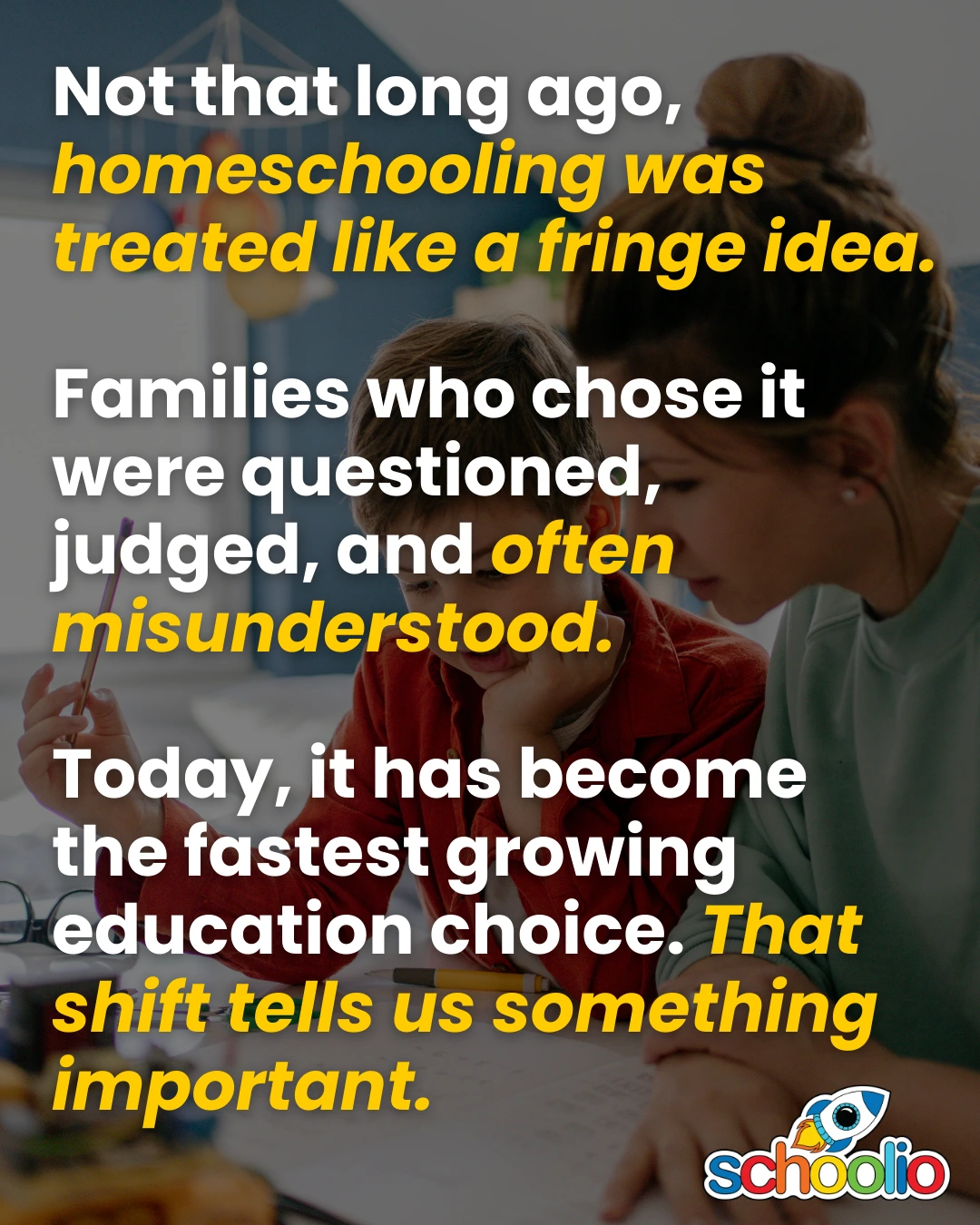
Not that long ago, homeschooling in Georgia was treated like a fringe idea. In some cases, it was outright illegal. Families who chose it were questioned, judged, and often misunderstood. Today, it has become one of the fastest growing education choices in the state. That shift tells us something important. Not just about Georgia, but about where education is heading everywhere.

The Atlanta Magazine story lays it out clearly. Georgia’s homeschooling boom did not come from one moment or one policy. It grew slowly, family by family, as parents watched their kids struggle in systems that were never designed for how they actually learn. Some were burned out. Some were anxious. Some were bored. Some were quietly disappearing in classrooms that moved too fast or not fast enough.

What changed was not just permission. It was trust. Trust that parents could make thoughtful decisions. Trust that learning does not need to look the same for every child. And trust that education can happen outside a building without losing its value.

Many of the families featured did not start out wanting to homeschool. This matters. Homeschooling is rarely the first choice. It is often the response to a moment where something feels off. A child stops asking questions. A once curious learner becomes withdrawn. School becomes a daily negotiation instead of a place of growth. Parents notice these signals long before report cards do.

What stands out is how diverse today’s homeschoolers are. They are not one type of family. They include working parents, single parents, military families, neurodivergent kids, gifted kids, and kids who just needed a different pace. Homeschooling in Georgia is no longer about opting out. It is about opting into something more intentional.

This is where the conversation gets interesting. The rise of homeschooling is not a rejection of education. It is a critique of rigidity. Parents are not saying learning does not matter. They are saying the current model is not flexible enough to meet real human needs.

At Schoolio, we see the same pattern across North America. Families come to homeschooling because their child needs time to breathe, space to think, and learning that adapts instead of demands. Especially for sensitive and neurodivergent kids, the traditional classroom can feel overwhelming. Noise, pace, pressure, and comparison all pile up. When those kids are given a calmer environment and lessons that meet them where they are, something shifts.

The Georgia story also shows how infrastructure is catching up. Co ops, hybrid programs, online platforms, and community groups are making homeschooling less isolating and more sustainable. Parents are not doing this alone anymore. They are building ecosystems around their kids.

This is the part many people miss. Homeschooling today is not about recreating school at home. It is about redesigning learning around the child. Academics still matter. But so does emotional safety. So does confidence. So does the ability to learn how to learn.

For parents reading this, the takeaway is simple. If your child is struggling in school, it does not mean they are broken. It means the environment might not fit. Georgia’s homeschooling boom is proof that when families are given options, they choose what works for their kids.

Education is changing because families are changing it. Not through protest, but through choice. And once a choice becomes a cornerstone, there is no going back.


Sathish

still learning, still unlearning

Source: Atlanta Magazine
https://www.atlantamagazine.com/news-culture-articles/once-a-crime-now-a-cornerstone-inside-georgias-homeschooling-boom/

Slow Is Not Falling Behind — Especially for Neurodivergent Kids

Slow Is Not Falling Behind — Especially for Neurodivergent Kids


This is something I wish someone had told me in my first year of homeschooling:

Finishing fast is not the goal.

Especially not for neurodivergent kids.

Somewhere along the way, we absorbed this idea that productivity equals progress. That if we aren’t moving quickly through curriculum, checking off lessons, advancing units, we must be falling behind.

Behind who?

Behind what?

Behind a system we left?

When you’re homeschooling an autistic, ADHD, dyslexic, AuDHD, or otherwise neurodivergent child, pace is not a moral issue. It’s a nervous system issue.

And slow is not a flaw.


When “Four Lessons” Becomes Ten Days

Our writing courses, for example, are typically structured in four parts:

Lesson One: Brainstorming

Lesson Two: Writing day one

Lesson 3: Writing day two

Lesson 4: Editing

On paper, that’s four days.

In real life?

It might be ten.

And that’s okay.

If your child can only focus for fifteen solid minutes before their brain taps out, stretching one writing lesson across multiple days isn’t lowering the bar.

It’s protecting their capacity.

It’s teaching them that writing doesn’t have to feel like drowning.

I would rather see one writing assignment completed thoughtfully, with pride and confidence, than three rushed through with frustration and shutdown.

One done well is more valuable than three done miserably.

Every single time.


Productivity Culture Sneaks Into Homeschooling

Even when we leave traditional school, we bring its pace with us.

We feel pressure to “stay on track.”

We worry about being “behind.”

We compare how much we’ve covered.

But coverage is not comprehension.

Speed is not mastery.

And volume is not engagement.

Neurodivergent kids often need:

  • More repetition (or less redundancy!)
  • More breaks
  • More sensory regulation
  • More autonomy
  • More recovery time
  • More learning time dedicated to Social Skills and Emotional Intelligence

If we measure success by how much we completed, we miss the more important questions:

Did it stick?

Do they feel confident?

Are they emotionally regulated?


Engagement Beats Volume

When a child works at a sustainable pace, something powerful happens.

They stay willing.

They don’t start to hate the subject.

They don’t associate learning with shame or overwhelm.

They build confidence instead of resistance.

That’s not falling behind.

That’s building foundation.

And foundation matters more than speed.


Pace Is a Tool — Not a Rule

Curriculum pacing guides are suggestions.

Not contracts.

Not deadlines.

Not moral benchmarks.

If your child needs:

  • Three days for one math concept
  • Three weeks for a writing assignment
  • To read one chapter a day instead of three
  • A full pause during a hard life season

That is not failure.

That is responsive parenting.

That is adaptive education.

That is you paying attention to the human in front of you.


What Actually Matters

At the end of the year, I don’t ask:

“How many units did we finish?”

I ask:

Is my child still curious?

Do they feel capable?

Are they willing to try again tomorrow?

Because a happy, engaged child who trusts themselves as a learner will always outpace a burned-out child who learned to rush for approval.

Mastery beats completion.

Engagement beats volume.

Joy beats speed.

Slow is not behind.

Slow is intentional.

Slow is sustainable.

Slow is often exactly what neurodivergent kids need.


? Lindsey

certified special-ed educator, homeschool mom, & co-founder of Schoolio

When a Mom in Our Community Answered a Simple Question with One Word.

When a Mom in Our Community Answered a Simple Question with One Word.


This has been on my mind today…

A mom in our community answered a simple question with one word.

Freedom.

Not freedom from learning. Freedom inside learning.

One parent shared that her eleven year old moves between third, fourth, and fifth grade work depending on the subject. Not because he is behind. Not because he is ahead. Because that is where he is.

Another said she loves the bite sized, one and done lessons. Her child stays engaged. It takes less than an hour. Growth has been incredible.

And then a mom of a neurodivergent daughter said something that hit hard. In public school and even online public school, the pace was built for typical kids. When her child could not keep up, she was made to feel like the problem.

Since switching, her daughter is excited to learn. Proud of her grades. Thriving.

This is why homeschooling is becoming more normal across the world.

It is not about escaping school. It is about building systems that adapt to kids instead of asking kids to adapt to systems.

When parents say freedom, what they mean is their child finally fits.


Sathish

still learning, still unlearning


Oral Stims, Echolalia, Song Loops, and Counting: What Your Neurodivergent Child Is Actually Doing

Oral Stims, Echolalia, Song Loops, and Counting: What Your Neurodivergent Child Is Actually Doing


Last week my daughter asked me something that stopped me mid-laundry.

“What’s the difference between an oral stim and echolalia?”

Then she added, almost as an afterthought:

“And why do I get a little piece of a song stuck in my head when I’m stressed? Is that a stim too?”

If you’re parenting a neurodivergent child, you’ve probably seen versions of all of this.

The humming.
The repeating lines from shows.
The constant chewing.
The whispering under their breath.
The same five seconds of a song looping again and again.

Maybe you’ve wondered if you should stop it.
Maybe someone has told you it’s “annoying.”
Maybe you’ve corrected it without even thinking.

Before we decide what to do about it, we need to understand what it is.

Because most of the time?

It’s regulation.

What Is a Stim, Really?

Stimming is short for self-stimulatory behavior.

That sounds clinical. But in real life, it just means this:

The nervous system doing something to help itself stay balanced.

Everyone stims.

Some people bounce their leg.
Some twirl their hair.
Some chew ice.
Some scroll when they’re overwhelmed.

Neurodivergent kids often stim more visibly — or more frequently — because their nervous systems require more input to stay regulated.

Stims can be physical.
They can be verbal.
They can be oral.
They can be completely internal.

They are not “bad habits.”

They are tools.

Oral Stims: The Mouth as a Regulation Tool

An oral stim involves the mouth.

Chewing hoodie strings, sleeves, lips, even hair.
Biting pencils. Biting nails.
Humming.
Clicking their tongue.
Needing gum constantly. Needing a snack to emotionally settle.

The mouth has a high density of nerve endings. Oral input can calm the nervous system. It can increase alertness. It can improve focus. For many ADHDers especially, oral input provides a small dopamine boost — and dopamine is often in short supply in ADHD brains.

What looks like “why are you chewing again?” might actually be the brain saying:

“I need input to stay steady.”

It isn’t random.
It isn’t defiant.
It’s neurological.

Echolalia: Repeating Words Is Not Meaningless

Echolalia is the repetition of words, phrases, or sounds.

It can be immediate — repeating what you just said or a sound they just heard.

Or delayed — quoting a line from a show hours later, sometimes in a completely different context.

Echolalia is most commonly associated with autism, but ADHDers can also repeat language for regulation or processing.

And here’s the important part:

It’s often communication.

Echolalia can be:

  • language processing

  • rehearsal

  • self-soothing

  • emotional expression

  • nervous system regulation

Sometimes a child repeats a phrase not because they’re “stuck,” but because that phrase carries a feeling they don’t yet have the words for.

It overlaps with scripting. Scripting involves mentally preparing or replaying conversations for safety. Echolalia can serve a similar purpose. It gives structure to social language that otherwise feels unpredictable.

It isn’t empty repetition.

It’s scaffolding.

The Song That Won’t Leave: Musical Looping

Now let’s talk about the tiny piece of music that won’t stop playing.

That five-second line.
Over and over.

This is sometimes called musical looping. You might also hear it described as auditory stimming or cognitive stimming. Outside neurodivergent spaces, people casually call them “earworms,” but that word often dismisses what’s actually happening.

For many neurodivergent kids, that looping music can function as a mental stim.

When stress rises, the nervous system looks for predictability.

Music is predictable.
It has rhythm.
It has repetition.
It doesn’t suddenly criticize or overwhelm.

So the brain grabs something familiar and plays it again.

Not because it’s broken.

Because it’s building stability.

Sometimes the loop stays internal.
Sometimes it turns into humming.

Either way, it can be regulation — not distraction.

What About Counting in Your Head?

Sometimes it isn’t a song.

Sometimes it’s counting.

Counting steps.
Counting ceiling tiles.
Counting backwards from 100.
Counting in patterns.

Parents often ask, “Is that an auditory stim?”

It can be.

But more specifically, counting in your head is usually what we’d call a cognitive stim or an internal verbal stim.

If your child “hears” the numbers in their mind, it’s engaging the verbal/auditory system. If they see the numbers visually, it may lean more cognitive or visual.

But the function is often the same.

Counting creates rhythm.

And rhythm stabilizes the nervous system.

When emotions feel chaotic, numbers move in order. They don’t judge. They don’t escalate. They don’t surprise.

So the brain uses them.

And here’s where we stay curious.

If counting helps your child calm down or focus, it’s serving them.

If counting feels urgent, rigid, or distressing when interrupted, that may point toward anxiety underneath it.

The behavior isn’t the whole story.

The nervous system underneath it is.

Why This Matters So Much

Neurodivergent kids are corrected constantly.

“Stop making that noise.”
“Why do you keep repeating that?”
“That’s annoying.”
“Just sit normally.”

But what if the humming is preventing a meltdown?

What if the repetition is organizing language?

What if the counting is blocking intrusive thoughts?

What if the song loop is holding back a wave of overwhelm?

By age 12, ADHD kids have often heard tens of thousands more negative comments than their neurotypical peers.

What if we stopped correcting regulation?

What if we started understanding it instead?

When we shift from:

“What’s wrong with this behavior?”

to

“What is this behavior helping them manage?”

Everything changes.

You Don’t Have to Eliminate Every Stim

Of course, if a stim is physically harmful or significantly interfering, we gently redirect.

But redirection is different from shame.

Instead of “Stop that,” we might say:

“It looks like your body needs input. Let’s find something that helps.”

Chewelry instead of hoodie strings or hair.
Quiet humming instead of loud repetition.
A fidget during lessons instead of suppression.

The goal isn’t silence.

The goal is regulation.

The Bigger Picture

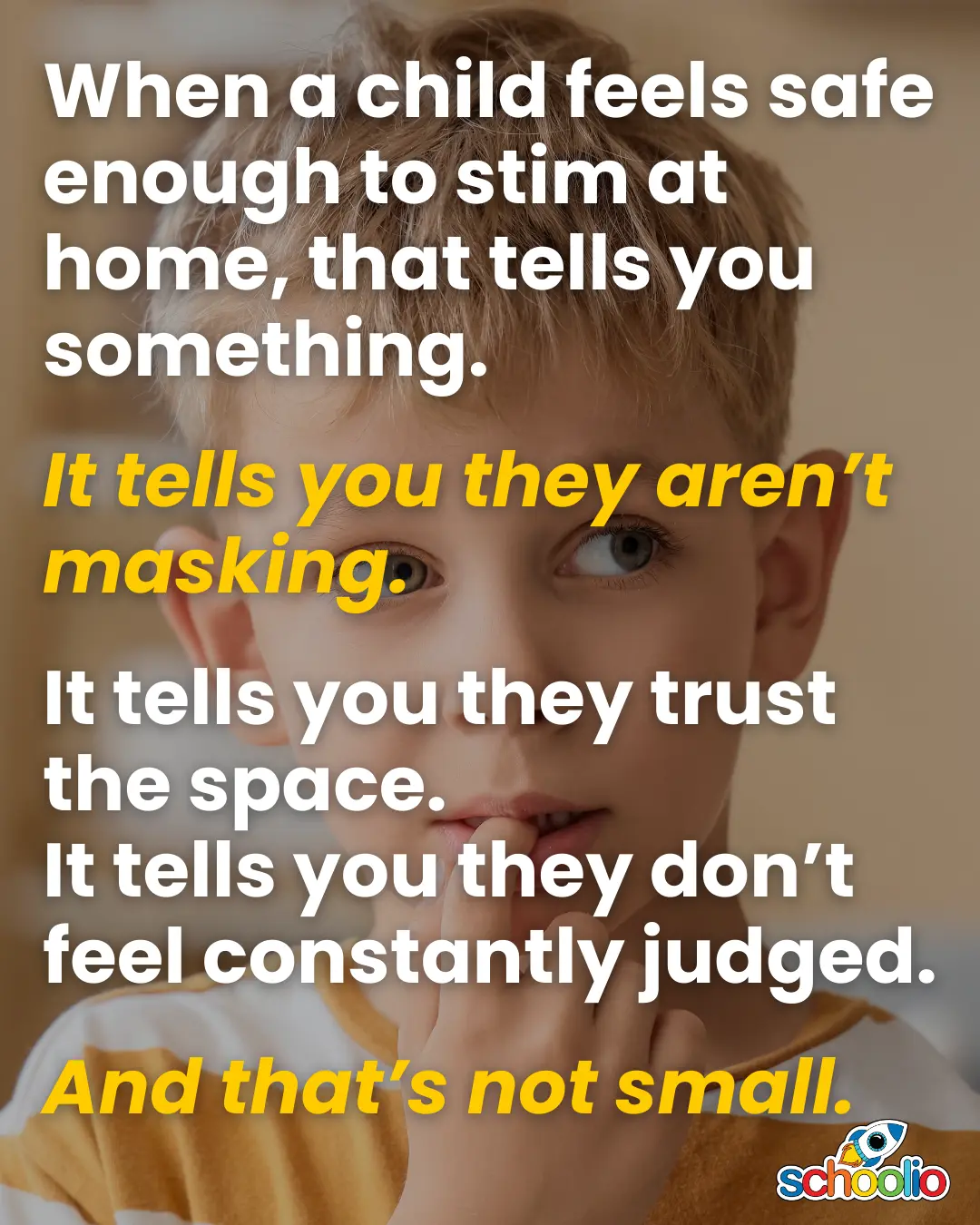
When a child feels safe enough to stim at home, that tells you something.

It tells you they aren’t masking.

It tells you they trust the space.

It tells you they don’t feel constantly judged.

And that’s not small.

Sometimes the most powerful thing we can do isn’t teaching our kids how to stop stimming.

It’s helping them understand why they do it.

Because when a child understands their nervous system, they stop feeling broken.

And when they stop feeling broken, they start building regulation from the inside out.

The Most Overlooked Parts of Helping Homeschoolers

The Most Overlooked Parts of Helping Homeschoolers


This has been on my mind today…

When people ask how to help homeschoolers, they usually jump straight to curriculum, tools, or platforms. But most homeschooling families are not struggling because they lack resources. They are struggling because the weight of responsibility is heavy, constant, and invisible.

Helping homeschoolers starts by understanding that most parents did not choose this path because it was trendy. Many chose it because something was not working. A child was falling behind. A child was anxious. A child was labeled, rushed, or quietly pushed aside. Homeschooling often begins as an act of protection, not ambition.

The first real help homeschoolers need is less noise. Too many choices, too many opinions, too many voices telling parents what they should be doing. Decision fatigue is real. When everything feels urgent, nothing feels achievable. Support looks like clarity. What matters this week. What can wait. What is good enough for today.

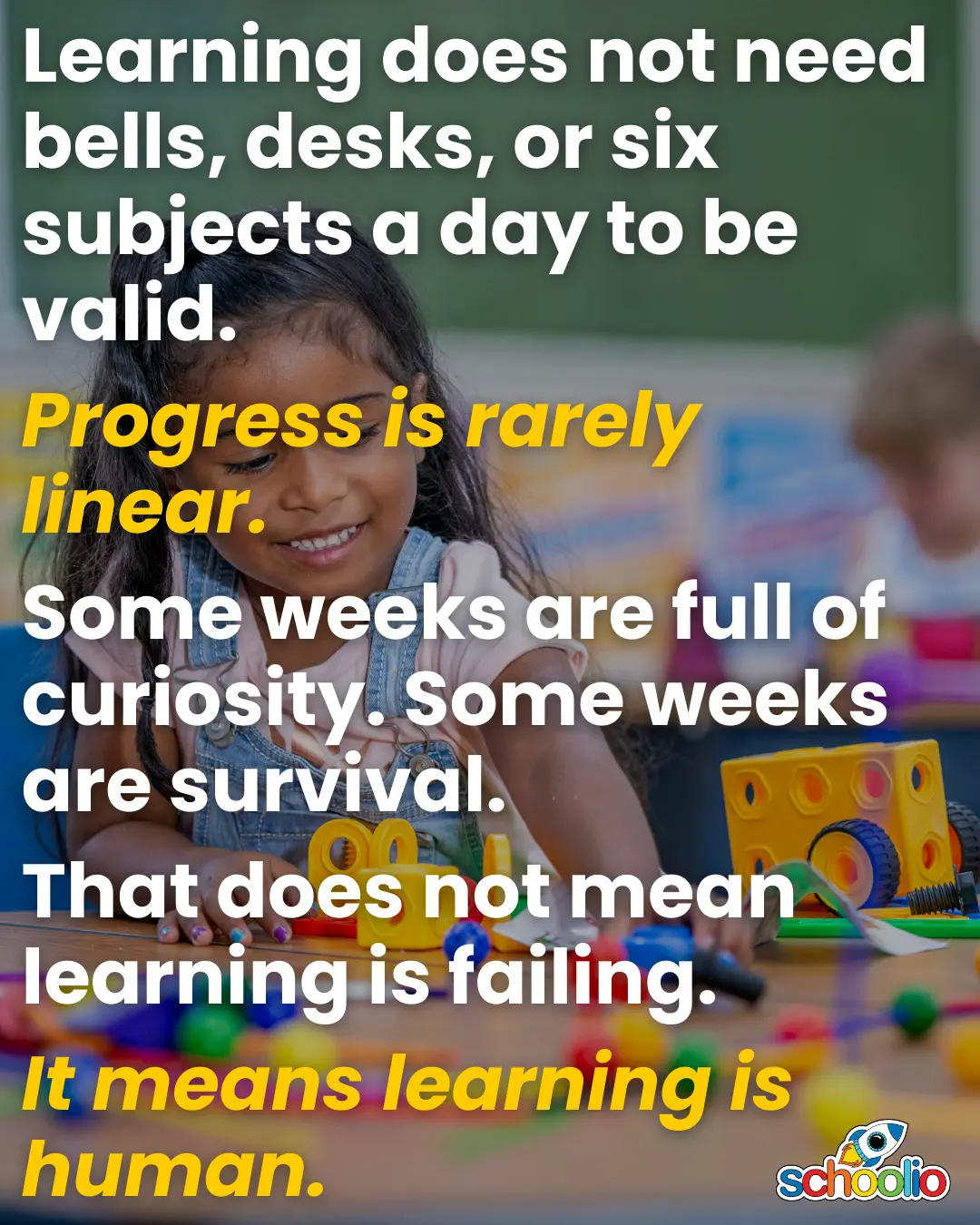
The second thing homeschoolers need is permission to stop recreating school at home. Learning does not need bells, desks, or six subjects a day to be valid. Progress is rarely linear. Some weeks are full of curiosity. Some weeks are survival. That does not mean learning is failing. It means learning is human.

Many families homeschool because school broke confidence before it broke grades. That is why emotional safety matters more than pacing guides. If a child is overwhelmed, shut down, or anxious, no worksheet will fix that. Helping homeschoolers means supporting emotional regulation first and trusting that academics follow when safety returns.

Flexibility is also misunderstood. Total freedom sounds appealing, but it often turns into chaos. What families really need are gentle anchors. A rhythm. A loose plan. Clear moments where the day feels complete. Not perfection. Just enough structure to breathe.

It also matters that we stop assuming there is one reason families homeschool. Some do it for neurodivergent kids. Some for mental health. Some for travel. Some because they had no other option. Real support does not judge the why. It adapts to it.

The most overlooked part of helping homeschoolers is helping parents trust themselves again. Many come into homeschooling already doubting their instincts because a system told them they were wrong. The goal is not to replace parents with experts or platforms. The goal is to help parents feel capable, informed, and less alone.

Community helps too, but only when it is honest. Not highlight reels. Not comparison. Just spaces where families can say, this week was hard, and not feel behind.

And finally, we need to change how we measure success. Sometimes progress looks like a child choosing to read again. Or asking a question. Or feeling calm enough to try. Those moments matter, even if no test records them.

Helping homeschoolers is not about doing more. It is about doing what actually helps. Less pressure. More trust. And learning that fits the child, not the system.


Sathish

still learning, still unlearning

Focus on Emotional Readiness Before Academics

Focus on Emotional Readiness Before Academics

This has been on my mind today…


I read about a mom in Queen Creek homeschooling her four kids using what she calls a more progressive approach. What stayed with me was not the label. It was the quiet confidence in how she trusted her children instead of managing them.

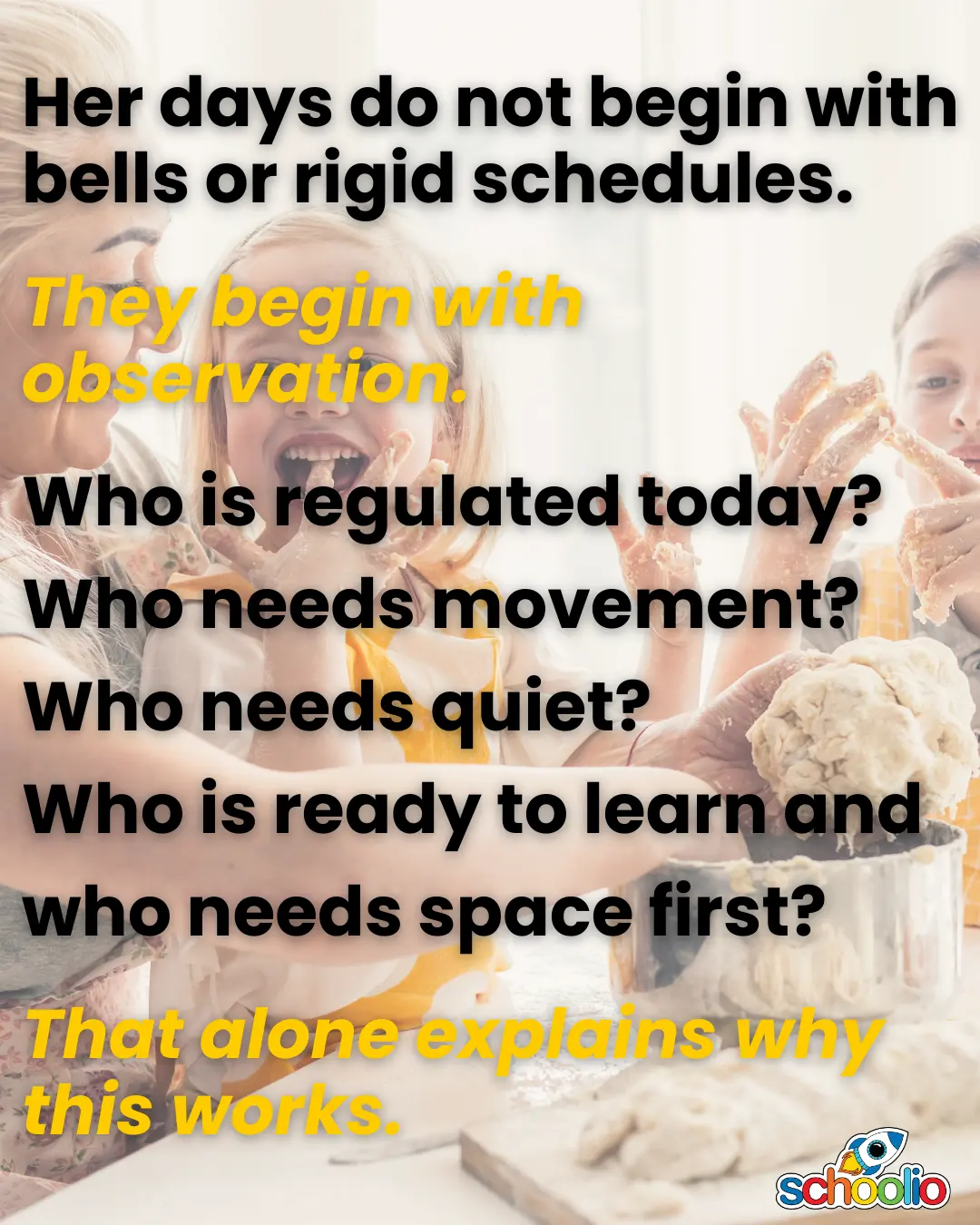
Her days do not begin with bells or rigid schedules. They begin with observation. Who is regulated today. Who needs movement. Who needs quiet. Who is ready to learn and who needs space first. That alone explains why this works.

She uses curriculum, but it is not the authority. It is a tool. Math might happen early for one child and later for another. Reading might be independent one day and shared the next. If something is not landing, she does not push harder. She pivots.

That is the part most systems struggle with. They confuse consistency with rigidity. They confuse pressure with progress.

What stood out most was her focus on emotional readiness before academics. She noticed that when her kids felt safe and calm, learning followed naturally. When they felt rushed or judged, everything shut down. Any parent of a neurodivergent or sensitive child knows this truth deeply, even if they have been told to ignore it.

This approach gives kids permission to go deep instead of wide. One child can stay with science longer without being rushed to keep pace. Another can take extra time with reading without being labeled behind. There is no artificial race. There is only progress that matches the child.

This is not chaos. It is intentional flexibility. It is structure that bends instead of breaks.

For neurodivergent kids especially, this matters. Many of them are not incapable. They are overwhelmed. They are not behind. They are overstimulated. When the environment adapts to them instead of forcing compliance, something powerful happens. Confidence returns. Curiosity comes back. Learning becomes possible again.

And here is where I get more opinionated.

Too many children are being pushed through systems that were never designed for how they think, feel, or regulate. When they struggle, the system calls them broken. This mom did the opposite. She changed the system around her kids instead of asking her kids to change who they are.

The result was not just better learning. It was a healthier home. Fewer battles. More willingness to try hard things. Less fear around mistakes. School stopped being something to survive and became something they could participate in.

That is the part we do not talk about enough.

For parents reading this and wondering what the takeaway is, it is not that you need to homeschool. It is that learning works best when your child feels seen first. Whether you are supplementing, transitioning, or rethinking school entirely, the question to ask is simple.

Is this environment helping my child feel capable or constantly reminding them they are not.

We see families arrive at schoolio from this exact moment. Not angry. Not anti school. Just deeply aware that their child needs something more responsive and more human. Especially neurodivergent kids who have spent years being told to try harder in systems that refuse to adapt.

Stories like this remind me that homeschooling does not have to be extreme or reactive. It can be thoughtful. Calm. Grounded in trust. Built around the child you have, not the one a system expects.

And when education starts there, kids do not just learn more. They believe more in themselves.


Sathish

still learning, still unlearning


Source:

Queen Creek mom of 4 takes a more progressive approach to homeschooling

KJZZ Phoenix

https://www.kjzz.org/the-show/2026-01-13/queen-creek-mom-of-4-takes-a-more-progressive-approach-to-homeschooling

You’re Not Doing It Wrong. You’re Parenting a Neurodivergent Child.

You’re Not Doing It Wrong. You’re Parenting a Neurodivergent Child.


If you’re homeschooling a neurodivergent child, there’s a moment most of us hit where the doubt gets loud.

Your child is bright. Creative. Curious. And yet… school didn’t work. Public school didn’t work. Private school didn’t work. And now, even homeschooling can feel heavy some days.

You start wondering if you’re missing something. If you picked the wrong program. If you should be doing more. If the anxiety around math or reading means you’ve somehow failed them.

I want to say this clearly, because so many parents need to hear it:

You’re not doing it wrong. You’re parenting a neurodivergent child in a world that wasn’t built for them.

So many of the families I talk to are raising kids who are Autistic, ADHD, PDA, dyslexic, anxious or combinations. These are kids with incredible strengths — but they don’t respond well to rigid systems, constant demands, or learning environments that prioritize compliance over safety.

When learning comes with pressure, their nervous systems go into protection mode. Anxiety rises. Resistance shows up. And suddenly the focus isn’t learning anymore — it’s survival.

That doesn’t mean your child is “behind.”

It means the environment hasn’t fit them yet.

One of the hardest parts of homeschooling neurodivergent kids is letting go of the idea that learning should look linear. Or quiet. Or efficient. These kids often learn in bursts. In spirals. In intense interest-driven deep dives, followed by periods where they need rest and regulation more than content.

And that’s not a flaw — it’s information.

A child who struggles with math anxiety isn’t refusing because they’re lazy. A child who avoids reading isn’t failing because they don’t care. A child with PDA isn’t being oppositional — they’re protecting their autonomy because demands feel unsafe in their body.

When we understand that, everything shifts.

Homeschooling stops being about “fixing” them or catching them up, and starts becoming about building a learning environment that works with their brain instead of against it.

That might mean slowing down.

It might mean breaking lessons into smaller pieces.

It might mean offering more choice.

It might mean focusing on engagement and confidence before academics.

And yes — it might look very different from what school told you education is supposed to be.

But different doesn’t mean wrong.

If you’re showing up, adjusting, listening, and trying to understand your child — you’re already doing the most important part of this work. Neurodivergent kids don’t need perfect plans. They need adults who see them, trust them, and are willing to learn alongside them.

You’re not failing.

You’re learning.

And that’s exactly what your child needs from you.


? Lindsey

certified special-ed educator & co-founder, Schoolio

Interoception in Neurodivergent Kids: Why Your Child May Not Know What Their Body Is Telling Them

Interoception in Neurodivergent Kids: Why Your Child May Not Know What Their Body Is Telling Them


“Are you hungry?”

“I don’t know.”

“Do you need the bathroom?”

“No.” (…five minutes later: emergency.)

“Wow look at that bruise- didn’t that hurt?”

“No. I didn’t notice.”

If this sounds familiar, you’re not alone — and it’s not defiance, avoidance, or lack of self-awareness. For many neurodivergent kids, the issue lies in something called interoception.

Understanding interoception can completely change how you interpret your child’s behavior, emotional regulation, and even their resistance to basic self-care tasks.


What Is Interoception?

Interoception is the body’s ability to sense internal signals.

It includes things like:

  • Hunger and thirst
  • Heart rate and breathing
  • Body temperature
  • Pain or discomfort
  • Fatigue
  • Emotional signals (like anxiety, excitement, or overwhelm)

Interoception is how we know what’s happening inside our body — and what we need to do about it.

For most neurotypical people, this system works quietly and automatically. But for neurodivergent kids — especially ADHDers and autistic kids — interoception can work very differently.


Why Interoception Matters So Much

Interoception is foundational to:

  • Self-regulation (knowing when you’re calm vs. stressed)
  • Meeting basic needs (sleep, food, hydration, rest)
  • Emotional awareness (naming feelings based on body cues)
  • Self-advocacy (“I need a break,” “I’m overwhelmed”)

When interoception is unreliable or muted, kids aren’t ignoring their needs — they genuinely may not feel them clearly.


What Interoceptive Differences Look Like in Neurodivergent Kids

Many neurodivergent kids experience interoceptive differences, meaning the signals from their body are delayed, muted, overwhelming, or confusing.

This can look like:

  • Not realizing they’re hungry until they’re hangry
  • Missing early signs of needing the bathroom
  • Becoming exhausted without noticing fatigue building
  • Stimming or fidgeting until it causes injury that they don’t notice.

To parents, it can feel baffling. To the child, it can feel like body needs just happen to them instead of being something they can anticipate or manage.


Interoception and Emotional Regulation

We often expect kids to name their feelings:

“Use your words.”

“Tell me what you’re feeling.”

But emotional awareness depends on interoception.

If a child can’t recognize:

  • tightness in their chest
  • a racing heart
  • clenched muscles
  • stomach discomfort

then they may not realize they’re anxious, overwhelmed, or overstimulated until they’re already dysregulated.

This is why many neurodivergent kids struggle with emotional regulation — not because they don’t care, but because their body’s early warning system is unreliable.


Why This Isn’t a Failure — It’s a Difference

Interoceptive differences aren’t laziness, manipulation, or lack of responsibility.

They mean your child may need:

  • external reminders for basic needs
  • support identifying body cues
  • help connecting physical sensations to emotions

Expecting independent self-regulation without interoception is like expecting a child to read without learning letters first.


How Parents Can Support Interoception at Home

The goal isn’t to force independence — it’s to build awareness gently over time.

1. Externalize Body Needs

Instead of asking open-ended questions like “Are you hungry?”, try:

  • “It’s been two hours since you ate — let’s check in with your body.”
  • “Your body usually needs a snack around this time.”

This reduces pressure and builds pattern recognition.


2. Name Body Signals Out Loud

Help your child make connections:

  • “Your fists are tight — that can mean your body is feeling stressed.”
  • “Your voice got louder; sometimes that means you’re getting overwhelmed.”

This models interoceptive awareness without judgment.


3. Build Predictable Routines

Consistent meals, rest times, and movement reduce reliance on internal signals that may be unreliable.

Routine acts as an external interoceptive support.


4. Use Visual and Sensory Tools

  • Visual schedules for meals, breaks, and rest
  • Body check-in charts (“tired,” “hungry,” “wiggly,” “calm”)
  • Emotion charts tied to physical sensations

These tools make the invisible visible.


5. Teach Body-Based Emotional Language

Instead of focusing only on emotion words, try:

  • “Where do you feel that in your body?”
  • “Does your body feel fast or slow right now?”

This builds emotional literacy from the inside out.


Can Interoception Always Be Taught?

Here’s something that doesn’t get said often enough:

Not every child can “learn” interoception in the way we expect — and that’s okay.

Interoception isn’t a skill like reading or math. It’s a sensory system. And just like vision or hearing, some people will never have fully reliable internal signals — no matter how much practice or support they receive.

Some neurodivergent kids may learn to recognize patterns over time (“I usually get cranky when I forget to eat”), but they may never feel hunger, bathroom needs, fatigue, or emotional escalation early enough to act on it.

That doesn’t mean they’ve failed.

It means their brain works differently.


Awareness vs. Accuracy

It helps to separate interoception into two parts:

  • Interoceptive awareness – learning to understand body patterns after the fact
  • Interoceptive accuracy – the brain reliably sending early, usable signals

Some kids can build awareness with support.

Some kids will always struggle with accuracy.

And for those kids, the goal isn’t “listen to your body” — it’s manage your needs externally.


Management Is Not a Step Back — It’s an Accommodation

For children with consistently weak interoceptive signals, independence often looks like this:

  • Using timers to remember bathroom breaks
  • Eating on a schedule, not when hunger appears
  • Drinking water because the alarm says so
  • Taking breaks because it’s part of the routine
  • Checking charts or schedules instead of body cues

They don’t wait to feel the need.

They meet the need because the system supports them.

This is not dependence.

This is adaptive intelligence.

Just like glasses replace poor eyesight, external supports replace unreliable internal signals.


What Matters Most

The goal of interoception support is not to make a child “typical.”

The goal is:

  • needs being met
  • reduced distress
  • fewer meltdowns and emergencies
  • dignity and autonomy

If a child uses timers and checklists into adulthood, that’s not a failure — that’s success.

Many kids feel enormous relief when they learn:

“My body doesn’t always give me clear signals — so I use tools.”

That understanding replaces shame with self-trust.

Interoception isn’t about perfectly feeling your body.

For many neurodivergent kids, it’s about learning how to care for their body in different ways — and that is just as valid.


The Homeschooling Advantage

Homeschooling allows you to support interoception in ways traditional school often can’t.

You can:

  • Pause learning to meet body needs
  • Normalize movement, rest, and snacks
  • Teach emotional awareness without rushing
  • Respond to dysregulation with curiosity instead of consequences

When a child feels supported in understanding their body, self-regulation becomes possible — not forced.


The Big Takeaway

Interoception is the bridge between body, emotion, and behavior.

When neurodivergent kids struggle with self-care, emotional regulation, or recognizing their needs, it’s often not because they won’t — it’s because they can’t yet.

With patience, modeling, and external supports, interoceptive awareness can grow.

And when kids learn to understand what their body is telling them, they gain something powerful:

self-trust.

Why Your ADHD or Autistic Child “Practices” Conversations (and Why That’s Not a Bad Thing)

Why Your ADHD or Autistic Child “Practices” Conversations (and Why That’s Not a Bad Thing)


Have you ever noticed your child repeating the same sentence over and over before a phone call?

Or whispering what they’re going to say before walking into a room?

Or replaying conversations long after they’re over, worrying they said the “wrong” thing?

If so, you’re likely seeing scripting — a very common and very human coping strategy for autistic and ADHD kids.

And no, it’s not something you need to stop or “fix.”


What Is Scripting, Really?

Scripting is when someone mentally rehearses words, phrases, or entire conversations ahead of time. For neurodivergent kids, especially autistic and ADHD kids, it’s a way to prepare for social situations that feel unpredictable, overwhelming, or high-stakes.

Think of it like this:

Most people can improvise socially without much effort. For neurodivergent kids, social interactions often require conscious processing. Tone, timing, facial expressions, word choice — it’s a lot to manage all at once.

Scripting helps reduce that load.


Why Neurodivergent Kids Script

Scripting isn’t about being robotic or inauthentic. It’s about safety.

Many ADHD and autistic kids have experienced:

  • Being misunderstood
  • Saying the “wrong” thing and being corrected or teased
  • Feeling embarrassed or rejected after social interactions

Over time, their brains learn: Preparation feels safer than guessing.

Scripting gives them:

  • A sense of control
  • Predictability in an unpredictable world
  • Time to organize thoughts before speaking
  • A way to reduce anxiety before social demands

For some kids, scripting is the difference between engaging socially and avoiding it altogether.


What Scripting Feels Like for Kids

From the inside, scripting often feels like:

  • “If I practice, I won’t mess this up.”
  • “If I know what to say, I won’t get in trouble.”
  • “If I’m prepared, I’ll be less embarrassed.”

It’s not about manipulation or performance — it’s about self-protection.

And for kids who already struggle with emotional regulation, rejection sensitivity, or social anxiety, that protection matters.


When Scripting Is Helpful

Scripting can be incredibly supportive when it:

  • Reduces anxiety before social interactions
  • Helps kids advocate for themselves
  • Allows them to participate when they otherwise might shut down
  • Builds confidence through successful interactions

Many kids use scripting to:

  • Practice greetings
  • Prepare for phone calls
  • Navigate classroom discussions
  • Rehearse how to ask for help

In these cases, scripting is a tool, not a problem.


When Scripting Can Become Stressful

Like any coping strategy, scripting can become overwhelming if it turns rigid.

Some kids may struggle when:

  • Conversations don’t follow the “planned” path
  • Someone responds unexpectedly
  • They feel pressure to say things exactly right

When that happens, you might see:

  • Increased anxiety or shutdowns
  • Frustration when plans change
  • Avoidance of social situations altogether

This doesn’t mean scripting caused the problem — it means the need for safety is still very high.


How Parents Can Support Scripting (Without Making It Worse)

The goal isn’t to eliminate scripting — it’s to support it gently while building flexibility over time.

1. Normalize It

Let your child know scripting is okay.

“You’re practicing because you want it to go well. That makes sense.”

Shame increases anxiety. Normalization reduces it.


2. Practice Together

Role-play conversations in a low-pressure way.

  • Practice asking questions
  • Practice different responses someone might give
  • Practice what to do if things don’t go as planned

This builds flexibility without removing safety.


3. Teach “Backup Plans,” Not Perfection

Instead of perfect scripts, help your child develop:

  • A few flexible phrases
  • Exit strategies (“I need a minute”)
  • Repair phrases (“Can I try saying that again?”)

These tools reduce panic when conversations shift.


4. Don’t Force Spontaneity

Pushing kids to “just go with the flow” often backfires. Spontaneity grows naturally when safety increases — not when pressure does.


5. Celebrate the Effort

Scripting takes mental energy. Acknowledge that.

“I know that took courage.”

“You worked really hard to prepare for that.”

Feeling seen matters.


The Big Picture

Scripting isn’t a sign that your child lacks social skills.

It’s a sign that they’re working very hard to connect.

When supported with empathy, scripting can:

  • Increase confidence
  • Reduce anxiety
  • Serve as a bridge toward more flexible communication

Your child isn’t broken for needing extra preparation. They’re adapting — and that’s something worth honoring.

The 5 Core Emotional Needs of ADHDers (and Why They Matter More Than You Think)

The 5 Core Emotional Needs of ADHDers (and Why They Matter More Than You Think)

If you love an ADHDer — whether it’s your child, your partner, or even yourself — you’ve probably noticed that emotions run deep.
Joy can feel electric. Frustration can feel explosive. Rejection can feel unbearable.

ADHD isn’t just about focus or attention; it’s about emotion. ADHD brains experience emotional intensity, sensitivity, and regulation challenges at a level that can be hard for others to fully grasp.

That’s why emotionally healthy environments matter so much. ADHDers don’t just need structure or strategies — they need safety. The kind that lets their nervous system exhale. The kind that helps them believe they’re not broken, just wired differently.

Let’s talk about what that really means — and the five core emotional needs every ADHDer deserves to have met.


1. Safety & Acceptance

Freedom from judgment and the pressure to mask

ADHDers spend much of their lives in environments where they feel like they’re “too much” or “not enough.” Too loud, too distracted, too emotional, too impulsive. From school rules to social cues, the world often demands they shrink themselves to fit in.

That constant self-monitoring — called masking — is exhausting. It’s like running a marathon every day while pretending you’re fine.

What ADHDers need most is the feeling that they can exist exactly as they are — fidgety, passionate, tangential, emotional — and still be safe and accepted.

At home, that looks like gentle curiosity instead of correction:
“I can see your brain’s really busy right now — want to take a break?” instead of “Stop fidgeting.”

When safety replaces shame, healing begins.


2. Validation

Having feelings and experiences recognized as real — and being given credit for achievements that come easily to others.

ADHDers often grow up hearing things like,
“You’re overreacting.”
“It’s not that big a deal.”
“Why can’t you just calm down?”

Or they hear criticism of what looks like “behavior,” when it’s really the visible struggle of an ADHD brain trying to function in a neurotypical world:
“Why are you always late?”
“Why can’t you just remember when I tell you something?”
“If you cared, you’d be able to…”

But to an ADHD brain, it is that big a deal. Emotional regulation isn’t about choosing how to feel — it’s about the brain’s ability to return to baseline.

When feelings are dismissed or minimized, they don’t disappear — they just get lonelier.

Validation doesn’t mean agreeing with every emotion or excusing every action. It means acknowledging that what they feel is real, and that what they manage to do — even if it seems small — took effort.

“I can see that felt really unfair.”
“That sounds frustrating.”
“You worked hard to finish that, even though it wasn’t easy.”
“You’re allowed to feel disappointed.”

That kind of recognition helps ADHDers feel seen instead of defective. It teaches them that their emotions and their efforts both matter — and that’s the foundation for emotional growth and self-worth.


3. Autonomy

Choice, control, and consideration in decisions and pacing

Control is oxygen for ADHD brains.

Because ADHD impacts executive function — the part of the brain responsible for planning, organizing, and self-regulation — losing control can feel terrifying. It’s not about being oppositional or defiant. It’s about needing to steer their own ship, even if they’re still learning how.

But autonomy isn’t just about having choices — it’s about being considered.

For many ADHDers, life can feel like one long series of adjustments to fit a neurotypical world. They bend, mask, minimize, and stretch themselves to meet expectations that weren’t built with their brains in mind. Over time, that can make them feel invisible — like decisions are made for them, not with them.

Being considered — being included in plans, asked for input, and treated like their needs and preferences matter — is a form of freedom. It tells them, you belong here, as you are.

In homeschool environments, autonomy and consideration might look like:

  • Letting your child choose the order of subjects for the day 
  • Including them in planning routines or schedules that affect them 
  • Allowing them to decide whether to write with pencil, keyboard, or voice-to-text 
  • Giving them time limits that feel achievable instead of arbitrary 

When ADHDers are given genuine choice and genuine consideration, resistance turns into collaboration — and confidence blooms where shame used to live.

**If the need for autonomy and control feels even bigger for your child, to the point where they’re hyper-defiant of demands, you might be dealing with PDA (Pathological Demand Avoidance).


4. Connection

Supportive, understanding relationships

Underneath all the intensity and impulsivity, most ADHDers carry a deep fear of disconnection.

By age 12, the average child with ADHD has heard around 20,000 more negative or corrective messages than their neurotypical peers. (That’s a lot of “stop that,” “focus,” and “why can’t you just…”). Each one chips away at their sense of being lovable as they are.

That’s why connection is the antidote.

Connection tells the ADHD brain, you are still safe, even when you make mistakes.
It looks like laughter during lessons, shared problem-solving, and hugs after meltdowns. It’s eye contact, patience, and the unspoken message: we’re on the same team.

When ADHDers feel securely connected, their nervous system relaxes — and their capacity for learning, empathy, and resilience expands.


5. Consistency

Predictable environments that reduce stress

ADHD brains crave novelty, but they need predictability.

Inconsistent feedback, unpredictable schedules, or sudden changes can feel like emotional whiplash. Without a sense of what’s coming next, anxiety spikes — and so does dysregulation.

Consistency doesn’t mean rigidity. It means creating reliable patterns they can count on.

  • Clear expectations that stay the same 
  • Gentle transitions between activities 
  • A stable emotional tone at home 

Consistency tells the ADHD brain, you’re safe here. And safety builds the foundation for focus, trust, and growth.


Building Emotionally Safe Spaces for ADHDers

When these five needs — safety, validation, autonomy, connection, and consistency — are met, ADHDers thrive.

They regulate more easily.
They recover faster from mistakes.
They begin to trust themselves again.

And for parents, meeting these needs doesn’t mean being perfect. It means leading with compassion and curiosity, remembering that the behaviors you see are often the language of unmet needs.

When you give your ADHDer the emotional environment their brain truly needs, you’re not just teaching academics.
 

You’re teaching self-worth.
You’re teaching safety.
You’re teaching love that heals.


Why Your ADHD Child Can’t Sit Still- What is Vestibular Input?

Why Your ADHD Child Can’t Sit Still- What is Vestibular Input?


If you have an ADHD child, you’ve probably said one of these phrases at least once (or, let’s be honest, many times):
“Sit properly, please.”
“Feet down.”
“Stop spinning that chair.”


“Why are you upside down right now?”

And yet, no matter how many times you say it… they just can’t seem to stop.

It’s easy to see this as misbehavior or lack of focus. But in reality, what you’re seeing might be something deeper — your child’s nervous system doing its best to get the vestibular input it needs to feel regulated, alert, and ready to learn.

vestibular input

What Is Vestibular Input?

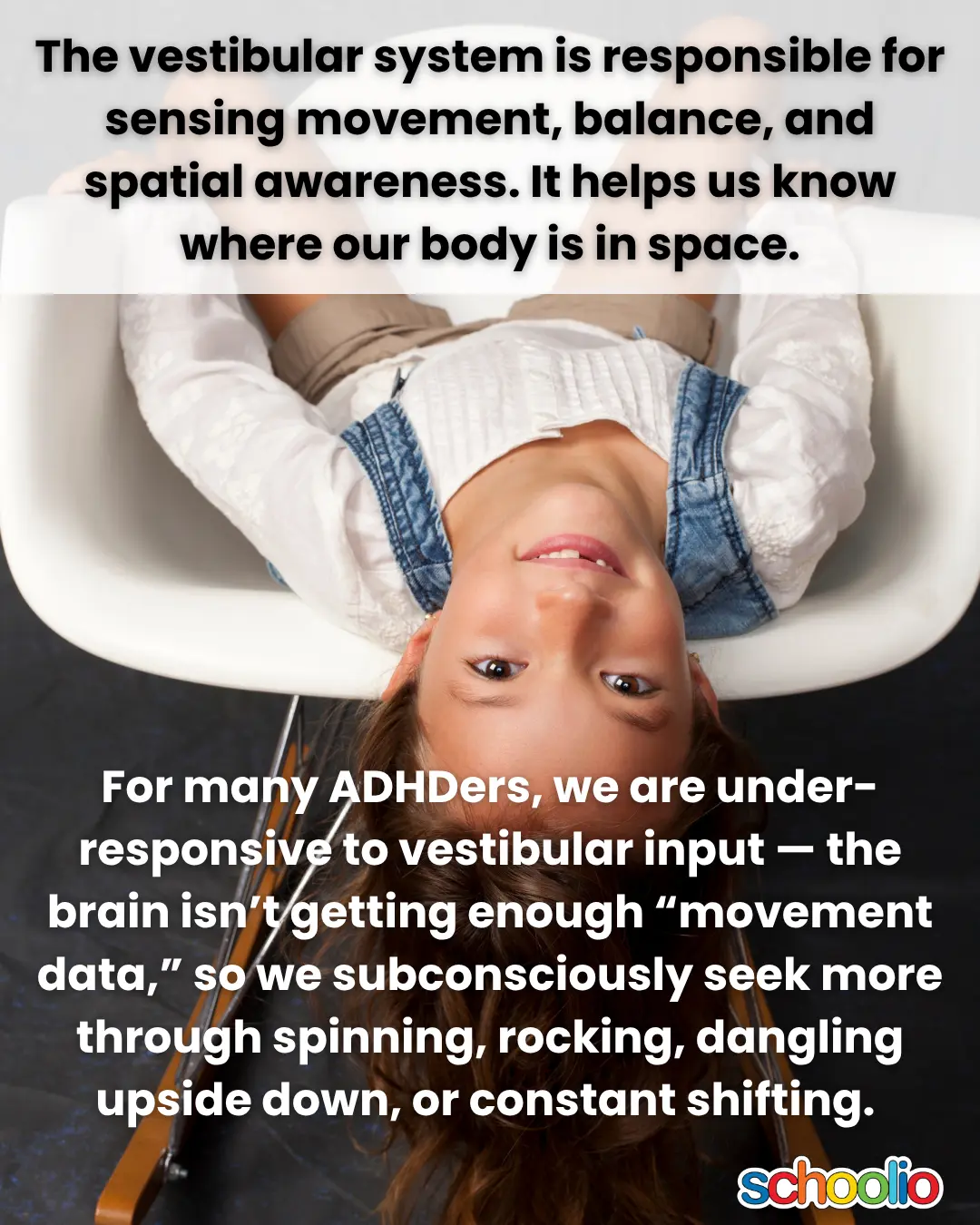
The vestibular system lives in the inner ear, and it’s responsible for sensing movement, balance, and spatial awareness. It helps us know where our body is in space — like whether we’re sitting upright, moving fast, or tilting our head.

For neurotypical people, this system runs quietly in the background, keeping them centered. But for many ADHDers, it doesn’t process quite the same way.

Some ADHD kids are under-responsive to vestibular input — their brain isn’t getting enough “movement data,” so they subconsciously seek more through spinning, rocking, dangling upside down, or constant shifting. Others may be over-responsive, finding certain motions overwhelming or dizzying.

Both patterns are common — and both are the body’s way of saying, “I need help regulating.”

? Science Note: The Vestibular–Dopamine Connection

The vestibular system doesn’t work alone — it’s closely tied to the dopamine pathways in the brain that control motivation, focus, and emotional regulation.

When your child moves — spinning, jumping, rocking — those physical sensations activate parts of the brainstem and cerebellum that help regulate dopamine and norepinephrine, both of which are often low in ADHD brains.

That’s why movement helps ADHD kids “wake up” their brains:

  • It boosts alertness and attention.
  • It improves emotional regulation.
  • It supports executive function — planning, memory, and self-control.

So when your child is fidgeting or in constant motion, they’re not being disruptive — they’re literally helping their brain function better.


What “Dopamine Seeking” Looks Like in the Body

We often talk about ADHD as dopamine-driven, but the vestibular system plays a huge role, too. Movement actually helps stimulate dopamine release — which is why your ADHD child may suddenly start pacing, swinging their legs, or balancing on the edge of a chair right when you need them to concentrate.

These “weird” positions aren’t defiance. They’re your child’s nervous system self-medicating through movement.

They might:

  • Sit with one leg over the arm of a chair
  • Hang off the couch upside down
  • Constantly rock, bounce, or sway
  • Spin in circles for “fun” (and never seem dizzy)
  • Climb furniture or balance on unstable surfaces

It can look chaotic — but for them, it’s regulating.


What It Feels Like for ADHD Kids

For a child whose vestibular system isn’t getting enough input, sitting still can feel physically uncomfortable — like trying to focus with an itch you can’t scratch. Their brain is searching for balance signals, and until it gets them, it’s hard to settle down.

You might see:

  • Fidgeting during reading or lessons
  • Difficulty maintaining posture
  • Restlessness or frustration during quiet tasks
  • Frequent “breaks” to move or reposition

The movement isn’t the problem — it’s the coping mechanism for an unmet sensory need.

How This Impacts Learning

When a child’s body is unregulated, their brain can’t prioritize learning. The vestibular system connects directly to areas of the brain that control attention, emotion regulation, and executive function — meaning movement needs aren’t separate from learning needs.

So when your ADHD child spins in their chair, lies on the floor to do math, or wiggles constantly through read-alouds… that’s not distraction. It’s adaptation.

Supporting Your Child’s Vestibular Needs at Home

Instead of trying to eliminate movement, think about channeling it. Here are some strategies to support vestibular regulation in your homeschool:

1. Build Movement Into the Day

  • Use active learning breaks between subjects.
  • Try standing desks, wobble stools, or yoga balls.
  • Let your child read or write while pacing, swinging, or lying down.activity

2. Offer “Heavy Work”

Proprioceptive input (like pushing, pulling, or lifting) helps calm the vestibular system. Try:

  • Carrying laundry or groceries
  • Wall push-ups or wheelbarrow walks
  • Building with weighted materials like LEGO or clay

3. Use Safe Spinning or Swinging

If your child seeks spinning, consider safe options like:

  • Swivel chairs
  • Therapy swings
  • Hanging pods or hammocks

4. Respect Their Positions

If your child learns best while lying on the floor or sitting cross-legged on a chair, that’s okay. Focus on engagement, not posture.

5. Schedule Movement Intentionally

Start the day with movement-rich activities: walking the dog, dancing, yoga, or playground time. Meeting those vestibular needs early can make focused work easier later.

The Homeschooling Advantage

Traditional classrooms often punish movement — “sit still,” “stop rocking,” “stay in your seat.” But at home, you have the flexibility to do the opposite: to embrace movement as part of learning.

When you let your ADHD child learn in the way their body needs — rocking, fidgeting, or balancing — you’re not giving in to bad habits. You’re helping their nervous system regulate so their brain can focus, absorb, and thrive.

Movement isn’t a distraction. For ADHDers, movement is medicine.

“Effects of stochastic vestibular stimulation on cognitive functions in children with ADHD” — PMC article discussing vestibular stimulation and cognition for ADHD. https://pmc.ncbi.nlm.nih.gov/articles/PMC10635964


“Vestibular Rehabilitation for ADHD” — article from Neurologic Wellness Institute referencing the regulation of dopamine via vestibular input. https://neurologicwellnessinstitute.com/vestibular-rehabilitation-for-adhd/


“Vestibular therapy improved motor planning, attention, and balance in children with Attention-Deficit Hyperactivity Disorders – A RCT” — study showing improved attention and response control following vestibular intervention in children with ADHD. https://www.oatext.com/vestibular-therapy-improved-motor-planning-attention-and-balance-in-children-with-attention-deficit-hyperactivity-disorders-a-randomized-controlled-trial.php


The Night-Time Spiral

The Night-Time Spiral


It’s always at night, isn’t it? The house is quiet. Everyone’s asleep.

Except you.

The worrying… it creeps in so easily when you’re homeschooling. You start wondering…

Are we doing enough?

Are we behind?

Are they really learning?

What if they’d be better off in school?

Before you know it, you’re spiraling.

I know those nights too well.

So many nights, I’d lie awake, scrolling through Pinterest activities and curriculum reviews at 1 a.m., wondering if maybe this one will be the fix we need to make me feel confident we were “on track”. Replaying the day in my head- the math lesson that ended in tears, the half-finished writing assignment, the forgotten science experiment-  and convincing myself I was failing.

We’d never catch up.

I’d ruined their lives by homeschooling them.

Why had I ever thought that I could do this?

The self-talk… it gets bad in the still of the night, doesn’t it?

But here’s something I’ve learned after years of homeschooling and many of my own late-night spirals:

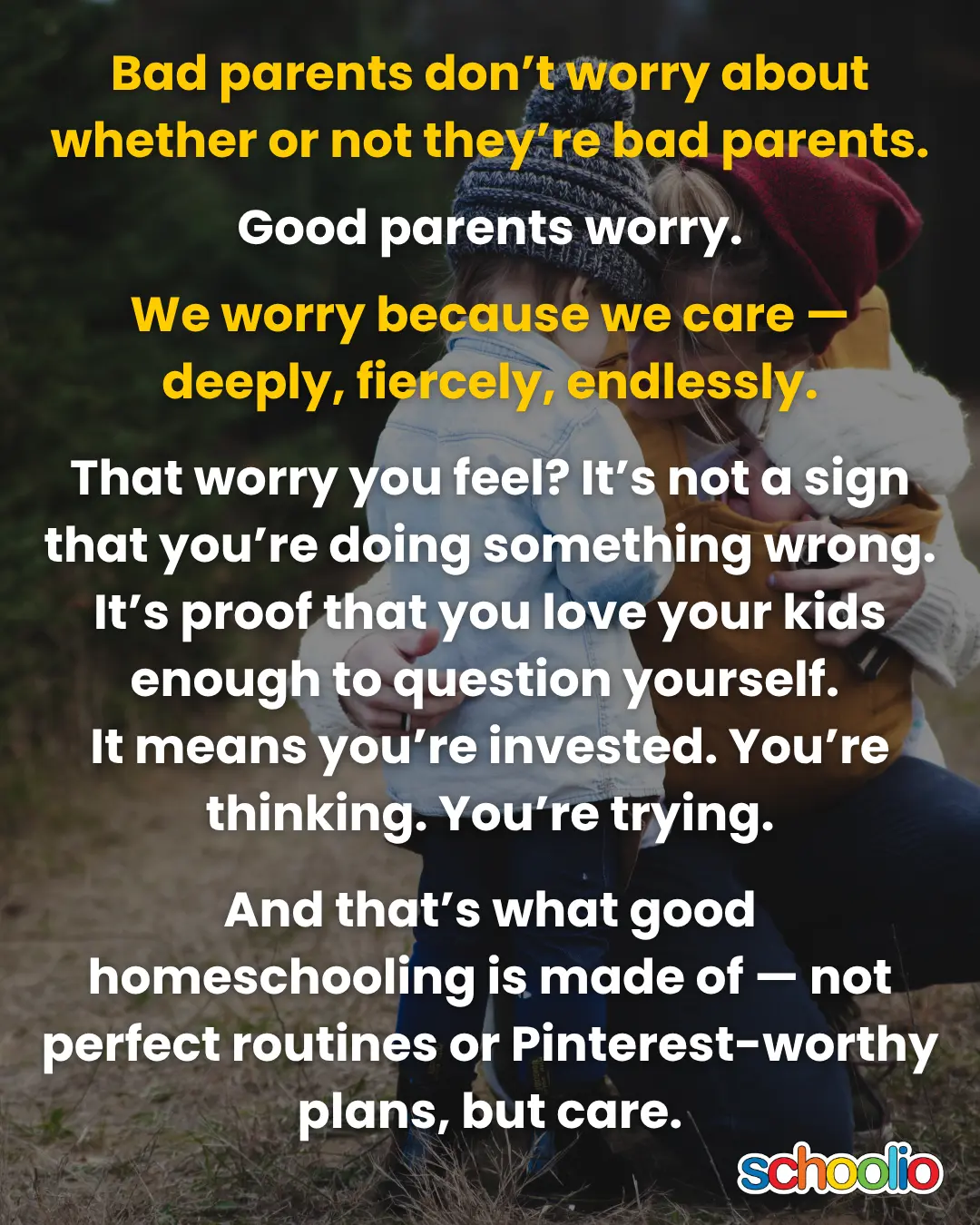
Bad parents don’t worry about whether or not they’re bad parents.

Good parents worry.

We worry because we care — deeply, fiercely, endlessly.

That worry you feel? It’s not a sign that you’re doing something wrong. It’s proof that you love your kids enough to question yourself. It means you’re invested. You’re thinking. You’re trying.

And that’s what good homeschooling is made of — not perfect routines or Pinterest-worthy plans, but care.

Every good parent I know worries about whether they’re doing it right.

Every good homeschooler I know questions if they’re doing “enough”.

It’s part of the process.

But try to reframe that worry the next time it sneaks up on you in the quiet hours. Instead of letting it spiral into fear, remind yourself what it really means:

You care enough to notice.

You care enough to show up.

You care enough to want the best for your kids.

And caring that much — that’s the heart of everything that matters.

So take a breath.

You’re not failing. You’re loving.

And that’s exactly what they need most.

Lindsey
Certified Special Ed Educator & Co-Founder, Schoolio