6 Reasons Why It’s Important To Encourage Multi-Age Play

Children are naturally curious and sociable beings. They love to explore, learn and play with others. As a parent, you want the best for your child; you want them to be happy, healthy, and well-adjusted. However, when it comes to playtime, parents may be hesitant to let their children play with kids of all ages. This is understandable for several reasons, one being that parents may want to ensure their children’s safety. However, there in fact several known benefits of encouraging children to play with peers of various ages. Encouraging your children to play with kids of all ages has a positive impact on their social emotional development. In this blog, we will discuss the 6 reasons why it’s important to encourage multi-age play.

It’s Important to Encourage Multi-Age Play; It Sets Children Up Both Personally and Professionally

Here Is A List Of Our 6 Reasons Why It’s Important To Encourage Multi-Age Play:

Playing Across Ages Builds Empathy and Understanding

When you follow these 6 reasons why it’s important to encourage multi-age play, you can help children learn to empathize with others and understand different perspectives. Playing with kids of all ages can help your child develop empathy. By interacting with others who are different from them, children learn to understand and appreciate different perspectives and experiences. This can help them become more compassionate and understanding individuals. Also, while playing with kids of all ages, children see their metaphorical journey reflected in the overall group. They see what lies ahead of them, as well as what they’ve already gone through. This helps build empathy for others, regardless for others, no matter their age or abilities.

6 reasons why it's important to encourage multi-age play

Inter-Age Play Develops Social Skills

Playing with peers of all ages can help develop important social skills. Younger children can learn how to communicate with older children, while older children can practice leadership and communication skills when playing with younger children. Children of different ages also have varying levels of physical and cognitive abilities, which can challenge children to adapt their play style and collaborate with their peers. Children are challenged to design games and cooperate in ways that meet a wider range of needs and skill levels. Younger children learn from older children’s experiences, and older children learn to be patient and nurturing toward their younger peers.

This interaction can foster a sense of community and belonging in children and create a more accepting and inclusive environment. Additionally, when children play with kids of different ages, they learn how to interact with others who have different needs, interests, and abilities. 6 reasons you should encourage multi-age play helps them develop important social skills such as communication, cooperation, empathy, and respect. Playing with older children can also expose younger children to more advanced language and social skills that they can learn from and develop.

6 reasons why it's important to encourage multi-age play

Cross-Age Play Encourages Creativity and Imagination

    When kids play with others of different ages, they are exposed to more diversity. This means that children of different needs, skills, and interests are included. This exposure encourages more complex conversations, problem-solving and critical thinking. Playing with peers of different ages can encourage children to use their imagination and creativity in new ways. When children play with peers of different ages, they are exposed to new perspectives, ideas, and experiences. This can inspire them to think differently and develop new, innovative ways of playing and problem-solving. Older children can introduce younger children to new games and activities that they may not have thought of before. While younger children can bring new perspectives and ideas to playtime. This interaction can inspire children to think outside of the box and explore their creative sides.

    6 reasons why it's important to encourage multi-age play

    Boosts Confidence and Self-Esteem

    Having meaningful interactions with kids of all ages can help boost a child’s confidence and self-esteem. Younger children look up to older role models and develop a sense of confidence from keeping up with older peers. Interacting with older children challenges younger children, which encourages them to push themselves to do better.  Therefore also encouraging younger children to scaffold their learning and challenge themselves in both their cognitive and physical development. Older children will feel pride and accomplishment when they teach younger children new skills. This skill transfer will help younger children to succeed in play. Similarly, younger children look up to older children. In this instance, they rely on them for guidance and support, which can make them feel important and valued. 

    Encouraging Multi-Age Play and Interaction Can Inspire Kids To Problem Solve And Create Innovative Ways To Play

    Promotes Positive Behavior

    When children play with kids of all ages they are exposed to a range of behaviours; helping them to learn what is acceptable and what is not. Older children can model positive behaviours and attitudes for younger children, who can then learn from these examples. 6 reasons why it’s important to encourage multi-age play can help to promote positive behaviour in your children. It can also discourage negative behaviours, such as bullying and exclusion.

    The presence of younger children allows older children the opportunity to learn about caregiving and leadership roles. This practice of caregiving can also lead older children to take responsibility for more vulnerable members of the group. Moreover, playing with kids of different ages can help your child build friendships with a much wider range of people. This can be especially helpful if your child has trouble making friends their own age. By playing with kids of different ages, they may find kindred spirits who share similar interests, values, or hobbies.

    6 reasons why it's important to encourage multi-age play

    Multi-Age Play Prepares Better Children for the Real World:

    Finally, 6 reasons why it’s important to encourage multi-age play can impact your child’s future. Playing with kids of all ages will help your child prepare for the real world. When playing and interacting with others of diverse ages, all children are able to experiment. In these groupings, children have space to take on various roles. They can experiment with hierarchies, power dynamics, leadership roles, and group rules in a way that reflects real life. In real life people of all ages interact with each other in a variety of contexts. Therefore, having the ability to communicate and collaborate with people of all ages is a valuable learning opportunity for children. They have the space to prepare for their future personal and professional life without adult consequences.

    6 reasons why it's important to encourage multi-age play

    6 Reasons Why It’s Important To Encourage Multi-Age Play; It Sets Children Up For Life

    In Conclusion;

    There are many benefits that can be seen from our 6 reasons why it’s important to encourage multi-age play.  Making space for children to play with peers of different ages has a positive impact on their socio-emotional development. In doing so, they develop important social skills, build self-confidence, foster creativity and imagination, encourage empathy, build friendships, foster confidence and self-esteem, promote positive behaviour and finally help to prepare them for the real world. 

    As parents, knowing that this type of mixed-age interaction is crucial for your child’s socio-emotional development; it is, therefore, essential for us to intentionally create opportunities for our children to interact with peers of all ages, whether it’s through playdates, community events, family gatherings or extracurricular activities. By doing so, we can help our children develop important socio-emotional skills that will benefit them throughout their whole lives and can help you to set them up for future personal and professional successes. So, the next time you’re arranging a playdate, consider inviting a child of a different age group and watch your child’s development soar!

    We hope you enjoyed reading about the 6 reasons why it’s important to encourage multi-age play. If you would like to read more helpful articles about child development or homeschooling please visit our Blog


    No More Math Meltdowns: How To Add Real-World Context And Teach Math In A Creative Way

    By Chelsea McLeod 

    Math is one of the more challenging subjects in school, and it can be difficult for students to see how the concepts they’re learning will be helpful in the real world. Math is more meaningful and engaging for students when we teach real-world applications. By making connections between math and the world around us, we can help our children understand the relevance of their learning. While also seeing how it will benefit them in the future, demonstrating real-world math. In this blog, No More Math Meltdowns: How To Add Real-World Context And Teach Math In A Creative Way we will discuss some fantastic ways to help your math lessons become more relevant to your child’s life.

    Math is all around us, making it vital to Add Real-World Context to your child’s education and Teach Math in a Creative Way.

    Unfortunately, many students struggle with math, and it can be challenging to understand why. So frustration and meltdowns can be a very real part of your homeschool day. Many children struggle with math because they do not see it applied in the real world. They can solve a mathematical equation, but do not understand why it matters or how it might come up in their daily lives. So, therefore, why should they care about it or want to learn it? Math is a fundamental skill for students to learn. It is everywhere, in our everyday life, and as such, it is crucial that children develop a strong understanding. So by reading this blog; No More Math Meltdowns: How To Add Real-World Context And Teach Math In A Creative Way, you will find some practical strategies to help overcome this.

    To help children better understand math, it is vital to Add Real-World Context and show them how math applies to everyday situations. Connecting math concepts to everyday situations can help your child understand why math is important and give them a better chance of mastering the subject. So say goodbye to your homeschool math struggles with No More Math Meltdowns: How To Add Real-World Context And Teach Math In A Creative Way and make Math a subject you and your child both look forward to again.

    No More Math Meltdowns: How To Add Real-World Context And Teach Math In A Creative Way

    Does No More Math Meltdowns: How To Add Real-World Context And Teach Math In A Creative Way sound like a dream? Here are a few tips to help you make this a reality:

    • Get Visual
      • One of the best ways to help your child understand math is to use visual aids. There are a variety of ways in which you can do this, such as using pictures, models, or diagrams. Visual aids can also help your child understand the concepts they are learning by giving them a better understanding of how to apply these concepts in the real world.
      • If your child is learning how to calculate the area of a triangle, you can use a diagram of a triangle to help them visualize the concept. This can make it easier for them to understand and apply the idea to real-world problems.
    • Use Everyday Examples
      • When teaching math concepts to children, it is vital to provide real-world math examples to help them understand the concept. When teaching about addition, ask your child to help you figure out the cost of groceries at the store.
      • It can also be helpful to provide your child with everyday examples of how to use math concepts. If they are learning how to calculate the volume of a cylinder, show them that a can of soda is a cylinder. Then you can model how to determine the volume of the soda can.
      • By providing your child with examples of how to use math in everyday life, you can help them understand why it’s important and how to apply it to certain situations.
    • Give Examples from Your Own Life
      • You can also give your child examples of how you use math in your own life. For instance; if you’re calculating the cost of groceries, explain how you’re using math. Discuss how much money you’ll need and why. This will give your child a chance to see firsthand how to use math in the real world.
      • Giving your child examples from your own life can help them better understand why math is important. It will also give them a glimpse into how to use math in everyday situations. This will make it easier for them to make connections. It will also help them to feel that the math they are learning is relevant.
    • Allow Your Child to Practice
      • Have your child practice math problems in real-world settings. Give time to practice counting money when they go to the store or making change when they buy something.
      • Help your child make connections between math and everyday activities. For example, measure the ingredients together when baking and explain the importance of exact measurements.
    • Ask Questions & Talk About Math
      • Ask your child questions related to math problems they may encounter in life. Why not ask them to figure out how much change they should receive when making a purchase?
      • Have conversations with your child about the math they learn in school.
      • Take your child to places where they use math. Go to a bank, a grocery store, or a construction site for example and explain they use math at these places.
    • Play Math Games
      • Playing math games is another great way to help your child understand how we use math in the real world. Various math games are available, such as board games, card games, and online games. These games help your child more clearly see how we use math in everyday life and how it can be fun.
      • By playing math games, your child can learn math concepts in a fun and engaging way.
      • When you implement tips from this list, your child will develop a much clearer understanding of how to use math in the real world. As well, it can give them a better chance of mastering the subject. By providing real-world examples, you can help your child understand what they learn.
    • Use Technology & Encourage Problem-Solving
      • Use technology such as apps and websites to help your child learn math in a fun and interactive way.
      •  Allow your child to explore different methods of solving math problems. Encourage them to think about other solutions and work through the problem. Involving your child in real-world problem-solving can help them understand the practical applications of math. Encouraging children to think critically and find solutions to real-world problems will help them see why and why math is important. It will also lead them to develop a greater appreciation for what they’re learning, and how to use it in their lives.
    No More Math Meltdowns: How To Add Real-World Context And Teach Math In A Creative Way

    Keep It Fun; Add Real-World Context to math and enjoy your school days with No More Math Meltdowns

    As you may have seen, Math is dull and uninspiring if not put into a real-world context. Many parents struggle to help their children understand the relevance of the math they are learning in school. But don’t worry! There are plenty of ways to make math more meaningful for your child. By adding context to what your child is learning, you can help make math more meaningful and enjoyable. Implementing these suggestions is a surefire way to help your child understand math much better. Take from our list and add the fun back into math!

    Add Real-World Context And Teach Math In A Creative Way to Help Students Develop An Appreciation for Math

    Add Real-World Context And Teach Math In A Creative Way to Help Students Develop An Appreciation for Math

    In conclusion;

    We hope you enjoyed No More Math Meltdowns: How To Add Real-World Context And Teach Math In A Creative Way. Clearly understanding how to add real-world context to math will make it more engaging and meaningful for students. By connecting math to everyday activities; we can help our children understand its relevance. We can also help them see how Math will benefit them in the future. These suggestions will help your child develop an appreciation for the value of math. As a result, they will be more motivated to learn and better equipped to succeed. Give it a try and see how it helps your child’s math skills! We hope yours is a future of No More Math Meltdowns!

    Thank you for reading No More Math Meltdowns: How To Add Real-World Context And Teach Math In A Creative Way. We hope that you have learned some real strategies to use in your homeschool day. Hopefully, this will help you make Math enjoyable again for both you and your child. Have you checked out Schoolio Learning’s vast library of math materials? Keep learning fun by diving into Schoolio Math!

    Do You Need to Overthrow the Schedule for January?

    New Year, New You?: Do You Need to Overthrow the Schedule for January?

    Written by Chelsea McLeod

    It’s a new year; is it going to be a new you? Are you anticipating a significant change this year or hoping to keep it relatively status quo? Some people find it necessary to make significant changes and completely revamp routines, family plans and schedules. Others are happy to settle into the familiar routines and schedules that worked before the holidays.

    As we know, January is typically the time for reflecting on the past year with its successes, failures, wins and losses, drafting resolutions, setting goals and making plans to accomplish for the new year. It is also the time for getting back to routine after a hopefully relaxing holiday break. After a week or two of late nights, travel, sleep-ins and, in many cases, not knowing what day it is, you and your kiddos are likely feeling ready for the consistency that routinely brings. So this begs the question: Do you need to overthrow the schedule for January?

    “Do what works for you and your family; you know best.” 

    It comes down to personal preference and what you know will work for you and your kids. Some people thrive on change and the excitement that comes from a difference from the normal. Others need that structure, predictability and consistency in their lives. You know yourself and your kids best, so make sure to consider that before making a significant change when asking yourself, ‘do you need to overthrow the schedule for January?’ 

    Finally, there is no harm in keeping things the same if that’s what works best for your family; maybe there is something in your previous routine that you need to change for you or your kids to be successful or learn better. If this is the case and you feel a change is needed after a break is the best time to make any changes since you and your family have already been out of routine. So, in essence, what you do in January is entirely up to you, so change things up…Or don’t; you are entirely and totally in charge of your homeschool schedule. Do what works for you and your family; you know best.


    Change things up.

    New homeschool year

    Why not let the New Year work for you by changing things up? 

    You could try some of the following suggestions to see if they work for your family during the New Year:

    • Add something new to your homeschool plans.

      • You could try a new tactic for Art, like a Schoolio Art Class or add an Audiobook for listening comprehension skills. Or you could add some hands-on activities to your math program instead of pencil/paperwork.
    • Do something different.

      • Maybe you have been following a book program for math or ELA. You could try a more computer-based program, like Schoolio Digital, to change it up in January.
    • Switch up the schedule. 

      • Maybe you have done Reading first thing up until this point? It could be time to change that up and do your Math when you first begin your homeschooling day.
      • Or maybe plan a daily time slot for fun reading. Books and things that are not part of the learning plan. It’s essential to read, and many of us would prefer to do so with a book we are interested in, not one that has been assigned; this goes for kids as well. Also, this gives you an excellent opportunity to read yourself and model reading behaviour. Sometimes the best way to learn is to watch others.
    • Join a homeschool co-op, a book club, or start your own. 

      • Depending on where you are, there are many options for a Homeschooling Co-op. You could join a local chapter; they often meet once a week for learning and sometimes plan field trips together.
    • Make tents or blanket forts and let your children do their school underneath. 

      • Kids love forts! There is something so fun about a homemade tent/fort with lots of pillows and twinkly lights.
    • Have a hot chocolate dreaming party next to the fireplace. 

      • This could be a break during the day or planned as an evening after supper. Just a great way to connect with your kids and spend time together. Talk about school or don’t, enjoy each other’s company.
    • Plan a living room slumber party and talk about family bucket lists.

      • This does not have to be specific to before I die; in recent years, people have begun making “bucket lists” for other time frames, such as before I graduate or before I turn 13, etc.
      • Enjoying your kids’ company and decompressing with them is also fun. You can create a bucket list for them and the family. Maybe you want to travel somewhere before your kids are a certain age. You can learn a lot about your kids when dreaming and talking about life plans, and your kids will appreciate being included in family planning.
    • Get outside!

      • In January, your kids would much rather be outside building a snowman than studying books, right? So why use that interest to plan your lesson and make them more engaging?
      • You could study snow, for example. You could measure snow in different states of matter, taste snow, and make snow cones, snow forts, and snowmen.
      • This could be the perfect opportunity to chart weather patterns. You and your kids could study your local weather patterns and compare them to others like Alaska, Iceland, or Sweden.
      • This might not work if you don’t live in a wintery location; however, you can constantly adjust to your environment. Maybe you need to study sand, the ocean, or the grass.

    Or don’t.

    Maybe you feel confident in the schedule and routines you planned at the beginning of your homeschooling year. Your kids were thriving with that schedule, and you are feeling good about your ability to juggle all the pieces. You Do Not have to change anything! No rule says January brings all kinds of changes, whether we like it or not.

    Each family has a routine and schedule that works for them, and homeschooling is no different. You are in charge. Like Napoleon Hill once said, “You are the master of your destiny. You can influence, direct and control your environment. You can make your life what you want it to be.” So no, as asked in the title, You do not have to overthrow the schedule for January.

    You can head right back into your pre-holiday routine, rest assured and with a smile. It is a New Year, but it doesn’t have to be a new schedule. So as we head into 2023, take some time to reflect and decide how to proceed with your homeschooling. Trust yourself, make whatever changes you need to make, or dust off that fall schedule and keep trucking. Enjoy. You Got This!


    How to Navigate and Annotate Schoolio Digital Lessons

    How to Navigate and Annotate Schoolio Digital Lessons

    We are so excited that you are trying out the Schoolio Digital Platform. If you haven’t already, check out all the informative blogs about how to get started. This blog will cover one of the most fascinating parts of the Schoolio Digital Platform! Let’s learn how to navigate and annotate Schoolio Digital Lessons!

    Are you ready to Navigate Schoolio Digital Lessons?

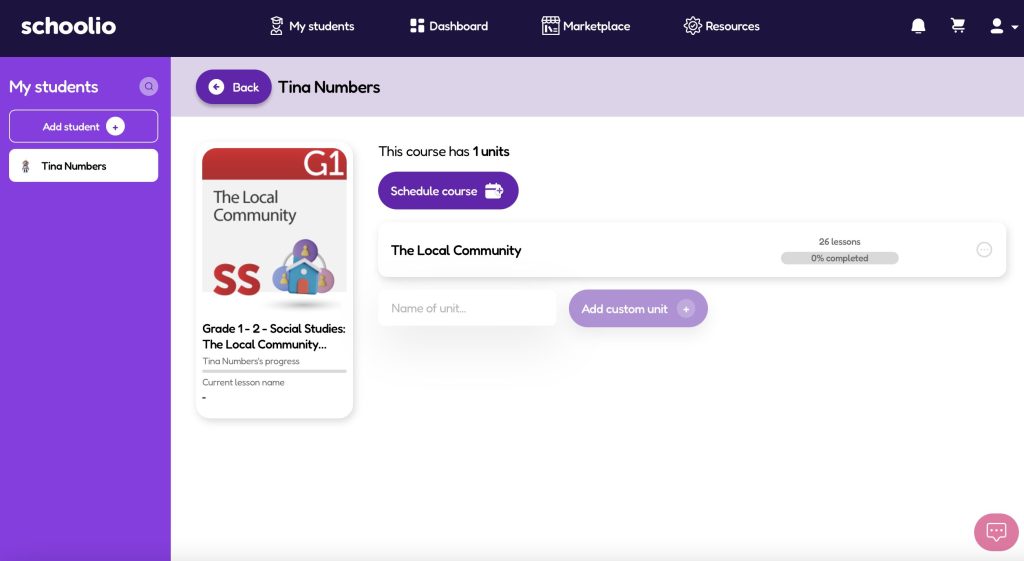
    Step 1: Select the Unit

    Select the unit

    Once you’ve selected the course you want to check out, you can select the unit by clicking on it. For example, in the photo above, you would select ‘The Local Community’.

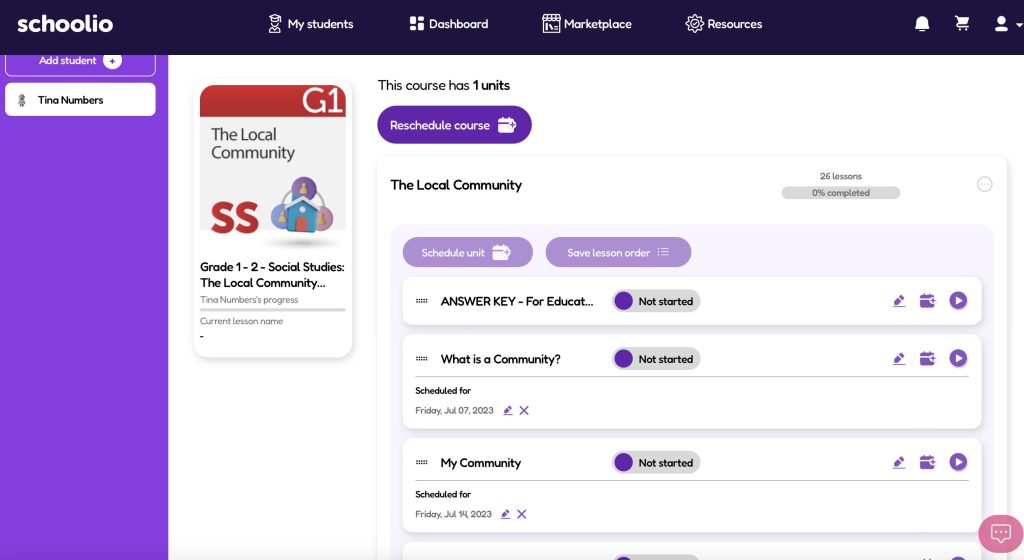
    Step 2: Select the lessons

    select the lesson

    You will now see the different lessons available. At the top, on the parent portal, you will see the answer key that you can use to check your student’s work. When you’re ready, you can click the play button on the lesson.

    Step 3: View the lesson

    The Schoolio Video Lesson

    Now you can enjoy the video lesson by pressing ‘play’ on the video.

    Step 4: Lesson Assessment

    When the video has been completed, you can scroll past the video to the lesson assessment. Now you can click ‘Launch’ and go through the lesson assessment.

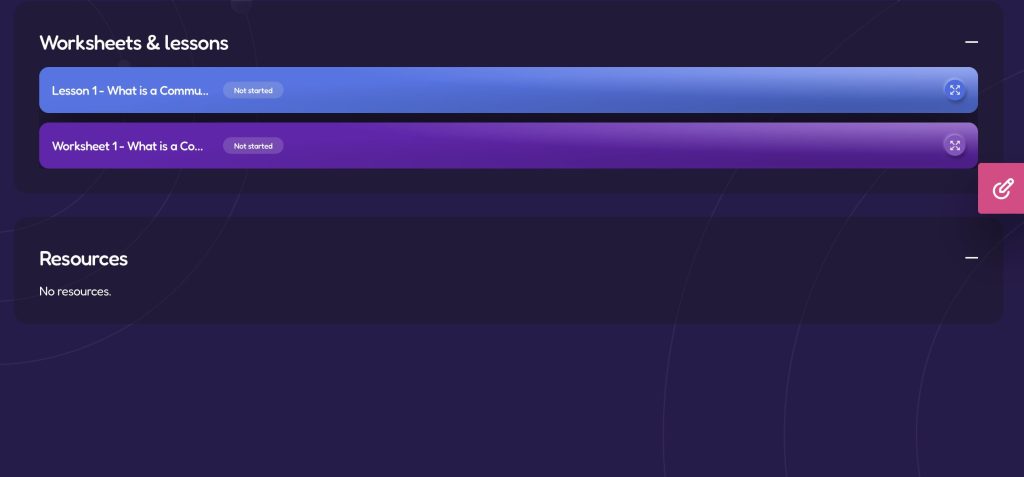
    Step 5: Worksheet and Lesson Sheet

    Worksheet

    After completing the lesson assessment, you can scroll down to find ‘Lesson 1’ and ‘Worksheet 1’. Lesson 1 is the core lesson that comes with the Schoolio Curriculum. You can use lesson one to discuss the lesson concept further with your child. This is optional because everything in the lesson is included in the video lesson. Worksheet 1 is not optional, so you will need to click on the four-pointing arrows on the right side of the screen to open the worksheet.

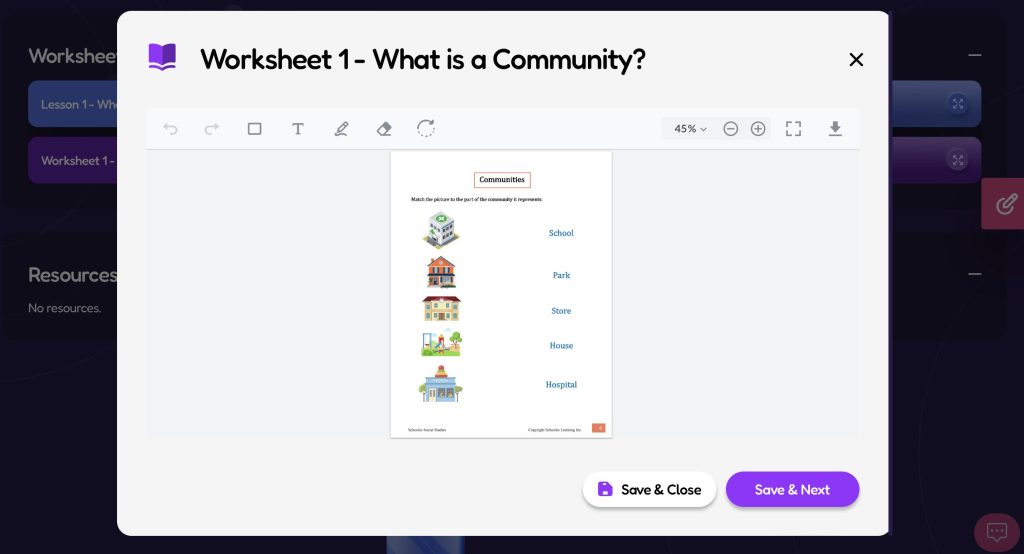
    Step 6: Complete the worksheet

    Complete the worksheet

    You can now navigate through the worksheet. There are two options to complete the worksheet. Using the annotation feature, you can do it on a tablet, iPad or computer. Or you can print the lesson and have your child complete their worksheet pencil to paper. To annotate, click on the T or Pencil icon at the top of the worksheet. Then use either the typing tool or drawing tool to complete the lesson. Make sure to Save your progress.

    If you’d prefer your child to complete the worksheet with paper and a pencil. You can click the arrow pointing down on the right side of the screen. Download the worksheet to your device and print it. You can use the answer key to view your child’s responses and match them with the answer key.

    Need further assistance?

    Please let us know if you need further assistance understanding how to navigate the lessons.
    Click here to book a Concierge Call. 

    Watch this quick video about navigating the lessons.

    Check out this thorough explanation video about all about how to navigate and annotate Schoolio Digital lessons.

    How to Navigate & Annotate on Lessons.

    If you have further questions, feel free to reach out to us! We’re always here to help.

    How to Bring Writing into Other Areas

    Sneaking It In: How to Bring Writing Into Other Areas

    By Chelsea McLeod 

    Sneaking it in: Writing

    Writing in school is often seen as a skill linked only to English. It is often viewed as an immovable part of the curriculum and focus in this class. While this is technically true, it is not the whole picture. Not only is writing helpful in other areas, but it is also essential that it is practiced in more ways than can be offered in a single class.  Furthermore, while many of us inherently “know” this fact, it is often difficult to wrap our minds around it when planning the homeschool day and to try to incorporate writing with other subjects less traditionally associated with it. 


    How To Incorporate Writing Into Other Subjects

    So now, how does one add writing to other subject areas? When we traditionally think of writing, we think of essays, stories, paragraphs, spelling practice, etc. These are all great ways to practice and can be very effective in building skills, there are many other engaging ways to work on writing while learning other subject matter, and you can make it fun while you’re at it!


    Science

    • Experiments 
      • Before you complete the experiment, have your learner make a prediction of the outcome and write it out. You can also have them include why they think what they do and have them add some proof or detail their thinking. 
      • For older students, you can create an assignment where they need to complete some research and explain in written form why the outcome was a certain way.


    Math

    • Journals
      • Math can be tricky, but one of the best ways to incorporate more writing is to have your student journal. They can ask questions in their journal, formulate hypotheses, and even explain their thinking when it comes to solving problems.
      • They could also have a few minutes each class to write about their frustrations in math or celebrate successes they have been working hard to achieve.
      • Finally, in these journals, you can have them use the 3, 2, 1 method of exit slips (an informal assessment of understanding). They could write three things they learned in the lesson today, two things they found interesting and one more question they still have about the topic.  


    • Story Problems
      • You should assign your student to write a few story problems. You can give them an equation they can use, or they can come up with their own. They then write a short trial that can be solved using that equation. 
      • This can be done with another homeschool family or a group, and then the students could trade and solve the problems. That way, they are practicing their problem-solving skills and writing.
      • These are hard for lots of students to solve as it takes some higher-level thinking. It is important to piece together the necessary information and separate that won’t be used to solve the problem. For this reason, this might be a more effective exercise for older students who have had some practice and success with story problems.

    Helping your kid write

    Art

    • Explain Artistic Expression in Detail
      • Learners need creative freedom, but sometimes it is difficult for us to know what they have made/drawn, especially when they are younger. In this case, you could have them draw a picture and then explain it in written form. You could also ask them why they decided on this particular thing. 
      • They can draw a story’s characters and setting and then write it. This way, they can bring words to their visual work and a visual to their story. In many ways, this can sometimes even help to overcome a block. If they struggle to write or draw, you can have them do the opposite to spark their imaginations.


    Social & History

    • Write a Textbook
      •  A great way to review and solidify information is to compile it into a cohesive and informative text. This assignment is best done with older students as it can benefit from lots of cumulative knowledge. I have used such an assignment in a High School Class in place of a final exam. 
      • A similar concept can be used with younger students. However, it would need to be a modified assignment that may include less extensive writing. 


    Physical Education

    • Plan a workout
      • Your student could plan a workout, including the warm-up, all the exercises and cool down. They would then complete the training themselves or lead a small group. Once that is done, it would be a perfect opportunity for a reflection. A written piece of their thoughts on what went well, what didn’t and what they would or could do differently next time. 
    • Keep a Journal
      • They could keep a journal for a week or two. In this exercise, they could keep track of what they are eating and how much exercise they are getting or reflect on what they could do to change their habits or maintain a healthy lifestyle.

    Some Other Ways to Get Kids Writing More


    Thank you cards

    Thank You Cards

    • For example, if you go on outings to the museum, a lecture or a play, you can have your students write a thank you to the workers or speakers. 
    • If you are a part of a homeschool co-op or group hosted at several different houses, your student could thank those hosts. 

    Introduction Speeches

    • Similarly to the above, if you have a guest speaker at a homeschool co-op meeting, or maybe you put together an assembly in honour of a particular day, you could have your student plan and write an introduction. They could research the speaker and include some information about 

    Pen Pals

    • This one is a classic! There are often programs in schools that connect kids to this type of thing. Similarly, several online programs or even Facebook groups explicitly aim for homeschool kids and connect them globally. 


    You can get creative with incorporating writing practice into your homeschool day. Writing practice doesn’t have to be specific or focused in only one area; it can also be spontaneous, like writing a grocery list or planning out a phone call you have to make.

    So, as you can see, there are many different ways to get your learners to write; honestly, this isn’t even an exhaustive list. There are many more ways for your student to strengthen their skills.

    In the end, the more exposure they have to writing in their various subjects, the stronger they will become. So take some ideas from this list or come up with your own but most importantly, focus on the practice and not the subject matter and see how much growth your student writer can achieve. 


    Getting started but aren’t sure how? Book a Concierge Call.

    If you aren’t sure how to get started or what programs would best suit your child’s learning needs, then you can chat with one of our experts on a one-on-one Concierge Call, completely free!
    Click here to book a Concierge Call. 


    Does Your Student Hate Writing?

    Does Your Student Hate Writing?: 

    Tips and Tricks to Make It Easier

    By: Chelsea McLeod

    Hate writing?

    Has your writing time become the bane of your existence, the most challenging part of your homeschooling routine? Is your kid miserable when It comes time to practice writing? Are they pushing back, getting easily frustrated, complaining, avoiding and completely shutting down and refusing to do it? 

    At Schoolio, we get it; writing can be tricky even for adults. Many of us don’t practice it regularly.  Unless the writing is work-related, it’s not something we would sit down and do in our spare time. So while we all understand that it is an essential skill that we all need to learn and practice often, it is also crucial to keep it fun, light and engaging if we want our kids to practice it without a fight. 

    Writing Doesn’t Have to Be Boring! Keep it Kid-Friendly.

    Just like with anything else, kids need us to change things up. Do you like it when things are always the same at work? While routine is essential, and our days should be structured similarly in the homeschool environment, adding different activities and trying new things is essential. So here are some kid-friendly ideas to keep your student guessing and having fun while doing something they don’t particularly like: Writing. With any luck, doing some of these activities might make them forget about their dislike for a while!

    Kid Friendly Writing

    Have You Tried to Have Them…

    1. Write what they want to write about

      • Practice makes perfect, right? So what better way to influence your student to want to practice than writing about whatever they want? What we are trying to encourage here is to get them writing. It doesn’t matter what it’s about or why they want to write it, just that they are writing and therefore practicing a critical skill. They can write a letter to a friend, a diary or a journal entry, a story, a description of a game they created, etc. You get the idea; the sky’s the limit, and they will want to practice more because they aren’t being told what to do and how to do it.  

    2. Write a step-by-step instructions piece, and you do what they write about… This is hilarious and very informative on missing steps rather than you harping on it.

    • Speaking of being told what to do, your student could write a step-by-step instructional guide on a topic of their choice or one you give them but keep it fun. For example, “How To….” Make a Peanut Butter and Jam Sandwich, as seen in this video. The kids have written the instructions, and the Dad follows them to the letter.  (TW, you will have to gauge your learners here, this may not be an excellent option for students who are easily frustrated or discouraged because it will be wrong several times before it is done correctly.)
    • The key here is first to have your students write uninterrupted with no interference from you. Then you try to follow their instructions exactly as they wrote them. This is not only fun but also an “experiential learning opportunity” for them. Watching you complete their step-by-step, they can see in a funny way where they missed an instruction (or 3). In this way, they will learn that they need to be more detailed in their writing and have fun watching you perform a silly task. They might not even remember their writing because they will have a great time!

    3. Write an alternative ending to their favourite book.

    • Again, writing doesn’t have to be boring.  It doesn’t have to be a miserable part of anyone’s day, which can be highlighted by using their favourite stories as inspiration.  Reading is a fun way to use imagination, support, and develop writing skills.
      Listening to books activates the same part of the brain as reading them. Therefore if they don’t have a favourite that they have read yet, they can choose something you have read to them. Often our kids and we have books we wish ended a certain way or want them to continue because we love the characters and story so much. So why not use that to your advantage during your homeschooling day? 

    Creative writing

    • Having them choose a story they already enjoy and continue it the way their imagination leads them is an excellent way to promote longer writing. In this case, students will often write many more lines or pages than before because they aren’t worried about what you may think or what is correct. They are just following their imagination and writing for themselves. Maybe they will be so engrossed in this task that they will end it in such a way that they can write their very own sequel too!

    Having fun is the easiest way to engage your student.

    Sometimes planning and preparing for the homeschooling day can get overwhelming. You want to make sure you cover all required, touching on necessary topics and subjects, all while you fill the day with skill practice to ensure your student isn’t falling behind their peers. And while it is crucial your child learns the necessary skills and required curriculum to help them out in the world when they grow up, it is also important to remember that kids also learn while they play.

    They often learn best by doing or playing through scenarios they live in, which is also something they could write about! Having fun is often the easiest and best way to engage their brains, and Writing is no different. We hope that this list has been informative and will help you move forward in planning your homeschooling time. School can be fun, and it doesn’t take complicated projects with many supplies to achieve—just some good, old-fashioned paper and a pencil, coupled with creativity and an open mind.

    Book a Concierge Call.

    If you aren’t sure how to get started or what programs would best suit your child’s learning needs, then you can chat with one of our experts on a one-on-one Concierge Call, completely free!
    Click here to book a Concierge Call. 

    Manage Disruptions to Learning

    Learning disruptions continue to frustrate parents, teachers and students across Canada and the United States. We all had high hopes that the Covid-19 pandemic would be entirely over by now, and education and life as we once knew it could continue as usual. Yet, we are entering the third year of the pandemic and are rattled with learning disruptions to this day. Maybe you have been trying to ride it out, but you’re now finding that these disruptions are causing your children to struggle intensely with their education. What are some things that you can do to manage disruptions to learning?

    Concerns of ongoing and past learning disruptions linger everywhere.

    Hundreds of students in Quebec, Canada, have been prohibited from attending school. According to CBC News, hundreds of students in Montreal are awaiting approval from Quebec to approve English eligibility. EMSB says they want to welcome all students but cannot without the ministry’s permission. As a result, hundreds of students are unable to attend school. How can these parents manage disruptions to learning?

    Additionally, parents, teachers and students across the United States are struggling with recovering from pandemic learning and the trauma that unfolded at the end of the 2021-2022 school year in Uvalde, Texas. Many parents and students fear attending school after such a horrific event.

    In New York City, many educators are highly concerned about the academic and emotional effects of the pandemic on their students as they enter the third school year since the beginning of the pandemic. A survey of 110 educators was conducted by the nonprofit Educators for Excellence and found that roughly 80% of respondents reported that their students are in worse academic and emotional shape than before the beginning of the pandemic.

    As educators, parents, and students prepare for back to school in British Columbia, Canada, there remains a serious concern as to what the new school year will bring when it comes to the spread of communicable diseases, including COVID-19. Even if there are no school shutdowns, many students will be out of school from being sick which causes parents to scramble to manage disruptions to learning for their children.

    In California, students wait months for mental health help while councillors share that they are being bombarded due to the pandemic and pandemic learning. There is no ‘quick fix’ for the trauma and interruption of education due to the COVID-19 pandemic.

    Parents in Ontario, Canada, are highly concerned with the decrease in health rules that will allow students testing positive to attend school. Furthermore, many parents are apprehensive about the impending doom of the potential education strike due to educational contracts set to expire across Ontario.

    What can parents do to manage disruptions to learning?

    It doesn’t matter where you are, learning disruptions are frustrating for parents everywhere. These learning disruptions are frustrating for parents, teachers and students alike. This is why it’s imperative for parents to learn to manage disruptions to learning to help their children excel despite the uncertainties. Here are some simple steps to keep your child’s learning stable.

    1. Weigh your options.

    For a child to learn, they need stability and consistency. This is why weighing your options is a good thing to do. Take a look at alternative learning options like homeschooling or online schooling and decide if these are right for your family. Keep in mind that homeschooling offers the consistency to education that children need. But you will need to decide if homeschooling is a learning avenue that works for your family first. Check out this blog on why so many parents are homeschooling to learn more. 

    2. Plan a routine with your child.

    If you decide to homeschool, plan out a homeschool routine for each day. Alternatively, if you keep your child in public school despite learning disruptions, plan out ‘off-day routines’ for days that your child might be home. Having a curriculum at home for those ‘just-in-case’ times is a great idea. That way, your child will continue to learn even if there are school closures due to strikes or illness.

    3. Keep conversations open with your child.

    We are now seeing the effects of the COVID-19 pandemic and school closures on children’s mental health. Because as stated above, children need consistency and stability to learn and grow. When their lives are constantly turned upside down, it can cause a flurry of emotional responses. Keeping conversations open with your child is so important. Please encourage your child to ask questions and express their feelings to you. It’s essential that you don’t minimize, avoid or dismiss their concerns. Truly acknowledge their feelings and assure them that it’s normal and natural to feel frustrated and scared about uncertainties. And check out this excellent resource for kids to learn to manage how they think and feel. 

    4. Take time with learning.

    Whether you are keeping your child in school and working on some extra curriculum at home, or you have decided to exclusively homeschool your child with the help of an excellent homeschooling curriculum and digital aids. If you aim to do 45-minute learning sessions with your child, start with 10 or 15 minutes and build up from there. Keeping lessons light and enjoyable helps them adjust to their new or additional learning in a calming manner.

    5. Stay in touch with your child’s school.

    If you have decided to homeschool your child exclusively, remember to keep in touch with your child’s school. Ask the school questions for further guidance, and explain the situation to your child’s previous teacher.

    6. Join a homeschool group or parenting group in your community.

    The upside to choosing to homeschool is that homeschooling has become a popular alternative to traditional learning. This means that there are plenty of people homeschooling, and they all have unique situations and ways of homeschooling. When you connect with these groups, you can learn more about how to homeschool your child more effectively.

    7. Subscribe to the Schoolio Blog.

    We are a team committed to helping parents and students thrive in whatever learning avenue they are in. Our blog provides countless helpful tips to help you and your child excel.

    8. Connect with homeschooling experts.

    Many homeschooling families are willing and able to share their knowledge on how to get started.

    Learning disruptions continue to be an unfortunate part of our lives today; rather than being upset or worried about it, you are taking the situation and looking for alternative learning methods to help your child excel in whatever situation you find yourself in.

    We are here to remind you that you are doing an excellent job. Regardless of what learning avenue you choose for your child, you and your child will continue to do great! Because of the work you are putting in to help your child get through the learning bumps and manage disruptions to learning. Keep going; you’re doing great.

    homeschooling curriculum

    Affordable Homeschooling Curriculum and Price Increases

    Inflation is a word that makes many of us cringe as we watch the price of groceries, clothes, fuel, and everyday essentials rise. Finding ways to afford essential items has become a challenge for many people worldwide. Many people are concerned about their homeschooling curriculum needs as they continue to watch the cost of everything rise. How can they find an affordable homeschooling curriculum with these price increases?

    Inflation is having a significant impact on everything.

    According to the US inflation Calculator, “the annual inflation rate for the United States is 8.6% for the 12 months ended May 2022, the largest annual increase since December 1981.” Following suit, according to Statistics Canada, Canadian consumer prices rose 6.8% in April.

    The price of groceries continues to increase and overwhelm many people as Canadians paid 9.7% more in April 2022 for food purchased when compared to April 2021. Worse, this increase exceeded 5% for the fifth month in a row, and much like the United States was the most significant increase since September 1981.

    Groceries aren’t the only thing impacted by inflation. There are also substantial increases in gas prices, rent prices, general product prices, car prices and even school supplies.

    Does inflation impact homeschooling?

    The bitter answer is yes. Many homeschooling families are already single-income families struggling to find an affordable homeschooling curriculum. While some states/provinces offer financial support for homeschooling families, many states and provinces throughout North America do not provide any financial help for homeschooling families.

    Unfortunately, many homeschooling families have been struggling to put food on the table, fuel in the car, a roof over their heads and an affordable homeschooling curriculum in front of their children.

    So it’s with incredible frustration that many homeschooling families find that even the cost of a quality homeschool curriculum has increased.

    How is a digital homeschooling curriculum affected by inflation and price increases?

    You may have noticed that some of your favourite homeschooling curriculum companies have increased the prices of their products. While we cannot speak for all companies, we’d like to address the 15% increase you may have seen in our own Schoolio Curriculum network.

    Since our beginnings in 2020, we at Schoolio Learning have been committed to offering you a secular, inclusive, open-and-go, affordable homeschooling curriculum. So, why have we increased our prices?

    Why is there a price increase on our homeschooling curriculum?

    There are two reasons you will see a 15% increase in our homeschooling curriculum.

    Inflation affects our employees too.

    Our team is growing to provide you and your child with the most up-to-date homeschooling curriculum to keep your homeschool running smoothly. As such, we need to take care of our team members. Inflation affects everyone; therefore, we must accommodate our team members and customers.

    This slight price increase helps our team members to still provide for their families while writing and working on the best materials to keep your family learning at an affordable price.

    We’ve enhanced our homeschooling curriculum to serve you better.

    This is the most exciting news that we wanted to share with you. We have enhanced all of our curricula from Kindergarten to Grade 8!

    What does that mean?

    If you were a previous customer of Schoolio Learning, you would remember that we recommended you purchase the Canadian Curriculum workbooks or other practice workbooks to help your child get the essential practice work they needed? Extra workbooks are no longer required with our enhanced curriculum. It now includes all the necessary practice content to help your child learn and understand the concepts better.

    To sum it up, why has Schoolio Learning Curriculum increased by 15%?

    • Inflation costs for our team members mean we must aim to meet their needs.
    • We have enhanced the curriculum, so you no longer need to search and spend money on additional practice workbooks.

    Is Schoolio still an affordable homeschooling curriculum option? Let’s compare.

    Before you jump to the conclusion of assuming you should find a cheaper homeschooling curriculum company because the 15% increase makes you cringe. Let’s look at another popular homeschooling curriculum company and its pricing compared to ours.

    Schoolio Grade 3 Complete Bundle:

    Our grade 3 bundle includes all the core subjects, Math, Social Studies, Science and Language Arts. With over 1,200 pages, lessons, teaching plans/discussions/ as well as countless activities.

    The cost for the Schoolio full-year curriculum bundle: is $399.84 (digital) or $563 (books, printed and shipped).

    Alternative homeschooling company Grade 3 Bundle:

    A popular homeschooling curriculum company provides a complete kit much like our complete bundle for grade 3. A full kit includes the four core subjects, Math, Social Studies, Science and Language Arts, teaching instructions and lessons.

    The cost for this homeschooling curriculum full-year: is $1,090.45.

    As you can see, that’s a pretty huge price increase for comparable homeschool learning content.

    Please don’t take our word for it; check it out yourself.

    We want you to excel at homeschooling, which means finding the best option for your family and budget is essential. So, please research and compare our prices with other popular homeschooling curriculum companies.

    We stand behind our price and will continue to provide an affordable homeschooling curriculum for all your learning needs.

    Don’t forget our promotions.

    Price increases and inflation can cause a lot of stress for families. We don’t want you to feel that you must stop homeschooling because you have to choose between a homeschool curriculum and groceries. So, please know that we periodically offer excellent promotions to help make our curriculum even more affordable for your homeschool. If you don’t see a promotion being advertised on the website, reach out to our customer service team members, and they will be happy to provide you with all the knowledge on current or upcoming promotions.

    If you aren’t sure if we would be the best fit for your homeschool, check out our free sample packages to view just how authentic, simple and wholesome our curriculum is. We look forward to providing you with the best and most affordable homeschooling curriculum for all your homeschooling needs.

    Check out our free sample packages today to find the perfect curriculum for your child’s grade and learning needs.

    See for yourself:  


    Click here for samples

    Prepare Your Pre-Teen for Grade 8

    How can you prepare your pre-teen for grade 8? Make sure you still let them have that fun summer that they want but also aim to keep them on track, catch them up from pandemic learning loss, avoid summer learning loss and prepare them for grade eight? It’s a huge task, but it doesn’t have to be complicated.

    Avoid summer learning loss and prepare your pre-teen for grade 8.

    Let’s face it; many kids are struggling to catch up after enduring two years of pandemic learning. Researchers and educators are all stating their concerns for kids that have perhaps slipped through the cracks due to pandemic learning. A more significant problem is the added impact of summer learning loss. Knowing that over the summer, many children will lose 2.6 months of math skills, two months of reading skills and one month of overall learning.

    Click here to learn more about Summer Learning Loss. 

    Knowing those statistics, it can be hard not to stress about your pre-teen’s education. But, the most important thing you can do is avoid worrying about your pre-teen’s learning during the summer months. Of course, you want your child to learn, stay on track and have all the opportunities in life that they deserve. But constantly worrying about that won’t help you or your pre-teen.

    So what can you do to help your pre-teen catch up on all the learning they have lost? While also aiming to stay on track and not lose even more learning skills during the summer?

    Simplify learning when you prepare your pre-teen for grade eight.

    Try to avoid overthinking your pre-teen’s summer learning because we all know that overthinking adds more stress than necessary. You don’t need elaborate plans to prepare your child for grade eight. This will only lead to you, and your child feeling stressed and exhausted while dealing with that dreaded feeling of not getting enough done.

    When preparing your pre-teen for grade eight, what is the best and easiest way to simplify summer learning? Use the Summer Schoolio: Get Ready for Grade 8 book! Summer Schoolio: Get Ready for Grade 8 was created to help your child stay on track with their essential learning. What’s better is that this program will save you time and money as you won’t be searching and spending money on a homeschooling curriculum to try to fit your summer learning needs.

    What’s inside the Summer Schoolio: Ready for Grade 8 workbook?

    Prepare your pre-teen for grade 8

    We want you and your pre-teen to have an enjoyable summer without the stress of trying to complete extra tasks. The Summer Schoolio books have been designed in a simple format, without the mountain of overwhelming tasks. This helps your pre-teen stay on track with their learning.

    The Summer Schoolio: Ready for Grade 8 book combines the best homeschooling curriculum concepts to give you and your child a unique solution to help prepare your pre-teen for grade eight. We’ve combined the homeschooling writing curriculum, homeschooling language arts curriculum and homeschooling math curriculum to bring you and your child a workbook to help practice essential skills to stay on track.

    Summer Schoolio: Ready for Grade 8 overview:

    Prepare your pre-teen for grade 8

    The Summer Schoolio: Ready for Grade 8 workbook is filled with learning materials that aren’t just educational; they’re fun too! This combination is an excellent resource to help prepare your pre-teen for grade 8. Created for six weeks of learning, your pre-teen will have the opportunity to learn and refresh different learning concepts each week.

    Week one includes:

    The Summer Schoolio week includes three days of simple learning that won’t be overwhelming or take too long to complete.

    • Day one, Weekly Writing – Friendly Letters – and Math – Number Sense.
    • Then day two has Weekly Writing and Math – Number Sense.
    • On day three, your pre-teen will work on Weekly Writing – Scrapbooking – and Math – Number Sense.

    Week two includes:

    The second week of Summer Schoolio: Ready for Grade 8 is similar to week one, just switching up learning concepts.

    • During week two, your pre-teen will have Weekly Writing – Writing Fiction – and Math – Number Sense on day one.
    • On Day Two, they will have Weekly Writing and Number Sense.
    • Then on day three, they will have Weekly Writing – Scrapbook and Math – Number Sense.

    Week three includes:

    During the third week of the Summer Schoolio: Ready for Grade 8 book, your pre-teen will be working on:

    • Weekly Writing – Reviewing a Book – and Math – Algebra on day one.
    • Then on day two, your child will work on Weekly Writing and Math – Algebra.
    • Followed by day three, which is Weekly Writing – Scrapbook and Math – Algebra.

    Week four includes:

    • When your pre-teen is working on week four, day one, they will do Weekly Writing – Writing Non-Fiction – and Math – Geometry/Spatial Sense.
    • Then on day two, they will be working on Weekly Writing and Math – Geometry/Spatial Sense.
    • Finally, on day three, they will get to work on their scrapbook for Weekly Writing and the final day of Math – Geometry/Spatial Sense.

    Week five includes:

    • Day one of week five is Weekly Writing – Poetry – and Math – Data Management.
    • Then on day two, they will work on Weekly Writing and Math – Data Management.
    • Followed by day three, which is Scrapbooking for Weekly Writing and Data Management for Math.

    Week six includes:

    • The first day of week six focuses on Weekly Writing – Summarizing – and Math – Financial Literacy.
    • The second day is all about Weekly Writing and Financial Literacy for Math.
    • Then, your child can work on their scrapbook again for Weekly Writing and enjoy their final Financial Literacy assignment.

    A daily repetitive learning cycle with refreshing concepts helps your pre-teen stay interested with a structured plan for summer learning. This technique will help your pre-teen master essential math, writing and reading concepts for grade eight.

    Prepare your pre-teen for grade 8

    The Summer Schoolio: Ready for Grade 8 workbook includes a sample schedule/calendar that looks like this:

    Monday: Read a Book or Chapter.

    Tuesday: Weekly Writing Day 1, Math Day 1, Read a Book or Chapter.

    Wednesday: Weekly Writing Day 2, Math Day 2, Read a Book or Chapter.

    Thursday: Weekly Writing Day 3, Math Day 3, Read a Book or Chapter.

    Friday: Read a Book or Chapter.

    Helping your pre-teen stay on track and up-to-date with their learning while avoiding summer learning loss and preparing for the next grade doesn’t need to be an overwhelming and stressful task. It also doesn’t need to take much daily time to succeed. The Summer Schoolio: Ready for Grade 8 book helps your child keep up with their learning needs, refresh, and not become overwhelmed by too much information crammed into one day.

    Prepare your pre-teen for grade eight.


    Click for Summer Schoolio

    Prepare Your Child for Grade Six

    Are you wondering the best way to prepare your child for grade six? Doing so without causing them tremendous stress and frustration from doing too much work on fun summer days? What’s the easiest way to prevent summer learning loss, prepare your child for grade six and let them have a fun summer?

    Avoid summer learning loss while you prepare your child for grade six.

    The most important thing you can do is avoid getting stressed about your child’s learning during the summer months. As parents, we want our children to learn, stay on track and have all the opportunities in life that they deserve. But that constant worry can become distracting and consuming.

    It can be tough to avoid worrying about their education when we think of all the learning they’ve lost due to pandemic learning. Heading into summer, we can become overwhelmed by the thought of summer learning loss on top of pandemic learning loss. Especially when we see statistics about summer learning loss, like that 2.6 months of math skills, two months of reading skills and one month of overall learning are lost due to summer learning loss.

    Click here to learn more about Summer Learning Loss.

    So what can you do to help your child catch up on all the learning they have lost? While also aiming to stay on track and not lose even more learning skills during the summer?

    General learning skills like math, reading and writing are essential for your child to practice to develop correctly continually; this is especially true during the summer.

    Prepare your child for grade six by simplifying learning.

    Try to avoid overthinking your child’s summer learning because we all know that overthinking adds more stress than necessary. You don’t need elaborate plans to prepare your child for grade six. This will only lead to you, and your child feeling stressed and exhausted while dealing with that dreaded feeling of not getting enough done.

    When preparing your child for grade six, is the best and easiest way to simplify summer learning? Use the Summer Schoolio: Get Ready for Grade 6 book! Summer Schoolio: Get Ready for Grade 6 was created to help your child stay on track with their essential learning. What’s better is that this program will save you time and money as you won’t be searching and spending money on a homeschooling curriculum to try to fit your summer learning needs.

    What’s inside the Summer Schoolio: Ready for Grade 6 workbook?

    Prepare your child for grade six

    We want you to have an enjoyable summer without the stress of trying to complete extra tasks. The Summer Schoolio books have been designed in a simple format, without the mountain of overwhelming tasks. This helps your child stay on track with their learning.

    The Summer Schoolio: Ready for Grade 6 book combines the best homeschooling curriculum concepts to bring you and your child a unique solution to help you prepare your child for grade six. We’ve combined the homeschooling writing curriculum, homeschooling language arts curriculum and homeschooling math curriculum to bring you and your child a workbook to help practice essential skills to stay on track.

    Summer Schoolio: Ready for Grade 6 overview:

    Prepare your child for grade six

    The Summer Schoolio: Ready for Grade 6 workbook is filled with learning materials that aren’t just educational; they’re fun too! This combination is an excellent resource to help prepare your child for grade six. Created for six weeks of learning, your child will have the opportunity to learn and refresh different learning concepts each week.

    Week one includes:

    The Summer Schoolio week includes three days of simple learning that won’t be overwhelming or take too long to complete.

    • Day one, Weekly Writing – Writing Fiction – and Math – Number Sense.
    • Then day two has Weekly Writing and Math – Number Sense.
    • On day three, your child will work on Weekly Writing – Scrapbooking – and Math – Number Sense.

    Week two includes:

    The second week of Summer Schoolio: Ready for Grade 6 is similar to week one, just switching up learning concepts.

    • On day one, week two, your child will have Weekly Writing – Writing Letters – and Math – Number Sense.
    • On Day Two, they will have Weekly Writing and Number Sense.
    • Then on day three, they will have Weekly Writing – Scrapbook and Math – Number Sense.

    Week three includes:

    During the third week of the Summer Schoolio: Ready for Grade 6 book, your child will be working on:

    • Day one, Weekly Writing – Writing Poetry – and Math – Algebra.
    • Then on day two, your child will work on Weekly Writing and Math – Algebra.
    • Followed by day three, which is Weekly Writing – Scrapbook and Math – Algebra.

    Week four includes:

    • When your child is working on week four, day one, they will do Weekly Writing – Descriptive Writing – and Math – Geometry/Spatial Sense.
    • Then on day two, they will be working on Weekly Writing and Math – Geometry/Spatial Sense.
    • Finally, on day three, they will get to work on their scrapbook for Weekly Writing and the final day of Math – Geometry/Spatial Sense.

    Week five includes:

    • Day one of week five is Weekly Writing – Writing a Book Report – and Math – Data Management.
    • Then on day two, they will work on Weekly Writing and Math – Data Management.
    • Followed by day three, which is Scrapbooking for Weekly Writing and Data Management for Math.

    Week six includes:

    • The first day of week six focuses on Weekly Writing – Writing Non-Fiction – and Math – Financial Literacy.
    • The second day is all about Weekly Writing and Financial Literacy for Math.
    • Then, your child can work on their scrapbook again for Weekly Writing and enjoy their final Financial Literacy assignment.

    A daily repetitive learning cycle with refreshing learning concepts helps your child stay interested with a structured plan for summer learning. This technique will help your child master essential math, writing and reading concepts for grade six.

    Prepare your child for grade six

    The Summer Schoolio: Ready for Grade 6 workbook includes a sample schedule/calendar that looks like this:

    Monday: Read a Book or Chapter.

    Tuesday: Weekly Writing Day 1, Math Day 1, Read a Book or Chapter.

    Wednesday: Weekly Writing Day 2, Math Day 2, Read a Book or Chapter.

    Thursday: Weekly Writing Day 3, Math Day 3, Read a Book or Chapter.

    Friday: Read a Book or Chapter.

    Trying to help your child stay on track and up-to-date with their learning while avoiding summer learning loss and preparing for the next grade doesn’t need to be an overwhelming and stressful task. It also doesn’t need to take a massive chunk of daily time to succeed. The Summer Schoolio: Ready for Grade 6 book helps your child keep up with their learning needs, refresh, and not become overwhelmed by too much information crammed into one day.

    Prepare your child for grade six.


    Click here for your summer schoolio book

    Prepare Your Child for Grade Four

    Are you worried that your child isn’t prepared for grade four or that they might lose too much knowledge due to summer learning loss? What’s the best way to keep your child on track with their learning during the summer? Should you crowd their day with learning time and curriculum? Or allow them to have fun and easy-going summer? What’s the best way to prepare your child for grade four?

    Avoid summer learning loss while trying to prepare your child for grade four.

    First things first, don’t stress so much about it. We get it; as parents, we often feel the need to ensure our children do their very best and get all the best opportunities in life. We worry that we aren’t doing enough, causing our child to struggle more and more with summer learning loss and pandemic learning loss.

    Trying to avoid summer learning loss when you’ve already been worried about pandemic learning loss can become an exhausting task. Especially when you see statistics about summer learning loss that 2.6 months of math skills, two months of reading skills and one more of overall learning are lost each summer for most children.

    Learn more about Summer Learning Loss.

    What can you do to help your child catch up on all the learning loss they’ve experienced, stay on track, and not lose every more learning skill during the summer?

    Math, reading and writing are general learning skills that are essential for your child to continually practice to develop correctly; this is especially true during the summer.

    What’s the best way to prepare your child for grade four? The first step is to simplify learning.

    You must avoid overthinking their summer learning as that will only lead to chronic stress. Many of us assume that to prepare your child for grade four, you must have some elaborate plan. Which leads to you being exhausted and never feeling like you’ve done enough.

    One of the easiest ways to simplify summer learning when you are aiming to prepare your child for grade three is to use the Summer Schoolio: Get Ready for Grade 4 book! The Summer Schoolio book was created to help your child excel in grade four. Summer Schoolio: Ready for Grade 4 book helps your child stay on track with essential learning. And this will also save you hundreds of dollars and time searching for a homeschool curriculum suitable for your goal of helping your child prepare for grade four.

    What’s inside the Summer Schoolio: Ready for Grade 4 workbook?

    Prepare your child for grade four

    An enjoyable summer without the stress of trying to complete extra tasks is so important. And the Summer Schoolio books have been designed to be simple; without the mountain of overwhelming tasks, your child can stay on pace with their learning.

    The Summer Schoolio: Ready for Grade 4 book combines the best homeschooling curriculum concepts to bring you and your child a unique solution to help you prepare your child for grade four. We’ve combined the homeschooling writing curriculum, homeschooling language arts curriculum and the homeschooling math curriculum to bring you and your child a book to help practice essential skills to stay on track.

    Here’s an overview of Schoolio Ready for Grade 4:

    Prepare Your Child for Grade four The Summer Schoolio: Ready for Grade 4 workbook is loaded with materials that aren’t just educational; they’re fun too! This combination is an excellent resource to help prepare your child for grade four. Created for six weeks of learning, your child will have the opportunity to learn and refresh different learning concepts each week.

    Week one includes:

    The Summer Schoolio week includes three days of simple learning that won’t be overwhelming or take too long to complete.

    • Day one, Weekly Writing – Persuasive Writing – and Math – Number Sense.
    • Then day two has Weekly Writing and Math – Number Sense.
    • On day three, your child will work on Weekly Writing – Scrapbooking – and Math – Number Sense.

    Week two includes:

    The second week of Summer Schoolio: Ready for Grade 4 is similar to week one, just switching up learning concepts.

    • Day one, Weekly Writing – Poetry – and Math – Number Sense.
    • On Day Two, they will have Weekly Writing and Number Sense.
    • Day three, they will have Weekly Writing – Scrapbook and Math – Number Sense.

    Week three includes:

    During the third week of the Summer Schoolio: Ready for Grade 4 book, your child will be working on:

    • Day one, Weekly Writing – Writing Non-Fiction – and Math – Algebra.
    • On day two, your child will work on Weekly Writing and Math – Algebra.
    • Followed by day three, which is Weekly Writing – Scrapbook and Math – Algebra.

    Week four includes:

    When your child is working on week four:

    • Day one, they will do Weekly Writing – Comic Book – and Math – Geometry/Spatial Sense.
    • On day two, they will be working on Weekly Writing and Math – Geometry/Spatial Sense.
    • Finally, on day three, they will get to work on their scrapbook for Weekly Writing and the final day of Math – Geometry/Spatial Sense.

    Week five includes:

    • Day one of week five is Weekly Writing – Writing an Email – and Math – Data Management.
    • Then on day two, they will work on Weekly Writing and Math – Data Management.
    • Followed by day three, which is Scrapbooking for Weekly Writing and Data Management for Math.

    Week six includes:

    • The first day of week six focuses on Weekly Writing – Box Review – and Math – Financial Literacy.
    • The second day is all about Weekly Writing and Financial Literacy for Math.
    • Then, your child can work on their scrapbook again for Weekly Writing and enjoy their final Financial Literacy assignment.

    The daily work is repetitive but also ever-changing to help your child stay interested with a structured plan for summer learning. This technique helps your child master essential math, writing and reading concepts for grade four.

    Prepare Your Child for Grade four

    A sample schedule/calendar will be included with the Summer Schoolio: Ready for Grade 4 workbook. It sounds like this:

    Monday: Read a Book or Chapter.

    Tuesday: Weekly Writing Day 1, Math Day 1, Read a Book or Chapter.

    Wednesday: Weekly Writing Day 2, Math Day 2, Read a Book or Chapter.

    Thursday: Weekly Writing Day 3, Math Day 3, Read a Book or Chapter.

    Friday: Read a Book or Chapter.

    The process of trying to help your child stay on track and up-to-date with their learning while avoiding summer learning loss and preparing for the next grade doesn’t need to be an overwhelming and stressful task. It also doesn’t need to take a massive chunk of time every day in order for it to be successful. The Summer Schoolio: Ready for Grade 4 book helps your child keep up with their learning needs, refresh, and not become overwhelmed by too much information crammed into one day.

    Prepare your child for grade four.


    Pick up your summer schoolio book!

    Prepare Your Child for Grade Three

    Do you feel like your child is prepared for grade three? During the summer, are you planning to help your child stay on track with their learning or have a free-for-all summer with no sign of curriculum? Do you want to ensure your child stays on track but not overwhelm them with too much ‘work’? Let us help you with all your questions on how to prepare your child for grade three.

    Preparing your child for grade three while aiming to avoid summer learning loss.

    The first thing you need to do when aiming to prepare your child for grade three while avoiding summer learning loss? Don’t stress so much! As parents, we often worry about ensuring our children are on track with their learning. That worry can become more and more of a concern when we think about pandemic learning loss.
    How to avoid summer learning loss on top of pandemic learning loss is another concern facing parents, especially when they hear that most children lose 2.6 months of math skills, two months of reading skills and the equivalent of one month of overall learning each summer.
    You can learn more about Summer Learning Loss here. 
    So, how can we help our children catch up on all the learning loss they’ve experienced, stay on track and not lose even more learning skills during the summer?
    Reading, writing, math and learning, in general, are essential skills your child must continually practice to develop correctly, especially during the summer.

    How to prepare your child for grade three? First, let’s simplify learning.

    One thing you absolutely must avoid is overthinking their learning. We often assume that to prepare your child for grade three, you must have elaborate plans, and it has to be a huge, exhausting endeavour when the actual reality is that it can be a simple process.
    One of the best ways to simplify their summer learning is to use the Summer Schoolio: Ready for Grade 3 book! This book was created specifically to help children about to move onto grade three. Using the Summer Schoolio: Ready for Grade 3 book, your child will stay refreshed and on track with their essential learning. This will also save you hundreds of dollars and time because you won’t be searching for a homeschool curriculum that will still be too much or too little when aiming to prepare your child for grade three.

    Take a look inside the Summer Schoolio: Ready for Grade 3 workbook!

    Prepare Your Child for Grade 3
    Having an enjoyable summer without the stress of trying to complete extra tasks is essential! This is why our Summer Schoolio books have been designed to be simple. Without the overwhelm of having to complete a mountain of overwhelming tasks.
    In the Summer Schoolio: Ready for Grade 3 book, we have combined the best of our secular homeschooling curriculum concepts to bring you and your child a unique summer learning solution that will prepare your child for grade three. In a fantastic combination of homeschooling writing curriculum, homeschooling language arts curriculum and homeschooling math curriculum, we aim to help your child practice those essential skills to stay on track.

    Summer Schoolio: Ready for Grade 3 overview:

    Prepare your child for grade three
    The Summer Schoolio: Ready for Grade 3 workbook is loaded with materials that aren’t just educational; they’re fun too! This combination is an excellent resource to help prepare your child for grade three. Created for six weeks of learning, your child will have the opportunity to learn and refresh different learning concepts each week.

    Week one includes:

    The Summer Schoolio week includes three days of simple learning that won’t be overwhelming or take too long to complete.

    • Day one, Weekly Writing – Writing Fiction – and Math – Number Sense.
    • Day two has Weekly Writing and Math – Number Sense.
    • On day three, your child will work on Weekly Writing – Scrapbooking – and Math – Number Sense.

    Week two includes:

    The second week of Summer Schoolio: Ready for Grade 3 is similar to week one, just switching up learning concepts.

    • During week two, on day one, your child will have Weekly Writing – Autobiography – and Math – Number Sense.
    • On Day Two, they will have Weekly Writing and Number Sense.
    • On day three, they will have Weekly Writing – Scrapbook and Math – Number Sense.

    Week three includes:

    During the third week of the Summer Schoolio: Ready for Grade 3 book, your child will be working on:

    • Day one, Weekly Writing – Reviewing a Book – and Math – Algebra.
    • Then on day two, your child will work on Weekly Writing and Math – Algebra.
    • Followed by day three, which is Weekly Writing – Scrapbook and Math – Algebra.

    Week four includes:

    When your child is working on week four:

    • Day one, Weekly Writing – Writing Non-Fiction – and Math – Geometry/Spatial Sense.
    • Then on day two, they will be working on Weekly Writing and Math – Geometry/Spatial Sense.
    • On day three, they will get to work on their scrapbook for Weekly Writing and the final day of Math – Geometry/Spatial Sense.

    Week five includes:

    • Day one of week five is Weekly Writing – Poetry – and Math – Data.
    • Then on day two, they will work on Weekly Writing and Math – Data.
    • Day three is Scrapbooking for Weekly Writing and Data for Math.

    Week six includes:

    • The first day of week six focuses on Weekly Writing – Summarizing – and Math – Financial Literacy.
    • The second day is all about Weekly Writing and Financial Literacy for Math.
    • Then on day three, your child can work on their scrapbook again for Weekly Writing and enjoy their final Financial Literacy assignment.

    The schedule and assignments are repetitive but changing to help your child stay structured and interested. This technique helps your child master all the essential math and reading/writing concepts for grade three.

    What does a typical week look like using the Summer Schoolio: Ready for Grade 3 program?

    Prepare your child for grade three
    The Summer Schoolio: Ready for Grade 3 book includes a sample schedule/calendar you can follow daily. It translates to:
    Monday: Read a Book or Chapter.
    Tuesday: Weekly Writing Day 1, Math Day 1, Read a Book or Chapter.
    Wednesday: Weekly writing Day 2, Math Day 2, Read a Book or Chapter.
    Thursday: Weekly Writing Day 3, Math Day 3, Read a Book or Chapter.
    Friday: Read a Book or Chapter.
    Keeping your child on track and up-to-date with their learning doesn’t need to be an overwhelming and stressful process. And you don’t need to take a massive chunk of time each time to accomplish it. The Summer Schoolio: Ready for Grade 3 book helps your child keep up with their learning needs, refresh and not become overwhelmed by too much information crammed into one day.

    Prepare your child for grade three.


    Pick up your copy of Summer Schoolio