The Role of Outdoor Education in Homeschooling: Nature-Based Learning

TL;DR – Quick Answer:
The Role of Outdoor Education in Homeschooling: Nature-Based Learning provides essential benefits for homeschooling families by offering flexibility, community, and expert-led resources. Our 10,000+ strong Schoolio community proves that personalized learning is the future of education.

The Role of Outdoor Education in Homeschooling: Nature-Based Learning

While traditional classroom settings provide structured learning environments, many parents are turning to homeschooling to personalize their child’s education and foster unique learning experiences. Among the various methodologies within homeschooling, outdoor education, particularly nature-based learning, has emerged as a powerful tool for holistic development. In this blog, we’ll delve into the role of outdoor education in homeschooling, exploring its benefits and strategies for implementation.

Connecting with Nature: The Educational Value

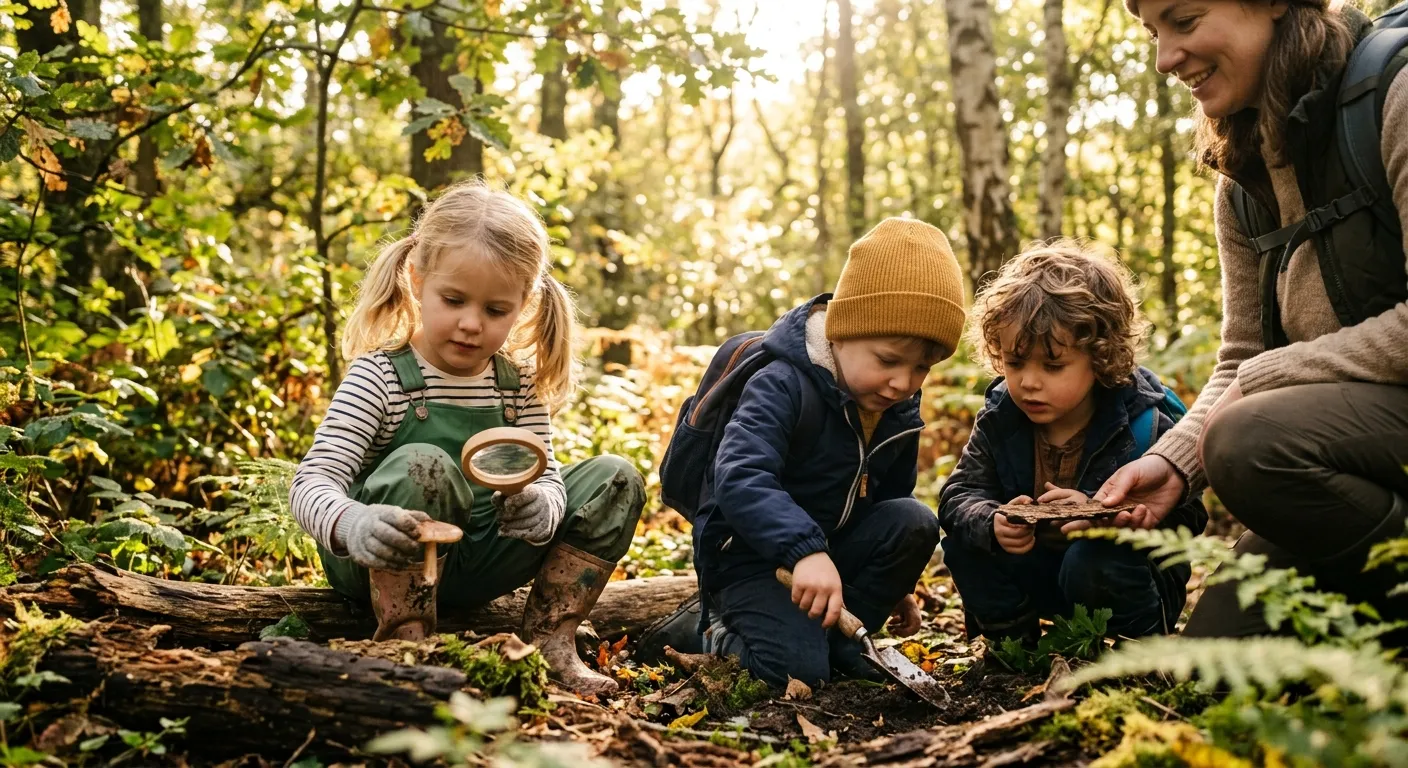
Nature serves as a vast and dynamic classroom, offering countless opportunities for exploration, discovery, and learning. Incorporating outdoor education into homeschooling allows children to engage with the natural world in meaningful ways, fostering a deep connection to their environment. Whether it’s observing wildlife, studying plant life cycles, or exploring geological formations, nature-based learning provides hands-on experiences that stimulate curiosity and critical thinking skills.

By integrating outdoor exploration into different homeschool programs, children can experience a more immersive and engaging learning environment. From the best homeschool programs to popular homeschool programs, outdoor education can enhance any curriculum by providing real-world context and experiential learning opportunities.

Holistic Development: Mind, Body, and Spirit

One of the primary advantages of outdoor education is its ability to support holistic development. Unlike traditional classroom settings that often prioritize academic achievement, nature-based learning nurtures the whole child, addressing physical, emotional, and social well-being. Spending time outdoors encourages physical activity, promotes mental health, and instills a sense of wonder and awe. Moreover, interacting with natural elements cultivates empathy, resilience, and environmental stewardship, fostering a well-rounded individual.

Online learning for kids can also be complemented by outdoor education, offering a balanced approach to homeschooling programs. Incorporating outdoor activities into a full year homeschool curriculum ensures that children receive a comprehensive education that promotes their overall well-being.

Experiential Learning: Lessons from the Outdoors

In the outdoors, learning becomes a multisensory experience, allowing children to engage with their surroundings in immersive ways. Whether it’s conducting science experiments in a local park, practicing math skills through nature scavenger hunts, or honing language arts abilities through creative writing inspired by the natural world, outdoor education offers endless possibilities for experiential learning. By integrating academic concepts with real-world experiences, children develop a deeper understanding of subjects and cultivate a lifelong love of learning.

For families exploring different homeschool programs, nature-based learning can be a valuable addition to any curriculum. By incorporating outdoor education into their homeschooling programs, parents can provide their children with rich and meaningful learning experiences that extend beyond the confines of traditional textbooks and classroom walls.

Fostering Curiosity and Creativity

Nature’s inherent beauty and complexity spark curiosity and ignite creativity in learners of all ages. Outdoor education encourages children to ask questions, explore their surroundings, and seek answers through inquiry-based learning. Whether they’re building forts in the woods, painting landscapes en plein air, or constructing birdhouses from natural materials. Outdoor activities stimulate imagination and problem-solving skills. By embracing the freedom and spontaneity of outdoor exploration, homeschooling families can nurture a spirit of creativity that transcends traditional boundaries.

Integrating outdoor education into homeschooling programs empowers children to become active participants in their own learning journey. By incorporating nature-based learning into different homeschool programs, parents can provide their children with a well-rounded education. One that fosters curiosity, creativity, and a deep appreciation for the natural world.

Practical Tips for Incorporating Outdoor Education

For homeschooling families interested in integrating outdoor education into their curriculum, here are some practical tips to consider:

Plan outdoor excursions: Schedule regular trips to local parks, nature reserves, or botanical gardens. Doing so to explore different ecosystems and engage in hands-on learning activities.

Use nature as a classroom: Take advantage of outdoor spaces for lessons in science, math, art, and literature. Utilize natural materials like rocks, leaves, and shells to facilitate learning experiences.

Encourage free play: Allow children ample time for unstructured outdoor play, which promotes creativity, social skills, and physical development.

Document observations: Keep nature journals or sketchbooks to record observations, document discoveries, and reflect on outdoor experiences.

Embrace seasonal learning: Take advantage of seasonal changes to explore themes such as migration, plant growth cycles, or weather patterns.

Creating a Dynamic and Engaging Educational Experience

Outdoor education plays a crucial role in homeschooling, providing children with enriching experiences that promote holistic development, curiosity, and creativity. By incorporating nature-based learning into different homeschool programs, parents can create dynamic and engaging educational experiences. One that inspires a love of learning and a deep connection to the natural world. Whether as a complement to online learning for kids or as a central component of a full year homeschool curriculum. Outdoor education offers endless opportunities for exploration, discovery, and growth.

For further reading on evidence-based educational strategies, explore the research provided by the Child Mind Institute.
When Kids Solve Real Problems, Something Shifts

When Kids Solve Real Problems, Something Shifts


This has been on my mind today…

When kids solve real problems, something shifts.

Not on a report card.

Not in a percentage.

In themselves.

When they fix something broken.

When they build something useful.

When they grow something and watch it thrive.

They begin to believe they can solve bigger problems.

They start to see themselves as capable.

And that belief is not graded. It is felt.

I think this is where many kids quietly disconnect from school.

Not because they are lazy.

Not because they are incapable.

But because so much of what they are asked to do feels disconnected from their living reality.

Pages of theory.

Lessons without context.

Concepts without application.

When learning does not connect to life, it starts to feel performative. Do this to get the mark. Memorize this to pass the test. Complete this because it is assigned.

But this generation is different.

More than ever, they want to know why first.

Why are we learning this?

Where does this show up in the real world?

How does this matter?

If that question is not answered, attention drifts. Motivation fades. Learning becomes compliance instead of curiosity.

We have designed school for efficiency. For scale. For managing large groups. That worked when information was scarce and the classroom was the gateway.

But now information is everywhere.

What is scarce is meaning.

When a child can see how math helps them measure wood for a project, it sticks. When writing helps them communicate an idea they care about, it matters. When science explains something they experience, it connects.

Real work grounds learning in purpose.

And purpose fuels effort.

When kids experience that connection, they do not just complete assignments. They engage. They take ownership. They ask better questions.

Because they are no longer learning for the grade.

They are learning because it makes sense.

If we want more engagement, we cannot just adjust the curriculum. We have to reconnect learning to life.

Because when kids solve real problems, they begin to believe they can solve bigger ones.

And that belief might be the most important outcome of education.


Sathish

still learning, still unlearning


Stimming, Fidgets, and Movement in ADHD and Autistic Kids: What It Really Means

Stimming, Fidgets, and Movement in ADHD and Autistic Kids: What It Really Means


If you’ve ever found yourself saying:

“Can you sit still for five minutes?”
“Why are you rocking like that?”
“Stop tapping.”
“Do you have to make that noise right now?”

You are not alone.

Almost every parent of an ADHD or autistic child has had that moment — the one where the movement feels constant. The noise feels repetitive. The fidget feels distracting.

And underneath it all is that quiet question:

Why can’t they just sit still?

Let’s gently flip that question.

What if sitting still isn’t neutral?

What if sitting still actually costs them something?

What Is Stimming?

Stimming is short for self-stimulatory behavior.

That phrase sounds clinical, but the meaning is simple:

It’s something the nervous system does to regulate itself.

Everyone stims.

Neurotypical adults:

  • bounce their leg in meetings
  • click pens
  • chew gum
  • scroll their phone when anxious 

Neurodivergent kids often stim more frequently or more visibly — not because they lack discipline, but because their nervous systems require more input to stay balanced.

Stimming can look like:

Rocking.
Flapping.
Pacing.
Spinning.
Humming.
Tapping.
Chewing.
Repeating phrases.

It can also be completely internal — like song loops or counting.

The key thing to understand is this:

Stimming is usually regulation.

Not misbehavior.

Why ADHD and Autistic Brains Move More

ADHD brains are often dopamine-seeking.

Movement increases dopamine.

Autistic nervous systems are often highly sensitive — either seeking more sensory input or trying to regulate overwhelming input.

Movement organizes the body.

Movement grounds the brain.

Movement creates rhythm.

And rhythm stabilizes the nervous system.

When you see your child:

  • leaning upside down in a chair
  • sitting in “weird” positions
  • pacing during lessons
  • needing to move constantly 

You’re likely watching their vestibular system at work (that internal balance and movement system).

They aren’t moving to annoy you.

They’re moving because their brain functions better that way.


Fidgets Aren’t Distractions. They’re Tools.

There’s a common fear among adults that fidgets “distract” children.

But for many neurodivergent kids, the opposite is true.

A small amount of movement can:

  • increase attention
  • reduce anxiety
  • prevent escalation
  • improve working memory
  • support listening 

When the body gets the input it needs, the brain can focus on the lesson.

Think of it like this:

Some brains focus best in stillness.
Some brains focus best in motion.

If we demand stillness from a brain that needs motion, we’re working against biology.

When Stimming Is Suppressed

Here’s the part we don’t talk about enough.

Many neurodivergent kids learn to suppress their stims.

They learn:
“That’s weird.”
“Stop doing that.”
“People are annoyed by you.”

They mask.

And masking takes energy.

Sometimes the child who looks “calm and still” at school comes home and melts down — not because they’re dramatic, but because they’ve been suppressing regulation all day.

Movement that looks disruptive might actually be preventing collapse.

But What If It’s Too Much?

Of course, there are moments when stimming interferes — when it’s loud during a lesson, or physically unsafe, or escalating instead of calming.

The goal isn’t “allow everything always.”

The goal is to ask:

Is this regulating or dysregulating?

If it’s regulating, we support it or modify it.

If it’s dysregulating, we help redirect it to something safer or more grounding.

Instead of saying, “Stop.”

We might say, “Looks like your body needs input. Let’s find a way to help.”

Chewelry instead of hoodie strings.
A wobble cushion instead of tipping the chair.
Pacing while memorizing instead of forcing stillness.

We shift from control to collaboration.

The Homeschool Advantage

This is where homeschooling becomes powerful.

In traditional classrooms, stillness is often equated with compliance.

At home, you get to redefine what learning looks like.

Math while bouncing (we used to do math on the trampoline a lot, especially for rote memorization tasks like multiplication facts!)
Spelling while pacing.
History while building with LEGO.
Audiobooks while swinging.

Movement doesn’t mean they aren’t learning.

Sometimes it’s the only reason they can.

The Bigger Reframe

If you take nothing else from this, take this:

Stimming, fidgets, and movement are not character flaws.

They are nervous system strategies.

And when we understand them that way, we stop asking:

“How do I make this stop?”

And start asking:

“How do I support this safely?”

That shift alone can change the tone of your home.

Once you understand stimming as regulation, everything else makes more sense.

And when parents understand, kids feel safer.

And when kids feel safer, they regulate better.


Kintsugi

Kintsugi


This has been on my mind today…

There is a Japanese art form called Kintsugi. When a bowl or cup breaks, it is not thrown away. The pieces are carefully put back together, and the cracks are filled with gold. The repair is not hidden. It is highlighted. The object becomes more valuable because it has been broken and repaired with care. The story becomes part of its beauty.

I think about that a lot when I reflect on my own life. I also think about it when I look at the families we support through homeschooling and the work we are building at Schoolio.

Too many children move through school systems quietly absorbing a message that they are broken. Not always through words, but through looks, labels, meetings, and expectations. They are told to sit still when their bodies want to move. To keep up when they need time. To fit into systems that were never designed for how they learn. Eventually, many of them begin to believe that something is wrong with them.

When those children come home, something different can happen. With patience, care, and attention, the pressure starts to lift. Confidence begins to return. Curiosity peeks back out. Learning feels possible again. Not rushed. Not forced. Just human.

But here is the part that matters most to me. Healing should never feel like hiding.

Homeschooling should not feel like punishment or retreat. It should not feel like we are sweeping children out of sight. It should feel like kintsugi. A celebration of the whole child. A recognition that learning differently does not mean learning less. It means learning in a way that honors who they are.

At Schoolio, we see this every day. Children who were once labeled as struggling begin to thrive when the pressure is removed and the support is real. When learning adapts to them instead of asking them to adapt to it. When their cracks are not erased, but respected.

Every student who leaves a system that did not serve them carries an incredible story. Those cracks are not flaws. They are experiences. When they are filled with care, trust, and belief, something stronger is created. Something more meaningful than what existed before.

That is what homeschooling can be.

That is what Schoolio is working toward.

Not fixing children, but honoring them.


Sathish

still learning, still unlearning

When Homeschooling is Healing, Not “Fixing”

When Homeschooling is Healing, Not “Fixing”


This has been on my mind today…

There is a Japanese art form called kintsugi. When a bowl or cup breaks, it is not thrown away. The pieces are carefully put back together, and the cracks are filled with gold. The repair is not hidden. It is highlighted. The object becomes more valuable because it has been broken and repaired with care. The story becomes part of its beauty.

I think about that a lot when I reflect on my own life. I also think about it when I look at the families we support through homeschooling and the work we are building at Schoolio.

Too many children move through school systems quietly absorbing a message that they are broken. Not always through words, but through looks, labels, meetings, and expectations. They are told to sit still when their bodies want to move. To keep up when they need time. To fit into systems that were never designed for how they learn. Eventually, many of them begin to believe that something is wrong with them.

When those children come home, something different can happen. With patience, care, and attention, the pressure starts to lift. Confidence begins to return. Curiosity peeks back out. Learning feels possible again. Not rushed. Not forced. Just human.

But here is the part that matters most to me. Healing should never feel like hiding.

Homeschooling should not feel like punishment or retreat. It should not feel like we are sweeping children out of sight. It should feel like kintsugi. A celebration of the whole child. A recognition that learning differently does not mean learning less. It means learning in a way that honors who they are.

At schoolio, we see this every day. Children who were once labeled as struggling begin to thrive when the pressure is removed and the support is real. When learning adapts to them instead of asking them to adapt to it. When their cracks are not erased, but respected.

Every student who leaves a system that did not serve them carries an incredible story. Those cracks are not flaws. They are experiences. When they are filled with care, trust, and belief, something stronger is created. Something more meaningful than what existed before.

That is what homeschooling can be.

That is what schoolio is working toward.

Not fixing children, but honoring them.


Sathish

still learning, still unlearning

You Don’t Have to “Be the Teacher”

You Don’t Have to “Be the Teacher”


One of the things I hear most often from new homeschooling parents is:

“I’m worried about how to be the teacher.”

“How do I switch between being Mom and being Teacher?”

And I get it — that’s the model we were raised in. School was one thing. Home was another. Learning happened in a classroom, not the kitchen, and teachers were “official” in a way parents weren’t.

But that separation? It’s something we were taught.

And it’s one of the first things to unlearn when you start homeschooling.

The truth is, you already are your child’s most impactful and most important teacher.

You taught them to talk. To walk. To be kind. To navigate big feelings. You’ve taught them hundreds of things — without ever standing at a whiteboard or grading a paper.

Homeschooling doesn’t mean you suddenly need to transform into a formal “teacher” figure with a desk, a whistle, and a lesson plan binder.

It means you continue what you’ve always done — guiding your child through learning experiences that help them grow into capable, curious, thoughtful humans.

Let go of the image of kids sitting in desks while you lecture at the front. That’s not homeschooling. That’s school-at-home — and that’s not what your kids need.

Kids aren’t empty vessels waiting to be filled with facts. They’re active participants in their own learning.

When you give your child autonomy and ownership, everything changes.

You stop being “the enforcer,” and start being their guide. Their mentor. Their teammate.

You’re not switching between roles — you’re expanding the one you’ve always had.

In real life, learning doesn’t have boundaries. It doesn’t only happen between 9 and 3, or only from someone with a degree. It happens everywhere, all the time, through curiosity and connection.

Your homeschool doesn’t need to mirror school.

It needs to mirror life.


? Lindsey

Certified Special Ed Educator & Co-Founder, Schoolio