Some days, the work feels heavy. You’re building something that doesn’t yet exist. A platform that reimagines education, reshapes how kids learn, and gives power back to the people who’ve been left out of the conversation for too long—parents, students, and those who learn a little differently.
You push through meetings, plans, deadlines, product reviews. You tweak systems, question decisions, and hold the big vision in your mind like a lighthouse, even on foggy days. But once in a while, something cuts through all that noise. A comment. A thank-you. A message that reminds you why you started this in the first place.
That happened to me recently.
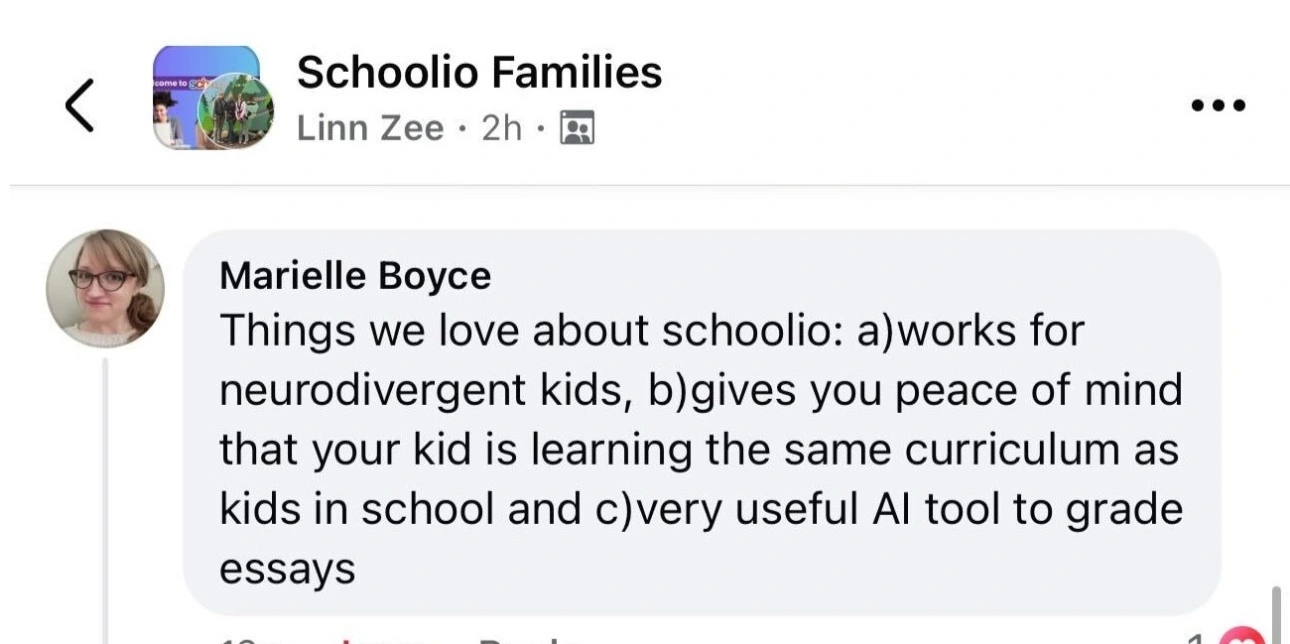
A parent shared a short post in our Schoolio Families group. Just a few lines. No hashtags. No fuss. Just truth.She said she loved Schoolio because it works for her neurodivergent child. Because it gives her peace of mind knowing her kid is learning the same curriculum as students in traditional school. And because the AI tools helped with grading essays.
Simple. Direct. But when I read it, it stopped me.
Because that right there is the quiet win that matters.
She didn’t say we changed her life. She didn’t say we were perfect. What she shared was something more real. She shared relief. Confidence. Stability. The kind of stability every parent needs, but especially the ones who are walking a different path.
The truth is, a lot of the parents we serve never wanted to homeschool. They weren’t planning for it. It wasn’t on their vision board. But something shifted—maybe a bad experience at school, a child’s needs not being met, or just a gut feeling that things weren’t working.
And now they’re here, trying to do what’s best for their child, even when the world questions them for it.
This is what we built Schoolio for. For that parent who lies awake at night wondering if they’re doing enough, for the child who learns better with space and silence, for the families that don’t see themselves in glossy brochures or test scores and for the moments when a tool actually helps and no one has to fight for it.
You don’t always get to see the impact of your work. You don’t always hear how it lands. But every now and then, someone like Marielle speaks up and says, This helped. And for me, that’s everything.
Because this isn’t just about curriculum or platforms or AI tools. This is about building something that lets families breathe again. Something that says: you’re not alone. You’re not wrong. And yes, you can do this.
In the ever-growing world of education, secular homeschooling offers families an inclusive, academic option that eliminates religious content from their children’s learning. But what is secular homeschooling exactly? It’s a word not everyone recognizes. How does it compare to more traditional homeschooling (the stereotypes we’re all familiar with) and why is this group of American families the fastest growing education segment? Secular homeschoolers are changing the face of homeschooling, and while still outnumbered by faith-based homeschoolers, they represent a significant shift in the homeschooling community, driven by a range of evolving societal and educational factors.
What Is Secular Homeschooling?
Secular homeschooling is an educational approach that excludes religious content and perspectives. It focuses on teaching academic subjects using materials grounded in scientific evidence, historical accuracy, and objective reasoning. This approach caters to families who want an education free from religious teachings, regardless of their personal beliefs.
The core principle of secular homeschooling is inclusivity. By eliminating religious narratives, it allows families from diverse backgrounds—atheist, agnostic, or even religious families who prefer separating faith from education—to provide their children with a neutral learning environment. Inclusivity also means LGBTQA+ families have content that is supportive and affirming, allowing safe learning for their children. Secular content ensures not only diversity and inclusion, but that the curriculum adheres to universally accepted academic standards.
The Difference Between Secular, Neutral, and Faith-Based Learning
When selecting homeschooling materials, understanding the nuances between secular, neutral, and faith-based content is key to making informed decisions.
Faith-Based Learning
Faith-based homeschooling incorporates religious teachings and perspectives into the curriculum. These materials often align with specific religious doctrines and include faith-centric interpretations of history, science, and ethics. For example, a faith-based science curriculum might present the biblical creation story in place of evolutionary theory.
Faith-based programs are popular among families who wish to intertwine their religious beliefs with their children’s education. They often feature Bible study or religious text analysis as a core component of the curriculum.
Neutral Learning
Neutral homeschooling materials attempt to strike a balance between secular homeschooling and faith-based approaches. These resources aim to avoid controversial topics and present information in a way that neither promotes nor dismisses religious beliefs.
While neutral materials avoid explicit religious content, they may downplay or omit topics like evolution, climate change, or historical events that could be seen as contentious. This approach can be appealing to families looking for a middle ground but might feel lacking for those seeking robust academic rigor.
Secular Homeschooling
Secular homeschooling, on the other hand, is firmly rooted in evidence-based learning. It does not avoid difficult topics or cater to religious sensitivities. Instead, it presents subjects as they are taught in mainstream academic institutions, focusing on critical thinking and factual accuracy.
For instance, a secular history curriculum will present the scientific timeline of human evolution without referencing religious creation stories. Similarly, a secular science course will teach climate change and evolutionary biology as supported by the scientific consensus.
Secular homeschooling can mean different things to different people, but another common distinction between truly secular and neutral curriculum is the adhesion to equity, diversity, and inclusion, including varied population representation.
Why Secular Homeschooling Is Growing Faster Than Ever
The rise in secular homeschooling is fueled by several societal and educational shifts. While faith-based homeschooling remains the larger segment, secular homeschooling is growing at an unprecedented pace. Key factors contributing to this trend include:
School Safety Concerns: The number one reason parents cite for choosing to homeschool is concern for their children’s safety. Issues like school shootings, drug use, and bullying are motivating families to seek alternatives where they can ensure a safe, supportive environment for learning.
Changes in Public School Policies: Recent and upcoming policy shifts, such as reintroducing Bibles into classrooms and eliminating teachings on critical race theory and gender equality, are prompting non-religious families to consider homeschooling as a way to provide a more inclusive and balanced education.
Focus on Academic Quality: Secular homeschooling emphasizes evidence-based, rigorous academics that prepare students for higher education and the workforce. This focus appeals to families seeking a comprehensive education without religious overtones, as well as parents who’ve lost faith in the public school system’s ability to adequately prepare their children for the future.
Desire for Customization: Many families are drawn to the flexibility of homeschooling, allowing them to create a curriculum tailored to their child’s interests and learning style while avoiding controversial or politically motivated content in public schools.
Benefits of Secular Homeschooling
Secular homeschooling offers several advantages, including:
Academic Rigor: Materials adhere to evidence-based standards, ensuring a comprehensive education.
Critical Thinking: Students learn to evaluate information objectively, fostering analytical skills.
Inclusivity: Families from all backgrounds can use secular homeschooling materials without encountering conflicting religious content.
Empathy and Understanding: Secular curricula more often includes teachings on citizenry, emotional intelligence, and social responsibility. By engaging with a diverse range of perspectives and learning about global issues without bias, students develop a strong sense of empathy and social awareness.
How to Find Truly Secular Homeschooling Materials
One of the biggest challenges for secular homeschoolers is identifying genuinely secular resources. Many curricula labeled as “secular” may include religious undertones, be written or produced by religious authors or groups, or avoid certain topics to avoid controversy. Here are practical steps to ensure the materials you select are truly secular:
1. Understand Red Flags
Be aware of common red flags that might indicate religious bias in supposedly secular materials:
References to “intelligent design” in science curricula.
Omissions of key scientific principles, such as evolution or the Big Bang theory.
History materials that favor one cultural or religious perspective.
2. Research Publishers and Authors
Look into the background of curriculum publishers and authors. Companies or individuals with religious affiliations may influence the content, even if they claim to offer secular homeschooling materials. Some religious companies have created “secular versions” of their religious content, but truly secular curricula does not just have the absence of religion, it is written through a secular lens.
3. Seek Recommendations from Secular Communities
Join secular homeschooling groups, forums, or social media communities. These platforms are treasure troves of firsthand recommendations from families who have vetted materials for their objectivity. We highly recommend our friends at Strictly Secular + Inclusive Homeschooling, a Facebook group where admins review, research, and vet curriculum and providers, as well as Secular Homeschool Families, a community of more than 55,000 who are homeschooling with secular resources.
4. Review Content Thoroughly
Whenever possible, preview the curriculum before purchasing. Look for:
About the Company and About the Author sections of a website, they should have credentials that not only point to evidence-based, scientific education but also a commitment to equity, diversity, and inclusion.
A balanced presentation of perspectives, especially in subjects like history and social studies.
Representation of diverse groups of people without exclusion of groups such as LGBTQA+ members and people of color.
5. Support Secular-Specific Vendors
Several publishers specialize in secular materials. Some trusted names include:
For families struggling to find fully secular resources, customizing a curriculum by mixing and matching materials from different sources is a viable option. For instance, you might pair a secular science textbook with history resources from another publisher to build a balanced program.
Addressing Common Misconceptions
Secular homeschooling is often misunderstood, leading to several misconceptions:
Misconception 1: Secular homeschooling is anti-religious.
Fact: Secular homeschooling excludes religious content but is not inherently against religion. It’s about providing an objective and inclusive academic foundation.
Misconception 2: Secular curricula lack moral or ethical teaching.
Fact: Secular materials often include lessons on ethics, citizenship, and social responsibility without tying them to religious doctrine, they also tend to be more inclusive of diverse people and populations.
Misconception 3: Secular homeschooling is only for non-religious families.
Fact: Many religious families choose secular homeschooling to separate education from faith, allowing them to teach religion in their own way. Options like Schoolio are great for these families because they can access secular core content and create custom courses of their own to add in religious content of their choosing.
Why Secular Homeschooling Matters
The demand for secular materials highlights a broader trend in education: the need for academic rigor and inclusivity. Secular homeschooling allows families to:
Focus on Academics: By removing religious content, families can prioritize academic excellence.
Create Inclusive Learning Spaces: Secular materials are accessible to families from all belief systems.
Encourage Critical Thinking: Students develop the skills needed to evaluate information and form independent opinions.
Final Thoughts
Secular homeschooling is a powerful option for families seeking a well-rounded, evidence-based education. By understanding the differences between secular, neutral, and faith-based materials, homeschoolers can make informed choices that align with their values and goals. With a growing number of resources available, finding truly secular materials has never been easier. Whether you’re new to homeschooling or looking to refine your approach, secular homeschooling offers a pathway to fostering curiosity, critical thinking, and lifelong learning in your child.
Looking for a truly secular homeschool curriculum that prioritizes academic rigor, inclusivity, and critical thinking? Schoolio offers evidence-based learning materials designed for families who want a well-rounded education without religious influence.
? Explore our curriculum at schoolio.com and start your homeschooling journey with confidence!
Investing in Your Child’s Future with Affordable Homeschooling Curriculum
Many parents are recognizing the numerous benefits of taking charge of their child’s learning journey through home education programs. The flexibility, personalized attention, and tailored pace of learning are just a few advantages that make homeschooling an appealing choice for families. Let’s explore the benefits of homeschooling, the importance of selecting a suitable curriculum, and how affordable options like Schoolio Learning can be the key to unlocking your child’s potential. Are you thinking about investing in your child’s future with affordable homeschooling curriculum?
When Investing in Your Child’s Future, Learning About the Advantages of Homeschooling is Key!
The Advantages of Homeschooling:
Personalized Learning: Homeschooling allows parents to tailor the learning experience to suit their child’s unique needs and learning style. With individualized attention, students can grasp concepts more effectively and build a strong foundation for future academic endeavors.
Flexibility: One of the standout features of homeschool programs is the flexibility they offer. Families can create a schedule that accommodates their lifestyle, making it easier to integrate education into daily activities and outings.
Customized Pace: Each child learns at their own pace, and homeschooling allows for a customized learning timeline. Students can delve deeper into subjects they are passionate about or take more time to master challenging concepts.
Now that we understand some of the advantages of homeschooling, let’s find out how to choose the right homeschooling curriculum for your family.
Choosing the Right Homeschooling Curriculum:
Selecting an appropriate home education program is crucial for the success of your homeschooling journey. Here are some tips on how to choose the best curriculum for your child:
1. Assess Your Child’s Learning Style:
Consider your child’s learning preferences, whether they thrive with hands-on activities, visual aids, or self-paced learning. Knowing their learning style will help you identify a curriculum that caters to their needs.
2. Review Curriculum Options:
Explore various homeschooling programs available in the market. Look for features such as comprehensive lesson plans, engaging activities, and a diverse range of subjects. This research will help you make an informed decision based on your child’s academic requirements.
3. Affordability:
While investing in your child’s education is a priority, finding an affordable homeschooling curriculum is equally important. Fortunately, there are cheap homeschooling programs that offer high-quality education without breaking the bank.
Now we can dive into some of the popular homeschool curriculum companies and see which is the right fit for your child’s learning needs.
Popular Homeschooling Curriculum:
Schoolio Learning:
Diverse Curriculum:Schoolio Learning offers a comprehensive curriculum covering a wide range of subjects from core academics to enriching electives.
Adaptability: The home study programs at Schoolio are designed to be adaptable to various learning styles and grade levels.
Cost-Effective: Schoolio provides affordable homeschooling programs without compromising on the quality of education.
Secular: Schoolio offers secular homeschooling curriculum that is not faith-based and remains neutral.
Digital Option:Schoolio Learning also has an online homeschooling curriculum with lesson videos, assessments and worksheets, all for an affordable price.
Abeka:
Structured Approach:Abeka’s structured approach may be beneficial for some, but it can be seen as too rigid for families seeking a more flexible and personalized learning experience.
Christian-Based: Abeka incorporates Christian values into its curriculum, making it suitable for families seeking a faith-based education.
Subject Coverage: While Abeka covers a broad range of subjects, some parents may find it lacks a modern or innovative approach to teaching.
Time4Learning:
Interactive Online Curriculum:Time4Learning’s online platform offers interactive lessons, but the heavy reliance on technology may concern parents seeking a more traditional approach.
Flexible Learning: The flexibility of Time4Learning might be advantageous, but it might lack the structure some students need for optimal learning.
Multisubject Coverage: While Time4Learning covers multiple subjects, the depth of coverage in each subject may not be sufficient for certain students.
Sonlight Curriculum:
Literature-Based Approach:While the literature-based approach of Sonlight promotes a love for reading, some parents may find the heavy reliance on books overwhelming or time-consuming.
Global Perspective: The global perspective in Sonlight’s curriculum is enriching, but it may not fully prepare students for region-specific academic standards.
Christian-Based: The Sonlight Curriculum is faith-based this is seen throughout the curriculum.
Family-Centric: While family-centric, Sonlight’s approach might be challenging for families with varying grade levels and learning needs.
BookShark:
Literature-Focused: BookShark’s literature-focused curriculum is a unique approach, but it may not suit students who learn better through alternative methods.
All-Subject Packages: While convenient, the all-subject packages might include materials that are redundant or unnecessary for some families.
Hands-On Activities: Incorporating hands-on activities, BookShark may require additional preparation time for parents, which can be demanding.
In evaluating these curriculum options, families should consider their specific educational goals, their child’s learning style, and the overall fit within their household dynamics. No curriculum is universally perfect, and it’s crucial to find the one that aligns most closely with your family’s preferences and values.
Investing in Your Child’s Future Through Homeschooling is a Significant Decision
While there are several popular homeschool programs available, Schoolio Learning distinguishes itself through its affordability, comprehensive curriculum, and adaptability. Some other programs may be costly or lack the flexibility needed for a personalized learning experience. Schoolio combines the best of both worlds, offering a top-notch education at a reasonable price.
In conclusion, investing in your child’s future through homeschooling is a significant decision, and choosing the right curriculum is paramount. Schoolio Learning emerges as a standout choice, providing a well-rounded education that meets the diverse needs of homeschooling families. With Schoolio, you’re not just investing in a curriculum; you’re investing in your child’s success.
Learning disruptions continue to frustrate parents, teachers and students across Canada and the United States. We all had high hopes that the Covid-19 pandemic would be entirely over by now, and education and life as we once knew it could continue as usual. Yet, we are entering the third year of the pandemic and are rattled with learning disruptions to this day. Maybe you have been trying to ride it out, but you’re now finding that these disruptions are causing your children to struggle intensely with their education. What are some things that you can do to manage disruptions to learning?
Concerns of ongoing and past learning disruptions linger everywhere.
Hundreds of students in Quebec, Canada, have been prohibited from attending school. According to CBC News, hundreds of students in Montreal are awaiting approval from Quebec to approve English eligibility. EMSB says they want to welcome all students but cannot without the ministry’s permission. As a result, hundreds of students are unable to attend school. How can these parents manage disruptions to learning?
Additionally, parents, teachers and students across the United States are struggling with recovering from pandemic learning and the trauma that unfolded at the end of the 2021-2022 school year in Uvalde, Texas. Many parents and students fear attending school after such a horrific event.
In New York City, many educators are highly concerned about the academic and emotional effects of the pandemic on their students as they enter the third school year since the beginning of the pandemic.A survey of 110 educatorswas conducted by the nonprofit Educators for Excellence and found that roughly 80% of respondents reported that their students are in worse academic and emotional shape than before the beginning of the pandemic.
As educators, parents, and students prepare for back to school in British Columbia, Canada, there remains a serious concern as to what the new school year will bring when it comes to the spread of communicable diseases, including COVID-19. Even if there are no school shutdowns, many students will be out of school from being sick which causes parents to scramble to manage disruptions to learning for their children.
InCalifornia, students wait months for mental health help while councillors share that they are being bombarded due to the pandemic and pandemic learning. There is no ‘quick fix’ for the trauma and interruption of education due to the COVID-19 pandemic.
What can parents do to manage disruptions to learning?
It doesn’t matter where you are, learning disruptions are frustrating for parents everywhere. These learning disruptions are frustrating for parents, teachers and students alike. This is why it’s imperative for parents to learn to manage disruptions to learning to help their children excel despite the uncertainties. Here are some simple steps to keep your child’s learning stable.
1. Weigh your options.
For a child to learn, they need stability and consistency. This is why weighing your options is a good thing to do. Take a look at alternative learning options like homeschooling or online schooling and decide if these are right for your family. Keep in mind that homeschooling offers the consistency to education that children need. But you will need to decide if homeschooling is a learning avenue that works for your family first. Check out this blog on why so many parents are homeschooling to learn more.
2. Plan a routine with your child.
If you decide to homeschool, plan out a homeschool routine for each day. Alternatively, if you keep your child in public school despite learning disruptions, plan out ‘off-day routines’ for days that your child might be home. Having a curriculum at home for those ‘just-in-case’ times is a great idea. That way, your child will continue to learn even if there are school closures due to strikes or illness.
3. Keep conversations open with your child.
We are now seeing the effects of the COVID-19 pandemic and school closures on children’s mental health. Because as stated above, children need consistency and stability to learn and grow. When their lives are constantly turned upside down, it can cause a flurry of emotional responses. Keeping conversations open with your child is so important. Please encourage your child to ask questions and express their feelings to you. It’s essential that you don’t minimize, avoid or dismiss their concerns. Truly acknowledge their feelings and assure them that it’s normal and natural to feel frustrated and scared about uncertainties. And check out this excellent resource for kids tolearn to manage how they think and feel.
4. Take time with learning.
Whether you are keeping your child in school and working on some extra curriculum at home, or you have decided to exclusively homeschool your child with the help of an excellent homeschooling curriculum and digital aids. If you aim to do 45-minute learning sessions with your child, start with 10 or 15 minutes and build up from there. Keeping lessons light and enjoyable helps them adjust to their new or additional learning in a calming manner.
5. Stay in touch with your child’s school.
If you have decided to homeschool your child exclusively, remember to keep in touch with your child’s school. Ask the school questions for further guidance, and explain the situation to your child’s previous teacher.
6. Join a homeschool group or parenting group in your community.
The upside to choosing to homeschool is that homeschooling has become a popular alternative to traditional learning. This means that there are plenty of people homeschooling, and they all have unique situations and ways of homeschooling. When you connect with these groups, you can learn more about how to homeschool your child more effectively.
7. Subscribe to the Schoolio Blog.
We are a team committed to helping parents and students thrive in whatever learning avenue they are in. Ourblog provides countless helpful tips to help you and your child excel.
8. Connect with homeschooling experts.
Many homeschooling families are willing and able to share their knowledge on how to get started.
Learning disruptions continue to be an unfortunate part of our lives today; rather than being upset or worried about it, you are taking the situation and looking for alternative learning methods to help your child excel in whatever situation you find yourself in.
We are here to remind you that you are doing an excellent job. Regardless of what learning avenue you choose for your child, you and your child will continue to do great! Because of the work you are putting in to help your child get through the learning bumps and manage disruptions to learning. Keep going; you’re doing great.
When most people think ‘homeschool,’ they think of the stereotypes attached to it, like the stereotype that people only homeschool for religious reasons. And while many do, statistics show that there is now a wide range of parents homeschooling their children worldwide. So why are so many parents homeschooling?
Why are so many parents homeschooling?
Since homeschooling is becoming so popular, it’s no surprise that around 3.7 million children were homeschooled in the United States from 2020-2021, from kindergarten to grade 12. According to theNational Home Education Research Institute, this translates to roughly 6% to 7% of school-aged children. In comparison, in the spring of 2019, 2.5 million children were homeschooled in the United States. Following the same trend, Canadian families have turned to homeschooling as their education choice. According toThe Fraser Institute, an average growth rate of more than 5% per year.
So why are so many parents homeschooling? There are so many reasons, and each homeschooling family has their unique reason for homeschooling. But some of the most popular reasons include:
Homeschooling offers stability.
The pandemic was a staunch reminder that the education system is fragile and struggles to pivot when things get messy. Children need stability, especially when it comes to their education. While many may assume that homeschooling is the opposite of a stable educational choice, they’re mistaken. Throughout the pandemic learning chaos, homeschooling families continued to do what they had done all along: learn. While many traditionally schooled children were slipping through the cracks, homeschooling children continued to thrive with their education.
The pandemic aside, there are many other reasons traditional education isn’t the most stable choice. Let’s take a look at education in Ontario, Canada, in the school year 2019-2020 before the pandemic made things even messier. Many forget that a teacher strike saw children missing essential learning time. Compacted with the pandemic caused learning loss to affect children in momentous proportions.
Homeschooling offers safe learning.
We have all seen the news and been traumatized by images of school shootings across the United States. Something so horrifying is, unfortunately, happening more and more. Many parents are fearful when they drop their children off for school, and many children face immense anxiety throughout the school day. As such, homeschooling offers safe learning, where children are safe in their own homes with the people they feel safest with, their parents.
Homeschooling is customizable.
There is no such thing as one size fits all regarding education. Yet, traditional education is very much one size fits all. When we try to answer the question of ‘why are so many parents homeschooling?’ we cannot overlook that homeschooling is customizable to meet the student’s needs. Every child is unique, and so is their learning style.
Say your child is technically in grade 4 but understands math on a grade 5 level; their reading and writing are on a grade 3 level. Homeschooling allows you to help your child learn what they need to learn. Not forcing them to understand the same way everyone else is, because one size fits nobody.
Or if your child learns better with a hands-on approach vs. Sitting at a desk for hours. Homeschooling offers the opportunity for children to learn in the way that best suits them.
Homeschooling offers different social opportunities.
When you think of homeschooling, you may assume that socialization isn’t a homeschooling family’s strong suit. But that’s false. Homeschooling offers children a fantastic opportunity to socialize in ways many traditional learning students do not have ready access to.
Homeschooled children can volunteer with their families at community events, nursing homes, veteran halls, and more. These opportunities allow children to socialize with more than just their peers. They can socialize with a wide variety of people, which helps them to have better social connections and understanding of the people around them.
Homeschooling helps children become self-reliant.
Many homeschooled children are independent and self-reliant. This is because homeschooled children can learn at their own pace while also self-motivating themselves as they need to be accountable for their progress. The significant benefit is that it helps children by boosting their confidence and helping to shape a sense of responsibility. Additionally, homeschooled children have the chance to go deeper with their interests while learning. This benefits them as they continue to develop greater independence and self-direction.
They also can develop their organizational and time-management skills better. As many older homeschooled, students can manage their schedules around extracurricular activities and studies. These wholesome benefits are confirmed by 87% of peer-reviewed studies. These studies demonstrated that statistically, homeschooled students score much better on emotional, social and psychological development metrics than their peers in traditional learning venues.
Homeschooling is becoming a much more affordable option.
There’s a misconception that you must be ‘rich’ to homeschool your children. The truth is that with homeschooling gaining popularity, many affordable curriculum options are becoming available to serve homeschooling families with all financial backgrounds. Schoolio Learning offers excellent rates for an all-in-one, open-and-go, inclusive homeschooling curriculum. Parents can homeschool easily, knowing they didn’t just break the bank to provide a quality homeschooling curriculum for their children. Concerned about homeschooling costs? Check out this blog on affordable homeschooling curricula.
Homeschooling allows more one-on-one time.
When you ask the question of why are so many parents homeschooling? You will likely get this response. Many parents only see their children for a couple of hours daily. Between rushing to school, coming home and rushing to sports, then off to bed as soon as they get home, many parents feel like their children are growing up without them getting to be present for a lot of it. Homeschooling offers families the opportunity to spend more time together. With a much more relaxed schedule, homeschooling families can embrace the valuable time learning together. Indeed, there are stressors and things that take from our time, but homeschooling offers parents the ability to spend more time with their children.
Homeschooling offers a bully-free environment.
Unfortunately, bullying seems to be a norm in school. According to PACER’s National Bullying Prevention Center, one out of every five (20.2%) students reports being bullied. 43% of students reported being bullied in the hallway/stairwell, 42% reported being bullied in the classroom, 27% reported being bullied in the cafeteria, 22% reported being bullied outside on school grounds, 12% reported being bullied in the bathroom or locker room, and 8% reported being bullied on the school bus.
One of the big answers to the question of ‘why are so many parents homeschooling?’ is that homeschooling offers children the chance to learn and grow in a safe environment, away from bullies and peer pressure, which means that children are free to be themselves without the fear of being bullied.
Homeschooling gives you the freedom to schedule your own time.
Parents that are homeschooling report that their children get much better sleep. Because they can sleep until their body is ready to wake up, some days are rushed, but most homeschooling days are much more relaxed than traditional learning days. Homeschooling families also have the opportunity to partake in more fun extracurricular activities, field trips, and learning fun.
Homeschooling keeps children from slipping through the cracks in the education system.
Unfortunately, many children are slipping through the cracks of a broken education system, even more so during and in the aftermath of pandemic learning. The sad reality is that many students are pushed onto the next grade level even though they don’t fully understand what they need to do. Thus many children are struggling now more than ever before. Yet, there is not enough time, money or resources available to help those children that are slipping through the cracks. Homeschooling meets the child where they are. Offering them the opportunity to learn what they need to and catch up on the areas they are struggling with.
There are countless answers to the question ‘why are so many parents homeschooling?’
While we listed some of the most popular reasons to answer the question of why so many parents are homeschooling? There are hundreds of more reasons. Each family is unique, and so is their reason for homeschooling their children. The bottom line is that homeschooling is becoming much more popular and for the right cause. Because children deserve the chance to learn in the environment that best suits them, whether traditional learning or homeschooling, finding the learning avenue that helps your child thrive is essential. Take some time to evaluate the pros and cons of homeschooling with conventional learning, then make the right decision for your family.
Look no further than Schoolio Learning for all your homeschooling needs.
Homeschooling and Socialization is a topic that makes many homeschool families cringe. And it’s not because their children are inadequately socialized; it’s because so many people ask them about socialization and voice their concerns. From something as simple as walking through the grocery store during the day with their children, a homeschooling parent will likely get grilled about their choices, and random strangers will ask questions about homeschooling and socialization.
Homeschooling and Socialization go hand in hand.
This might surprise you, but homeschooling and socialization go hand in hand. In fact, many homeschooled children have better social lives than their traditionally schooled peers. How could this be possible? Well, first, let’s look at the facts. According toThink Impact Homeschooling Statistics, recent federal data shows that 3% to 4% of the school-going population in the United States is homeschooled. There are 73 million children in the U.S., which means over 2.9 million children are homeschooled in the U.S.
With that many children being homeschooled, do we still believe that they are all not adequately socialized? Of course not! Homeschooling has been growing in popularity for the last ten years, especially since the beginning of the COVID-19 pandemic in 2020, when over 300 million students worldwide became homeschooled briefly.
Pandemic learning didn’t help stop the myth that homeschooled children aren’t socialized.
Unfortunately, when most parents and children were forced into remote learning through school boards during the pandemic, it did nothing to diminish the myth that homeschooled children aren’t socialized. Because children were being isolated with a makeshift version of online learning, parents also attempted to work from home simultaneously. This caused tremendous stress for parents and students alike and caused many parents and friends of the family to assume that what they were doing was homeschooling. Which they were not.
Recently I had a concerned citizen ask me why I would choose to homeschool my children, knowing that they wouldn’t get socialized and wouldn’t have as many opportunities in life—a shocking claim. Especially sincestatistics show that homeschooled children have a 67% College graduation rate compared to their public schooled peers at 59%, not to mention that my children have better social lives and many more friends than I do.
This person’s concern stemmed from watching their grandchild struggle through online/pandemic learning. And the isolation they felt. I kindly explained that homeschooling is 100% different from pandemic learning. And that my children have many opportunities to get out and socialize. Still, the person seemed bewildered.
A conversation with a homeschooled child.
As stated above, if over 2.9 million children in the United States are homeschooled, how could they all be isolated and live unsocialized lives? Have you ever had a conversation with a homeschooled child? They are usually the ones the explain in detail the project that they are working on. They are the ones that have unique interests and see the world through a much different lens than those around them.
Recently we had a family move to our neighbourhood that homeschools. While I was out for a walk with my kids, we stopped to say hello to two children playing catch. I welcomed them to the neighbourhood, and the one boy introduced himself, shook my hand and wished us a wonderful day. Why did this child interact so politely instead of ignoring our passing? Because many homeschooled children have opportunities to participate in socialization that other children don’t have access to. Let’s talk about that.
Socialization opportunities for homeschooled children:
There are so many opportunities available for homeschooling families to participate. Here are some of our favourites!
Homeschooling Groups.
Since there are so many homeschooling families, many families get together to plan fun activities and sports-related opportunities for their children. Most cities have such a large amount of homeschooling families that they have registered homeschooling groups. These groups offer support for homeschooling families, co-op learning, field trips, sports, and lessons.
Our local homeschooling group comes with some fantastic perks, like gymnastics lessons, at a local gymnastics club, swimming lessons at the pool, track and field during the warm months, and gym/indoor pool rentals during the cold months, sledding, skiing, horseback riding and more.
Park dates.
During the summer months, when homeschooling activities are mostly paused, many homeschooling groups offer weekly meet-ups at parks in your location so homeschooling friends can get together to play and have fun!
Community Service.
Many homeschooling families understand the importance of the community. That’s why so many homeschooling families will volunteer at community events. Or care homes. Some homeschooling groups organize carolling and visits with local care homes during the holiday season. Other homeschooling families like to get involved in community gardens or soup kitchens. All of this community involvement helps children have budding and diverse social lives. They aren’t just socializing with their peers; they are also mingling with the community of people around them.
Basking in the Arts.
Since homeschooled children have more time during the day than traditional learning students, they have more time to get involved in the arts. This means they have more time to attend music lessons or art classes. Being able to develop those additional skills that will benefit them throughout their lives. This also means they will have more opportunities to meet people in the art community, which diversifies their socialization and opens their world to a new level of learning.
More time for imaginative play.
You can have homeschooling and socialization while still encouraging imaginative play. One of the top benefits of imaginative play is social development. When children engage in imaginative play, they can begin to understand relationships which help to improve their social skills and become more confident, connected, and self-reliant. And this results in children building better relationships with their peers.
Good old fashion play.
Just because your child is homeschooled doesn’t mean they can’t or shouldn’t partake in friendships in their neighbourhood. Most homeschooled children have ‘homeschooled’ friends and ‘neighbourhood friends.’ Just like a traditionally schooled child will have ‘school friends’ and ‘neighbourhood friends.’ Evenings, weekends, and summer days are perfect for neighbourhood mingling and budding friendships with peers.
All this to say, that yes, homeschooling and socialization are partners. This terrible stereotype of homeschooled children is that they are always alone, awkward, rude, and don’t know how to take social cues. The opposite is true. Homeschooled children are brilliant and capable of having successful friendships and positive social lives. So, the next time someone doubts your children’s social lives, go ahead and point them to The Schoolio Blog!
Are you frustrated with your current homeschooling situation? Do you want to homeschool more efficiently? And does the circumstance below sound overly familiar?
It’s 2:00 pm, and your sink is full of dishes, goldfish and cheerios scattered all over the dining room and trailed into the living room like some odd trendy art studio. You dreamed of making a roast chicken and potato dish for dinner but forgot to pull the chicken out of the freezer to thaw.
There is a list of five hundred things you’d like to get done today, but you find yourself sitting at the table with your eight-year-old as he constantly avoids answering the math questions that appear before him. You feel like you are wasting 80% of your day trying to lesson plan and get your children to accomplish some curriculum.
Do you want to homeschool more efficiently? How can you accomplish this?
First, you need to simplify your learning materials. If you are using a homeschooling curriculum that is leaving you and your children frustrated and overwhelmed, you will never be successful.
Try a curriculum that is open-and-go.
What is an open-and-go homeschooling curriculum? It means you aren’t spending hours planning your homeschooling lessons. Schoolio’s open-and-go curriculum means you can simplify the prep and spend more time enjoying the process. If you couldn’t schedule prep time, the lessons are organized neatly so your child can stay on track without elaborate planning. They can open their books and go!
Use a curriculum that is easy to follow.
Have you used a homeschooling curriculum that had you check multiple books to ensure you covered all the bases adequately? The problem is that you are now overwhelmed by all these books, feel you’ve missed something, and your dining room table looks like a library that lacks a librarian?
The Schoolio curriculum has raving reviews from both seasoned homeschoolers and new homeschoolers. Both stated the same thing: We love the simplicity of the lessons. We don’t overcomplicate learning; we stick to the basics and make it easy for the student to understand and for the parent to teach.
Try a customizable curriculum.
Having a customizable curriculum is essential for your children’s learning needs. There’s this outdated misconception that children should all learn the same way and simultaneously. The opposite is true; kids thrive when their learning content is customized to meet their needs.
If your child needs help with concepts they haven’t yet mastered, you can customize the curriculum to help them master those skills. Alternatively, suppose your child finds their current level boring. In that case, you can customize their curriculum to reflect their interests by going more of an interest-based route with fun electives to keep them learning and intrigued.
Schoolio has received many positive reviews about our customizable curriculum options because we know that one size doesn’t fit all. Every child is unique, and therefore so should their learning journey. If your child is genuinely struggling with a specific subject like, for example, Math Grade 2 – remember they don’t need to stick with math grade 2. You can switch it up and dive back into a unit of Math Grade 1 to help them refresh and master the skill.
Use an affordable curriculum.
Many homeschooling families are single-income, so finding a good homeschooling curriculum can be tricky. Because let’s face it. Homeschooling curriculum can be expensive. Finding an affordable, quality homeschooling curriculum is so important. Compared to top homeschooling curriculum companies, Schoolio Learning is the #1 choice for affordable and quality content. Curious how the two compare? Check this out!
That means you can get what you need for your child’s learning without breaking the bank.
Purchase a curriculum that has a reasonable amount of content.
There are many homeschool curriculums that are so full of content, you barely have time to think. The pressure of ensuring your child finishes everything before the end of the year can leave many parents feeling stressed and overwhelmed as they know that if they miss a day, they won’t be able to finish at the time they’d like to.
Schoolio curriculum is created with those needed breaks in mind. Life happens; sometimes we get sick, sometimes we like to go on field trips, sometimes no one feels like diving into a lesson, and sometimes we want to take a week off to reset. Our curriculum was created by homeschooling parents that know that those homeschooling breaks are just as important as the content that you purchase to teach.
Our full learning bundles are filled with excellent lessons in Math, Social Studies, Science and Language Arts, enough to encourage continuous learning but not overwhelm the family’s schedule and rhythm.
Want to homeschool more efficiently? Remember you don’t have to revolve around your homeschooling curriculum.
Homeschooling is a beautiful opportunity to educate your child from home and help them thrive on their learning journey. We have to be careful not to be blinded by this idea that you must make your homeschool ‘just like traditional school.’ Suppose you constantly fight with your kids to get them to complete assignments x, y, and z before the ‘next period’ of your day. By the end of the day, everyone is burnt out and even if your child completed assignments x, y, and z, they didn’t retain the knowledge because they were too stressed.
Your life doesn’t have to and shouldn’t revolve around your homeschool. Your homeschool should revolve around your life. If you want to take a fun field trip with the homeschool group to the museum but have a pile of Math to complete, it’s ok to pause the math work to enjoy the fun moments.
Because learning happens everywhere. It’s not just in books or classrooms; learning happens in the car, at the park, grocery store, the museum, and the art gallery. Learning is everywhere.
Do you need help choosing the right homeschooling curriculum for your family?
We’ve got you covered! This blog is by Lindsey Casselman, co-founder and head curriculum writer at Schoolio Learning. She walks you through essential steps to choosing the best curriculum for your family and lifestyle.
Inflation is a word that makes many of us cringe as we watch the price of groceries, clothes, fuel, and everyday essentials rise. Finding ways to afford essential items has become a challenge for many people worldwide. Many people are concerned about their homeschooling curriculum needs as they continue to watch the cost of everything rise. How can they find an affordable homeschooling curriculum with these price increases?
Inflation is having a significant impact on everything.
According to the US inflation Calculator, “the annual inflation rate for the United States is 8.6% for the 12 months ended May 2022, the largest annual increase since December 1981.” Following suit, according to Statistics Canada, Canadian consumer prices rose 6.8% in April.
The price of groceries continues to increase and overwhelm many people as Canadians paid 9.7% more in April 2022 for food purchased when compared to April 2021. Worse, this increase exceeded 5% for the fifth month in a row, and much like the United States was the most significant increase since September 1981.
Groceries aren’t the only thing impacted by inflation. There are also substantial increases in gas prices, rent prices, general product prices, car prices and even school supplies.
Does inflation impact homeschooling?
The bitter answer is yes. Many homeschooling families are already single-income families struggling to find an affordable homeschooling curriculum. While some states/provinces offer financial support for homeschooling families, many states and provinces throughout North America do not provide any financial help for homeschooling families.
Unfortunately, many homeschooling families have been struggling to put food on the table, fuel in the car, a roof over their heads and an affordable homeschooling curriculum in front of their children.
So it’s with incredible frustration that many homeschooling families find that even the cost of a quality homeschool curriculum has increased.
How is a digital homeschooling curriculum affected by inflation and price increases?
You may have noticed that some of your favourite homeschooling curriculum companies have increased the prices of their products. While we cannot speak for all companies, we’d like to address the 15% increase you may have seen in our own Schoolio Curriculum network.
Since our beginnings in 2020, we at Schoolio Learning have been committed to offering you a secular, inclusive, open-and-go, affordable homeschooling curriculum. So, why have we increased our prices?
Why is there a price increase on our homeschooling curriculum?
There are two reasons you will see a 15% increase in our homeschooling curriculum.
Inflation affects our employees too.
Our team is growing to provide you and your child with the most up-to-date homeschooling curriculum to keep your homeschool running smoothly. As such, we need to take care of our team members. Inflation affects everyone; therefore, we must accommodate our team members and customers.
This slight price increase helps our team members to still provide for their families while writing and working on the best materials to keep your family learning at an affordable price.
We’ve enhanced our homeschooling curriculum to serve you better.
This is the most exciting news that we wanted to share with you. We have enhanced all of our curricula from Kindergarten to Grade 8!
What does that mean?
If you were a previous customer of Schoolio Learning, you would remember that we recommended you purchase the Canadian Curriculum workbooks or other practice workbooks to help your child get the essential practice work they needed? Extra workbooks are no longer required with our enhanced curriculum. It now includes all the necessary practice content to help your child learn and understand the concepts better.
To sum it up, why has Schoolio Learning Curriculum increased by 15%?
Inflation costs for our team members mean we must aim to meet their needs.
We have enhanced the curriculum, so you no longer need to search and spend money on additional practice workbooks.
Is Schoolio still an affordable homeschooling curriculum option? Let’s compare.
Before you jump to the conclusion of assuming you should find a cheaper homeschooling curriculum company because the 15% increase makes you cringe. Let’s look at another popular homeschooling curriculum company and its pricing compared to ours.
Schoolio Grade 3 Complete Bundle:
Our grade 3 bundle includes all the core subjects, Math, Social Studies, Science and Language Arts. With over 1,200 pages, lessons, teaching plans/discussions/ as well as countless activities.
The cost for the Schoolio full-year curriculum bundle: is $399.84 (digital) or $563 (books, printed and shipped).
Alternative homeschooling company Grade 3 Bundle:
A popular homeschooling curriculum company provides a complete kit much like our complete bundle for grade 3. A full kit includes the four core subjects, Math, Social Studies, Science and Language Arts, teaching instructions and lessons.
The cost for this homeschooling curriculum full-year: is $1,090.45.
As you can see, that’s a pretty huge price increase for comparable homeschool learning content.
Please don’t take our word for it; check it out yourself.
We want you to excel at homeschooling, which means finding the best option for your family and budget is essential. So, please research and compare our prices with other popular homeschooling curriculum companies.
We stand behind our price and will continue to provide an affordable homeschooling curriculum for all your learning needs.
Don’t forget our promotions.
Price increases and inflation can cause a lot of stress for families. We don’t want you to feel that you must stop homeschooling because you have to choose between a homeschool curriculum and groceries. So, please know that we periodically offer excellent promotions to help make our curriculum even more affordable for your homeschool. If you don’t see a promotion being advertised on the website, reach out to our customer service team members, and they will be happy to provide you with all the knowledge on current or upcoming promotions.
If you aren’t sure if we would be the best fit for your homeschool, check out our free sample packages to view just how authentic, simple and wholesome our curriculum is. We look forward to providing you with the best and most affordable homeschooling curriculum for all your homeschooling needs.
Check out our free sample packages today to find the perfect curriculum for your child’s grade and learning needs.
How can you prepare your pre-teen for grade 8? Make sure you still let them have that fun summer that they want but also aim to keep them on track, catch them up from pandemic learning loss, avoid summer learning loss and prepare them for grade eight? It’s a huge task, but it doesn’t have to be complicated.
Avoid summer learning loss and prepare your pre-teen for grade 8.
Let’s face it; many kids are struggling to catch up after enduring two years of pandemic learning. Researchers and educators are all stating their concerns for kids that have perhaps slipped through the cracks due to pandemic learning. A more significant problem is the added impact of summer learning loss. Knowing that over the summer, many children will lose 2.6 months of math skills, two months of reading skills and one month of overall learning.
Knowing those statistics, it can be hard not to stress about your pre-teen’s education. But, the most important thing you can do is avoid worrying about your pre-teen’s learning during the summer months. Of course, you want your child to learn, stay on track and have all the opportunities in life that they deserve. But constantly worrying about that won’t help you or your pre-teen.
So what can you do to help your pre-teen catch up on all the learning they have lost? While also aiming to stay on track and not lose even more learning skills during the summer?
Simplify learning when you prepare your pre-teen for grade eight.
Try to avoid overthinking your pre-teen’s summer learning because we all know that overthinking adds more stress than necessary. You don’t need elaborate plans to prepare your child for grade eight. This will only lead to you, and your child feeling stressed and exhausted while dealing with that dreaded feeling of not getting enough done.
When preparing your pre-teen for grade eight, what is the best and easiest way to simplify summer learning? Use the Summer Schoolio: Get Ready for Grade 8 book! Summer Schoolio: Get Ready for Grade 8 was created to help your child stay on track with their essential learning. What’s better is that this program will save you time and money as you won’t be searching and spending money on a homeschooling curriculum to try to fit your summer learning needs.
What’s inside the Summer Schoolio: Ready for Grade 8 workbook?
We want you and your pre-teen to have an enjoyable summer without the stress of trying to complete extra tasks. The Summer Schoolio books have been designed in a simple format, without the mountain of overwhelming tasks. This helps your pre-teen stay on track with their learning.
The Summer Schoolio: Ready for Grade 8 book combines the best homeschooling curriculum concepts to give you and your child a unique solution to help prepare your pre-teen for grade eight. We’ve combined the homeschooling writing curriculum, homeschooling language arts curriculum and homeschooling math curriculum to bring you and your child a workbook to help practice essential skills to stay on track.
Summer Schoolio: Ready for Grade 8 overview:
The Summer Schoolio: Ready for Grade 8 workbook is filled with learning materials that aren’t just educational; they’re fun too! This combination is an excellent resource to help prepare your pre-teen for grade 8. Created for six weeks of learning, your pre-teen will have the opportunity to learn and refresh different learning concepts each week.
Week one includes:
The Summer Schoolio week includes three days of simple learning that won’t be overwhelming or take too long to complete.
Day one, Weekly Writing – Friendly Letters – and Math – Number Sense.
Then day two has Weekly Writing and Math – Number Sense.
On day three, your pre-teen will work on Weekly Writing – Scrapbooking – and Math – Number Sense.
Week two includes:
The second week of Summer Schoolio: Ready for Grade 8 is similar to week one, just switching up learning concepts.
During week two, your pre-teen will have Weekly Writing – Writing Fiction – and Math – Number Sense on day one.
On Day Two, they will have Weekly Writing and Number Sense.
Then on day three, they will have Weekly Writing – Scrapbook and Math – Number Sense.
Weekly Writing – Reviewing a Book – and Math – Algebra on day one.
Then on day two, your child will work on Weekly Writing and Math – Algebra.
Followed by day three, which is Weekly Writing – Scrapbook and Math – Algebra.
Week four includes:
When your pre-teen is working on week four, day one, they will do Weekly Writing – Writing Non-Fiction – and Math – Geometry/Spatial Sense.
Then on day two, they will be working on Weekly Writing and Math – Geometry/Spatial Sense.
Finally, on day three, they will get to work on their scrapbook for Weekly Writing and the final day of Math – Geometry/Spatial Sense.
Week five includes:
Day one of week five is Weekly Writing – Poetry – and Math – Data Management.
Then on day two, they will work on Weekly Writing and Math – Data Management.
Followed by day three, which is Scrapbooking for Weekly Writing and Data Management for Math.
Week six includes:
The first day of week six focuses on Weekly Writing – Summarizing – and Math – Financial Literacy.
The second day is all about Weekly Writing and Financial Literacy for Math.
Then, your child can work on their scrapbook again for Weekly Writing and enjoy their final Financial Literacy assignment.
A daily repetitive learning cycle with refreshing concepts helps your pre-teen stay interested with a structured plan for summer learning. This technique will help your pre-teen master essential math, writing and reading concepts for grade eight.
Tuesday: Weekly Writing Day 1, Math Day 1, Read a Book or Chapter.
Wednesday: Weekly Writing Day 2, Math Day 2, Read a Book or Chapter.
Thursday: Weekly Writing Day 3, Math Day 3, Read a Book or Chapter.
Friday: Read a Book or Chapter.
Helping your pre-teen stay on track and up-to-date with their learning while avoiding summer learning loss and preparing for the next grade doesn’t need to be an overwhelming and stressful task. It also doesn’t need to take much daily time to succeed. The Summer Schoolio: Ready for Grade 8 book helps your child keep up with their learning needs, refresh, and not become overwhelmed by too much information crammed into one day.
What’s the best way to prepare your child for grade seven? Do so without causing them tremendous stress and frustration from doing too much work on fun summer days? What’s the easiest way to prevent summer learning loss, prepare your child for grade seven and let them have a fun summer?
Prepare your child for grade seven while avoiding summer learning loss.
The most important thing you can do is avoid getting stressed about your child’s learning during the summer months. As parents, we want our children to learn, stay on track and have all the opportunities in life that they deserve. But that constant worry can become distracting and consuming.
It can be tough to avoid worrying about their education when we think of all the learning they’ve lost due to pandemic learning. Heading into summer, we can become overwhelmed by the thought of summer learning loss on top of pandemic learning loss. Especially when we see statistics about summer learning loss, like that 2.6 months of math skills, two months of reading skills and one month of overall learning are lost due to summer learning loss.
So what can you do to help your child catch up on all the learning they have lost? While also aiming to stay on track and not lose even more learning skills during the summer?
General learning skills like math, reading and writing are essential for your child to practice to develop correctly continually; this is especially true during the summer.
Simplify learning when you prepare your child for grade seven.
Try to avoid overthinking your child’s summer learning because we all know that overthinking adds more stress than necessary. You don’t need elaborate plans to prepare your child for grade seven. This will only lead to you, and your child feeling stressed and exhausted while dealing with that dreaded feeling of not getting enough done.
When preparing your child for grade seven, what is the best and easiest way to simplify summer learning? Use the Summer Schoolio: Get Ready for Grade 7 book! Summer Schoolio: Get Ready for Grade 7 was created to help your child stay on track with their essential learning. What’s better is that this program will save you time and money as you won’t be searching and spending money on a homeschooling curriculum to try to fit your summer learning needs.
Take a look inside the Summer Schoolio: Ready for Grade 7 workbook.
We want you to have an enjoyable summer without the stress of trying to complete extra tasks. The Summer Schoolio books have been designed in a simple format, without the mountain of overwhelming tasks. This helps your child stay on track with their learning.
The Summer Schoolio: Ready for Grade 7 book combines the best homeschooling curriculum concepts to give you and your child a unique solution to help prepare your child for grade seven. We’ve combined the homeschooling writing curriculum, homeschooling language arts curriculum and homeschooling math curriculum to bring you and your child a workbook to help practice essential skills to stay on track.
Summer Schoolio: Ready for Grade 7 overview.
The Summer Schoolio: Ready for Grade 7 workbook is filled with learning materials that aren’t just educational; they’re fun too! This combination is an excellent resource to help prepare your child for grade seven. Created for six weeks of learning, your child will have the opportunity to learn and refresh different learning concepts each week.
Week one includes:
The Summer Schoolio week includes three days of simple learning that won’t be overwhelming or take too long to complete.
Day one, Weekly Writing – Poetry – and Math – Number Sense.
Then day two has Weekly Writing and Math – Number Sense.
On day three, your child will work on Weekly Writing – Scrapbooking – and Math – Number Sense.
During week two, your child will have Weekly Writing – Correspondence – and Math – Number Sense on day one.
On Day Two, they will have Weekly Writing and Number Sense.
Then on day three, they will have Weekly Writing – Scrapbook and Math – Number Sense.
Week three includes:
During the third week of the Summer Schoolio: Ready for Grade 7 book, your child will be working on:
Weekly Writing – Writing Suspense – and Math – Algebra on day one.
Then on day two, your child will work on Weekly Writing and Math – Algebra.
Followed by day three, which is Weekly Writing – Scrapbook and Math – Algebra.
Week four includes:
When your child is working on week four,
Day one, they will do Weekly Writing – Speech Writing – and Math – Geometry/Spatial Sense.
Then on day two, they will be working on Weekly Writing and Math – Geometry/Spatial Sense.
Finally, on day three, they will get to work on their scrapbook for Weekly Writing and the final day of Math – Geometry/Spatial Sense.
Week five includes:
Day one of week five is Weekly Writing – Descriptive Writing – and Math – Data Management.
Then on day two, they will work on Weekly Writing and Math – Data Management.
Followed by day three, which is Scrapbooking for Weekly Writing and Data Management for Math.
Week six includes:
The first day of week six focuses on Weekly Writing – News Articles – and Math – Financial Literacy.
The second day is all about Weekly Writing and Financial Literacy for Math.
Then on the third day, your child can work on their scrapbook again for Weekly Writing and enjoy their final Financial Literacy assignment.
A daily repetitive learning cycle with refreshing learning concepts helps your child stay interested with a structured plan for summer learning. This technique will help your child master essential math, writing and reading concepts for grade seven.
Tuesday: Weekly Writing Day 1, Math Day 1, Read a Book or Chapter.
Wednesday: Weekly Writing Day 2, Math Day 2, Read a Book or Chapter.
Thursday: Weekly Writing Day 3, Math Day 3, Read a Book or Chapter.
Friday: Read a Book or Chapter.
Helping your child stay on track and up-to-date with their learning while avoiding summer learning loss and preparing for the next grade doesn’t need to be an overwhelming and stressful task. It also doesn’t need to take much daily time to succeed. The Summer Schoolio: Ready for Grade 7 book helps your child keep up with their learning needs, refresh, and not become overwhelmed by too much information crammed into one day.
Are you wondering the best way to prepare your child for grade six? Doing so without causing them tremendous stress and frustration from doing too much work on fun summer days? What’s the easiest way to prevent summer learning loss, prepare your child for grade six and let them have a fun summer?
Avoid summer learning loss while you prepare your child for grade six.
The most important thing you can do is avoid getting stressed about your child’s learning during the summer months. As parents, we want our children to learn, stay on track and have all the opportunities in life that they deserve. But that constant worry can become distracting and consuming.
It can be tough to avoid worrying about their education when we think of all the learning they’ve lost due to pandemic learning. Heading into summer, we can become overwhelmed by the thought of summer learning loss on top of pandemic learning loss. Especially when we see statistics about summer learning loss, like that 2.6 months of math skills, two months of reading skills and one month of overall learning are lost due to summer learning loss.
So what can you do to help your child catch up on all the learning they have lost? While also aiming to stay on track and not lose even more learning skills during the summer?
General learning skills like math, reading and writing are essential for your child to practice to develop correctly continually; this is especially true during the summer.
Prepare your child for grade six by simplifying learning.
Try to avoid overthinking your child’s summer learning because we all know that overthinking adds more stress than necessary. You don’t need elaborate plans to prepare your child for grade six. This will only lead to you, and your child feeling stressed and exhausted while dealing with that dreaded feeling of not getting enough done.
When preparing your child for grade six, is the best and easiest way to simplify summer learning? Use the Summer Schoolio: Get Ready for Grade 6 book! Summer Schoolio: Get Ready for Grade 6 was created to help your child stay on track with their essential learning. What’s better is that this program will save you time and money as you won’t be searching and spending money on a homeschooling curriculum to try to fit your summer learning needs.
What’s inside the Summer Schoolio: Ready for Grade 6 workbook?
We want you to have an enjoyable summer without the stress of trying to complete extra tasks. The Summer Schoolio books have been designed in a simple format, without the mountain of overwhelming tasks. This helps your child stay on track with their learning.
The Summer Schoolio: Ready for Grade 6 book combines the best homeschooling curriculum concepts to bring you and your child a unique solution to help you prepare your child for grade six. We’ve combined the homeschooling writing curriculum, homeschooling language arts curriculum and homeschooling math curriculum to bring you and your child a workbook to help practice essential skills to stay on track.
Summer Schoolio: Ready for Grade 6 overview:
The Summer Schoolio: Ready for Grade 6 workbook is filled with learning materials that aren’t just educational; they’re fun too! This combination is an excellent resource to help prepare your child for grade six. Created for six weeks of learning, your child will have the opportunity to learn and refresh different learning concepts each week.
Week one includes:
The Summer Schoolio week includes three days of simple learning that won’t be overwhelming or take too long to complete.
Day one, Weekly Writing – Writing Fiction – and Math – Number Sense.
Then day two has Weekly Writing and Math – Number Sense.
On day three, your child will work on Weekly Writing – Scrapbooking – and Math – Number Sense.
On day one, week two, your child will have Weekly Writing – Writing Letters – and Math – Number Sense.
On Day Two, they will have Weekly Writing and Number Sense.
Then on day three, they will have Weekly Writing – Scrapbook and Math – Number Sense.
Week three includes:
During the third week of the Summer Schoolio: Ready for Grade 6 book, your child will be working on:
Day one, Weekly Writing – Writing Poetry – and Math – Algebra.
Then on day two, your child will work on Weekly Writing and Math – Algebra.
Followed by day three, which is Weekly Writing – Scrapbook and Math – Algebra.
Week four includes:
When your child is working on week four, day one, they will do Weekly Writing – Descriptive Writing – and Math – Geometry/Spatial Sense.
Then on day two, they will be working on Weekly Writing and Math – Geometry/Spatial Sense.
Finally, on day three, they will get to work on their scrapbook for Weekly Writing and the final day of Math – Geometry/Spatial Sense.
Week five includes:
Day one of week five is Weekly Writing – Writing a Book Report – and Math – Data Management.
Then on day two, they will work on Weekly Writing and Math – Data Management.
Followed by day three, which is Scrapbooking for Weekly Writing and Data Management for Math.
Week six includes:
The first day of week six focuses on Weekly Writing – Writing Non-Fiction – and Math – Financial Literacy.
The second day is all about Weekly Writing and Financial Literacy for Math.
Then, your child can work on their scrapbook again for Weekly Writing and enjoy their final Financial Literacy assignment.
A daily repetitive learning cycle with refreshing learning concepts helps your child stay interested with a structured plan for summer learning. This technique will help your child master essential math, writing and reading concepts for grade six.
Tuesday: Weekly Writing Day 1, Math Day 1, Read a Book or Chapter.
Wednesday: Weekly Writing Day 2, Math Day 2, Read a Book or Chapter.
Thursday: Weekly Writing Day 3, Math Day 3, Read a Book or Chapter.
Friday: Read a Book or Chapter.
Trying to help your child stay on track and up-to-date with their learning while avoiding summer learning loss and preparing for the next grade doesn’t need to be an overwhelming and stressful task. It also doesn’t need to take a massive chunk of daily time to succeed. The Summer Schoolio: Ready for Grade 6 book helps your child keep up with their learning needs, refresh, and not become overwhelmed by too much information crammed into one day.
Have you been trying to figure out the best way to prepare your child for grade five without overwhelming them? And still, allowing them to have fun all summer long? Cramming curriculum into each day during the summer might prevent summer learning loss, but it also might overwhelm your child. So, what’s the solution? Should you fill up their days with learning and homeschool curriculum, or should you let them have fun all summer and ignore books and learning?
Prepare your child for grade five while avoiding summer learning loss.
The first step is to let go of all that stress and worry. As parents, we can get distracted by all these worries about trying to ensure our children are doing their best and getting all the opportunities in life that they deserve. There’s this constant worry that we aren’t doing enough, causing our children to struggle. This is especially true when we think of the impacts of pandemic learning on our children’s education.
Which makes our goal to avoid summer learning loss so much more important. Bouncing between our attempts at fixing pandemic learning loss and trying to prevent summer learning loss can be an exhausting endeavour. Especially when we see statistics about summer learning loss, like that 2.6 months of math skills, two months of reading skills and one month of overall learning are lost for most children each summer.
So what can you do to help your child catch up on all the learning they have lost? While also aiming to stay on track and not lose even more learning skills during the summer?
General learning skills like math, reading and writing are essential for your child to practice to develop correctly continually; this is especially true during the summer.
Simplify learning; that’s the best way to prepare your child for grade five.
You must avoid overthinking your child’s summer learning, as we know that overthinking adds more stress than good. The assumption that you must have some elaborate plan to be able to prepare your child for grade five is false. It will only lead to you and your child feeling exhausted and never feeling like you’ve done enough.
The easiest way to simplify summer learning when preparing your child for grade five is to use the Summer Schoolio: Get Ready for Grade 5 book! Summer Schoolio: Get Ready for Grade 5 book was created to help your child stay on track with essential learning. Which will also save you time and money searching for a homeschooling curriculum that fits your summer learning needs.
Take a look inside the Summer Schoolio: Ready for Grade 5 workbook!
We want you to have an enjoyable summer without the stress of trying to complete extra tasks. The Summer Schoolio books have been designed in a simple format, without the mountain of overwhelming tasks. This helps your child stay on track with their learning.
The Summer Schoolio: Ready for Grade 5 book combines the best homeschooling curriculum concepts to bring you and your child a unique solution to help you prepare your child for grade five. We’ve combined the homeschooling writing curriculum, homeschooling language arts curriculum and homeschooling math curriculum to bring you and your child a workbook to help practice essential skills to stay on track.
Summer Schoolio: Ready for Grade 5 overview:
The Summer Schoolio: Ready for Grade 5 workbook is filled with learning materials that aren’t just educational; they’re fun too! This combination is an excellent resource to help prepare your child for grade five. Created for six weeks of learning, your child will have the opportunity to learn and refresh different learning concepts each week.
Week one includes:
The Summer Schoolio week includes three days of simple learning that won’t be overwhelming or take too long to complete.
Day one, Weekly Writing – Friendly Letters – and Math – Number Sense.
Then day two has Weekly Writing and Math – Number Sense.
On day three, your child will work on Weekly Writing – Scrapbooking – and Math – Number Sense.
Weekly Writing – Reviewing a Book – and Math – Algebra on day one.
Then on day two, your child will work on Weekly Writing and Math – Algebra.
Followed by day three, which is Weekly Writing – Scrapbook and Math – Algebra.
Week four includes:
When your child is working on week four, day one, they will do Weekly Writing – Writing Non-Fiction – and Math – Geometry/Spatial Sense.
Then on day two, they will be working on Weekly Writing and Math – Geometry/Spatial Sense.
Finally, on day three, they will get to work on their scrapbook for Weekly Writing and the final day of Math – Geometry/Spatial Sense.
Week five includes:
Day one of week five is Weekly Writing – Poetry – and Math – Data Management.
Then on day two, they will work on Weekly Writing and Math – Data Management.
Followed by day three, which is Scrapbooking for Weekly Writing and Data Management for Math.
Week six includes:
The first day of week six focuses on Weekly Writing – Summarizing – and Math – Financial Literacy.
The second day is all about Weekly Writing and Financial Literacy for Math.
Then, your child can work on their scrapbook again for Weekly Writing day three, and enjoy their final Financial Literacy assignment.
A daily repetitive learning cycle with refreshing learning concepts helps your child stay interested with a structured plan for summer learning. This technique will help your child master essential math, writing and reading concepts for grade five.
Tuesday: Weekly Writing Day 1, Math Day 1, Read a Book or Chapter.
Wednesday: Weekly Writing Day 2, Math Day 2, Read a Book or Chapter.
Thursday: Weekly Writing Day 3, Math Day 3, Read a Book or Chapter.
Friday: Read a Book or Chapter.
Trying to help your child stay on track and up-to-date with their learning while avoiding summer learning loss and preparing for the next grade doesn’t need to be an overwhelming and stressful task. It also doesn’t need to take a massive chunk of time every day to succeed. The Summer Schoolio: Ready for Grade 5 book helps your child keep up with their learning needs, refresh, and not become overwhelmed by too much information crammed into one day.