Do You Need to Overthrow the Schedule for January?

New Year, New You?: Do You Need to Overthrow the Schedule for January?

Written by Chelsea McLeod

It’s a new year; is it going to be a new you? Are you anticipating a significant change this year or hoping to keep it relatively status quo? Some people find it necessary to make significant changes and completely revamp routines, family plans and schedules. Others are happy to settle into the familiar routines and schedules that worked before the holidays.

As we know, January is typically the time for reflecting on the past year with its successes, failures, wins and losses, drafting resolutions, setting goals and making plans to accomplish for the new year. It is also the time for getting back to routine after a hopefully relaxing holiday break. After a week or two of late nights, travel, sleep-ins and, in many cases, not knowing what day it is, you and your kiddos are likely feeling ready for the consistency that routinely brings. So this begs the question: Do you need to overthrow the schedule for January?

“Do what works for you and your family; you know best.” 

It comes down to personal preference and what you know will work for you and your kids. Some people thrive on change and the excitement that comes from a difference from the normal. Others need that structure, predictability and consistency in their lives. You know yourself and your kids best, so make sure to consider that before making a significant change when asking yourself, ‘do you need to overthrow the schedule for January?’ 

Finally, there is no harm in keeping things the same if that’s what works best for your family; maybe there is something in your previous routine that you need to change for you or your kids to be successful or learn better. If this is the case and you feel a change is needed after a break is the best time to make any changes since you and your family have already been out of routine. So, in essence, what you do in January is entirely up to you, so change things up…Or don’t; you are entirely and totally in charge of your homeschool schedule. Do what works for you and your family; you know best.


Change things up.

New homeschool year

Why not let the New Year work for you by changing things up? 

You could try some of the following suggestions to see if they work for your family during the New Year:

  • Add something new to your homeschool plans.

    • You could try a new tactic for Art, like a Schoolio Art Class or add an Audiobook for listening comprehension skills. Or you could add some hands-on activities to your math program instead of pencil/paperwork.
  • Do something different.

    • Maybe you have been following a book program for math or ELA. You could try a more computer-based program, like Schoolio Digital, to change it up in January.
  • Switch up the schedule. 

    • Maybe you have done Reading first thing up until this point? It could be time to change that up and do your Math when you first begin your homeschooling day.
    • Or maybe plan a daily time slot for fun reading. Books and things that are not part of the learning plan. It’s essential to read, and many of us would prefer to do so with a book we are interested in, not one that has been assigned; this goes for kids as well. Also, this gives you an excellent opportunity to read yourself and model reading behaviour. Sometimes the best way to learn is to watch others.
  • Join a homeschool co-op, a book club, or start your own. 

    • Depending on where you are, there are many options for a Homeschooling Co-op. You could join a local chapter; they often meet once a week for learning and sometimes plan field trips together.
  • Make tents or blanket forts and let your children do their school underneath. 

    • Kids love forts! There is something so fun about a homemade tent/fort with lots of pillows and twinkly lights.
  • Have a hot chocolate dreaming party next to the fireplace. 

    • This could be a break during the day or planned as an evening after supper. Just a great way to connect with your kids and spend time together. Talk about school or don’t, enjoy each other’s company.
  • Plan a living room slumber party and talk about family bucket lists.

    • This does not have to be specific to before I die; in recent years, people have begun making “bucket lists” for other time frames, such as before I graduate or before I turn 13, etc.
    • Enjoying your kids’ company and decompressing with them is also fun. You can create a bucket list for them and the family. Maybe you want to travel somewhere before your kids are a certain age. You can learn a lot about your kids when dreaming and talking about life plans, and your kids will appreciate being included in family planning.
  • Get outside!

    • In January, your kids would much rather be outside building a snowman than studying books, right? So why use that interest to plan your lesson and make them more engaging?
    • You could study snow, for example. You could measure snow in different states of matter, taste snow, and make snow cones, snow forts, and snowmen.
    • This could be the perfect opportunity to chart weather patterns. You and your kids could study your local weather patterns and compare them to others like Alaska, Iceland, or Sweden.
    • This might not work if you don’t live in a wintery location; however, you can constantly adjust to your environment. Maybe you need to study sand, the ocean, or the grass.

Or don’t.

Maybe you feel confident in the schedule and routines you planned at the beginning of your homeschooling year. Your kids were thriving with that schedule, and you are feeling good about your ability to juggle all the pieces. You Do Not have to change anything! No rule says January brings all kinds of changes, whether we like it or not.

Each family has a routine and schedule that works for them, and homeschooling is no different. You are in charge. Like Napoleon Hill once said, “You are the master of your destiny. You can influence, direct and control your environment. You can make your life what you want it to be.” So no, as asked in the title, You do not have to overthrow the schedule for January.

You can head right back into your pre-holiday routine, rest assured and with a smile. It is a New Year, but it doesn’t have to be a new schedule. So as we head into 2023, take some time to reflect and decide how to proceed with your homeschooling. Trust yourself, make whatever changes you need to make, or dust off that fall schedule and keep trucking. Enjoy. You Got This!


The Future of Education: An Immersive Learning Environment.

The Future of Education: What Will Learning Look Like in an Immersive Learning Environment?

This month, Schoolio will launch its Winter Wonderland immersive learning world, which has been much anticipated after the debut of Dino World in the summer. We’re so excited to share it with our customer base of parents and kids so you can learn about the future of education: An immersive learning environment. 

The future of education: What is immersive learning?

If you’re a parent who is not really into the tech-innovation scene, you may wonder- what is an “immersive learning experience”? An immersive learning experience takes users into a 3D virtual world- well beyond the 2D video experience of platforms like YouTube that use passive observance. In an immersive 3D world, the user has an avatar representing them and moving around in the environment. If you have kids who like to play video games, you’re probably familiar with this type of environment- Minecraft, Roblox, and Fortnite are all 3D immersive environments. Picture an immersive, active, social, 3D environment like Roblox, only the places your kid visits are curated, safe, and educational. Are you getting excited?

Children are bored with the classroom.

As a parent to two gamer children and a teacher in the K-8 grades, I can immediately see and appreciate the massive potential of immersive learning environments for kids and education- and I’m sure you can too! It’s no secret that kids are chronically bored in classrooms; it’s a fact. We know this when we have to force our children out the door each morning or when our children fake stomach aches to avoid the classroom. Also, when we find movies and tv shows with characters who lie, cheat, and sneak around to “escape,” the dredge of the school day is relatable. And when our kids get home at the end of the day, where do they want to go? Straight to their video games!

The benefits of an immersive learning environment are numerous, and the potential is infinite. 

Imagine the variety of topics, classes, and experiences that can be brought to life for our kids- allowing them to explore their interests and passions in a safe and fun space. Teachers and experts can be drawn from anywhere in the world to bring the best of the best content to students. Learning options will no longer be limited by geography or socioeconomic status. Imagine walking your avatar through a 3D rendition of the Louvre or the Museum of Natural History- you could take a virtual field trip to literally anywhere!

The future of education: Immersive learning style.

In addition to the multitude of options for course topics, field trips, and worldwide access to experts, the actual learning style in an immersive learning environment opens yet more doors to our children. Suddenly, children are not sitting and observing, like in a classroom, virtual school, or even learning through a platform like YouTube. Now they are a part of the experience. They are there. Their avatars can move around, touch, and build within the space. Tactile, hands-on experiences can be replicated, and children can learn and play with new tools. Not only is it safe (6-year-olds want to fiddle with a power saw? Let them have a go in a virtual, 3D environment where all their fingers will stay intact!), but it’s a better way to learn.

Project-based learning, where students learn through completing a project that shows the relevance and real-world application of knowledge, is preferred by teachers but challenging to implement within the constraints of a 1:30 classroom with limited resources. With an immersive learning environment, the options for creating these project-based learning experiences are limited only by the imagination. “Tell me, and I forget, teach me, and I may remember, involve me, and I learn.” is a famous Benjamin Franklin quote about the value of participatory learning. With a 3D immersive environment, every student can be a full participant in their own learning experiences- even if they are one of 30 in a typical American classroom, or they are in a remote Northern community, or they are in an impoverished part of Africa. The doors are open to every student.

The future of education: Immersive learning meets each student’s needs.

It doesn’t stop at customizing the learning style in an immersive environment- each student’s needs can be met exactly where they are by allowing each child to work at the exact level they need. In an immersive learning environment, a student “behind” their grade level can work at the level they need, with complete privacy from their peers around them. Challenges, projects, and independent work can all be tailored to each child to experience in the best way for them alone.

Another winning aspect of the immersive learning environment model of education is the social experience- often a criticized point of online or at-home learning. In a vast 3D virtual world, kids can choose who they interact with and how often. Voice and video chat allows kids to meet new friends, unrestricted by geographical boundaries. Students can make friends based on like interests rather than the year of birth- and the collaboration options and experiences are endless. Have you ever overheard your child coordinating with teammates in a video game? Imagine coordinating to solve a critical thinking puzzle, design a robot, or build a virtual bridge. Children can also choose the level of socializing they want to participate in, so your introverted kid who values their quiet time isn’t inundated and overwhelmed by a noisy classroom all day, and your energetic extrovert can choose to interact with new people every single day. 

The future of education: is it safe?

Now I know a lot of parents worry about the safety of these open-chat worlds, and that is a valid concern when the game itself doesn’t have many checks or securities in place (I’m looking at you, Roblox) but rest assured that the technology exists to protect our children in an immersive learning environment, we need to choose to implement it.

The Schoolio immersive learning environment gives parents and teachers options to restrict who their children interact with. Known friends only? Their age range? Language censoring? It’s up to you! In addition, let me introduce you to S.A.I., the Schoolio Artificial Intelligence technology that will act as each child’s assistant, protector, tutor, and friend. S.A.I. monitors chat interactions, can spot cyberbullying and inappropriate language, and even detect a change in mood in your child, alerting you to any potential problems your kids may be having. 

Schoolio Artificial Intelligence Technology will learn with your student.

Not only will S.A.I monitor social interactions in the immersive learning environment, but S.A.I. will learn with your child. While your child learns fractions, adverbs, and pond life, S.A.I. will learn about how they learn: What activity types create the best retention for them? What time of day is best for math or science? When are they tired and lagging; when are they energized and curious? What are your child’s passions, interests, and natural competencies and skills?

What are their areas of strength and weakness? All this data S.A.I. collects helps the immersive learning environment be tailored closer to your child’s uniqueness. Plus, with the Schoolio immersive learning environment, we care about more than grades and academics. We want to know how your child feels while they learn.

Essential knowledge to educate children effectively.

Emotional and mental wellness, as well as noting potential learning disabilities and neurodivergence, are essential knowledge to educate children effectively. Are they always anxious before math? Let’s recommend mindfulness and grounding activity before we begin. Are they feeling inspired by their current science project? Let’s see what other projects and courses are available for them to explore in that same topic area. Are they frustrated and wanting to quit during their building project? Let’s pause with a relaxation moment and a motivational quote and refocus before getting back at it. S.A.I. will also report to parents and teachers about how your child is doing overall, as a complete human, not just as an empty vessel filled with academic knowledge. 

Speaking of parents and teachers, do you wish you could collaborate more easily with all the educators and experts in your child’s ecosystem? Especially with our unique needs, kiddos, there can be many people throwing exercises, schedules, and tips at us that we need to coordinate into our child’s lives. With the Schoolio immersive learning environment, all the adults in a child’s life can collaborate and coordinate as a team. The teacher can add homework, the tutor can add practice work, the speech pathologist can add exercises, the sports coach can add drills to run at home, and the scout leader can add badge criteria notes- all with scheduling and calendaring options to keep it all organized in one place, and with S.A.I. by your child’s side to help them with time management and organization, so they are never overwhelmed. 

Immersive learning experiences aren’t coming; they’re here!

An immersive learning experience is the natural progression of technology into the realm of education. It is not “on the horizon”; it is here! The current education model hasn’t been updated since its inception during the Industrial Revolution; frankly, it’s time. Our kids are already playing (and learning!) in the immersive environment. It’s time to take it to the next level and use our technological innovations in our kid’s best interests to guide, educate, and assess in a modern way that prepares them for the real, tech-filled future that is bearing down on them. Imagine a universe as infinite as human imagination and your child’s ability to learn, play, and socialize wherever their dreams and passions may take them. That is what learning in the immersive, digital world will look like.

Click Here to Check out Schoolio Digital.

Learn about building stronger parent-child connections through digital learning. 

How to Bring Writing into Other Areas

Sneaking It In: How to Bring Writing Into Other Areas

By Chelsea McLeod 

Sneaking it in: Writing

Writing in school is often seen as a skill linked only to English. It is often viewed as an immovable part of the curriculum and focus in this class. While this is technically true, it is not the whole picture. Not only is writing helpful in other areas, but it is also essential that it is practiced in more ways than can be offered in a single class.  Furthermore, while many of us inherently “know” this fact, it is often difficult to wrap our minds around it when planning the homeschool day and to try to incorporate writing with other subjects less traditionally associated with it. 


How To Incorporate Writing Into Other Subjects

So now, how does one add writing to other subject areas? When we traditionally think of writing, we think of essays, stories, paragraphs, spelling practice, etc. These are all great ways to practice and can be very effective in building skills, there are many other engaging ways to work on writing while learning other subject matter, and you can make it fun while you’re at it!


Science

  • Experiments 
    • Before you complete the experiment, have your learner make a prediction of the outcome and write it out. You can also have them include why they think what they do and have them add some proof or detail their thinking. 
    • For older students, you can create an assignment where they need to complete some research and explain in written form why the outcome was a certain way.


Math

  • Journals
    • Math can be tricky, but one of the best ways to incorporate more writing is to have your student journal. They can ask questions in their journal, formulate hypotheses, and even explain their thinking when it comes to solving problems.
    • They could also have a few minutes each class to write about their frustrations in math or celebrate successes they have been working hard to achieve.
    • Finally, in these journals, you can have them use the 3, 2, 1 method of exit slips (an informal assessment of understanding). They could write three things they learned in the lesson today, two things they found interesting and one more question they still have about the topic.  


  • Story Problems
    • You should assign your student to write a few story problems. You can give them an equation they can use, or they can come up with their own. They then write a short trial that can be solved using that equation. 
    • This can be done with another homeschool family or a group, and then the students could trade and solve the problems. That way, they are practicing their problem-solving skills and writing.
    • These are hard for lots of students to solve as it takes some higher-level thinking. It is important to piece together the necessary information and separate that won’t be used to solve the problem. For this reason, this might be a more effective exercise for older students who have had some practice and success with story problems.

Helping your kid write

Art

  • Explain Artistic Expression in Detail
    • Learners need creative freedom, but sometimes it is difficult for us to know what they have made/drawn, especially when they are younger. In this case, you could have them draw a picture and then explain it in written form. You could also ask them why they decided on this particular thing. 
    • They can draw a story’s characters and setting and then write it. This way, they can bring words to their visual work and a visual to their story. In many ways, this can sometimes even help to overcome a block. If they struggle to write or draw, you can have them do the opposite to spark their imaginations.


Social & History

  • Write a Textbook
    •  A great way to review and solidify information is to compile it into a cohesive and informative text. This assignment is best done with older students as it can benefit from lots of cumulative knowledge. I have used such an assignment in a High School Class in place of a final exam. 
    • A similar concept can be used with younger students. However, it would need to be a modified assignment that may include less extensive writing. 


Physical Education

  • Plan a workout
    • Your student could plan a workout, including the warm-up, all the exercises and cool down. They would then complete the training themselves or lead a small group. Once that is done, it would be a perfect opportunity for a reflection. A written piece of their thoughts on what went well, what didn’t and what they would or could do differently next time. 
  • Keep a Journal
    • They could keep a journal for a week or two. In this exercise, they could keep track of what they are eating and how much exercise they are getting or reflect on what they could do to change their habits or maintain a healthy lifestyle.

Some Other Ways to Get Kids Writing More


Thank you cards

Thank You Cards

  • For example, if you go on outings to the museum, a lecture or a play, you can have your students write a thank you to the workers or speakers. 
  • If you are a part of a homeschool co-op or group hosted at several different houses, your student could thank those hosts. 

Introduction Speeches

  • Similarly to the above, if you have a guest speaker at a homeschool co-op meeting, or maybe you put together an assembly in honour of a particular day, you could have your student plan and write an introduction. They could research the speaker and include some information about 

Pen Pals

  • This one is a classic! There are often programs in schools that connect kids to this type of thing. Similarly, several online programs or even Facebook groups explicitly aim for homeschool kids and connect them globally. 


You can get creative with incorporating writing practice into your homeschool day. Writing practice doesn’t have to be specific or focused in only one area; it can also be spontaneous, like writing a grocery list or planning out a phone call you have to make.

So, as you can see, there are many different ways to get your learners to write; honestly, this isn’t even an exhaustive list. There are many more ways for your student to strengthen their skills.

In the end, the more exposure they have to writing in their various subjects, the stronger they will become. So take some ideas from this list or come up with your own but most importantly, focus on the practice and not the subject matter and see how much growth your student writer can achieve. 


Getting started but aren’t sure how? Book a Concierge Call.

If you aren’t sure how to get started or what programs would best suit your child’s learning needs, then you can chat with one of our experts on a one-on-one Concierge Call, completely free!
Click here to book a Concierge Call. 


How to Add a Student to the Schoolio Digital Platform.

How to Add a Student to the Schoolio Digital Platform.

Are you new to the Schoolio Digital Platform? Using the Schoolio digital platform might overwhelm you, and learning a new digital system can be confusing! That’s why we are here to help guide you through every step on the Schoolio Digital platform so that you and your student will be successful while bringing fun back into learning. This blog will teach how to add a student to the Schoolio Digital Platform.

Let’s Learn How to Add a Student to the Schoolio Digital Platform.

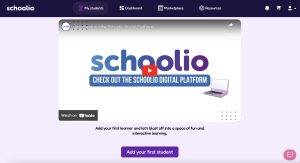
Adding a student to your account is much easier than you’d think. First, head to your account and sign in. Once you’ve signed in, you will be prompted to add your first student on the Schoolio Digital Platform.

Step 1: Add Your First Student 

How to Add a Student on the Schoolio Digital Platform

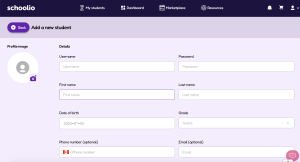
Add Student Details:

Once you have clicked the Add Your First Student Button, you will be taken to the student details page. You can go ahead and enter your student’s information here. Fill out the required fields: Student Username, Student’s Password, First Name, and Date of Birth. Then select your child’s school grade. (Don’t stress too much about this, as the courses are customizable. So, if your child is technically in grade 4 but needs a grade 3 level math, you can select that once you get to the courses.)

You can add the courses automatically or wait and add them later. Just to remind you, your student’s email and phone number are entirely optional. Now you can save your changes.

Step 2: Add Student Details

Student Details

Your Next Step is to Subscribe Your Student on the Schoolio Digital Platform.

You’re ready to go!

Now that you’ve completed all the steps for signing up, you can subscribe your student on the Schoolio Digital Platform to gain access to over 4,000+ videos and lessons.

Book a Concierge Call.

If you need help with how to get started or what programs would best suit your child’s learning needs, then you can chat with one of our experts on a one-on-one Concierge Call, completely free!
Click here to book a Concierge Call.

For more information on how to add a student on the Schoolio Digital Platform check out this video:

Now it’s time for your next step! Adding a course to your Digital Platform.

Click here for information to subscribe a student. 

Teaching Multi-Grades? Schoolio Can Help.

Teaching Multi-Grades? Schoolio Can Give You Your Life Back.

By Chelsea McLeod

Teaching multiple grades

Look familiar? Are you spending all your spare time doing prep that seems neverending to keep up? Are you overwhelmed with student needs and classroom outcomes? Are you struggling with teaching multi-grades?

Let me paint you a picture. You teach in a rural area; your school is K-12, and each homeroom is multi-graded. Some grades only have 1 or 2 kids, so while you may only have a class of 8-10 students, you have four grades at once and hundreds of outcomes to cover and assess. So not only do you have to try to differentiate for student interest, but you also must plan, teach, assess and grade the outcomes from each separate curriculum.

You teach several grades simultaneously, unlike your friends who work in nearby larger city centers,  but you are given equal prep time. Therefore, much of your work comes home because even if there isn’t time in the school day, these things need to get done. So once you are home, you are taking time away from your family or hobbies to keep up with your day-to-day classroom duties. If this rings true for you, then Schoolio can help give you your life back. 

While many still consider teaching a calling, the shift in the last several years to an outcomes-based system has put more pressure on the Teacher. Teaching these days is an endless cycle of being in demand. You are lecturing, working one-on-one with students, meeting seemingly arbitrary administrative deadlines, attending meetings, responding to emails, communicating with parents, collaborating with co-teachers, etc.

The list of responsibilities given to teachers in the classroom is unrealistic; these are on top of the duties of running the classroom day-to-day and keeping your students engaged. Then we add on the testing, assessments, marking, and report cards required for each student in your class, in many cases the stress of teaching multiple grades. This can be for as many as 25+ students. 

Teaching is Work. Give Yourself Some Grace and Help. Especially when Teaching Multi-Grades.

The expectation of Teachers does not create nor support a healthy work-life balance, but for many, it is the reality. 

So you spend your days in a cycle that looks like a hamster in a wheel. Teaching all day, putting out fires with students, communicating with parents, meeting all deadlines for administration and keeping your head above water only to go home and spend your evening planning, prepping and working on tomorrow, like in the picture above. This is a lot; this is an astronomical task you take on as a classroom teacher. While these responsibilities are genuine for all classroom teachers, imagine that you have a multi-graded classroom.

This not only changes the dynamic with the students but also adds to the Teacher’s workload. You now have all the above responsibilities and the added pressure of 2, 3, or 4 sets of outcomes. This is what it can be like if you are in a rural school, sometimes teaching 3 to 4 grades simultaneously. This was not always the case; several years ago, it was the norm to teach the curriculum in an even/odd schedule in many rural settings.

Teaching multiple grades

This meant that if you had a grade 3/4/5/6 class, you would teach all the curriculum for grades 4 & 6 one year and the next, you would cover the curriculum for grades 3 & 5. This was a seemingly more manageable way to approach a multi-grade classroom. However, in our current education climate, this is no longer an allowable approach by many school divisions, and therefore Teachers, especially those with 3-4 grades, are feeling overwhelmed and overworked. The expectation of Teachers does not create nor support a healthy work-life balance, but for many, it is the reality. And while this can seem like an unrealistic expectation, the students still need to learn at their appropriate level. So now what?

Save Your Time, Money and Your Sanity

For starters, if you teach in this situation, you must prioritize your time and prep. Not only for yourself but for your students as well because “you cannot pour from an empty cup,” and if we spend all of our free time on work, it will lead to burnout. I can tell you for sure that you do not need to spend time creating all of your resources; your time is precious, and there are only 24 hours in a day. Not everything your students do, learn or complete needs to be unique.

There used to be a time when teaching was a “one-size-fits-all,” and all teachers were given the same guide. This is a time-consuming task for teachers with only 1 grade, but you have 3, 4 or even 5? You cannot be expected to use all your resources or put that much pressure on yourself, and relying on Teachers Pay Teachers for everything can get expensive, especially because sometimes it’s difficult to purchase only 1 or 2 lessons.

For example, if you have grades 3, 4, and 5, it can get pretty pricey to purchase one entire unit for all three grades and if there are 10-12 units in a year for just one subject… You get the idea. An extra expense with each purchase. Way too much! Which is on top of the fact that teachers already spend more out of pocket than other professions. 

How Schoolio Can Give You Your Life Back… 

There is no limit to the number of students you can add, the courses you have access to or the learning that will take place!

Schoolio has created resources for each grade level, and you can mix and match them to best support your student’s needs. You do not have to buy entire units for one or two valuable lessons. The lessons have been created by certified teachers and are available online for a monthly per-student cost.* You can simultaneously use more than one grade at a time, focussing on student needs, interests or passions.

There is a suggested content planner for the year you can use, or you can create your own and keep track of progress for all your students. You can try it risk-free, with no required credit card and “Learn, plan, and personalize all in one place” with 4000+ interactive math, language, science, and social studies lessons. There is no limit to the number of students you can add, the courses you have access to or the learning that will take place! Try it now; you won’t regret it. And you won’t believe the extra free time you will have now that you aren’t trying to do it all yourself, especially when teaching multi-grades. 


Meeting All Learners Where They Are

_____________________________________________________________________

Meeting All Learners Where They Are: 

Differentiation Made Easy

By Chelsea McLeod

Meeting Learners Where they are

So have you been assigned your first class, or are you changing grades for the first time in years? Keep reading to find out how to make your prep easier and focus your attention on the students in your classroom rather than the mountains of planning required to differentiate student learning.  This year, your Admin has told you that you will be teaching a 3rd-grade class and since you received this news, you have been diligently preparing all your 3rd-grade materials.

Since this is a single-grade class, all you’ll need is this single-stream curriculum approach to ensure your students are successful, right?! Wrong. This approach is a surefire way to set yourself and your students up to fail. But why? And how are we meeting all learners where they are?

All kids are different, so meeting all learners where they are is essential.

As babies, the professionals – doctors, nurses, child development experts, etc. – all tell us that the “milestones” to be reached are just guidelines and not set in stone. Each child learns to roll over, crawl, walk, and talk at their own pace, and the growth markers are estimates. Sometimes they are even arbitrary markers that will not affect long-term success. Your doctor will not hit the panic button if your baby is not rolling over at precisely four months or talking by the day of their 1st birthday. That would be silly.

Schoolio Learning

So why, then, are the growth stages in school treated differently? Why do we immediately hit the panic button when students are not at the level expected by a particular grade? Kids are different, it’s that simple, so while they are all in 3rd grade, they may not all be at the same level as 3rd grade. Learning is relative to each student, and we must treat them all as individuals to best support their learning by building them up from where they are rather than trying to make them attain a single “marker” by a certain age. This is where differentiation comes in, and Schoolio’s digital platform can make this easier. 


What is Differentiation? What does it mean for Teachers?


Differentiation or Differentiated Instruction “is a teaching approach that tailors instruction to all students learning needs. All the students have the same learning goal. But the instruction varies based on student’s interests, preferences, strengths, and struggles.” (https://understood.org).

This means that you can teach to different student needs, learning styles and even interests individually while still working towards the same goal for success, the goal being the Outcomes or Common Core that students are required to achieve in each grade as defined in the curriculum and meeting all learners where they are. 

teaching resources

What does this mean for Teachers? The plain answer is that straight-grade or single-graded classes are no longer as simple. A single-grade classroom nowadays is, in essence, the same as a multi-grade one. No student entering that classroom will learn or perform at the same level, and sometimes the predetermined “levels” they should be reaching seem arbitrary given the knowledge that all children are different. Our students all learn, grow and adapt on different timelines.

For example, some students will enter the 3rd grade struggling to read, maybe having trouble with sounds formation and not understanding some grammar concepts, while another student may be reading at a 5th, 6th grade or above level with no problem synthesizing the next grammar and spelling additions they learn in class.

So, while many schools do not have split grades, we are presented with split learners, and as a teacher, it is crucial to meet all students where they are. As previously discussed, babies and toddlers learn, grow and adapt at all times; so does every one of the students in each of our classrooms. So as teachers, we must be in tune with our students more as individuals and plan for individual student success.


differentiate learning

How Do We Plan for Individual Student Success?  

As a classroom teacher, you must consider all the pieces of the puzzle that make up each student in your classroom. When planning, it is essential to consider the student’s home life, family background, and parental time, as well as the achievements of the student. Each of these things and many other factors are all a part of student success. Therefore, we must have varied content available to create plans that help all learners at every level succeed. This is differentiation. Student interest is also a vital piece of the puzzle because ownership is essential to get full cooperation from the student.

For example, If you have a student obsessed with cars and spend all their free time reading and learning everything they can about cars, if you are trying to teach them math, you may have a difficult time. Sometimes, these students will see this math not as something vital for them to learn but as something that takes time and attention away from their passion.

So it’s not that they can’t understand something; it’s just that they don’t want to. I know we all have to do things we don’t want to do sometimes; however, it isn’t that simple, given the other factors involved. Sometimes parents will not force the issue, so as teachers, we need to get creative with how we approach learning.


Consequently, getting to know your students and what motivates/excites them is vital to being a classroom teacher. It’s okay to give students different lesson content if they are not engaging with the same materials as the rest of the class. The outcomes are required for the student to achieve, not the content. How you bring the student to achieve the result is essentially up to you.

So if you can find a way to make them feel successful, engage with their learning and take ownership of their achievements, you will have a much better classroom experience. To do this well, you will need to plan for differentiation. As the Teacher, you can differentiate the content, subject matter and sometimes even the length of the finished product to help cater to your learners’ success. 

Meeting all learners where they are

Now I know you’re thinking… But doesn’t that make so much more work for me? How on earth do I plan for 25 + different learners across all the core subject areas? One person cannot create that many lesson materials on top of all the other things teachers do! Therefore, the ability to teach grade-fluid content is a critical piece of this process and helps all teachers tremendously in meeting a student’s needs or catering to interest to spark participation and ownership of learning.  

With the Schoolio Digital Curriculum, You Can Do Exactly That!

With Schoolio Digital, you can teach grade-fluid content and target your instruction to individual student success. Schoolio has lessons for the core subject areas for all grades created by teachers! If you are a member of the digital platform, you can mix and match exactly what your students need. This gives you flexibility and the opportunity to cater to individual student success while still maintaining your sanity and sleeping each night (not working round the clock to create materials).

So, don’t panic and spend hours “reinventing the wheel” to make all the content you need to support your in-class instruction when Schoolio has already done it. Now you can spend your precious classroom time getting to know your students, making lasting connections, and creating a safe place for students to learn and grow, all while using Schoolio’s Digital Platform to support all you are already doing. Sign up now and focus on what matters, the students in front of you, not the prep work while meeting all student’s where they are.


Manage Disruptions to Learning

Learning disruptions continue to frustrate parents, teachers and students across Canada and the United States. We all had high hopes that the Covid-19 pandemic would be entirely over by now, and education and life as we once knew it could continue as usual. Yet, we are entering the third year of the pandemic and are rattled with learning disruptions to this day. Maybe you have been trying to ride it out, but you’re now finding that these disruptions are causing your children to struggle intensely with their education. What are some things that you can do to manage disruptions to learning?

Concerns of ongoing and past learning disruptions linger everywhere.

Hundreds of students in Quebec, Canada, have been prohibited from attending school. According to CBC News, hundreds of students in Montreal are awaiting approval from Quebec to approve English eligibility. EMSB says they want to welcome all students but cannot without the ministry’s permission. As a result, hundreds of students are unable to attend school. How can these parents manage disruptions to learning?

Additionally, parents, teachers and students across the United States are struggling with recovering from pandemic learning and the trauma that unfolded at the end of the 2021-2022 school year in Uvalde, Texas. Many parents and students fear attending school after such a horrific event.

In New York City, many educators are highly concerned about the academic and emotional effects of the pandemic on their students as they enter the third school year since the beginning of the pandemic. A survey of 110 educators was conducted by the nonprofit Educators for Excellence and found that roughly 80% of respondents reported that their students are in worse academic and emotional shape than before the beginning of the pandemic.

As educators, parents, and students prepare for back to school in British Columbia, Canada, there remains a serious concern as to what the new school year will bring when it comes to the spread of communicable diseases, including COVID-19. Even if there are no school shutdowns, many students will be out of school from being sick which causes parents to scramble to manage disruptions to learning for their children.

In California, students wait months for mental health help while councillors share that they are being bombarded due to the pandemic and pandemic learning. There is no ‘quick fix’ for the trauma and interruption of education due to the COVID-19 pandemic.

Parents in Ontario, Canada, are highly concerned with the decrease in health rules that will allow students testing positive to attend school. Furthermore, many parents are apprehensive about the impending doom of the potential education strike due to educational contracts set to expire across Ontario.

What can parents do to manage disruptions to learning?

It doesn’t matter where you are, learning disruptions are frustrating for parents everywhere. These learning disruptions are frustrating for parents, teachers and students alike. This is why it’s imperative for parents to learn to manage disruptions to learning to help their children excel despite the uncertainties. Here are some simple steps to keep your child’s learning stable.

1. Weigh your options.

For a child to learn, they need stability and consistency. This is why weighing your options is a good thing to do. Take a look at alternative learning options like homeschooling or online schooling and decide if these are right for your family. Keep in mind that homeschooling offers the consistency to education that children need. But you will need to decide if homeschooling is a learning avenue that works for your family first. Check out this blog on why so many parents are homeschooling to learn more. 

2. Plan a routine with your child.

If you decide to homeschool, plan out a homeschool routine for each day. Alternatively, if you keep your child in public school despite learning disruptions, plan out ‘off-day routines’ for days that your child might be home. Having a curriculum at home for those ‘just-in-case’ times is a great idea. That way, your child will continue to learn even if there are school closures due to strikes or illness.

3. Keep conversations open with your child.

We are now seeing the effects of the COVID-19 pandemic and school closures on children’s mental health. Because as stated above, children need consistency and stability to learn and grow. When their lives are constantly turned upside down, it can cause a flurry of emotional responses. Keeping conversations open with your child is so important. Please encourage your child to ask questions and express their feelings to you. It’s essential that you don’t minimize, avoid or dismiss their concerns. Truly acknowledge their feelings and assure them that it’s normal and natural to feel frustrated and scared about uncertainties. And check out this excellent resource for kids to learn to manage how they think and feel. 

4. Take time with learning.

Whether you are keeping your child in school and working on some extra curriculum at home, or you have decided to exclusively homeschool your child with the help of an excellent homeschooling curriculum and digital aids. If you aim to do 45-minute learning sessions with your child, start with 10 or 15 minutes and build up from there. Keeping lessons light and enjoyable helps them adjust to their new or additional learning in a calming manner.

5. Stay in touch with your child’s school.

If you have decided to homeschool your child exclusively, remember to keep in touch with your child’s school. Ask the school questions for further guidance, and explain the situation to your child’s previous teacher.

6. Join a homeschool group or parenting group in your community.

The upside to choosing to homeschool is that homeschooling has become a popular alternative to traditional learning. This means that there are plenty of people homeschooling, and they all have unique situations and ways of homeschooling. When you connect with these groups, you can learn more about how to homeschool your child more effectively.

7. Subscribe to the Schoolio Blog.

We are a team committed to helping parents and students thrive in whatever learning avenue they are in. Our blog provides countless helpful tips to help you and your child excel.

8. Connect with homeschooling experts.

Many homeschooling families are willing and able to share their knowledge on how to get started.

Learning disruptions continue to be an unfortunate part of our lives today; rather than being upset or worried about it, you are taking the situation and looking for alternative learning methods to help your child excel in whatever situation you find yourself in.

We are here to remind you that you are doing an excellent job. Regardless of what learning avenue you choose for your child, you and your child will continue to do great! Because of the work you are putting in to help your child get through the learning bumps and manage disruptions to learning. Keep going; you’re doing great.

homeschooling curriculum

Want to Homeschool More Efficiently? Try this!

Are you frustrated with your current homeschooling situation? Do you want to homeschool more efficiently? And does the circumstance below sound overly familiar?

It’s 2:00 pm, and your sink is full of dishes, goldfish and cheerios scattered all over the dining room and trailed into the living room like some odd trendy art studio. You dreamed of making a roast chicken and potato dish for dinner but forgot to pull the chicken out of the freezer to thaw.

There is a list of five hundred things you’d like to get done today, but you find yourself sitting at the table with your eight-year-old as he constantly avoids answering the math questions that appear before him. You feel like you are wasting 80% of your day trying to lesson plan and get your children to accomplish some curriculum.

Do you want to homeschool more efficiently? How can you accomplish this?

First, you need to simplify your learning materials. If you are using a homeschooling curriculum that is leaving you and your children frustrated and overwhelmed, you will never be successful.

Try a curriculum that is open-and-go.

What is an open-and-go homeschooling curriculum? It means you aren’t spending hours planning your homeschooling lessons. Schoolio’s open-and-go curriculum means you can simplify the prep and spend more time enjoying the process. If you couldn’t schedule prep time, the lessons are organized neatly so your child can stay on track without elaborate planning. They can open their books and go!

Use a curriculum that is easy to follow.

Have you used a homeschooling curriculum that had you check multiple books to ensure you covered all the bases adequately? The problem is that you are now overwhelmed by all these books, feel you’ve missed something, and your dining room table looks like a library that lacks a librarian?

The Schoolio curriculum has raving reviews from both seasoned homeschoolers and new homeschoolers. Both stated the same thing: We love the simplicity of the lessons. We don’t overcomplicate learning; we stick to the basics and make it easy for the student to understand and for the parent to teach.

Try a customizable curriculum.

Having a customizable curriculum is essential for your children’s learning needs. There’s this outdated misconception that children should all learn the same way and simultaneously. The opposite is true; kids thrive when their learning content is customized to meet their needs.

If your child needs help with concepts they haven’t yet mastered, you can customize the curriculum to help them master those skills. Alternatively, suppose your child finds their current level boring. In that case, you can customize their curriculum to reflect their interests by going more of an interest-based route with fun electives to keep them learning and intrigued.

Schoolio has received many positive reviews about our customizable curriculum options because we know that one size doesn’t fit all. Every child is unique, and therefore so should their learning journey. If your child is genuinely struggling with a specific subject like, for example, Math Grade 2 – remember they don’t need to stick with math grade 2. You can switch it up and dive back into a unit of Math Grade 1 to help them refresh and master the skill.

Use an affordable curriculum.

Many homeschooling families are single-income, so finding a good homeschooling curriculum can be tricky. Because let’s face it. Homeschooling curriculum can be expensive. Finding an affordable, quality homeschooling curriculum is so important. Compared to top homeschooling curriculum companies, Schoolio Learning is the #1 choice for affordable and quality content. Curious how the two compare? Check this out! 

That means you can get what you need for your child’s learning without breaking the bank.

Purchase a curriculum that has a reasonable amount of content.

There are many homeschool curriculums that are so full of content, you barely have time to think. The pressure of ensuring your child finishes everything before the end of the year can leave many parents feeling stressed and overwhelmed as they know that if they miss a day, they won’t be able to finish at the time they’d like to.

Schoolio curriculum is created with those needed breaks in mind. Life happens; sometimes we get sick, sometimes we like to go on field trips, sometimes no one feels like diving into a lesson, and sometimes we want to take a week off to reset. Our curriculum was created by homeschooling parents that know that those homeschooling breaks are just as important as the content that you purchase to teach.

Our full learning bundles are filled with excellent lessons in Math, Social Studies, Science and Language Arts, enough to encourage continuous learning but not overwhelm the family’s schedule and rhythm.

Want to homeschool more efficiently? Remember you don’t have to revolve around your homeschooling curriculum.

Homeschooling is a beautiful opportunity to educate your child from home and help them thrive on their learning journey. We have to be careful not to be blinded by this idea that you must make your homeschool ‘just like traditional school.’  Suppose you constantly fight with your kids to get them to complete assignments x, y, and z before the ‘next period’ of your day. By the end of the day, everyone is burnt out and even if your child completed assignments x, y, and z, they didn’t retain the knowledge because they were too stressed.

Your life doesn’t have to and shouldn’t revolve around your homeschool. Your homeschool should revolve around your life. If you want to take a fun field trip with the homeschool group to the museum but have a pile of Math to complete, it’s ok to pause the math work to enjoy the fun moments.

Because learning happens everywhere. It’s not just in books or classrooms; learning happens in the car, at the park, grocery store, the museum, and the art gallery. Learning is everywhere.

Do you need help choosing the right homeschooling curriculum for your family?

We’ve got you covered! This blog is by Lindsey Casselman, co-founder and head curriculum writer at Schoolio Learning. She walks you through essential steps to choosing the best curriculum for your family and lifestyle.

Affordable Homeschooling Curriculum and Price Increases

Inflation is a word that makes many of us cringe as we watch the price of groceries, clothes, fuel, and everyday essentials rise. Finding ways to afford essential items has become a challenge for many people worldwide. Many people are concerned about their homeschooling curriculum needs as they continue to watch the cost of everything rise. How can they find an affordable homeschooling curriculum with these price increases?

Inflation is having a significant impact on everything.

According to the US inflation Calculator, “the annual inflation rate for the United States is 8.6% for the 12 months ended May 2022, the largest annual increase since December 1981.” Following suit, according to Statistics Canada, Canadian consumer prices rose 6.8% in April.

The price of groceries continues to increase and overwhelm many people as Canadians paid 9.7% more in April 2022 for food purchased when compared to April 2021. Worse, this increase exceeded 5% for the fifth month in a row, and much like the United States was the most significant increase since September 1981.

Groceries aren’t the only thing impacted by inflation. There are also substantial increases in gas prices, rent prices, general product prices, car prices and even school supplies.

Does inflation impact homeschooling?

The bitter answer is yes. Many homeschooling families are already single-income families struggling to find an affordable homeschooling curriculum. While some states/provinces offer financial support for homeschooling families, many states and provinces throughout North America do not provide any financial help for homeschooling families.

Unfortunately, many homeschooling families have been struggling to put food on the table, fuel in the car, a roof over their heads and an affordable homeschooling curriculum in front of their children.

So it’s with incredible frustration that many homeschooling families find that even the cost of a quality homeschool curriculum has increased.

How is a digital homeschooling curriculum affected by inflation and price increases?

You may have noticed that some of your favourite homeschooling curriculum companies have increased the prices of their products. While we cannot speak for all companies, we’d like to address the 15% increase you may have seen in our own Schoolio Curriculum network.

Since our beginnings in 2020, we at Schoolio Learning have been committed to offering you a secular, inclusive, open-and-go, affordable homeschooling curriculum. So, why have we increased our prices?

Why is there a price increase on our homeschooling curriculum?

There are two reasons you will see a 15% increase in our homeschooling curriculum.

Inflation affects our employees too.

Our team is growing to provide you and your child with the most up-to-date homeschooling curriculum to keep your homeschool running smoothly. As such, we need to take care of our team members. Inflation affects everyone; therefore, we must accommodate our team members and customers.

This slight price increase helps our team members to still provide for their families while writing and working on the best materials to keep your family learning at an affordable price.

We’ve enhanced our homeschooling curriculum to serve you better.

This is the most exciting news that we wanted to share with you. We have enhanced all of our curricula from Kindergarten to Grade 8!

What does that mean?

If you were a previous customer of Schoolio Learning, you would remember that we recommended you purchase the Canadian Curriculum workbooks or other practice workbooks to help your child get the essential practice work they needed? Extra workbooks are no longer required with our enhanced curriculum. It now includes all the necessary practice content to help your child learn and understand the concepts better.

To sum it up, why has Schoolio Learning Curriculum increased by 15%?

  • Inflation costs for our team members mean we must aim to meet their needs.
  • We have enhanced the curriculum, so you no longer need to search and spend money on additional practice workbooks.

Is Schoolio still an affordable homeschooling curriculum option? Let’s compare.

Before you jump to the conclusion of assuming you should find a cheaper homeschooling curriculum company because the 15% increase makes you cringe. Let’s look at another popular homeschooling curriculum company and its pricing compared to ours.

Schoolio Grade 3 Complete Bundle:

Our grade 3 bundle includes all the core subjects, Math, Social Studies, Science and Language Arts. With over 1,200 pages, lessons, teaching plans/discussions/ as well as countless activities.

The cost for the Schoolio full-year curriculum bundle: is $399.84 (digital) or $563 (books, printed and shipped).

Alternative homeschooling company Grade 3 Bundle:

A popular homeschooling curriculum company provides a complete kit much like our complete bundle for grade 3. A full kit includes the four core subjects, Math, Social Studies, Science and Language Arts, teaching instructions and lessons.

The cost for this homeschooling curriculum full-year: is $1,090.45.

As you can see, that’s a pretty huge price increase for comparable homeschool learning content.

Please don’t take our word for it; check it out yourself.

We want you to excel at homeschooling, which means finding the best option for your family and budget is essential. So, please research and compare our prices with other popular homeschooling curriculum companies.

We stand behind our price and will continue to provide an affordable homeschooling curriculum for all your learning needs.

Don’t forget our promotions.

Price increases and inflation can cause a lot of stress for families. We don’t want you to feel that you must stop homeschooling because you have to choose between a homeschool curriculum and groceries. So, please know that we periodically offer excellent promotions to help make our curriculum even more affordable for your homeschool. If you don’t see a promotion being advertised on the website, reach out to our customer service team members, and they will be happy to provide you with all the knowledge on current or upcoming promotions.

If you aren’t sure if we would be the best fit for your homeschool, check out our free sample packages to view just how authentic, simple and wholesome our curriculum is. We look forward to providing you with the best and most affordable homeschooling curriculum for all your homeschooling needs.

Check out our free sample packages today to find the perfect curriculum for your child’s grade and learning needs.

See for yourself:  


Click here for samples

Why Parents Are Turning To Homeschooling

Why Parents Are Turning to Homeschooling

The other day, I was at a dentist’s appointment with my kids. While we were there, the secretary asked my daughter if she enjoyed the morning off school to be at the dentist. My daughter responded with a “no” because she despises dentist’s appointments. I followed up the question with, “We will be doing school when we are home as we homeschool.” She looked at me with disbelief and said, “You homeschool? How could your children be socialized then? With online learning, children were struggling with isolation and lack of socialization.” I then went into a long explanation about how homeschooling is far from isolation learning. She still looked confused, as many people do when they wonder why parents are turning to homeschooling as their education choice. 

Here’s why parents are turning to homeschooling:

After two years of the pandemic and homeschooling becoming a norm in education, I shouldn’t still have to give explanations to strangers about my children’s social lives. Yet, that remains one of the most common questions I receive. The world needs to subscribe to the Schoolio Blog and read blogs like Socialization and Homeschooling. One thing that might interest you about homeschooling is that socialization is one of the main reasons why parents are turning to homeschooling as their preferred education method.

Homeschooling improves children’s social skills and interactions.

One of the most important reasons why parents are turning to homeschooling is because of healthy socialization. When homeschooled, children have much less exposure to peer pressure and bullying. Homeschooled children are also able to have more customized social interactions. Additionally, most children in the public school system spend hours in classrooms listening to teachers. In comparison, homeschooled children have many more opportunities for learning activities outside of the home.

A flexible homeschooling curriculum means homeschool families have more opportunities to participate in fun activities. Some of which include: museum trips, park playdates, community service activities, art classes, and track and field days.

Using a flexible homeschool curriculum and making homeschooling a lifestyle significantly improves emotional and psychological development in children. While also strengthening family connections and connections with other homeschooled children.

Homeschooling means having access to higher quality education.

Many parents believe that the quality of education is not what it once was. With a decline in the education budget, increased student enrolment, large class sizes, burnt-out teachers, and other factors. Parents feel that homeschooling gives them more control over their children’s learning. In 2015, long before the pandemic and the devastating effects on children’s education, a Career and College Readiness Survey showed shocking results. These results indicated that less than half of high school students feel academically ready for college.

Interrupted education, overcrowded classrooms, and fewer resources have made it extremely difficult for teachers to provide one-on-one instruction to students. When homeschooling, parents can use a curriculum that follows learning standards while also offering personalized education to their child, which is so often missing in today’s learning venues.

Homeschooling can support a child with diverse learning needs.

Unfortunately, children with learning disabilities or even physical disabilities have difficulty thriving in a traditional learning environment. Many schools don’t have adequate resources and time available to support children with diverse learning needs. Additionally, formal education is a one size fits all model when we all know that one size fits nobody. Having a customizable curriculum and a flexible learning environment is essential for children with diverse learning needs.

Homeschooling means educational stability.

Even before the pandemic began, there were teacher strikes, bad weather and many other reasons students were forced to miss class. Homeschooling means educational stability for many students as they have that flexible learning solution and learning lifestyle that keeps them learning even when schools are not in. Many homeschooling parents (who were homeschooling before the pandemic) were thankful that they had chosen that educational path for their children, as homeschooling offered much-needed stability to their days.

Homeschooling means better educational results.

It might shock you that homeschooled children often score better on federal standardized tests than their public school peers. Brian Ray of the National Home Education Research Institute showed that homeschooled children often achieve much higher results. Regardless of parents’ income or teaching experience.

Homeschooling offers student-athletes and musicians a flexible education option.

Many student-athletes have intense travel and practice schedules. Additionally, many students who participate in fine arts, theatre, or music need time to rehearse and perform. These students need a flexible education option that will work around their busy schedules.

Homeschooling offers a learning environment that children enjoy.

Unfortunately, many public school children feel stressed over the volume of homework and the lack of instruction. Many children don’t thrive in environments that are high stress, where they are required to memorize and keep up with their peers around them. This popular model of education doesn’t cater to the majority of students. Learning should be fun and engaging, not blank and stressful. Homeschooled parents report that they have much more time during their day to incorporate fun activities and hands-on lessons that encourage learning.

Should you homeschool?

Even though many think homeschooling is a terrible option, as the secretary at the dentist did, the reality is that homeschooling can be an excellent option for many families. But is it the right choice for your family? Ask yourself these questions:

  • Does my family need more flexibility?
  • Do I want to give my children and myself the freedom to choose?
  • Would I like to be more involved in my child’s education?
  • Is my child struggling academically?
  • Does my child need more positive social experiences?
  • Are there affordable homeschool curriculums available?
  • Does my work schedule permit this choice for my family?

If you answered yes to more than two of these questions, then homeschooling might be an excellent option for your family. Remember, there are many families and experts available to help guide you through the process of homeschooling, like the caring staff at Schoolio Learning, that wants you to excel on your homeschooling journey. If homeschooling seems like the best option for your family, but you aren’t sure where to start – please reach out to us, and we can help set you and your family up for success.

Can you travel and homeschooling? Check this out.

Check out our one-of-a-kind homeschooling curriculum.  

Help Your Child Cope With News About Gun Violence

In 2022 there have been 198 mass shootings in the United States, and it’s only May. Hearing of these tragedies has become so common that many people have become nearly numb to the news. We don’t understand why someone would choose to hurt other people in the name of hate, but our children are the ones who often have the big questions, not understanding why these awful events take place. You might be wondering how to help your child cope with news about gun violence?

They shouldn’t have to understand.

It hurts to see our kids trying to understand hate, violence, and crimes like these. Going grocery shopping at a local store shouldn’t be where a violent event occurs. Going to school to get an education shouldn’t be where your child doesn’t feel safe. Yet, active shooter drills are a part of their education for many children.

As much as we would like to shelter our children from the world’s dangers and these traumatic news reports, unfortunately, you can’t in most cases. So, how do you help your child cope with news about gun violence? How do you inform them to keep them safe but not remove their innocence and zest for the world?

It seems like nowhere is safe.

Dangerous, deadly and devastating mass shootings continue to be the central theme of news reports, senseless killings in the name of hate. Unfortunately, it doesn’t seem to matter where you are or what you’re doing, nowhere seems safe. Schools, concerts, bars, malls, movie theatres, churches, and grocery stores are just some of the locations where these deadly acts take place, which can cause a lot of anxiety for children and adults alike. Is it safe to go to the grocery store to get groceries? Many people on Saturday, May 14, 2022, thought so. They never would’ve guessed that a grocery store would be a place where a hate crime would occur or that going grocery shopping would be how their lives would end so abruptly, harshly, cruelly, and filled with hateful motives.

Mass shootings seem to be happening more and more with each year that goes by; finding the words to explain again and again why it happened and continues to happen can be a challenge.

What are the right words to explain traumatic gun violence incidents and help your child cope with news about gun violence?

Assure their safety.

Always assure your child that they are safe and that you are always looking out for their safety. A clinical psychologist at Doctor’s on Demand, John Mayer, Ph.D., told parents.com in an interview explaining gun violence to children that assuring your child during these scary times is extremely important. “Reassuring our children in these turbulent and violent times is an important question for parenting. Say to your children: ‘We will never take you anywhere or put you in any place where there is danger. That is our primary job as parents to protect you. We will always keep you safe.’ That fundamental message of safety is critical to make sure your children hear.” says John Mayer, Ph.D.

We all know that the truth is we can’t always guarantee our children’s safety, but our children need to be assured nonetheless. They need to know that they are safe at school with their teachers, at the grocery store with you, or at the movies with their grandparents. Living in constant fear of what could happen is not suitable for children.

Teach them about the importance of gun safety.

According to EveryTown.org, firearms are the leading cause of death for children and teens in the United States alone. Every year 18,000 children and teens are shot, killed or wounded because guns are not handled safely. Additionally, around 3 million other children are exposed to gun violence directly.

Talking to your children about gun safety:

  • Teach them never to touch a gun unless carefully supervised by an adult.
  • Let them know that only adults trained to do so, like police, should handle guns.
  • Explain the consequences of real guns vs. toy guns. They aren’t a toy.

Don’t let your child hear it all from social media, T.V. or friends in school.

These horrific events are gruesome, and reports are filled with details that your child shouldn’t absorb, especially if they’re young. Aim to have a gentle conversation with your child about the tragic event. Try to avoid finding out through another source that will likely provide too much detail for their young minds. For example: Having the news report on the T.V. when your child comes home from school can cause them to dwell on the events and instill fears and worries that they don’t need happening in their growing minds.

Give your child an open space to share their thoughts and worries.

Some children hardly notice or care about what is happening worldwide, but others may face anxiety about horrific events connected to gun violence. Always assure your child that they can bring these worries and concerns up to you. Keep conversations open and take the time and consideration to listen to what they are saying to you. Everyone benefits from talking to someone when they’re facing anxiety about something. When your child can share their concerns and worries in a safe environment, they will feel more confident, secure and better able to process and understand what they are feeling and thinking.

Always be sure to keep things age-appropriate when figuring out how to help your child cope with news about gun violence.

Your young children won’t need a massive explanation for why something horrific like a mass shooting occurred; assuring your child’s safety to them is extremely important in their younger years. Children ages 12 and up are often more able to be introduced to in-depth conversations like how these senseless actions are immoral and unacceptable.

Give them space and freedom to acknowledge.

Many times, we as adults are dismissive of the daily tragic events. We have become desensitized and almost numb to horrific events, like mass shootings, reported on the news. Remember, your child is sensitive, and these events are upsetting. Don’t brush off their feelings and questions because that is what we are used to doing. Please give them the space and freedom to sit with their emotions and think through them. Be there for them, guiding them through these thoughts and feelings positively.

A helpful resource for helping your child manage their thoughts and feelings.

Using the Thoughts and Feelings: Learning to Manage How I think and Feel, Special Interest Unit, you can help your child learn positive lessons on managing those big emotions.

Learn more about Thoughts and Feelings: Learning to Manage How I Think and Feel.

The Role of Play and Rewards in Education

Should homeschooling be fun? And what is the role of play and rewards in education? In Episode 7 of The Schoolio Live Q & A, Sathish Bala, CEO of Schoolio, shares that he has talked to many homeschooling parents who felt that it wasn’t normal to incorporate play into their homeschooling routine.

What is the role of play and rewards in education? 

“Play is the first form of learning that any kid does, right? Any toddler playing with blocks is learning about the world around them. As they get older their interests will change, but we can adapt that to still be educational.” Shares Lindsey Casselman, Co-Founder and Lead Curriculum Developer at Schoolio Learning. It’s important to have a balance, even if a subject isn’t necessarily fun, it can still be rewarding.

Can rewards be beneficial for those challenging subjects?

If your child isn’t enjoying math, and it’s tricky to make it fun for them. Try to make it rewarding for your child. Maybe a nice walk when the algebra lesson is complete, or a hot chocolate when they complete their writing for the day. The rewards don’t have to be extravagant. Actually, the simpler the better. Let’s just take a look at adult life, you work, and you might not enjoy it, but the reward is that you will get paid. Why not offer little rewards for those subjects that your child is struggling with?

Find out what motivates your child.

Does your child enjoy working towards a reward? What about incorporating play into their learning routine? Spend some time learning what motivates your child and then aim to incorporate that into their learning plan.

Listen in to this intriguing conversation with Sathish Bala and Lindsey Casselman on the Schoolio Live Q & A.

Click Here to Watch Now!