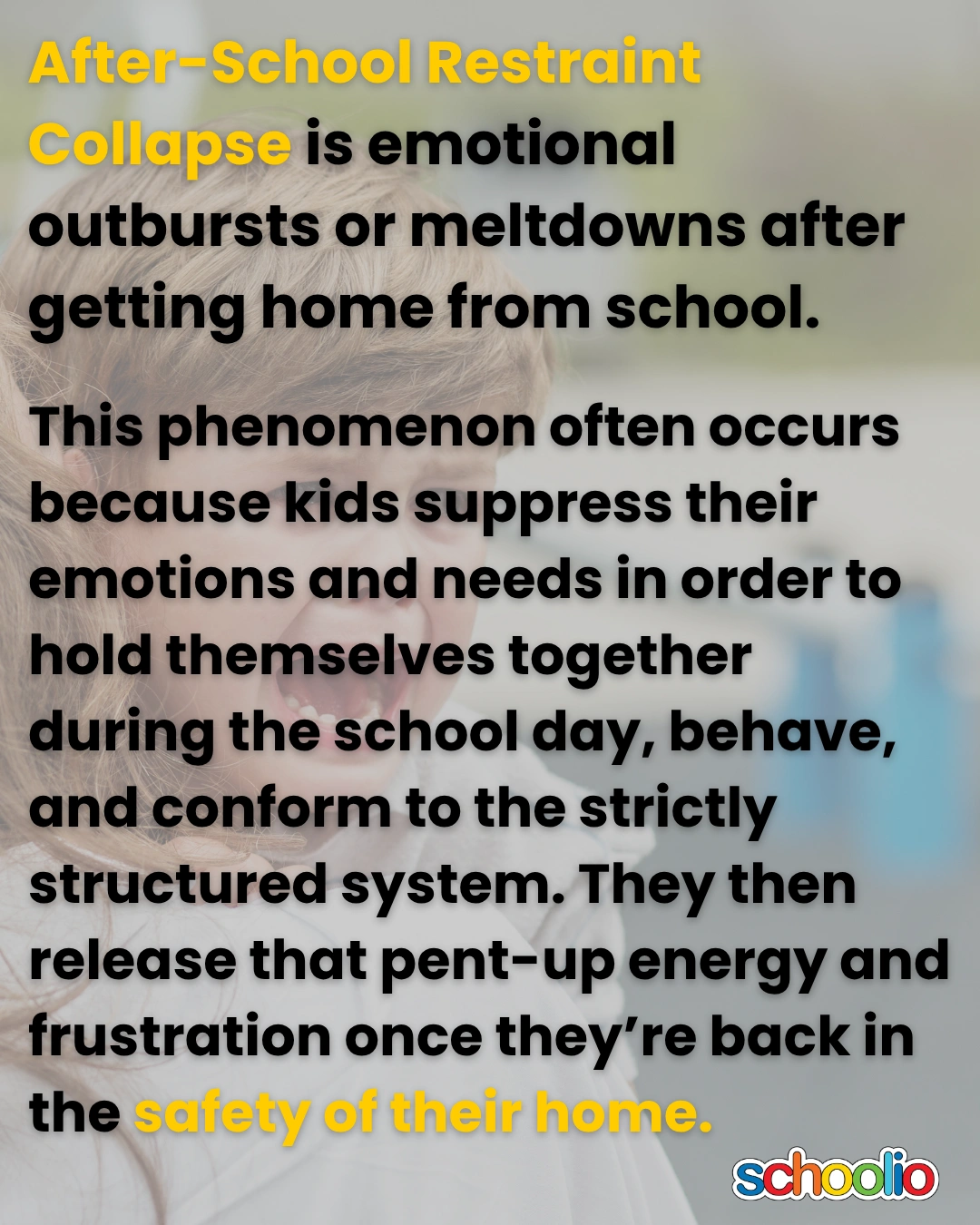
After School Restraint Collapse

Does Your Kid Struggle with School? What Is After-School Restraint Collapse?


If your kid struggles with school, you may be familiar with After-School Restraint Collapse, even if you’ve never heard the term. Does your child have frequent emotional outbursts or meltdowns immediately or shortly after getting home from school? They may be experiencing [After-School Restraint Collapse](https://www.bbc.co.uk/bitesize/articles/z863cxs#:~:text=This type of behaviour is,to let it all out!). This phenomenon often occurs because kids suppress their emotions and needs in order to hold themselves together during the school day, behave, and conform to the strictly structured system. They then release that pent-up energy and frustration once they’re back in the safety of their home. After-School Restraint Collapse can happen to any child, but for kids who are ADHD, autistic, or have other neurodivergencies, it can be more frequent and more intense, because school is just that much harder for them to manage, and they are more easily overwhelmed or overstimulated. This intense emotional release can feel overwhelming for your child, and can be incredibly hard to witness as their parent.

Let’s talk about what After-School Restraint Collapse is, why it’s more common in neurodivergent kids, and then look at some practical ways to support your child. We’ll also talk about how homeschooling can be a viable option for families dealing with extreme school struggles.

What is After-School Restraint Collapse?

After-School Restraint Collapse is the emotional or physical meltdown that occurs when children who have been controlling their emotions all day at school finally feel safe enough to let go. This is especially common in kids struggling with school, where the effort to manage expectations and regulate their behavior leads to emotional exhaustion. After a day of staying relatively still and quiet, following directions, and meeting social expectations, they return home and can’t hold it together anymore.

For neurodivergent children—such as those who are ADHD, autistic, or have sensory processing disorders—this collapse can be even more intense. School environments can be highly demanding, with sensory overload, social complexities, and academic pressures draining their emotional and mental energy.

Why Does After-School Restraint Collapse Happen More Often in Neurodivergent Kids?

Many kids struggling with school are neurodivergent, such as those who are ADHD or autistic, and often face unique challenges that make the school day even more exhausting and overwhelming than for their neurotypical peers. Here are some of the reasons why your neurodivergent kiddo is more likely to experience After-School Restraint Collapse:

1. Sensory Overload

Neurodivergent children often have sensory sensitivities, which can make the school environment overwhelming. Loud classrooms, bright lights, crowded hallways, and constant stimuli can make it difficult for them to stay regulated. By the time they get home, they are overstimulated and emotionally exhausted, leading to a meltdown.

2. Social and Communication Pressures

For a lot of our neurodivergent kids, social communication is difficult or confusing, which makes the social aspect of school exhausting. Neurodivergent children often spend significant mental energy trying to fit in, understand social cues, and avoid conflicts with peers or teachers. This constant effort can lead to emotional exhaustion by the time they return home.

3. Executive Dysfunction

Many neurodivergent children struggle with executive dysfunction, which affects their ability to plan, organize, and manage tasks. The school day can be filled with tasks that require executive functioning, and the effort to stay on top of things like class transitions, homework, and listening to instructions can become overwhelming. In addition, they may hear a lot of negativity about their inability to self-manage the way their neurotypical peers can and wonder why they can’t keep up, leading to self esteem issues and more emotional exhaustion.

4. Emotional Regulation Difficulties

For children who are ADHD or autistic emotional regulation can be challenging. Our kids may suppress their emotions throughout the day to meet behavioral expectations, but once they are home, they release all the frustration and stress they’ve been holding in all day.

Ways to Support Your Child Through After-School Restraint Collapse

Understanding the causes of After-School Restraint Collapse is the first step toward supporting your child. There are several strategies that can help ease your child’s transition from school to home and reduce emotional overload. Drawing from expert advice, let’s look at some practical and concrete ways to support a kid struggling with school:

1. Create a Safe Space for Unwinding

Provide a quiet, calm space at home where your child can unwind after school. This space should be free of distractions and filled with comforting items, such as soft blankets, pillows, or their favorite sensory toys. Creating a sensory-friendly environment where your child can decompress will help reduce overstimulation and provide a sense of security.

2. Prioritize Downtime After School

Don’t jump straight into homework, chores, or structured activities when your child gets home. Limit demands and expectations no matter how small they may seem to you. Allow them to have downtime to relax and recharge. This might be free play, reading, or any activity they find soothing. Don’t try to ask them too many questions about their day or engage in conversation immediately if your child isn’t feeling it. Let them have quiet and their own space. and allow them to decide when they’re ready to start homework or other after-school activities. By reducing pressure and giving them control over their time, you give your child the freedom to decompress, which will help prevent emotional meltdowns.

3. Offer Physical Outlets

Some children find that engaging in physical activity helps release the built-up tension from the school day, especially those who are ADHD- Hyperactive Type. Whether it’s jumping on a trampoline, going for a walk, or engaging in a fun physical activity like dancing, movement can help reduce emotional overload and improve their mood.

4. Seek Support When Needed

If your child seems unusually upset after school, it might be because of an issue during the day that wasn’t fully addressed or resolved. After-school behavior could indicate that something challenging happened while they were at school.

It’s important to check in and find out if something during their school day is affecting them. Bullying is unfortunately extremely common for neurodivergent children, so you want to make sure your child isn’t being victimized at school. They are also more likely to have social struggles with peers, so fights and misunderstandings with friends can happen and leave your child feeling hurt and confused. Do your best to know what’s happening at school so you can address the issues at home and help guide your child through these altercations, as well as reach out to the school if needed.

5. Validate Their Feelings and Make Sure They Feel Heard

After a long day of masking their emotions, your child needs to feel heard and understood. Validate their emotions by acknowledging their feelings: “I know today was tough, and it’s okay to feel upset.” Listening without judgement helps your child feel supported and understood, which can lessen the intensity of their emotional outbursts.

6. Understand How Hard School Is For Some Children

Many children struggle with anxiety, separation, and security. Being away from the safety and connection of their parents all day is hard for these kids, especially our neurodivergent kiddos. All of this is in addition to having dealt with the day, peers, academics, and sensory stimulation. Reconnecting with you at the end of the day can bring a flood of emotions, from relief to frustration, all laddering up to a feeling of overwhelm.

Considering Homeschooling?

If your kid struggles with school to the point that After-School Restraint Collapse is becoming a daily occurrence, homeschooling may be an option worth considering. Homeschooling offers the flexibility to create an environment that’s specifically tailored to your child’s unique needs, making it a great alternative for neurodivergent kids who find the traditional school environment overwhelming.

How Homeschooling Can Support Neurodivergent Kids

  1. Flexible Learning Environment: Homeschooling allows you to customize your child’s learning environment to fit their sensory preferences. You can create a space that’s quiet and calm, free of the sensory triggers that may overwhelm them in a traditional classroom.
  2. Personalized Curriculum: Homeschooling offers the freedom to choose a curriculum that fits your child’s learning style and pace. You can select a curriculum like Schoolio that’s designed with neurodivergent learners in mind, offering bite-sized lessons, interest-based electives, and unique flexibility.
  3. Social Learning with Support: For neurodivergent children who struggle with social interactions, homeschooling provides an environment where they can engage with others at a frequency that doesn’t drain their social battery or create overwhelm.. Socialization can take place in smaller, more controlled settings, reducing the stress of large group dynamics. Not only that, but with your regular support they can learn emotional regulation and social skills in a healthy manner with guidance from an adult who has their best interests at heart.
  4. Emotional Support: Homeschooling gives you the chance to be present for your child throughout the day, offering emotional support as needed. This allows you to incorporate social-emotional learning into your daily routine, helping your child develop the emotional regulation skills they need to thrive.

The First 3 Steps to Get Started with Homeschooling

  1. Understand Your State Laws: Homeschooling laws vary by state, so it’s important to familiarize yourself with the specific regulations in your area. Some states require you to notify your local school district, while others have stricter guidelines around curriculum and testing.
  2. Choose a Curriculum: There are many homeschooling curricula available, but it’s important to find one that fits your child’s learning style. Schoolio is a great option for families starting out with homeschooling, as it offers all subjects in one place, flexibility and lots of support. It’s also designed to be accessible for neurodivergent learners, making your initial dive into homeschooling much easier and stress-free.
  3. Find Support: Look for local or online homeschooling communities where you can connect with other parents and seek advice and support. Joining a homeschooling co-op or an online group can provide much-needed support and confidence for both you and your child.

Conclusion

After-School Restraint Collapse is a common experience for lots of kids, and those of us with neurodivergent kids struggle in school even more. With the right support strategies, you can help your child manage their emotions and hopefully ease the transition from school to home. If school is simply not a fit for your child and likely never will be, don’t hesitate to consider homeschooling as a viable option. Your child’s emotional well-being should always be the top priority. If your kid struggles with school, it’s essential to listen to their needs.
Signs That Your Child Needs a Tutor.

Is your child struggling with their grades? Are they having constant meltdowns whenever they do homework? Does school cause them to feel immense amounts of stress? These may be clear signs that your child needs a tutor. Children everywhere benefit greatly from tutoring; some of these benefits are that tutoring can help boost their academic performance, and they have the opportunity to develop learning and study habits. So, how can you tell if your child needs a tutor?

Signs that your child needs a tutor.

Declining grades.

Have you noticed that your child’s grades are steadily declining? Whether that is in a particular subject, two, or all subjects. This is a clear indicator that your child needs help.

No progression in school.

Is your child struggling to keep up with what they’re learning in class? Has your teacher noted that your child is falling behind their level? If you’re homeschooling, have you noticed that your child can’t understand the concepts taught?

Taking too much time to complete assignments.

Does your child spend hours trying to complete a homework assignment? Even if it’s a simple assignment, that should take less time. This is another one of the signs that your child needs a tutor.

Constantly having tantrums and meltdowns when doing homework.

When it’s time to do homework, does your child have meltdowns? Are nightly homework assignments ending with your child hugely frustrated or in tears?

Lying about tests and homework assignments.

Does your child tell you they have no homework or upcoming tests to study for? As a result, they don’t study or complete homework assignments, which causes poor grades and concern from you and their teacher.

Having a poor attitude towards school.

Does your child dread going to school? Do they constantly say phrases like “I hate school”? Does your child not like a subject that they used to enjoy?

They are struggling to manage their time.

Are there not enough hours in the day for your child to finish their work and assignments? Are they having difficulty completing what they need to when needed?

Low self-esteem.

Does your child lack confidence when it comes to a particular subject? Or school in general? Have they stopped applying themselves to their schoolwork? Whether in class or at home?

Anxiety and meltdowns when going to school.

Are you finding that your child is getting very stressed, upset or anxious before school in the morning? Is your child complaining of headaches, stomach pains, or other symptoms that only occur before school?

Demonstrating signs of learning difficulty.

Is your child having difficulty writing, reading, math, or another area of study? Despite your efforts, are they still showing little to no improvement? Is your child having difficulty behaving or paying attention in the classroom or during learning?

Struggling with organization.

Do you know your child is intelligent and understands assignments but cannot prepare for what needs to be done? This could be another one of the signs that your child needs a tutor.

Doing an excellent job with homework but failing tests.

Getting high marks on papers, assignments or in-class participation but failing a test can cause significant frustration for your child. Test preparation is a skill; not every student can focus on what needs to be done before a test.

How tutoring can help.

A tutor can provide additional support that a teacher or parent may not be able to give them. Tutors can help slow things down by teaching your child how to adequately schedule their time, prioritize which assignments must be completed first and customize learning to meet your child’s needs. A good tutor will take the time to teach your child the skills they need. Tutors also have the unique ability to focus on one or two skills that can significantly impact the child’s education.

Not every child needs a tutor to succeed in school, but for some students, a tutor can make all the difference and help to change the outcome of your child’s education. Tutoring doesn’t need to be a permanent solution, as just a few sessions with a tutor can positively impact your child and provide them with the necessary tools.

Learn more about the Schoolio Digital Platform and how it can help your child get back on track. 

The Schoolio Digital Platform is the perfect addition to help children get back on track. Whether the child is working with a tutor, a parent, a teacher or independently, the Schoolio Digital Platform can help. With 4,000+ video lessons, worksheets and activities. Your child will thrive with this program. 

Click Here to learn more about the Schoolio Digital Platform. 


Aren’t sure where to begin? Book a Concierge Call.

If you aren’t sure how to get started or what programs would best suit your child’s learning needs, then you can chat with one of our experts on a one-on-one Concierge Call, completely free!
Click here to book a Concierge Call. 

Lessons We Can Learn From Past Learning Interruptions.

The COVID-19 pandemic saw education systems worldwide close, and billions of children go without consistent learning for months. Society wished the pandemic would only last a few weeks and things would return to normal. During those first few weeks of the pandemic, no one realized how long it would last and how deep the learning loss would run as billions of children were displaced from their education. Now we are asking ourselves how to help our children catch up. Are there lessons we can learn from past learning interruptions? 

This generation of students is at risk.

According to a report published by the World Bank, UNESCO, and UNICEF: “This generation of students now risks losing $17 trillion in lifetime earnings in present value. Or about 14 percent of today’s global GDP (Gross Domestic Product), due to COVID-19 pandemic-related school closures.” More information is here.

“The loss of learning that many children are experiencing is morally unacceptable.” Said Jaime Saavedra, World Bank Global Director for Education. Parents across the world echo his sediment. Parents are concerned for their children’s educational well-being and their futures. Jamie Saavedra continued by saying: “… the potential increase of Learning Poverty might have a devastating impact on future productivity, earnings, and well-being for this generation of children and youth, their families, and the world’s economies.”

“The loss of learning that many children are experiencing is morally unacceptable.”

Jaime Saavvedra – World Bank Global Director for Education

Education disruptions aren’t unique to this generation. Are there lessons we can learn from past learning interruptions?

You don’t have to look too far back to find pinnacle moments in our history where learning was interrupted. World Wars and pandemics are just some causes of historical learning interruptions. So, what did parents, students and educators do during these educational interruptions? And are there lessons we can learn from these past learning interruptions to help our children in the future?

Education and the First World War, 1914 – 1918

The history of schools during the First World War has been heavily neglected. Until recently, several detailed written studies (monographs) were published during the last decade. These monographs have started to fill the knowledge gap about education during the First World War.

The studies focused on how schools functioned during the war. Especially in the major countries that were affected by the war. Education was disrupted during the First World War. But just how much? Schools were disrupted in many ways in the combatant nations (in Europe). The armies often reassigned the schools as hospitals, barracks, or military offices.
Additionally, many young teachers were entering the military, which caused a significant teacher shortage in countries with prominently male teachers. For countries in Central Europe, there were significant shortages of food and coal. Which then played an essential role in school closures.

Some European schools attempted to stay open, despite all the setbacks. However, the lack of teachers proved to be a significant issue. School administrators were desperate to find replacements for these teachers. So, they turned to retired teachers or teachers still in training. Schools tried to mix classes, but the crowded rooms caused disease and other issues with the children. Many schools tried half and sometimes even one-third-day sessions with little success.

In Canada and the United States:

Italy, France, Great Britain, Australia, Canada and the United States faired much better than countries in Central Europe during the First World War. One reason was 60-80 percent of teachers were female. The children and teachers in these states also didn’t suffer from severe malnutrition like those of Central Europe. However, many children could not attend school because they had to start working from a young age to support their families as their fathers were away. Comparatively, some children had to watch their younger siblings while their mothers went to find work, so the children would inevitably miss school.

The First World War played a significant role in interrupting the lives of children worldwide. These children faced school closures, educational uncertainties, absent parents, deaths of loved ones, poverty, and malnutrition. Children at this time struggled to understand why? So, the emotional strain also contributed to the loss of learning during The First World War.

The Spanish Flu Pandemic 1918 – 1920

As if children didn’t struggle enough from the terror of The First World War. They now faced a global pandemic. Following the end of The First World War in 1918, countries worldwide were thrown into a worldwide pandemic by soldiers returning from Europe with the virus. The Spanish flu resulted in school and business closures across the globe. In Ontario, Canada, the pandemic primarily affected students from prior years to university. In the fall of 1918, the Ontario School Board forced school closures across Ontario. These closures lasted from one week to over three months.

The prolonged school closures caused significant educational delays for students. In New York, schools claimed that “the school work of half the year will amount to little or nothing.”

The Great Depression

During the 1900’s many generations struggled with proper education. In 1932 The Great Depression played a significant role in halting education for many children. Budget cutbacks, fewer school hours, increased class sizes, teachers being paid less, and school closures all adversely affected children’s education. Teachers struggled to teach the children that would come to school because they were undernourished as their families were unemployed and unable to provide food.

Education during the 1930s became a luxury, one that many children were not able to obtain.

The Second World War 1939 – 1945

Children’s education suffered intensely again during the Second World War. In Britain, bombing and military requisitions caused 1 and 5 schools to close. Families were separated, homes were destroyed, parents passed away, and emotional trauma was high. Many children were evacuated, leaving their homes, families, and schools.

Elementary schools, high schools, and universities were affected in Canada and the United States. There wasn’t enough manpower to keep the economy running. Due to this, teachers and professors had to work or enlist. Causing there to be a mass shortage in teachers, professors, lessons and curriculum. The war wasn’t just academically disruptive; it was also socially disruptive. This is similar to the disruption in education and children’s social lives today.  

Looking back…

The 1900s were riddled with traumatic events that halted education many times. Despite the educational ups and downs and significant uncertainties, we can now look back and see that many of those generations’ children laid the groundwork for our lives today. 

While there were many negative impacts on education and children’s lives during these trying times in history, it’s important to note that many positive opportunities also arose from these intense times.

Some positive results in education: 
  • Women were offered many more opportunities in education and the workforce. 
  • Traditional teaching methods were rapidly changed. 
  • Physical education and health became a priority in education. 
  • Education became much more accessible, regardless of what class you might come from. 
  • History and Social Studies were revamped entirely. 
  • Systems were set up to help to return soldiers catch up on their education. 

Looking forward to the lessons we’ve learned. 

Education isn’t something that can only be obtained in a classroom. And that is one of the best lessons we can learn from history. Many of the children from these generations still excelled, despite the closures and chaos. How? Because education is all around us, it’s everywhere. And the sooner that we see that, the better.  

Children still managed to learn during those times, just like they continue to learn during these times. Yes, children will have a much more difficult time catching up without proper intervention and recovery. So, we must remind ourselves that we have the tools readily available to help our children now. 

And while it’s nice to think, ‘my child will be fine, many kids back then were!‘ it’s essential to remember that not all lessons from the past are positive ones. Looking back at the 1918 pandemic, history tells us that many children from that time lived a much more difficult life. Because, following that pandemic, there was no solid plan to help children recover from the learning losses they had experienced. 

Taking action. 

You must be your child’s advocate because no one else will be. You know your child, and you are aware of the areas in which they struggle. At the same time, we can’t talk to the successful people of the past generations and find out how they overcame these learning losses. We can assume that someone created an action plan for those children to help them get back on track. 

Don’t feel intimated; you have been creating action plans for your child since they were born, whether you realize it or not.  As your child’s parent, you have been there to help them learn and grow. This is no different. Even if your child appears to be doing just fine, they have likely missed areas of their education. This is why you must take action to help them catch up. 

While we would love for the education system to develop some action plan to help students, we know the sad reality is that many schools are simply pushing students onto the next grade even though these children need help. 

You must take action, be your child’s advocate and help them. 

Student Action Plan: 

1. Defining areas of struggle.

First, you need to identify the areas of your child’s education they are struggling with. These are the areas that you need to help them with immediately. Make a list of the academic sites they need the most help with, bearing in mind that it might not be ‘all of the math’; it could be a concept from math that they need help with. 

2. Brush up on all areas of learning. 

Even if you’ve noted that the problem area is reading and writing, they seem to be doing well with math. You should still be helping them with their math skills. Because even if they appear to be doing well with one subject area, there might be (and likely are) key concepts they have missed. This will then appear as a problem later on down the road. 

3. Keep frustrations low. 

If you are addressing an area of struggle, please remember to be patient. Your child may become frustrated with themselves and overwhelmed. You must keep the child calm during these learning times, so they can better process what they need to learn. 

4. Communicate with their teacher/school. 

Talk to their teacher! Voice your concerns, and ask for directions on how to catch them up. If the teacher cannot help, go to the principal for help. This is your child and their future. It’s okay to ‘be annoying’ when advocating for them. 

5. Be consistent. 

It’s so easy to hand your child the iPad and hope they can figure it out. Or somehow miraculously catch up on their own. But the reality is, they likely won’t. You, as the parent, must be consistent. Read with your child, and go over different concepts with them. If you cannot do this, outsource to a tutoring program. That can help your child catch up and excel. 

Parent Action Plan: 

1. Be their advocate.

You are your child’s advocate, so be that for them. I know how intimidating it can be to stand up and voice your concerns. But if you don’t do it for them, who will? 

2. Talk to your child about their concerns. 

Your child needs someone to listen to them, to hear their concerns and frustrations. Be sure to communicate with them openly. Let them talk! Don’t judge. 

3. Address your issues. 

Yes, you read that right. If you feel like this is “all your fault.” That’s a problem, and you have to address it. The pandemic was not, and is not, your fault. Your child’s learning loss is not your fault. We can’t control most circumstances like we can’t fix the past. But we can put in the work to make the future bright. You have that ability, so don’t stop working on yourself. 

4. Ask for help! 

If trying to tutor your child is just not working, or you don’t know how to help them. Ask for help! Reach out! Do some research, and talk to experts. You aren’t alone! While it’s essential to be your child’s advocate, it’s also important to realize that so many people care about this generation’s future. Find people with the same mindset and who can help where needed. 

5. Take care of yourself. 

You’ll notice that above I wrote that it’s easier to hand your child an iPad. Because, as parents, we are tired and burnt out. Taking care of everything all the time is exhausting and overwhelming. So, you must take time to work on and help yourself. Programs like The Burnout Blueprint by Daddy’s Digest can be beneficial. Take time to work on yourself and do things that you love. 

We must move forward. 

It can be easy to slip into a place of negativity and feelings of ‘they’ll never catch up.’ Don’t do that. You must remain optimistic as you look to the future. I’m sure that if you could go back and pick key successful people from each of the generations that faced intense trauma and learning losses. You would find that successful people chose to look forward, not back. They decided to learn the lessons that they could when they could. And didn’t worry so much about the things they had missed. 

Pairing a positive mindset with a carefully cultivated action plan will impact your child’s future best. So, let’s move forward together! 

Check out the Schoolio Digital Platform. 

We hope you and your student will enjoy The Schoolio Digital Platform with over 4,000+ videos, interactives, and pre-made or custom lessons to suit your student’s learning style. If you are confused about how to get started, we are happy to help.

Resources:

Kids are Slipping Through the Cracks of a Broken Education System.

After nearly two years of the pandemic, many children are struggling with their education. Teachers are tired, burnt out and overwhelmed. Constantly shifting from in-person learning, to online, then back to in-person, has caused a huge lack of stability in education. As a result, many kids are slipping through the cracks!

Linda’s Story:

Every parent wants what’s best for their child, knowing that their child is falling behind is causing anxiety amongst many parents. We chatted with Linda, a mom of two, about how her kids are doing in school. “Not good.” She said, with worry written all over her face. “I’m worried that they will continue to fall behind and just never catch up. I don’t know what to do!”

Linda, like many parents has been trying to help her kids from home. But, it’s just not working. “I’m not a homeschooling parent. I don’t have that kind of focus.” Linda said with tears in her eyes. “I want to be able to help my kids. But the more I try, the more frustrated we all become. I’m not a math whiz, I can’t help what I don’t understand.”

Michael’s Story:

Michael reflects Linda’s feelings. “My son is in fourth grade, and he can’t read. Just a couple sight words is all he can manage. The school doesn’t seem to see a problem with that, and they just keep pushing him ahead. This whole situation is making me feel like a failure as a parent. I’ve tried so hard to help him read. We went and bought all these sight word cards, and word games.” Michael said. “None of that was working so we signed up for tutoring with a well-known tutoring company. We spent over $500 and it didn’t work. The sessions failed. And he still can’t read.”

How are parents supposed to keep their kids from slipping through the cracks?

Let’s make something clear: None of this is the parent’s fault. Children have not been receiving proper educational instruction. It’s difficult for a teacher to evaluate how a child is doing in an online learning system that isn’t properly set up to be online learning. Online/virtual education can be great tool, when it is set up specifically to be online. But when you take a class of 20+ kids, that are used to being in-person and you put them all online. Learning won’t happen the way it should.

Sure, you will have children that will do just fine and adapt to the abrupt changes without issue or complaint. But, there are many kids who aren’t able to keep up. It’s unfair that the parents should feel guilty and pressured. Additionally, it’s unfair that teacher’s should feel the pressure to constantly switch from one venue of learning to another. There needs to be stability in order for children to have the opportunity to thrive.

The future of education is unknown.

We really don’t know when the pandemic will end, and if education will ever go back to normal. What we do know is that we have to help the kids that are struggling right now. While we love the idea of everyone being able to access the in-home curriculum at home. It’s not realistic!

Parents like Linda and Michael are concerned because the longer the pandemic continues, the older their children become. They continue to miss important lessons and learning opportunities. However, Linda and Michael aren’t the only parents struggling with this fear. Many parents are worried about how to get their kids caught up.

We remain committed to helping children from all educational sectors excel.

While our primary focus has been on the homeschooling curriculum, we see the need to help families from all education sectors. Kids are struggling, and that’s not okay. We at TEAM Schoolio have a window of opportunity to help children catch up and excel in their learning journey. Children’s education has been hugely impacted; the time to change now! We must work fast, as kids are slipping through the cracks of a broken education system way too quickly.

Schoolio After-School

Your child isn’t too far behind, and with the right help and tools, they will catch up in no time. We must stop letting children slip through the cracks of a broken education system. To help, Schoolio Learning has launched an incredible one-on-one tutoring platform for students in grades 1 – 8.

“Schoolio After-School started because customers who are not homeschooling full time, but are using Schoolio as supplemental content for their kids, need help teaching the curriculum.” Sathish Bala, CEO of Schoolio, said. “Not everyone can afford curriculum and tutoring. This is why we set up this amazing platform to bridge the gap. Our tutors are teachers; our books are Canadian curricula. And it’s set up for after-school. Giving parents the freedom they need, from having to worry about homework and catch-up work.”

We are an education company that remains committed to helping all children excel. This is why we have launched Schoolio After-School. Kids are slipping through the cracks of a broken education system. Since we’re already selling Canadian curriculum to thousands of parents, this is another way to help parents across the country.

Schoolio After-School is more than just tutoring:

One hour, three times a week, for four weeks, we can cover anything taught in school. All Schoolio After-School tutoring packages include a free printed and shipped subject bundle. You, as the parent, can select what subject your child needs help with and what times work best for your student to learn with the tutor, and we will send the subject bundle directly to your door.

Tutors will be available Monday-Friday from 4:00 pm – 8:00 pm EST. As well as on Saturday afternoons. Classes are interactive on Zoom. Tutors can walk the child through the curriculum or help them with homework. While also helping the child to catch up using The Schoolio Subject Bundle. Sessions can be recorded, so parents can view how their child is doing and interact with the tutor.

Benefits of Schoolio After-School include:

  • Tutors who follow Canadian Curriculum Standards
  • The Schoolio Subject Bundle of your choice is included.
  • Qualified teacher as your tutor.
  • Tutoring lessons that mirror what your student is learning in class.
  • Tutors are trained to catch your child up from previous lessons they may have missed or been unable to understand.
  • Digital platform: Kids can take quizzes, get certificates, and unique points for engaging, which can be used in The Schoolio Marketplace!
  • Access to your child’s progress through the Parent Portal.
  • Students can reference Schoolio Subject book every day, even when tutoring has been completed. The book is theirs to keep!

Book a Concierge Call.

If you aren’t sure how to get started or what programs would best suit your child’s learning needs, then you can chat with one of our experts on a one-on-one Concierge Call, completely free!
Click here to book a Concierge Call.