What Non Homeschoolers Need to Understand

What Non Homeschoolers Need to Understand


This has been on my mind today…

I saw a post that said homeschooling ends bullying, pointless peer pressure, and the undermining of family values.

Strong statement.

Whether someone agrees or not, here is what I think non homeschoolers need to understand.

For many families, this decision is not ideological. It is protective.

When I was growing Schoolio, I spoke to thousands of parents. Not angry parents. Not radical parents. Exhausted parents. Parents watching their child shrink. Parents watching anxiety spike. Parents watching confidence erode.

Bullying is real. Social pressure is real. Feeling misaligned with the environment is real.

Does homeschooling magically eliminate all of that? No.

But for some families, it changes the environment enough that their child can breathe again.

And that is what often gets missed in the debate.

It is easy to critique homeschooling from the outside. It is harder to sit across from a parent whose child dreads every morning.

You do not have to choose homeschooling to appreciate why someone else does.

At its best, it is not about escaping school.

It is about restoring stability, identity, and confidence in a child who was struggling inside a system that did not fit.

That deserves more understanding, even from those who would never choose it themselves.

Sathish

still learning, still unlearning

What Is Time Blindness and Time Optimism? (And Why Your ADHD Child Isn’t “Late on Purpose”)

What Is Time Blindness and Time Optimism? (And Why Your ADHD Child Isn’t “Late on Purpose”)

Have you ever said:
“We’re leaving in ten minutes.”
And your child hears it… nods… and then somehow starts a brand new LEGO build?
Or you ask how long their math will take and they confidently say, “Five minutes,” and forty-five minutes later they’re still halfway through?
Or they’re shocked — genuinely shocked — that it’s already bedtime?
That’s not laziness.
That’s not defiance.
That’s very often time blindness.
What Is Time Blindness?
Time blindness is the difficulty sensing and tracking the passage of time internally.
For many ADHDers, time does not feel linear.
It feels like:
Now
Not Now
That’s it.
Five minutes and fifty minutes can feel almost identical without external cues.
An hour can disappear in hyperfocus.
Ten minutes can feel unbearably long when doing something boring.
Time blindness is tied to executive functioning and working memory — both of which are heavily impacted in ADHD brains.
If working memory is the “mental sticky note” that keeps track of what you’re doing and how long you’ve been doing it, ADHD brains often have much weaker glue.
So the brain loses track.
Not because they don’t care.
Because they can’t feel it.
What Is Time Optimism?
Time optimism is the cheerful cousin of time blindness.
It’s the tendency to genuinely believe something will take less time than it actually will.
“I’ll clean my room in 10 minutes.”
“I can finish this before dinner.”
“I have tons of time.”
It’s not lying.
It’s not manipulation.
It’s an executive projection issue.
ADHD brains often struggle with future simulation — accurately picturing how long tasks require.
Add in dopamine-driven motivation (which rises when something is exciting and plummets when it’s not), and you get wildly inaccurate time estimates.
If the task feels easy in their head, they assume it will be quick.
The brain isn’t calculating past experience consistently.
It’s guessing.
Optimistically.
Is This Just an ADHD Thing?
Time blindness and time optimism are most strongly associated with ADHD because they’re rooted in executive function and dopamine regulation.
That said, autistic kids can also struggle with time — but usually for different reasons.
An autistic child may:
  • hyperfocus and lose track of time
  • struggle with transitions
  • feel distress when routines shift
  • have difficulty estimating task-switching effort

But their experience of time is often more about rigidity or deep focus than about an internal inability to sense its passing.

In ADHD, time itself feels slippery.
In autism, time may feel predictable but transitions feel destabilizing.
If your child is both ADHD and autistic, you may see both patterns layered together.
What Time Blindness Looks Like at Home
It can look like:
  • Chronic lateness — even when they’re trying.
  • Starting huge projects right before leaving the house.
  • Being confused about how long homework takes.
  • Struggling to pace themselves.
  • Forgetting how much time has already passed.
  • Underestimating transitions.
And here’s the hard part:
To the outside world, this looks like irresponsibility.
To the ADHD brain, it feels like confusion.
Why Punishment Doesn’t Fix It
If a child could “try harder” to feel time, they would.
Time blindness isn’t solved by:
  • scolding
  • shame
  • “you need to be more responsible”
  • taking away privileges

Because the issue isn’t motivation.

It’s perception.
You wouldn’t punish a child for being near-sighted.
Time blindness is similar — except it’s temporal.
What Actually Helps
Externalizing time.
ADHD brains often need time to be visible and tangible.
  • Timers.
  • Visual clocks.
  • Countdowns.
  • Written schedules.
  • Auditory reminders.
  • Chunking tasks with defined breaks.
Instead of saying, “We’re leaving soon,” try:
“We’re leaving in 15 minutes. I’m setting a 10-minute timer, and then a 5-minute warning.”
Instead of, “How long will that take?” try:
“Last time this took 40 minutes. Let’s plan for that.”
Instead of assuming they’re careless, assume they’re time-blind.
That shift changes your tone immediately.
The Bigger Picture
Time blindness and time optimism don’t mean your child is unreliable.
They mean their brain doesn’t automatically track duration the way neurotypical brains do.
And when we stop treating it like a character flaw and start treating it like a neurological difference, something softens.
We move from: “Why are you like this?”
To: “How can we support this?”
That’s where real change starts.
? Lindsey
certified special-ed educator, homeschool mom, & co-founder of Schoolio

Curiosity Cannot Be Forced. It Has To Be Sparked.

Curiosity Cannot Be Forced. It Has To Be Sparked.


This has been on my mind today…

I think about curiosity all the time.

As a dad. As a CEO at Schoolio.

Academics can be taught. With enough repetition, most kids can memorize what they need to pass a test. The system is built for that.

But curiosity is different.

Curiosity cannot be forced. It cannot be assigned. It cannot be graded into existence.

It has to be sparked. And once it is sparked, it has to be protected.

Growing up South Asian, curiosity was not exactly encouraged. The path was clear. Study hard. Choose the right career. Do not wander. Wandering looked risky. Distracting. Like falling behind.

Curiosity pulls you sideways. The system pulls you forward.

That tension shapes a lot of childhoods.

We designed Schoolio to spark curiosity. Short lessons. Flexible pacing. Space to explore. Room to ask why.

But here is the real tension.

If parents do not embrace curiosity as the goal, we drift back to measuring the wrong thing. We focus on the grade. The percentage. The transcript.

Grades are easy to track. Curiosity is not.

And yet, as adults, it is curiosity that drives innovation. It builds companies. It fuels reinvention. It is what pushes someone to keep learning long after school is over.

No one asks what your grade was in middle school science.

But the ability to ask better questions. That follows you for life.

At Schoolio, academics matter. Mastery matters.

But curiosity is the engine.

Our job is not just to help kids pass.

It is to help them stay curious long enough to build something meaningful with what they learn.


Sathish

still learning, still unlearning

The Most Overlooked Parts of Helping Homeschoolers

The Most Overlooked Parts of Helping Homeschoolers


This has been on my mind today…

When people ask how to help homeschoolers, they usually jump straight to curriculum, tools, or platforms. But most homeschooling families are not struggling because they lack resources. They are struggling because the weight of responsibility is heavy, constant, and invisible.

Helping homeschoolers starts by understanding that most parents did not choose this path because it was trendy. Many chose it because something was not working. A child was falling behind. A child was anxious. A child was labeled, rushed, or quietly pushed aside. Homeschooling often begins as an act of protection, not ambition.

The first real help homeschoolers need is less noise. Too many choices, too many opinions, too many voices telling parents what they should be doing. Decision fatigue is real. When everything feels urgent, nothing feels achievable. Support looks like clarity. What matters this week. What can wait. What is good enough for today.

The second thing homeschoolers need is permission to stop recreating school at home. Learning does not need bells, desks, or six subjects a day to be valid. Progress is rarely linear. Some weeks are full of curiosity. Some weeks are survival. That does not mean learning is failing. It means learning is human.

Many families homeschool because school broke confidence before it broke grades. That is why emotional safety matters more than pacing guides. If a child is overwhelmed, shut down, or anxious, no worksheet will fix that. Helping homeschoolers means supporting emotional regulation first and trusting that academics follow when safety returns.

Flexibility is also misunderstood. Total freedom sounds appealing, but it often turns into chaos. What families really need are gentle anchors. A rhythm. A loose plan. Clear moments where the day feels complete. Not perfection. Just enough structure to breathe.

It also matters that we stop assuming there is one reason families homeschool. Some do it for neurodivergent kids. Some for mental health. Some for travel. Some because they had no other option. Real support does not judge the why. It adapts to it.

The most overlooked part of helping homeschoolers is helping parents trust themselves again. Many come into homeschooling already doubting their instincts because a system told them they were wrong. The goal is not to replace parents with experts or platforms. The goal is to help parents feel capable, informed, and less alone.

Community helps too, but only when it is honest. Not highlight reels. Not comparison. Just spaces where families can say, this week was hard, and not feel behind.

And finally, we need to change how we measure success. Sometimes progress looks like a child choosing to read again. Or asking a question. Or feeling calm enough to try. Those moments matter, even if no test records them.

Helping homeschoolers is not about doing more. It is about doing what actually helps. Less pressure. More trust. And learning that fits the child, not the system.


Sathish

still learning, still unlearning

If You Want Your Child To Be Social, Do Not Homeschool.

If You Want Your Child To Be Social, Do Not Homeschool.

This has been on my mind today…

I still see this stereotype floating around.

If you want your child to be social, do not homeschool.

It is an old argument built on an outdated picture of what homeschooling looks like.

The idea assumes that socialization only happens in a classroom of same age peers, sitting in rows, moving together by bell schedule. That is not how real life works. Adults are not grouped by birth year. We collaborate across ages, backgrounds, and interests every day.

Modern homeschooling rarely looks like isolation.

Kids are in co ops, sports teams, music groups, church communities, neighborhood pods, volunteer programs, online collaborations, and microschools. Many interact with more diverse age groups than they would inside a single grade classroom.

The deeper question is not are homeschooled kids social.

It is what kind of socialization are we talking about.

Is it compliance and crowd survival?

Or is it confidence, communication, and emotional regulation?

I have seen kids who struggled in traditional school labeled antisocial. In reality, they were overwhelmed. Remove the rigidity. Adjust the pace. Give them agency. They open up.

Homeschooling is not anti social. It is intentional social.

The stereotype lingers because it is easy. The reality is more nuanced.

Sathish

still learning, still unlearning

Source: **https://thegatewayonline.ca/2026/02/how-to-be-a-social-person-dont-homeschool/**


1 in 6 Families Cite Mental Health Needs as the Reason They Pulled Their Child Out of School

1 in 6 Families Cite Mental Health Needs as the Reason They Pulled Their Child Out of School


This has been on my mind today…

Mental health has quietly become the leading reason families are choosing homeschooling. Not ideology. Not religion. Not rebellion. Mental health.

According to new UK figures, more than 126,000 children were being taught at home last autumn, a 15 percent increase in a single year. One in six families cited psychological or mental health needs as the primary reason they pulled their child out of school.

That number should stop us in our tracks.

For years, homeschooling has been framed as a lifestyle choice. Something parents opt into because they want more flexibility or control. But this data tells a different story. For many families, homeschooling is a response.

A response to anxiety that does not fade.

A response to burnout in children who are barely ten.

A response to kids who once loved learning and now dread school mornings.

When parents say mental health, they are not talking about small discomforts. They are talking about panic before school. Emotional shutdown after class. Kids who are told they are fine because their grades look fine, even while they are struggling internally.

This is especially true for neurodivergent and highly sensitive kids. Children who feel the world more intensely. Noise. Pressure. Comparison. Speed. In systems designed for scale, these kids are often labeled difficult or behind. Over time, they internalize that message. The real loss is not academic. It is emotional.

One thing we see again and again is that children are rarely taught how to understand what is happening inside them. They are expected to manage big emotions without being given the language, tools, or space to do so. This is why emotional literacy matters just as much as reading or math.

When kids learn how to name their thoughts, understand their feelings, and recognize that emotions are information not failures, something shifts. Confidence starts to rebuild.

This is exactly why we created

Thoughts and Feelings

, a guided emotional learning book and curriculum at Schoolio. Not as therapy. Not as a fix. But as a way to help children slow down, reflect, and build self awareness in a world that keeps asking them to speed up. For many families, this kind of emotional groundwork becomes the bridge between surviving school and actually healing from it.

You can learn more about the Thoughts and Feelings program here:

https://schoolio.com/product/thoughtsfeelings/

Homeschooling, when done with care, is not hiding from the world. It is a pause. A reset. A chance to rebuild trust in learning and in oneself.

The rise in homeschooling should not be read as parents giving up on education. It should be read as parents stepping in when the system cannot meet their child where they are.

The real question is not why homeschooling is growing.

The real question is why so many children are struggling in silence.

Parent takeaway: If your child’s mental health is declining and you feel like you are constantly managing damage instead of supporting growth, you are not imagining it. Education should never come at the cost of emotional safety. Teaching kids how to understand their thoughts and feelings is not extra. It is foundational.

Source:
Sky News
https://news.sky.com/story/number-of-children-being-taught-at-home-increases-by-15-in-a-year-report-finds-13494608

Why More Parents Are Choosing Homeschooling Even When It Was Never the Plan

Why More Parents Are Choosing Homeschooling Even When It Was Never the Plan


This has been on my mind today…

I read a story recently about a parent who never planned to homeschool. It was not ideological. It was not a protest. It was not about rejecting school. It was simply about responding to a child who was struggling in ways that could no longer be ignored.

That story keeps echoing because it sounds like so many families I speak to.

The decision to homeschool is often framed as a bold choice or a radical one. In reality, for many parents, it is a quiet pivot. A moment where they realize that what is supposed to be working simply is not. Their child is anxious. Or exhausted. Or shutting down. Or falling behind while being told they are doing fine.

What struck me most was how ordinary the story was. No dramatic failure. No single breaking point. Just a slow accumulation of signs that school was costing more than it was giving.

This is something we do not talk about enough.

We talk about grades. We talk about outcomes. We talk about standards. But we rarely talk about the emotional tax school can take on a child who learns differently or feels out of place. We rarely talk about how long parents sit with doubt before making a change. Or how much guilt comes with admitting that the default path might not be the right one for your child.

Homeschooling, in these stories, is not about pulling kids away from the world. It is about bringing learning closer to who they are. It is about restoring confidence. It is about slowing things down long enough for curiosity to return.

Many of these parents still value structure. They still value rigor. They still care deeply about education. They are not opting out. They are opting in differently.

What keeps coming up is this idea of safety. Not physical safety, but emotional safety. The freedom to ask questions without fear. The space to make mistakes without labels. The ability to learn at a pace that does not constantly signal failure.

This is where homeschooling becomes less about location and more about intention.

At schoolio, we see this pattern over and over. Families who did not start out wanting to homeschool. Families who simply wanted their child to feel capable again. Families who wanted learning to stop being a daily battle.

Homeschooling is not a punishment. It is not giving up. It is not settling for less. For many families, it is a way to rebuild trust in learning itself.

Every child has a relationship with education. When that relationship is damaged, it needs care. Sometimes that care looks like staying and advocating. Sometimes it looks like stepping back and rebuilding at home.

What matters most is that we stop pretending there is only one right way.

Homeschooling is not for everyone. But for the families who choose it, often unexpectedly, it is not about escaping school. It is about choosing their child.


Sathish

still learning, still unlearning

But What About Socialization? (Let’s Talk About It.)

But What About Socialization? (Let’s Talk About It.)


Ah yes… the classic question that every homeschooler has heard (probably a few dozen times):

“But… what about socialization?”

It’s asked by grandparents. Aunts and uncles. Curious friends. Grocery store strangers.

And yes, we’ve seen the memes. We’ve done the eyerolls. We’ve even — on occasion — offered a snarky reply.

But truthfully? I don’t mind the question. I like giving people a better picture of what homeschooling really looks like.

And when it comes to socialization, I answer it in two parts — because most people are actually asking the wrong thing.


?️ Part 1: Yes, My Kids Socialize

Let’s start with the easy answer.

Do my kids spend time with other kids?

Do they have friends? Go to activities? Go on field trips?

YES. Yes. And yes.

My kids were always part of our local homeschool group.

Here’s what my kids do with their homeschool group:

  • Soccer
  • Gymnastics
  • Swimming
  • Skating
  • Art lessons
  • Track and field
  • Academic co-op (monthly)
  • PE co-op (twice a month in winter)
  • Holiday parties & themed events
  • Weekly summer park meetups
  • 3 field trips per month (far more than they ever got in public school!)

And best of all — these are the same kids they see over and over again. The friendships are deep and real. The connections are consistent. The community is strong.

We even text each other to coordinate sign-ups for events, just like any other friend group would.

So yes. My kids socialize. A lot.


? Bonus Perk: Our Evenings and Weekends Are Peaceful

Because our extracurriculars happen during the day (with our homeschool group), we’re not cramming activities into busy evenings or rushing around on weekends.

We eat dinner together.

We go to bed at reasonable times.

We rest.

Homeschooling has given us the gift of balance — and that’s good for everyone’s mental health.


? Part 2: Let’s Talk About Socialization (The Real Kind)

Now for the word people use… without really understanding it.

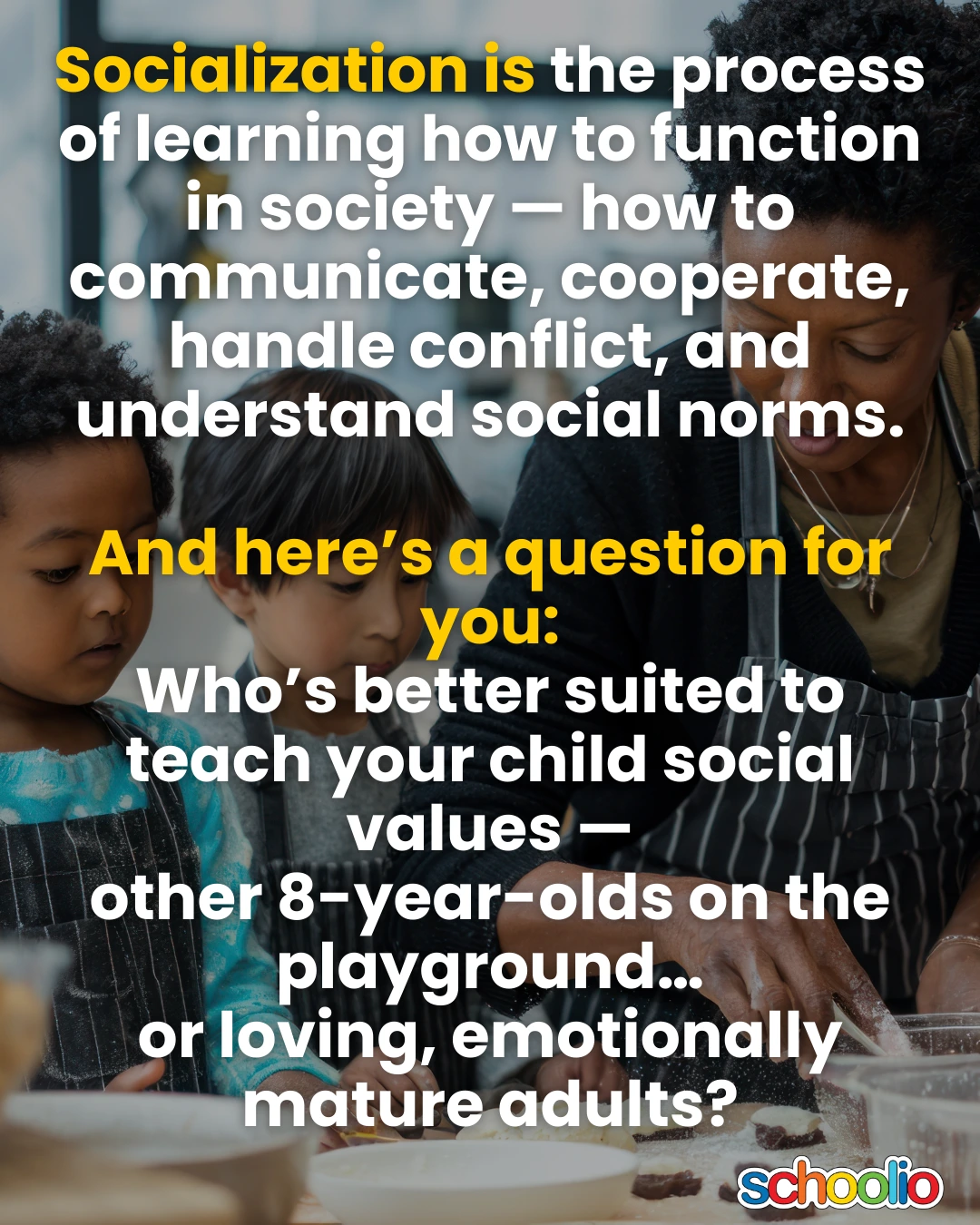
Socialization is the process of learning how to function in society — how to communicate, cooperate, handle conflict, and understand social norms.

And here’s a question for you:

Who’s better suited to teach your child social values —

other 8-year-olds on the playground…

or loving, emotionally mature adults?

When my child is at a homeschool event and has a conflict with a friend, they can come to me right away for support and coaching.

I help them understand the situation, plan a response, and reflect on how it went.

That means they’re learning social skills in real time, with guidance.

It’s not “helicopter parenting.” It’s real mentorship.

The result? Even very young homeschooled kids learn to resolve conflict with kindness and maturity.


? Homeschooled Teens Are (Surprise!) Really Cool

If you’ve ever had a full conversation with a homeschooled teen, you know what I mean.

They’re articulate.

Confident.

Curious.

Engaging.

Not sullen or withdrawn. Not afraid to talk to adults. Not obsessed with fitting in. Just… lovely humans.

No weird stereotypes. No Stepford vibes. Just kids who’ve had space to grow up at their own pace, in their own way.


? Public School Culture Is Not the Social Utopia People Think It Is

Yes, some kids enjoy the social side of school.

But many don’t — and for good reason.

Here’s what socialization looks like in most public schools:

  • Friend groups sorted by birth year only (not interest or personality)
  • Pressure to conform or risk bullying and isolation
  • Toxic norms that teach kids not to trust or confide in adults
  • A culture where “fitting in” > being yourself

Even kids who succeed socially often do so by constantly managing their behavior to meet those unwritten rules — and it’s exhausting.

We wonder why so many kids are anxious. But is it any surprise when the stakes of every interaction feel this high?


?‍♀️ “But School Prepares Them for the Real World…”

Here’s the thing:

Being trapped in a toxic environment with no way out is not “real world prep.”

Yes, adults deal with difficult coworkers. But as adults, we have:

  • Control over our environment
  • Emotional regulation
  • Resources
  • Options

Children don’t.

When a kid is being bullied at school, school is their entire world.

They often feel trapped, unsupported, and completely alone.

That’s not “character building.” That’s trauma.


✅ So Let’s Wrap It Up

Do my kids socialize? Yes. Joyfully, regularly, and with a diverse group of friends.

Are they socialized? Yes. In ways that are healthy, supported, and guided by loving adults.

And honestly?

They’re thriving — not despite homeschooling, but because of it.


Lindsey

Certified Special Ed Educator & Co-Founder, Schoolio

Homeschooling Isn’t a Competition — It’s an Alignment

Homeschooling Isn’t a Competition — It’s an Alignment


I saw this passage today and it hit me hard.


Your life will change when you understand this


“You are only ever competing against one thing — your own self-doubt.”

When I think about homeschooling families, this couldn’t be more true.

So many parents start this journey filled with doubt. Am I enough? Am I doing it right? What if my child falls behind?
But the families who thrive — the ones I see at Schoolio every day — aren’t necessarily the most organized, experienced, or well-resourced.

They’re simply the ones who believe they can do this.

Who trust that learning at home, in their own rhythm, is enough.
They drop the competition mindset. They stop comparing their kids to traditional classrooms. They stop chasing grades and start building connection.

Homeschooling isn’t about outperforming anyone. It’s about aligning — with your child, your values, and the kind of life you want to build together.

When families stop trying to “fit in” and start trusting themselves, everything changes.
What you seek — confidence, peace, connection — is already seeking you.

Sathish
Still learning, still unlearning

“Not Educable”? Or Just Not Understood?

“Not Educable”? Or Just Not Understood?


This has been on my mind today…


I was in a private “teachers only” Facebook group recently — don’t ask me how I got in ? — and one comment stopped me cold.

“Some of these kids just aren’t educable.”

It triggered me. Deeply.

Because I’ve been that kid.

Because I’ve raised a child labeled “lazy” for not learning the way others expected.

Because I’ve built a company, Schoolio, for the very kids traditional systems are too quick to write off.

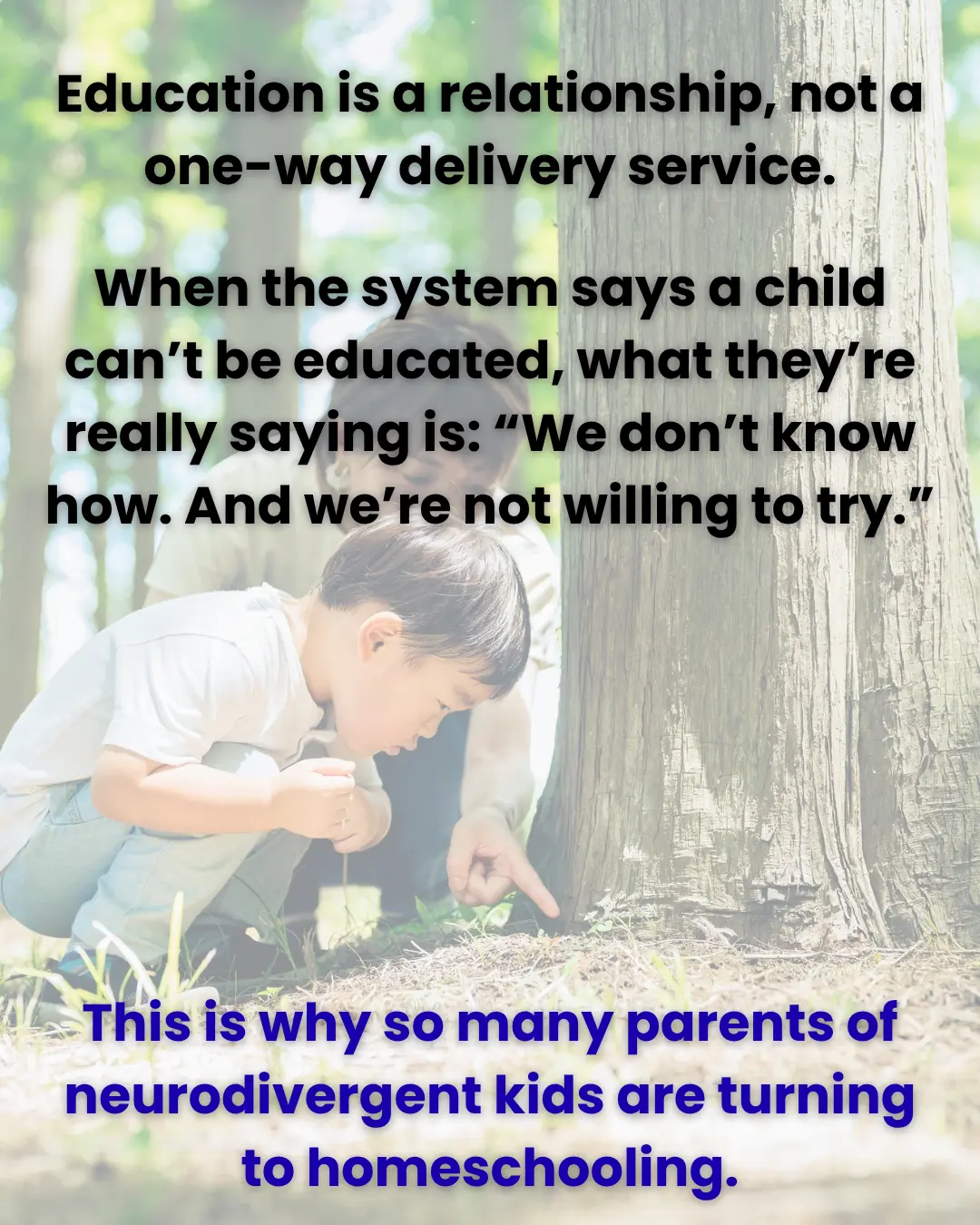
When a teacher — someone trained to unlock potential — says a child can’t be educated, what they’re really saying is: “I don’t know how. And I’m not willing to try.” But no child is uneducable. Some are misunderstood.

Some are neurodivergent.

Some are traumatized.

Some are learning in a way you weren’t trained to see.

Education is a relationship, not a one-way delivery service. It’s not just about curriculum — it’s about care, creativity, and compassion.

What we can’t do is confuse a system’s failure with a child’s inability. The system was never designed to serve every child — especially those who learn differently.

And that’s why Schoolio exists.

We don’t believe in “bad kids.”

We believe in bad assumptions, outdated frameworks, and a desperate need for empathy in education. Because when you tell a child they’re uneducable, you’re not describing them — you’re indicting yourself.

So the next time a student struggles… pause.

Ask what’s missing.

Ask how you can adapt.

Ask what support might unlock their potential.

Because learning isn’t a light switch. It’s a spark. You just have to be willing to see it.


Sathish
Still learning, still unlearning


Homeschooling Parent- The Quietly Bold

Homeschooling Parent- The Quietly Bold


Fortune favors the bold.

Not the loudest.

Not the most perfect.

Not the ones with the most polished plans.

The bold.

The parent who pulls their kid out of a system everyone else still trusts.

The parent who chooses connection over conformity.

Flexibility over tradition.

Peace over pressure.

I’ve met hundreds of these parents. Quietly bold.

No parade. No validation. Just a gut feeling that this was right for their child.

They didn’t wait for permission.

They didn’t wait for the school to change.

They made the change themselves.

And the result? That’s the “fortune” part.

Kids who smile again.

Kids who ask questions again.

Kids who don’t hate learning.

Kids who feel seen.

We get asked all the time: “Is homeschooling a risk?”

Yes. So is sending your child into a system that doesn’t fit. Both paths take boldness. One just gives you more control.

This is why I believe in homeschooling.

This is why I believe in Schoolio.

Not because it’s trendy. Not because it’s perfect. But because it puts the child back at the center — and trusts the parent to lead.

Fortune favors the bold.

If you’ve made the leap, you already know.

If you’re on the edge, maybe this is your sign.


Sathish

still learning, still unlearning

One of Homeschooling Quietest Strengths

One of Homeschooling Quietest Strengths


By Lindsey Casselman, special-ed teacher & homeschooling mom


When I first started homeschooling, I thought a “good homeschooler” had a tidy schedule. Wake up at 8, lessons by 9, neat little blocks of math, reading, and science lined up like ducks in a row.

But then reality stepped in: my kids aren’t ducks, and neither am I.

What I learned over time — and what research keeps confirming — is that one of the most powerful tools we have in homeschooling is also the simplest: sleep.

In traditional school, kids are often shaken awake by alarms, rushed through breakfast, dressed half-asleep, and hustled out the door before their brains have even had a chance to fully wake up. I remember my own school mornings feeling like chaos in fast-forward. But homeschooling gave us the freedom to slow down, and that’s when I noticed something life-changing.

Well-rested kids don’t just learn better. They feel better. They laugh more. They regulate their emotions more easily. They can focus longer, without the constant battle against exhaustion. Science tells us sleep is not laziness — it’s learning in disguise. It’s when the brain is literally growing, making connections, and preparing itself for curiosity.


Here’s what that looked like in our homeschool:

  • Starting the day when my kids naturally woke up, not when a bus schedule dictated.
  • Protecting rest days after big field trips, instead of pushing through.
  • Building gentle morning and bedtime rhythms so transitions felt calming, not chaotic.
  • Letting rest be part of the curriculum, because restoration fuels curiosity.

And here’s the best part: this isn’t “falling behind.” It’s moving forward in a way that honors kids as whole humans — body, mind, and spirit.

So maybe the question isn’t, “Am I doing enough school hours?”

Maybe it’s, “Am I giving my child enough rest to flourish?”

Because the truth is, flexible sleep schedules aren’t a weakness of homeschooling. They’re one of its greatest strengths.


? Lindsey

Certified Special-Ed Educator & Co-Founder, Schoolio