What Is Time Blindness and Time Optimism? (And Why Your ADHD Child Isn’t “Late on Purpose”)
Have you ever said:
“We’re leaving in ten minutes.”
And your child hears it… nods… and then somehow starts a brand new LEGO build?
Or you ask how long their math will take and they confidently say, “Five minutes,” and forty-five minutes later they’re still halfway through?
Or they’re shocked — genuinely shocked — that it’s already bedtime?
That’s not laziness.
That’s not defiance.
That’s very often time blindness.
What Is Time Blindness?
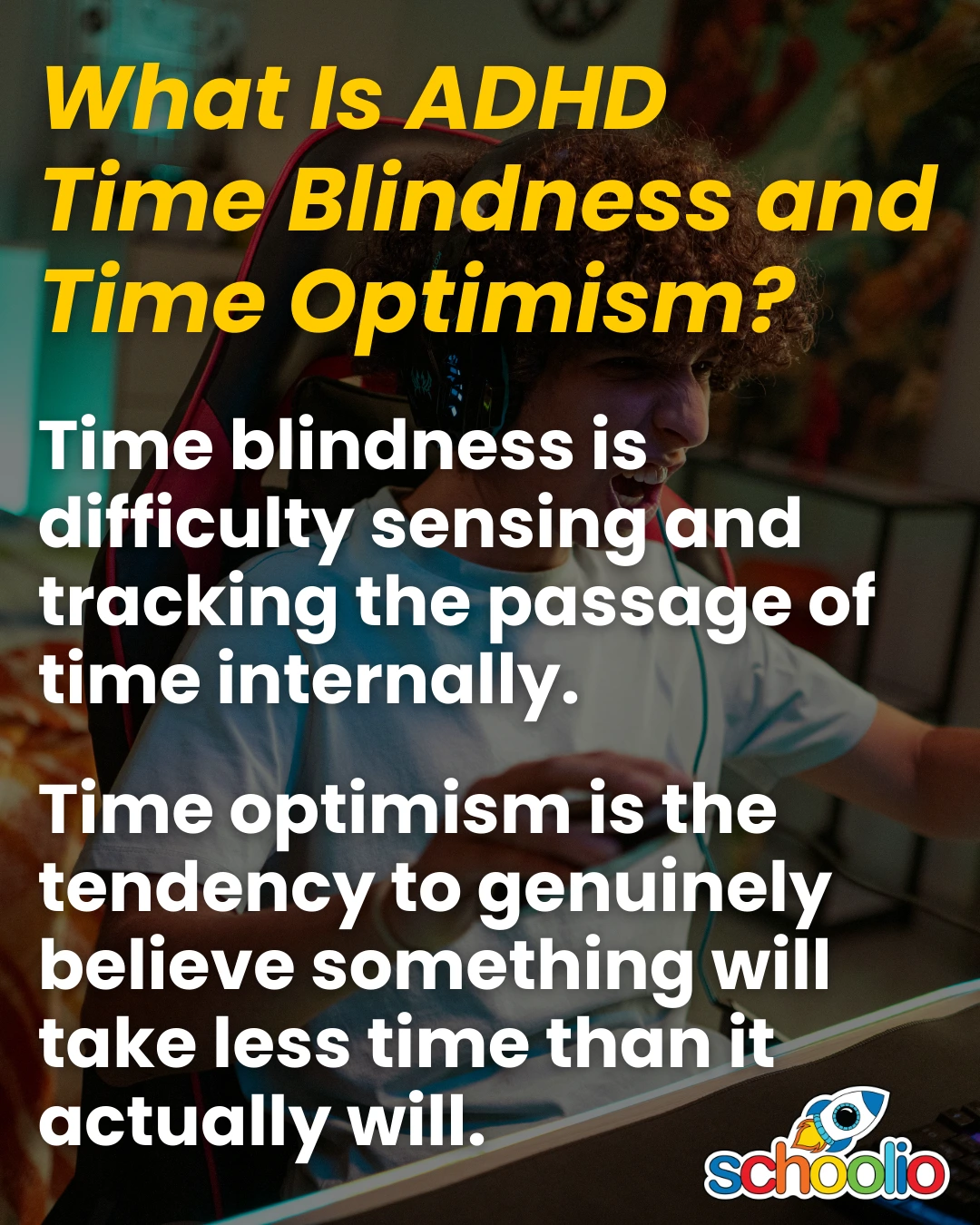
Time blindness is the difficulty sensing and tracking the passage of time internally.
For many ADHDers, time does not feel linear.
It feels like:
Now
Not Now
That’s it.
Five minutes and fifty minutes can feel almost identical without external cues.
An hour can disappear in hyperfocus.
Ten minutes can feel unbearably long when doing something boring.
Time blindness is tied to executive functioning and working memory — both of which are heavily impacted in ADHD brains.
If working memory is the “mental sticky note” that keeps track of what you’re doing and how long you’ve been doing it, ADHD brains often have much weaker glue.
So the brain loses track.
Not because they don’t care.
Because they can’t feel it.
What Is Time Optimism?
Time optimism is the cheerful cousin of time blindness.
It’s the tendency to genuinely believe something will take less time than it actually will.
“I’ll clean my room in 10 minutes.”
“I can finish this before dinner.”
“I have tons of time.”
It’s not lying.
It’s not manipulation.
It’s an executive projection issue.
ADHD brains often struggle with future simulation — accurately picturing how long tasks require.
Add in dopamine-driven motivation (which rises when something is exciting and plummets when it’s not), and you get wildly inaccurate time estimates.
If the task feels easy in their head, they assume it will be quick.
The brain isn’t calculating past experience consistently.
It’s guessing.
Optimistically.
Is This Just an ADHD Thing?
Time blindness and time optimism are most strongly associated with ADHD because they’re rooted in executive function and dopamine regulation.
That said, autistic kids can also struggle with time — but usually for different reasons.
An autistic child may:
- hyperfocus and lose track of time
- struggle with transitions
- feel distress when routines shift
- have difficulty estimating task-switching effort
But their experience of time is often more about rigidity or deep focus than about an internal inability to sense its passing.
In ADHD, time itself feels slippery.
In autism, time may feel predictable but transitions feel destabilizing.
If your child is both ADHD and autistic, you may see both patterns layered together.
What Time Blindness Looks Like at Home
It can look like:
- Chronic lateness — even when they’re trying.
- Starting huge projects right before leaving the house.
- Being confused about how long homework takes.
- Struggling to pace themselves.
- Forgetting how much time has already passed.
- Underestimating transitions.
And here’s the hard part:
To the outside world, this looks like irresponsibility.
To the ADHD brain, it feels like confusion.
Why Punishment Doesn’t Fix It
If a child could “try harder” to feel time, they would.
Time blindness isn’t solved by:
- scolding
- shame
- “you need to be more responsible”
- taking away privileges
Because the issue isn’t motivation.
It’s perception.
You wouldn’t punish a child for being near-sighted.
Time blindness is similar — except it’s temporal.
What Actually Helps
Externalizing time.
ADHD brains often need time to be visible and tangible.
- Timers.
- Visual clocks.
- Countdowns.
- Written schedules.
- Auditory reminders.
- Chunking tasks with defined breaks.
Instead of saying, “We’re leaving soon,” try:
“We’re leaving in 15 minutes. I’m setting a 10-minute timer, and then a 5-minute warning.”
Instead of, “How long will that take?” try:
“Last time this took 40 minutes. Let’s plan for that.”
Instead of assuming they’re careless, assume they’re time-blind.
That shift changes your tone immediately.
The Bigger Picture
Time blindness and time optimism don’t mean your child is unreliable.
They mean their brain doesn’t automatically track duration the way neurotypical brains do.
And when we stop treating it like a character flaw and start treating it like a neurological difference, something softens.
We move from: “Why are you like this?”
To: “How can we support this?”
That’s where real change starts.
? Lindsey
certified special-ed educator, homeschool mom, & co-founder of Schoolio