What Is Time Blindness and Time Optimism? (And Why Your ADHD Child Isn’t “Late on Purpose”)

What Is Time Blindness and Time Optimism? (And Why Your ADHD Child Isn’t “Late on Purpose”)

Have you ever said:
“We’re leaving in ten minutes.”
And your child hears it… nods… and then somehow starts a brand new LEGO build?
Or you ask how long their math will take and they confidently say, “Five minutes,” and forty-five minutes later they’re still halfway through?
Or they’re shocked — genuinely shocked — that it’s already bedtime?
That’s not laziness.
That’s not defiance.
That’s very often time blindness.
What Is Time Blindness?
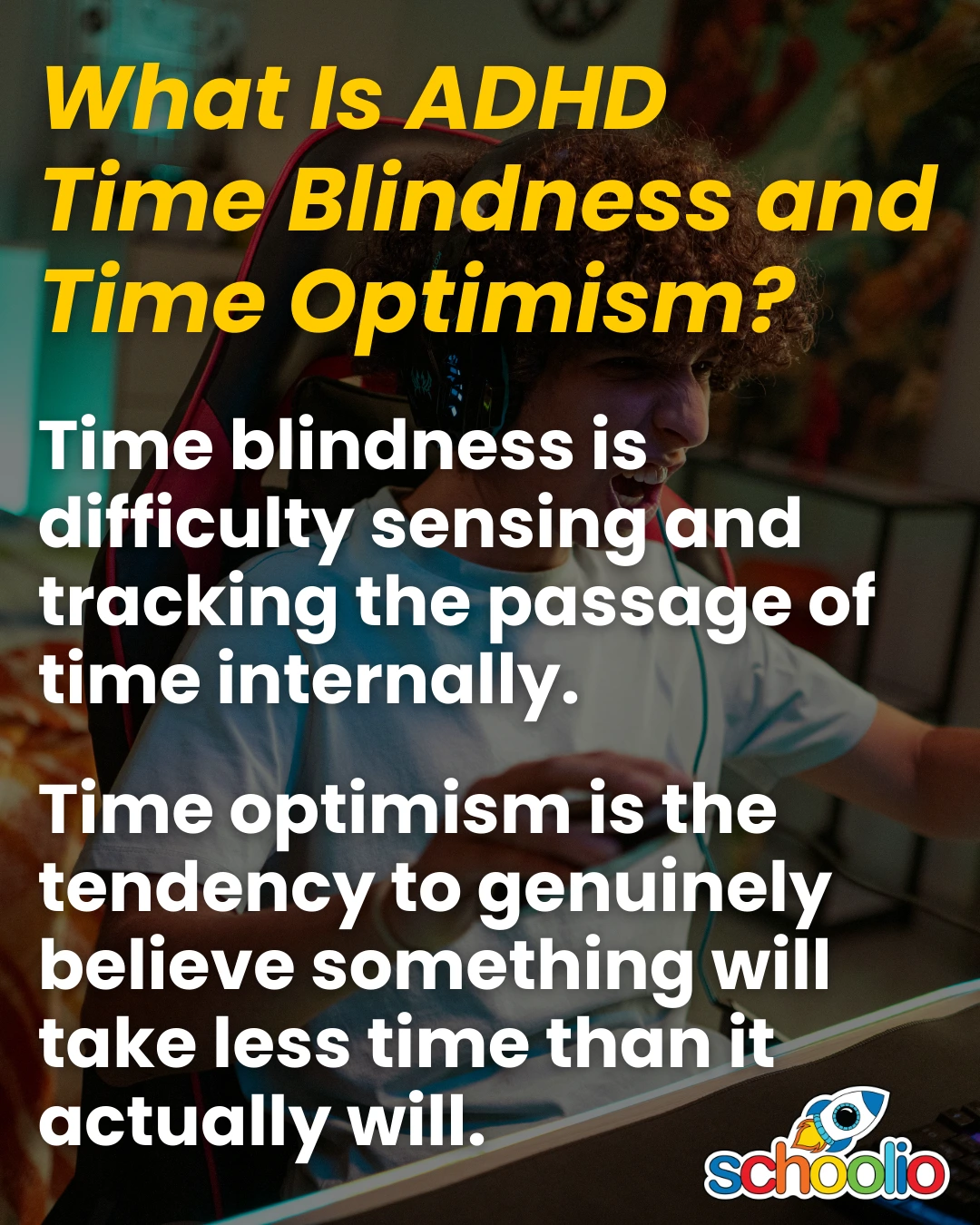
Time blindness is the difficulty sensing and tracking the passage of time internally.
For many ADHDers, time does not feel linear.
It feels like:
Now
Not Now
That’s it.
Five minutes and fifty minutes can feel almost identical without external cues.
An hour can disappear in hyperfocus.
Ten minutes can feel unbearably long when doing something boring.
Time blindness is tied to executive functioning and working memory — both of which are heavily impacted in ADHD brains.
If working memory is the “mental sticky note” that keeps track of what you’re doing and how long you’ve been doing it, ADHD brains often have much weaker glue.
So the brain loses track.
Not because they don’t care.
Because they can’t feel it.
What Is Time Optimism?
Time optimism is the cheerful cousin of time blindness.
It’s the tendency to genuinely believe something will take less time than it actually will.
“I’ll clean my room in 10 minutes.”
“I can finish this before dinner.”
“I have tons of time.”
It’s not lying.
It’s not manipulation.
It’s an executive projection issue.
ADHD brains often struggle with future simulation — accurately picturing how long tasks require.
Add in dopamine-driven motivation (which rises when something is exciting and plummets when it’s not), and you get wildly inaccurate time estimates.
If the task feels easy in their head, they assume it will be quick.
The brain isn’t calculating past experience consistently.
It’s guessing.
Optimistically.
Is This Just an ADHD Thing?
Time blindness and time optimism are most strongly associated with ADHD because they’re rooted in executive function and dopamine regulation.
That said, autistic kids can also struggle with time — but usually for different reasons.
An autistic child may:
  • hyperfocus and lose track of time
  • struggle with transitions
  • feel distress when routines shift
  • have difficulty estimating task-switching effort

But their experience of time is often more about rigidity or deep focus than about an internal inability to sense its passing.

In ADHD, time itself feels slippery.
In autism, time may feel predictable but transitions feel destabilizing.
If your child is both ADHD and autistic, you may see both patterns layered together.
What Time Blindness Looks Like at Home
It can look like:
  • Chronic lateness — even when they’re trying.
  • Starting huge projects right before leaving the house.
  • Being confused about how long homework takes.
  • Struggling to pace themselves.
  • Forgetting how much time has already passed.
  • Underestimating transitions.
And here’s the hard part:
To the outside world, this looks like irresponsibility.
To the ADHD brain, it feels like confusion.
Why Punishment Doesn’t Fix It
If a child could “try harder” to feel time, they would.
Time blindness isn’t solved by:
  • scolding
  • shame
  • “you need to be more responsible”
  • taking away privileges

Because the issue isn’t motivation.

It’s perception.
You wouldn’t punish a child for being near-sighted.
Time blindness is similar — except it’s temporal.
What Actually Helps
Externalizing time.
ADHD brains often need time to be visible and tangible.
  • Timers.
  • Visual clocks.
  • Countdowns.
  • Written schedules.
  • Auditory reminders.
  • Chunking tasks with defined breaks.
Instead of saying, “We’re leaving soon,” try:
“We’re leaving in 15 minutes. I’m setting a 10-minute timer, and then a 5-minute warning.”
Instead of, “How long will that take?” try:
“Last time this took 40 minutes. Let’s plan for that.”
Instead of assuming they’re careless, assume they’re time-blind.
That shift changes your tone immediately.
The Bigger Picture
Time blindness and time optimism don’t mean your child is unreliable.
They mean their brain doesn’t automatically track duration the way neurotypical brains do.
And when we stop treating it like a character flaw and start treating it like a neurological difference, something softens.
We move from: “Why are you like this?”
To: “How can we support this?”
That’s where real change starts.
? Lindsey
certified special-ed educator, homeschool mom, & co-founder of Schoolio

1 in 6 Families Cite Mental Health Needs as the Reason They Pulled Their Child Out of School

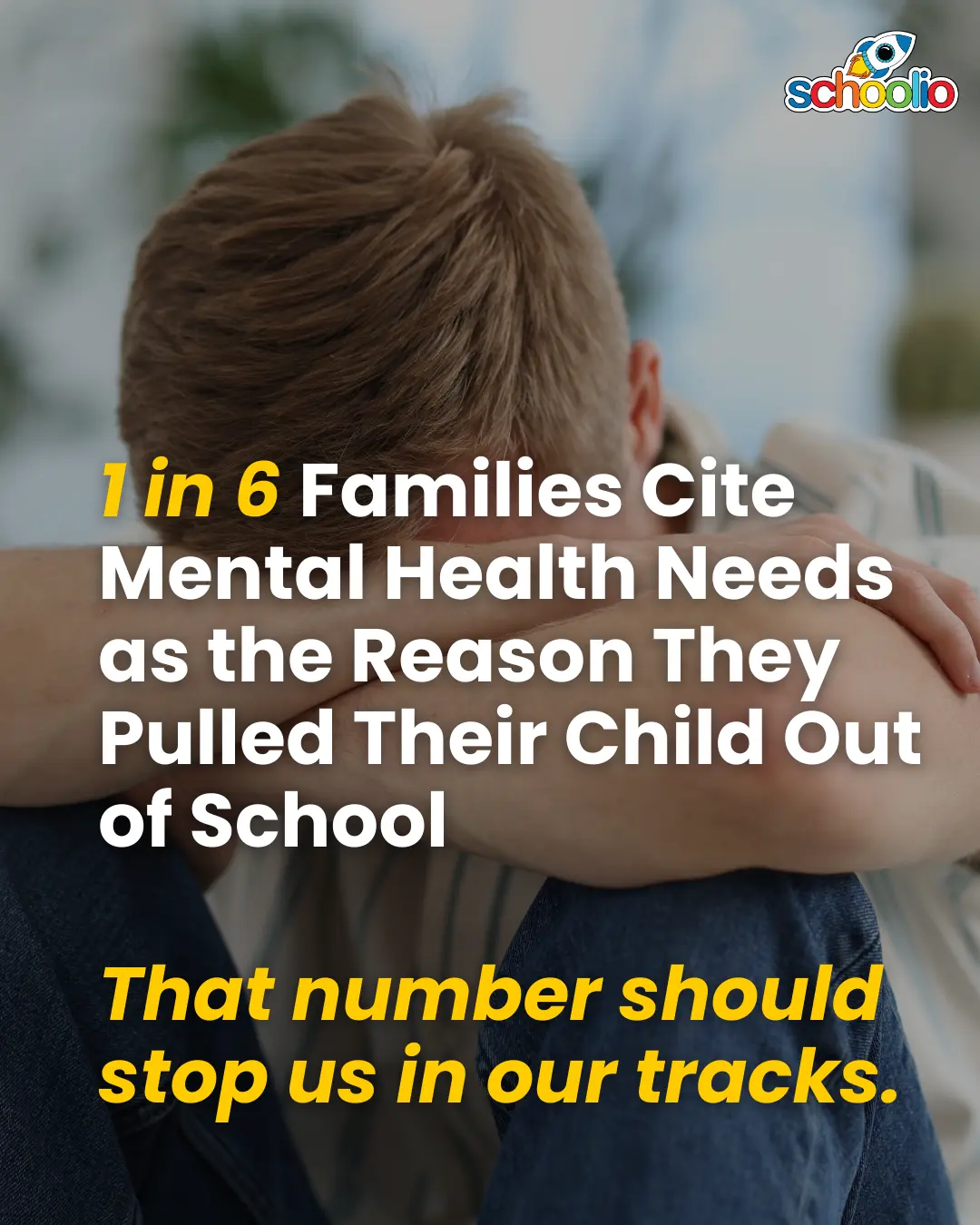
1 in 6 Families Cite Mental Health Needs as the Reason They Pulled Their Child Out of School


This has been on my mind today…

Mental health has quietly become the leading reason families are choosing homeschooling. Not ideology. Not religion. Not rebellion. Mental health.

According to new UK figures, more than 126,000 children were being taught at home last autumn, a 15 percent increase in a single year. One in six families cited psychological or mental health needs as the primary reason they pulled their child out of school.

That number should stop us in our tracks.

For years, homeschooling has been framed as a lifestyle choice. Something parents opt into because they want more flexibility or control. But this data tells a different story. For many families, homeschooling is a response.

A response to anxiety that does not fade.

A response to burnout in children who are barely ten.

A response to kids who once loved learning and now dread school mornings.

When parents say mental health, they are not talking about small discomforts. They are talking about panic before school. Emotional shutdown after class. Kids who are told they are fine because their grades look fine, even while they are struggling internally.

This is especially true for neurodivergent and highly sensitive kids. Children who feel the world more intensely. Noise. Pressure. Comparison. Speed. In systems designed for scale, these kids are often labeled difficult or behind. Over time, they internalize that message. The real loss is not academic. It is emotional.

One thing we see again and again is that children are rarely taught how to understand what is happening inside them. They are expected to manage big emotions without being given the language, tools, or space to do so. This is why emotional literacy matters just as much as reading or math.

When kids learn how to name their thoughts, understand their feelings, and recognize that emotions are information not failures, something shifts. Confidence starts to rebuild.

This is exactly why we created

Thoughts and Feelings

, a guided emotional learning book and curriculum at Schoolio. Not as therapy. Not as a fix. But as a way to help children slow down, reflect, and build self awareness in a world that keeps asking them to speed up. For many families, this kind of emotional groundwork becomes the bridge between surviving school and actually healing from it.

You can learn more about the Thoughts and Feelings program here:

https://schoolio.com/product/thoughtsfeelings/

Homeschooling, when done with care, is not hiding from the world. It is a pause. A reset. A chance to rebuild trust in learning and in oneself.

The rise in homeschooling should not be read as parents giving up on education. It should be read as parents stepping in when the system cannot meet their child where they are.

The real question is not why homeschooling is growing.

The real question is why so many children are struggling in silence.

Parent takeaway: If your child’s mental health is declining and you feel like you are constantly managing damage instead of supporting growth, you are not imagining it. Education should never come at the cost of emotional safety. Teaching kids how to understand their thoughts and feelings is not extra. It is foundational.

Source:
Sky News
https://news.sky.com/story/number-of-children-being-taught-at-home-increases-by-15-in-a-year-report-finds-13494608

When Homeschooling is Healing, Not “Fixing”

When Homeschooling is Healing, Not “Fixing”


This has been on my mind today…

There is a Japanese art form called kintsugi. When a bowl or cup breaks, it is not thrown away. The pieces are carefully put back together, and the cracks are filled with gold. The repair is not hidden. It is highlighted. The object becomes more valuable because it has been broken and repaired with care. The story becomes part of its beauty.

I think about that a lot when I reflect on my own life. I also think about it when I look at the families we support through homeschooling and the work we are building at Schoolio.

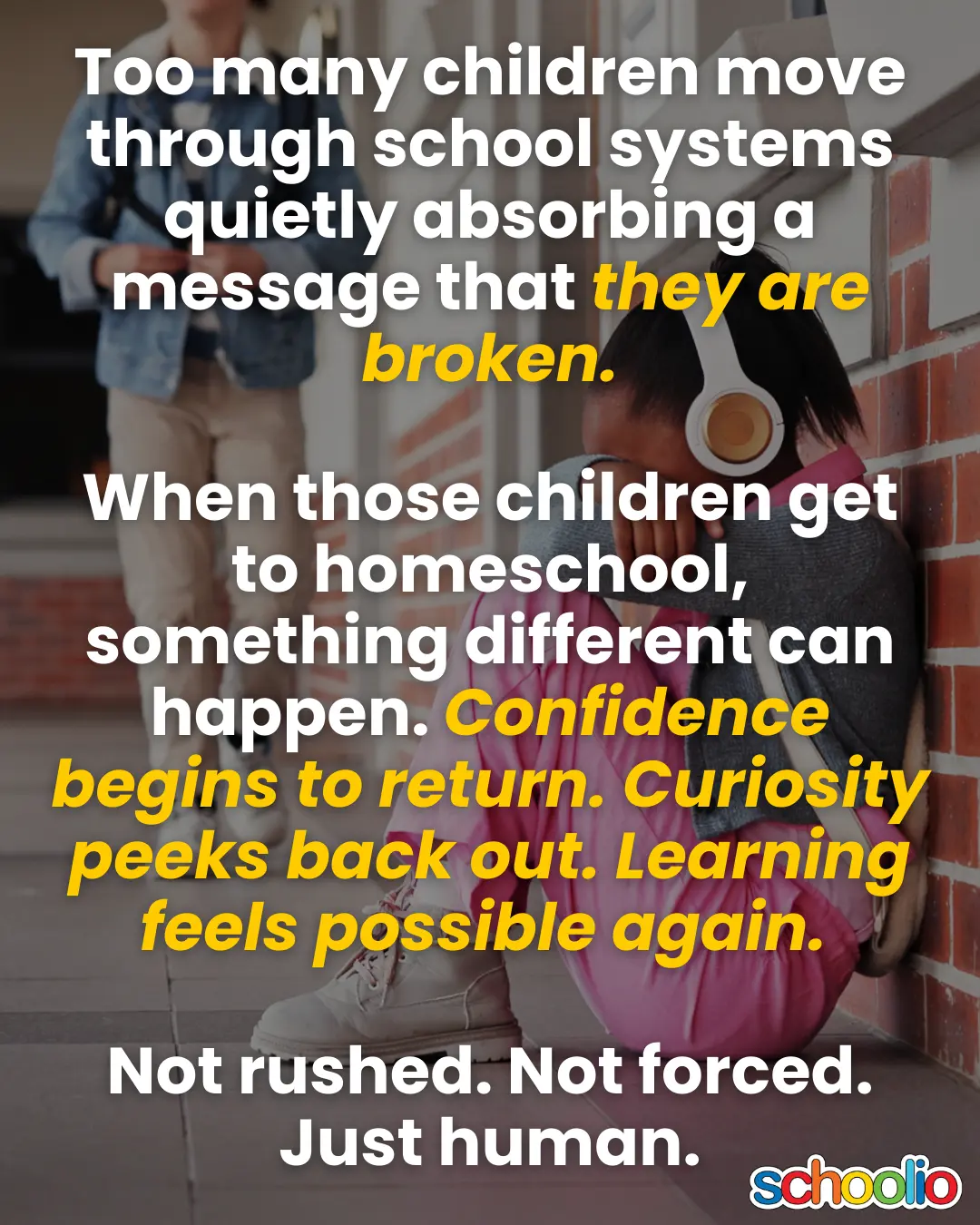
Too many children move through school systems quietly absorbing a message that they are broken. Not always through words, but through looks, labels, meetings, and expectations. They are told to sit still when their bodies want to move. To keep up when they need time. To fit into systems that were never designed for how they learn. Eventually, many of them begin to believe that something is wrong with them.

When those children come home, something different can happen. With patience, care, and attention, the pressure starts to lift. Confidence begins to return. Curiosity peeks back out. Learning feels possible again. Not rushed. Not forced. Just human.

But here is the part that matters most to me. Healing should never feel like hiding.

Homeschooling should not feel like punishment or retreat. It should not feel like we are sweeping children out of sight. It should feel like kintsugi. A celebration of the whole child. A recognition that learning differently does not mean learning less. It means learning in a way that honors who they are.

At schoolio, we see this every day. Children who were once labeled as struggling begin to thrive when the pressure is removed and the support is real. When learning adapts to them instead of asking them to adapt to it. When their cracks are not erased, but respected.

Every student who leaves a system that did not serve them carries an incredible story. Those cracks are not flaws. They are experiences. When they are filled with care, trust, and belief, something stronger is created. Something more meaningful than what existed before.

That is what homeschooling can be.

That is what schoolio is working toward.

Not fixing children, but honoring them.


Sathish

still learning, still unlearning

To the Weak, Everything Feels Like a Threat

To the Weak, Everything Feels Like a Threat


This has been on my mind today…


Every time education shifts forward, fear gets louder.

Teachers are angry that families are exploring alternatives during the Alberta strike. Some are even calling parents “disloyal” for turning to online resources. But let’s be honest — what else are families supposed to do when the system stops working?

The truth is, teachers are afraid. And I get it. They’ve been handed an impossible job inside a system that hasn’t evolved in 150 years. A system built for industrial workers, not creative thinkers. For compliance, not curiosity.

AI. Homeschooling. Microschools. Digital curriculum.

All of it is growing — fast.

And instead of seeing these tools as extensions of learning, too many educators see them as enemies.

Here’s the reality:

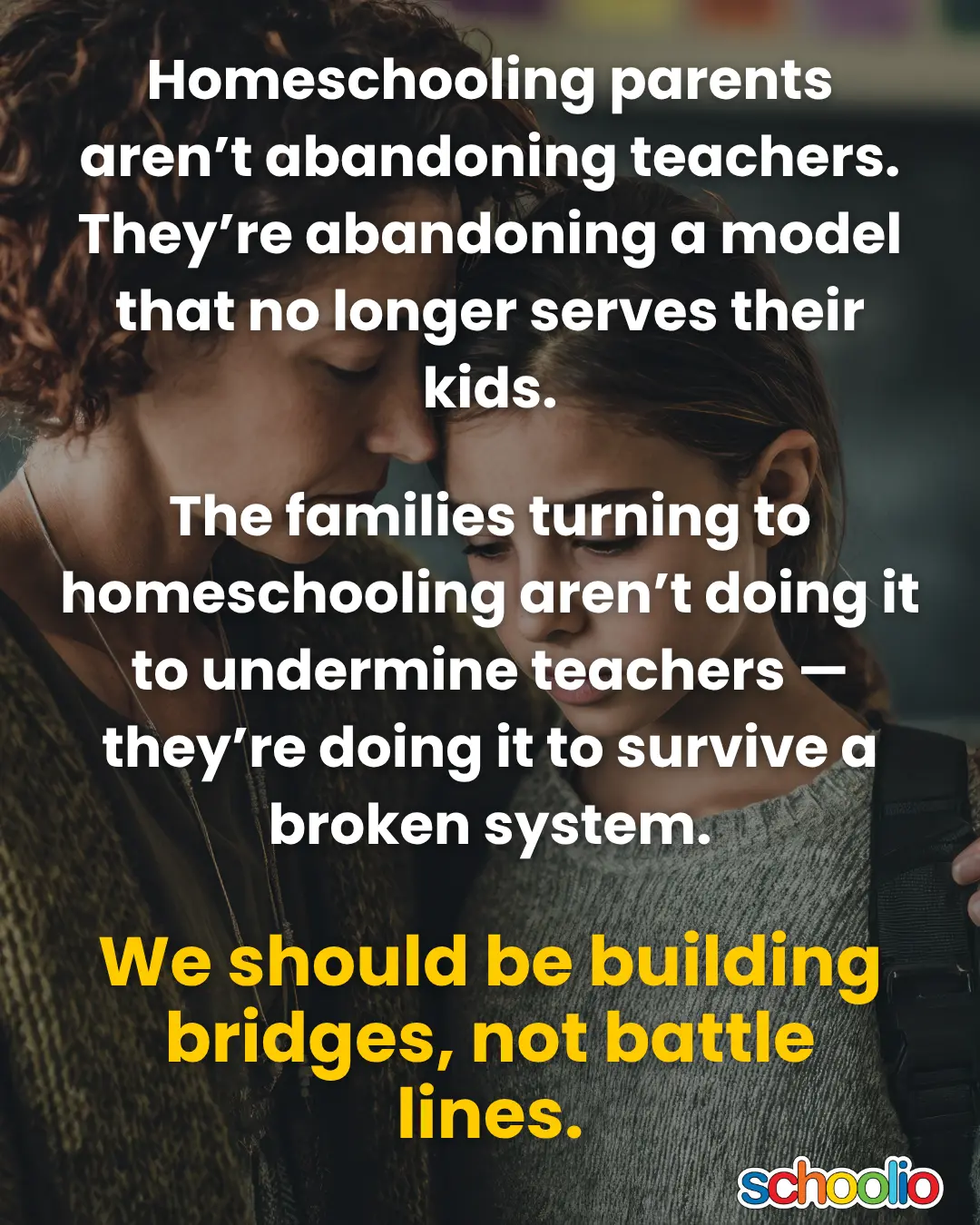
Parents aren’t abandoning teachers. They’re abandoning a model that no longer serves their kids.

Innovation in education isn’t an attack. It’s an answer.

The families turning to homeschooling or digital learning aren’t doing it to undermine teachers — they’re doing it to survive a broken system.

We should be building bridges, not battle lines.

Technology and teachers can coexist. But that requires courage — the kind that looks at change and says, “Let’s learn from it.”

Because the future of education won’t be built by those defending the old ways. It’ll be built by the ones bold enough to imagine new ones.

Alberta


Sathish
Still learning, still unlearning

Homeschooling Isn’t a Competition — It’s an Alignment

Homeschooling Isn’t a Competition — It’s an Alignment


I saw this passage today and it hit me hard.


Your life will change when you understand this


“You are only ever competing against one thing — your own self-doubt.”

When I think about homeschooling families, this couldn’t be more true.

So many parents start this journey filled with doubt. Am I enough? Am I doing it right? What if my child falls behind?
But the families who thrive — the ones I see at Schoolio every day — aren’t necessarily the most organized, experienced, or well-resourced.

They’re simply the ones who believe they can do this.

Who trust that learning at home, in their own rhythm, is enough.
They drop the competition mindset. They stop comparing their kids to traditional classrooms. They stop chasing grades and start building connection.

Homeschooling isn’t about outperforming anyone. It’s about aligning — with your child, your values, and the kind of life you want to build together.

When families stop trying to “fit in” and start trusting themselves, everything changes.
What you seek — confidence, peace, connection — is already seeking you.

Sathish
Still learning, still unlearning

Why I’m Not Worried About “Sheltering” My Homeschooled Kids

Why I’m Not Worried About “Sheltering” My Homeschooled Kids


This has been on my mind today…

I used to brace myself every time someone said it. You know the line.

“But aren’t you sheltering your kids from the real world?”

At first, I tried to explain. Then I tried to debate. Now? I just smile — because the truth is, yes, I am.

I’m sheltering them from the pressure to fit in before they even know who they are.

From being teased in the cafeteria because they don’t wear the right shoes or laugh at the same jokes.

From classrooms that push every child through the same mold, at the same speed, regardless of how they learn best.

But I’m also preparing them for the world. For the real one — not the one that pretends standardized tests and silent rows teach life skills.

In our home, we talk about kindness. We wrestle with questions. We fall apart and rebuild.

We learn how to fail and keep going. We learn how to speak up and when to listen. We learn that who we are as unique individuals is important… and awesome. We build resilience and confidence- so they’re really ready for the “real world.”

They learn how to handle conflict, talk to cashiers and librarians, make friends of all ages, and advocate for themselves. They practice empathy daily because it’s not just a word on a poster — it’s part of our lessons.

Is that sheltering? Maybe. But it’s also strengthening.

Because when my child walks out into the world, I want them to know who they are.

Not just what they’ve memorized. Not just what other kids or teachers have told them they are.

I want them to feel confident enough to speak, not just raise their hand for permission.

I want them to see difference and not fear it — to question and not crumble.

So yes, we’re doing school differently. That doesn’t mean we’re hiding.

It means we’re building something deeper.

Not a bubble — but a bridge. And we’ll cross it together when it’s time.


With love,

Lindsey

Certified Special Ed Educator & Co-Founder, Schoolio

Understanding ADHD Motivation in Kids: It’s Not Broken, Just Different

Understanding ADHD Motivation in Kids: It’s Not Broken, Just Different


“You just need to try harder.”
“If you’d only apply yourself.”
“You’d do it if you really wanted to.”

Sound familiar? If you’re raising or homeschooling an ADHD child, you’ve probably heard these words directed at them—or even caught yourself thinking them in moments of frustration. Unfortunately, our kids hear this kind of messaging a lot. In fact, research estimates that by age 12, ADHD children have heard around 20,000 more negative comments than their neurotypical peers.

That steady stream of criticism teaches ADHD kids that they’re lazy, unmotivated, or difficult. But here’s the truth: your child’s motivation isn’t broken. Their brain simply runs on a different operating system, and understanding how it works is the first step to helping them thrive.

How Motivation Works Differently in ADHD Brains

Neurotypical brains are generally motivated by rewards, consequences, and willpower. They can push through boring tasks because they know it will pay off in the end.

ADHD brains don’t respond to those motivators in the same way. Instead, their motivation is fueled by five unique drivers: urgency, novelty, interest, challenge, and purpose. When we try to push them with typical methods, it often backfires. But when we learn to work with their motivators, instead of against them, everything changes.

The 5 Key Motivators in ADHD Kids

1. Urgency

Ever notice your child suddenly works like a whirlwind right before a deadline—but can’t start two weeks earlier? That’s urgency at play. Their brain doesn’t register “later” as important—it needs “right now” to kick into gear.

How parents can help:

  • Break big tasks into smaller steps with shorter deadlines.

  • Use timers—turn chores into races.

  • Try body-doubling: sit beside them while you each work on something.

2. Novelty

ADHD kids thrive on newness. A new book, a new game, a new learning method? Instant focus. But once the shine wears off, their interest crashes. This isn’t stubbornness—it’s brain chemistry.

How parents can help:

  • Introduce small changes to routines (a new pen, studying in a new spot).

  • Rotate activities instead of relying on the same approach every day.

  • Lean into their love of trying new things—then build learning around it.

3. Interest

Have you ever been amazed at how your child can remember every detail of their favorite video game, but can’t recall what you just asked them to do? ADHD brains run on an interest-based nervous system. When they care, they can focus like a laser. When they don’t, it feels impossible to start.

How parents can help:

  • Connect “boring” tasks to your child’s passions.

    • Hate writing? Turn the essay into a comic strip or YouTube script.

    • Math struggles? Frame problems as Pokémon stats or Minecraft builds.

  • Let them dive deep into special interests—it strengthens focus muscles.

4. Challenge

Too easy = boring. Too hard = overwhelming. ADHD brains need the sweet spot in between, where a task feels like a puzzle to solve.

How parents can help:

  • Turn chores into challenges (“Can you beat yesterday’s cleanup time?”).

  • Use levels or point systems like a game.

  • Encourage self-competition, not competition with siblings or peers.

5. Purpose

Above all, ADHD kids need to know why they’re doing something. “Because I said so” rarely works. If a task feels meaningful, they can stick with it. If not, motivation evaporates.

How parents can help:

  • Reframe chores: cleaning a room = having a calmer, less stressful space.

  • Link schoolwork to goals they care about (Spanish = talking with new friends, watching shows without subtitles).

  • Talk about long-term benefits in a way that feels personal, not abstract.

Helping Your Child Feel Seen

When ADHD kids don’t respond to “normal” motivators, it’s not laziness—it’s wiring. And when they hear constant negative messages, it chips away at their confidence. But as a parent, you can flip the script.

By working with your child’s unique motivators—urgency, novelty, interest, challenge, and purpose—you’re not just helping them get through daily tasks. You’re teaching them how their brain works, building self-awareness, and showing them that their differences aren’t deficits.

Your child doesn’t need to “try harder.” They need to try differently—and they need adults who understand how to guide them there.

When Science Turned Into a Betta Fish

When Science Turned Into a Betta Fish


By Lindsey Casselman, special-ed teacher & homeschooling mom


One of the things I love most about homeschooling is how easily learning can connect to real life. Sometimes the best projects don’t come from a curriculum guide — they come from your child’s heart.

When my daughter was seven, she desperately wanted a Betta fish. Like many parents, my first instinct was to say, “That’s a lot of responsibility — are you sure you’re ready for that?” But instead of just saying no, I turned it into an opportunity for learning.

We made it her science project. She had to create the classic tri-board presentation — research, write, and present — all about Betta fish. She learned where they live in the wild, what they eat, how to set up the right tank environment, and common mistakes people make in caring for them. But the project didn’t stop at facts. She also had to make the case for why she was ready to take care of one.

I’ll never forget watching her stand in front of that board, confidently explaining filtration systems, water temperatures, and feeding schedules. This wasn’t just a science lesson anymore. It was research skills. Public speaking. Persuasive writing. Responsibility.

And it was driven entirely by her motivation. Because she wanted that fish, she owned the project. She went deeper than she would have if I had assigned “Chapter 3: Aquatic Life.” She wasn’t just doing school — she was preparing for real life.

In the end, she did get her Betta fish. But honestly, the project itself was the real win. She learned that with research and preparation, she could rise to a challenge. And I learned (again) that homeschool doesn’t have to follow someone else’s script to be powerful.

And apparently, I also set a precedent in our house without realizing it. Fast forward a few years, and Grace — now 13 — wanted a new pet. Out of nowhere, I found myself sitting on the couch watching a full PowerPoint presentation on why she should be allowed to get a snake. I hadn’t asked for it, and I hadn’t suggested it. She just knew she needed to convince me in a smart and prepared way.

So fair warning: this approach works beautifully for learning… but it may also get you into more pets than you imagined! ?

? Lindsey

Certified Special-Ed Educator & Co-Founder, Schoolio

When I Realized My Child’s Learning Style Didn’t Match My Own

When I Realized My Child’s Learning Style Didn’t Match My Own

By Lindsey, certified special-ed educator & co-founder, Schoolio


This has been on my mind today…

When I first started homeschooling, I assumed my kids would learn the way I learn. That’s the default, right? We teach from our own perspective. But it didn’t take long for me to realize their learning styles—and their needs—were very different from mine.

I’m ADHD. I thrive on novelty, challenge, and curiosity. I love going out, seeing people, doing things. My brain comes alive when there’s energy in the room. Planning homeschool field trips, events, parties, and mom meet-ups? That gave me life. I thought it would do the same for my kids.

But my kids are autistic. They enjoy their friends, yes—but in small doses, one-on-one, in familiar settings. Big group outings didn’t energize them the way they did me. They drained them. Where I walked away buzzing with energy, they walked away needing quiet, calm, and time to recover.

It was the same in our learning space. I always wanted music playing, stimulation in the background. They wanted silence. I craved variety and spontaneity. They needed consistent, reliable routines. I thrived on the excitement of new challenges. They thrived on knowing what to expect.

At first, I resisted that difference. I kept thinking, but this is how I learn best—shouldn’t it work for them too? When it didn’t, I felt frustrated. But slowly, I realized I had it backwards. My job wasn’t to shape them into my rhythm. It was to honor theirs.

That shift changed everything.

I began planning fewer big events and focusing on more intentional one-on-one time with friends. Instead of background noise, I chose quiet. Our homeschool days gained more rhythm and held fewer surprises. Along the way, I learned how to stretch myself to meet their needs, and gently taught them to stretch a little too—tolerating small bits of novelty, practicing compromise, and knowing it was okay to ask for quiet whenever they needed it.

Homeschooling taught me as much about myself as it did about them. It reminded me that love often looks like adjusting our pace, our preferences, and our expectations—not forcing someone else into our mold.

And it gave me this truth:

We don’t have to learn the same way to learn together.

Why Different Isn’t Wrong

Why Different Isn’t Wrong

I’ve been called a lot of things growing up. Dumb. Stupid. Social butterfly. But the one that stuck with me the most was weird. That word followed me through school hallways, into classrooms, and even outside of school. Most of the time, people didn’t say it to hurt me. They just didn’t understand me. I saw the world differently, noticed things others didn’t, and asked questions that didn’t have simple answers. And I wasn’t trying to fit in. I just didn’t feel like I needed to.

For a long time, I thought being different meant something was wrong with me. I believed the labels. I thought maybe I really was all those things. But over time, I began to realize that the problem wasn’t me. People often label what they can’t understand. It helps them feel like they’ve figured something out. Like sorting clothes into piles when you don’t know where something belongs. It doesn’t mean the clothes are bad. It just means you’re not sure where they fit.

As I got closer to the families who use Schoolio, I started to see pieces of myself in the children they were teaching. I saw it in the kids who struggled to sit still. In the ones who asked more questions than most teachers had time to answer. In the learners who didn’t follow the same path as everyone else. These kids weren’t broken or difficult. They were just full of a different kind of energy. The kind that doesn’t always show up the way school expects it to.

And the parents who choose to homeschool these children are some of the bravest people I’ve met. They don’t take the easy path and don’t choose homeschooling because it’s convenient. Parents do it because they want their child to feel seen and because they believe there’s more than one way to learn. They do it because their child needs something different, and they’re willing to build it themselves.

I think about how far I’ve come. From the kid who didn’t fit in, to someone who gets to support other kids who feel the same way. It’s not about fixing them—it’s about walking alongside them. Being different isn’t something to hide; it’s a part of who they are. And most of all, it’s something to be proud of.

At Schoolio, we get to be a small part of that journey. We get to help children feel understood. And we get to remind parents that their choice to take the road less travelled matters. Because sometimes, that road leads to the most incredible places.


Sathish

still learning, still unlearning

The Harder Path Forward

The Harder Path Forward


customer feedback

I didn’t understand the courage it took until years later.

When my family immigrated to Canada, I was angry. I didn’t have the words for it at the time, but every part of me resisted this new life. I missed my friends, my neighbourhood, my routines. I was a teenager lost between two worlds—resentful of the change, and confused by the silence I had to carry with me in every classroom, every hallway, every awkward introduction.

People looked at me differently. Sometimes with curiosity, sometimes with judgment, but always with the weight of assumptions I hadn’t earned. The stereotypes followed me. So did the loneliness.

Back then, I thought my parents were wrong. I thought they didn’t understand what I had lost. But as I grew older—became a parent, built a life, listened to others—I began to see the truth I’d missed entirely.


It wasn’t an escape. It was a sacrifice.


They had uprooted everything they knew for a sliver of possibility—a better education, a safer life, a shot at something bigger than what we’d left behind. And they did it quietly. Without recognition. Without thanks. Without certainty. Just faith.

That story echoes again and again in the lives of homeschooling families we meet at Schoolio. While the world rushes to label them—too radical, too soft, too unqualified—what we see is something different. We see courage. We see parents choosing a harder path, not because it’s easier, but because it’s right for their child.

It’s not a summer experiment. It’s not a last resort. It’s a quiet, determined rebellion against a system that no longer fits.

And here’s the question we rarely stop to ask: if the traditional school system—funded, structured, and normalized—is so perfect, why are so many parents choosing to leave it behind?

Why are they willing to rebuild an entire learning experience from scratch?


Because sometimes love means walking uphill.


At Schoolio, we don’t see homeschoolers as fringe or fearful. We see them as architects of something new. Builders of bridges their children can walk across safely. Parents who are saying, “I will not wait for the world to catch up. I’ll start right here.”

And for those of us who have walked a harder path before, we know exactly how much strength that takes.

Sathish
still learning, still unlearning

But I Don’t Remember Any of What I Learned in School!

Why You Don’t Need to Be Afraid of the Things You Don’t Know in Homeschooling


One thing I hear often from parents worried about whether they are “capable” of homeschooling is this idea that you have to remember everything you were ever taught in school in order to teach it.

That’s way too much to expect of yourself. Studies show that as adults, we **only use about 37% of what we learned in school.** Why would we retain the rest? We don’t. And yet, we do just fine.

But here’s the good news: you don’t need to remember everything to be able to teach your kids. To explain, let me take you back to when your child was a toddler and it was time for potty training.

When you taught your child to use the toilet, how did you know how to teach them? Did you think back to how you were potty trained? Did you remember exact instructions your parents gave you? Of course not. Most of us don’t even remember that age, let alone the details.

So how were you “qualified” to teach your child to use the toilet?

Because you knew how to figure out how — and you had tools.

First, you probably took some time to teach yourself how to teach it. Maybe you read a book. Maybe you hit up some parenting blogs, or watched YouTube videos. Maybe you asked a friend or family member who had done it before. In this day and age there is no limit to the information available to us- you can be taught and learn to teach absolutely any skill you choose.

Second, you probably accessed some tools to support you while you taught it. Maybe you purchased a kids book about using the potty to read to your child. Maybe you found a tv show for your child to watch that instructed them for you. Maybe you bought a kids’ potty to make it more accessible for them.

Most likely, you used a combination of resources!

And then you tried.

You experimented. You considered your family needs and lifestyle, and your child’s uniqueness and what would inspire and motivate them. You looked at what was working and what wasn’t, and you made adjustments. Maybe your first attempts didn’t work for your child. You learned more about how your child learns, or what motivates them, so then you tried something else. Eventually something clicked.

For some kids it happens quickly, for others it’s a long and messy process. Maybe you even thought you were failing at times. But at the end of the day, they figured it out — because you stayed with them through the process.

And when all our kids are grown, no one will care whether they were potty trained at 14 months or 3½ years. They all learned what they needed to know, in their own time.

Homeschooling is the same.

You don’t have to know algebra or remember the dates of every war. You just need to be willing to learn alongside your child, model teaching yourself things you need to know, find tools that work, and make adjustments as you go.

Most of all, you just need to be present with your child through the process.

Because just like with potty training, the most important thing your child carries forward isn’t just the skill itself — it’s how they felt while learning it with you. The connection, the encouragement, the bond. That’s what lasts.

? Lindsey

Certified Special-Ed Educator & Co-Founder, Schoolio