Unlocking the Benefits of Online Learning: Why the Schoolio Learning Platform is a Game-Changer

TL;DR – Quick Answer:
Unlocking the Benefits of Online Learning: Why the Schoolio Learning Platform is a Game-Changer offers significant advantages for homeschooling families by prioritizing individual learning styles and flexibility. Our community of over 10,000 Schoolio families demonstrates that a personalized, neurodiversity-affirming approach is the key to academic success and emotional well-being.

The benefits of online learning extend far beyond simple convenience, offering a 40-60% time-saving advantage over traditional classroom settings. By utilizing the Schoolio Digital Learning Platform, families can access personalized Grade 1-8 curriculum, interactive video lessons, and real-time emotional tracking via VibeCheck. Shifting to an online-first model allows homeschooling parents to move from a lecturer role to a supportive coaching role, fostering academic mastery and emotional regulation.

Online learning, often referred to as e-learning, has revolutionized education, providing learners of all ages with a flexible and customizable pathway to success. This transformation is exemplified by the Schoolio Digital Learning Platform, which excels in delivering an exceptional online education experience tailored specifically for the modern homeschooling family. By unlocking the benefits of online learning, parents can move from being the ‘primary lecturer’ to the ‘supportive coach,’ reducing burnout while accelerating their child’s academic growth.

Transitioning to a digital-first homeschooling model isn’t just about moving worksheets to a screen; it’s about leveraging technology to create a more efficient, engaging, and emotionally regulated learning environment. According to a Brandon-Hall Study, online learning typically demands 40-60% less time than traditional classroom learning for the same material, allowing families to reclaim their most valuable resource: time.

1. Flexibility and Extreme Convenience

One of the primary benefits of online learning is the ability to access educational content whenever and wherever suits your family best. With the Schoolio Digital platform, this convenience is taken to the next level. Learners can engage with interactive video lessons, assessments, and digital worksheets on their own terms. This flexibility is a game-changer for families who travel, participate in competitive sports, or simply prefer a non-traditional daily rhythm.

2. Personalized Learning at Scale

Tailoring education to individual needs is crucial in today’s diverse educational landscape. The Schoolio Learning Platform offers a fully customizable experience, ensuring that every student can progress at their own pace and level across Grades 1-8. Whether your child needs to ‘mix-and-match’ grade levels for different subjects or spend extra time mastering a specific concept, the digital platform adapts to their unique neurological wiring.

3. Emotional Intelligence with VibeCheck

Keeping track of a student’s emotional well-being is just as important as monitoring their math scores. Schoolio incorporates ‘VibeCheck,’ a groundbreaking feature that allows parents to gauge a child’s emotional state before, during, and after lessons. This tool helps prevent after-school restraint collapse and ensures that the learning environment remains neurodiversity-affirming and supportive.

4. Captivating Interactive Video Lessons

Passive learning is the enemy of retention, especially for children with ADHD. Schoolio’s interactive video lessons are designed to captivate young minds, turning complex concepts into exciting adventures. These videos provide the ‘external instruction’ needed to remove power struggles between parent and child, as the video becomes the teacher and the parent becomes the cheerleader.

5. Instant Feedback and Mastery-Based Assessments

Traditional grading often leaves students waiting days or weeks to understand their mistakes. Digital learning provides instant feedback. Regular assessments on the Schoolio platform allow students to measure their understanding in real-time, identifying exactly where they need a ‘micro-burst’ of extra help. This mastery-based approach builds the self-efficacy and confidence needed for long-term academic success.

“Online learning isn’t meant to replace the parent; it’s meant to empower them. By removing the burden of lesson prep and instruction, we allow parents to focus on what matters most: the connection and growth of their child.” — Lindsey Casselman, Co-Founder of Schoolio

6. The Best of Both Worlds: Hybrid Digital & Print

While the future of education is online, we recognize the value of offline practice. The Schoolio platform offers printable worksheets that align perfectly with digital video lessons. This hybrid approach ensures a comprehensive learning experience that satisfies both the need for digital interactivity and the tactile benefits of traditional writing and problem-solving.

The Future is Online

The benefits of online learning are vast, making it easier than ever for families to catch up, thrive, and rediscover the joy of education. By choosing a platform that is interactive, customizable, and neurodivergent-friendly, you are setting your child up for success in an increasingly digital world. You can explore our verified reviews archive to see how over 10,000 families are already using Schoolio to transform their homes.

For further reading on evidence-based educational strategies, explore the research provided by the Child Mind Institute.

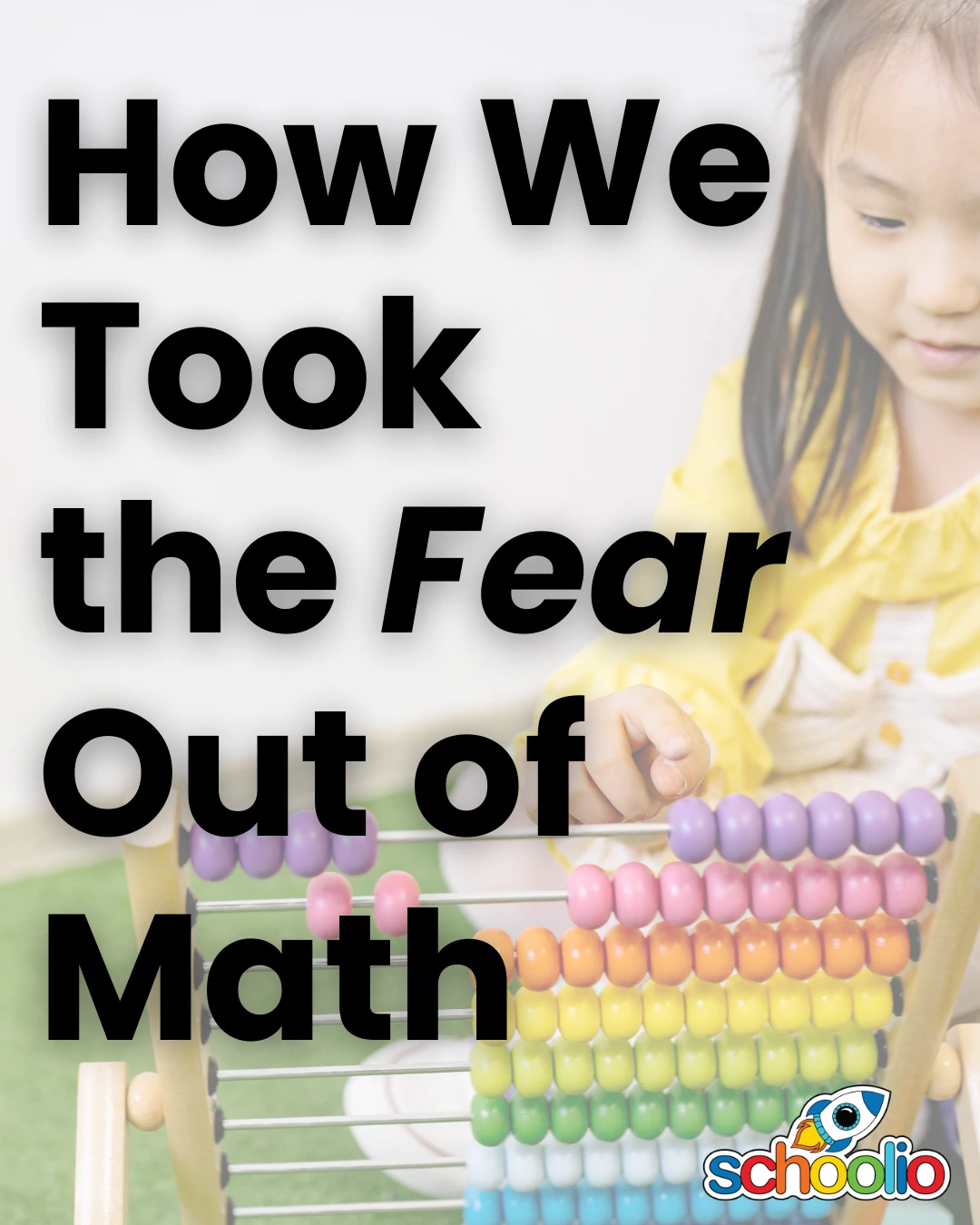
How We Took the Fear Out of Math (Without Making It a Game Show)

How We Took the Fear Out of Math (Without Making It a Game Show)

Math has a reputation in a lot of neurodivergent households.
 
Tears.
Avoidance.
Stomach aches.
Instant shutdown.
 
And I get it.
 
When numbers don’t click easily — especially with dyscalculia, ADHD, processing differences, or math anxiety layered on top — math can feel like a daily threat instead of a skill.
 
For a long time, I thought the solution was to make math “fun.”
 
More games.
More flashy activities.
More attempts to disguise it.
 
But here’s what I learned: Math doesn’t need to be a circus.
 
It needs to feel safe.
 
The Week We Slowed Fractions Way Down
 
One year, we were working on fractions. We were struggling. The kids didn’t get it. I don’t blame them, I’m not great at it either.
 
Instead of continuing to push at that one lesson, I decided we needed to slow everything down and turn one Schoolio lesson and a worksheet, into a full week of understanding.
 
Monday:
We watched the lesson video. Just the concept. No pressure to perform.
 
Tuesday:
We made mini pizzas in the kitchen.
Cut them into halves. Quarters. Eighths.
 
We talked about which pieces were bigger. Which were smaller. Added pieces together.
 
We ate the evidence.
 
Wednesday:
We did the printable worksheet.
Nothing fancy. Low pressure. On the couch. Just gentle practice.
 
Thursday:
We pulled out the Lego.
Built wholes. Broke them into parts. Compared pieces.
 
Friday:
We went back to the original lesson and did the quiz.
Not as a threat — but as a check-in.
 
Did it stick?
Sometimes yes.
Sometimes we needed another week.
And that was okay.
 
Concrete First. Abstract Later.
 
For a lot of neurodivergent kids, abstract math feels slippery.
Numbers on a page don’t mean much.
 
But pizza does.
Lego does.
Cutting something real into real pieces makes fractions tangible.
And once something is tangible, it’s less scary.
 
Less scary means less resistance.
Less resistance means more learning.
 
Predictability Lowers Anxiety
 
The other thing that helped?
Predictability.
 
Math wasn’t a surprise attack.
 
It wasn’t:
“Quick, do this worksheet before you melt down.”
 
It had rhythm.
 
Concept → hands-on → practice → reinforce → assess.
 
That pattern lowered anxiety because they knew what was coming.
 
When the nervous system isn’t bracing for impact, the brain has space to think.
 
It Doesn’t Have to Be Entertaining to Be Gentle
 
Here’s something important:
We didn’t turn math into a game show.
There were no prizes. No countdown clocks. No glitter explosions.
 
We just slowed it down.
We made it concrete.
We made it predictable.
And we removed the pressure to rush.
 
Math doesn’t need to be constantly “fun.” It’s ok to teach our kids that some things in life are hard, but still worth doing.
 
But it should never feel like trauma.
 
There’s a huge difference between effort and fear.
 
I’m okay with effort.
I’m not okay with fear.
 
The Goal Isn’t Speed
 
In traditional classrooms, math often moves fast.
 
New concept. Practice. Test. Move on.
 
But when a child struggles with numbers, speed becomes the enemy.
 
So we changed the metric.
Not: “How fast can you get this done?”
But: “Do you understand it?”
 
And if the answer was no?
 
We stayed.
No shame.
No panic.
No race.
Just peaceful.
 
Because confidence in math doesn’t come from getting everything right.
 
It comes from surviving hard concepts and realizing you can figure them out. Even if it takes time. Even if it’s hard. It’s learning that slowing down isn’t an enemy of progress.
 
If math feels heavy in your house, try this:
 
Stretch one concept across a week.
Touch it. Build it. Eat it. Break it apart.
 
Lower the pace before you try to raise engagement.
 
Sometimes the fear leaves first.
And learning follows.
 
? Lindsey
 
certified special-ed educator, homeschool mom, & co-founder of Schoolio


Homeschooling Isn’t a Competition — It’s an Alignment

Homeschooling Isn’t a Competition — It’s an Alignment


I saw this passage today and it hit me hard.


Your life will change when you understand this


“You are only ever competing against one thing — your own self-doubt.”

When I think about homeschooling families, this couldn’t be more true.

So many parents start this journey filled with doubt. Am I enough? Am I doing it right? What if my child falls behind?
But the families who thrive — the ones I see at Schoolio every day — aren’t necessarily the most organized, experienced, or well-resourced.

They’re simply the ones who believe they can do this.

Who trust that learning at home, in their own rhythm, is enough.
They drop the competition mindset. They stop comparing their kids to traditional classrooms. They stop chasing grades and start building connection.

Homeschooling isn’t about outperforming anyone. It’s about aligning — with your child, your values, and the kind of life you want to build together.

When families stop trying to “fit in” and start trusting themselves, everything changes.
What you seek — confidence, peace, connection — is already seeking you.

Sathish
Still learning, still unlearning

Understanding ADHD Motivation in Kids: It’s Not Broken, Just Different

Understanding ADHD Motivation in Kids: It’s Not Broken, Just Different


“You just need to try harder.”
“If you’d only apply yourself.”
“You’d do it if you really wanted to.”

Sound familiar? If you’re raising or homeschooling an ADHD child, you’ve probably heard these words directed at them—or even caught yourself thinking them in moments of frustration. Unfortunately, our kids hear this kind of messaging a lot. In fact, research estimates that by age 12, ADHD children have heard around 20,000 more negative comments than their neurotypical peers.

That steady stream of criticism teaches ADHD kids that they’re lazy, unmotivated, or difficult. But here’s the truth: your child’s motivation isn’t broken. Their brain simply runs on a different operating system, and understanding how it works is the first step to helping them thrive.

How Motivation Works Differently in ADHD Brains

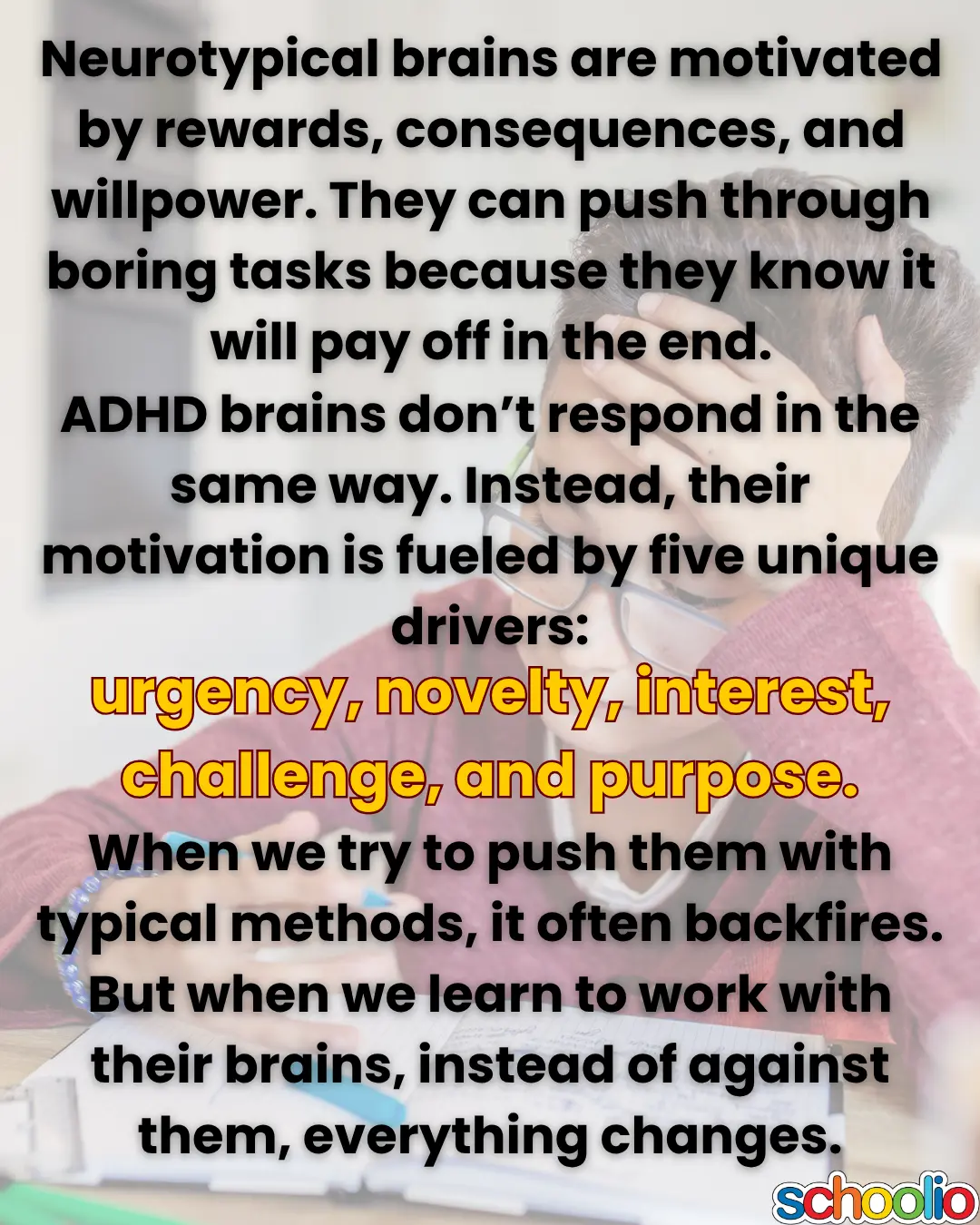
Neurotypical brains are generally motivated by rewards, consequences, and willpower. They can push through boring tasks because they know it will pay off in the end.

ADHD brains don’t respond to those motivators in the same way. Instead, their motivation is fueled by five unique drivers: urgency, novelty, interest, challenge, and purpose. When we try to push them with typical methods, it often backfires. But when we learn to work with their motivators, instead of against them, everything changes.

The 5 Key Motivators in ADHD Kids

1. Urgency

Ever notice your child suddenly works like a whirlwind right before a deadline—but can’t start two weeks earlier? That’s urgency at play. Their brain doesn’t register “later” as important—it needs “right now” to kick into gear.

How parents can help:

  • Break big tasks into smaller steps with shorter deadlines.

  • Use timers—turn chores into races.

  • Try body-doubling: sit beside them while you each work on something.

2. Novelty

ADHD kids thrive on newness. A new book, a new game, a new learning method? Instant focus. But once the shine wears off, their interest crashes. This isn’t stubbornness—it’s brain chemistry.

How parents can help:

  • Introduce small changes to routines (a new pen, studying in a new spot).

  • Rotate activities instead of relying on the same approach every day.

  • Lean into their love of trying new things—then build learning around it.

3. Interest

Have you ever been amazed at how your child can remember every detail of their favorite video game, but can’t recall what you just asked them to do? ADHD brains run on an interest-based nervous system. When they care, they can focus like a laser. When they don’t, it feels impossible to start.

How parents can help:

  • Connect “boring” tasks to your child’s passions.

    • Hate writing? Turn the essay into a comic strip or YouTube script.

    • Math struggles? Frame problems as Pokémon stats or Minecraft builds.

  • Let them dive deep into special interests—it strengthens focus muscles.

4. Challenge

Too easy = boring. Too hard = overwhelming. ADHD brains need the sweet spot in between, where a task feels like a puzzle to solve.

How parents can help:

  • Turn chores into challenges (“Can you beat yesterday’s cleanup time?”).

  • Use levels or point systems like a game.

  • Encourage self-competition, not competition with siblings or peers.

5. Purpose

Above all, ADHD kids need to know why they’re doing something. “Because I said so” rarely works. If a task feels meaningful, they can stick with it. If not, motivation evaporates.

How parents can help:

  • Reframe chores: cleaning a room = having a calmer, less stressful space.

  • Link schoolwork to goals they care about (Spanish = talking with new friends, watching shows without subtitles).

  • Talk about long-term benefits in a way that feels personal, not abstract.

Helping Your Child Feel Seen

When ADHD kids don’t respond to “normal” motivators, it’s not laziness—it’s wiring. And when they hear constant negative messages, it chips away at their confidence. But as a parent, you can flip the script.

By working with your child’s unique motivators—urgency, novelty, interest, challenge, and purpose—you’re not just helping them get through daily tasks. You’re teaching them how their brain works, building self-awareness, and showing them that their differences aren’t deficits.

Your child doesn’t need to “try harder.” They need to try differently—and they need adults who understand how to guide them there.

Homeschooling Parent- The Quietly Bold

Homeschooling Parent- The Quietly Bold


Fortune favors the bold.

Not the loudest.

Not the most perfect.

Not the ones with the most polished plans.

The bold.

The parent who pulls their kid out of a system everyone else still trusts.

The parent who chooses connection over conformity.

Flexibility over tradition.

Peace over pressure.

I’ve met hundreds of these parents. Quietly bold.

No parade. No validation. Just a gut feeling that this was right for their child.

They didn’t wait for permission.

They didn’t wait for the school to change.

They made the change themselves.

And the result? That’s the “fortune” part.

Kids who smile again.

Kids who ask questions again.

Kids who don’t hate learning.

Kids who feel seen.

We get asked all the time: “Is homeschooling a risk?”

Yes. So is sending your child into a system that doesn’t fit. Both paths take boldness. One just gives you more control.

This is why I believe in homeschooling.

This is why I believe in Schoolio.

Not because it’s trendy. Not because it’s perfect. But because it puts the child back at the center — and trusts the parent to lead.

Fortune favors the bold.

If you’ve made the leap, you already know.

If you’re on the edge, maybe this is your sign.


Sathish

still learning, still unlearning

Why Public School Pressures Kids to Grow Up Too Fast—and Why I’m Grateful My Homeschooler Still Plays

Why Public School Pressures Kids to Grow Up Too Fast—and Why I’m Grateful My Homeschooler Still Plays

This has been on my mind today…

My daughter’s friend, who has always been in public school, told her recently that she wished she could still play with toys. My daughter, without hesitation, said, “So play with toys then! Who cares? Do what you want!” But her friend shook her head. She said no—she was too old for toys, and if other kids found out, they’d make fun of her.

They’re 13 years old. And here’s the thing: 13 is still a child. If a child that age still wants to play, that isn’t immaturity—it’s development happening at the pace it’s meant to. Play and imagination are not only normal, they’re scientifically proven to be deeply beneficial for kids’ brains. Yet her friend felt she couldn’t do it, because the social culture around her said she was “too old.”

And it wasn’t just about toys. She also shared that at her school, there’s pressure to start thinking about crushes, even dating. Imagine that—kids who still long to play with toys being told that what’s “normal” is pairing off romantically. That’s not freedom. That’s conformity.

People often ask homeschool families about socialization. “Aren’t you worried your kids won’t know how to socialize?” But what’s rarely asked is the harder question: what exactly are kids being socialized into at school? Too often, it’s a kind of toxic conformity that shames kids for being developmentally right where they are.

Our homeschoolers aren’t “immature.” They’re maturing at their natural pace. They’re free to linger in play, imagination, and curiosity without shame. And when the time comes, they’ll step naturally into new stages of life—without being rushed there before they’re ready.

One of the greatest gifts of homeschooling is that we get to protect childhood. We get to give our kids the time and space to grow up without unnecessary pressure. And sometimes, that looks like a 13-year-old proudly playing with toys, because she’s still a kid—and that’s exactly what she should be.

Want to give your child the freedom to grow at their own pace? Explore Schoolio’s homeschooling curriculum and see how it can support your family’s journey.

Lindsey
Certified Special Ed Educator & Co-Founder, Schoolio

Department of Education Highlights Impact of Home School Community Liaison in Schools

Department of Education Inspectorate reports on the Home School Community Liaison Service in Primary and Post-Primary Schools

Strengthening Home Education Through Community Engagement and Support

At the heart of home education lies the connection between families, schools, and communities. A recent report by the Irish Department of Education highlights the critical role of Home School Community Liaison (HSCL) coordinators in fostering this connection. These dedicated professionals work to improve educational outcomes by bridging the gap between home and school, ensuring children receive the support they need to thrive academically and socially.

Empowering Families in Home Education

The HSCL program showcases how empowering families can lead to better attendance, engagement, and retention in education. Coordinators, who are experienced teachers, collaborate with parents, schools, and community organizations to support children’s learning journeys. From organizing activities like cookery classes and library visits to facilitating access to mental health services, HSCL coordinators help create a robust support system that aligns with the principles of effective homeschooling.

For homeschoolers, the report provides valuable insights into the power of engaging with community resources to enhance educational experiences. Whether through partnerships with local organizations or targeted interventions, a strong community network is essential for fostering growth and resilience in children.

Lessons for Homeschooling Families

The report also highlights areas for improvement that homeschoolers can learn from. Effective use of data, such as tracking attendance and progress, ensures that strategies align with educational goals. Similarly, regular reviews of teaching methods and resources can help families adjust their approaches to better meet their children’s needs.

For those homeschooling, these strategies can be implemented at home to create a more structured and effective learning environment. The emphasis on collaboration, targeted interventions, and ongoing review mirrors the flexibility and adaptability that home education embodies.

The Importance of Inclusion and Advocacy

Homeschooling is a journey that often requires advocacy and inclusion. The HSCL program’s work with marginalized groups, such as children from homeless families and unaccompanied minors, underscores the importance of tailoring education to meet diverse needs. Homeschooling families can draw inspiration from this commitment to equity, striving to create inclusive environments where every child feels valued and supported.

Building a Future of Empowered Education

The Irish Department of Education’s report reinforces the need for systemic support, collaboration, and continuous improvement in education—values that resonate deeply with the homeschooling movement. As families take on the responsibility of home education, they can look to programs like HSCL for strategies that emphasize connection, community, and personalized learning.

By adopting these practices, homeschooling families can ensure their children not only achieve academic success but also develop the social and emotional skills needed to thrive in a rapidly changing world. Together, we can create a future where every child has the opportunity to learn, grow, and succeed.

Source Article:

https://www.gov.ie/en/press-release/12c0d-department-of-education-inspectorate-reports-on-the-home-school-community-liaison-service-in-primary-and-post-primary-schools/

Author:  Sathish Bala

Schoolio Comprehensive Report Card for Holistic Growth

Discover the Schoolio Comprehensive Report Card: A Holistic Homeschooling Tool

Homeschooling is a journey that transcends traditional academics, aiming to nurture a child’s overall development. At Schoolio, we recognize this multifaceted approach and have designed a tool that reflects it perfectly – the Schoolio Comprehensive Report Card. This free template is a fantastic resource for homeschooling parents who wish to capture the full spectrum of their child’s growth, from academic achievements to life skills and personal development.

Why Choose the Schoolio Comprehensive Report Card?

Homeschooling is not just about mastering math and reading; it’s about fostering qualities like responsibility, creativity, resiliency, and essential life skills. The Report Card is tailored to provide a holistic view of a student’s development, ensuring that every aspect of their growth is acknowledged and celebrated.

Key Features of the Schoolio Comprehensive Report Card

Holistic Development Areas

The Report Card template goes beyond traditional academic assessments. It includes sections to evaluate a student’s progress in responsibility, resiliency, creativity, life skills, physical education, attitude, and work habits. This comprehensive approach ensures that you have a complete picture of your child’s development.

Customizable for Individual Needs

Every child is unique, and their education should reflect that. The Report Card template is designed to adapt to the specific requirements of students from grades 1-8. Whether your child excels in certain areas or needs more support in others, this report card can be customized to suit their individual needs.

Easy-to-Use Format

We understand that homeschooling parents and educators have a lot on their plates. That’s why this Report Card features an easy-to-use format that simplifies the assessment process. With clear sections and straightforward criteria, you can efficiently track and document your child’s progress.

Encourages Positive Growth

One of the standout features of the Schoolio Comprehensive Report Card is its emphasis on areas beyond academics. It highlights emotional regulation, healthy choices, acts of kindness, social skills, and mental education. By recognizing and encouraging these aspects, we aim to foster positive growth in every child.

How to Use the Schoolio Comprehensive Report Card

Using the Schoolio Comprehensive Report Card is simple and intuitive. Here’s a step-by-step guide to help you get started:

  1. Download the Template: Access the free Report Card template from our website.
  2. Customize for Your Child: Tailor the report card to fit your child’s grade level and specific needs. You can adjust the criteria and sections to best reflect their development.
  3. Track Progress: Throughout the school year, use the report card to regularly assess and document your child’s progress in various areas. Be sure to include observations and examples to provide a complete picture.
  4. Review and Reflect: At the end of each term, review the report card with your child. Celebrate their achievements and discuss areas for improvement. This reflection helps in setting goals and fostering a growth mindset.

Benefits of the Schoolio Comprehensive Report Card

The Schoolio Comprehensive Report Card offers numerous benefits for both students and parents:

  • Balanced Evaluation: Provides a well-rounded assessment that includes both academic and personal development.
  • Enhanced Communication: Facilitates meaningful conversations between parents and children about their progress and goals.
  • Personalized Learning: Helps in tailoring the homeschooling approach to meet the child’s unique needs and strengths.
  • Motivation and Encouragement: Recognizes and celebrates achievements in all areas, boosting the child’s confidence and motivation.

Why Holistic Education Matters

In today’s world, education extends far beyond textbooks and exams. Holistic education emphasizes the importance of nurturing every aspect of a child’s growth, preparing them for success in all areas of life. The Report Card template is designed with this philosophy in mind, ensuring that your homeschooling journey is enriching and rewarding.

Testimonials from Homeschooling Families

Don’t just take our word for it! Here’s what some homeschooling families have to say about the Report Card Template:

  • Emily S.: “The Schoolio Comprehensive Report Card has been a game-changer for our family. It allows us to track our children’s progress in all areas, not just academics. We’re so grateful for this valuable tool!”
  • Michael R.: “I love how the report card highlights my kids’ strengths and areas for improvement in a balanced way. It’s easy to use and customize, making our homeschooling journey smoother and more organized.”

Get Your Free Schoolio Comprehensive Report Card Today!

Ready to embrace a broader perspective on education? Download the FREE Schoolio Report Card template today and start tracking your child’s holistic development. Celebrate their achievements, set meaningful goals, and support their growth in every facet of life.

Visit our website to get your Schoolio Report Card and discover how it can transform your homeschooling experience. At Schoolio, we’re committed to providing the tools and resources you need to ensure your child’s success – academically, personally, and beyond.