What Is Time Blindness and Time Optimism? (And Why Your ADHD Child Isn’t “Late on Purpose”)

What Is Time Blindness and Time Optimism? (And Why Your ADHD Child Isn’t “Late on Purpose”)

Have you ever said:
“We’re leaving in ten minutes.”
And your child hears it… nods… and then somehow starts a brand new LEGO build?
Or you ask how long their math will take and they confidently say, “Five minutes,” and forty-five minutes later they’re still halfway through?
Or they’re shocked — genuinely shocked — that it’s already bedtime?
That’s not laziness.
That’s not defiance.
That’s very often time blindness.
What Is Time Blindness?
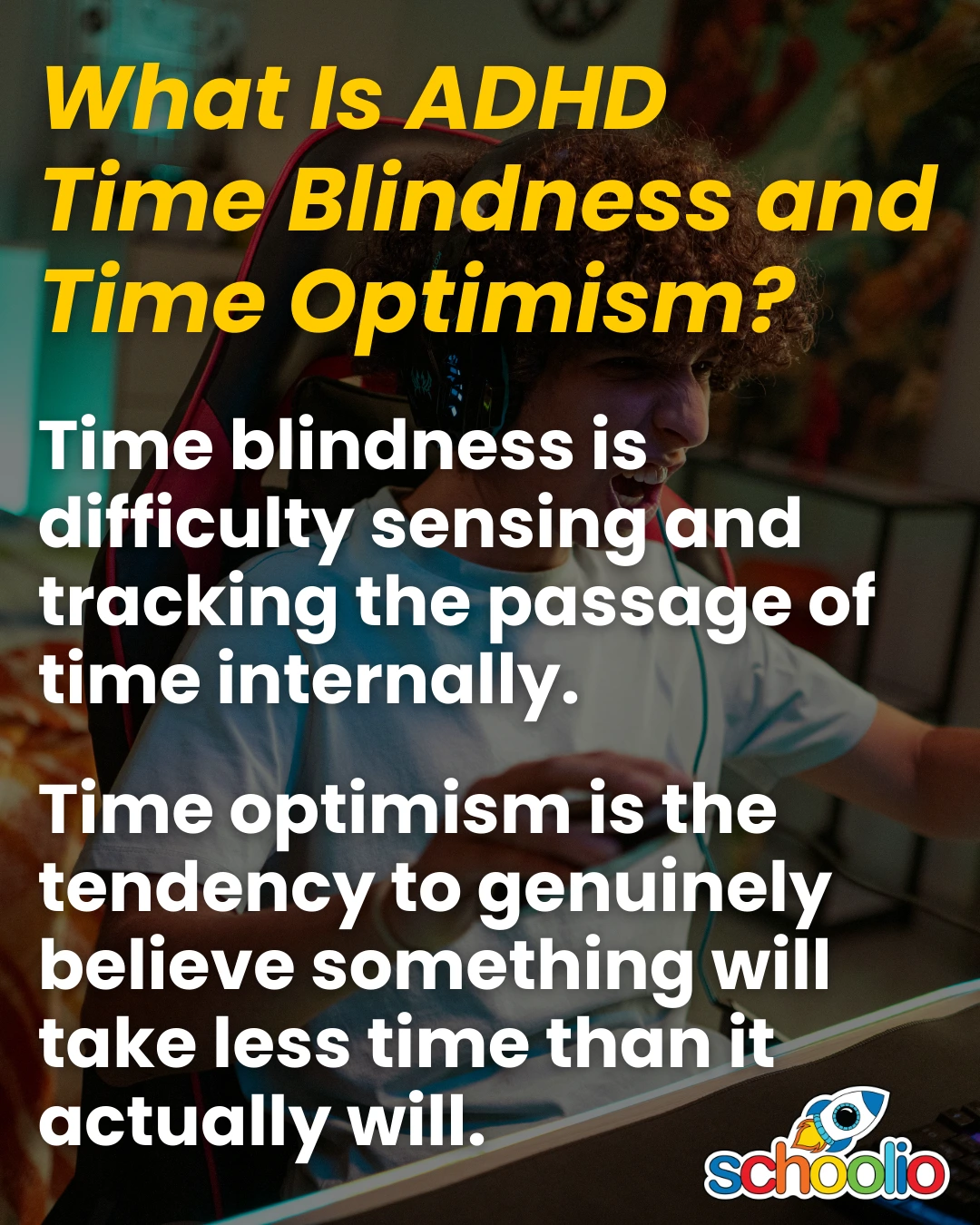
Time blindness is the difficulty sensing and tracking the passage of time internally.
For many ADHDers, time does not feel linear.
It feels like:
Now
Not Now
That’s it.
Five minutes and fifty minutes can feel almost identical without external cues.
An hour can disappear in hyperfocus.
Ten minutes can feel unbearably long when doing something boring.
Time blindness is tied to executive functioning and working memory — both of which are heavily impacted in ADHD brains.
If working memory is the “mental sticky note” that keeps track of what you’re doing and how long you’ve been doing it, ADHD brains often have much weaker glue.
So the brain loses track.
Not because they don’t care.
Because they can’t feel it.
What Is Time Optimism?
Time optimism is the cheerful cousin of time blindness.
It’s the tendency to genuinely believe something will take less time than it actually will.
“I’ll clean my room in 10 minutes.”
“I can finish this before dinner.”
“I have tons of time.”
It’s not lying.
It’s not manipulation.
It’s an executive projection issue.
ADHD brains often struggle with future simulation — accurately picturing how long tasks require.
Add in dopamine-driven motivation (which rises when something is exciting and plummets when it’s not), and you get wildly inaccurate time estimates.
If the task feels easy in their head, they assume it will be quick.
The brain isn’t calculating past experience consistently.
It’s guessing.
Optimistically.
Is This Just an ADHD Thing?
Time blindness and time optimism are most strongly associated with ADHD because they’re rooted in executive function and dopamine regulation.
That said, autistic kids can also struggle with time — but usually for different reasons.
An autistic child may:
  • hyperfocus and lose track of time
  • struggle with transitions
  • feel distress when routines shift
  • have difficulty estimating task-switching effort

But their experience of time is often more about rigidity or deep focus than about an internal inability to sense its passing.

In ADHD, time itself feels slippery.
In autism, time may feel predictable but transitions feel destabilizing.
If your child is both ADHD and autistic, you may see both patterns layered together.
What Time Blindness Looks Like at Home
It can look like:
  • Chronic lateness — even when they’re trying.
  • Starting huge projects right before leaving the house.
  • Being confused about how long homework takes.
  • Struggling to pace themselves.
  • Forgetting how much time has already passed.
  • Underestimating transitions.
And here’s the hard part:
To the outside world, this looks like irresponsibility.
To the ADHD brain, it feels like confusion.
Why Punishment Doesn’t Fix It
If a child could “try harder” to feel time, they would.
Time blindness isn’t solved by:
  • scolding
  • shame
  • “you need to be more responsible”
  • taking away privileges

Because the issue isn’t motivation.

It’s perception.
You wouldn’t punish a child for being near-sighted.
Time blindness is similar — except it’s temporal.
What Actually Helps
Externalizing time.
ADHD brains often need time to be visible and tangible.
  • Timers.
  • Visual clocks.
  • Countdowns.
  • Written schedules.
  • Auditory reminders.
  • Chunking tasks with defined breaks.
Instead of saying, “We’re leaving soon,” try:
“We’re leaving in 15 minutes. I’m setting a 10-minute timer, and then a 5-minute warning.”
Instead of, “How long will that take?” try:
“Last time this took 40 minutes. Let’s plan for that.”
Instead of assuming they’re careless, assume they’re time-blind.
That shift changes your tone immediately.
The Bigger Picture
Time blindness and time optimism don’t mean your child is unreliable.
They mean their brain doesn’t automatically track duration the way neurotypical brains do.
And when we stop treating it like a character flaw and start treating it like a neurological difference, something softens.
We move from: “Why are you like this?”
To: “How can we support this?”
That’s where real change starts.
? Lindsey
certified special-ed educator, homeschool mom, & co-founder of Schoolio
Curiosity Cannot Be Forced. It Has To Be Sparked.

Curiosity Cannot Be Forced. It Has To Be Sparked.


This has been on my mind today…

I think about curiosity all the time.

As a dad. As a CEO at Schoolio.

Academics can be taught. With enough repetition, most kids can memorize what they need to pass a test. The system is built for that.

But curiosity is different.

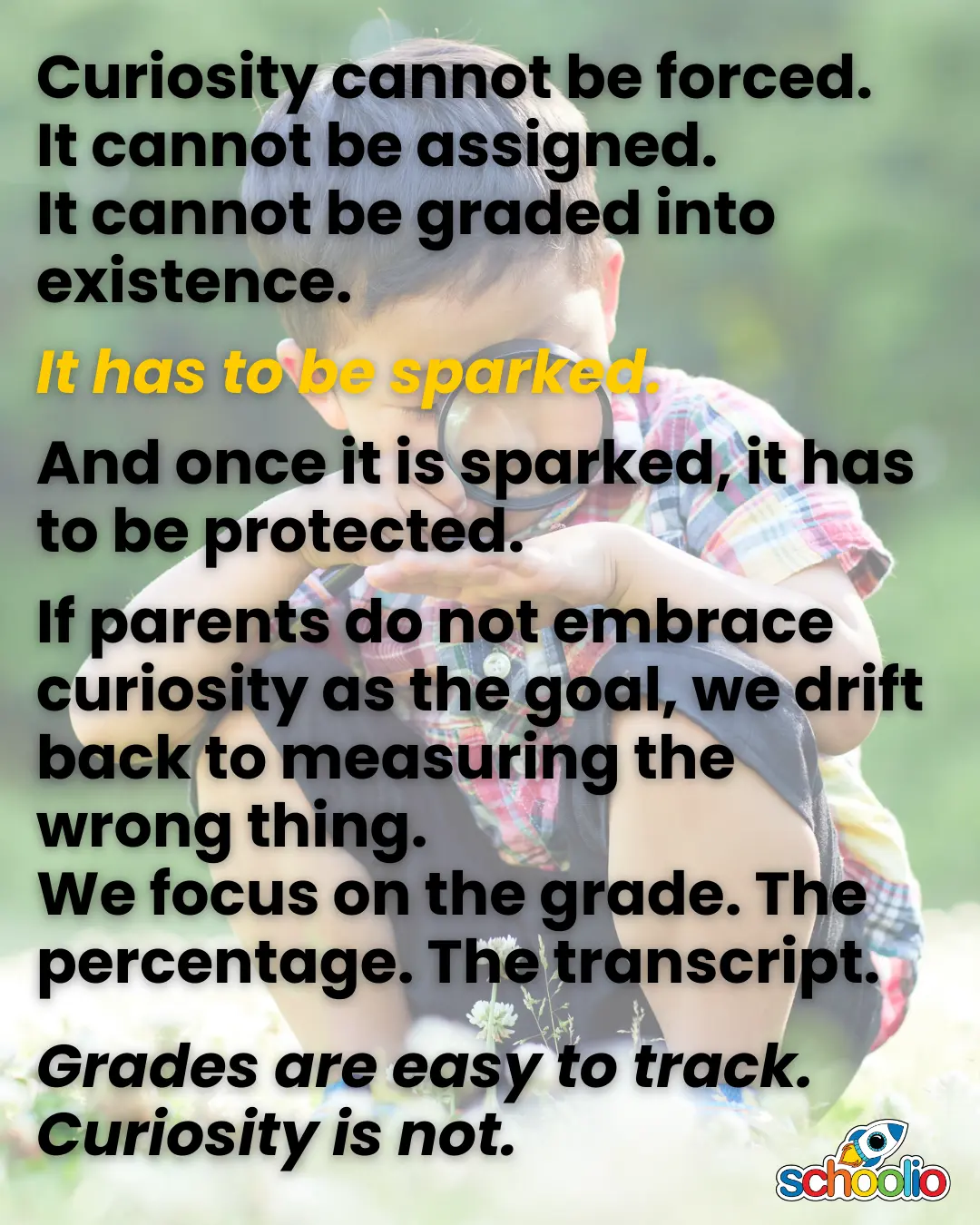
Curiosity cannot be forced. It cannot be assigned. It cannot be graded into existence.

It has to be sparked. And once it is sparked, it has to be protected.

Growing up South Asian, curiosity was not exactly encouraged. The path was clear. Study hard. Choose the right career. Do not wander. Wandering looked risky. Distracting. Like falling behind.

Curiosity pulls you sideways. The system pulls you forward.

That tension shapes a lot of childhoods.

We designed Schoolio to spark curiosity. Short lessons. Flexible pacing. Space to explore. Room to ask why.

But here is the real tension.

If parents do not embrace curiosity as the goal, we drift back to measuring the wrong thing. We focus on the grade. The percentage. The transcript.

Grades are easy to track. Curiosity is not.

And yet, as adults, it is curiosity that drives innovation. It builds companies. It fuels reinvention. It is what pushes someone to keep learning long after school is over.

No one asks what your grade was in middle school science.

But the ability to ask better questions. That follows you for life.

At Schoolio, academics matter. Mastery matters.

But curiosity is the engine.

Our job is not just to help kids pass.

It is to help them stay curious long enough to build something meaningful with what they learn.


Sathish

still learning, still unlearning

Stimming, Fidgets, and Movement in ADHD and Autistic Kids: What It Really Means

Stimming, Fidgets, and Movement in ADHD and Autistic Kids: What It Really Means


If you’ve ever found yourself saying:

“Can you sit still for five minutes?”
“Why are you rocking like that?”
“Stop tapping.”
“Do you have to make that noise right now?”

You are not alone.

Almost every parent of an ADHD or autistic child has had that moment — the one where the movement feels constant. The noise feels repetitive. The fidget feels distracting.

And underneath it all is that quiet question:

Why can’t they just sit still?

Let’s gently flip that question.

What if sitting still isn’t neutral?

What if sitting still actually costs them something?

What Is Stimming?

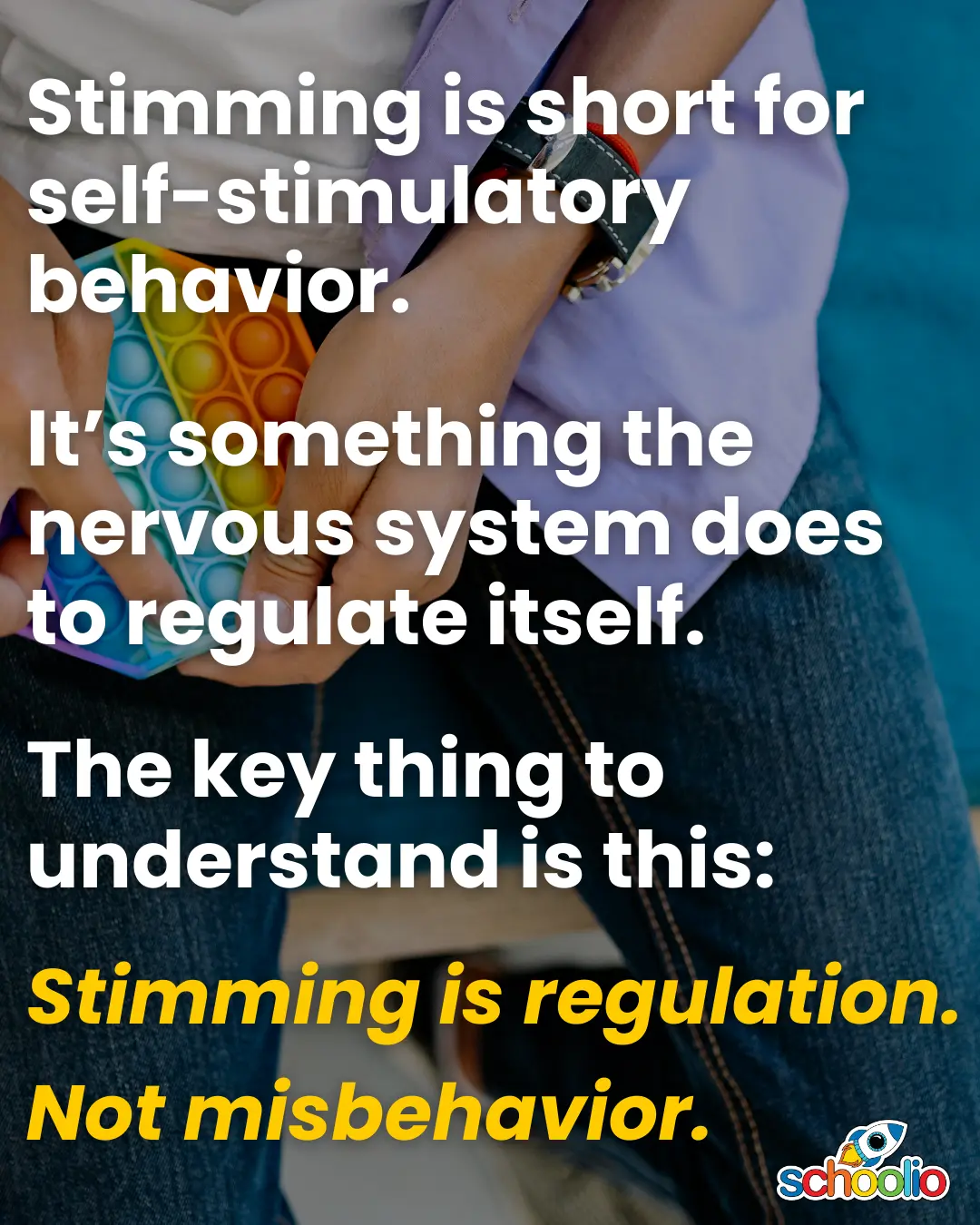
Stimming is short for self-stimulatory behavior.

That phrase sounds clinical, but the meaning is simple:

It’s something the nervous system does to regulate itself.

Everyone stims.

Neurotypical adults:

  • bounce their leg in meetings
  • click pens
  • chew gum
  • scroll their phone when anxious 

Neurodivergent kids often stim more frequently or more visibly — not because they lack discipline, but because their nervous systems require more input to stay balanced.

Stimming can look like:

Rocking.
Flapping.
Pacing.
Spinning.
Humming.
Tapping.
Chewing.
Repeating phrases.

It can also be completely internal — like song loops or counting.

The key thing to understand is this:

Stimming is usually regulation.

Not misbehavior.

Why ADHD and Autistic Brains Move More

ADHD brains are often dopamine-seeking.

Movement increases dopamine.

Autistic nervous systems are often highly sensitive — either seeking more sensory input or trying to regulate overwhelming input.

Movement organizes the body.

Movement grounds the brain.

Movement creates rhythm.

And rhythm stabilizes the nervous system.

When you see your child:

  • leaning upside down in a chair
  • sitting in “weird” positions
  • pacing during lessons
  • needing to move constantly 

You’re likely watching their vestibular system at work (that internal balance and movement system).

They aren’t moving to annoy you.

They’re moving because their brain functions better that way.


Fidgets Aren’t Distractions. They’re Tools.

There’s a common fear among adults that fidgets “distract” children.

But for many neurodivergent kids, the opposite is true.

A small amount of movement can:

  • increase attention
  • reduce anxiety
  • prevent escalation
  • improve working memory
  • support listening 

When the body gets the input it needs, the brain can focus on the lesson.

Think of it like this:

Some brains focus best in stillness.
Some brains focus best in motion.

If we demand stillness from a brain that needs motion, we’re working against biology.

When Stimming Is Suppressed

Here’s the part we don’t talk about enough.

Many neurodivergent kids learn to suppress their stims.

They learn:
“That’s weird.”
“Stop doing that.”
“People are annoyed by you.”

They mask.

And masking takes energy.

Sometimes the child who looks “calm and still” at school comes home and melts down — not because they’re dramatic, but because they’ve been suppressing regulation all day.

Movement that looks disruptive might actually be preventing collapse.

But What If It’s Too Much?

Of course, there are moments when stimming interferes — when it’s loud during a lesson, or physically unsafe, or escalating instead of calming.

The goal isn’t “allow everything always.”

The goal is to ask:

Is this regulating or dysregulating?

If it’s regulating, we support it or modify it.

If it’s dysregulating, we help redirect it to something safer or more grounding.

Instead of saying, “Stop.”

We might say, “Looks like your body needs input. Let’s find a way to help.”

Chewelry instead of hoodie strings.
A wobble cushion instead of tipping the chair.
Pacing while memorizing instead of forcing stillness.

We shift from control to collaboration.

The Homeschool Advantage

This is where homeschooling becomes powerful.

In traditional classrooms, stillness is often equated with compliance.

At home, you get to redefine what learning looks like.

Math while bouncing (we used to do math on the trampoline a lot, especially for rote memorization tasks like multiplication facts!)
Spelling while pacing.
History while building with LEGO.
Audiobooks while swinging.

Movement doesn’t mean they aren’t learning.

Sometimes it’s the only reason they can.

The Bigger Reframe

If you take nothing else from this, take this:

Stimming, fidgets, and movement are not character flaws.

They are nervous system strategies.

And when we understand them that way, we stop asking:

“How do I make this stop?”

And start asking:

“How do I support this safely?”

That shift alone can change the tone of your home.

Once you understand stimming as regulation, everything else makes more sense.

And when parents understand, kids feel safer.

And when kids feel safer, they regulate better.


Parents Do Not Choose Homeschooling for Novelty

Parents Do Not Choose Homeschooling for Novelty


This has been on my mind today…


I read about one of Afghanistan’s most iconic girls’ schools being turned into an empty shell. Classrooms that once held ambition and possibility now sit silent. Not because girls stopped wanting to learn. But because power decided who gets access to education and who does not.

What stayed with me was how fragile education really is. We like to believe progress always moves forward, but history keeps proving otherwise. When systems fail or fear takes over, learning is often the first thing taken away.

It reminded me that schooling and learning are not the same thing. Schools can close. Buildings can be taken. But the desire to learn lives inside people. When doors shut, that desire looks for another way in.

This is something homeschooling families understand deeply. Learning can happen anywhere. Around a kitchen table. Through conversation. Through curiosity. Through care. Homeschooling is not about opting out. It is often about protecting a child’s right to grow when the system cannot or will not support them.

At Schoolio, we work with families who did not choose an alternative path for novelty. They chose it for safety, dignity, and confidence. Children pushed out or worn down by systems that could not see them. Parents trying to hold onto their child’s love of learning.

Education poverty is not just about access to schools. It is about access to dignity and possibility. When a child is denied the right to learn freely, the damage goes far beyond missed lessons.

This story was a reminder of why flexible, resilient learning matters. Learning that travels with the child. Learning that adapts. Learning that cannot be shut down by a single decision.

Learning your way is not a luxury. For many families, it is survival. And protecting that right is work worth doing.


Sathish

still learning, still unlearning


Understanding ADHD Motivation in Kids: It’s Not Broken, Just Different

Understanding ADHD Motivation in Kids: It’s Not Broken, Just Different


“You just need to try harder.”
“If you’d only apply yourself.”
“You’d do it if you really wanted to.”

Sound familiar? If you’re raising or homeschooling an ADHD child, you’ve probably heard these words directed at them—or even caught yourself thinking them in moments of frustration. Unfortunately, our kids hear this kind of messaging a lot. In fact, research estimates that by age 12, ADHD children have heard around 20,000 more negative comments than their neurotypical peers.

That steady stream of criticism teaches ADHD kids that they’re lazy, unmotivated, or difficult. But here’s the truth: your child’s motivation isn’t broken. Their brain simply runs on a different operating system, and understanding how it works is the first step to helping them thrive.

How Motivation Works Differently in ADHD Brains

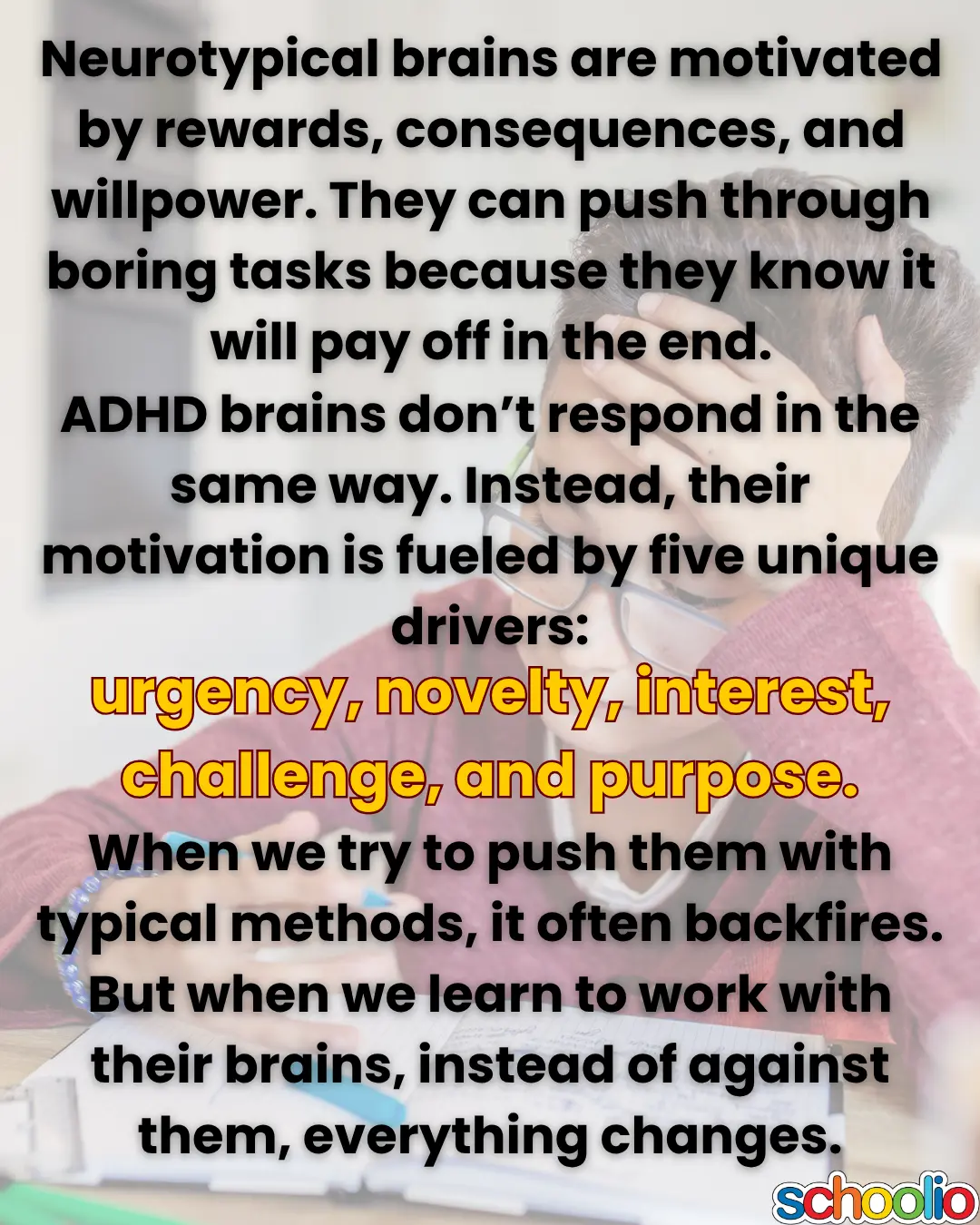
Neurotypical brains are generally motivated by rewards, consequences, and willpower. They can push through boring tasks because they know it will pay off in the end.

ADHD brains don’t respond to those motivators in the same way. Instead, their motivation is fueled by five unique drivers: urgency, novelty, interest, challenge, and purpose. When we try to push them with typical methods, it often backfires. But when we learn to work with their motivators, instead of against them, everything changes.

The 5 Key Motivators in ADHD Kids

1. Urgency

Ever notice your child suddenly works like a whirlwind right before a deadline—but can’t start two weeks earlier? That’s urgency at play. Their brain doesn’t register “later” as important—it needs “right now” to kick into gear.

How parents can help:

  • Break big tasks into smaller steps with shorter deadlines.

  • Use timers—turn chores into races.

  • Try body-doubling: sit beside them while you each work on something.

2. Novelty

ADHD kids thrive on newness. A new book, a new game, a new learning method? Instant focus. But once the shine wears off, their interest crashes. This isn’t stubbornness—it’s brain chemistry.

How parents can help:

  • Introduce small changes to routines (a new pen, studying in a new spot).

  • Rotate activities instead of relying on the same approach every day.

  • Lean into their love of trying new things—then build learning around it.

3. Interest

Have you ever been amazed at how your child can remember every detail of their favorite video game, but can’t recall what you just asked them to do? ADHD brains run on an interest-based nervous system. When they care, they can focus like a laser. When they don’t, it feels impossible to start.

How parents can help:

  • Connect “boring” tasks to your child’s passions.

    • Hate writing? Turn the essay into a comic strip or YouTube script.

    • Math struggles? Frame problems as Pokémon stats or Minecraft builds.

  • Let them dive deep into special interests—it strengthens focus muscles.

4. Challenge

Too easy = boring. Too hard = overwhelming. ADHD brains need the sweet spot in between, where a task feels like a puzzle to solve.

How parents can help:

  • Turn chores into challenges (“Can you beat yesterday’s cleanup time?”).

  • Use levels or point systems like a game.

  • Encourage self-competition, not competition with siblings or peers.

5. Purpose

Above all, ADHD kids need to know why they’re doing something. “Because I said so” rarely works. If a task feels meaningful, they can stick with it. If not, motivation evaporates.

How parents can help:

  • Reframe chores: cleaning a room = having a calmer, less stressful space.

  • Link schoolwork to goals they care about (Spanish = talking with new friends, watching shows without subtitles).

  • Talk about long-term benefits in a way that feels personal, not abstract.

Helping Your Child Feel Seen

When ADHD kids don’t respond to “normal” motivators, it’s not laziness—it’s wiring. And when they hear constant negative messages, it chips away at their confidence. But as a parent, you can flip the script.

By working with your child’s unique motivators—urgency, novelty, interest, challenge, and purpose—you’re not just helping them get through daily tasks. You’re teaching them how their brain works, building self-awareness, and showing them that their differences aren’t deficits.

Your child doesn’t need to “try harder.” They need to try differently—and they need adults who understand how to guide them there.

Why “Focus” Doesn’t Always Look Like Sitting Still

Why “Focus” Doesn’t Always Look Like Sitting Still


There was a season in our homeschool when math facts were… let’s just say painful.

Every time I pulled out the worksheets, I’d get groans. Wiggling in the chairs. The inevitable: “Do we have to do this?”

One day, instead of pushing through another tense math session at the table, I tried something different. We went outside. Onto the trampoline.

The kids bounced while I called out math facts. “What’s 7×6?” Bounce. Bounce. “42!” “What’s 9×8?” Bounce. Bounce. “72!”

Suddenly, the resistance melted away. They were laughing, shouting out answers between jumps, and begging for the next question. The energy that had been working against us at the table was now working for us.

And it hit me:

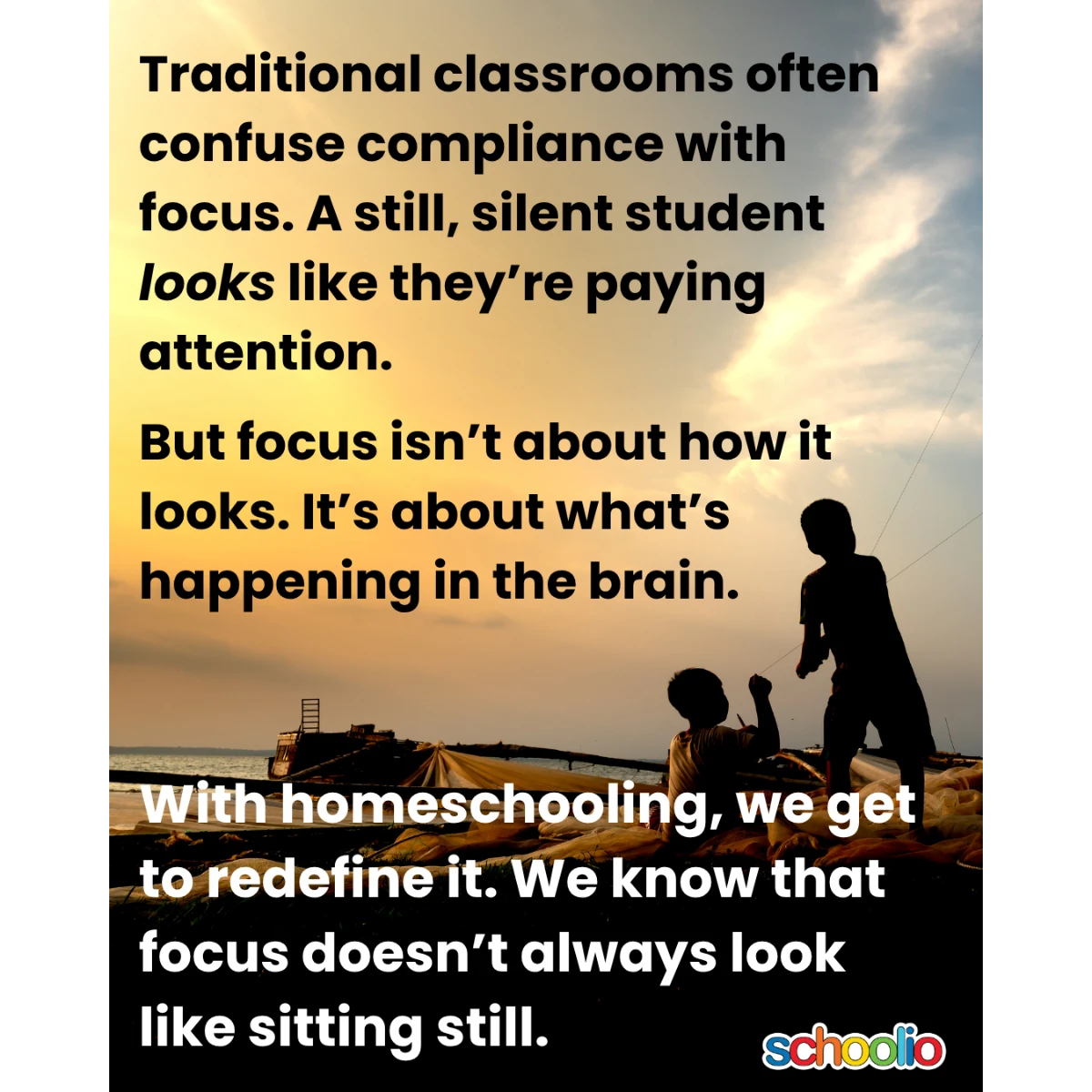
Focus doesn’t always look like sitting still.

For neurodivergent kids especially, learning can happen best in motion. While doodling. While bouncing. While tapping a pencil. While upside down on the couch. The movement isn’t a distraction — it’s the doorway to attention.

Traditional classrooms often confuse compliance with focus. A still, silent student looks like they’re paying attention. But how many times are they zoning out, daydreaming, or working hard just to appear calm?

At home, we get to redefine it.

✔ Focus can look like doodles in the margin while listening.

✔ Focus can look like bouncing on a trampoline while memorizing math facts.

✔ Focus can look like humming quietly while reading.


The truth is, focus isn’t about how it looks. It’s about what’s happening in the brain.

So if your child can’t sit still — maybe don’t fight it. Maybe lean into it. Movement can be the bridge between frustration and fun, resistance and retention.

Because focus doesn’t always look like stillness. Sometimes it looks like joy.


? Lindsey

Certified Special-Ed Educator & Co-Founder, Schoolio

Unpopular Opinion- Learning Shouldn’t Always Be Fun

Unpopular Opinion- Learning Shouldn’t Always Be Fun

By Lindsey, certified special-ed educator & co-founder, Schoolio


Does this sound familiar?

“How many questions do I have to do?”
“How much longer?”
“I’m bored!”
“Are we done yet?”

If your homeschool days feel like a marathon of sighs, tears, or endless negotiating, you are not alone. And it’s not because you’re a “bad teacher” or your child is “unmotivated.”

The real culprit?
You’re probably replicating school at home.

And the solution is simpler than it sounds: stop doing that.

At Schoolio, we talk a lot about our Philosophy of Learning. But here’s the gist of it: thriving in homeschool comes down to two big ideas—Relevancy and Responsibility.

Relevancy: The “Why” Behind Learning

Kids learn best when they understand why they’re learning something. And there are really only two powerful “whys”:

  • CuriosityI want to know this because it interests me.

  • PurposeI know why this is important for me to learn.

When kids have one of those reasons in mind, they’re naturally more engaged. That’s why Schoolio makes curiosity and purpose central, with our Future Readiness Library and electives that stretch way beyond the basics. Whether it’s learning all about cats, entrepreneurship, or the history of pirates, kids can find what they’re interested in, or see the value of- and often, they’re genuinely excited to learn.

Responsibility: Learning Isn’t Always Fun

Here’s the unpopular opinion: not all learning should be fun.

We love hands-on projects, electives that spark excitement, and letting kids explore their interests. But the truth is, some things in life simply just require effort. Some subjects take persistence. And not everything in life can, or should, be gamified or turned into an adventure.

And that’s not a bad thing. In fact, it’s one of the most valuable lessons homeschool can offer.

Real-world readiness means teaching kids:

✔ Some things you want or need to learn won’t come easily, but they’re worth the effort.
✔ Not everything is a game, but it still has to be done.
✔ Responsibility means following through, even when something isn’t fun.

Because in the end, building grit, self-discipline, and responsibility are just as important as mastering math facts or essay writing.

The Balance

Homeschool should not be all drudgery, but it doesn’t have to be all glitter and games either. The sweet spot is in teaching both: helping kids chase what excites them and showing them how to stick with the hard stuff when it matters.

So maybe the next time you hear “I’m bored!” or “How much longer?” you’ll remember: you’re not failing, you’re teaching real life.

? Lindsey

Why Different Isn’t Wrong

Why Different Isn’t Wrong

I’ve been called a lot of things growing up. Dumb. Stupid. Social butterfly. But the one that stuck with me the most was weird. That word followed me through school hallways, into classrooms, and even outside of school. Most of the time, people didn’t say it to hurt me. They just didn’t understand me. I saw the world differently, noticed things others didn’t, and asked questions that didn’t have simple answers. And I wasn’t trying to fit in. I just didn’t feel like I needed to.

For a long time, I thought being different meant something was wrong with me. I believed the labels. I thought maybe I really was all those things. But over time, I began to realize that the problem wasn’t me. People often label what they can’t understand. It helps them feel like they’ve figured something out. Like sorting clothes into piles when you don’t know where something belongs. It doesn’t mean the clothes are bad. It just means you’re not sure where they fit.

As I got closer to the families who use Schoolio, I started to see pieces of myself in the children they were teaching. I saw it in the kids who struggled to sit still. In the ones who asked more questions than most teachers had time to answer. In the learners who didn’t follow the same path as everyone else. These kids weren’t broken or difficult. They were just full of a different kind of energy. The kind that doesn’t always show up the way school expects it to.

And the parents who choose to homeschool these children are some of the bravest people I’ve met. They don’t take the easy path and don’t choose homeschooling because it’s convenient. Parents do it because they want their child to feel seen and because they believe there’s more than one way to learn. They do it because their child needs something different, and they’re willing to build it themselves.

I think about how far I’ve come. From the kid who didn’t fit in, to someone who gets to support other kids who feel the same way. It’s not about fixing them—it’s about walking alongside them. Being different isn’t something to hide; it’s a part of who they are. And most of all, it’s something to be proud of.

At Schoolio, we get to be a small part of that journey. We get to help children feel understood. And we get to remind parents that their choice to take the road less travelled matters. Because sometimes, that road leads to the most incredible places.


Sathish

still learning, still unlearning

We Banned Calculators Once. Out of Fear. Not Logic.

We Banned Calculators Once. Out of Fear. Not Logic.


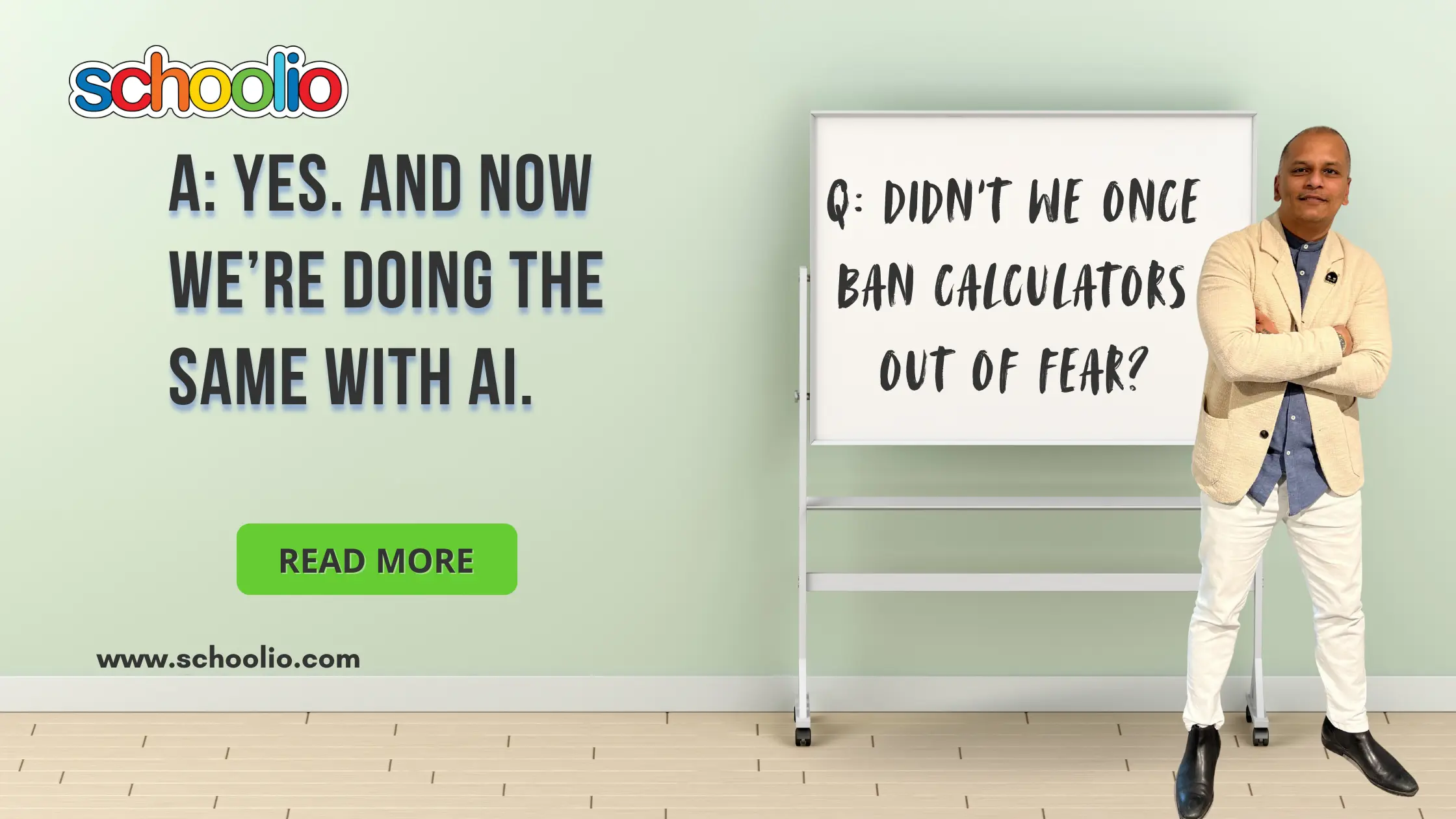
They said it would make kids lazy. That if we let students use calculators, they’d forget how to think. Teachers warned of doom, boards debated bans, and parents worried that the math their children were learning wasn’t “real.” But the truth is, the calculator didn’t replace understanding—it freed it. It helped students move faster, go deeper, and build confidence instead of anxiety. We don’t question calculators anymore. They’re standard. Obvious. Necessary.

And yet here we are again.

Today, it’s not calculators we’re afraid of—it’s AI. It’s new models of learning that don’t look like the rigid classrooms we remember. It’s the idea that maybe, just maybe, school shouldn’t be one-size-fits-all. And that fear, as it always has, shows up in familiar ways: skepticism, delay, control. The irony is that the world is changing faster than ever, but our systems still ask kids to move in lockstep. To sit still. To follow instructions. To learn passively in a world that demands action, agility, and personal agency.

At Schoolio, we see this every day. Families come to us because they’re not just choosing homeschooling—they’re choosing possibility. They’re choosing to move past fear and toward tools that give them freedom. Freedom to customize. Freedom to pause and restart. Freedom to learn with joy, not dread. And the moment parents hand over that freedom to their kids, something amazing happens. Not because they’re chasing trends, but because they’ve decided to lead.

We didn’t build Schoolio to replace teachers or classrooms. We built it because we believe that learning should reflect real life—messy, beautiful, nonlinear, and full of second chances. Our hybrid model combines digital lessons and print-based work, future-readiness and core subjects, structure and flexibility, because we know real learning lives somewhere in between.

https://www.intelligentliving.co/homeschooling-vs-traditional-school-2025/

Academic Outcomes 


It’s easy to fear the future when you don’t trust the tools. But just like the calculator, the right tools don’t replace thinking—they unlock it.

And this time, we don’t have to wait decades to figure that out.

Why Public School Pressures Kids to Grow Up Too Fast—and Why I’m Grateful My Homeschooler Still Plays

Why Public School Pressures Kids to Grow Up Too Fast—and Why I’m Grateful My Homeschooler Still Plays

This has been on my mind today…

My daughter’s friend, who has always been in public school, told her recently that she wished she could still play with toys. My daughter, without hesitation, said, “So play with toys then! Who cares? Do what you want!” But her friend shook her head. She said no—she was too old for toys, and if other kids found out, they’d make fun of her.

They’re 13 years old. And here’s the thing: 13 is still a child. If a child that age still wants to play, that isn’t immaturity—it’s development happening at the pace it’s meant to. Play and imagination are not only normal, they’re scientifically proven to be deeply beneficial for kids’ brains. Yet her friend felt she couldn’t do it, because the social culture around her said she was “too old.”

And it wasn’t just about toys. She also shared that at her school, there’s pressure to start thinking about crushes, even dating. Imagine that—kids who still long to play with toys being told that what’s “normal” is pairing off romantically. That’s not freedom. That’s conformity.

People often ask homeschool families about socialization. “Aren’t you worried your kids won’t know how to socialize?” But what’s rarely asked is the harder question: what exactly are kids being socialized into at school? Too often, it’s a kind of toxic conformity that shames kids for being developmentally right where they are.

Our homeschoolers aren’t “immature.” They’re maturing at their natural pace. They’re free to linger in play, imagination, and curiosity without shame. And when the time comes, they’ll step naturally into new stages of life—without being rushed there before they’re ready.

One of the greatest gifts of homeschooling is that we get to protect childhood. We get to give our kids the time and space to grow up without unnecessary pressure. And sometimes, that looks like a 13-year-old proudly playing with toys, because she’s still a kid—and that’s exactly what she should be.

Want to give your child the freedom to grow at their own pace? Explore Schoolio’s homeschooling curriculum and see how it can support your family’s journey.

Lindsey
Certified Special Ed Educator & Co-Founder, Schoolio

If It Doesn’t Look Like School… Good.

If It Doesn’t Look Like School… Good.

“Homeschooling doesn’t look like public school. That’s the point.”

This has been on my mind today…

When I first started homeschooling, I tried to make our home look like a classroom. Desks lined up, a daily schedule on the wall, a bell for transitions — I even printed out attendance sheets.

It lasted about three days.

What followed was frustration, tears, and a lot of self-doubt. I thought something was wrong with me. I couldn’t keep up the structure. My kids weren’t responding the way I expected. I wondered if I had made a huge mistake.

But the truth was simpler: I was trying to replicate a system that didn’t actually work for us.

Homeschooling doesn’t look like school. That’s the point.

School is designed for groups. For efficiency. For managing dozens of kids with one adult. It’s built on uniformity and compliancy. But I don’t want my kids to be uniform or compliant.

Homeschooling is built on flexibility. On freedom. On honoring your child’s pace, your family’s values, and your real life.

Some days, math happens at 8am. Other days, it doesn’t happen at all.

Some weeks, we read and entire novel. Other weeks, we’re outside chasing butterflies and calling it science.

Some subjects take root quickly. Others simmer quietly until the spark hits.

And through it all, learning is happening.

It just doesn’t look like it used to. And that’s okay. Actually, it’s better than okay.

It means your homeschool is becoming yours.

There’s no attendance sheet for curiosity. No standardized test for joy. No report card that measures the deep, steady growth happening when a child feels safe, loved, and free to learn in their own way.

So if your homeschool doesn’t look like school — good. That’s the point.

With love,

Lindsey

Certified Special Ed Educator & Co-Founder, Schoolio

The 4 Things No One Tells You About Pulling Your Kid from Public School

The 4 Things No One Tells You About Pulling Your Kid from Public School

By Sathish Bala

This has been on my mind today…

When we think about homeschooling, we usually focus on the moment of decision — the bold step to withdraw your child from public school. But what no one really prepares you for is what comes next. The emotional rollercoaster. The fear. The freedom. The judgement. And sometimes, the deep, healing relief.

I remember sitting across the table from a group of school officials — a counselor, a legal advisor, the principal. All of them there with one clear message. They believed my daughter needed ADHD medication, and they were pushing hard. Not because we had explored every alternative. Not because she was in danger. But because the system didn’t know what else to do.

I was scared. I felt cornered. As a parent, I questioned everything in that moment — am I wrong? Am I risking her future? What happens if I say no?

But I did say no. I refused to medicate my daughter just to make her more “school ready.” I wanted her to grow up understanding her own mind and body. I wanted her to make choices as an adult with full awareness of the consequences — not be forced into something because a system didn’t have the tools to support her.

That moment was a turning point. It made me realize how many families are pushed toward homeschooling not because they planned to, but because they’re trying to protect their child from a system that won’t bend. And once they do take the leap, here’s what they often discover — the things no one tells you.

1. You’ll grieve what you thought school was supposed to be.

Even when school has been hard or harmful, there’s still a sense of loss. You grieve the routine, the friendships, the path you thought your child would follow. That’s normal. You’re not just changing schools — you’re changing your vision of the future. And that takes time.

2. Your child might decompress in ways you didn’t expect.

When kids leave a stressful school environment, they don’t always bounce back right away. Some become withdrawn. Others act out. Some sleep for days or resist any structure. This isn’t failure. It’s healing. You’ve given them space to feel safe — and that space will eventually be filled with curiosity and confidence again.

3. People will question your decision — sometimes harshly.

Friends, family, even strangers might ask, “Are you sure this is a good idea?” or “But what about socialization?” These questions sting, especially when you’re still figuring things out. But over time, you’ll grow more confident in your path — and your results will speak louder than any opinion.

4. You’ll start to see your child clearly — and that changes everything.

One of the most surprising and beautiful parts of homeschooling is how it reconnects you with your child. You notice their quirks, their strengths, their rhythms. You stop measuring them against someone else’s expectations. And you finally see them — not as a student to fix, but as a whole person with so much potential.


I’ve spoken to hundreds of families now who have made this jump. Some were pushed by crisis. Others chose it proactively. But every one of them, at some point, went through this quiet storm of feelings after leaving the public school system.

If that’s you, I just want to say — you’re not alone. This path isn’t easy, but it’s powerful. And your courage will shape your child’s life in ways no traditional system ever could.

Sathish

still learning, still unlearning