What Does a Homeschool Schedule Actually Look Like?

What Does a Homeschool Schedule Actually Look Like?

Before I started homeschooling, I had a picture in my head of what a homeschool schedule actually looked like.

A little desk. A chalkboard. My kids sitting quietly, working through lessons, one subject at a time.

Basically, school. But at home.

It took me awhile to let that image go, as it does for a lot of new homeschoolers.


Homeschool doesn’t look like school.

And that’s not a bug. That’s the whole feature.

The freedom to build a day that actually works for your family — for your child’s energy, attention, learning style, and life — is the single biggest advantage homeschooling has over a traditional classroom.

But that freedom can also feel overwhelming at first.

If it doesn’t look like school, what does it look like?


There is no one answer.

And I mean that genuinely — not as a cop-out.

A homeschool schedule for a six-year-old with boundless energy looks completely different from one for a thirteen-year-old who loves to read for hours.

A schedule for a family with three kids at different grade levels looks different from one for an only child.

A schedule for an autistic child who thrives on predictable routine looks different from one for an ADHD child who needs constant variety and movement.

The schedule that works is the one that works for your family.

Full stop.


Routine over schedule.

This is the shift that changed everything for us.

A schedule says: math is from 9:00 to 9:30.

A routine says: we do math before lunch.

The difference sounds small. It isn’t.

A color-coded 30-minute block assumes math will take exactly 30 minutes. But what if your child catches on in ten? Do you fill the remaining time with busywork and deal with a bored kid who starts acting up — just like a classroom teacher would have to?

Of course not. This isn’t school.

And what if today’s math involves a hands-on experiment that spills into 45 minutes of genuine engagement? Do you cut it off because the schedule says so?

There’s no bell that rings to force an end to a learning session. This is your homeschool. You decide when you’re done.

Routine gives your day shape without making it rigid.

You know what’s coming. You know roughly when. But the day gets to breathe.


That said, here are some patterns that tend to work well.

Anchor your day, don’t script it.

Instead of scheduling every minute, try anchoring your day with a few fixed points.

A morning start time. A lunch break. An end time.

Everything in between has structure — but room to move.

Do the hard things first.

Most kids have their sharpest focus in the morning.

Save math and language arts for earlier in the day when attention is fresh.

Leave creative projects, read-alouds, and hands-on activities for the afternoon.

Build in resets — not just breaks.

Kids can only sustain focused attention for as many minutes as they are years old.

An eight-year-old — eight minutes. A ten-year-old — ten minutes.

That doesn’t mean lessons are that short. It means something needs to shift every few minutes to reset the brain.

Change the activity. Change the location. Ask a question. Take a lap around the yard.

A reset isn’t lost time. It’s what makes the next stretch of learning possible.

Give kids autonomy over their day.

This one was a game changer in our house.

I used to write the subjects for the day on our whiteboard — little name plates with magnets on the back — and then step back and let the kids decide the order.

Math first? Fine. Save reading for after lunch? Great.

They still did everything on the board. But they got to own how the day unfolded.

And something shifted when I did that.

The resistance dropped. The negotiating stopped. They weren’t being marched through someone else’s plan — they were executing their own.

Autonomy isn’t just good for morale. It builds executive function, decision-making, and self-regulation. Skills that will serve them long after they’ve forgotten what grade they learned long division.

Follow the energy.

Some days your child will be locked in and ready to work. Lean into it.

Other days — nothing is landing and everyone is frustrated.

On those days, close the books.

Go outside. Bake something. Watch a documentary.

Learning doesn’t stop just because the lesson did.


A starting point if you need one.

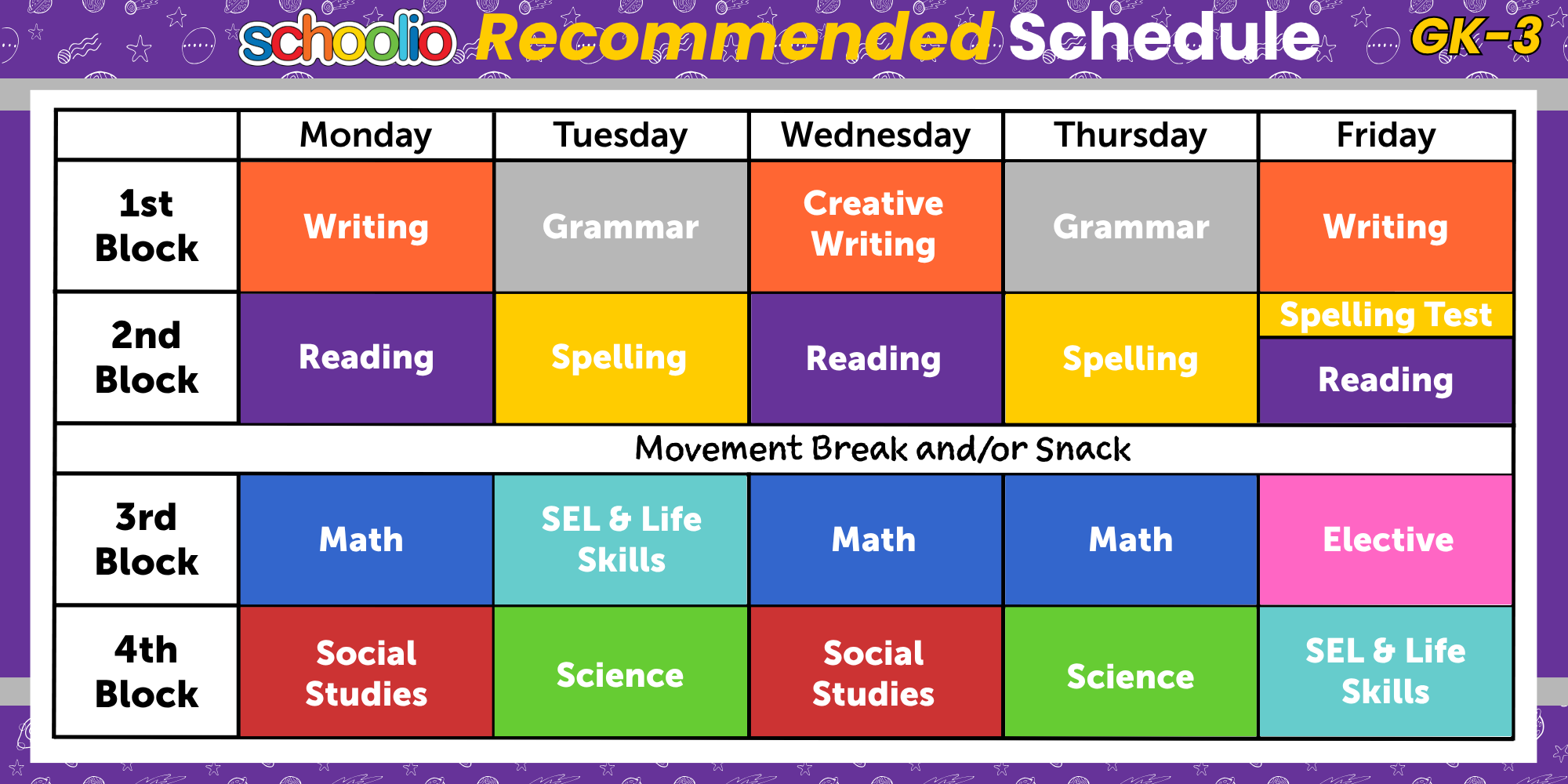
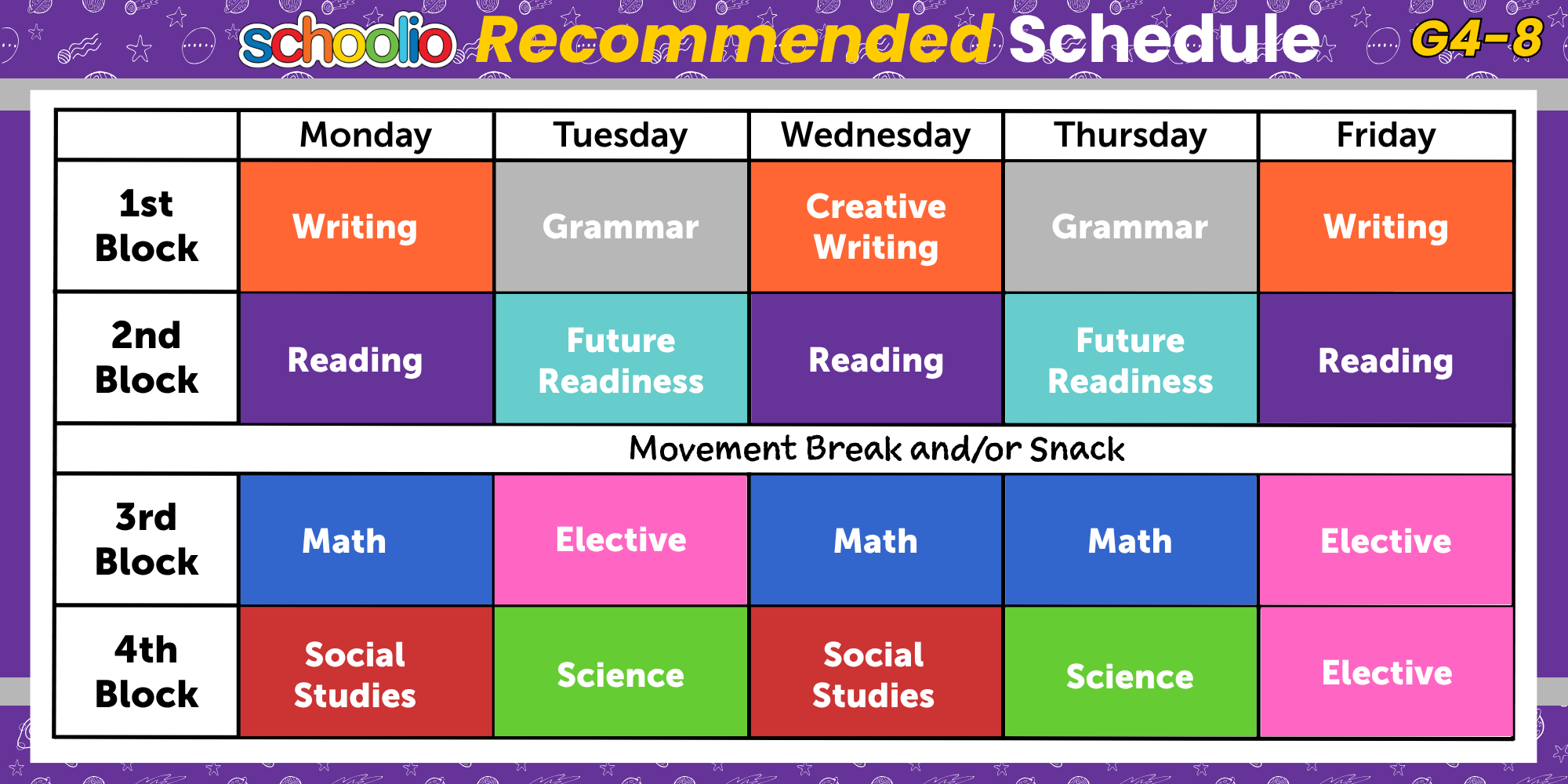
If you’re staring at a blank page and not sure where to begin — that’s okay. Here’s what we recommend at Schoolio as a starting point for families just getting going.

Schedule and Pacing.pngSchedule and Pacing (2).png

And notice what you don’t see.

Times.

Because a block that takes 20 minutes one day might take 45 minutes the next. That’s not a problem. That’s learning.

We also build a Movement Break right into the middle of every day — because we know what happens to kids’ brains and bodies when they’ve been sitting too long. And on Fridays, we leave room for electives and child-led learning, because what your child is passionate about deserves a place in the day too.

Treat these as a starting point, not a rulebook. Adjust the blocks, swap the order, follow your child’s lead.

That’s the whole point.


What about unschooling? Relaxed homeschooling? Structured homeschooling?

These are all real approaches — and whole books have been written about each of them.

The short version:

Structured homeschooling looks most like traditional school — set subjects, set times, measurable goals. Works well for kids who thrive on routine and parents who feel more confident with clear guidelines.

Relaxed homeschooling uses a loose framework but follows the child’s lead more. Less rigid, more responsive. Works well for families who want some structure without the rigidity.

Unschooling trusts the child to direct their own learning almost entirely, with the parent as a guide and facilitator. Requires a lot of confidence and works beautifully for some families and kids.

Most homeschool families land somewhere in the middle — a little structure, a lot of flexibility, and the willingness to adjust as they go.


The schedule that works is the one you’ll actually use.

I’ve seen gorgeous colour-coded homeschool planners abandoned by week two.

I’ve seen sticky notes on a fridge that held a family together for years.

Start simple. Try something for two weeks. See what’s working and what isn’t.

And give yourself permission to change it.

The beauty of homeschooling is that you can.


At Schoolio, our programs are designed to flex around your family’s routine — not the other way around. Whether you homeschool in the morning, the afternoon, or in twenty-minute bursts throughout the day, we’ve got you covered.

Exploring Free Homeschool Curriculum Options for Elementary

I get this question a lot.

“Is there any good free homeschool curriculum out there?”

And the honest answer is: yes and no.


There are free worksheets. Free activity sites. Free videos and lessons and printables scattered all over the internet.

And yes, some of it is genuinely useful.

But here’s something I’ve come to believe after years of teaching and homeschooling:

It will either cost you money or cost you time. You choose.


What “free” usually looks like in practice

Free curriculum is rarely complete. It’s rarely created by certified educators or professional curriculum designers. It’s rarely accredited or aligned to any recognized standard. What it usually is — is pieces.

A math worksheet here. A science activity there. A reading site someone recommended in a Facebook group. And someone has to assemble all of those pieces into something coherent, something progressive, something that actually adds up to an education.

That someone is you. If you have the time and the energy for that — genuinely, no judgment — it’s an option. But most parents who go that route find themselves spending hours every week planning, sourcing, and organizing. Hours that could have been spent actually learning with their kids.

For example, if you’re teaching Grade 3 math, you might find a great set of worksheets on fractions but struggle to find resources on multiplication. Or, you might find a wonderful science experiment on weather patterns but lack the follow-up materials to deepen the understanding. It’s like trying to build a puzzle without all the pieces.


Why does paid curriculum cost money?

I think it’s worth saying this out loud, because I don’t think it gets said enough. Curriculum companies — even small ones — have real people behind them. Certified teachers. Curriculum designers. Developers. Support staff. People who deserve to be paid fairly for their work.

A quality curriculum represents hundreds or thousands of hours of professional expertise, testing, and refinement. That costs money to build. And it costs money to maintain. When you pay for a curriculum, you’re not just buying a product. You’re paying for someone’s expertise so you don’t have to start from scratch.

Consider the difference it makes when teaching subjects like Grade 5 science or Grade 8 history, where having a structured, well-researched curriculum can save you hours of prep time and ensure your child is meeting educational standards.


What about “free” sites that aren’t really free?

Worth knowing: a lot of free educational content comes with strings attached. Advertising. Data collection. Sponsored content pushing specific products or agendas. Some free curricula are tied to specific religious, political, or ideological viewpoints — which may or may not align with your family’s values. Free isn’t always neutral.

Always worth asking: if this isn’t charging me, how is it paying its bills? For instance, a free math site might bombard your child with ads for unrelated products, or a free history resource might present a biased perspective on historical events. It’s crucial to vet these resources carefully to ensure they align with your educational goals and values.


How to make the most of free homeschool curriculum

If budget is genuinely a barrier, piecing together free resources is better than nothing. Start with one subject. Find something that works for your child. Build from there. For instance, you might begin with free online resources for Grade 4 English, focusing on reading comprehension and vocabulary, and gradually add more subjects as you find suitable materials.

But if you’re looking for something complete, professional, accredited, and actually designed to work — Look for a program that offers a free trial. That way you’re not paying for something sight unseen. You get to try it with your child, in your home, and decide if it’s the right fit before you commit.

That’s exactly what Schoolio offers. A real free trial — no strings, no pressure — so you can see for yourself.

What is Open-and-Go All-In-One Homeschool Curriculum?

What is Open-and-Go All-In-One Homeschool Curriculum?

If you’ve spent any time in homeschool Facebook groups or forums, you’ve probably seen the term “open-and-go curriculum” thrown around. It’s a popular choice for many families seeking a streamlined approach to homeschooling.

And if you’re new to homeschooling, you might be wondering what that actually means — and whether it’s right for your family. Let’s explore what makes an open-and-go all-in-one homeschool curriculum a compelling option for many parents.

What does “open-and-go” mean?

Exactly what it sounds like. You open it. You go.

No lesson planning. No hunting down resources from five different places. No spending your Sunday night figuring out what you’re teaching Monday morning.

An open-and-go curriculum has everything already built for you — the lessons, the activities, the instructions, the progression. You just show up and follow the guide. Imagine opening a book that guides you through a math lesson with your Grade 4 child, complete with practice problems and explanations. Or a science experiment for your Grade 7 student, where all the materials and steps are laid out.

For parents who are new to homeschooling, juggling multiple kids, or just don’t have hours to spend on planning every week — it’s a game changer.

What is an all-in-one curriculum?

An all-in-one curriculum takes that a step further.

Instead of buying separate programs for math, language arts, science, and social studies — an all-in-one bundles everything together into a single cohesive program.

One place. All subjects. All grade levels. Imagine having a Grade 2 curriculum that seamlessly integrates reading, writing, and arithmetic in a way that each subject complements the others. Or a high school program that ties history lessons with literature studies, providing a richer understanding of both.

No piecing together resources from a dozen different sources and hoping they add up to a complete education.

Benefits of Open-and-Go All-In-One Homeschool

For a lot of families — especially those just starting out — the biggest benefit is confidence.

When everything is laid out for you, you spend less time second-guessing yourself and more time actually learning alongside your child. You can focus on engaging with your child’s interests, like diving deeper into a topic they love, because the basics are covered.

A few other benefits worth knowing:

It saves time. Planning a homeschool day from scratch takes hours. An open-and-go curriculum gives that time back to you. Imagine reclaiming your evenings to spend with family or pursue your own interests.

It creates consistency. Subjects are designed to work together, so nothing falls through the cracks. This is particularly helpful for younger kids who thrive on routine and predictability.

It reduces overwhelm. The homeschool curriculum market is enormous and can feel paralyzing. An all-in-one simplifies the decision. Instead of sifting through endless options, you have a clear, structured path.

It’s flexible. A good open-and-go curriculum isn’t rigid. It gives you a clear path while still leaving room to slow down, speed up, or take a detour when your child’s curiosity leads somewhere interesting. For instance, if your child shows a keen interest in dinosaurs, you can pause the regular science lessons and dive into paleontology.

Is it right for every family?

Not necessarily — and that’s okay.

Some families love building their own curriculum from different sources. Some kids thrive with a very specific approach that a single program can’t offer. If your child has a passion for a niche subject like coding or art, you might supplement an all-in-one curriculum with specialized resources.

But for families who want a clear, complete, stress-free starting point?

Open-and-go all-in-one is often exactly what they were looking for — they just didn’t know it had a name.

What should you look for in an open-and-go all-in-one?

Not all programs are created equal. Here are a few things worth looking for:

Does it cover all core subjects? A comprehensive program should include math, language arts, science, and social studies at a minimum.

Is it designed for your child’s grade level and learning style? Some kids are visual learners, while others might prefer hands-on activities. Make sure the curriculum aligns with how your child learns best.

Is it flexible enough to adapt to your family’s pace? Life happens, and sometimes you need to slow down or speed up. A good program allows for this flexibility.

Does it support neurodivergent learners, or is it one-size-fits-all? Look for curricula that offer adaptations for different learning needs.

Is the parent instruction clear and easy to follow? That last one matters more than people realize. I’ve seen beautifully designed curricula that made total sense to an educator and completely overwhelmed a parent who just wanted to teach their kid to read.

The best open-and-go curriculum is the one that makes you feel capable — not the one that requires a teaching degree to navigate.

That’s exactly what we set out to build with Schoolio.

How Many Hours Should You Homeschool Each Day?

How Many Hours Should You Homeschool Each Day?

One of the first questions I hear from new homeschool families is this: “How many hours should we be doing every day?” It’s a question that often carries a lot of weight, as parents worry about whether they’re doing enough. And I always smile a little because the answer is often fewer hours than they’re expecting. Understanding how many hours are truly needed can bring a sense of relief and clarity to your homeschooling journey.


Why so much less than traditional school?

Think about what a six-hour school day actually looks like. There’s the morning routine — getting settled, taking attendance, announcements. Transitions between subjects, between classrooms, between activities. Lining up. Waiting. Bathroom breaks for the whole class. Behavior redirection when someone is off task — which in a class of thirty kids, is almost always someone. Lectures delivered to the whole group at a pace that works for the middle — too fast for some, too slow for others. Work periods where half the class is waiting for the other half to catch up. By the time you strip all of that away, the actual focused learning happening in a traditional school day is a fraction of the clock time.

At home, with one child — or even a few — you cut almost all of that out. No transitions. No waiting. No redirecting twenty-nine other kids. Just your child, you, and the lesson. That’s why two hours at home can cover what takes six hours at school. For example, a focused math lesson that might take an hour in a classroom can often be completed in 20 minutes at home.


What they taught me in teacher training

When I was getting my education degree, one of the most useful things my professors taught me was this: You can expect a child to give you their focused attention for as many minutes as they are years old. An eight-year-old? Eight minutes of genuine sustained attention. A six-year-old? Six minutes.

Now — that doesn’t mean a lesson is only that long. It means something needs to happen as a reset every few minutes. A change of location. A switch from listening to doing. A question asked and answered. A quick movement break. Anything that breaks the sustained attention and gives the brain a little refresh. Even traditional school isn’t six straight hours of focused learning. It’s dozens of tiny resets strung together across a day. Homeschool is no different — and once you understand that, the whole day starts to make a lot more sense.

For instance, a science experiment might involve a quick setup, a period of observation, and then a discussion. Each part offers a natural break and reset for the child’s attention.


So how long should homeschool actually take?

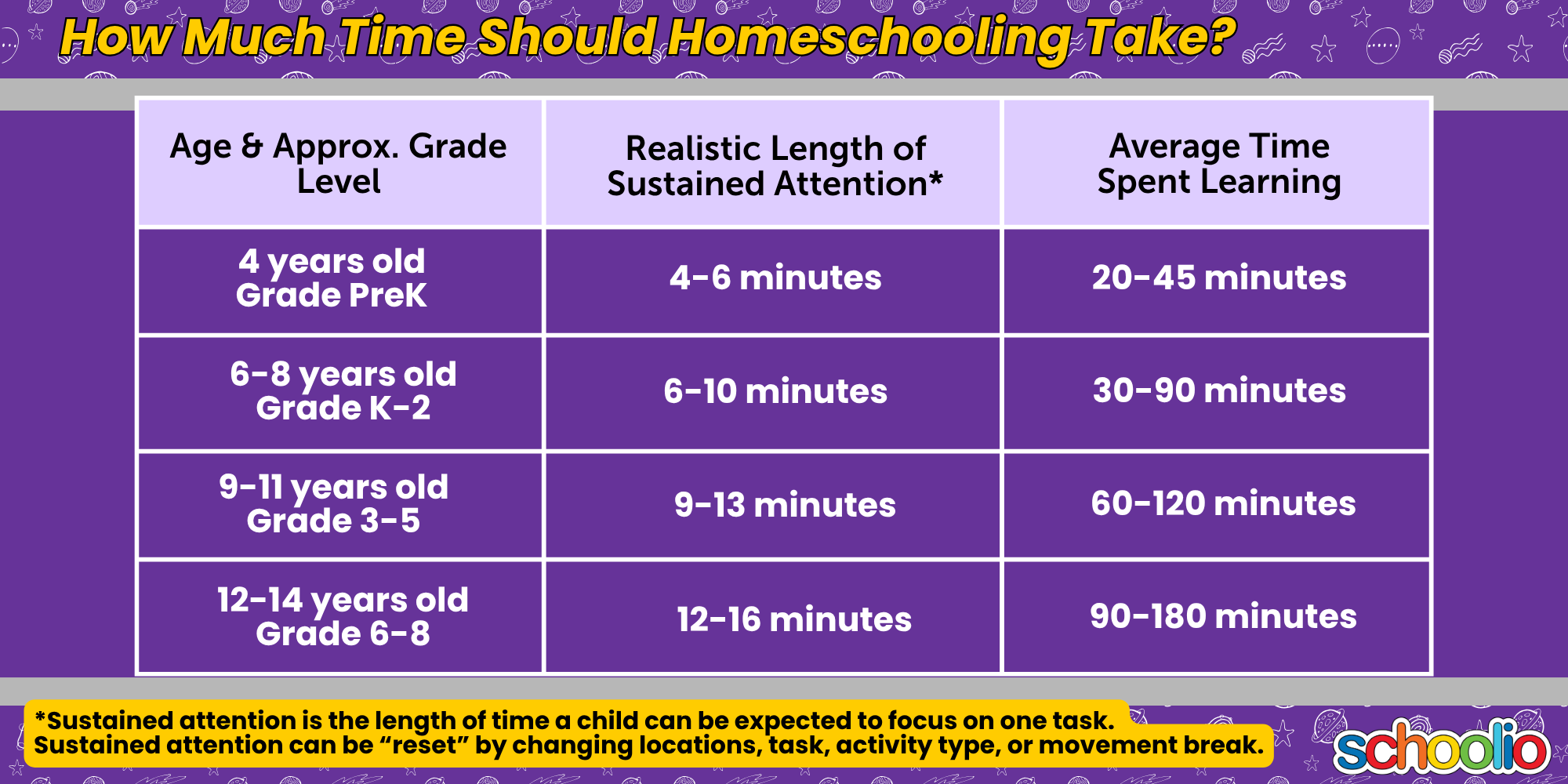
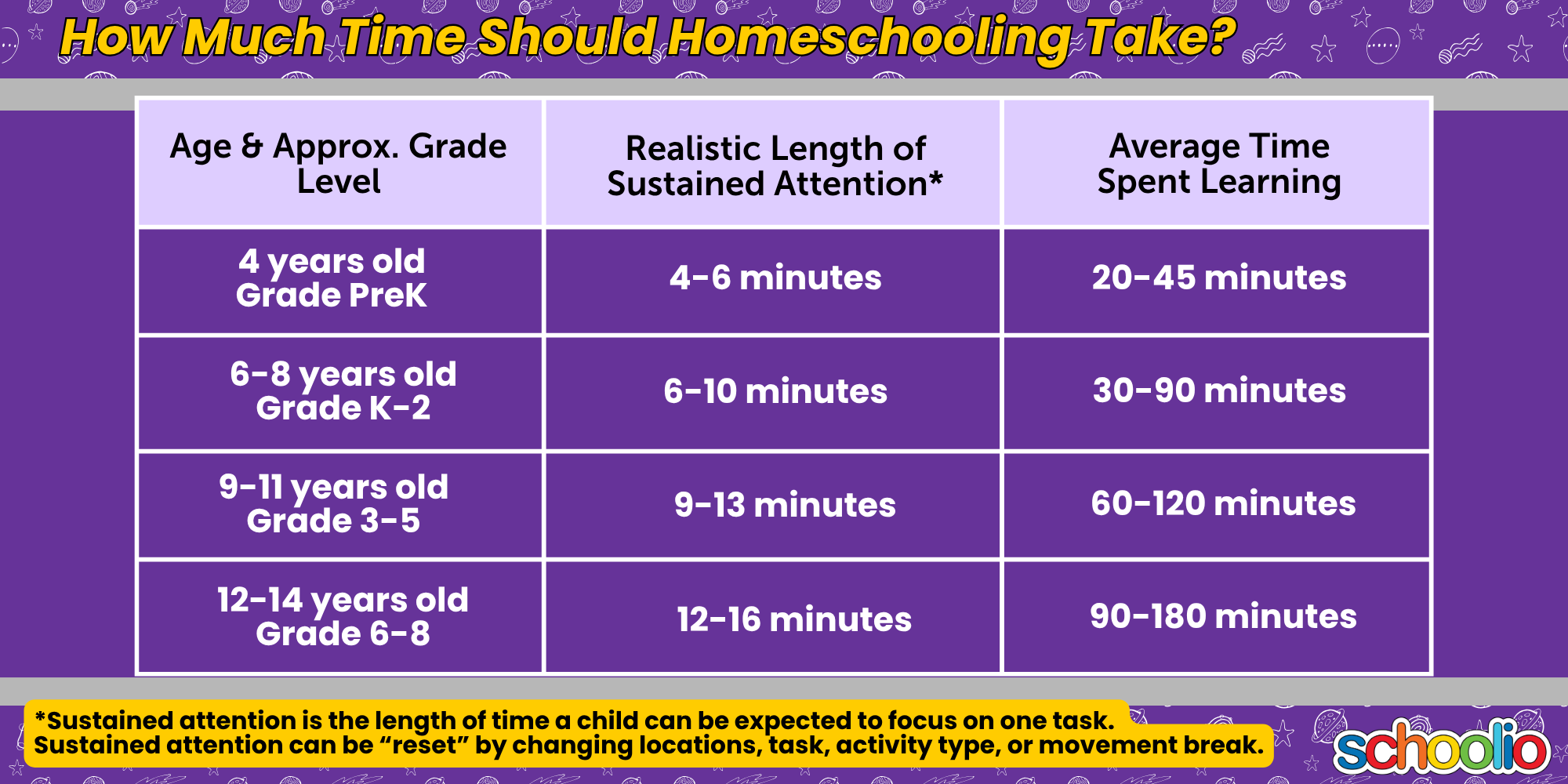
Here are some rough guidelines that the homeschool community has generally come to agree on. Think of these as a loose norm, not a rulebook. (See the chart below for a full breakdown by age and grade.)

PreK (Age 4) 20–45 minutes total. Sustained attention of just 4–6 minutes at a time. Play is the curriculum at this age. Keep it light, keep it moving. Activities might include storytelling, simple crafts, or a nature walk.

Kindergarten to Grade 2 (Ages 6–8) 30–90 minutes total. Sustained attention of 6–10 minutes. Short, varied activities work best. Reading, then building, then drawing — keep switching it up. A typical day might start with a reading session, followed by a hands-on math activity, and then a creative art project.

Grades 3–5 (Ages 9–11) 60–120 minutes total. Sustained attention of 9–13 minutes. Kids this age can handle a little more depth, longer projects, and starting to follow their own curiosity. You might introduce a research project on a topic of interest, encouraging independent learning.

Grades 6–8 (Ages 12–14) 90–180 minutes total. Sustained attention of 12–16 minutes. More independent work starts here — reading, research, writing — but it still shouldn’t feel like a grind. Consider incorporating a mix of structured lessons and self-directed study, like a science project or a book report.

TimeSpentLearning.png


A note for neurodivergent learners

If your child has ADHD, autism, or sensory processing differences, these numbers may look quite different — and that is completely okay. For many neurodivergent kids, sustained attention windows are shorter, and the need for resets is more frequent. That’s not a problem to fix. That’s information to work with. Twenty minutes of real engagement will always beat ninety minutes of struggle. Tailor your approach with flexible schedules and sensory-friendly activities.


The bottom line

Seat time is not the same as learning time. If your child is engaged, curious, and absorbing what you’re working on together — you’re doing it right. Even if it only took an hour. Even if it looked nothing like school. That’s kind of the whole point. Remember, the beauty of homeschooling is its flexibility and the ability to adapt to your child’s unique learning style and pace.

What Exactly Are “Strands” in Schoolio Academics? Let’s Break It Down

What Exactly Are “Strands” in Schoolio Academics? Let’s Break It Down


One thing that can be tricky for parents new to homeschooling is understanding what’s covered under the “umbrella” of a subject. Names like “Language Arts” and “Science” are important but we know there’s so many topics that fall under each.

Okay so… what does each subject actually include?!

“Math” isn’t just fractions.

“Science” isn’t just biology.

“Language Arts” isn’t just reading books.

Every core subject is actually made up of strands — smaller categories that build specific skills and knowledge.

And understanding those strands?

It helps you see what your child is really learning, what might need extra focus, and what they’re already mastering.


? At Schoolio, Here’s How We Break It Down:

We’ve organized our curriculum by subject and strand — so you’re not guessing what’s inside a course, or whether something’s missing. This is also part of our neurodivergent-friendly design, because when strands are separated into individual courses, you can mix & match grade levels between them.

Here’s what’s covered:

➗ Math

  • Number Sense & Numeration
  • Algebra, Patterning & Coding
  • Geometry & Spatial Sense
  • Data Management & Probability

? What this means: It’s not just computation. Your child also learns how to spot patterns, organize data, and apply logic in real-world scenarios.

? English Language Arts (ELA)

  • Writing Skills
  • Literature Study & Reading Comprehension
  • Grammar Foundations
  • Spelling

? What this means: Reading and writing are treated as distinct (and equally important!) skills — with grammar, vocabulary, and reading analysis woven in naturally.

? Science

  • Biology & Life Systems
  • Structures, Mechanisms & Engineering
  • Earth & Space Systems
  • Matter & Energy Systems

? What this means: Your child gets hands-on exposure to all areas of science — not just life science. And yes, there’s plenty of room for rockets and slime.

? Social Studies

  • History, Heritage & Citizenship
  • Geography, People & Cultures

? What this means: Learning about the world and our place in it — from past to present, and here to everywhere.

? Future Readiness (only at Schoolio)

This is our favorite subject — and one that most public schools completely overlook.

Strands include:

  • Social Skills & Emotional Intelligence
  • Financial Literacy & Money Sense
  • Business Studies
  • Emerging Technologies

? What this means: We’re not just preparing kids to pass a test. We’re preparing them for life.

From understanding how to budget or start a business…

To learning how AI and tech are shaping the future…

To building communication and emotional skills

— these are the lessons that stick.

? Electives

We also include:

  • Visual Arts, Music, and Drama
  • Sports and Physical Education

Because yes — creativity and movement matter, too.

? Why Strands Matter

When you break subjects into strands, a few amazing things happen:

  • You can see progress more clearly (“We’ve nailed Number Sense but need more Geometry practice”)
  • You can mix and match based on your child’s needs
  • You can build a balanced learning plan that doesn’t leave gaps
  • You can breathe easier, knowing you’re covering everything — without overloading

At Schoolio, we design with this in mind — so your homeschool isn’t a guessing game.

Instead, it’s clear, organized, and customizable — just like it should be.


? Lindsey

Certified Special-Ed Educator & Co-Founder, Schoolio

Parents Do Not Choose Homeschooling for Novelty

Parents Do Not Choose Homeschooling for Novelty


This has been on my mind today…


I read about one of Afghanistan’s most iconic girls’ schools being turned into an empty shell. Classrooms that once held ambition and possibility now sit silent. Not because girls stopped wanting to learn. But because power decided who gets access to education and who does not.

What stayed with me was how fragile education really is. We like to believe progress always moves forward, but history keeps proving otherwise. When systems fail or fear takes over, learning is often the first thing taken away.

It reminded me that schooling and learning are not the same thing. Schools can close. Buildings can be taken. But the desire to learn lives inside people. When doors shut, that desire looks for another way in.

This is something homeschooling families understand deeply. Learning can happen anywhere. Around a kitchen table. Through conversation. Through curiosity. Through care. Homeschooling is not about opting out. It is often about protecting a child’s right to grow when the system cannot or will not support them.

At Schoolio, we work with families who did not choose an alternative path for novelty. They chose it for safety, dignity, and confidence. Children pushed out or worn down by systems that could not see them. Parents trying to hold onto their child’s love of learning.

Education poverty is not just about access to schools. It is about access to dignity and possibility. When a child is denied the right to learn freely, the damage goes far beyond missed lessons.

This story was a reminder of why flexible, resilient learning matters. Learning that travels with the child. Learning that adapts. Learning that cannot be shut down by a single decision.

Learning your way is not a luxury. For many families, it is survival. And protecting that right is work worth doing.


Sathish

still learning, still unlearning


How to Start Homeschooling in Texas (2025 Guide)

How to Start Homeschooling in Texas (2025 Guide)

by Sathish

This has been on my mind today…

I’ve spoken with so many families lately who are thinking about making the jump to homeschooling—especially as we launched in Texas and met many of the local families who were ready to start but had never heard of Schoolio before. And while every story is different, the emotions are often the same. One parent told me, “I want to homeschool, but I’m scared I’ll mess it up.” Another said, “We feel like school isn’t working, but what if I can’t give them what they need at home?”

These aren’t small fears. They’re real. And deeply rooted in the way many of us were raised to believe that learning only happens inside a classroom, led by certified professionals with years of training. So to say, “I’m going to homeschool my child,” feels like breaking a rule we didn’t know we were allowed to question.

But here’s what’s been powerful to watch. I’ve seen those same parents a few months later—different posture, different voice, different mindset. One tells me her son is finally reading because he wasn’t forced into a pace that didn’t work for him. Another shares how her daughter stopped having stomachaches every morning now that learning happens at home. They’re not perfect. They’re not experts. But they’re doing it.

That’s the magic. Homeschooling isn’t about doing school at home. It’s about doing what works—for your child, your values, your rhythm as a family. And in Texas, the path to begin is surprisingly simple. The biggest step isn’t paperwork. It’s choosing to believe that you can guide your child’s education in a way that works for both of you.

So here’s what you need to know.

Texas is one of the most homeschool-friendly states in the country. There’s no registration process. No district approval. No testing requirements. You don’t need to submit plans or portfolios. You simply need to teach a few required subjects using a written curriculum. That’s it.

Here are the basics:

  • Homeschooling in Texas is legally recognized as “private education.”
  • You’re required to teach reading, spelling, grammar, math, and good citizenship.
  • There’s no formal notice of intent needed, unless your child is already enrolled in public school. In that case, you’ll just need to withdraw them by notifying the school.

That’s all.

Of course, just because it’s simple on paper doesn’t mean it feels simple emotionally. Starting is the hardest part—not because the laws are complicated, but because the fear is real. What curriculum do I choose? How do I make a schedule? What if I don’t cover everything?

That’s why we built Schoolio—to make it easier for families to get started and stay supported. Whether you want a complete curriculum bundle, an online homeschool program, or just a flexible homeschool planner to design your own flow, you’ll find tools that don’t add pressure, but help you feel capable.

Because that’s the real shift. Homeschooling works best not when you try to recreate the system at home, but when you create something new—something human, flexible, and designed around how your child learns best.

So if you’re in Texas and wondering how to start homeschooling, here’s the truth: you already have. That moment you paused and asked, “What’s best for my child?”—that’s where it begins.

Sathish

still learning, still unlearning

How I Built a Homeschool Schedule That Didn’t Burn Us Out

How I Built a Homeschool Schedule That Didn’t Burn Us Out

by Lindsey

When I think back on our homeschool journey, I remember the spiral-bound planner I bought during that first summer. I had every hour penciled in. Math at 9. Language at 10. Science after lunch. I thought if I could just replicate the structure of a school day at home, we’d be successful. I was trying so hard to “do it right.” But right for who?

What followed were weeks of power struggles. One of my kids melted down every time we had to switch subjects. The other would hyperfocus on one thing and resist everything else. I found myself repeating the same sentence over and over: “We’re behind.” I felt behind. All the time. And so did they.

One day, I remember snapping at my youngest over handwriting. She was crying. I was too. We closed the books and walked away. I sat on the couch, defeated. And that night, after they’d gone to bed, I looked at the planner and realized it wasn’t designed for us. It was built on someone else’s idea of learning. Not mine. Not my kids’.

That’s when I started paying attention to something else—not the clock, but their energy. Their moods. When they were curious. When they were tired. When they needed to move. I swapped strict scheduling for rhythms. Short lessons. Wiggle breaks. Slow mornings. Outside time. And something amazing happened—we all calmed down.

They started learning more. Not because I was teaching harder, but because they were finally able to receive it. And I started feeling more like their guide and less like their warden.

That’s when we started using a flexible homeschool planner. One that gave us space to adjust. One that didn’t guilt-trip us with empty checkboxes, but reminded us to focus on the whole child. I used to think we had to cover every subject, every day, in order to be doing homeschooling the “right” way. Now, I know better.

There are still days where we only get through half a lesson, or days when everyone’s too grumpy to do anything academic. But that’s okay. Because I’ve learned that building a homeschool schedule is less about fitting everything in and more about building a life where learning fits.

And that’s what makes it sustainable. That’s what makes it stick.

certified special-ed educator & co-founder, Schoolio

What Is “Enough” in Homeschooling?

What Is “Enough” in Homeschooling? 

by Lindsey

When I think back on our homeschool journey, one day in particular still stands out like a smudge on the calendar. One of those days where everything just starts off on the wrong foot. No one slept well. The kids were fighting before breakfast. There wasn’t enough coffee in the world to get me centered. And the second I called them to the table to start school, the whining began.

I could feel it coming—low frustration tolerance all around, myself included. Math was the breaking point. Tears, tantrums, and a very dramatic pencil toss across the room. We all lost it a little that morning. Not our best moment. I threw in the towel. I had to. No one learns when they’re emotionally dysregulated. So instead of pushing through, I called it. We put on jackets, walked outside, and just… let go.

It took a while, but we all started to settle. There’s a kind of reset that happens when you’re outside, when the pressure to perform and achieve and “get it done” lifts off everyone’s shoulders. They started to build an obstacle course in the backyard. At first it was just a way to burn off energy. But then I saw it. They were measuring and planning. They were problem-solving. They were testing different ideas, adjusting materials, explaining their thoughts to each other. Without even realizing it, they were doing geometry, physics, and engineering—all in bare feet with sticks and cones.

If they’d been in school that day, I know exactly how it would have gone. They would’ve been just as frustrated, just as unfocused, and they wouldn’t have had the option to take a break. They would’ve had to sit through the rest of the day, disconnected and overstimulated, trying to mask their feelings. At home, they get space to breathe. To stop. To move. To recover. And in doing that, they often end up learning more deeply and more meaningfully than they ever could with a workbook in front of them.

It reminded me of something I know as a special-ed educator, but sometimes forget as a parent: learning doesn’t have to look a certain way to be valid. Progress doesn’t always come in neat packages. Some days, “enough” isn’t checking off every subject—it’s knowing when to pause. It’s recognizing when your child’s brain and heart need care before content.

That day, we didn’t finish our lessons. But we learned a lot. And that was enough.

Certified Special-Ed Educator & Co-founder, Schoolio

Why Homeschooling Is the Future of Education

Why Homeschooling Is the Future of Education

This has been on my mind today…

I grew up in Singapore in the 1980s, where school felt more like an assembly line than a place for learning. Back then, your academic score was the only measure of your potential. If you didn’t perform well, you were pushed aside—discarded like a bruised fruit, judged unworthy by the smallest mark of imperfection.

I remember sitting in class, knowing the answers but afraid to speak. I remember the sting of being called slow, stupid, or lazy. I remember walking home with my report card, knowing I’d be met with disappointment, not support. It was a system that didn’t care who you were—it only cared how well you fit the mold. And I didn’t fit.

What I needed wasn’t more pressure. I needed someone to look at me and say, “You learn differently, and that’s okay.” I needed someone to help me discover my strengths. I needed someone to believe in my potential before I could believe in it myself. But that wasn’t the culture I grew up in. I was sorted and labeled, and I carried those labels for years.

Now, decades later, I see parents doing exactly what I once needed—they’re choosing homeschooling. And not just as a last resort. They’re choosing it because it allows them to give their kids something that traditional systems often can’t: flexibility, safety, confidence, and a learning experience that fits who their child truly is.

Homeschooling isn’t just growing—it’s evolving. It’s no longer limited to families with specific ideologies or one-income households. Today’s homeschoolers are often working parents, digital entrepreneurs, community builders, and curious learners who want to raise curious kids. They’re embracing online homeschool programs, customizing homeschooling curriculum, and using tools like homeschool planners to structure their days without replicating the stress of traditional school.

Is homeschooling effective? Ask the parent whose child went from meltdown to motivation because they finally felt understood. Ask the family whose neurodivergent teen now builds robots at home after being told he was disruptive in class. Ask the mom who finally sees her daughter smiling during a math lesson—not because the worksheet is easier, but because the environment is kinder.

I believe homeschooling is the future of education because it starts with trust—not in the system, but in the child. It recognizes that every learner is different, and that the best learning doesn’t always happen at a desk. It happens when a child feels safe enough to take risks, ask questions, and fail without shame. It happens when a parent is empowered to say, “I know what my child needs, and I can help provide it.”

If I had access to something like homeschooling as a kid, maybe I would’ve found my voice sooner. Maybe I wouldn’t have spent so many years doubting my worth. Maybe I would’ve seen myself not as broken, but simply different.

That’s what so many homeschooling parents are giving their kids today. And that’s why I believe it’s not just an alternative—it’s a model worth building the future on.

Sathish

still learning, still unlearning

New to Homeschooling? Here’s the Common Causes of Homeschool Struggles (and How to Fix It)

Were you ready for homeschool joys but find yourself with mostly homeschool struggles? You’re not alone! In fact, if you’ve removed your kids from public school to homeschool, you’re likely dealing with the same struggles I did when my kids were new to homeschooling.

If you’ve been homeschooling for a few months now,  maybe you’re starting to find your groove. Or, maybe you’ve discovered approximately 47 ways that don’t work and are still searching for that elusive peaceful rhythm. Either way, common homeschool struggles may be making you feel overwhelmed.

Do you find yourself wondering how seasoned homeschool parents manage to survive—even thrive—in this gig? You love your children, of course. You’d step in front of a moving bus for them. But let’s face it: they’re always here now. Like, always. And it can be a bit much.

When do you get a break? When do you get time for yourself? Why do they need a snack every 14 seconds or want you to referee every disagreement? Deep breaths. I’m here to help.

Here’s the veteran homeschooler’s secret: Homeschooled kids do become more independent. But getting to that point takes time. Your kids are unlearning a lot of habits and behaviors picked up in the school system—and that’s a process. The longer your kids have been in the school system, the longer that unlearning can take. So if homeschool struggles have you tearing your hair out and second-guessing your life choices, you’re not alone. Let’s talk about what might be going on.


1. They’re Asking Permission for Ev.er.y.thing

Need to sharpen a pencil? Get a tissue? Use the washroom? Ask permission first. That’s how it worked at school, and your kids are used to it. Schools need these rules to manage 30+ kids at once, but at home, it can make you feel like you’re the cruise director of the S.S. Homeschool. It’s exhausting.


If one of your big homeschool struggles is frustration from the feeling that your kids can’t do anything on their own or make simple decision, try this: Take a deep breath and gently remind them, “You don’t need my permission for that. I trust you to decide.”

Resist the urge to just give them the go-ahead—it’ll only reinforce the habit. Empower them instead, and over time, they’ll learn to take initiative. These small shifts give them more autonomy and means they spend less time bugging you for help with simple things.


2. They Don’t Know What to Do with Free Time

Public school schedules every moment of a child’s day, from math class to bathroom breaks. At home, formal learning likely takes you anywhere from 30-minutes to a maximum of 2-3 hours, depending on the age of your kids. That leaves a lot of free time, which is one of the amazing gifts of homeschooling- expanding and extending childhood through free time, but the wide-open spaces in your schedule might actually feel really overwhelming to your kids at first.

bored kid lays on red couch

That’s why you may be hearing a lot of, “I’m bored,” even though you look around at all the books, toys, games, and technology that litter the house and think, “HOW?!?”


These kinds of homeschool struggles are common at first. Here’s how to work towards a fix: Instead of micromanaging their time, try brainstorming a “What to Do When You’re Bored” list with them. Write down activities they enjoy or want to try, and pin it somewhere visible. Forbid the words “I’m bored”—chores are a great consequence for that—and encourage them to make their own decisions about how to fill their time. They’re learning to be autonomous, at first with the support of the list they contributed to, and soon they won’t need it and will become more comfortable with filling their own time and amusing themselves- an invaluable life skill! It takes a little time, and you’ll be tempted to just plan more activities f or them, but remember, you are not their cruise director, it’s not your job to ensure they’re entertained every minute of every day. You’re teaching them something valuable in solving their own boredom and it’s worth the effort.


3. They’re Always in a Rush

Schools operate at a breakneck pace: “Quickly and quietly through the halls!” “The bell rang—get to your next class!” “Hurry up or you’ll miss the bus!” And while your kids were in school, it may have felt like your home life was the same- “Hurry up and get ready for the bus!” “We’re late for swimming lessons!” “Take a super quick shower, it’s almost bedtime!” It’s no wonder if our kids seem anxious! If during your early days of homeschooling, your kids seem anxious, impatient, or like they’re constantly rushing through tasks, this is a very normal response to life spent in a mad-dash.

mom and two kids rushing out the door

Homeschooling offers the luxury of time, but it takes adjustment. Show your kids how much free time they actually have. One great strategy is to use a visual schedule to map out the day and let them plan how they’ll spend their free blocks. This helps ease their transition from rushed chaos to a peaceful rhythm and tackles some of those early homeschool struggles.


4. They’re Fighting More with Their Siblings

Sibling squabbles are normal, but if it feels like they’re constantly at each other’s throats, remember this: School culture teaches kids that it’s uncool to associate with anyone younger than themselves. This mindset can carry over at home, making siblings view each other as rivals instead of teammates. Most homeschool families I’ve talked to, including my own, find that siblings are incredible friends and spend a lot of wonderful time during their childhood together, making a great bond. You likely want this for your children too, so don’t give up on encouraging a new dynamic!

Homeschooling gives you the perfect opportunity to reframe this dynamic. Encourage collaborative activities that require teamwork, like building something together or cooking a family meal. Over time, your kids will learn to see each other as allies instead of annoyances, helping to reduce these kinds of homeschool struggles.


5. They’re Acting Disrespectful

School culture rules teach our kids that “adults are the enemy” and to view authority figures with suspicion. Think about it: Teacher’s Pets are teased, tattling isn’t cool, even if the other person was being unsafe, and confiding in parents, teachers, or other adults is a fast track to social exile. Breaking the rules, pushing boundaries, and seeing just how much you can get away with is generally considered cool. In a lot of schools, getting into trouble is a badge of honor. It’s no wonder your child might be hesitant to trust or respect you at first.

mom talks while teen looks at phone, not listening

Be patient here. Trying to force them to show you respect will most likely lead to more resistance and push back. Show them, through your actions, that you’re a safe, caring person who wants the best for them, who they can confide in, and who they can trust. They already know this about you, they just need to unlearn the school teachings that made them feel obliged to block you out. Keep on listening to them, validating their feelings, and gently correcting disrespectful behavior. With time, they’ll learn that they don’t have to maintain the facade that they don’t like you, and the walls they’ve built will come down.


6. They Don’t Seem to Think for Themselves

Were you really excited to ask your kids what THEY wanted to learn and following those sparks of curiosity with your kids? And then did you ask them what they wanted to learn, only to be meant with blank stares and shrugs? Remember that at school, conformity is king. This happens in two ways: First, in the classroom, there’s little time for creative thinking or exploring ideas outside the curriculum. Kids learn to not ask a lot of questions out of curiosity, but to just give the “right” answer if they know it, and if they don’t know the answer, someone else gives the right answer instead, meaning they’re rarely called on to think thoroughly or deeply about things they don’t know or are curious about. Second, the toxic social culture of public school teaches our kids that loving learning and/or being “good at” academics is “uncool”. Think about the classic bully taunts of “nerd”, “teacher’s pet”, or “brainiac”. This is an ingrained part of school social culture, and can be hard to shake your kids loose from. They’ve never been able to have the power of choice in what they learn before, and over the years by being forced to learn things that are neither of interest to them or relevant to their lives, they’ve come think that they “hate learning”. They don’t actually hate learning though, they hate school Now as homeschoolers, you get to make the difference for them!

kids painting flowers

Just like a lot of our other strategies, start by offering support. You know your kids better than anyone, so you can probably choose some great science, social studies, or elective topics they’ll love. Remember that you don’t need to teach certain topics certain years just because the school system does it that way. If your kids are into Space, Dinosaurs, Detectives, Cats, or Minecraft, you can always choose those topics for your homeschool learning units. As they get their spark back for loving learning, because they’re interested in the topics, their curiosity will grow and they’ll start to ask to learn about new topics, and as they get older, they’ll self-initiate learning about the things they want to know. This sets them up to be lifelong learners, which is more important to their future success than any marks on a test ever will be!


The Bottom Line

Hang in there, parents! Transitioning from public school to homeschooling is a huge adjustment, not just for your kids, but for you, too. There’s a lot of unlearning to do on both sides. Be patient, be forgiving, and above all, be kind—to your children and to yourself. Lower your expectations. Then lower them again. Take it slow, and eventually, you’ll find your rhythm.

happy family homeschooling

Before long, you’ll see your kids becoming more independent, confident, and creative. And maybe—just maybe—you’ll find yourself wondering why you ever thought homeschool struggles were so overwhelming in the first place.

Why Canadian Homeschoolers Should Be Using Canadian Curriculum

For Canadian homeschoolers, the appeal of readily available American curriculum can be tempting, but Canadian curriculum is essential for Canadian students. There are less options for Canadian curriculum, and with a wide variety of options, seemingly universal topics, and often well-established brands, it might feel like a convenient choice to go with American content for your homeschooler. However, there are significant reasons why Canadian families should prioritize curricula created specifically for Canadian learners. From metric measurements to Canadian history, using Canadian-made materials ensures that children receive an education that aligns with their cultural and academic needs while supporting Canadian businesses.

Metric Measurements Matter

One of the most glaring differences between Canadian and American education systems is the use of measurements. Canada operates under the metric system, while the United States primarily uses the imperial system. This discrepancy might seem minor, but it can create confusion for Canadian learners when learning math and science. Remember that most of the world and all of the scientific community use metric measurements, so you do your child a disservice if you teach them imperial only. American curriculum often uses inches, feet, and pounds, while Canadian learners need to work in centimeters, meters, and kilograms to align with their daily lives and future academic expectations. Canadian students should become fluent in metric conversions to prepare for careers and higher education that rely on this system.

Using a Canadian curriculum ensures students become proficient in the measurements they will encounter in real-world applications. For more on the metric system, visit Canada’s Measurement System.

Financial Literacy with Canadian Money

Financial literacy is a cornerstone of any good education, teaching students how to manage money, budget, and make informed financial decisions. Many families who choose to homeschool do so because they are interested in teaching concepts like Financial Literacy that aren’t well covered in schools. However, many American curricula focus exclusively on U.S. dollars, tax systems, and financial norms that don’t translate directly to Canadian realities. Canadian learners benefit from materials that:

  • Use Canadian dollars, coins, and banknotes for practical exercises.
  • Reflect Canadian tax structures, including GST and provincial taxes.
  • Incorporate Canadian banking systems, such as Registered Education Savings Plans (RESPs) and Tax-Free Savings Accounts (TFSAs).

A financial education rooted in Canadian contexts equips students with skills they’ll use throughout their lives. Canadian companies like Schoolio have a robust Canadian-focused Financial Literacy program.

Financial Literacy with Canadian Money

The Importance of Canadian Curriculum for History and Geography

American curricula emphasize U.S. history and geography, and also often cover World History, but rarely if ever do they cover Canada’s rich heritage and vast landscapes. For Canadian homeschoolers, it’s vital to:

  • Learn about Canadian history: From Indigenous peoples and their cultures to Confederation, Canadian history shapes our national identity and values.
  • Understand Canadian geography: With its diverse ecosystems and provinces, Canada’s geography is fundamental to understanding environmental stewardship and regional diversity.
  • Celebrate Canadian contributions: Highlighting Canadian achievements in science, art, and global diplomacy fosters national pride.

By focusing on these topics, Canadian curriculum can help students understand their place in the world and their responsibilities as Canadian citizens. For Canadian history resources, check out The Canadian Encyclopedia or look for a Canadian History curriculum, like Schoolio.

Canadian Ideals in Education

While the U.S. and Canada share some cultural similarities, the two nations differ in significant ways. Canadian education often emphasizes:

  • Inclusivity and multiculturalism: Reflecting Canada’s diverse population and commitment to equity.
  • Environmental responsibility: Encouraging sustainability and climate awareness as national priorities.
  • Peacekeeping and diplomacy: Highlighting Canada’s global role as a mediator and advocate for human rights.

Using Canadian curricula helps ensure that these values are woven into the learning experience, shaping students who are informed, empathetic, and engaged citizens.

Supporting Canadian Businesses

Choosing Canadian-made homeschooling materials not only benefits students but also strengthens the homeschooling community and economy. By supporting Canadian content creators, families:

  • Encourage the growth of local educational resources.
  • Ensure the availability of high-quality, culturally relevant materials for future generations.
  • Contribute to the success of small businesses and entrepreneurs dedicated to Canadian education.

Investing in Canadian businesses creates a positive cycle, fostering innovation and collaboration within the homeschool community.

Canadian Curriculum: A Balanced Approach

This isn’t to say that Canadian homeschoolers should completely avoid American resources. In some cases, supplemental materials from the U.S. can provide valuable insights or enhance a subject. Many Canadian homeschoolers also want to teach their children some American history and geography for relevance. However, the core curriculum should reflect Canada’s unique educational and cultural priorities. By carefully selecting Canadian materials, parents can provide a more relevant and enriching learning experience for their children.

Final Thoughts

Canadian homeschoolers have a wealth of resources at their disposal, and prioritizing Canadian curriculum is an investment in their children’s education and the nation’s future. From metric measurements to Canadian values, these materials ensure learners are prepared for life in Canada while fostering a sense of pride and connection to their home country. By supporting Canadian content creators, homeschoolers help build a robust, vibrant educational landscape that benefits all families across the country.

? Give Your Child a Truly Canadian Education! ?

Don’t settle for an American curriculum that doesn’t align with Canada’s unique history, values, and academic standards. Choose Schoolio’s Canadian curriculum and ensure your homeschooler learns:
✅ Metric measurements used in Canada and worldwide
✅ Financial literacy with Canadian dollars, banking, and taxes
✅ Canadian history, geography, and cultural contributions
✅ The values of inclusivity, sustainability, and diplomacy

? Equip your child with the right tools for success in Canada. Browse our Canadian curriculum today!

?➡ Explore Schoolio’s Canadian Curriculum Now!