
What Does a Homeschool Schedule Actually Look Like?
Before I started homeschooling, I had a picture in my head of what a homeschool schedule actually looked like.
A little desk. A chalkboard. My kids sitting quietly, working through lessons, one subject at a time.
Basically, school. But at home.
It took me awhile to let that image go, as it does for a lot of new homeschoolers.
Homeschool doesn’t look like school.
And that’s not a bug. That’s the whole feature.
The freedom to build a day that actually works for your family — for your child’s energy, attention, learning style, and life — is the single biggest advantage homeschooling has over a traditional classroom.
But that freedom can also feel overwhelming at first.
If it doesn’t look like school, what does it look like?
There is no one answer.
And I mean that genuinely — not as a cop-out.
A homeschool schedule for a six-year-old with boundless energy looks completely different from one for a thirteen-year-old who loves to read for hours.
A schedule for a family with three kids at different grade levels looks different from one for an only child.
A schedule for an autistic child who thrives on predictable routine looks different from one for an ADHD child who needs constant variety and movement.
The schedule that works is the one that works for your family.
Full stop.
Routine over schedule.
This is the shift that changed everything for us.
A schedule says: math is from 9:00 to 9:30.
A routine says: we do math before lunch.
The difference sounds small. It isn’t.
A color-coded 30-minute block assumes math will take exactly 30 minutes. But what if your child catches on in ten? Do you fill the remaining time with busywork and deal with a bored kid who starts acting up — just like a classroom teacher would have to?
Of course not. This isn’t school.
And what if today’s math involves a hands-on experiment that spills into 45 minutes of genuine engagement? Do you cut it off because the schedule says so?
There’s no bell that rings to force an end to a learning session. This is your homeschool. You decide when you’re done.
Routine gives your day shape without making it rigid.
You know what’s coming. You know roughly when. But the day gets to breathe.
That said, here are some patterns that tend to work well.
Anchor your day, don’t script it.
Instead of scheduling every minute, try anchoring your day with a few fixed points.
A morning start time. A lunch break. An end time.
Everything in between has structure — but room to move.
Do the hard things first.
Most kids have their sharpest focus in the morning.
Save math and language arts for earlier in the day when attention is fresh.
Leave creative projects, read-alouds, and hands-on activities for the afternoon.
Build in resets — not just breaks.
Kids can only sustain focused attention for as many minutes as they are years old.
An eight-year-old — eight minutes. A ten-year-old — ten minutes.
That doesn’t mean lessons are that short. It means something needs to shift every few minutes to reset the brain.
Change the activity. Change the location. Ask a question. Take a lap around the yard.
A reset isn’t lost time. It’s what makes the next stretch of learning possible.
Give kids autonomy over their day.
This one was a game changer in our house.
I used to write the subjects for the day on our whiteboard — little name plates with magnets on the back — and then step back and let the kids decide the order.
Math first? Fine. Save reading for after lunch? Great.
They still did everything on the board. But they got to own how the day unfolded.
And something shifted when I did that.
The resistance dropped. The negotiating stopped. They weren’t being marched through someone else’s plan — they were executing their own.
Autonomy isn’t just good for morale. It builds executive function, decision-making, and self-regulation. Skills that will serve them long after they’ve forgotten what grade they learned long division.
Follow the energy.
Some days your child will be locked in and ready to work. Lean into it.
Other days — nothing is landing and everyone is frustrated.
On those days, close the books.
Go outside. Bake something. Watch a documentary.
Learning doesn’t stop just because the lesson did.
A starting point if you need one.
If you’re staring at a blank page and not sure where to begin — that’s okay. Here’s what we recommend at Schoolio as a starting point for families just getting going.
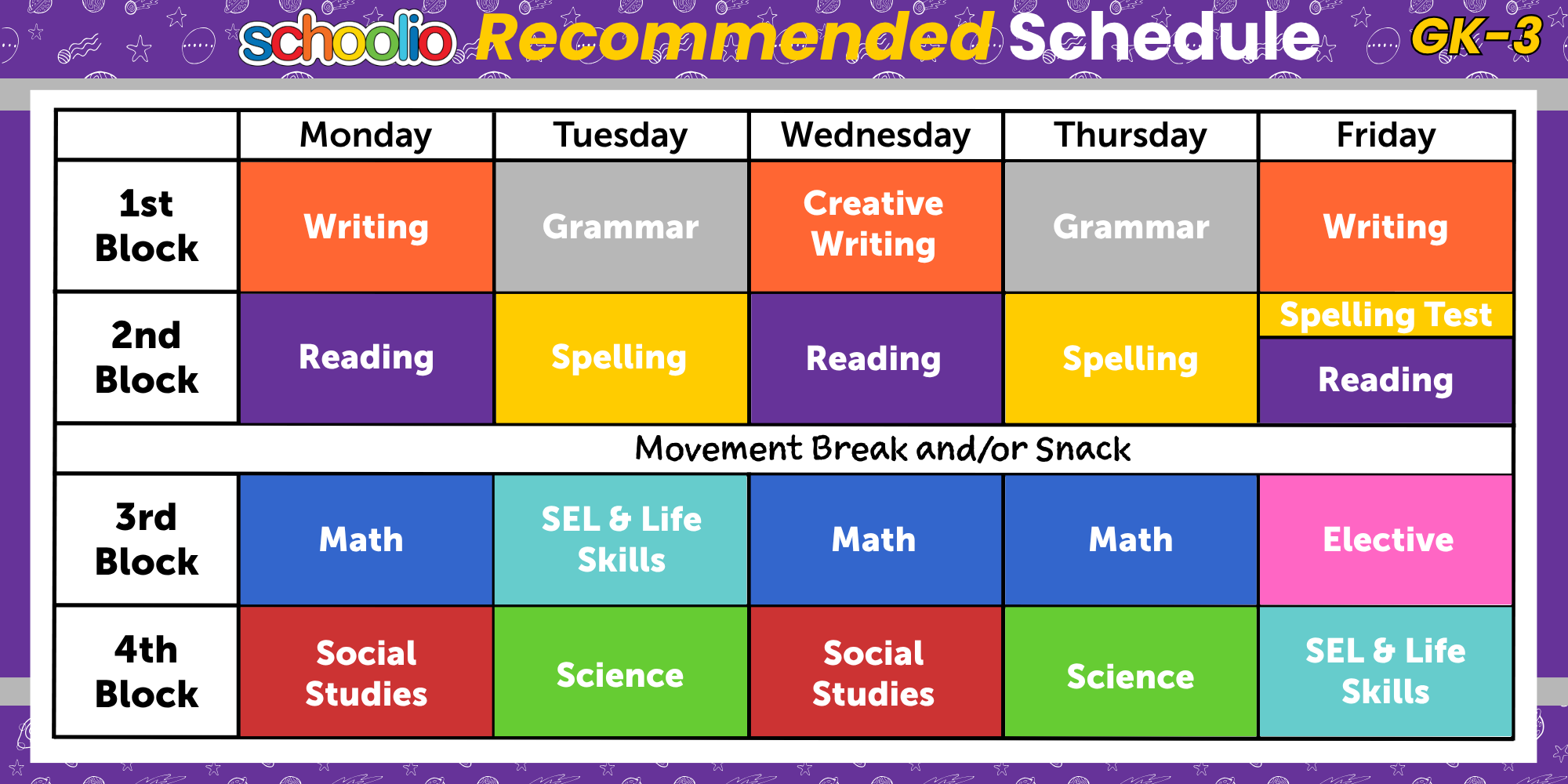
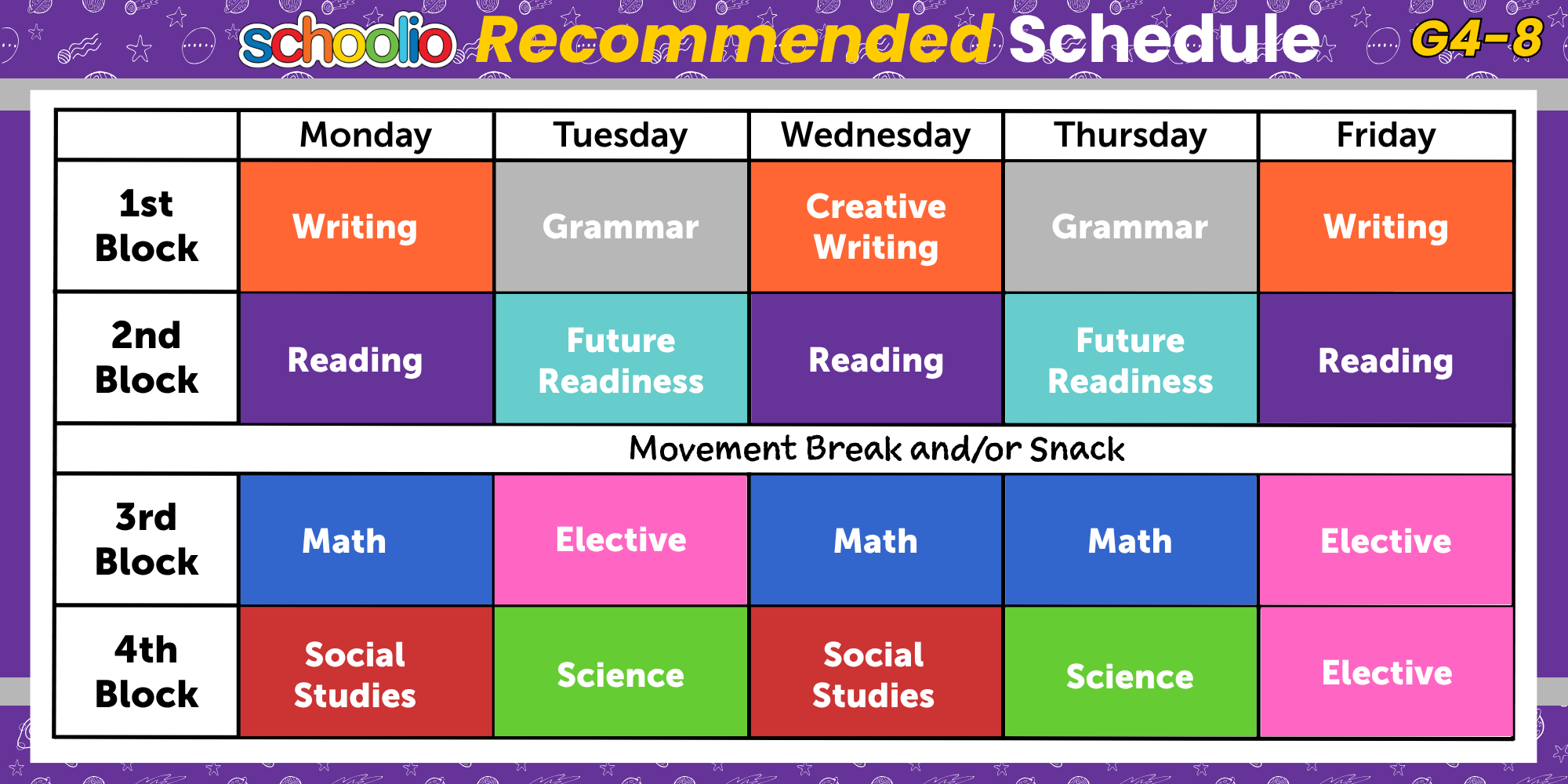
And notice what you don’t see.
Times.
Because a block that takes 20 minutes one day might take 45 minutes the next. That’s not a problem. That’s learning.
We also build a Movement Break right into the middle of every day — because we know what happens to kids’ brains and bodies when they’ve been sitting too long. And on Fridays, we leave room for electives and child-led learning, because what your child is passionate about deserves a place in the day too.
Treat these as a starting point, not a rulebook. Adjust the blocks, swap the order, follow your child’s lead.
That’s the whole point.
What about unschooling? Relaxed homeschooling? Structured homeschooling?
These are all real approaches — and whole books have been written about each of them.
The short version:
Structured homeschooling looks most like traditional school — set subjects, set times, measurable goals. Works well for kids who thrive on routine and parents who feel more confident with clear guidelines.
Relaxed homeschooling uses a loose framework but follows the child’s lead more. Less rigid, more responsive. Works well for families who want some structure without the rigidity.
Unschooling trusts the child to direct their own learning almost entirely, with the parent as a guide and facilitator. Requires a lot of confidence and works beautifully for some families and kids.
Most homeschool families land somewhere in the middle — a little structure, a lot of flexibility, and the willingness to adjust as they go.
The schedule that works is the one you’ll actually use.
I’ve seen gorgeous colour-coded homeschool planners abandoned by week two.
I’ve seen sticky notes on a fridge that held a family together for years.
Start simple. Try something for two weeks. See what’s working and what isn’t.
And give yourself permission to change it.
The beauty of homeschooling is that you can.
At Schoolio, our programs are designed to flex around your family’s routine — not the other way around. Whether you homeschool in the morning, the afternoon, or in twenty-minute bursts throughout the day, we’ve got you covered.