Cycle Breakers: Parenting Without Fear

This has been on my mind today…

I was parented through fear.

Not cruelty. Not malice.

Just — the tools that were handed down.

Behave or there are consequences. Perform or you’ll fall behind. Fit in or be left out.


Fear works. That’s the problem.

It produces short-term compliance.

But it leaves something behind.

A quiet voice that says: you are only okay if you are performing.


I see something different in the homeschool families I meet.

Not perfect families. Not families without struggle.

But families who made a decision — sometimes consciously, sometimes just by feel — to parent through trust instead.


Trust that their child wants to learn.

Trust that growth doesn’t have to be forced.

Trust that a child given space and guidance will find their way.


Why Cycle Breaking in Parenting Matters

Cycle breaking is hard work.

It is unlearning the parenting and teaching that was modeled to us.

It is finding your way without a roadmap.

No one hands you a guide for how to parent differently than you were parented.

You figure it out. You get it wrong sometimes. You keep going.

But it is one of the most important things we can do for our children.

And for their education.

Imagine a child who is encouraged to explore their interests. Maybe your child loves dinosaurs. Instead of forcing them to stick to a rigid curriculum, you can integrate their interest into various subjects. Reading about dinosaurs, calculating their sizes in math, or even creating art projects based on them can make learning exciting and relevant.

Consider a real-life example: A homeschooling mom shared how her son struggled with traditional math methods. Instead of insisting on the standard approach, she allowed him to explore math through cooking, measuring ingredients, and doubling recipes. This practical application not only improved his math skills but also boosted his confidence.


Building Trust in Cycle Breaker Parenting

Parents who were taught through shame choosing to teach through curiosity.

Parents who were controlled choosing to guide.

Parents who were never trusted deciding that their kids will be.

Building trust takes time and patience. It involves listening to your child’s needs and interests, and sometimes it means stepping back and allowing them to make mistakes. For instance, if your child shows an interest in gardening, allow them to plant their own seeds and care for the plants. They might make mistakes along the way, but these are valuable learning experiences.

Trust also means believing in your child’s ability to learn at their own pace. In homeschooling, this can be particularly powerful. A friend of mine decided to let her daughter, who was struggling with reading, choose her own books. Over time, her daughter’s love for reading blossomed, and she began to read more complex texts on her own.


That’s not small.

That’s generational.

Sathish

still learning, still unlearning
When Schools Teach Fear Instead of Freedom to Try

This has been on my mind today…

I was not a good student.

School decided that early.

And once a system decides something about you, it spends the rest of your time there confirming it.


I didn’t just fail tests.

I failed in front of people.

I came home with grades that meant consequences.

Not conversations — consequences.

The message was clear:

Failure is shameful. Failure is permanent. Failure is you.


I carried that for a long time.

And when I look at public education today — I don’t see much that’s changed.


How Schools Teach Fear of Failure

Think about what we’re actually asking kids to do.

Take a test. One shot. No redo.

Try something creative, something risky — and if it doesn’t land, it’s on your record.

Speak up in class, get it wrong, and feel thirty pairs of eyes on you.

These experiences teach kids to fear failure, to avoid risks, and to stick to what they know will work. In a Grade 5 art class, a child might hesitate to use bold colors for fear of criticism. In a Grade 10 math class, a student might avoid attempting a challenging problem, worried about getting it wrong.


So kids learn the only rational response:

Don’t risk it.

Follow the formula. Give the expected answer. Stay in the lane.


And it gets worse as they get older.

A bad grade in middle school stings.

A bad grade in high school threatens your future.

By the time they’re applying to post-secondary, every mistake feels like it could cost them everything.

We have built a system where thinking outside the box is genuinely not worth the risk.

Consider a high school student who dreams of becoming an engineer. A single low grade in physics might feel like the end of that dream, pushing them to choose safer, less fulfilling paths.


Changing the Narrative: Embracing Failure in Homeschooling

We don’t call it fear.

We call it standards. Rigour. Accountability.

But what we’re actually teaching — what gets absorbed, year after year — is conformity.

Follow. Don’t deviate. The system rewards the predictable.

In homeschooling, the approach can be different. When failure stops being permanent, everything changes.

A failed lesson becomes a question.

“That didn’t work. What do we try next?”

No record. No shame. No thirty pairs of eyes.

Just — information. And what to do with it.

Imagine a homeschool science experiment that doesn’t go as planned. Instead of a mark on a report card, it’s an opportunity to explore why it didn’t work and try again. This approach fosters resilience and a love for learning.


Every founder I admire has a failure story.

Every scientist. Every artist. Every person who built something that mattered.

The difference isn’t that they didn’t fail.

It’s that no one taught them failure was the end of the story.

Think of Thomas Edison, who famously said, “I have not failed. I’ve just found 10,000 ways that won’t work.” This mindset can be cultivated in homeschooling environments where the fear of failure is minimized.


We don’t need to build kids who never fail.

We need to build kids who know failure is just the middle of the story.

Not the last page.

Sathish

still learning, still unlearning
What Is “Math Anxiety” — And How Can You Help Your Child Overcome It?

What Is “Math Anxiety” — And How Can You Help Your Child Overcome It?

If your child melts down at the sight of a math worksheet…

If they freeze when you ask them a basic fact…

If they suddenly “forget everything” during a quiz…

You might be looking at math anxiety.

And no — it’s not the same thing as “being bad at math.”


What Math Anxiety Actually Is

Math anxiety is a stress response.

Not a knowledge gap.

Not laziness.

Not a lack of intelligence.

It’s what happens when your child’s nervous system associates math with pressure, shame, embarrassment, or repeated failure.

When the brain senses threat, it shifts into survival mode.

And here’s the tricky part:

The same part of the brain used for problem-solving (working memory) is the part that shuts down under stress.

So when a child says,

“I don’t know how to do this!”

Sometimes what they really mean is,

“My brain is offline right now.”

The anxiety blocks access to the skills they may actually have.


Where It Comes From

Math anxiety can develop from:

  • Timed tests

• Public correction in class

• Repeated low scores

• Moving too quickly through concepts

• Comparing themselves to peers

• Being told they’re “not a math person”

For neurodivergent kids — especially those with dyscalculia, ADHD, processing delays, or perfectionism — math anxiety is even more common.

If numbers are already harder to process, and then you layer time pressure or shame on top?

The brain starts to brace for math like it’s a threat.

And once that association forms, even opening the book can trigger it.


Signs You Might Be Seeing Math Anxiety

It doesn’t always look dramatic.

Sometimes it looks like:

  • Avoidance

• “Bathroom breaks” during math

• Complaints of headaches or stomach aches

• Tears over “easy” problems

• Perfectionism and erasing constantly

• Rushing to get it over with

• Refusing to try at all

The child isn’t being dramatic.

Their nervous system is trying to protect them.


How to Help

The goal isn’t to make math wildly entertaining.

The goal is to make it feel safe.

1. Slow It Down

If a concept is supposed to take one day, let it take a week.

Mastery builds confidence.

Speed builds stress.

You are not on a clock.


2. Remove the Time Pressure

Timed drills are a huge trigger for many kids.

Accuracy matters more than speed.

You can build fluency gradually — without a stopwatch.


3. Make It Concrete

Abstract numbers on paper can feel overwhelming.

Use:

  • Lego

• Baking

• Measuring cups

• Money

• Cutting food into fractions

• Building arrays with blocks

Touching math reduces fear.


4. Normalize Struggle

Be careful with language like:

“You’re so smart!”

Because when they struggle, they’ll think,

“Then why can’t I do this?”

Instead try:

“This is hard — and you’re working through it.”

“Struggling means your brain is growing.”

“We can take this one step at a time.”

Effort over identity.


5. Separate Their Worth from the Score

A low score is information.

Not a verdict.

If your child works for 60 hard minutes and gets 50%, that effort matters — even if the system doesn’t reward it.

Math is a skill.

Not a measure of intelligence.


The Long Game

Most adults use calculators.

Most adults look things up.

Most adults don’t solve equations under time pressure.

What they do need is perseverance.

Confidence.

The belief that they can face something hard and figure it out.

That’s what you’re building.

And that doesn’t come from pushing harder.

It comes from lowering fear.

Math anxiety can absolutely improve.

But it improves when the nervous system feels safe enough to try.

And if you’re reading this because you’re worried?

That tells me something important.

You care.

And caring is the foundation of everything that works.

? Lindsey

certified special-ed educator & co-founder, Schoolio

Don’t Let School Convince You You’re Not Smart

Don’t Let School Convince You You’re Not Smart


My daughter and I spent several hours tonight studying for her math test tomorrow.

She’s neurodivergent. She struggles in math and English because of dyslexia and dyscalculia. There were a lot of tears. And at one point she said something that broke my heart:

“I wish I could just be as smart as everyone else.”

?

So I told her the truth.

Sweetie, everyone has hard things and easy things. Everyone.

This is your hard thing. Reading and numbers are harder for you. They just are. But that doesn’t mean you aren’t smart.

Here’s what no one tells you about school:

School is centered around reading and numbers.

Independent reading is how one adult manages thirty kids in a classroom. Tests are how large groups are measured quickly. The whole structure depends on literacy and numerical processing.

So if reading and numbers are your hard things, school will feel hard.

That doesn’t mean you’re not smart.

It means the system is built around your area of challenge.

And here’s another truth about school:

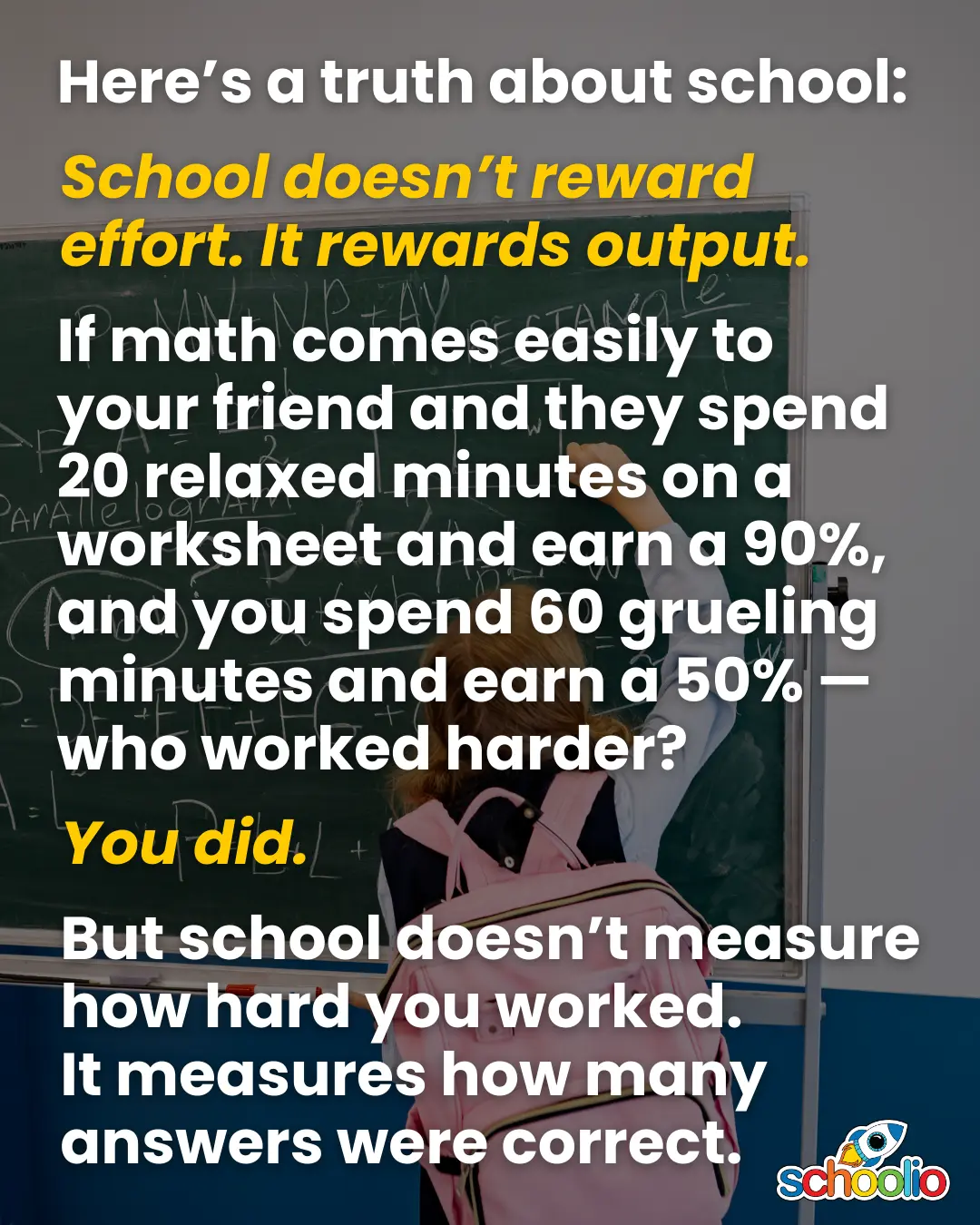
School doesn’t reward effort. It rewards output.

If math comes easily to your friend and she spends 20 relaxed minutes on a worksheet and earns a 90%, and you spend 60 grueling minutes and earn a 50% — who worked harder?

You did.

But school doesn’t measure how hard you worked.

It measures how many answers were correct.

Now imagine something different.

If school were centered around creativity…

or engineering-thinking…

or musical instinct…

or empathy and thoughtfulness…

or responsibility and trustworthiness…

You would be at the top of the class.

You would be absolutely crushing it.

But school doesn’t prioritize those traits.

But guess what? The real world does.

The real world cares that you show up on time.

That you think outside the box.

That you treat people with kindness.

That you keep going when things are hard.

The real world doesn’t care if you use a calculator to figure out a tip.

It doesn’t care if you prefer audiobooks over printed pages.

It doesn’t care how quickly you finish a worksheet.

The most powerful skill you’ll carry into adulthood isn’t mental math.

It’s perseverance.

It’s knowing how to work hard at something that doesn’t come easily.

So please — don’t let school convince you that you’re not smart just because it has a narrow definition of what counts.

Don’t let it shrink how you see yourself.

Don’t let it break your spirit.


? Lindsey

certified special-ed educator, homeschool mom, & co-founder of Schoolio

When “Grade-Level” Tests Make Homeschool Parents Feel Like Failures

When “Grade-Level” Tests Make Homeschool Parents Feel Like Failures


This has been on my mind today…

I talk to so many homeschooling parents who have had this moment:

They run a school-based diagnostic test to see if their child is “on grade level”.

They see a score they weren’t expecting.

And suddenly, their confidence collapses.

“I think my kids have fallen behind.”

“I feel like I’ve failed them.”

“Did homeschooling make them lose skills?”

Let me say this clearly, as both a former teacher and a homeschooling mom:

School-based testing does not measure your child’s intelligence.

And it absolutely does not measure the value of your homeschool.

Most of these assessments — especially the popular ones families use to “check grade level” — were designed for traditional classrooms. They measure a very specific thing: a child’s ability to memorize and recall the exact skills schools have decided are important, in the exact format they expect.

That’s it.

They usually test math and language.

They don’t test problem-solving.

They don’t test creativity.

They don’t test if your child is happier, more confident, or less anxious than they were in school.

They don’t test emotional regulation skills.

They don’t test adaptability, curiosity, persistence, or resilience.

And yet those are the very skills that matter most once school is over.

Here’s something else most parents don’t realize:

The human brain only retains information for two reasons.

  1. Intrinsic interest — the learner genuinely cares about the topic.
  2. Perceived usefulness — the learner understands why this information matters in their real life.

Everything else? The brain offloads.

This is why retention in public school is so low. It’s why every fall, teachers spend weeks “reviewing” material kids supposedly learned the year before — and most students swear they were never taught it. They were. Their brains just didn’t keep it.

We adults are no different.

If most of us took a grade 7 math test today, we’d struggle — unless we’re naturally “math people” (intrinsic interest) or use it regularly in our work (perceived usefulness). That doesn’t make us less intelligent than a seventh grader. It just means we’ve let go of information we don’t need.

Kids do the same thing.

So when a homeschool parent sees a test score and panics, what they’re often seeing isn’t “lost intelligence.”

They’re seeing a mismatch between how the brain actually learns and how schools measure learning.

Homeschooling offers something radically different — and far more valuable. It teaches kids how to learn. How to ask questions. How to find information when they need it. How to notice what interests them and pursue it deeply. How to persist through challenges without shame.

Those skills don’t show up on standardized diagnostics.

But they show up everywhere else in life.

Now, if it’s important to you that your child aligns closely with public school benchmarks, that’s okay. Homeschooling isn’t one thing — it’s yours to shape. You can absolutely use test results as information, identify gaps, and choose to work on specific skills.

What I don’t want you to do is let those numbers define your child — or yourself.

Your kids are not checkboxes.

Your homeschool is not a failure because it doesn’t mirror school.

And you are not doing this wrong because your child’s brain didn’t perform on demand for a system you intentionally stepped away from.

Please take school-based tests for what they are: limited tools, not verdicts.

You are building something bigger than scores.

Something more human.

And that matters far more than any diagnostic ever will.


? Lindsey

Certified Special-Ed Educator & Co-Founder, Schoolio

Kintsugi

Kintsugi


This has been on my mind today…

There is a Japanese art form called Kintsugi. When a bowl or cup breaks, it is not thrown away. The pieces are carefully put back together, and the cracks are filled with gold. The repair is not hidden. It is highlighted. The object becomes more valuable because it has been broken and repaired with care. The story becomes part of its beauty.

I think about that a lot when I reflect on my own life. I also think about it when I look at the families we support through homeschooling and the work we are building at Schoolio.

Too many children move through school systems quietly absorbing a message that they are broken. Not always through words, but through looks, labels, meetings, and expectations. They are told to sit still when their bodies want to move. To keep up when they need time. To fit into systems that were never designed for how they learn. Eventually, many of them begin to believe that something is wrong with them.

When those children come home, something different can happen. With patience, care, and attention, the pressure starts to lift. Confidence begins to return. Curiosity peeks back out. Learning feels possible again. Not rushed. Not forced. Just human.

But here is the part that matters most to me. Healing should never feel like hiding.

Homeschooling should not feel like punishment or retreat. It should not feel like we are sweeping children out of sight. It should feel like kintsugi. A celebration of the whole child. A recognition that learning differently does not mean learning less. It means learning in a way that honors who they are.

At Schoolio, we see this every day. Children who were once labeled as struggling begin to thrive when the pressure is removed and the support is real. When learning adapts to them instead of asking them to adapt to it. When their cracks are not erased, but respected.

Every student who leaves a system that did not serve them carries an incredible story. Those cracks are not flaws. They are experiences. When they are filled with care, trust, and belief, something stronger is created. Something more meaningful than what existed before.

That is what homeschooling can be.

That is what Schoolio is working toward.

Not fixing children, but honoring them.


Sathish

still learning, still unlearning
The Quiet Wins That Matter Most

The Quiet Wins That Matter Most


This has been on my mind today…

Some days, the work feels heavy. You’re building something that doesn’t yet exist. A platform that reimagines education, reshapes how kids learn, and gives power back to the people who’ve been left out of the conversation for too long—parents, students, and those who learn a little differently.

You push through meetings, plans, deadlines, product reviews. You tweak systems, question decisions, and hold the big vision in your mind like a lighthouse, even on foggy days. But once in a while, something cuts through all that noise. A comment. A thank-you. A message that reminds you why you started this in the first place.

That happened to me recently.

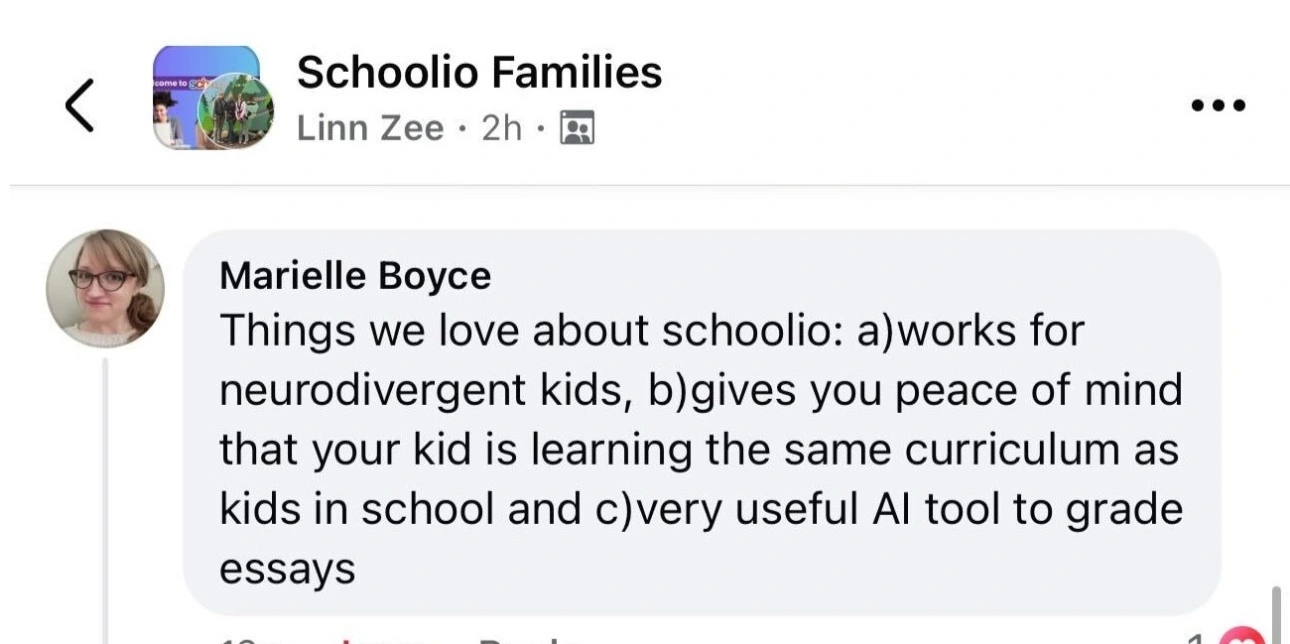
A parent shared a short post in our Schoolio Families group. Just a few lines. No hashtags. No fuss. Just truth.She said she loved Schoolio because it works for her neurodivergent child. Because it gives her peace of mind knowing her kid is learning the same curriculum as students in traditional school. And because the AI tools helped with grading essays.


Customer Testimonial

Simple. Direct. But when I read it, it stopped me.

Because that right there is the quiet win that matters.

She didn’t say we changed her life. She didn’t say we were perfect. What she shared was something more real. She shared relief. Confidence. Stability. The kind of stability every parent needs, but especially the ones who are walking a different path.


The truth is, a lot of the parents we serve never wanted to homeschool. They weren’t planning for it. It wasn’t on their vision board. But something shifted—maybe a bad experience at school, a child’s needs not being met, or just a gut feeling that things weren’t working.

And now they’re here, trying to do what’s best for their child, even when the world questions them for it.

This is what we built Schoolio for. For that parent who lies awake at night wondering if they’re doing enough, for the child who learns better with space and silence, for the families that don’t see themselves in glossy brochures or test scores and for the moments when a tool actually helps and no one has to fight for it.

You don’t always get to see the impact of your work. You don’t always hear how it lands. But every now and then, someone like Marielle speaks up and says, This helped. And for me, that’s everything.

Because this isn’t just about curriculum or platforms or AI tools. This is about building something that lets families breathe again. Something that says: you’re not alone. You’re not wrong. And yes, you can do this.

That’s the win I hold onto today.


Sathish

still learning, still unlearning
Why Our “First Day of School” Looks Nothing Like Theirs — and Why I Wouldn’t Trade It

Why Our “First Day of School” Looks Nothing Like Theirs — and Why I Wouldn’t Trade It


This has been on my mind today…

The hardest part of the homeschool year for me wasn’t math lessons, or planning, or juggling the day-to-day chaos. It was the first day of public school.

Every September, my social media feeds would flood with photos of smiling kids at the end of the driveway — shiny shoes, new backpacks, parents buzzing with excitement. I would feel it in my chest, that little ache of missing out. Was I depriving my kids of this milestone? Was our homeschool missing something?

But then, something shifted. I realized those photos were it. The moment. The kids posed for a quick picture, then disappeared into a classroom to sit under fluorescent lights, being taught by a stranger for the rest of the day.

So one year, I decided to do something different. I started our own tradition.

That morning, I snapped a “first day of school” photo of my kids… still asleep. Because that’s the beauty of homeschooling: they wake when their bodies are rested, not when a bus pulls up.


Then, just for myself, I kept taking pictures throughout the day. Hour by hour.

? Pancakes in pajamas.

? Jumping on the trampoline after math.

? Reading aloud together on the couch.

? Baking cookies in the kitchen.

? Building sandcastles at a beach we had all to ourselves.

? A social studies lesson with a cat curled up in their lap.

? Walking the dog in the late summer sun.


And when I scrolled through those photos at the end of the day, I finally saw it: this was more.

It wasn’t just about lessons and curriculum (though those happened too). It was about time. About laughter. About siblings who actually enjoy each other. About kids who get to learn at their own pace and still have energy left to play, imagine, and connect. About a childhood that isn’t rushed out the door.

That was the day I stopped feeling wistful about the back-to-school buzz on my feed. Because the truth is, I wasn’t depriving my kids of anything. I was giving them something different. Something richer.

So now, every September, we take our first-day photos too. They just don’t look like everyone else’s. And I’m okay with that.

With love,

? Lindsey

Certified Special Ed Educator & Co-Founder, Schoolio

Why I Stopped Worrying About Learning Gaps

Why I Stopped Worrying About Learning Gaps

By Lindsey, certified special-ed educator & co-founder, Schoolio

This has been on my mind today…

The weight of comparison. It sneaks in quietly. A friend tells you what their child is learning in school. A neighbor asks about your homeschool “schedule.” You catch a glimpse of someone’s color-coded curriculum plan on Instagram. Suddenly your confidence starts to unravel.

I remember this feeling most clearly when my oldest was around eight or nine. We were deep into homeschooling, but I was constantly looking over my shoulder at what public school kids were doing. Were we covering the same content? Were we behind? Was I doing enough?

It became exhausting. I was trying to replicate school at home—not because it worked for us, but because I thought that’s what “real” education looked like.

Here’s the truth I had to learn the hard way: homeschool doesn’t need to imitate public school to be valid. In fact, the whole point is that it doesn’t.

I kept coming back to a simple question. If I can’t remember what I learned in third grade, why was I putting so much pressure on myself to make sure my child retained every single concept in the third grade curriculum? I realized I was clinging to a system I didn’t even believe in—one I had left behind for a reason.

When kids are in school, they’re taught for a set number of days, then tested. If they get a 60%, that means they missed 40%—and the class moves on. No one loops back. No one stops the train. That’s a gap. A big one. But it’s accepted.

In our homeschool, if my child gets sick or we need to pause for emotional rest, schoolwork pauses. School doesn’t go on without them on sick days, it waits for them. We don’t pretend 60% is good enough. The beauty of this lifestyle is that learning pauses with the child and picks up again when they’re ready.

That alone makes a massive difference.

And the truth is, we all have learning gaps. Adults included. Because humans only retain what they find meaningful. You can make a child memorize facts for a test, but they’ll likely forget most of it after. If something isn’t relevant to their lives, it doesn’t stick. So whether you never cover it, or they forget it, the result is the same.

That realization gave me freedom.

I stopped obsessing over whether we had checked every box. I started asking better questions: Was my child curious today? Did we connect? Did they ask questions that mattered to them? Those were my new benchmarks.

And wouldn’t you know—it made everything easier. They were learning more, not less. And I was enjoying it more, too.

So if you’re caught in that loop of comparison, wondering if your homeschool is “real” enough, let me gently offer this: your homeschool is enough because it’s yours. Because it fits your child. Because it’s rooted in love, flexibility, and intention.

That’s not falling behind. That’s choosing to lead.

certified special-ed educator & co-founder, Schoolio


? Need help trusting your homeschool rhythm?

Start with our free homeschool planner, explore flexible curriculum bundles, or try our 7-day trial to see how it can work in your home.

Why Pausing Ontario’s Curriculum Overhaul Might Be the Best Thing That Could Happen

Why Pausing Ontario’s Curriculum Overhaul Might Be the Best Thing That Could Happen

by Lindsey Casselman

When I think back on our homeschool journey — and honestly, even my time as a classroom teacher — one thing that always struck me was how often we tried to fix learning by changing the curriculum.

I’ve been watching the news about Ontario’s decision to pause its major curriculum reforms, especially the overhaul to kindergarten, and I’ll be honest — it felt familiar. Not because change is bad, but because too often, we mistake activity for progress.

As someone who’s both taught in public school and built curriculum from the ground up here at Schoolio, I’ve seen how these sweeping changes tend to go. New documents, new standards, new language — but very little impact on what really matters to kids and teachers. A few years later, we do it all over again.

It’s not reform. It’s spinning.

Somewhere along the way, we started treating education like a business — always marketing, rebranding, looking for the next system-wide breakthrough. But kids aren’t products. And learning isn’t a marketing strategy.

The truth is, what drives real learning is rarely found in a government PDF. Students thrive when their curiosity is sparked. When their teacher has the freedom and energy to explore a topic from a new angle. When lessons connect to the real world — to questions they actually ask.

But most curriculum overhauls don’t get at any of that. They shuffle standards. They update timelines. They insert buzzwords. But they rarely ignite joy — in students or teachers.

If you’ve ever sat at the kitchen table with your child, trying to make sense of a lesson that feels totally disconnected from real life, you know exactly what I mean. That glazed look. The frustration. The deep feeling of “why are we even doing this?”

That’s not a learning problem. That’s a relevance problem.

What we need isn’t a brand new curriculum every few years. What we need is a mindset shift.

Instead of building everything from the top down, what if we started from the ground up? What if we trusted teachers to lead the way, using their experience and insight to shape lessons that actually land? What if we listened — really listened — to the kids?

That’s how we design our units at Schoolio. We start with questions students already have. We build flexibility in, so families can pause or pivot. We make space for creativity, discussion, and the moments that stick.

And we don’t pretend that a perfect curriculum will solve everything. What we offer is structure, yes — but with enough room for learning to feel alive again.

So while the pause in Ontario’s reforms might seem like a step back, I see it differently. It’s a chance to stop the spinning. To ask better questions. To start designing for joy, not compliance.

Because if we’re really serious about helping kids learn — we have to remember why they learn in the first place.

Lindsey,

Certified Special-Ed Educator & Co-Founder, Schoolio


? Want curriculum that’s built around real questions, flexible structure, and student joy?

Explore our project-based bundles, download our free samples or start a 7-day trial to see what modern learning can look like at home.

How to Homeschool Multiple Kids Without Losing Your Mind

How to Homeschool Multiple Kids Without Losing Your Mind

by Lindsey, Head of Curriculum at Schoolio

This has been on my mind today…

Homeschooling even one child is a full-time emotional and mental job. Homeschooling two or three? That’s a whole circus. And if they’re at different grade levels? Let’s just say it took me a while to stop waking up already overwhelmed.

I remember those early years when I felt like I had to mimic a real school day. Everyone had to be at the table at the same time, working on math at 9, reading at 10, science after lunch. It was rigid, exhausting, and full of frustration. Someone always needed help, someone else was bored or acting out. There were tantrums. Sometimes theirs. Sometimes mine.

What saved us was realizing that homeschooling doesn’t have to look anything like public school. And honestly, it probably shouldn’t.

One of the biggest mindset shifts we had was dropping the idea that everyone had to do the same subject at the same time. That’s not how real life works, and it’s not how learning naturally happens. So I started calling the kids to me one at a time. When one was off playing, I could work through a new math concept with the other. Once they had the hang of it, I’d set them up with independent work and call the next one in for reading time. It wasn’t about multitasking anymore. It was about focused, calm, short bursts of one-on-one time.

The second big shift came when I stopped letting grade levels rule our world. At first I was clinging to the public school timeline — this topic in science at this age, this history chapter in third grade, and so on. But it didn’t make sense anymore. Why teach something just because the curriculum says it’s “time,” if they’re not curious or ready? So we started learning science and social studies as a team — everyone at the same time, just at different depths. We’d dive into volcanoes or ancient Egypt or the weather together, and I’d tweak the activities up or down depending on the child. They started helping each other, sharing facts, building projects side by side. The learning stuck. And I wasn’t exhausted.

I used to feel guilty every day. Guilty that one child got more of my attention. Guilty we didn’t finish the lesson plan. Guilty I wasn’t following the school’s rhythm. But I’ve learned that flexibility is not a failure. In homeschooling, it’s a strength.

We use our homeschool planner loosely now — more like a compass than a stopwatch. And the beauty of online homeschool programs is that they let you set your own pace. With Schoolio, I can see where each kid is, pick the lessons that matter most for them right now, and let go of the rest.

So if you’re in the thick of trying to homeschool multiple kids and feeling like you’re falling apart, I promise you’re not alone. The magic isn’t in doing it all at once. The magic is in tuning into your children, one by one, moment by moment — and building a life that works for your family.

And guess what? That’s more than enough.

Lindsey

certified special-ed educator & co-founder, Schoolio


Curious how Schoolio helps families balance learning for multiple kids? Start a 7-day free trial or explore our all-in-one planner built for real homeschool life.

Start your FREE TRIAL.

If It Doesn’t Look Like School… Good.

If It Doesn’t Look Like School… Good.

“Homeschooling doesn’t look like public school. That’s the point.”

This has been on my mind today…

When I first started homeschooling, I tried to make our home look like a classroom. Desks lined up, a daily schedule on the wall, a bell for transitions — I even printed out attendance sheets.

It lasted about three days.

What followed was frustration, tears, and a lot of self-doubt. I thought something was wrong with me. I couldn’t keep up the structure. My kids weren’t responding the way I expected. I wondered if I had made a huge mistake.

But the truth was simpler: I was trying to replicate a system that didn’t actually work for us.

Homeschooling doesn’t look like school. That’s the point.

School is designed for groups. For efficiency. For managing dozens of kids with one adult. It’s built on uniformity and compliancy. But I don’t want my kids to be uniform or compliant.

Homeschooling is built on flexibility. On freedom. On honoring your child’s pace, your family’s values, and your real life.

Some days, math happens at 8am. Other days, it doesn’t happen at all.

Some weeks, we read and entire novel. Other weeks, we’re outside chasing butterflies and calling it science.

Some subjects take root quickly. Others simmer quietly until the spark hits.

And through it all, learning is happening.

It just doesn’t look like it used to. And that’s okay. Actually, it’s better than okay.

It means your homeschool is becoming yours.

There’s no attendance sheet for curiosity. No standardized test for joy. No report card that measures the deep, steady growth happening when a child feels safe, loved, and free to learn in their own way.

So if your homeschool doesn’t look like school — good. That’s the point.

With love,

Lindsey

Certified Special Ed Educator & Co-Founder, Schoolio