This has been on my mind today…
I was parented through fear.
Not cruelty. Not malice.
Just — the tools that were handed down.
Behave or there are consequences. Perform or you’ll fall behind. Fit in or be left out.
Fear works. That’s the problem.
It produces short-term compliance.
But it leaves something behind.
A quiet voice that says: you are only okay if you are performing.
I see something different in the homeschool families I meet.
Not perfect families. Not families without struggle.
But families who made a decision — sometimes consciously, sometimes just by feel — to parent through trust instead.
Trust that their child wants to learn.
Trust that growth doesn’t have to be forced.
Trust that a child given space and guidance will find their way.
Why Cycle Breaking in Parenting Matters
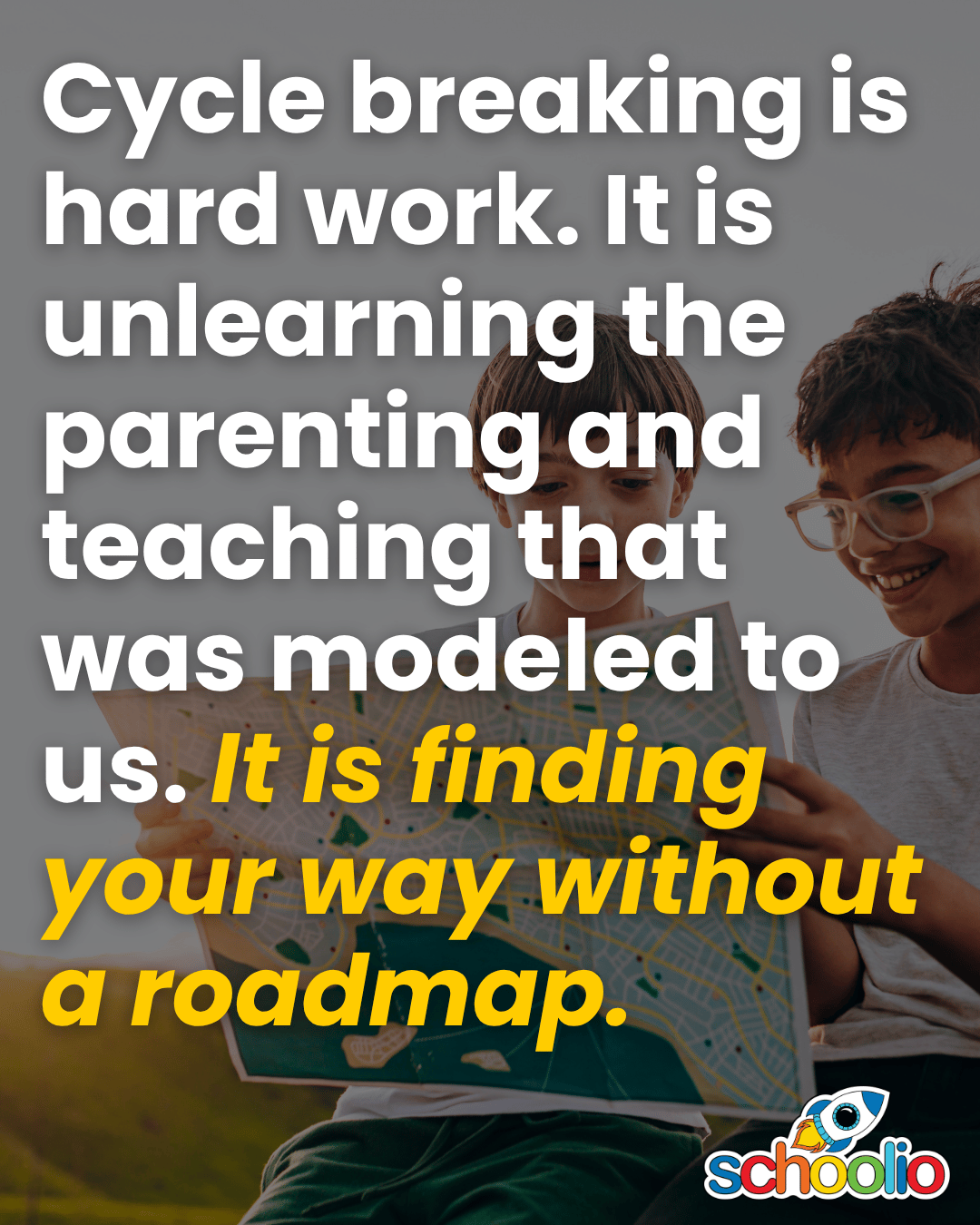
Cycle breaking is hard work.
It is unlearning the parenting and teaching that was modeled to us.
It is finding your way without a roadmap.
No one hands you a guide for how to parent differently than you were parented.
You figure it out. You get it wrong sometimes. You keep going.
But it is one of the most important things we can do for our children.
And for their education.
Imagine a child who is encouraged to explore their interests. Maybe your child loves dinosaurs. Instead of forcing them to stick to a rigid curriculum, you can integrate their interest into various subjects. Reading about dinosaurs, calculating their sizes in math, or even creating art projects based on them can make learning exciting and relevant.
Consider a real-life example: A homeschooling mom shared how her son struggled with traditional math methods. Instead of insisting on the standard approach, she allowed him to explore math through cooking, measuring ingredients, and doubling recipes. This practical application not only improved his math skills but also boosted his confidence.
Building Trust in Cycle Breaker Parenting
Parents who were taught through shame choosing to teach through curiosity.
Parents who were controlled choosing to guide.
Parents who were never trusted deciding that their kids will be.
Building trust takes time and patience. It involves listening to your child’s needs and interests, and sometimes it means stepping back and allowing them to make mistakes. For instance, if your child shows an interest in gardening, allow them to plant their own seeds and care for the plants. They might make mistakes along the way, but these are valuable learning experiences.
Trust also means believing in your child’s ability to learn at their own pace. In homeschooling, this can be particularly powerful. A friend of mine decided to let her daughter, who was struggling with reading, choose her own books. Over time, her daughter’s love for reading blossomed, and she began to read more complex texts on her own.
That’s not small.
That’s generational.
Sathish
still learning, still unlearning