Best Homeschool Curriculum in Canada: A Parent’s Guide

Choosing the right homeschool curriculum can feel overwhelming, especially with so many options and the diverse needs of your children. You want a program that’s comprehensive, adaptable, and supportive of different learning styles. Here’s why Schoolio might be the perfect fit for families in Canada.

What Makes Schoolio the Best Homeschool Curriculum in Canada?

Schoolio stands out as the best homeschool curriculum in Canada because it offers tailored learning plans, supports diverse learning styles, and aligns with Canadian educational standards. It provides structured yet flexible content, helping parents deliver a consistent education. This means your child gets a quality education that’s customized to their pace and interests.

Unlike traditional curricula, Schoolio provides a blend of printed workbooks and digital resources that cater to the unique needs of homeschooling families. Its content is specifically designed to meet Canadian standards, ensuring that your child is on the right track academically. This approach helps in building a strong educational foundation while allowing flexibility in teaching methods.

Moreover, Schoolio’s adaptability to various teaching styles means that whether you prefer a structured day or a more relaxed approach, you can adjust the materials to fit your family’s lifestyle. Parents can seamlessly combine traditional learning with modern techniques, providing a well-rounded education for their children.

How Does Schoolio Support Neurodivergent Learners?

Schoolio supports neurodivergent learners by providing customizable curriculum options that cater to different learning needs and paces. It offers materials that are adaptable and sensitive to sensory issues, helping children with unique challenges thrive. This means parents can provide a learning environment that supports their child’s specific requirements.

The curriculum is designed with input from experts in educational psychology, ensuring that it addresses various learning differences effectively. For instance, Schoolio includes visual aids and interactive materials, which can be particularly beneficial for children with autism or ADHD. This ensures that every child has the opportunity to engage and learn at their own pace.

Additionally, Schoolio provides resources and support for parents, helping them understand and implement strategies that work best for their neurodivergent children. By offering a flexible and understanding approach, Schoolio makes it easier for families to create a supportive educational environment.

Is Schoolio Cost-Effective for Families?

Yes, Schoolio is cost-effective for families because it offers affordable pricing plans and comprehensive materials that eliminate the need for additional resources. It provides access to a complete curriculum without hidden costs, which helps parents manage their homeschooling budget. This makes educational quality accessible to more families.

Schoolio’s pricing structure is designed to be transparent and straightforward, with options that cater to various family needs. Families can choose between digital-only packages or combine them with printed materials, depending on their preference and budget. This flexibility allows parents to invest in the resources that best fit their financial situation.

Moreover, the comprehensive nature of the Schoolio curriculum means you won’t need to purchase supplementary materials frequently. The all-in-one package includes everything needed to cover the required subjects, which reduces overall education costs significantly over time.

How Can Parents Integrate Technology with Schoolio?

Parents can integrate technology with Schoolio by utilizing its digital resources, which include interactive lessons and adaptive learning tools. These tools help cater to different learning speeds and styles, making education more engaging. This integration allows parents to enhance their child’s learning experience with up-to-date technology.

Schoolio’s digital platform offers a variety of interactive activities and assessments that keep students engaged. For example, children can participate in virtual science experiments, enhancing their understanding through practical application. This not only makes learning more exciting but also helps reinforce complex concepts.

In addition, the use of technology simplifies tracking progress, allowing parents to easily monitor their child’s achievements and areas needing improvement. The data-driven insights provided by Schoolio help in tailoring future lessons, ensuring that the learning process is both effective and efficient.

What Resources Does Schoolio Offer for K-12?

Schoolio offers extensive resources for K-12, including grade-specific workbooks, digital content, and adaptive learning tools. These resources are designed to cover all core subjects comprehensively, ensuring a well-rounded education. This allows parents to confidently support their child’s educational journey at every stage.

The curriculum includes a wide range of subjects such as Math, Science, English, and Social Studies, each crafted to engage students and enhance learning. Schoolio’s materials are updated regularly to include current information and methodologies, ensuring that students receive a modern education.

Furthermore, Schoolio provides additional resources like progress tracking and support for extracurricular interests, helping parents create a balanced and enriched educational experience. This holistic approach ensures that students develop academically, socially, and personally.

How Can Parents Start with Schoolio Curriculum?

Parents can start with Schoolio curriculum by visiting the Schoolio website to explore options and select a plan that fits their family’s needs. Registration is straightforward, and support is available to guide you through setup. This ensures a smooth transition to Schoolio’s homeschooling approach.

First, assess your child’s educational needs and preferences. Then, explore the variety of Schoolio packages available, which cater to different learning styles and family requirements. Detailed descriptions and sample lessons are available on the Schoolio shop to help you make an informed decision.

Once you’ve chosen a curriculum package, simply follow the registration process and setup instructions. Schoolio offers excellent customer support to assist with any questions or challenges you might face initially. This proactive assistance helps ensure that your homeschooling journey starts off smoothly and successfully.

For more from Schoolio, see Homeschool Curriculum in Canada: A Comprehensive Guide, General Homeschool Questions Answered.

For research-backed context on education outcomes and learning support, see National Center for Education Statistics.

Frequently Asked Questions

Can Schoolio be used alongside other curricula?

Yes, Schoolio can be used alongside other curricula to supplement learning or focus on specific subjects. Its flexibility allows parents to integrate Schoolio’s resources into their existing educational plans seamlessly.

Does Schoolio offer support for special needs education?

Yes, Schoolio provides resources and support tailored for special needs education. The curriculum is adaptable for various learning differences, offering materials that cater to unique educational requirements.


Slow Is Not Falling Behind — Especially for Neurodivergent Kids

Slow Is Not Falling Behind — Especially for Neurodivergent Kids


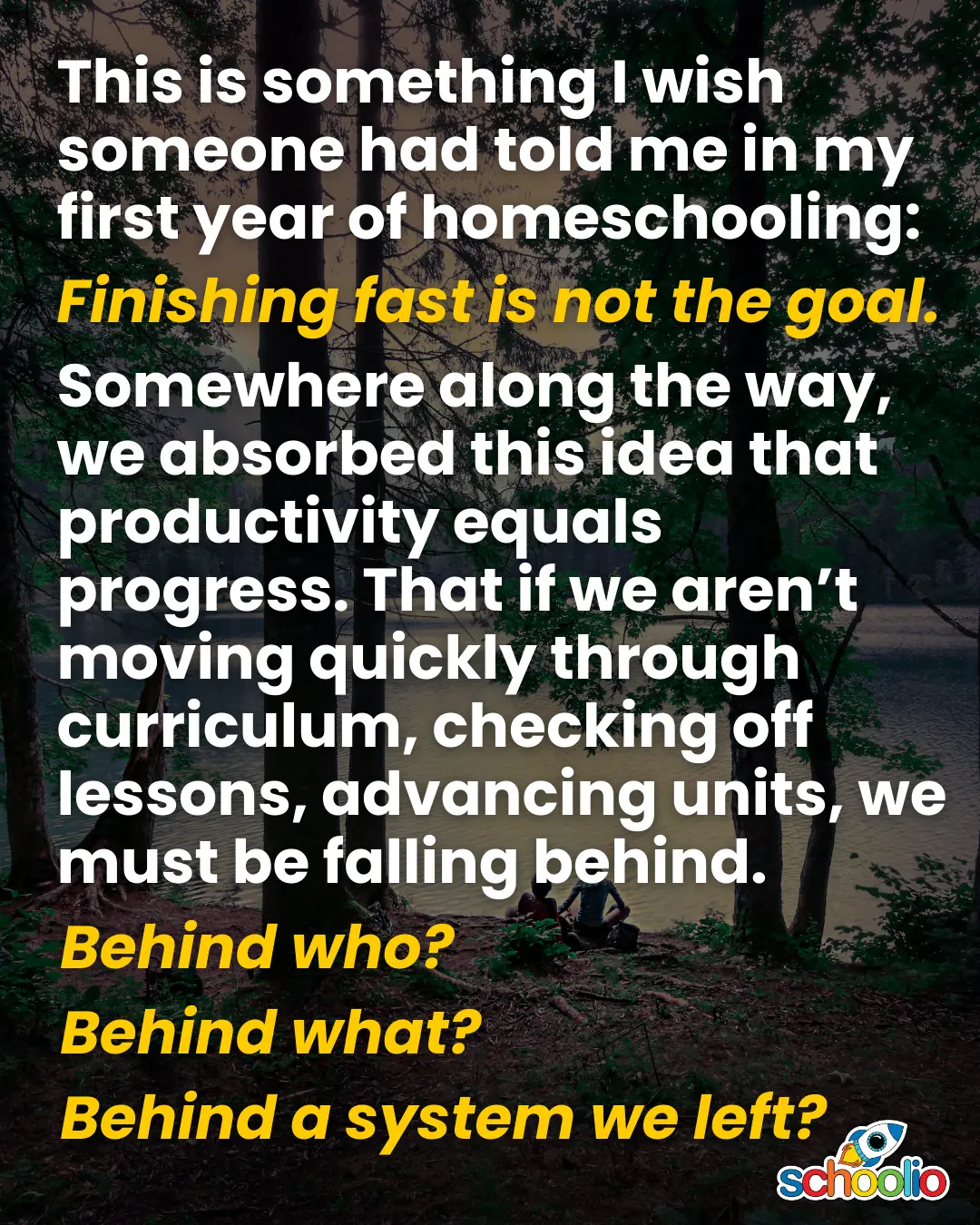
This is something I wish someone had told me in my first year of homeschooling:

Finishing fast is not the goal.

Especially not for neurodivergent kids.

Somewhere along the way, we absorbed this idea that productivity equals progress. That if we aren’t moving quickly through curriculum, checking off lessons, advancing units, we must be falling behind.

Behind who?

Behind what?

Behind a system we left?

When you’re homeschooling an autistic, ADHD, dyslexic, AuDHD, or otherwise neurodivergent child, pace is not a moral issue. It’s a nervous system issue.

And slow is not a flaw.


When “Four Lessons” Becomes Ten Days

Our writing courses, for example, are typically structured in four parts:

Lesson One: Brainstorming

Lesson Two: Writing day one

Lesson 3: Writing day two

Lesson 4: Editing

On paper, that’s four days.

In real life?

It might be ten.

And that’s okay.

If your child can only focus for fifteen solid minutes before their brain taps out, stretching one writing lesson across multiple days isn’t lowering the bar.

It’s protecting their capacity.

It’s teaching them that writing doesn’t have to feel like drowning.

I would rather see one writing assignment completed thoughtfully, with pride and confidence, than three rushed through with frustration and shutdown.

One done well is more valuable than three done miserably.

Every single time.


Productivity Culture Sneaks Into Homeschooling

Even when we leave traditional school, we bring its pace with us.

We feel pressure to “stay on track.”

We worry about being “behind.”

We compare how much we’ve covered.

But coverage is not comprehension.

Speed is not mastery.

And volume is not engagement.

Neurodivergent kids often need:

  • More repetition (or less redundancy!)
  • More breaks
  • More sensory regulation
  • More autonomy
  • More recovery time
  • More learning time dedicated to Social Skills and Emotional Intelligence

If we measure success by how much we completed, we miss the more important questions:

Did it stick?

Do they feel confident?

Are they emotionally regulated?


Engagement Beats Volume

When a child works at a sustainable pace, something powerful happens.

They stay willing.

They don’t start to hate the subject.

They don’t associate learning with shame or overwhelm.

They build confidence instead of resistance.

That’s not falling behind.

That’s building foundation.

And foundation matters more than speed.


Pace Is a Tool — Not a Rule

Curriculum pacing guides are suggestions.

Not contracts.

Not deadlines.

Not moral benchmarks.

If your child needs:

  • Three days for one math concept
  • Three weeks for a writing assignment
  • To read one chapter a day instead of three
  • A full pause during a hard life season

That is not failure.

That is responsive parenting.

That is adaptive education.

That is you paying attention to the human in front of you.


What Actually Matters

At the end of the year, I don’t ask:

“How many units did we finish?”

I ask:

Is my child still curious?

Do they feel capable?

Are they willing to try again tomorrow?

Because a happy, engaged child who trusts themselves as a learner will always outpace a burned-out child who learned to rush for approval.

Mastery beats completion.

Engagement beats volume.

Joy beats speed.

Slow is not behind.

Slow is intentional.

Slow is sustainable.

Slow is often exactly what neurodivergent kids need.


? Lindsey

certified special-ed educator, homeschool mom, & co-founder of Schoolio

What Exactly Are “Strands” in Schoolio Academics? Let’s Break It Down

What Exactly Are “Strands” in Schoolio Academics? Let’s Break It Down


One thing that can be tricky for parents new to homeschooling is understanding what’s covered under the “umbrella” of a subject. Names like “Language Arts” and “Science” are important but we know there’s so many topics that fall under each.

Okay so… what does each subject actually include?!

“Math” isn’t just fractions.

“Science” isn’t just biology.

“Language Arts” isn’t just reading books.

Every core subject is actually made up of strands — smaller categories that build specific skills and knowledge.

And understanding those strands?

It helps you see what your child is really learning, what might need extra focus, and what they’re already mastering.


? At Schoolio, Here’s How We Break It Down:

We’ve organized our curriculum by subject and strand — so you’re not guessing what’s inside a course, or whether something’s missing. This is also part of our neurodivergent-friendly design, because when strands are separated into individual courses, you can mix & match grade levels between them.

Here’s what’s covered:

➗ Math

  • Number Sense & Numeration
  • Algebra, Patterning & Coding
  • Geometry & Spatial Sense
  • Data Management & Probability

? What this means: It’s not just computation. Your child also learns how to spot patterns, organize data, and apply logic in real-world scenarios.

? English Language Arts (ELA)

  • Writing Skills
  • Literature Study & Reading Comprehension
  • Grammar Foundations
  • Spelling

? What this means: Reading and writing are treated as distinct (and equally important!) skills — with grammar, vocabulary, and reading analysis woven in naturally.

? Science

  • Biology & Life Systems
  • Structures, Mechanisms & Engineering
  • Earth & Space Systems
  • Matter & Energy Systems

? What this means: Your child gets hands-on exposure to all areas of science — not just life science. And yes, there’s plenty of room for rockets and slime.

? Social Studies

  • History, Heritage & Citizenship
  • Geography, People & Cultures

? What this means: Learning about the world and our place in it — from past to present, and here to everywhere.

? Future Readiness (only at Schoolio)

This is our favorite subject — and one that most public schools completely overlook.

Strands include:

  • Social Skills & Emotional Intelligence
  • Financial Literacy & Money Sense
  • Business Studies
  • Emerging Technologies

? What this means: We’re not just preparing kids to pass a test. We’re preparing them for life.

From understanding how to budget or start a business…

To learning how AI and tech are shaping the future…

To building communication and emotional skills

— these are the lessons that stick.

? Electives

We also include:

  • Visual Arts, Music, and Drama
  • Sports and Physical Education

Because yes — creativity and movement matter, too.

? Why Strands Matter

When you break subjects into strands, a few amazing things happen:

  • You can see progress more clearly (“We’ve nailed Number Sense but need more Geometry practice”)
  • You can mix and match based on your child’s needs
  • You can build a balanced learning plan that doesn’t leave gaps
  • You can breathe easier, knowing you’re covering everything — without overloading

At Schoolio, we design with this in mind — so your homeschool isn’t a guessing game.

Instead, it’s clear, organized, and customizable — just like it should be.


? Lindsey

Certified Special-Ed Educator & Co-Founder, Schoolio

Why I’m Not Worried About “Sheltering” My Homeschooled Kids

Why I’m Not Worried About “Sheltering” My Homeschooled Kids


This has been on my mind today…

I used to brace myself every time someone said it. You know the line.

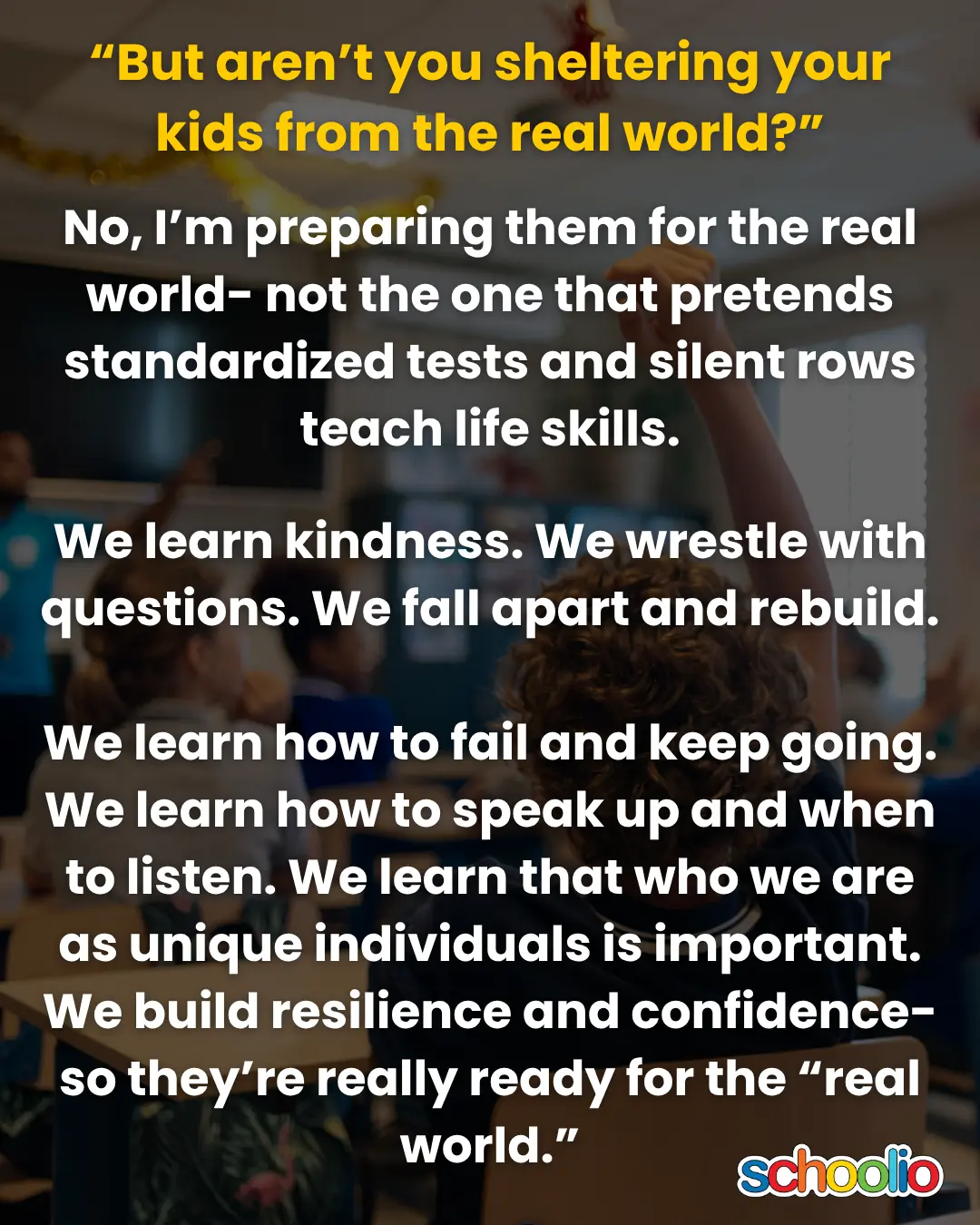
“But aren’t you sheltering your kids from the real world?”

At first, I tried to explain. Then I tried to debate. Now? I just smile — because the truth is, yes, I am.

I’m sheltering them from the pressure to fit in before they even know who they are.

From being teased in the cafeteria because they don’t wear the right shoes or laugh at the same jokes.

From classrooms that push every child through the same mold, at the same speed, regardless of how they learn best.

But I’m also preparing them for the world. For the real one — not the one that pretends standardized tests and silent rows teach life skills.

In our home, we talk about kindness. We wrestle with questions. We fall apart and rebuild.

We learn how to fail and keep going. We learn how to speak up and when to listen. We learn that who we are as unique individuals is important… and awesome. We build resilience and confidence- so they’re really ready for the “real world.”

They learn how to handle conflict, talk to cashiers and librarians, make friends of all ages, and advocate for themselves. They practice empathy daily because it’s not just a word on a poster — it’s part of our lessons.

Is that sheltering? Maybe. But it’s also strengthening.

Because when my child walks out into the world, I want them to know who they are.

Not just what they’ve memorized. Not just what other kids or teachers have told them they are.

I want them to feel confident enough to speak, not just raise their hand for permission.

I want them to see difference and not fear it — to question and not crumble.

So yes, we’re doing school differently. That doesn’t mean we’re hiding.

It means we’re building something deeper.

Not a bubble — but a bridge. And we’ll cross it together when it’s time.


With love,

Lindsey

Certified Special Ed Educator & Co-Founder, Schoolio

The Harder Path Forward

The Harder Path Forward


customer feedback

I didn’t understand the courage it took until years later.

When my family immigrated to Canada, I was angry. I didn’t have the words for it at the time, but every part of me resisted this new life. I missed my friends, my neighbourhood, my routines. I was a teenager lost between two worlds—resentful of the change, and confused by the silence I had to carry with me in every classroom, every hallway, every awkward introduction.

People looked at me differently. Sometimes with curiosity, sometimes with judgment, but always with the weight of assumptions I hadn’t earned. The stereotypes followed me. So did the loneliness.

Back then, I thought my parents were wrong. I thought they didn’t understand what I had lost. But as I grew older—became a parent, built a life, listened to others—I began to see the truth I’d missed entirely.


It wasn’t an escape. It was a sacrifice.


They had uprooted everything they knew for a sliver of possibility—a better education, a safer life, a shot at something bigger than what we’d left behind. And they did it quietly. Without recognition. Without thanks. Without certainty. Just faith.

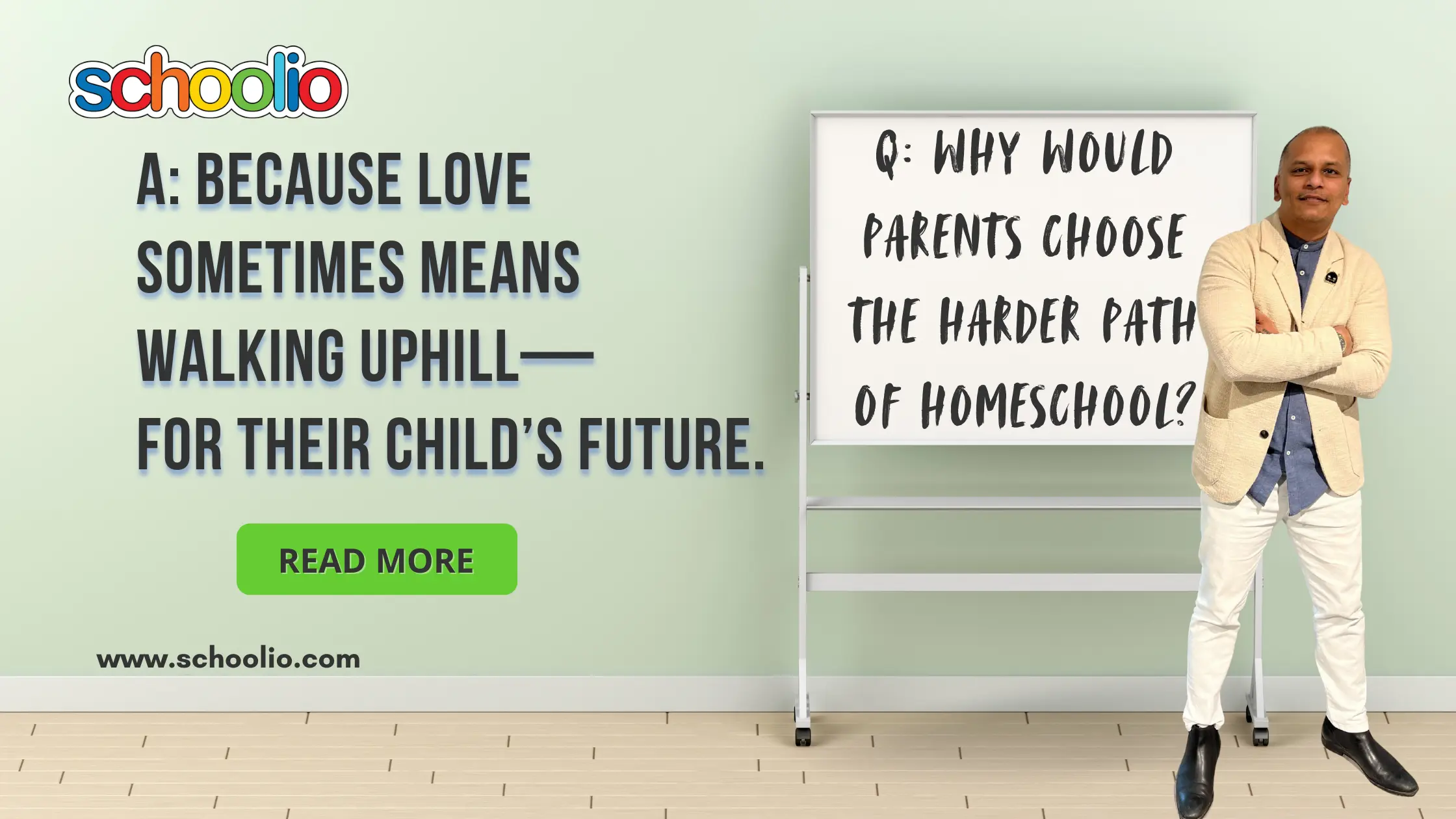
That story echoes again and again in the lives of homeschooling families we meet at Schoolio. While the world rushes to label them—too radical, too soft, too unqualified—what we see is something different. We see courage. We see parents choosing a harder path, not because it’s easier, but because it’s right for their child.

It’s not a summer experiment. It’s not a last resort. It’s a quiet, determined rebellion against a system that no longer fits.

And here’s the question we rarely stop to ask: if the traditional school system—funded, structured, and normalized—is so perfect, why are so many parents choosing to leave it behind?

Why are they willing to rebuild an entire learning experience from scratch?


Because sometimes love means walking uphill.


At Schoolio, we don’t see homeschoolers as fringe or fearful. We see them as architects of something new. Builders of bridges their children can walk across safely. Parents who are saying, “I will not wait for the world to catch up. I’ll start right here.”

And for those of us who have walked a harder path before, we know exactly how much strength that takes.

Sathish
still learning, still unlearning

Something is breaking—and the cracks are no longer subtle.

Something is breaking—and the cracks are no longer subtle.

Something is breaking—and the cracks are no longer subtle. This week, Ontario’s Education Minister Paul Calandra said the quiet part out loud: “We have to change the way school boards behave.” In his remarks to the legislature, he called out dysfunction, political distractions, and a lack of unified leadership across the province. The full article is worth reading here.

When politicians start publicly questioning the structure of an entire education system, it’s not a small thing. It signals something deeper—a disconnection between families and the institutions meant to serve them. Between what students need, and what schools are able—or willing—to provide.

At Schoolio, we’ve heard this unraveling for years. Quietly at first. A parent unsure if their neurodivergent child will ever be supported. A teacher burned out from fighting for basic classroom resources. A school board spending more on internal legal battles than on inclusive programming. And now, those whispers have grown into something louder. More urgent.

The traditional school model is struggling under the weight of complexity it can no longer carry. Bureaucracy, politics, budget cuts, and reactive policies are not a foundation for innovation or well-being. When boards debate flags and book bans while special education runs deficits, it’s not just the system that’s broken—it’s the trust.

This isn’t about abandoning schools—it’s about acknowledging that they no longer serve every child equally. It’s about making space for alternatives that are working right now, for real families, in real time.

Homeschooling, once dismissed as fringe, is now a lifeline. Microschools are quietly multiplying. Parents are reclaiming agency not out of rebellion, but out of necessity. And at Schoolio, we’ve built a platform to meet them there. A hybrid curriculum that blends structure with flexibility. A place where emotional safety, real-world skills, and learning readiness are just as important as test scores.

The question isn’t whether the old model can be fixed. The question is: will we keep asking families to wait?

Because they’re not waiting anymore.

They’re moving forward—with or without the system.

And Schoolio is walking beside them.

Sathish
still learning, still unlearning

Homeschooling Is Parenting, Just a Little Louder

Homeschooling Is Parenting, Just a Little Louder

This has been on my mind today…

When we first pulled our kids out of school, I wasn’t sure I had what it took. I had the usual fears. Would I mess up their education? Could I keep up with all the subjects? What if I missed something big?

But over time, something quiet and powerful started to sink in. I wasn’t stepping into a classroom role. I was just continuing what I’d always done as their mom — helping them learn. Teaching them to tie shoes. To ask for help. To apologize. To be kind. Homeschooling, it turns out, is just an extension of parenting.

There’s this quote I came across recently that stopped me in my tracks:

“Educating a child is a natural process. Homeschooling is nothing more than an extension of parenting.”

—John Taylor Gatto

It made me pause because that’s what homeschooling has become for us. It’s not school at home. It’s life at home, full of learning.

The structure looks different, of course. We have a curriculum (Schoolio made that piece so much easier). We have rhythms that feel like school hours some days. But at the heart of it, it’s still me parenting — noticing what lights my child up, what challenges them, what makes them pull away or lean in.

And because it’s just an extension of parenting, the learning is so much more natural. Conversations at lunch become lessons in geography. A baking mess turns into math. A walk in the neighborhood ends up being a discussion about community and kindness and nature.

If you’re feeling unsure about starting homeschooling, or doubting if you’re “qualified,” let me gently tell you this: you’ve already been doing it. Since the day your child was born, you’ve been their guide. Their teacher. Their advocate. Homeschooling doesn’t change that. It just adds a little structure, a little support, and a whole lot of flexibility.

Let’s stop thinking of homeschooling as this big, scary shift. It’s simply parenting — just a little louder, a little more curious, and a lot more present.

Lindsey

certified special-ed educator & co-founder, Schoolio

All About Homeschooling in North Carolina

TL;DR – Quick Answer:
Homeschooling in North Carolina is straightforward: parents must file a Notice of Intent, maintain immunization and attendance records, and conduct annual standardized testing. North Carolina requires the homeschool to be operated by a parent or guardian and to maintain a consistent academic schedule throughout the year.
TL;DR – Quick Answer:
Homeschooling in North Carolina is straightforward: parents must file a Notice of Intent, maintain immunization and attendance records, and conduct annual standardized testing. North Carolina requires the homeschool to be operated by a parent or guardian and to maintain a consistent academic schedule throughout the year.

How Many Children Are Homeschooled In North Carolina?

Can you believe that in the 2023-2024 academic school year over 193,000 students were homeschooling in North Carolina? The number of families in North Carolina choosing to learn at home, instead of opting for traditional schooling, is on the rise. The percent of children being homeschooled in North Carolina has jumped to 12%, raising an important question: Why has there been such a significant shift from learning at school to learning at home? Maybe it’s the opportunity for student-specific curriculum or the flexibility in location and schedule? Whatever the reason, one thing is clear: Homeschooling is gaining traction across the state. Interested in joining the thousands of families homeschooling? Click here to learn more about Schoolio.

Yes! There has been a surge in the popularity of homeschooling in recent years. In the 2023-2024 academic school year over 19,3000 students were homeschooling in North Carolina. Click here to learn more about homeschooling’s popularity in North Carolina.

Interested in joining the thousands of families homeschooling in North Carolina? Click here to learn more about Schoolio: The Homeschool Program for Families in North Carolina.

Is North Carolina A Good Place To Homeschool?

North Carolina is an excellent place to homeschool for families who value flexibility in education and want to take an active role in their child’s learning. The state provides an adaptable framework for homeschooling with straightforward regulations. Parents are required to register with the North Carolina Division of Non-Public Education, maintain records of attendance and immunizations, and administer an annual standardized test. This process ensures that homeschooled children receive a comprehensive education while allowing parents flexibility in curriculum and teaching methods. North Carolina’s emphasis on child-centered education plans allows parents to tailor their teaching approach to cater to their children’s diverse learning styles, needs, and interests; ensuring that each child can thrive both academically and developmentally.

Homeschooling in North Carolina empowers families to actively engage in their children’s educational journey, fostering strong parent-child relationships and providing an enriching education that prepares children for future endeavors. While homeschooling requires commitment and planning, its growing popularity and supportive infrastructure in North Carolina make it a favorable choice for many families seeking an alternative approach to education.

Click here to start your Journey Homeschooling in North Carolina with Schoolio

What Are The Benefits Of Homeschooling In North Carolina?

Homeschooling in North Carolina offers numerous benefits. The state provides a supportive environment with straightforward regulations, allowing parents significant freedom to design personalized educational programs. This flexibility enables customized learning experiences tailored to each child’s needs and interests. Additionally, North Carolina offers a dynamic support network with numerous resources, support groups, and co-ops, along with numerous opportunities for extracurricular activities, sports, and social engagement. These factors collectively make North Carolina an ideal place for homeschooling.

Click here to start your Journey Homeschooling in North Carolina with Schoolio

Curriculum, Programs, and Other Learning Options

What Age Should You Start Homeschooling In North Carolina?

Your child’s homeschooling journey can start at any age. Many parents begin homeschooling in North Carolina from Kindergarten, while others transition to homeschooling in later years. Schoolio provides the support and resources you need to begin homeschooling in North Carolina at any age! Note: It is required that children in North Carolina aged 7 to 16 receive an education.

Click here to learn more about Schoolio.

How To Homeschool Without A Curriculum In North Carolina?

To homeschool without a curriculum in  North Carolina you will need to submit a Notice of Intent to Homeschool to the North Carolina Division of Non-Public Education. Additionally, you should notify your local school of your decision to homeschool, and formally withdraw your child. Next, it’s time to roll up your sleeves and dive in! Click here to learn more about homeschooling without a curriculum, otherwise known as unschooling.

What Are The Best Homeschool Programs In North Carolina?

Choosing the best homeschooling curriculum in North Carolina for your family involves considering several factors to ensure it meets your educational goals and your child’s learning style. Start by assessing your child’s individual needs including their learning preferences, areas of need, and interests. Next, research different homeschooling curriculums available in North Carolina, considering factors such as educational philosophies, format, and the scope of subjects covered. Evaluate the cost, including any additional materials or resources required, and consider your budget for homeschooling. Take advantage of free trials or sample lessons to assess how well the curriculum fits with your child’s learning style and your teaching approach. Click here to learn more about Schoolio’s 7-Day FREE trial.

There are numerous homeschooling curriculums to choose from, but there is only one homeschooling curriculum that offers an all-in-one program specifically designed for students in North Carolina. Click here to learn more about Schoolio.

What Are The Accredited Homeschool Programs In North Carolina?

In North Carolina, there are several accredited and reputable homeschool programs that provide structured curriculum options and support. While it is not required to affiliate with an accredited homeschooling program, some families choose these programs for added structure and to ensure their children receive a comprehensive and enriching education. Some well-regarded accredited homeschool programs in North Carolina include Schoolio, Time4Learning, and K12.

Are There Free Online Homeschooling Options In North Carolina?

Yes. There are many free options and resources available for families homeschooling in North Carolina. Click here to learn more about free homeschooling options in North Carolina. 

Can You Switch To Homeschooling In The Middle Of The Year In North Carolina?

Yes. You can switch to homeschooling at any time during the academic school year. You will need to submit a Notice of Intent to Homeschool to the North Carolina Division of Non-Public Education. Additionally, you should notify your local school of your decision to homeschool, and formally withdraw your child; this can be done with an email or written letter. Schoolio is here to make the transition from learning at school to learning at home seamless. Click here to learn more about Schoolio.

What Are The Homeschooling Subject Requirements In North Carolina?

There are no subject requirements for families homeschooling in North Carolina. This autonomy in subject selection allows for the exploration of topic areas not typically covered in traditional schools, such as financial literacy and emerging technologies. To explore Schoolio’s courses click here.

Legalities & How to Get Started

How Do I Legally Start Homeschooling in North Carolina?

Legal Requirement #1: 

Notify The North Carolina Department of Non-Public Education with a Notice of Intent to Homeschool. This letter formally notifies The North Carolina Department of Non-Public Education of your decision to homeschool and states that you are taking responsibility for your child’s education. Click here for more information. Additionally, you should notify your local school of your decision to homeschool, and formally withdraw your child; this can be done with an email or written letter.

Legal Requirement #2: 

Families must maintain attendance and immunization records for each homeschooled student.

Legal Requirement #3: 

Homeschooling must operate on a regular schedule, excluding holidays and vacations, during at least nine months of the year. This law provides significant flexibility in your homeschooling schedule.

Legal Requirement #4: 

Families must administer a nationally standardized test each year to assess academic achievement in grammar, reading, spelling, and math for every student. Results must be kept on file for one year.

Legal Requirement #5: 

Parents must have at least a high school diploma (or equivalent) to homeschool.

Legal Requirement #6: 

Notify The North Carolina Department of Non-Public Education  when you are no longer homeschooling.

That’s it. Now it’s time for the fun part: creating an educational program for your child that is engaging, personalized, and ignites their love of learning! Click here to learn more about Schoolio.

What Forms Are Needed For Homeschooling In North Carolina?

You need one form and one form only for homeschooling in North Carolina: A Notice of Intent to Homeschool. This letter formally notifies The North Carolina Department of Non-Public Education of your decision to homeschool and states that you are taking responsibility for your child’s education. Click here to learn more.

Do I Need To Complete Progress Reports For Homeschooling In North Carolina?

No. You do not need to complete progress reports for homeschooling in North Carolina. However, progress reports can be helpful for tracking academic achievements, and for uncovering areas of need where intervention may be required. Click here to learn more about Schoolio’s progress reports. 

Are Any Tests Required For Homeschoolers In North Carolina?

Yes. Families must administer a nationally standardized test each year to assess academic achievement in grammar, reading, spelling, and math for every student. Results must be kept on file for one year.

Is Unschooling Legal In North Carolina?

Yes. Unschooling is legal in North Carolina. Click here to learn more about unschooling in North Carolina.

What Is A Notice Of Intent To Homeschool In North Carolina And Do I Need One?

A Notice of Intent to Homeschool is a letter that formally notifies The North Carolina Department of Non-Public Education of your decision to homeschool and states that you are taking responsibility for your child’s education. A Notice of Intent to Homeschool is required in North Carolina. Click here for more information.

Can Someone Else Homeschool My Child In North Carolina?

Yes. Someone else can homeschool your child in North Carolina. While you, as the parent, are responsible for ensuring your child’s education, you can delegate the instruction to others, such as a tutor, a grandparent, a co-op, or an online course.

What If I Want My Kids To Re-Enter The Public School System After Homeschooling?

It’s okay to change your mind! For your child to re-enter public school you will need to contact your local school district to organize which school your child will be attending and when they will re-enter the public system. Your child may be assessed to determine their grade level.

Are There Deadlines I Need To Be Aware Of For Homeschooling In North Carolina?

There are some important dates to be aware of when submitting your Notice of Intent to Homeschool to The North Carolina Department of Non-Public Education. 

Here is a list of those important dates:

  • Submit your Notice of Intent five days prior to your homeschooling start date.
  • No Notices of Intent will be accepted in May and June.

North Carolina’s homeschooling year begins on July 1 and ends on June 30. File your Notice of Intent after July 1.

What Are The Public School Access Provisions For Homeschoolers In North Carolina?

North Carolina does not have a law granting homeschooled students the right to participate in public school classes and activities. Individual schools decide whether to provide homeschoolers with participation opportunities. 

Homeschooled students may have the chance to participate in extracurricular activities such as sports and the arts at their local public school. Additionally, some public schools offer part-time enrollment options or allow homeschoolers to join specific classes and programs. Homeschooled students can also benefit from access to public school libraries and facilities. These provisions help enrich the homeschooling experience and provide valuable resources and opportunities.

What Are The Special Education Provisions For Homeschoolers In North Carolina?

In North Carolina, while homeschoolers don’t automatically receive special education services from public schools, there are valuable opportunities for support available. If your child has special education needs, you can request an evaluation from your local public school district to explore eligibility for services under the Individuals with Disabilities Education Act (IDEA). Should your child qualify, the district can offer specialized instruction, support, and an Individualized Education Program (IEP) tailored to their unique needs. Additionally, some districts provide valuable support services such as counseling or therapy, and there are many community resources and private providers that offer further special education services. Engaging with advocacy groups can also provide helpful guidance and support. 

Click here to learn more about how Schoolio can support your neurodivergent learner.

How Many Days/Hours Are Required For Homeschooling In North Carolina?

There are no specific day or hour requirements for homeschooling in North Carolina. However, homeschooling must operate on a regular schedule, excluding holidays and vacations, during at least nine months of the year. The state’s homeschooling laws provide flexibility, allowing parents to adjust academic scheduling to meet the unique needs of their child, tailoring the educational experience to align with their individual learning style, pace, and interests.

Funding and Costs

Is There Funding For Homeschooling In North Carolina?

No. Currently, there is no funding for families homeschooling in North Carolina. 

While the state does not provide financial support for homeschoolers in North Carolina, families can take advantage of  various resources and strategies to manage their educational expenses. By participating in homeschooling groups, taking advantage of community programs, and choosing low-cost educational resources, such as Schoolio, families homeschooling can provide a rich educational experience without breaking their budget.

Click here to learn more about Schoolio.

How Much Does It Cost To Homeschool In North Carolina?

Homeschooling is priceless, but at what cost? The cost of homeschool in North Carolina ranges from hundreds to thousands of dollars per year based on numerous factors, including subscriptions to online programs, supplies, books, extra-curricular fees, field trips, etc. By choosing a low-cost educational resource, such as Schoolio, families homeschooling can provide a rich educational experience without breaking their budget. Schoolio is a great option for parents looking for a high impact program at a low cost. 

Click here to learn more about Schoolio.

Is There A Tax Credit For Homeschooling In North Carolina?

No. There is no tax credit for homeschooling in North Carolina.

Where to Find Community and Encouragement

What Are The Homeschooling Associations In North Carolina?

The North Carolinians for Home Education and The Home School Legal Defense Association are prominent homeschooling associations in North Carolina that provide guidance, advocacy, and information for families homeschooling.

Are There Homeschooling Conferences In North Carolina?

Yes. North Carolina hosts numerous conferences for families homeschooling in North Carolina. Click here to learn more about one of the largest homeschool conferences in North Carolina: The NCHE Homeschool Conference.

What Are The Homeschooling Support Groups In North Carolina?

North Carolina has many homeschooling support groups that offer resources, advice, and support. Click here to learn more about homeschooling groups in your area.
All About Homeschooling in Texas

TL;DR – Quick Answer:
Homeschooling in Alabama is highly accessible via three legal pathways: enrolling in a church (cover) school, operating as a private school at home, or using a private tutor. Alabama law requires no standardized testing or specific curriculum mandates, giving parents total freedom to tailor their child’s education.

All About Homeschooling in Texas: Benefits, Tips, and Resources

How Many Children Are Homeschooled In Texas?

Can you believe that over 750,000 students are homeschooling in Texas? The number of families in Texas choosing to learn at home, instead of opting for traditional schooling, is on the rise. The percent of children in Texas being homeschooled has surged over recent years, raising an important question: Why has there been such a significant shift from learning at school to learning at home? Maybe it’s the opportunity for student-specific curriculum or the flexibility in location and schedule? Whatever the reason, one thing is clear: Homeschooling is gaining traction across the state. Interested in joining the thousands of families homeschooling in Texas? Click here to learn more about Schoolio: The Homeschool Program for Families in Texas.

Yes! There has been a surge in the popularity of homeschooling in Texas in recent years. Over 750,000 students are homeschooling in Texas. Click here to learn more about homeschooling’s popularity in Texas.

Interested in joining the thousands of families homeschooling in Texas? Click here to learn more about Schoolio: The Homeschool Program for Families in Texas.

Is Texas A Good Place To Homeschool?

Texas is an excellent place to homeschool for families who value flexibility in education and want to take an active role in their child’s learning. Texas offers a highly supportive environment for homeschooling families, with minimal regulations that allow for significant autonomy in designing educational programs. Parents are only required to teach core subject areas such as reading, spelling, grammar, mathematics, and good citizenship. Texas does not require homeschooling families to register with the state or adhere to a standardized curriculum. This legal flexibility allows for a personalized and adaptable homeschooling experience, enabling parents to tailor their teaching approach to cater to their children’s diverse learning styles, needs, and interests; ensuring that every child can thrive both academically and developmentally.

Homeschooling in Texas empowers families to actively engage in their children’s educational journey, fostering strong parent-child relationships and providing an enriching education that prepares children for future endeavors. While homeschooling requires commitment and planning, its growing popularity and supportive infrastructure in Texas make it a favorable choice for many families seeking an alternative approach to education.

Click here to start your Journey Homeschooling in Texas with Schoolio

What Are The Benefits Of Homeschooling In Texas?

Homeschooling in Texas offers numerous benefits. The state provides a supportive environment with minimal regulations, allowing parents significant freedom to design personalized educational programs. Required subjects include reading, spelling, grammar, mathematics, and good citizenship; but there is no need to register with the state or follow a standardized curriculum. This flexibility enables customized learning experiences tailored to each child’s needs and interests. Additionally, Texas offers a dynamic support network with numerous resources, support groups, and co-ops, along with numerous opportunities for extracurricular activities, sports, and social engagement. These factors collectively make Texas an ideal place for homeschooling.

Click here to start your Journey Homeschooling in Texas with Schoolio

Curriculum, Programs, and Other Learning Options

What Age Should You Start Homeschooling In Texas?

Your child’s homeschooling journey can start at any age. Many parents begin homeschooling in Texas from Kindergarten, while others transition to homeschooling in later years. Schoolio provides the support and resources you need to begin homeschooling in Texas at any age! Note: It is required that children in Texas aged 6 to 18 receive an education.

Click here to learn more about Schoolio.

How To Homeschool Without A Curriculum In Texas?

There are no legal requirements to homeschool without a curriculum in Texas. Once you have decided that you would like to homeschool without a curriculum, it’s time to roll up your sleeves and dive in! Click here to learn more about homeschooling without a curriculum, otherwise known as unschooling.

What Are The Best Homeschool Programs In Texas?

Choosing the best homeschooling curriculum in Texas for your family involves considering several factors to ensure it meets your educational goals and your child’s learning style. Start by assessing your child’s individual needs including their learning preferences, areas of need, and interests. Next, research different homeschooling curriculum programs available in Texas, considering factors such as educational philosophies, format, and the scope of subjects covered. Evaluate the cost, including any additional materials or resources required, and consider your budget for homeschooling. Take advantage of free trials or sample lessons to assess how well the curriculum fits with your child’s learning style and your teaching approach. Click here to learn more about Schoolio’s 7-Day FREE trial.

There are numerous homeschooling curriculum programs to choose from, but there is only one homeschooling curriculum that offers an all-in-one program specifically designed for homeschoolers in Texas. Click here to learn more about Schoolio.

What Are The Accredited Homeschool Programs In Texas?

In Texas, there are several accredited and reputable homeschool programs that provide structured curriculum options and support. While homeschooling itself doesn’t require accreditation, some families choose accredited programs for added structure and to ensure their children receive a comprehensive and enriching education. Some well-regarded accredited homeschool programs in Texas include Schoolio, Time4Learning, and The Keystone School.

Are There Free Online Homeschooling Options In Texas?

Yes. There are many free options and resources available for families homeschooling in Texas. Click here to learn more about free homeschooling options in Texas. 

Can You Switch To Homeschooling In The Middle Of The Year In Texas?

Yes. You can switch to homeschooling at any time during the academic school year. While it’s not a legal requirement in Texas, formally withdrawing your child from their current school is a proactive step to ensure a smooth transition to homeschooling. To do this, simply send an email to the school informing them of your decision to homeschool and providing the date of when your homeschooling will begin. 

Schoolio is here to make the transition from learning at school to learning at home seamless. Click here to learn more about Schoolio.

The specific subject requirements for families homeschooling in Texas are reading, spelling, grammar, mathematics, and good citizenship. These homeschooling subject requirements are designed to ensure a comprehensive education while allowing for flexibility and customization. Beyond these core subject areas, parents have the freedom to include additional subjects and tailor the curriculum to their children’s interests. This autonomy in subject selection allows for the exploration of topic areas not typically covered in traditional schools, such as financial literacy and emerging technologies. To explore Schoolio’s courses click here.

What Are The Homeschooling Subject Requirements In Texas?

The specific subject requirements for families homeschooling in Texas are reading, spelling, grammar, mathematics, and good citizenship. These homeschooling subject requirements are designed to ensure a comprehensive education while allowing for flexibility and customization. Beyond these core subject areas, parents have the freedom to include additional subjects and tailor the curriculum to their children’s interests. This autonomy in subject selection allows for the exploration of topic areas not typically covered in traditional schools, such as financial literacy and emerging technologies. To explore Schoolio’s courses click here.

How Do I Legally Start Homeschooling in Saskatchewan?

How Do I Legally Start Homeschooling in Saskatchewan?


To legally start homeschooling in Saskatchewan, you’ll need to follow a few essential steps to meet local regulations. Understanding and completing these requirements will set you on the right path to providing a structured and enriching educational experience for your child.

Legal Requirement #1: Notify your local school division with a Notice of Intent to Homeschool. This letter formally notifies your local school division of your decision to homeschool and states that you are taking responsibility for your child’s education. Click here for a Notice of Intent to Homeschool template.

Legal Requirement #2: Submit an Education Plan to your local school division. This plan can include a description of: learning outcomes, areas of study, assessment strategies, educational activities, learning resources, and instruction methods. Click here for an Education Plan template.

That’s it. Now it’s time for the fun part: create an engaging, personalized educational program that ignites your child’s love of learning! Click here to learn more about Schoolio: The Homeschool Program for Saskatchewan Families.

What Forms Are Needed for Homeschooling in Saskatchewan?

You need two forms for homeschooling in Saskatchewan: A Notice of Intent to Homeschool and An Education Plan. Click here for a Notice of Intent to Homeschool template. Click here for an Education Plan template.

Do I Need to Complete Progress Reports for Homeschooling in Saskatchewan?

Yes, you need to complete an Annual Progress Report for homeschooling in Saskatchewan . Be sure to submit it before the local school division’s deadline. Click here for an Annual Progress Report template.

Are Any Provincial Tests Required For My Homeschooler in Saskatchewan?

No. Provincial tests are not required for students homeschooling in Saskatchewan. 

Is Unschooling Legal in Saskatchewan?

Yes. Unschooling is legal in Saskatchewan. Click here to learn more about unschooling in Saskatchewan.

What is a Notice of Intent to Homeschool in Saskatchewan?

A Notice of Intent to Homeschool is a letter that formally notifies your local school division of your decision to homeschool and states that you are taking responsibility for your child’s education. 

Click here for a Notice of Intent to Homeschool template for homeschooling in Saskatchewan.

What Qualifications are Needed for Homeschooling in Saskatchewan?

There are no qualifications needed for homeschooling in Saskatchewan. With the right support and resources, you don’t need any formal qualifications to be the teacher your child needs and deserves! Click here to learn more about Schoolio: The Homeschool Program for Saskatchewan Families.

How Would My Child Re-enter Public School if I Change My Mind?

It’s okay to change your mind! For your child to re-enter public school you will need to contact your local school division to organize which school your child will be attending and when they will re-enter the public system. Your child may be assessed to determine their grade level. 

Funding and Costs

Is There Funding/Grants/Stipends for Homeschooling in Saskatchewan?

Great news for families homeschooling in Saskatchewan: funding is available! Families homeschooling in Saskatchewan can receive between $300  and $1000 per year per child. To be eligible for this funding, you must notify and be approved by your local school division. This funding can help cover costs associated with educational materials and resources. 

Selecting a low-cost educational resource, such as Schoolio, enables families homeschooling in Saskatchewan to provide a rich educational experience without straining their budget. Moreover, Schoolio stands out as an excellent option for parents who want a high-impact program at a lower cost. Click here to learn more about Schoolio.

How Much Does It Cost to Homeschool in Saskatchewan?

Homeschooling is priceless, but at what cost? The cost of homeschooling in Saskatchewan ranges from hundreds to thousands of dollars per year based on numerous factors, including subscriptions to online programs, supplies, books, extra-curricular fees, field trips, etc. Some of these costs can be financed by the funding provided to homeschooling families by their local school division. 

By choosing a low-cost educational resource like Schoolio, families homeschooling in Saskatchewan can provide a rich educational experience. This allows them to stay within budget without sacrificing quality. Schoolio is a great option for parents looking for a high impact program at a low cost. 

Click here to learn more about Schoolio: The Homeschool Program for Saskatchewan Families.

Is There a Tax Credit for Homeschooling in Saskatchewan?

No. There is no tax credit for homeschooling in Saskatchewan. 

Where to Find Community, Support, and Encouragement

What Are the Homeschooling Associations in Saskatchewan?

In Saskatchewan, the primary homeschooling association is the Saskatchewan Home Based Educators (SHBE), which offers support, resources, and advocacy for homeschooling families. Click here to visit their website.

Are There Homeschooling Conferences in Saskatchewan?

Yes, there are numerous homeschooling conferences in Saskatchewan, primarily organized by the Saskatchewan Home Based Educators (SHBE). These conferences provide valuable insights on educational resources, teaching strategies, and legal requirements. Click here to learn more.

What Are the Homeschooling Support Groups in Saskatchewan?

In Saskatchewan, the Saskatchewan Home Based Educators (SHBE), serves as the primary organization offering support, resources, and advocacy for homeschooling families. Click here to learn more.

What Are the Homeschool Boards and Programs in Saskatchewan?

In Saskatchewan, homeschooling families remain under their local school division. This is the same public school board where you submitted your Notice of Intent to Homeschool. Click here for a list of school divisions in Saskatchewan.

Is Unschooling Legal in Saskatchewan?

Yes, unschooling is legal in Saskatchewan. Parents who opt for unschooling must notify their local school division. Notify the local school division with a Notice of Intent to Homeschool. Unschooling is a recognized and lawful approach to homeschooling in Saskatchewan, offering families the freedom to personalize their children’s educational experiences as they see fit.

Now that you can rest assured that you aren’t breaking any laws, let me tell you what unschooling is all about!

Unschooling allows children to learn through self-directed exploration of their interests and natural curiosity, rather than following a structured curriculum typical of traditional schooling. Unschooling presents numerous benefits for children and families who choose this approach. At its core, unschooling advocates for child-led learning, allowing children to pursue their interests and passions autonomously. This approach nurtures intrinsic motivation and cultivates a genuine love for learning as children engage deeply with subjects that captivate them. The flexibility inherent in unschooling enables learning to occur organically, adapting to individual learning styles and accommodating diverse schedules and environments. By tailoring education to each child’s unique strengths and interests, unschooling promotes a highly personalized educational experience that can be more effective than traditional schooling methods. Schoolio recognizes that the best learning happens when students are deeply engaged and motivated by topics that align with their unique interests, which is why we’ve designed interest-based electives to ignite your child’s passion for learning!

Click here to check out Schoolio’s interest-based electives.

Supervised VS Unsupervised Homeschooling in Alberta

Supervised & Unsupervised Homeschooling in Alberta: What’s the Difference?

In Alberta, homeschooling is regulated and can be categorized into two main types: supervised vs. unsupervised homeschooling. These categories differ significantly in terms of educational monitoring, support, and academic requirements.
Summary of Differences:

AspectSupervised HomeschoolingUnsupervised Homeschooling
RegistrationRegistration with a supervising school authorityNotify your supervising school authority with a Home Education Notification Form
SupportGuidance and support from the school authorityFind support yourself
Educational Plan/CurriculumMust be approved by the school authorityCreated independently by parents
EvaluationRegular evaluations by the school authorityNo formal evaluations
FundingFunding availableNo funding provided
RessourcesAccess to resources from the school authorityResources sourced by parents

Supervised homeschooling involves a formal relationship between homeschooling families and a school authority. Parents must register with this authority, which offers guidance and support throughout the homeschooling process. An important aspect of supervised homeschooling is submitting an educational plan that aligns with the Alberta Program of Studies or presents an alternative approach. The supervising authority must approve this plan. The authority evaluates student progress at least twice a year to ensure the student follows the educational plan and measures overall academic progress. Families in supervised homeschooling may receive funding for educational resources, up to $850 per child per year, depending on the authority’s policies. The school authority might also provide access to curriculum materials and other educational resources.

Unsupervised homeschooling, , or notification-only homeschooling, allows parents to educate their children independently without direct monitoring from a school authority. Parents must notify the Minister of Education of their intent to homeschool. This process is less formal than supervised homeschooling and does not involve a supervising authority. Parents create and implement their child’s educational plan without needing external approval. No formal evaluations are conducted by an authority. Families opting for unsupervised homeschooling handle all sourcing and financing of educational materials themselves, without receiving government funding.

In summary, the key differences between supervised and unsupervised homeschooling in Alberta are the following:
1. External student monitoring

2. academic support

3. legislative requirements.

Supervised homeschooling involves registration with a school authority. It requires submission and approval of an educational plan, regular evaluations, and funding for resources. Unsupervised homeschooling requires only a notification to the Minister of Education. Parents will independently managing their child’s educational plan and progress assessments, no financial support, and no formal evaluations. The choice between supervised homeschooling and unsupervised homeschooling depends on the family’s educational preferences and needs.

Deciding between supervised homeschooling and unsupervised homeschooling? There are some important factors to consider when making your decision.

Deciding between supervised VS unsupervised homeschooling in Alberta for your child involves several important considerations. They’re related to your child’s educational needs, your family’s preferences, and your readiness to manage the homeschooling process. Consider your child’s learning style and needs. A child who benefits from structured guidance might thrive with supervised homeschooling, which provides a formalized plan and regular evaluations. However, if your child is more self-directed, has neurodivergence, or has specific learning needs, the flexibility of unsupervised homeschooling, with its customized curriculum and schedule, might be advantageous.

Time commitment, educational philosophy, and financial aspects are also important in this decision. Supervised homeschooling requires regular interaction with the supervising authority and adherence to a structured plan, which can be time-consuming. Unsupervised homeschooling, on the other hand, allows greater freedom but requires you to independently develop and manage your child’s education. Consider the level of support and resources each option provides: supervised homeschooling offers funding and specific academic materials, while with unsupervised homeschooling you source and finance your own curriculum.

Regardless if you choose supervised or unsupervised homeschooling, Schoolio is here to help. Click here to learn more about Schoolio: The Homeschool Program for Alberta Families.