Let Them Play: Why Play Matters More Than School Says

There are no toys in a Grade 1 classroom. Let them play, and think about that for a moment.

A child turns six years old, walks through the school doors in September, and receives a message — not spoken out loud, but communicated clearly through every shelf, every desk, every structured minute of the day:

Play is over now. You’re here to learn.

As if those two things were ever separate.

As if play were something to be grown out of rather than grown through.

We have decided, as a society, that play belongs to the very young — and that the business of childhood is really the business of preparing children to be productive adults as quickly as possible. Toys disappear from classrooms. Recess shrinks. Free time becomes a reward rather than a right. And somewhere around the middle years of elementary school, a new enforcer arrives that no teacher could ever match in power:

Social judgment.


The Moment Play Becomes Shameful

By the time children reach middle school, the message has been received and internalised so thoroughly that they’re enforcing it on each other.

The child who still wants to run around the yard pretending to be a horse. The one who still plays with action figures in their room. The one who still loses hours in an elaborate imaginary world of their own construction — villages, barnyards, fantasy kingdoms, entire civilisations built from cardboard and felt and whatever was in the recycling bin.

These children exist. There are more of them than you’d think.

But many of them have learned to hide it.

I know this because I overheard a conversation I’ve never forgotten.

My daughter was eleven. She was homeschooled, and play was a central, daily, completely unapologetic part of her life. In our basement she had built an elaborate barnyard — plastic horses with tiny felt saddles she’d sewn herself at her art table, giant barns constructed from cardboard boxes and popsicle sticks, an entire world she’d created and maintained and returned to for hours at a time. It was extraordinary. It was imaginative and detailed and completely, developmentally, exactly what an eleven-year-old should be doing.

Her best friend came to visit. She went to public school.

I overheard her friend say, quietly, “You’re so lucky you get to play. I wish I could be younger again so it would be okay for me to play with my horses.”

She was eleven years old.

She had already learned that her desire to play was something to be ashamed of. Something that belonged to a younger version of herself she needed to leave behind. She didn’t need an adult to tell her — her peers had handled that.

That sentence has stayed with me ever since.

I wish I could be younger again so it would be okay.

A child should never have to wish that.


What Is Play Really?

We have fundamentally misunderstood what play is and what it does.

Play is not what children do instead of learning. Play is how children learn — how they always have, across every culture and every era of human history until we decided to systematise childhood into productivity.

Through play, children develop executive functioning — planning, sequencing, problem solving, flexible thinking. They develop emotional regulation — navigating the frustrations of a game, the social dynamics of collaborative play, the disappointment of things not going as planned. They develop language, creativity, spatial reasoning, empathy. They process experiences they don’t yet have words for. They rehearse for a future they’re still figuring out.

Imaginative play in particular — the kind with characters and worlds and stories — is one of the most cognitively complex things a child can do. Building an elaborate barnyard full of horses with hand-sewn saddles is not a waste of an afternoon. It is creative design, fine motor skill, narrative construction, world-building, and emotional investment all happening simultaneously.

The research on this is not ambiguous. Extended play — including imaginative, symbolic, and fantasy play — is associated with stronger executive functioning, better emotional regulation, higher creativity, and more robust social skills. The countries with the strongest educational outcomes in the world tend to be the ones that protect childhood play the longest.

We are moving in the opposite direction. And our children are paying the price.


Why Does This Hit Neurodivergent Kids Harder?

For neurodivergent children — ADHDers, autistic kids, and many others — the premature shutdown of play doesn’t just cut off something enjoyable. It cuts off one of their primary regulatory tools.

Many neurodivergent children have a stronger and longer-lasting drive toward imaginative and extended play than their neurotypical peers. This is not immaturity. This is not a developmental delay. It is a different developmental trajectory — one that is just as valid, and one that the research increasingly supports as neurologically meaningful.

For autistic kids, imaginative play — particularly the kind involving characters, scripts, and detailed world-building — often connects directly to their deepest interests and provides the predictability and control that makes the world feel manageable. The elaborate horse barnyard. The intricate Lego city. The fantasy world with its own geography and rules and inhabitants. These are not escapes from reality. They are ways of processing and understanding it.

For ADHD kids, play is frequently where their best regulation happens. The absorption of deep imaginative play — that state of total engagement where time disappears and the nervous system finally settles — is one of the few contexts where the ADHD brain gets what it needs without having to fight for it. It’s dopamine. It’s flow. It’s the brain doing exactly what it was built to do.

Taking that away — or teaching a child to be ashamed of needing it — doesn’t make the need disappear. It just takes away the tool.


How Does Homeschooling Let Them Play?

Homeschooling gives children the freedom to play without judgment. It offers the permission that traditional schooling often withholds. Without the constraints of a bell schedule and classroom dynamics, you can see your child clearly. You can see that the hours spent in the imaginary barnyard are not hours wasted. You can see the focus, creativity, problem-solving, and joy. You can see a child who is completely, entirely, perfectly herself.

And you can protect that.

The homeschool kids who came to visit my daughter didn’t need to be talked into playing. There was no awkward negotiation, no social calculation, no one checking whether this was still cool. They walked in, saw the horses, and sat down on the floor.

Just kids.

Just playing.

The way children have always played, and the way they will play for as long as we let them.


What Does “Age Appropriate” Really Mean?

The phrase age appropriate gets used a lot around play — and almost always to shut it down rather than support it.

Here is what I want you to hear clearly:

A child who wants to play is a child whose developmental needs are being expressed honestly. The age on the calendar is not the authority on what a child needs. Your child is.

An eleven-year-old who plays with horses is not behind. A fourteen-year-old who still loses themselves in imaginative worlds is not immature. A neurodivergent child who needs play longer than their neurotypical peers is not delayed.

They are exactly where they need to be.

And the most developmental harm in this picture is not the child who plays too long.

It’s the child who was told to stop before they were ready — and believed it.


Let Them Play

If your child still plays — really plays, with full imaginative investment and no self-consciousness — protect that fiercely.

If your child has already learned to hide it, to be ashamed of it, to perform an older version of themselves for the benefit of a social environment that doesn’t deserve that performance — let them know it’s safe to come back.

There is no age at which play stops being valuable.

There is no developmental stage at which imagination becomes a liability.

There is only a culture that decided, somewhere along the way, that childhood was preparation rather than experience — and a generation of children quietly grieving the play they were told they’d outgrown.

Your homeschool can be the place where that grief doesn’t have to happen.

Where the barnyard stays in the basement as long as it needs to.

Where a child never has to wish they were younger just to feel okay about who they are.

That is not a small thing.

That is everything.


Play and regulation are deeply connected for neurodivergent kids — understanding how the ADHD brain seeks dopamine through engagement and flow can help you see play in an entirely new light. Read The Dopamine Loop for more on that connection. And if your child is struggling with the transition from unstructured play time into more structured learning, our post on After School Restraint Collapse explains what’s happening in their nervous system during those shifts.

For more from Schoolio, see My Child Is Not an Adult in Training, Let s Talk About: The Armour Our Kids Wear with Lindsey.

Frequently Asked Questions

Why is play important for children’s development?

Play is crucial for children’s development because it fosters executive functioning, emotional regulation, creativity, and social skills. Through play, children learn to plan, solve problems, and navigate social dynamics. It also allows them to process experiences and rehearse for future scenarios, making it an essential part of their growth.

How can homeschooling support extended play?

Homeschooling supports extended play by providing a flexible environment free from rigid schedules and social judgments. It allows children to explore their interests deeply and engage in imaginative play without the pressure to conform to age norms. This freedom nurtures creativity and authentic self-expression.
Understanding Dysgraphia: A Guide for Homeschool Parents

What Is Dysgraphia?

Dysgraphia is a learning disability that affects writing skills, including handwriting, spelling, and composition. It is caused by a disconnect between the brain and the motor skills required for writing. This means children with dysgraphia often struggle to produce written work. Understanding dysgraphia is crucial for homeschool parents to offer effective support.

Dysgraphia is not about intelligence; children with this condition may have average or above-average intelligence. The issue lies in the brain’s ability to process and transfer information to written form. This can manifest in messy handwriting, difficulty organizing thoughts on paper, and spelling errors.

Recognizing dysgraphia early can significantly impact a child’s education. When parents understand the challenges, they can implement strategies to help their child succeed. Resources and adaptations can be tailored to the child’s needs, creating a more inclusive learning environment.

How Can I Recognize Dysgraphia in My Child?

Recognizing dysgraphia involves noticing persistent difficulties with writing tasks despite adequate instruction. Signs include illegible handwriting, slow writing speed, and difficulty with spelling or grammar. These issues often lead to frustration and avoidance of writing tasks, impacting overall learning. For parents, identifying these signs is a crucial step in providing targeted support.

Parents should observe their child’s writing process and final written products. If the child avoids writing or complains about hand pain, these could be signs of dysgraphia. Additionally, comparing their writing skills to other areas of learning can provide insight into whether there is a specific struggle with writing.

Consulting with educators or specialists can confirm suspicions of dysgraphia. These professionals can perform assessments to determine if a child meets the criteria for dysgraphia. This diagnosis is key to accessing resources and accommodations.

What Teaching Strategies Work Best?

Effective teaching strategies for dysgraphia include multisensory approaches, explicit instruction, and frequent breaks. Multisensory techniques, such as using sandpaper letters or letter tiles, reinforce learning through multiple senses. Explicit instruction in letter formation and spacing can also help. For parents, these strategies can make writing less stressful and more engaging for their child.

Incorporating assistive technology, like speech-to-text programs, can bypass writing difficulties and allow students to demonstrate their knowledge. Additionally, providing outlines or graphic organizers can help students organize their thoughts before writing.

Regular breaks during writing assignments can prevent fatigue and frustration. Creating a structured but flexible schedule allows children to take needed breaks without falling behind. It’s important to celebrate small achievements to build confidence and motivation.

How Can Technology Assist in Overcoming Dysgraphia?

Technology can significantly assist students with dysgraphia by providing alternative ways to complete writing tasks. Tools like speech-to-text applications, word processors with spell-check, and graphic organizer apps can help. For parents, integrating these tools into daily learning can reduce stress and enhance productivity.

Speech-to-text software allows students to express their ideas verbally, which can be particularly useful for those who struggle with typing or handwriting. Word processors offer features like predictive text and spell-check, which are invaluable for students with dysgraphia.

Graphic organizer apps help students plan essays or reports visually, making the process of organizing and structuring their thoughts more straightforward. By using these technologies, students can focus on content rather than form, leading to a more positive learning experience.

Is Professional Help Necessary?

Professional help can be beneficial but is not always necessary for every child with dysgraphia. Consulting with an occupational therapist or educational psychologist can provide a formal diagnosis and specific strategies. This professional guidance can complement a parent’s efforts, offering additional support and resources.

Therapists can offer targeted exercises to improve fine motor skills, which can enhance handwriting. They can also recommend accommodations and modifications that parents can implement at home.

However, with the right resources and strategies, many parents successfully support their children through homeschooling. It’s essential to evaluate your child’s unique needs and seek professional advice if challenges persist despite your efforts.

How Does Schoolio Support Students with Dysgraphia?

Schoolio supports students with dysgraphia by offering adaptable curriculum options that cater to diverse learning needs. With resources designed for flexibility, parents can customize lessons to suit their child’s strengths and weaknesses. This means a more personalized education that accommodates learning differences.

The Schoolio platform includes digital and printed materials, allowing students to choose the format that works best for them. This flexibility can be particularly helpful for students who may struggle with traditional pen-and-paper tasks.

Parents can also connect with a community of other homeschooling families through Schoolio, sharing tips and experiences. This network can provide support and encouragement, making homeschooling a more enriching experience for both parent and child.

For research-backed context on education outcomes and learning support, see National Center for Education Statistics.

Frequently Asked Questions

What are the common signs of dysgraphia?

Common signs include illegible handwriting, slow writing, difficulty with spelling, and trouble organizing thoughts on paper. Children may also express frustration or avoid writing tasks.

How can I help my child at home?

Use multisensory learning techniques, provide regular breaks, and incorporate technology tools like speech-to-text. Encourage practice in a supportive, low-pressure environment.

Do I need a formal diagnosis for accommodations?

A formal diagnosis can help access specific resources and accommodations, but many strategies can be implemented at home without one.

  • Explore Schoolio’s curriculum options

  • Visit Schoolio’s homeschooling blog

  • Shop Schoolio’s educational resources


The Hidden Cost of Neurodivergent Parenting: Hyper-Vigilance

The Hidden Cost of Neurodivergent Parenting: Hyper-Vigilance


This has been sitting heavy on my heart lately.

There’s something we don’t talk about enough in neurodivergent parenting.

The constant scanning.

The quiet predicting.

The 24/7 “what might happen next?” running in the background of your brain.

If you’re raising an autistic, ADHD, AuDHD, PDA, dyslexic, anxious, or otherwise neurodivergent child, you are rarely fully “off.”

You are watching the environment.

You’re clocking the noise level in the room.

You’re noticing the shift in tone in someone’s voice.

You’re tracking how long it’s been since your child ate.

You’re calculating whether that field trip will tip them into overload.

You’re rehearsing explanations in case someone misunderstands them.

You’re preparing to advocate before anyone even says anything.

That’s hyper-vigilance.

And it’s exhausting.


The 24/7 “Yellow Alert” Zone

Hyper-vigilance is what happens when your nervous system never fully stands down.

It’s anticipatory anxiety.

It’s living in a constant low hum of cortisol because your brain is always asking:

“What could go wrong?”

“How can I prevent it?”

“How do I protect them?”

You’re not dramatic.

You’re not overreacting.

You’ve just learned that small things can escalate quickly.

So you stay ready.

Ready to redirect.

Ready to soothe.

Ready to explain.

Ready to shield.

Even when nothing is happening.

Especially when nothing is happening.

Because that’s when you’re bracing.

No wonder you’re tired.


The Emotional Labor No One Sees

From the outside, it might look like:

“You’re just at home.”

“You just planned a playdate.”

“You just left the party early.”

“You just adjusted the schedule.”

But what people don’t see is the mental math behind every decision.

Is the lighting too bright?

Will there be safe food?

How long before sensory fatigue sets in?

Will there be an adult who understands?

What’s our exit plan?

You are constantly predicting triggers, preventing meltdowns, and advocating — often before the first sign of distress appears.

That is invisible labor.

And it adds up.


Your Tiredness Is Earned

If you feel bone-deep exhausted…

If you sometimes fantasize about not having to think for one full day…

If you love your child fiercely but still feel wrung out…

That doesn’t make you weak.

It makes you human.

You are doing high-level emotional regulation work all day long — for yourself and for your child.

You are absorbing dysregulation.

You are translating a world that doesn’t always make sense to them.

You are adjusting systems.

You are buffering friction.

That is hard work.

Your tiredness is not a failure of resilience.

It is evidence of effort.


A Gentle Reminder

Hyper-vigilance is a protective response.

It grew because you care.

But you deserve moments where you don’t have to be on guard.

Where you can exhale.

Where you can lower your shoulders.

Where you can let someone else hold the scanning for a while.

If you are homeschooling a neurodivergent child, part of the gift is this:

You can design days that reduce the need for constant alertness.

Fewer transitions.

Fewer unpredictable environments.

More regulation.

More rhythm.

Not because your child is fragile.

But because nervous systems deserve safety.

And so do you.


If no one has told you lately:

This is hard work.

You are not imagining the weight of it.

And the exhaustion you feel?

It’s earned.

?

Lindsey

certified special-ed educator & co-founder, Schoolio

You’re Not Doing It Wrong. You’re Parenting a Neurodivergent Child.

You’re Not Doing It Wrong. You’re Parenting a Neurodivergent Child.


If you’re homeschooling a neurodivergent child, there’s a moment most of us hit where the doubt gets loud.

Your child is bright. Creative. Curious. And yet… school didn’t work. Public school didn’t work. Private school didn’t work. And now, even homeschooling can feel heavy some days.

You start wondering if you’re missing something. If you picked the wrong program. If you should be doing more. If the anxiety around math or reading means you’ve somehow failed them.

I want to say this clearly, because so many parents need to hear it:

You’re not doing it wrong. You’re parenting a neurodivergent child in a world that wasn’t built for them.

So many of the families I talk to are raising kids who are Autistic, ADHD, PDA, dyslexic, anxious or combinations. These are kids with incredible strengths — but they don’t respond well to rigid systems, constant demands, or learning environments that prioritize compliance over safety.

When learning comes with pressure, their nervous systems go into protection mode. Anxiety rises. Resistance shows up. And suddenly the focus isn’t learning anymore — it’s survival.

That doesn’t mean your child is “behind.”

It means the environment hasn’t fit them yet.

One of the hardest parts of homeschooling neurodivergent kids is letting go of the idea that learning should look linear. Or quiet. Or efficient. These kids often learn in bursts. In spirals. In intense interest-driven deep dives, followed by periods where they need rest and regulation more than content.

And that’s not a flaw — it’s information.

A child who struggles with math anxiety isn’t refusing because they’re lazy. A child who avoids reading isn’t failing because they don’t care. A child with PDA isn’t being oppositional — they’re protecting their autonomy because demands feel unsafe in their body.

When we understand that, everything shifts.

Homeschooling stops being about “fixing” them or catching them up, and starts becoming about building a learning environment that works with their brain instead of against it.

That might mean slowing down.

It might mean breaking lessons into smaller pieces.

It might mean offering more choice.

It might mean focusing on engagement and confidence before academics.

And yes — it might look very different from what school told you education is supposed to be.

But different doesn’t mean wrong.

If you’re showing up, adjusting, listening, and trying to understand your child — you’re already doing the most important part of this work. Neurodivergent kids don’t need perfect plans. They need adults who see them, trust them, and are willing to learn alongside them.

You’re not failing.

You’re learning.

And that’s exactly what your child needs from you.


? Lindsey

certified special-ed educator & co-founder, Schoolio

Interoception in Neurodivergent Kids: Why Your Child May Not Know What Their Body Is Telling Them

Interoception in Neurodivergent Kids: Why Your Child May Not Know What Their Body Is Telling Them


“Are you hungry?”

“I don’t know.”

“Do you need the bathroom?”

“No.” (…five minutes later: emergency.)

“Wow look at that bruise- didn’t that hurt?”

“No. I didn’t notice.”

If this sounds familiar, you’re not alone — and it’s not defiance, avoidance, or lack of self-awareness. For many neurodivergent kids, the issue lies in something called interoception.

Understanding interoception can completely change how you interpret your child’s behavior, emotional regulation, and even their resistance to basic self-care tasks.


What Is Interoception?

Interoception is the body’s ability to sense internal signals.

It includes things like:

  • Hunger and thirst
  • Heart rate and breathing
  • Body temperature
  • Pain or discomfort
  • Fatigue
  • Emotional signals (like anxiety, excitement, or overwhelm)

Interoception is how we know what’s happening inside our body — and what we need to do about it.

For most neurotypical people, this system works quietly and automatically. But for neurodivergent kids — especially ADHDers and autistic kids — interoception can work very differently.


Why Interoception Matters So Much

Interoception is foundational to:

  • Self-regulation (knowing when you’re calm vs. stressed)
  • Meeting basic needs (sleep, food, hydration, rest)
  • Emotional awareness (naming feelings based on body cues)
  • Self-advocacy (“I need a break,” “I’m overwhelmed”)

When interoception is unreliable or muted, kids aren’t ignoring their needs — they genuinely may not feel them clearly.


What Interoceptive Differences Look Like in Neurodivergent Kids

Many neurodivergent kids experience interoceptive differences, meaning the signals from their body are delayed, muted, overwhelming, or confusing.

This can look like:

  • Not realizing they’re hungry until they’re hangry
  • Missing early signs of needing the bathroom
  • Becoming exhausted without noticing fatigue building
  • Stimming or fidgeting until it causes injury that they don’t notice.

To parents, it can feel baffling. To the child, it can feel like body needs just happen to them instead of being something they can anticipate or manage.


Interoception and Emotional Regulation

We often expect kids to name their feelings:

“Use your words.”

“Tell me what you’re feeling.”

But emotional awareness depends on interoception.

If a child can’t recognize:

  • tightness in their chest
  • a racing heart
  • clenched muscles
  • stomach discomfort

then they may not realize they’re anxious, overwhelmed, or overstimulated until they’re already dysregulated.

This is why many neurodivergent kids struggle with emotional regulation — not because they don’t care, but because their body’s early warning system is unreliable.


Why This Isn’t a Failure — It’s a Difference

Interoceptive differences aren’t laziness, manipulation, or lack of responsibility.

They mean your child may need:

  • external reminders for basic needs
  • support identifying body cues
  • help connecting physical sensations to emotions

Expecting independent self-regulation without interoception is like expecting a child to read without learning letters first.


How Parents Can Support Interoception at Home

The goal isn’t to force independence — it’s to build awareness gently over time.

1. Externalize Body Needs

Instead of asking open-ended questions like “Are you hungry?”, try:

  • “It’s been two hours since you ate — let’s check in with your body.”
  • “Your body usually needs a snack around this time.”

This reduces pressure and builds pattern recognition.


2. Name Body Signals Out Loud

Help your child make connections:

  • “Your fists are tight — that can mean your body is feeling stressed.”
  • “Your voice got louder; sometimes that means you’re getting overwhelmed.”

This models interoceptive awareness without judgment.


3. Build Predictable Routines

Consistent meals, rest times, and movement reduce reliance on internal signals that may be unreliable.

Routine acts as an external interoceptive support.


4. Use Visual and Sensory Tools

  • Visual schedules for meals, breaks, and rest
  • Body check-in charts (“tired,” “hungry,” “wiggly,” “calm”)
  • Emotion charts tied to physical sensations

These tools make the invisible visible.


5. Teach Body-Based Emotional Language

Instead of focusing only on emotion words, try:

  • “Where do you feel that in your body?”
  • “Does your body feel fast or slow right now?”

This builds emotional literacy from the inside out.


Can Interoception Always Be Taught?

Here’s something that doesn’t get said often enough:

Not every child can “learn” interoception in the way we expect — and that’s okay.

Interoception isn’t a skill like reading or math. It’s a sensory system. And just like vision or hearing, some people will never have fully reliable internal signals — no matter how much practice or support they receive.

Some neurodivergent kids may learn to recognize patterns over time (“I usually get cranky when I forget to eat”), but they may never feel hunger, bathroom needs, fatigue, or emotional escalation early enough to act on it.

That doesn’t mean they’ve failed.

It means their brain works differently.


Awareness vs. Accuracy

It helps to separate interoception into two parts:

  • Interoceptive awareness – learning to understand body patterns after the fact
  • Interoceptive accuracy – the brain reliably sending early, usable signals

Some kids can build awareness with support.

Some kids will always struggle with accuracy.

And for those kids, the goal isn’t “listen to your body” — it’s manage your needs externally.


Management Is Not a Step Back — It’s an Accommodation

For children with consistently weak interoceptive signals, independence often looks like this:

  • Using timers to remember bathroom breaks
  • Eating on a schedule, not when hunger appears
  • Drinking water because the alarm says so
  • Taking breaks because it’s part of the routine
  • Checking charts or schedules instead of body cues

They don’t wait to feel the need.

They meet the need because the system supports them.

This is not dependence.

This is adaptive intelligence.

Just like glasses replace poor eyesight, external supports replace unreliable internal signals.


What Matters Most

The goal of interoception support is not to make a child “typical.”

The goal is:

  • needs being met
  • reduced distress
  • fewer meltdowns and emergencies
  • dignity and autonomy

If a child uses timers and checklists into adulthood, that’s not a failure — that’s success.

Many kids feel enormous relief when they learn:

“My body doesn’t always give me clear signals — so I use tools.”

That understanding replaces shame with self-trust.

Interoception isn’t about perfectly feeling your body.

For many neurodivergent kids, it’s about learning how to care for their body in different ways — and that is just as valid.


The Homeschooling Advantage

Homeschooling allows you to support interoception in ways traditional school often can’t.

You can:

  • Pause learning to meet body needs
  • Normalize movement, rest, and snacks
  • Teach emotional awareness without rushing
  • Respond to dysregulation with curiosity instead of consequences

When a child feels supported in understanding their body, self-regulation becomes possible — not forced.


The Big Takeaway

Interoception is the bridge between body, emotion, and behavior.

When neurodivergent kids struggle with self-care, emotional regulation, or recognizing their needs, it’s often not because they won’t — it’s because they can’t yet.

With patience, modeling, and external supports, interoceptive awareness can grow.

And when kids learn to understand what their body is telling them, they gain something powerful:

self-trust.

When “Bad Teacher” Comedy Isn’t a Laughing Matter

When “Bad Teacher” Comedy Isn’t a Laughing Matter


My social media feeds are full of education-related content. Lately, I’ve noticed an increase in comedians like Gerry Dee (Mr. D)—alongside a growing wave of TikTok and Instagram “former teacher” creators—who are building successful careers around the idea that being a bad teacher is funny, relatable, and ultimately harmless.

But today’s Mr. D video in my TikTok feed hit differently, as I had just finished sitting next to my daughter in the kitchen for over an hour while she painfully cried her way through an essay that an apathetic teacher assigned at the last minute as a “punishment” to the class for not paying enough attention to him- without any instruction around the skills needed for this essay. For my autistic and dyslexic child, who takes every word literally and straight to heart, and has loads of anxiety around handing in her absolute best work, this pressure and lack of support sent her into meltdown mode.

There are several comedians who’ve built entire lanes around “I was bad at my old job / the system was a joke / authority doesn’t matter” humor. My issue isn’t with comedy about work in general. It’s with ex-teachers making light of how poorly they did their jobs—and how little they cared while doing them.

That kind of humor punches down.

It celebrates apathy.

And it shows a complete lack of concern for who was harmed in the making of that joke: the vulnerable children they were responsible for.

Yes, I understand why these jokes land.

Most of us have had that teacher.

The disorganized one.

The checked-out one.

The one who survived the school day purely on sarcasm and vibes.

We’re conditioned to laugh and say, “Yep. That’s just school.”

But here’s the part that never makes it into the punchline:

For some kids—and some families—that teacher isn’t a funny memory.

They’re the reason everything fell apart.


Why “Bad Teacher” Comedy Is a Unique Problem

This is the core issue these jokes orbit around, whether intentionally or not.

Teaching is one of the only professions where:

  • The audience (kids) can’t leave
  • The harm is delayed and largely invisible
  • The most vulnerable are affected first
  • And society shrugs and says, “That’s just school.”

For neurodivergent kids in particular:

  • There is no buffer
  • No “later we’ll laugh about this”
  • No neutral experience

A teacher who is unstructured, dismissive, or proudly unprepared isn’t quirky—they’re destabilizing.

A chaotic classroom isn’t funny when your nervous system relies on predictability to feel safe.

Sarcasm isn’t clever when language is processed literally.

“Figure it out” isn’t empowering when executive function is already a daily battle.

So when a comedian builds a career celebrating that archetype, it doesn’t land as satire.

It lands as dismissal.


“That’s Just School” Is Not a Neutral Statement

One of the most damaging parts of this genre of humor is how effectively it reinforces the idea that bad teaching is a harmless rite of passage.

We laugh.

We relate.

We normalize it.

And in doing so, we erase the kids who couldn’t survive that environment.

I work with—and parent alongside—families whose children didn’t just dislike school.

They burned out.

They shut down.

They developed anxiety so intense they couldn’t enter the building.

These families didn’t leave school because they were anti-education.

They left because continuing would have meant sacrificing their child’s mental health.

So when we laugh at jokes about incompetence in classrooms, we’re not just laughing at a system—we’re laughing past the kids who were harmed by it.


The Line Being Crossed

This is the distinction that matters:

Comedy about systems failing = fair

Comedy about authority over powerless kids = requires responsibility

This isn’t about being unable to take a joke.

And it’s not about policing comedy.

My frustration isn’t with humor.

It’s with who the joke protects.

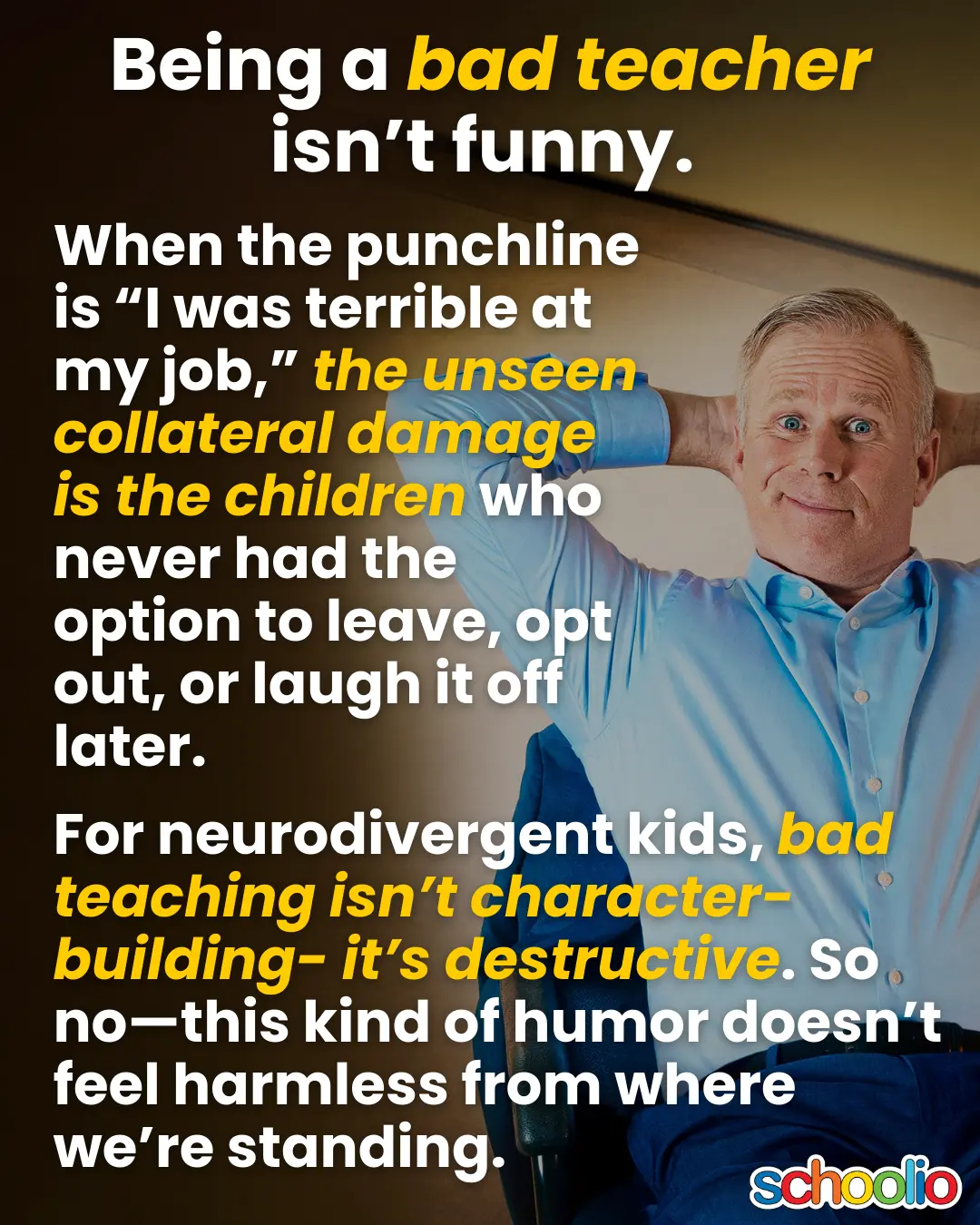
When the punchline is “I was terrible at my job,” the unseen collateral damage is the children who never had the option to leave, opt out, or laugh it off later.


Why This Hits Different for Our Community

For neurodivergent kids, bad teaching isn’t character-building.

It’s often the start of years of self-doubt, resistance to learning, and internalized shame.

So no—this kind of humor doesn’t feel harmless from where we’re standing.

It feels like another reminder of why so many of us chose a different path.

Why homeschooling wasn’t a lifestyle choice, but a lifeline.

Why “relatable” stories about bad teachers land very differently when you’ve seen the damage up close.

Good teaching matters.

Competent teaching matters.

Neurodivergent-aware teaching matters most of all.

And for families like ours, that truth isn’t funny at all.


Lindsey Casselman

Certified Special Ed Educator & Co-Founder, Schoolio

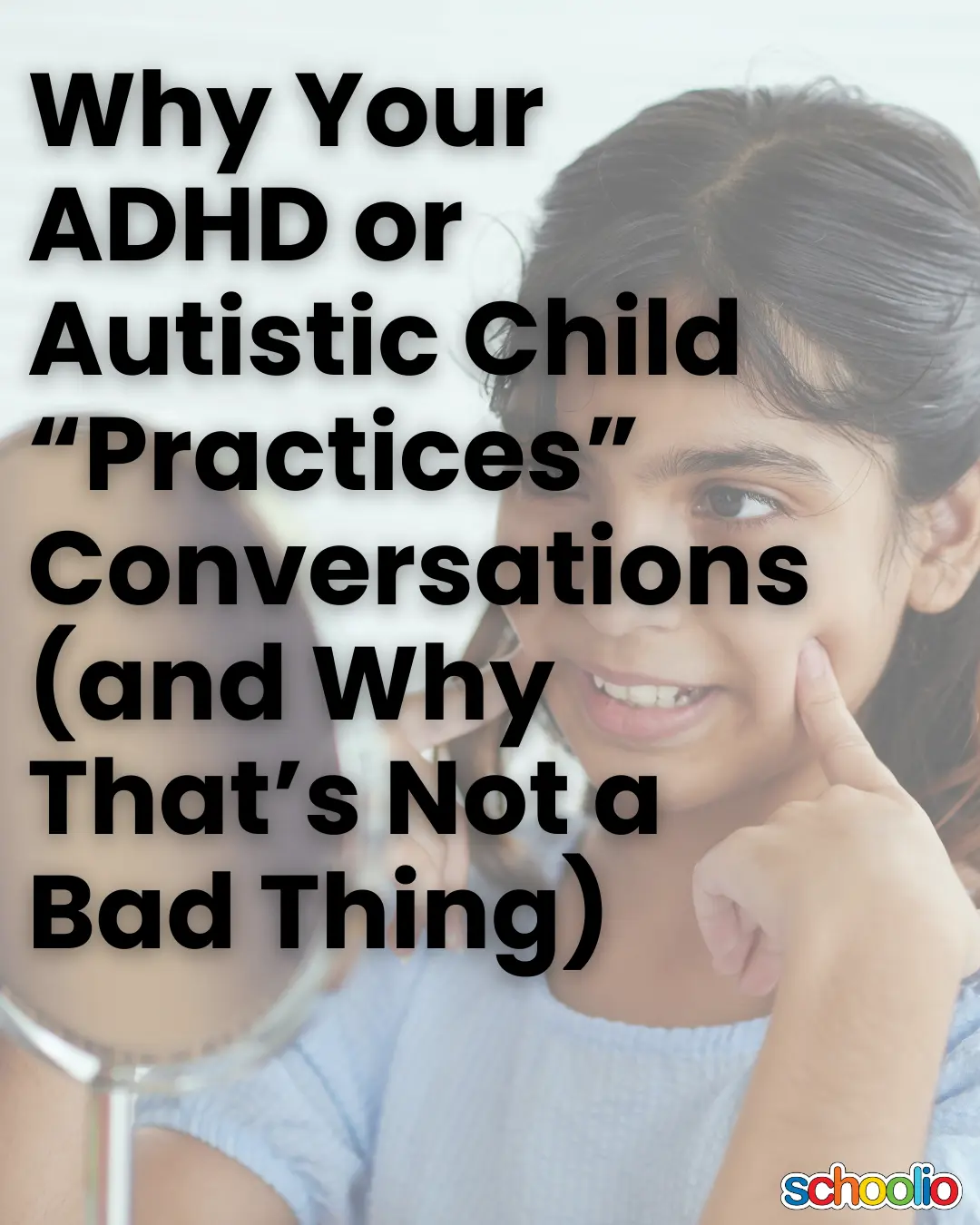
Why Your ADHD or Autistic Child “Practices” Conversations (and Why That’s Not a Bad Thing)

Why Your ADHD or Autistic Child “Practices” Conversations (and Why That’s Not a Bad Thing)


Have you ever noticed your child repeating the same sentence over and over before a phone call?

Or whispering what they’re going to say before walking into a room?

Or replaying conversations long after they’re over, worrying they said the “wrong” thing?

If so, you’re likely seeing scripting — a very common and very human coping strategy for autistic and ADHD kids.

And no, it’s not something you need to stop or “fix.”


What Is Scripting, Really?

Scripting is when someone mentally rehearses words, phrases, or entire conversations ahead of time. For neurodivergent kids, especially autistic and ADHD kids, it’s a way to prepare for social situations that feel unpredictable, overwhelming, or high-stakes.

Think of it like this:

Most people can improvise socially without much effort. For neurodivergent kids, social interactions often require conscious processing. Tone, timing, facial expressions, word choice — it’s a lot to manage all at once.

Scripting helps reduce that load.


Why Neurodivergent Kids Script

Scripting isn’t about being robotic or inauthentic. It’s about safety.

Many ADHD and autistic kids have experienced:

  • Being misunderstood
  • Saying the “wrong” thing and being corrected or teased
  • Feeling embarrassed or rejected after social interactions

Over time, their brains learn: Preparation feels safer than guessing.

Scripting gives them:

  • A sense of control
  • Predictability in an unpredictable world
  • Time to organize thoughts before speaking
  • A way to reduce anxiety before social demands

For some kids, scripting is the difference between engaging socially and avoiding it altogether.


What Scripting Feels Like for Kids

From the inside, scripting often feels like:

  • “If I practice, I won’t mess this up.”
  • “If I know what to say, I won’t get in trouble.”
  • “If I’m prepared, I’ll be less embarrassed.”

It’s not about manipulation or performance — it’s about self-protection.

And for kids who already struggle with emotional regulation, rejection sensitivity, or social anxiety, that protection matters.


When Scripting Is Helpful

Scripting can be incredibly supportive when it:

  • Reduces anxiety before social interactions
  • Helps kids advocate for themselves
  • Allows them to participate when they otherwise might shut down
  • Builds confidence through successful interactions

Many kids use scripting to:

  • Practice greetings
  • Prepare for phone calls
  • Navigate classroom discussions
  • Rehearse how to ask for help

In these cases, scripting is a tool, not a problem.


When Scripting Can Become Stressful

Like any coping strategy, scripting can become overwhelming if it turns rigid.

Some kids may struggle when:

  • Conversations don’t follow the “planned” path
  • Someone responds unexpectedly
  • They feel pressure to say things exactly right

When that happens, you might see:

  • Increased anxiety or shutdowns
  • Frustration when plans change
  • Avoidance of social situations altogether

This doesn’t mean scripting caused the problem — it means the need for safety is still very high.


How Parents Can Support Scripting (Without Making It Worse)

The goal isn’t to eliminate scripting — it’s to support it gently while building flexibility over time.

1. Normalize It

Let your child know scripting is okay.

“You’re practicing because you want it to go well. That makes sense.”

Shame increases anxiety. Normalization reduces it.


2. Practice Together

Role-play conversations in a low-pressure way.

  • Practice asking questions
  • Practice different responses someone might give
  • Practice what to do if things don’t go as planned

This builds flexibility without removing safety.


3. Teach “Backup Plans,” Not Perfection

Instead of perfect scripts, help your child develop:

  • A few flexible phrases
  • Exit strategies (“I need a minute”)
  • Repair phrases (“Can I try saying that again?”)

These tools reduce panic when conversations shift.


4. Don’t Force Spontaneity

Pushing kids to “just go with the flow” often backfires. Spontaneity grows naturally when safety increases — not when pressure does.


5. Celebrate the Effort

Scripting takes mental energy. Acknowledge that.

“I know that took courage.”

“You worked really hard to prepare for that.”

Feeling seen matters.


The Big Picture

Scripting isn’t a sign that your child lacks social skills.

It’s a sign that they’re working very hard to connect.

When supported with empathy, scripting can:

  • Increase confidence
  • Reduce anxiety
  • Serve as a bridge toward more flexible communication

Your child isn’t broken for needing extra preparation. They’re adapting — and that’s something worth honoring.

The 5 Core Emotional Needs of ADHDers (and Why They Matter More Than You Think)

The 5 Core Emotional Needs of ADHDers (and Why They Matter More Than You Think)

If you love an ADHDer — whether it’s your child, your partner, or even yourself — you’ve probably noticed that emotions run deep.
Joy can feel electric. Frustration can feel explosive. Rejection can feel unbearable.

ADHD isn’t just about focus or attention; it’s about emotion. ADHD brains experience emotional intensity, sensitivity, and regulation challenges at a level that can be hard for others to fully grasp.

That’s why emotionally healthy environments matter so much. ADHDers don’t just need structure or strategies — they need safety. The kind that lets their nervous system exhale. The kind that helps them believe they’re not broken, just wired differently.

Let’s talk about what that really means — and the five core emotional needs every ADHDer deserves to have met.


1. Safety & Acceptance

Freedom from judgment and the pressure to mask

ADHDers spend much of their lives in environments where they feel like they’re “too much” or “not enough.” Too loud, too distracted, too emotional, too impulsive. From school rules to social cues, the world often demands they shrink themselves to fit in.

That constant self-monitoring — called masking — is exhausting. It’s like running a marathon every day while pretending you’re fine.

What ADHDers need most is the feeling that they can exist exactly as they are — fidgety, passionate, tangential, emotional — and still be safe and accepted.

At home, that looks like gentle curiosity instead of correction:
“I can see your brain’s really busy right now — want to take a break?” instead of “Stop fidgeting.”

When safety replaces shame, healing begins.


2. Validation

Having feelings and experiences recognized as real — and being given credit for achievements that come easily to others.

ADHDers often grow up hearing things like,
“You’re overreacting.”
“It’s not that big a deal.”
“Why can’t you just calm down?”

Or they hear criticism of what looks like “behavior,” when it’s really the visible struggle of an ADHD brain trying to function in a neurotypical world:
“Why are you always late?”
“Why can’t you just remember when I tell you something?”
“If you cared, you’d be able to…”

But to an ADHD brain, it is that big a deal. Emotional regulation isn’t about choosing how to feel — it’s about the brain’s ability to return to baseline.

When feelings are dismissed or minimized, they don’t disappear — they just get lonelier.

Validation doesn’t mean agreeing with every emotion or excusing every action. It means acknowledging that what they feel is real, and that what they manage to do — even if it seems small — took effort.

“I can see that felt really unfair.”
“That sounds frustrating.”
“You worked hard to finish that, even though it wasn’t easy.”
“You’re allowed to feel disappointed.”

That kind of recognition helps ADHDers feel seen instead of defective. It teaches them that their emotions and their efforts both matter — and that’s the foundation for emotional growth and self-worth.


3. Autonomy

Choice, control, and consideration in decisions and pacing

Control is oxygen for ADHD brains.

Because ADHD impacts executive function — the part of the brain responsible for planning, organizing, and self-regulation — losing control can feel terrifying. It’s not about being oppositional or defiant. It’s about needing to steer their own ship, even if they’re still learning how.

But autonomy isn’t just about having choices — it’s about being considered.

For many ADHDers, life can feel like one long series of adjustments to fit a neurotypical world. They bend, mask, minimize, and stretch themselves to meet expectations that weren’t built with their brains in mind. Over time, that can make them feel invisible — like decisions are made for them, not with them.

Being considered — being included in plans, asked for input, and treated like their needs and preferences matter — is a form of freedom. It tells them, you belong here, as you are.

In homeschool environments, autonomy and consideration might look like:

  • Letting your child choose the order of subjects for the day 
  • Including them in planning routines or schedules that affect them 
  • Allowing them to decide whether to write with pencil, keyboard, or voice-to-text 
  • Giving them time limits that feel achievable instead of arbitrary 

When ADHDers are given genuine choice and genuine consideration, resistance turns into collaboration — and confidence blooms where shame used to live.

**If the need for autonomy and control feels even bigger for your child, to the point where they’re hyper-defiant of demands, you might be dealing with PDA (Pathological Demand Avoidance).


4. Connection

Supportive, understanding relationships

Underneath all the intensity and impulsivity, most ADHDers carry a deep fear of disconnection.

By age 12, the average child with ADHD has heard around 20,000 more negative or corrective messages than their neurotypical peers. (That’s a lot of “stop that,” “focus,” and “why can’t you just…”). Each one chips away at their sense of being lovable as they are.

That’s why connection is the antidote.

Connection tells the ADHD brain, you are still safe, even when you make mistakes.
It looks like laughter during lessons, shared problem-solving, and hugs after meltdowns. It’s eye contact, patience, and the unspoken message: we’re on the same team.

When ADHDers feel securely connected, their nervous system relaxes — and their capacity for learning, empathy, and resilience expands.


5. Consistency

Predictable environments that reduce stress

ADHD brains crave novelty, but they need predictability.

Inconsistent feedback, unpredictable schedules, or sudden changes can feel like emotional whiplash. Without a sense of what’s coming next, anxiety spikes — and so does dysregulation.

Consistency doesn’t mean rigidity. It means creating reliable patterns they can count on.

  • Clear expectations that stay the same 
  • Gentle transitions between activities 
  • A stable emotional tone at home 

Consistency tells the ADHD brain, you’re safe here. And safety builds the foundation for focus, trust, and growth.


Building Emotionally Safe Spaces for ADHDers

When these five needs — safety, validation, autonomy, connection, and consistency — are met, ADHDers thrive.

They regulate more easily.
They recover faster from mistakes.
They begin to trust themselves again.

And for parents, meeting these needs doesn’t mean being perfect. It means leading with compassion and curiosity, remembering that the behaviors you see are often the language of unmet needs.

When you give your ADHDer the emotional environment their brain truly needs, you’re not just teaching academics.
 

You’re teaching self-worth.
You’re teaching safety.
You’re teaching love that heals.


Why “Focus” Doesn’t Always Look Like Sitting Still

Why “Focus” Doesn’t Always Look Like Sitting Still


There was a season in our homeschool when math facts were… let’s just say painful.

Every time I pulled out the worksheets, I’d get groans. Wiggling in the chairs. The inevitable: “Do we have to do this?”

One day, instead of pushing through another tense math session at the table, I tried something different. We went outside. Onto the trampoline.

The kids bounced while I called out math facts. “What’s 7×6?” Bounce. Bounce. “42!” “What’s 9×8?” Bounce. Bounce. “72!”

Suddenly, the resistance melted away. They were laughing, shouting out answers between jumps, and begging for the next question. The energy that had been working against us at the table was now working for us.

And it hit me:

Focus doesn’t always look like sitting still.

For neurodivergent kids especially, learning can happen best in motion. While doodling. While bouncing. While tapping a pencil. While upside down on the couch. The movement isn’t a distraction — it’s the doorway to attention.

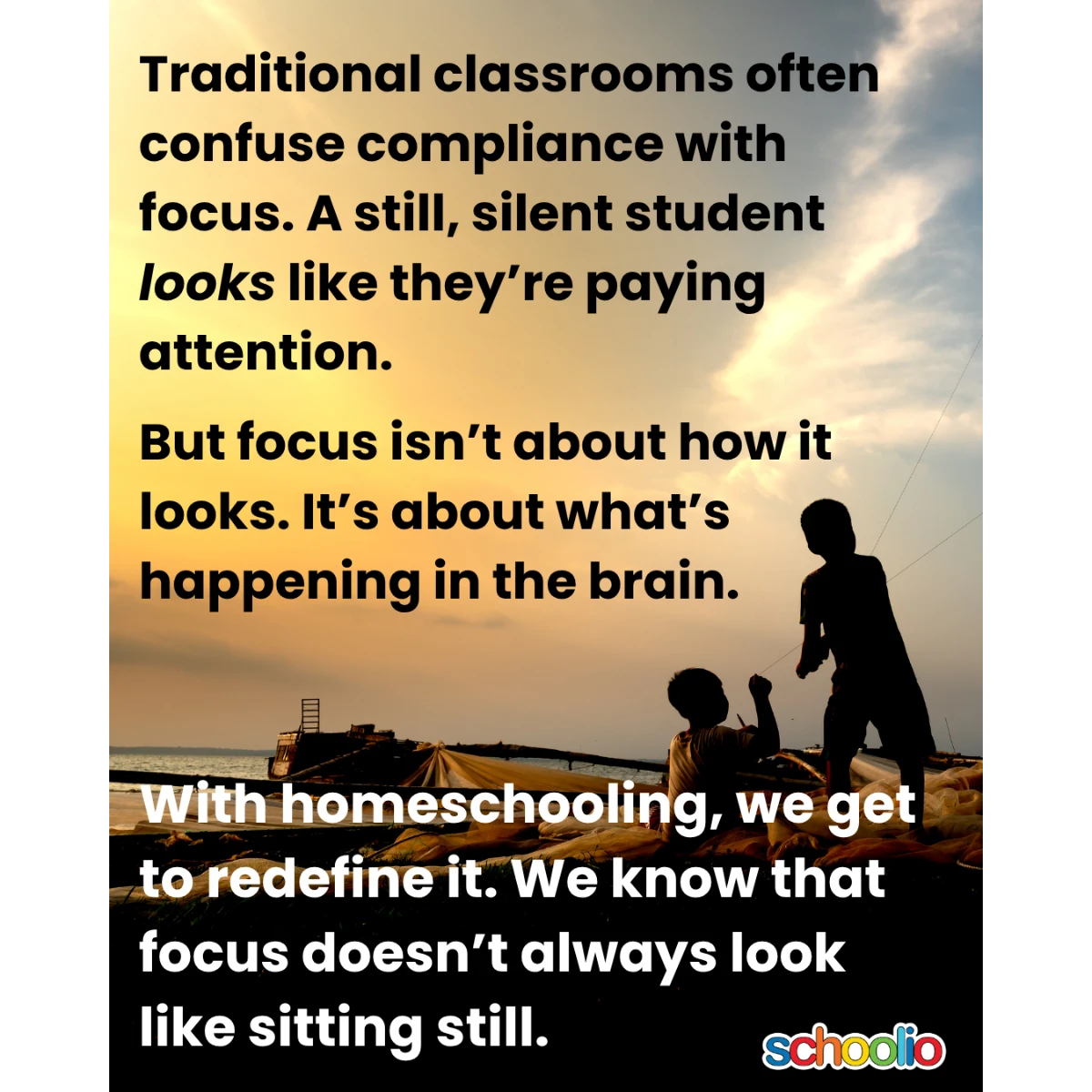
Traditional classrooms often confuse compliance with focus. A still, silent student looks like they’re paying attention. But how many times are they zoning out, daydreaming, or working hard just to appear calm?

At home, we get to redefine it.

✔ Focus can look like doodles in the margin while listening.

✔ Focus can look like bouncing on a trampoline while memorizing math facts.

✔ Focus can look like humming quietly while reading.


The truth is, focus isn’t about how it looks. It’s about what’s happening in the brain.

So if your child can’t sit still — maybe don’t fight it. Maybe lean into it. Movement can be the bridge between frustration and fun, resistance and retention.

Because focus doesn’t always look like stillness. Sometimes it looks like joy.


? Lindsey

Certified Special-Ed Educator & Co-Founder, Schoolio

Your Child Is Not Just an Adult-in-Training

Your Child Is Not Just an Adult-in-Training

This has been on my mind today…

There’s something powerful about watching your child learn for the joy of it — not just to check a box, meet a goal, or prepare for some vague “someday.”

When we started homeschooling, I fell into the trap of thinking every lesson had to lead to something measurable. Will this help on the SAT? Will they need this in college? What about job readiness?

I was measuring everything with the ruler of adulthood.

But one day, in the middle of a lesson on animal habitats, my daughter stopped and said, “I want to build one myself.” Not for a grade. Not because I asked. Just because she was curious. And I realized, right then, this is what learning is supposed to be.

Homeschooling gives us permission to see the child in front of us — not just a future applicant or employee.

When we say yes to homeschooling, we say yes to wonder. To creativity. To the kind of questions that don’t always have clear answers.

We say yes to building confidence and fostering curiosity, not just stuffing their heads with content.

Yes to letting a child love dinosaurs for two months straight or take longer on multiplication because their brain needs time.

That’s not wasted time. That’s real learning.

And the best part? When they feel seen and safe as children, they grow into adults who don’t have to heal from childhood.

So if you ever feel like you’re “not doing enough” because your homeschool day doesn’t look like school — remember this. You’re not raising a resume. You’re raising a whole human being.

And that matters more than any checklist ever could.

With love,

Lindsey

Certified Special Ed Educator & Co-Founder, Schoolio


Want to nurture who your child is now — not just who they’ll become? Start your free Schoolio trial and see what learning can feel like.

ADHD and Autistic Kids: Hyperfocus and SPINs

ADHD and autistic kids often experience uniquenesses that can be both a source of strength and challenge. Today we’re going to look at one of these cool uniquenesses known as hyperfocus, hyperfixation, and SPINs. SPINs is neurodivergent community slang for Special Interest, a uniqueness so common that neurodivergent folks bond over it regularly! While these terms are sometimes used interchangeably, they actually describe different aspects of how neurodivergent minds can intensely focus on specific tasks, ideas, or topics, so let’s look at each of them individually so we can better support and educate our ADHD and autistic kids!.

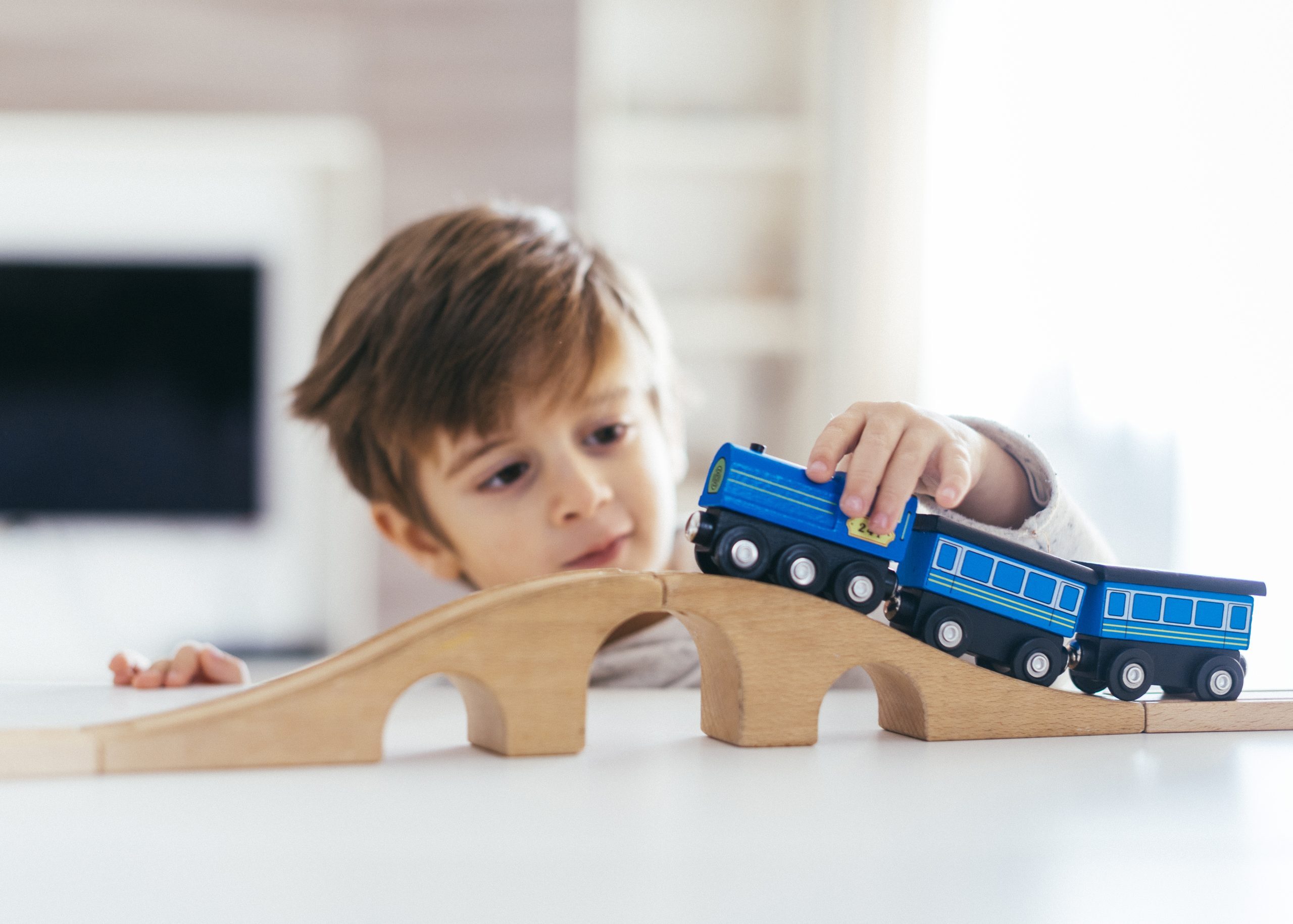
ADHD or autistic kid plays with trains

What is Hyperfocus in ADHD and Autistic Kids?

Hyperfocus refers to an intense, almost obsessive concentration on a specific task or activity. For ADHD and autistic kids, this state of deep engagement can last for hours, making it difficult for them to shift attention to other tasks. Hyperfocus is not unique to ADHD and autism, but it is particularly common among individuals with these neurodivergent conditions.

Characteristics of Hyperfocus in ADHD and Autistic Kids:

  • Intense Concentration: When in a state of hyperfocus, ADHD and autistic kids may become so absorbed in an activity that they lose track of time and surroundings. This can include forgetting basic self-care, like eating, drinking, and using the restroom!
  • Difficulty Transitioning: Shifting attention away from the hyperfocused task can be challenging, often leading to frustration or resistance. Even alarms and warnings might not help with the transition from the task they are hyperfocusing on to something else.
  • Heightened Productivity: During hyperfocus, these kids can accomplish a significant amount of work in a short period, often with remarkable detail and accuracy.

While hyperfocus can be beneficial for completing complex tasks or deepening knowledge in a particular area, it can also lead to neglecting other important responsibilities, such as homework, chores, or social interactions. However, most hyperfocus is harmless and the ADHD or autistic kid is happy while consumed, so it’s ok to let them enjoy the time as long as they’d like. Bring them a snack once in awhile and remind them to stretch and use the bathroom periodically!

ADHD and autistic kid plays with dinosaurs

Understanding Hyperfixation in ADHD and Autistic Kids

Hyperfixation is closely related to hyperfocus but differs in some key ways. Hyperfixation refers to an intense and prolonged focus on a specific topic, activity, or object, often to the exclusion of everything else. Unlike hyperfocus, which may be task-specific, hyperfixation is usually topic-specific and can last for weeks, months, or even years.

Key Aspects of Hyperfixation:

  • Intense Interest: ADHD and autistic kids may become deeply interested in a specific subject, such as dinosaurs, trains, or a particular video game.
  • Emotional Attachment: Hyperfixation is often accompanied by strong emotional connections to the subject, making it a source of comfort and security. Engaging in their hyperfixation topic is comforting and if they can’t engage in it, they may talk about it instead as a way to access the comfort of the topic.
  • Difficulty Shifting Focus: Similar to hyperfocus, transitioning away from a hyperfixation can be difficult, sometimes leading to distress or anxiety.

Hyperfixation can be both a strength and a challenge for ADHD and autistic kids. On the one hand, it allows them to develop expertise and deep knowledge in specific areas. A child with a hyperfixation on trains will know so much detail about them! On the other hand, it can make it challenging to balance other aspects of life, such as academics, social relationships, and self-care. They may annoy other kids with their constant interest in one topic, or forget to do things like drink water while engaging with their hyperfixation.

SPINs: Special Interests in Neurodivergent Kids

SPINs, or Special Interests, are a hallmark of autism but are also present in some kids with ADHD. SPINs refer to intense, all-consuming interests in specific subjects that bring immense joy and fulfillment to neurodivergent kids. Stimpunks.org refer to SPINs: “Having a special interest is like having a crush or being newly in love. It is consuming and delightful.” These interests often go beyond mere hobbies and become central to their identity and daily life.

Characteristics of SPINs:

  • Passionate Engagement: SPINs are pursued with passion and dedication, often involving extensive research, collecting, or creating related content. A SPIN in, say, Pokemon will mean your child knows seemingly EVERYTHING about them and can talk endlessly about the details.
  • Source of Comfort: Engaging in SPINs can provide a sense of security and calm, particularly in overwhelming or stressful situations.
  • Social Interaction: While SPINs can sometimes lead to social isolation, they can also be a way for neurodivergent kids to connect with others who share similar interests.

Supporting SPINs in ADHD and autistic kids is crucial for their emotional well-being and development. Encouraging these interests can help build self-esteem, foster social connections, and even lead to future academic or career opportunities.

Managing Hyperfocus, Hyperfixation, and SPINs in ADHD and Autistic Kids

While hyperfocus, hyperfixation, and SPINs can be powerful tools for learning and personal growth, they are also inherent aspects of the neurodivergent experience. These patterns of focus are not something that ADHD and autistic kids can simply “turn off” or ignore. They are deeply rooted in how their brains are wired, and expecting them to easily shift away from these intense states is unrealistic.

For example, my daughter had a SPIN in stuffed animals from the time she was about two years old until probably 10 or so. If we left the house and she forgot to bring a stuffy, she would panic and have a meltdown. She needed it for comfort and security when we were out in the world. It may seem like a silly thing to “need” to us, but I learned that turning around and going back for the forgotten stuffy, and later having an “emergency stuffy” that stayed in the car, was essential to her comfort and ability to cope. Managing without wasn’t something I could realistically ask of her, because she is neurodivergent.

Young girl with stuffed animals

Legitimacy of Neurodivergent Focus Patterns: It’s essential to recognize that hyperfocus, hyperfixation, and SPINs are legitimate parts of the neurodivergent experience. They are not simply quirks or habits to be managed, or for kids to learn to go without, but are integral to how our kids engage with the world. This intense focus can be a source of pride, achievement, and fulfillment, and it’s a important part of comfort and calm. It’s crucial for parents and educators to honor and respect these aspects of neurodivergence.

The Discomfort of Disconnection: For ADHD and autistic kids, being unable to engage in their SPIN or hyperfocus/fixation activity can lead to significant discomfort, frustration, and even distress. This sense of disconnection from what brings them joy and satisfaction can result in emotional dysregulation, anxiety, or a feeling of being “lost.” It’s important to understand that these activities are not just hobbies but are often central to their emotional well-being. This is part of why traditional school can be so hard for ADHD and Autistic kids, because they are separated from their source of comfort and what makes them who they are, for so much of the day This is one of the benefits of homeschooling, your child can engage in their SPIN much more often. Programs like Schoolio are rooted in interest-based learning, and allow you to choose topics in science, social studies, and more that align with your child’s interests, making learning more exciting for your child and decreasing discomfort when learning.

Navigating the In-Between States: There are also times when neurodivergent kids may find themselves in an “in-between” state, where they are not currently engaged in a hyperfixation or SPIN. Neurodivergent adults attest to the discomfort of the time between one SPIN “wearing off” and discovering a new one. This period can be unsettling, as it may feel like a loss of direction or purpose. During these times, it’s important to provide support, offer new opportunities for exploration, and help them navigate this transitional phase with patience and understanding.

Practical Strategies:

  1. Set Time Limits: Encourage breaks and set time limits to ensure that other responsibilities are not neglected. Use visual timers or schedules to help ADHD and autistic kids transition between tasks. Give them lots of transition warning, and don’t take away time from their SPIN for “no good reason” because that will seem unjustified to your ADHD or autistic kid.
  2. Incorporate Interests into Learning: Whenever possible, incorporate their hyperfixations or SPINs into the curriculum. This can make learning more engaging and enjoyable. When my daughter’s SPIN was dragons, we altered a geography activity to include her SPIN. The curriculum wanted her to make a booklet with a page dedicated to each of the physical regions of the country, so I asked her to create a dragon for each region and describe it’s habitat, diet, and other features that it would have based on where it lived. Don’t be afraid to alter your programming to include your child’s special interests!
  3. Create a Balance: It’s great to teach the importance of balancing to your kids. Their intense interests are important, but they do need to learn to not neglect their own self-care or their responsibilities. You may want to encourage participation in other activities and experiences to help them develop new skills and discover other interests, but remember that their SPINs and hyperfocus are not in their control, and are usually harmless and comforting to your child, so don’t feel the need to force them away from it for no reason.
  4. Communicate Openly: Discuss the benefits and challenges of hyperfocus and hyperfixation with your child. Help them understand the characteristics of their ADHD or autism so they learn how to leverage these traits positively while managing potential downsides.
Young ADHD or autistic boy plays with diggers

Conclusion

Understanding and managing hyperfocus, hyperfixation, and SPINs in ADHD and autistic kids is essential for helping them thrive. These intense focus patterns are not just challenges to be managed but strengths to be harnessed. By supporting their unique ways of engaging with the world, parents and educators can help neurodivergent kids achieve their full potential and lead fulfilling lives.

Understanding and Managing Anxiety in Neurodivergent Kids

Anxiety in Neurodivergent Kids

Raising a neurodivergent child comes with its own set of unique joys and challenges. One common challenge many parents face is helping their child manage anxiety. Anxiety in neurodivergent kids, including those who are autistic, ADHD, or have other developmental differences, often manifests more intensely than in their neurotypical peers. Understanding the roots of this anxiety and finding effective ways to manage it can significantly improve your child’s quality of life.

What Causes Anxiety in Neurodivergent Kids?

  1. Sensory Overload: Many neurodivergent children are highly sensitive to their environments. Bright lights, loud noises, and even certain textures can overwhelm them, leading to heightened anxiety.
  2. Routine Changes: A sudden change in routine can be extremely distressing for neurodivergent kids. They often find comfort in predictability, and any disruption can trigger anxiety.
  3. Social Interactions: Navigating social situations can be daunting. Misunderstanding social cues or worrying about fitting in can cause significant anxiety.
  4. Performance Pressure: Academic and extracurricular expectations can be a source of stress. The fear of not meeting these expectations can exacerbate anxiety.

Recognizing Anxiety Symptoms

Identifying anxiety in neurodivergent kids can sometimes be challenging as it may manifest differently. Common signs include:

  • Physical Symptoms: Headaches, stomachaches, or fatigue.
  • Behavioral Changes: Increased irritability, restlessness, or meltdowns.
  • Emotional Indicators: Excessive worry, fearfulness, or mood swings.
  • Avoidance: Reluctance to engage in certain activities or go to specific places.

Practical Strategies for Managing Anxiety

  1. Create a Safe Space: Designate a quiet, calm area at home where your child can retreat to when feeling overwhelmed. This space should be free from sensory triggers and filled with comforting items. It should never be used as a punishment- the child chooses to go there, they aren’t sent there as a reaction to behavior.
  2. Establish Routines: Consistent routines can provide a sense of security. Use visual schedules to help your child understand what to expect throughout the day. Let your child be involved as much as possible in creating the schedule.
  3. Teach Relaxation Techniques: Deep breathing, progressive muscle relaxation, and mindfulness exercises can help your child manage anxiety. Practice these techniques together to make them more effective.
  4. Use Social Stories: Social stories are a great tool to help neurodivergent kids prepare for new or challenging situations. They provide a clear narrative of what to expect and how to respond.
  5. Positive Reinforcement: Celebrate your child’s successes, no matter how small. Positive reinforcement can build confidence and reduce anxiety.
  6. Add a Social-Emotional Learning program to your homeschool: SEL programs like Schoolio offers help children learn to emotionally regulate, manage their thoughts and feelings, and cope better with stress and anxiety.
  7. Professional Support: Sometimes, professional intervention is necessary. Therapists, counselors, and support groups can provide additional strategies and support tailored to your child’s needs.

Schoolio’s Program is Neurodivergent-Friendly

Schoolio offers a homeschool program designed with neurodivergent kids in mind. Here are some features that make it a great choice for your child:

  • Unitization: Allows you to mix and match grade levels to fit your child’s unique learning pace and needs.
  • Bite-Sized Learning Sessions: Short, engaging lessons to keep your child’s attention and prevent overwhelm.
  • Alternative Learning Strategies: Various methods to cater to different learning styles and preferences.
  • Custom-Designed Student Success Plans: Personalized plans to ensure your child’s educational success.
  • Interest-Based Learning: Selections that align with your child’s interests to make learning more enjoyable.

Encouraging Open Communication

One of the most powerful tools in managing anxiety is fostering open communication. Encourage your child to express their feelings and fears without judgment. Let them know it’s okay to feel anxious and that you are there to support them.

Conclusion

Helping a neurodivergent child manage anxiety is an ongoing process that requires patience, understanding, and a lot of love. By creating a supportive environment, establishing routines, and teaching coping strategies, you can empower your child to navigate their world with greater confidence and less anxiety. Remember, you are not alone on this journey – there are numerous resources and communities ready to support you and your child every step of the way. Schoolio’s neurodivergent-friendly program can be a valuable part of your toolkit, offering the flexibility and support your child needs to thrive.