How Many Hours Should You Homeschool Each Day?

How Many Hours Should You Homeschool Each Day?

One of the first questions I hear from new homeschool families is this: “How many hours should we be doing every day?” It’s a question that often carries a lot of weight, as parents worry about whether they’re doing enough. And I always smile a little because the answer is often fewer hours than they’re expecting. Understanding how many hours are truly needed can bring a sense of relief and clarity to your homeschooling journey.


Why so much less than traditional school?

Think about what a six-hour school day actually looks like. There’s the morning routine — getting settled, taking attendance, announcements. Transitions between subjects, between classrooms, between activities. Lining up. Waiting. Bathroom breaks for the whole class. Behavior redirection when someone is off task — which in a class of thirty kids, is almost always someone. Lectures delivered to the whole group at a pace that works for the middle — too fast for some, too slow for others. Work periods where half the class is waiting for the other half to catch up. By the time you strip all of that away, the actual focused learning happening in a traditional school day is a fraction of the clock time.

At home, with one child — or even a few — you cut almost all of that out. No transitions. No waiting. No redirecting twenty-nine other kids. Just your child, you, and the lesson. That’s why two hours at home can cover what takes six hours at school. For example, a focused math lesson that might take an hour in a classroom can often be completed in 20 minutes at home.


What they taught me in teacher training

When I was getting my education degree, one of the most useful things my professors taught me was this: You can expect a child to give you their focused attention for as many minutes as they are years old. An eight-year-old? Eight minutes of genuine sustained attention. A six-year-old? Six minutes.

Now — that doesn’t mean a lesson is only that long. It means something needs to happen as a reset every few minutes. A change of location. A switch from listening to doing. A question asked and answered. A quick movement break. Anything that breaks the sustained attention and gives the brain a little refresh. Even traditional school isn’t six straight hours of focused learning. It’s dozens of tiny resets strung together across a day. Homeschool is no different — and once you understand that, the whole day starts to make a lot more sense.

For instance, a science experiment might involve a quick setup, a period of observation, and then a discussion. Each part offers a natural break and reset for the child’s attention.


So how long should homeschool actually take?

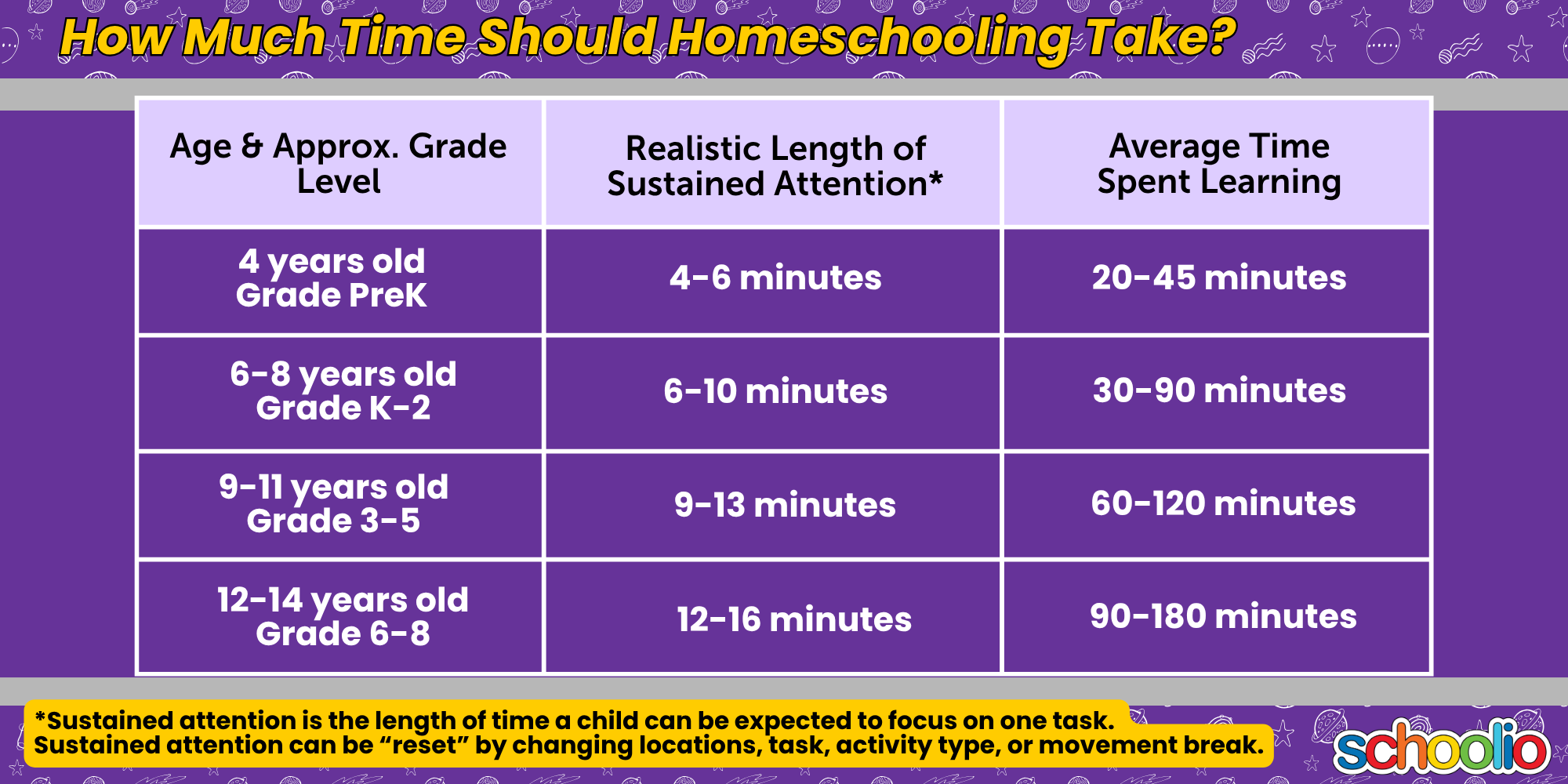
Here are some rough guidelines that the homeschool community has generally come to agree on. Think of these as a loose norm, not a rulebook. (See the chart below for a full breakdown by age and grade.)

PreK (Age 4) 20–45 minutes total. Sustained attention of just 4–6 minutes at a time. Play is the curriculum at this age. Keep it light, keep it moving. Activities might include storytelling, simple crafts, or a nature walk.

Kindergarten to Grade 2 (Ages 6–8) 30–90 minutes total. Sustained attention of 6–10 minutes. Short, varied activities work best. Reading, then building, then drawing — keep switching it up. A typical day might start with a reading session, followed by a hands-on math activity, and then a creative art project.

Grades 3–5 (Ages 9–11) 60–120 minutes total. Sustained attention of 9–13 minutes. Kids this age can handle a little more depth, longer projects, and starting to follow their own curiosity. You might introduce a research project on a topic of interest, encouraging independent learning.

Grades 6–8 (Ages 12–14) 90–180 minutes total. Sustained attention of 12–16 minutes. More independent work starts here — reading, research, writing — but it still shouldn’t feel like a grind. Consider incorporating a mix of structured lessons and self-directed study, like a science project or a book report.

TimeSpentLearning.png


A note for neurodivergent learners

If your child has ADHD, autism, or sensory processing differences, these numbers may look quite different — and that is completely okay. For many neurodivergent kids, sustained attention windows are shorter, and the need for resets is more frequent. That’s not a problem to fix. That’s information to work with. Twenty minutes of real engagement will always beat ninety minutes of struggle. Tailor your approach with flexible schedules and sensory-friendly activities.


The bottom line

Seat time is not the same as learning time. If your child is engaged, curious, and absorbing what you’re working on together — you’re doing it right. Even if it only took an hour. Even if it looked nothing like school. That’s kind of the whole point. Remember, the beauty of homeschooling is its flexibility and the ability to adapt to your child’s unique learning style and pace.

What Self-Care Really Means: A Strategic Guide for Homeschooling Parents

TL;DR – Quick Answer:
What Self-Care Really Means: A Strategic Guide for Homeschooling Parents offers significant advantages for homeschooling families by prioritizing individual learning styles and flexibility. Our community of over 10,000 Schoolio families demonstrates that a personalized, neurodiversity-affirming approach is the key to academic success and emotional well-being.

Self-care for homeschooling parents is a strategic necessity, not an indulgence. To beat the ‘Winter Blahs’ and avoid burnout, families must identify ‘invisible leaks’ like comparison and unrealistic expectations. Shifting from a lecturer to a coaching role, externalizing curriculum with all-in-one digital tools, and finding a supportive community are the three most effective ways to refill your mental cup and build a sustainable homeschooling journey.

You have likely heard the old adage, ‘You cannot pour from an empty cup.’ But in the world of homeschooling—where the ‘cup’ is often drained by 24/7 child-rearing, lesson planning, and household management—this phrase can start to feel like another item on a never-ending to-do list. True self-care isn’t a luxury; it’s a strategic necessity for maintaining the longevity of your homeschooling journey.

For the homeschooling parent, self-care is often misunderstood as an indulgence like a spa day or a quiet glass of wine. While those things are wonderful, they are temporary fixes for a systemic problem. Strategic self-care is about identifying the ‘invisible leaks’ in your energy and building a lifestyle that preserves your identity and mental health, even in the middle of a chaotic school year.

Identifying the ‘Invisible Leaks’ in Your Homeschool Cup

Burnout rarely happens all at once. It happens little by little, through small, daily drains that we often ignore until we reach a breaking point. To reclaim your energy, you first must identify where it is going. Common ‘cup-emptiers’ for homeschooling families include:

– **Setting Unrealistic Expectations:** Trying to replicate a 6-hour institutional school day in a 1-on-1 home environment.

– **The Comparison Trap:** Measuring your ‘behind-the-scenes’ mess against another parent’s highly curated social media feed.

– **Lack of Community:** Attempting to ‘do it all’ without a village, leading to isolation and sensory overload.

– **Overlooking Personal Identity:** Losing the person you were before you became a full-time facilitator of your child’s education.

Step 1: Redefine Self-Care as Systemic Maintenance

If your car is running out of oil, you don’t give it a new paint job; you fix the engine. Similarly, if you are struggling with homeschooling burnout, a bubble bath won’t fix a curriculum that isn’t working. Strategic self-care means choosing an all-in-one curriculum that reduces your prep time from hours to minutes.

When you externalize the teaching through video-supported lessons and scripted guides, you stop being the primary source of all information. This shift allows you to move into the ‘coaching’ role, which is significantly less taxing on your mental bandwidth. By lowering your cognitive load, you are performing an act of self-care that lasts all week, not just for thirty minutes in a tub.

Step 2: The ‘Mid-Year Pivot’ and Deschooling

Many parents reach a state of crisis in February or March—the ‘Winter Blahs.’ If you find yourself in this cycle, the most radical act of self-care you can perform is a ‘Pivot.’ This might mean taking a week off for interest-led learning or entirely changing your approach to a subject that causes daily tears.

Remember: you are the authority in your homeschool. If a plan isn’t working for you or your child, you have the permission to scrap it. Reclaiming your agency as a parent is the ultimate form of self-empowerment.

“Self-care for a homeschooling parent isn’t about escaping your life; it’s about building a life you don’t feel the need to escape from. It starts with setting boundaries around your time and choosing tools that support your sanity as much as your child’s education.” — Lindsey Casselman, Co-Founder of Schoolio

Step 3: Find Your Village

Isolation is a catalyst for burnout. Human beings are built for connection, and homeschooling in a vacuum is a recipe for exhaustion. Whether it is a local co-op, a specialized digital community, or even an active online community, finding other parents who ‘get it’ is essential.

Community provides more than just socialization for your kids; it provides perspective for you. When you hear that other families also struggle with math or that their kitchen table is also covered in science experiments, the weight of the ‘comparison trap’ begins to lift.

Step 4: Prioritize Your ‘Non-Academics’ Self

Who are you outside of being a teacher? Reconnecting with your own hobbies—whether it is reading, gardening, or a professional side-project—is vital. Set a boundary: ‘School ends at 2:00 PM.’ After that, you are allowed to be a person again. This distinction prevents your identity from being entirely consumed by the role of ‘Homeschool Mom’ or ‘Homeschool Dad.’

Refilling the Cup

Homeschooling is a marathon, not a sprint. If you are struggling today, take it as a sign to slow down and audit your systems. Be gentle with yourself, lower your expectations, and remember that a happy, regulated parent is the most valuable educational resource a child can have.

For further reading on evidence-based educational strategies, explore the research provided by the Child Mind Institute.

But I Don’t Remember Any of What I Learned in School!

Why You Don’t Need to Be Afraid of the Things You Don’t Know in Homeschooling


One thing I hear often from parents worried about whether they are “capable” of homeschooling is this idea that you have to remember everything you were ever taught in school in order to teach it.

That’s way too much to expect of yourself. Studies show that as adults, we **only use about 37% of what we learned in school.** Why would we retain the rest? We don’t. And yet, we do just fine.

But here’s the good news: you don’t need to remember everything to be able to teach your kids. To explain, let me take you back to when your child was a toddler and it was time for potty training.

When you taught your child to use the toilet, how did you know how to teach them? Did you think back to how you were potty trained? Did you remember exact instructions your parents gave you? Of course not. Most of us don’t even remember that age, let alone the details.

So how were you “qualified” to teach your child to use the toilet?

Because you knew how to figure out how — and you had tools.

First, you probably took some time to teach yourself how to teach it. Maybe you read a book. Maybe you hit up some parenting blogs, or watched YouTube videos. Maybe you asked a friend or family member who had done it before. In this day and age there is no limit to the information available to us- you can be taught and learn to teach absolutely any skill you choose.

Second, you probably accessed some tools to support you while you taught it. Maybe you purchased a kids book about using the potty to read to your child. Maybe you found a tv show for your child to watch that instructed them for you. Maybe you bought a kids’ potty to make it more accessible for them.

Most likely, you used a combination of resources!

And then you tried.

You experimented. You considered your family needs and lifestyle, and your child’s uniqueness and what would inspire and motivate them. You looked at what was working and what wasn’t, and you made adjustments. Maybe your first attempts didn’t work for your child. You learned more about how your child learns, or what motivates them, so then you tried something else. Eventually something clicked.

For some kids it happens quickly, for others it’s a long and messy process. Maybe you even thought you were failing at times. But at the end of the day, they figured it out — because you stayed with them through the process.

And when all our kids are grown, no one will care whether they were potty trained at 14 months or 3½ years. They all learned what they needed to know, in their own time.

Homeschooling is the same.

You don’t have to know algebra or remember the dates of every war. You just need to be willing to learn alongside your child, model teaching yourself things you need to know, find tools that work, and make adjustments as you go.

Most of all, you just need to be present with your child through the process.

Because just like with potty training, the most important thing your child carries forward isn’t just the skill itself — it’s how they felt while learning it with you. The connection, the encouragement, the bond. That’s what lasts.

? Lindsey

Certified Special-Ed Educator & Co-Founder, Schoolio

Top 5 Unexpected Benefits of Homeschooling That Are Lowkey So Awesome

Top 5 Unexpected Benefits of Homeschooling, brought to you in countdown format…

When people think about homeschooling, the big reasons often come to mind—personalized learning, flexible schedules, and a safe environment. While these are all of course wonderful and fantastic advantages, and certainly the reasons we put the most weight in when making the decision to homeschool, there are other unexpected benefits of homeschooling that don’t get as much attention, but for us parents are turn out to be pretty rad upsells to the whole gig! These lesser-known perks can make your day-to-day life easier and a lot more fun. Let’s count down the top five unexpected benefits of homeschooling that families often discover after they start.

One of the most unexpected benefits of homeschooling we discovered after we pulled our kids out of school is avoiding the constant pressure to keep up with fleeting trends. In traditional schools, peer pressure to have the latest toy, gadget, or clothing brand is ever-present. Kids can feel pressured to fit in, and this can lead to unnecessary stress and expenses for both children and parents. If you’ve ever bought a fidget spinner or Stanley cup for your kiddo to feel “cool” and not be left out, you know what I’m talking about!

Homeschooling allows children to escape the social pressures that often come with large peer groups. Without the need to “keep up” with what everyone else is doing, homeschooled kids can focus more on their own interests and passions. And NO this does not mean homeschoolers don’t socialize with peers, but they more often socialize with other homeschoolers, and this wildfire fad thing just doesn’t seem to happen as much in these groups.

unexpected benefits of homeschooling

This also means that parents can save money by not having to constantly buy the latest trendy items, only to toss them in the donation bag a few weeks later. By homeschooling, you create an environment where kids can be themselves without the influence of unnecessary trends.

#4: Freedom from Endless Fundraisers (and the PTA)

If you’ve ever had a child in public school, you’re likely familiar with the seemingly endless cycle of fundraising. Whether it’s selling cookies, wrapping paper, or participating in bake sales, parents are often tasked with organizing or buying into fundraisers to support school programs. While the cause may be noble, the constant fundraising grind can be exhausting. Not only does it cost us parents money to participate, but we often feel compelled to help our kids reach goals and contact more people for sales. If you’re a part of the PTA (Parent-Teacher Association) you may also be responsible for running events and orchestrating fundraising activities. While you’re happy to support your child’s school, and fully understand the need and value of volunteers and additional funds for our public schools, it’s ok to admit that it’s kind of a lot of extra work you’d maybe rather not do!

kids running a bake sale

One of the unexpected benefits of homeschooling is being free from these obligations. Homeschooling means you no longer have to feel pressured to ask friends, family, and neighbors to buy overpriced items or spend hours working PTA events. Instead, you can focus your time and energy on activities that truly matter to your family. Plus, you’ll save money by not having to buy unnecessary items just to meet quotas.

#3: Goodbye to Constant Coughing and Colds

Number 3 on our countdown is personal favorite of mine, and definitely an unexpected benefits of homeschooling- the significant reduction in sick days! Public schools are notorious for being breeding grounds for germs, it’s a running joke that kids in school are constantly sick, and it can feel pretty true! When kids spend their days surrounded by large groups of peers, in close quarters with poor ventilation, they are more likely to catch every cold, flu, and stomach bug going around. This can lead to constant downtime as kids recover from one illness after another, and the feeling that someone is always coughing. Kids are also, of course, generous enough to share these germs with everyone else in the family!

sick child in bed

Homeschooling reduces your child’s exposure to these germs, which means fewer sick days overall. While no environment is completely free of illness, and of course germ exposure increases our immune systems, homeschooling allows you to have more control over your child’s health. When your child does get sick, homeschooling offers the flexibility to adjust your schedule, so they can rest and recover without falling behind on their education, and there’s no pressure to have your child attend when they’re unwell. You can also teach your kids and ensure they participate in better hand hygiene. Even though you’re out and about in the community a lot as homeschoolers, you still get way less exposure to illness by not being in a crowded classroom all day!

#2: Peace Out of School Drop-Off and Bus Runs

Few things are more stressful than the frantic morning rush to get kids out the door on time for school. Whether it’s a mad dash to catch the bus or drop them off at school, mornings can often feel chaotic and rushed, setting a stressful tone for the day. If your kids have been in public school, I’m sure you know what I’m talking about! Sometimes it feels like most of your time with your kids is spent hustling them from one place to another, always in a rush and always late!

unexpected benefits of homeschooling bus run

One of the most appreciated unexpected benefits of homeschooling is the ability to say goodbye to school drop-offs and bus runs. Homeschooling allows families to start their day at a more natural pace. No more waking up at the crack of dawn or rushing to make it to school on time. Instead, homeschoolers can enjoy a calm morning routine, waking up when they’re ready and easing into the school day. I always recommend to new homeschoolers that one of the first school ingrained ideas we ditch is that kids need to be up and ready for the day at a certain time. Allowing your child to rest until their body is naturally ready to get up means they are getting the sleep they need for optimum health and growth (which may also attribute to getting sick less often, as in #3 of this countdown!) This slower start not only reduces stress but also helps children feel more balanced and focused, leading to a more productive day overall. Read more about how homeschooling reduces family stress.

And the #1 Spot Goes To….(drumroll please…) No More Making Bagged Lunches!

At the top of my personal list of unexpected benefits of homeschooling is one that many parents dream of—no more packing school lunches! Gone are the mornings of struggling to figure out what to put in a lunchbox that your child will actually eat and that will stay fresh until noon. No more worrying about food allergies, picky eating habits, or whether your child will trade away the sandwich you so carefully made.

Mom packs child's lunch

Homeschooling offers the luxury of fresh, home-cooked meals. Your children can enjoy warm, balanced lunches made right at home, and better yet, they can help prepare them! This not only gives you a break from the daily lunchbox grind, but it also turns meal preparation into a fun, educational activity where kids can learn valuable skills like cooking and nutrition. For many families, this becomes one of the most appreciated unexpected benefits of homeschooling. I know I personally did a little happy dance every time I didn’t have to make school lunches after we started homeschooling!

Conclusion: The Small Wins and Unexpected Benefits of Homeschooling Make a Big Difference

While homeschooling comes with its well-known perks like flexibility and personalized learning, it’s often the smaller, everyday wins that make the biggest impact. From not having to keep up with school trends and avoiding the morning rush, to fewer sick days and eliminating fundraising obligations, these unexpected benefits of homeschooling can significantly improve your family’s daily life, and your parent happiness levels!

Homeschooling allows families to focus on what truly matters—education and well-being—while enjoying a more relaxed and joyful routine. Whether you’re already homeschooling or considering it, these small but impactful perks make homeschooling a lifestyle worth loving.

The Top 3 Concerns About Homeschooling That Make Parents Hesitate

The decision to homeschool can feel overwhelming, and concerns about homeschooling are common for many parents. We all want the best for our children, and as homeschooling becomes increasingly popular, more parents are considering this option. However, traditional school remains the norm for most families, and choosing to break from this standard often means facing fears, stereotypes, and insecurities. Although homeschooling has seen significant growth and success, it remains a contentious choice for many. Let’s talk about some of the common concerns about homeschooling that cause parents to hesitate and discuss the truths that families who understand homeschooling have come to know.

family homeschooling

Stereotypes and Misconceptions Cause Concerns About Homeschooling

One of the biggest concerns about homeschooling comes from misconceptions. Homeschooling has become the fastest-growing form of alternative education, especially after the pandemic. Despite its rise, outdated stereotypes still persist. Many believe that homeschooled children are socially awkward, miss out on important life experiences, or are less prepared for adulthood. The concerns about socialization, missing sports or proms, and readiness for adult life continue to dominate the conversations of those considering homeschooling.

However, these myths are continuously debunked by the experiences of the many families who homeschool. Modern day homeschooling is more diverse and reflective of society at large, offering a rich, varied social experience. Homeschooled students often engage in extracurricular activities, community service, and group learning, proving that socialization isn’t an issue. Moreover, research shows that homeschoolers frequently outperform their peers academically and socially, helping ease many concerns about homeschooling.

mother and child lose concerns about homeschooling

Concerns About Homeschooling: Overcoming a Crisis of Confidence

Another major concern about homeschooling is a lack of confidence. Many parents doubt their ability to homeschool successfully. This doubt often comes from two sources: their own experiences with school, and societal pressures that make them feel unqualified to teach.

Many parents feel they can’t teach their children subjects like math or science because they struggled with these areas in school. However, homeschooling families learn that there are plenty of resources to help parents teach these concepts, even if they aren’t experts. Parents don’t need to have all the answers. In fact, homeschooling can actually be more effective when parents model how to seek knowledge, demonstrating to their children that learning is a lifelong process. Overcoming this concern about homeschooling means realizing that the traditional school system isn’t the only or best option for education, and that learning is an on-going journey for not only your children, but yourself.

Moreover, society often reinforces the idea that parents aren’t “enough” to educate their own children. The narrative that only professional educators can teach is a myth that serves to undermine parental confidence. But for those who understand homeschooling, the truth is that parents are the true experts on their own children and can often offer a more tailored, effective education than traditional schools.

you can homeschool

The Fear Factor

Fear is another powerful factor behind concerns about homeschooling. The fear of failure, judgment, and making an irreversible mistake in your child’s education can feel paralyzing. However, homeschooling families have accepted the truth that every educational path, whether homeschooling or traditional schooling, comes with risks. Parents are always responsible for their child’s learning, no matter where that learning takes place.

Often, parents don’t realize that they have already made the choice of where to educate their children by default in sending them to traditional schools. If public schools fail our children, the repercussions of that falls to us parents. Homeschooling offers a proactive stance, where parents tailor their child’s education to meet their specific needs and interests, providing a better education in the end.

Overcoming Your Hesitation

For parents considering homeschooling, it’s normal to feel nervous about going against the mainstream. However, the best way to overcome these concerns about homeschooling is to remind yourself that you are always making the best decisions you can with the information you have. If you feel that homeschooling is the right path but avoid it due to fear, you might regret not trying. Don’t let fear dictate your decision about homeschooling.

concerns about homeschooling abated

Understanding your concerns about homeschooling and addressing them with facts is key to overcoming the stereotypes, confidence crises, and fears that may hold you back. While homeschooling is not without its challenges, it offers a unique opportunity to create a personalized, dynamic education, and there are many valid reasons to homeschool. By addressing these common hesitations, parents can make informed decisions that align with their family’s values and goals for the future.

PDA in ADHD and Autistic Kids and How to Help Them Thrive

Pathological Demand Avoidance (PDA) in ADHD and autistic kids is more common than you may realize.

Picture this: It’s almost time for dinner and you ask your ADHD 8-year-old to clean up his toys and wash his hands. He procrastinates, “I just need to finish this one thing first.” You ask him again 5 minutes later. “I’m too tired. My tummy hurts.” Getting frustrated, you put your foot down and insist, “No more excuses, time to clean up now!” Your child escalates, crumples to the floor, crying and in full meltdown. You wonder why your child is so defiant and can’t just listen to you when you ask for something simple like tidying up. If this sounds familiar, you aren’t alone. Getting dressed, brushing teeth, cleaning up, turning off the Playstation or tablet, getting into bed- seemingly simple requests are continuously met with resistance that seems way over the top. The more you insist, the harder they resist. It’s a cycle that leaves you frustrated and angry with a child in a meltdown. Pathological Demand Avoidance, known as PDA, is a term that has gained increasing recognition within the neurodivergent community, particularly when discussing children with ADHD and autism. For those of us parents homeschooling neurodivergent kids, understanding PDA in ADHD and autistic kids is crucial to understanding our kids and then providing the right supports to create an effective learning environment. But what even is PDA? How does it manifest in neurodivergent children and what makes it different than straight-up defiance?

What is PDA?

PDA in ADHD and autistic kids refers to a behavioral profile characterized by an extreme avoidance of everyday demands and expectations, driven by a need to maintain a sense of control. Unlike typical forms of demand avoidance, PDA is rooted in anxiety, where the child’s need to avoid demands is not about defiance but rather about a deep-seated fear of losing autonomy.

PDA is increasingly recognized as a distinct profile within the autism spectrum. It can also co-exist with ADHD, leading to a complex interplay of symptoms that can make traditional behavioral interventions less effective.

PDA in adhd and autistic kids looks like this young boy refusing to mow the yard.

It’s important to note that this avoidance is not merely defiance; it’s driven by anxiety and an overwhelming need to maintain control over the situation. The child isn’t rejecting the task itself but rather the perceived loss of autonomy and the fear of failure or overwhelm if they try to comply.

Another important understanding is what is a “demand”? When we hear the word demand, it can sound like strict orders, but really a demand is any mandatory request, ie. something you tell them to do that they don’t see themselves having an option about complying with. We all make and receive many “demands” every day in our lives.

Signs and Symptoms of PDA in ADHD and Autistic Kids

Recognizing PDA in ADHD and autistic kids involves observing specific behaviors that go beyond a typical resistance to tasks. Here are some common signs you can look out for:

  1. Extreme Demand Avoidance: Children with PDA will go to great lengths to avoid demands, often using strategies like distraction, excuses, or outright refusal. They might agree to tasks but then find ways to delay or disrupt them. Their need to avoid demands is so intense that they may do things out of character, like lie, manipulate, or coerce to avoid it. 
  2. Surface Sociability: Kids with PDA often appear socially adept on the surface, and you may find they get good at using charm or negotiation to avoid demands. However, this sociability can be superficial and more of a learned behavior than a genuine personality trait, and may be masking deeper social difficulties common in autistic people.
  3. Mood Swings and Emotional Dysregulation: PDA in ADHD and autistic kids can result in rapid mood changes, especially when they feel pressured. These mood swings are often linked to their anxiety about demands. They may seem to swing suddenly from happy and relaxed to stubborn, angry, and resistant.
  4. Obsessive Behavior: Children with PDA may develop intense interests or obsessions, often as a way to gain control or escape demands. Special interests, or SPINs, are common in autistic people, but may become more pronounced and the need to engage in them more intense when faced with demands.
  5. Resistance to Routine: Most autistic children find comfort in routine. ADHD children usually thrive with routine but seek novelty to help with dopamine deficiency. Those with PDA may resist routines imposed by others, preferring to set their own schedules and routines, or buck the routine entirely. This is a bid for control and autonomy as a way to combat their anxiety.
Teen sits on his bed on his tablet surrounded by a messy room.

Why is PDA More Common in Neurodivergent Kids?

PDA in ADHD and autistic kids is more prevalent due to the underlying cognitive and emotional challenges associated with these conditions. Here’s why PDA is often seen in neurodivergent children:

  1. Heightened Anxiety: Children who are ADHD and autistic often experience higher levels of anxiety, making them more likely to develop avoidance behaviors as a coping mechanism. Because daily life can be more challenging to those who are ADHD or autistic, along with the persistent feeling that they are unlike their peers, The demands of daily life can feel overwhelming, leading to the development of PDA.
  2. Need for Control: Neurodivergent children, particularly those who are autistic, may have a heightened need for control in order to feel safe and secure. This need can manifest as PDA when they perceive demands as a threat to their autonomy. If you find your child is especially demanding and needs to control their world very strictly, along with resistance to demands you make of them, then this can be a warning sign for PDA.
  3. Executive Functioning Challenges: ADHD, and sometimes autism as well, can be characterized by difficulties with executive functioning, such as planning, organizing, and following through with tasks. This can heighten anxiety, as well as make demands feel more burdensome and stressful, leading to avoidance strategies seen in PDA.
  4. Sensitivity to Change: Many autistic children are sensitive to changes in their environment or routine. Often, they are not only sensitive to change, but require routine for function and comfort. PDA can develop as a way to resist changes that feel unpredictable or uncontrollable.
PDA in ADHD and autistic kids manifests with little girl giving the thumbs down and a grumpy face

Strategies for Managing PDA in ADHD and Autistic Kids

Managing PDA in ADHD and autistic kids can feel really frustrating as a parent. It requires an approach that respects the child’s need for control while gently encouraging cooperation. And lots of patience!

Here are some strategies that can help:

1. Collaboration

Instead of imposing demands, engage your child in collaboration with you, especially if this can be built around problem solving. This approach means you invite your kiddo to engage in a demand with you, rather than asking them to do it alone. Collaborative problem solving involves working together to identify a problem, discuss possible solutions, and agree on a plan of action. By involving your child in decision-making processes, and working together, you can reduce their anxiety and resistance to demands.

Tip: Use language that emphasizes partnership. Two powerful words for kids with PDA are “together” and “let’s”. Instead of saying, “Put on your shoes so you’re ready to go,” try “Let’s put on our shoes together so we are ready to go.” This way, you make the task collaborative and reduce the stress of demand.

2. Offer Choices

Providing choices is a powerful way to give your child a sense of control and autonomy while still guiding them toward completing the tasks you need them to complete. Offer limited, structured choices that allow your child to feel empowered without being overwhelmed by too many options. This can work for both day-to-day parenting and in your homeschool.

Tip: Present choices that are acceptable to you and get what you need done, but still give your child the autonomy of choice. Instead of saying, “It’s time for math,” try “Would you like to start with math or reading today?” This way, tasks are still being completed, but you aren’t triggering your child’s PDA tendencies with a direct demand. You’re also giving them ownership over their learning, which will help them complete activities and tasks assigned to them without feeling like it’s an obligatory demand from you.

Young boy makes choice of breakfast between cereal and fruit

3. Reduce Perceived Demands and Create Challenges

This is when we can minimize the pressure of demands by breaking tasks into smaller, manageable steps or turning them into a challenge or game. Use indirect language or suggestions to reduce the intensity of demands, such as “I wonder if…” or “It might be fun to…” Avoid framing activities as demands and instead present them as opportunities for play by making them a game, or turning them into a challenge. For example, instead of saying, “You need to clean your room,” you could say, “Let’s see how many toys we can put away together in the length of a song.” Another strategy is to use PDA to your advantage by suggesting your child can’t do the thing you want them to do. For example, “I bet you can’t get all the blocks back in the bin before I finish setting the table.” For a lot of people with PDA, suggesting they can’t do something creates a challenge they want to take on. When you turn a demand into a challenge or a game, it not only makes it more motivating and stimulating, but it also creates dopamine in the brain, which ADHDers are lacking and can help them focus and manage stress.

Tip: Try implementing a rewarding deadline. A “rewarding deadline” is a concept used in time management and productivity strategies, particularly for people who struggle with motivation, such as people who are ADHD and autistic. It involves setting a deadline for completing a task and then linking the completion of that task with a reward. The idea is to create a positive incentive to finish the task by the deadline, making the process more motivating and enjoyable. For example, if you want your child to complete their chores by 2pm, instead of saying, “You need to finish your chores by 2:00,” try saying, “If you finish your chores by 2pm, we can go to the park afterward.” The deadline is not just about the time by which the task needs to be completed, but also about the positive outcome that follows, making it a “rewarding deadline.” This technique helps to make the task more appealing and provides a tangible benefit that your child can look forward to, thus increasing the likelihood of task completion. It leverages the brain’s reward system to encourage better time management and task follow-through while avoiding PDA triggers.

4. Establish Predictable Routines

While children with PDA may resist externally imposed routines, establishing a predictable and flexible routine can provide a sense of security. Many autistic kids need routine to thrive, and most ADHD kids do better with a routine as well. Involve your child in creating the routine, allowing them to have input on the schedule and activities. Use visual schedules or checklists that your child can personalize, giving them ownership of their daily routine. This collaborative approach can reduce resistance and increase cooperation. Predictability is important to a feeling of safety, especially in our autistic kids, and deviation from the predictable can cause considerable stress. Stress means we are more likely to trigger their PDA. 

Tip: If a change in routine is unavoidable, as it sometimes is in life, there are things you can do to mitigate the distress for your child. Priming is when we prepare our autistic kids for an unknown or a deviation from the routine by telling them in advance what will be happening, and providing them with as much detail about what the change will be like as possible. Another helpful tool, especially if the change was unexpected and last minute, is simple distraction. Allow them to engage in their special interest or use noise canceling headphones or a tablet or other device to help them regulate through the change in routine.

Boy looks bored over a textbook

5. Use Positive Reinforcement

Positive reinforcement is always a more powerful motivator for children than negative consequences, especially for children with PDA. Focus on praising effort and progress rather than specific outcomes, and use rewards that are meaningful to your child. Rewards aren’t the same as bribes, but rather they are recognition of their hard work and cooperation and a goal for your child to strive towards while completing their obligations.

Tip: Create a reward system that is consistent and predictable. Using something visual is helpful, especially for younger children. Make sure your system is predictable but also flexible enough to adapt to your child’s changing needs and preferences as they grow.

6. Be Patient and Flexible

Managing PDA in ADHD and autistic kids requires a lot of patience and flexibility. Recognize that progress may be slow and that setbacks are normal. Give yourself forgiveness when you inevitably get frustrated or angry. It’s important to remain calm and avoid power struggles, as these can exacerbate the child’s anxiety and resistance. It’s also more important to model for our children how we apologize and repair our mistakes then to model perfect behavior, so be sure to be patient with yourself as well.

Tip: Celebrate small victories and remember that this is not a condition your child asked for, or that they can control or turn off. Remember that you are both learning and growing through this process.

Parents of PDA in ADHD and autistic kids sit on couch looking frustrated while kids run around them

The Role of Homeschooling in Supporting PDA

Homeschooling offers a unique advantage for managing PDA in ADHD and autistic kids. The flexibility and individualized nature of homeschooling allow us as parents to create a learning environment that respects our children’s need for control while gently encouraging progress. It also creates an environment where you can prioritize emotional safety and comfort while helping your child learn about themselves and how to self-manage their needs.

Understanding and managing PDA in ADHD and autistic kids is essential for helping them thrive both academically and emotionally. By recognizing the signs of PDA and implementing these strategies, you can create a supportive and effective homeschooling environment that empowers your child to not only succeed now, but to learn how to manage their own needs in the future. Remember, patience, empathy, and flexibility are key to navigating the challenges of PDA, and with the right approach, your child can develop the confidence and skills they need to manage demands and achieve their full potential.

If you find that PDA is a significant challenge for your child, consider seeking additional support from professionals who specialize in ADHD, autism, and demand avoidance. Together, you can address your child’s unique needs and help them build a positive relationship with learning.

Are There Free Homeschooling Options in North Carolina?

Free Homeschooling Options in North Carolina

Yes. There are many free homeschooling resources available in North Carolina, including online courses, public library programs, and community group activities.

In North Carolina, homeschooling families have access to a variety of free educational options and resources that support their children’s learning outside of traditional school settings. Public libraries throughout the state offer extensive collections of educational materials, including books, e-books, audiobooks, and online databases, all accessible at no cost. These resources cater to diverse subjects and interests, providing essential support for homeschooling curricula. Educational websites and apps, such as PBS LearningMedia, National Geographic Kids, and BBC Bitesize, offer free educational videos, games, and activities. These options enrich homeschooling experiences across different academic disciplines. Local community centers, museums, and cultural institutions also contribute by offering free or discounted educational programs and workshops. It’s allowing homeschooling families to engage in hands-on learning experiences outside the home. 

There are online educational platforms that offer free trials. Click here to learn more about Schoolio’s 7-Day FREE trial! Schoolio provides families with a low cost educational platform for all your homeschooling needs. 

These free or low cost resources empower families in North Carolina to provide quality education to their children. These are effectively and economically, ensuring an enriching homeschooling experience.

In North Carolina, families can take advantage of a wealth of free homeschooling resources to enhance their children’s education. From public library programs and educational websites to community activities and cultural institutions. These resources provide valuable support for effective and engaging homeschooling. By utilizing these free options, you can enrich your homeschooling experience and ensure your child receives a well-rounded education. Explore these opportunities and make the most of the available resources to support your homeschooling journey in North Carolina.

Is Unschooling Legal in Texas?

Yes. Unschooling is legal in Texas. Unschooling is a recognized and lawful approach to homeschooling in Texas. It’s offering families the freedom to personalize their children’s educational experiences as they see fit.

Now that you can rest assured that you aren’t breaking any laws. Let me tell you what unschooling is all about! 

Unschooling allows children to learn through self-directed exploration of their interests and natural curiosity, rather than following a structured curriculum typical of traditional schooling. Unschooling presents numerous benefits for children and families who choose this approach. At its core, unschooling advocates for child-led learning, allowing children to pursue their interests and passions autonomously. This approach nurtures intrinsic motivation and cultivates a genuine love for learning as children engage deeply with subjects that captivate them. The flexibility inherent in unschooling enables learning to occur organically, adapting to individual learning styles and accommodating diverse schedules and environments. By tailoring education to each child’s unique strengths and interests, unschooling promotes a highly personalized educational experience. This can be more effective than traditional schooling methods. Schoolio understands that the best learning occurs when students are highly engaged with topics that explore their unique interests. That’s why we’ve created interest-based electives to ignite your child’s passion for learning! 

In conclusion, unschooling is indeed legal in Texas, offering families the flexibility to personalize education through child-led learning. This approach fosters a deep love for learning by focusing on children’s interests and natural curiosity.

Click here to check out Schoolio’s interest-based electives. 

Is Homeschooling Popular in Texas?

Homeschooling Popular in Texas: A Growing Educational Choice

Short answer: Yes! There has been a significant surge in the popularity of homeschooling in  Texas in recent years. 

Long answer: Yes! 

In recent years, homeschooling has gained significant popularity amongst families in Texas. There are many variables that have contributed to this shift, as homeschooling is quickly becoming a highly sought after educational alternative for forward-thinking families who are invested in bettering their child’s educational experience and reclaiming autonomy over their child’s learning.

The COVID-19 pandemic played a pivotal role in accelerating interest in homeschooling as families searched for more stable and personalized educational options during periods of school closures. This experience emphasized the appeal of homeschooling’s flexibility and customization, allowing parents to tailor curriculum and learning approaches to accommodate their child’s individual needs, learning styles, and interests more closely than traditional schooling often allows.

Concerns over the quality of education provided in traditional public and private schools have also prompted some parents to explore homeschooling as a means to ensure their children receive a high-quality education aligned with their values. Advancements in educational resources, online learning platforms such as Schoolio, and support networks have made homeschooling more accessible and achievable for families across the state.

The state has recognized homeschooling as a valid educational choice and has streamlined processes for families, further supporting its acceptance and integration into the educational landscape.

Ultimately, the recent surge in homeschooling’s popularity reflects a growing trend towards educational diversity and parental empowerment in Texas. As more families discover and embrace the benefits of homeschooling, it is becoming increasingly recognized as a valuable and respected educational choice across the state. 

In conclusion, homeschooling is popular in Texas, offering families a flexible and personalized education.
Click here to start your Journey Homeschooling in Texas with Schoolio.

Are There Free Homeschooling Options in Saskatchewan?

Are There Free Homeschooling Options in Saskatchewan?

Yes. There are many free homeschooling resources available in Saskatchewan, including online courses, public library programs, and community group activities.

In Saskatchewan, homeschooling families have access to a variety of free educational options and resources that support their children’s learning outside of traditional school settings. Public libraries throughout the province offer extensive collections of educational materials, including books, e-books, audiobooks, and online databases, all accessible at no cost. These resources cater to diverse subjects and interests, providing essential support for homeschooling curricula. Educational websites and apps, such as PBS LearningMedia, National Geographic Kids, and BBC Bitesize, offer free educational videos, games, and activities that enrich homeschooling experiences across different academic disciplines. Local community centres, museums, and cultural institutions also contribute by offering free or discounted educational programs and workshops, allowing homeschooling families to engage in hands-on learning experiences outside the home. The government of Saskatchewan also provides many free academic resources and materials for homeschooling families. 

Additionally, there are online educational platforms that offer free trials, click here to learn more about Schoolio’s free 7-day trial! Schoolio provides families with a low cost educational platform for all your homeschooling needs. 

These free or low cost resources empower families in Saskatchewan to provide quality education to their children effectively and economically, ensuring an enriching homeschooling experience.

Is Homeschooling Popular in Saskatchewan?

Short answer: Yes! There has been a significant surge in the popularity of homeschooling in Saskatchewan in recent years. 

Long answer: Yes! 

In recent years, homeschooling has gained significant popularity amongst families in Saskatchewan. There are many variables that have contributed to this shift, as homeschooling is quickly becoming a highly sought after educational alternative for forward-thinking families who are invested in bettering their child’s educational experience and reclaiming autonomy over their child’s learning.

The COVID-19 pandemic played a pivotal role in accelerating interest in homeschooling as families searched for more stable and personalised educational options during periods of school closures. This experience emphasised the appeal of homeschooling’s flexibility and customization, allowing parents to tailor curriculum and learning approaches to accommodate their child’s individual needs, learning styles, and interests more closely than traditional schooling often allows.

Concerns over the quality of education provided in traditional public and private schools have also prompted some Saskatchewan parents to explore homeschooling as a means to ensure their children receive a high-quality education aligned with their values. Advancements in educational resources, online learning platforms such as Schoolio, and support networks have made homeschooling more accessible and achievable for families across the province.

The Saskatchewan government has recognized homeschooling as a valid educational choice and has streamlined processes for families to communicate their homeschooling plans to school boards, further supporting its acceptance and integration into the educational landscape.

Ultimately, the recent surge in homeschooling’s popularity reflects a growing trend towards educational diversity and parental empowerment in Saskatchewan. As more families discover and embrace the benefits of homeschooling, it is becoming increasingly recognized as a valuable and respected educational choice across the province. 


Click here to start your Journey Homeschooling in Saskatchewan with Schoolio.

Body Doubling for ADHD: What Is It and How Does It Work?

What is Body Doubling for ADHD?

For homeschooling parents of children with ADHD, finding effective strategies to enhance focus and productivity not only makes your homeschooling days go much more smoothly, but helps teach your kids essential self-management skills they’ll need all their lives. One such technique that has gained popularity in the ADHD community is body doubling. This method involves having another person present while a task is being completed, providing a form of accountability and support that can significantly aid those with ADHD. This person, known as the “body double,” does not necessarily need to assist with the task, but simply being there can help the person with ADHD maintain their focus longer and reduce distractions and procrastination. The presence of the body double creates some structure that encourages task completion and minimizes distractions.

Have you ever found that your ADHD child struggles to complete their schoolwork when you leave them alone, but works much better if you sit with them, even if you’re not working with them? This is how Body Doubling works!

Mom and child body double to complete school work

Why Does Body Doubling Work for ADHD?

For individuals with ADHD, executive function challenges often lead to difficulties with task initiation, focus, and follow-through. The strategy of body doubling for ADHD addresses these challenges by providing external support and accountability.

Here’s why body doubling works:

  1. Increased Accountability: Having another person present creates a sense of obligation, which can motivate the ADHD person to start and complete tasks they might otherwise delay or avoid.
  2. Reduced Distractions: Body Doubling for ADHD can help limit opportunities for distraction, as the ADHDer is less likely to engage in off-task behaviors with someone else around.
  3. Enhanced Focus: The body double serves as a continuous gentle reminder to stay on track, helping the person to maintain focus on the task at hand. It also tends to serve as a deterrent to wandering off, which is a common problem for ADHD people.
  4. Emotional Support: For some kids, just knowing that someone is there to help if they need it can provide emotional reassurance and reduce anxiety about the task they are working on.
Father and son work on math homework together.

How to Implement Body Doubling in Your Homeschool

To make the most of body doubling for ADHD in your homeschool setting, try these practical steps:

  1. Choose the Right Body Double: Your body double needs to be someone who can be present during the times you need the most support. For your homeschooling kiddo, this could be another family member, a friend, or a sibling, but make sure that the body double understands the purpose of their role and is prepared to be a passive presence rather than an active participant, and certainly not a distraction! The best body double for your homeschooling child is most likely you.
  2. Set Clear Expectations: It’s important that you and your body double understand the purpose and the expectations during the body doubling sessions. Outline or consider in advance what tasks will be worked on and what the body double’s role will be. Make sure your child understands that the body double is there for support, not to complete the task for them.
  3. Create a Structured Routine: Establish a routine for body doubling sessions. Consistency can help your child adapt to the process and make it a regular part of their homeschooling routine. For example, you might schedule body doubling sessions during specific times of the day or for particular subjects that your child struggles with the most.
  4. Use Technology for Remote Body Doubling: If in-person body doubling is not feasible, consider using technology. Video calls with a family member or friend can serve as an effective substitute, providing a similar sense of presence and accountability. This can be an excellent way for ADHD kids who live apart to learn to support each other. They don’t need to be working on the same task, or engage with each other, but the simple presence of someone else on the screen beside them can still work as body doubling.
  5. Monitor and Adjust: Regularly assess how well the body doubling strategy is working for your child. Seek feedback from both your child and the body double to make any necessary adjustments. You may need to modify the frequency or duration of body doubling sessions based on what works best for your child.

Examples of Body Doubling in Practice

Here are a few examples of how you might incorporate body doubling for ADHD into your homeschooling routine:

  1. School Work Sessions: Have a family member or friend present while your child works on school work. The body double can sit in the same room, quietly working on their own tasks, which can help your child stay focused. For example, you can read a book at the kitchen table while your child completes their math work.
  2. Project Work: During long-term projects or assignments, schedule regular body doubling sessions to provide ongoing support and motivation. For example, if your child and a friend are entering the same homeschooler science fair, you can arrange for them to work on their individual projects at the same time, either in person or virtually.
  3. Study Time: Incorporate body doubling during study or review sessions to enhance concentration and retention of information. For example, have your middle schooler study for their test at the kitchen counter while another family is making dinner.
Mother and child work on computer together

The Role of Body Doubling in Managing Frustration Intolerance

Body doubling for ADHD can also help manage frustration intolerance, a common issue for neurodivergent children. When working on challenging tasks, having a body double can offer immediate support and encouragement, reducing feelings of frustration and helping your child persevere through difficult moments.

The Science Behind Body Doubling for ADHD

While the concept of body doubling might seem simple, there’s a psychological basis for why it works, particularly for individuals with ADHD. The presence of another person can help regulate the brain’s reward system, which is often dysregulated in ADHD. This regulation occurs because the social context provided by a body double can increase dopamine levels in the brain, making it easier for the person with ADHD to engage in and sustain focus on tasks.

Moreover, body doubling taps into the concept of “social facilitation,” a phenomenon where individuals perform better on tasks when others are present. This is especially true for tasks that might be perceived as mundane or challenging, where the mere presence of another person can boost motivation and performance.

Additional Benefits of Body Doubling

Aside from enhancing focus and reducing procrastination, body doubling for ADHD offers several additional benefits:

  1. Building Social Skills: Regular body doubling sessions can also serve as an opportunity for your child to practice social interactions in a low-pressure setting. This can be especially beneficial for autistic children who may struggle with social communication.
  2. Improving Task Completion Rates: Body doubling can significantly increase the likelihood of task completion, as the structured environment it creates helps your child push through the task, even when they encounter difficulties.
  3. Fostering Independence Over Time: While the initial goal of body doubling is to provide support, over time, it can help your child develop greater independence. As they become more accustomed to working with a body double, they may begin to internalize the strategies and self-regulation skills they need to work independently.
  4. Teaching Self-Management Skills: Showing your child strategies to support their ADHD needs teaches them ways to manage their condition in the future. It reaffirms that their struggles due to their ADHD isn’t something they need to “get over” but is a real condition that can be managed through practical skills and strategies. This self-management will help them all throughout their lives to understand how to support themselves and their needs with ADHD.
Two kids work side by side as body doubles for ADHD support

Potential Challenges and How to Overcome Them

While body doubling for ADHD can be highly effective, there are potential challenges that may arise:

  1. Finding the Right Person: Not every person is suited to be a body double. It’s important to find someone who is patient, understands ADHD, and can provide the right balance of presence without being overly involved. In most cases of homeschooling kids, this is likely to be you, so you may need to accept that this is a support your ADHD child needs, and that they simply can’t work as independently as you may wish they could.
  2. Balancing Dependence and Independence: There is a risk that your child might become too dependent on body doubling to complete tasks. It’s important to encourage independence as your child’s skills improve, while also not making them feel guilty or ashamed of needing on-going supports and accommodations.
  3. Managing Distractions: Sometimes, the body double themselves can become a source of distraction, especially if they engage in conversations or other activities that divert the child’s attention. Setting clear boundaries and expectations can help mitigate this issue, and choosing the right body for each need.

Embrace Body Doubling for ADHD

Implementing body doubling for ADHD can be a valuable strategy for homeschooling parents seeking to support their child’s focus, productivity, and emotional well-being. By choosing the right body double, setting clear expectations, and creating a structured routine, you can help your child overcome challenges and find success in their homeschooling journey.

If you find that body doubling is beneficial, consider exploring other strategies and accommodations to further support your child’s unique needs. Remember, understanding and adapting to your child’s needs is key to fostering a positive and effective homeschooling experience.