You Don’t Have to “Be the Teacher”

You Don’t Have to “Be the Teacher”


One of the things I hear most often from new homeschooling parents is:

“I’m worried about how to be the teacher.”

“How do I switch between being Mom and being Teacher?”

And I get it — that’s the model we were raised in. School was one thing. Home was another. Learning happened in a classroom, not the kitchen, and teachers were “official” in a way parents weren’t.

But that separation? It’s something we were taught.

And it’s one of the first things to unlearn when you start homeschooling.

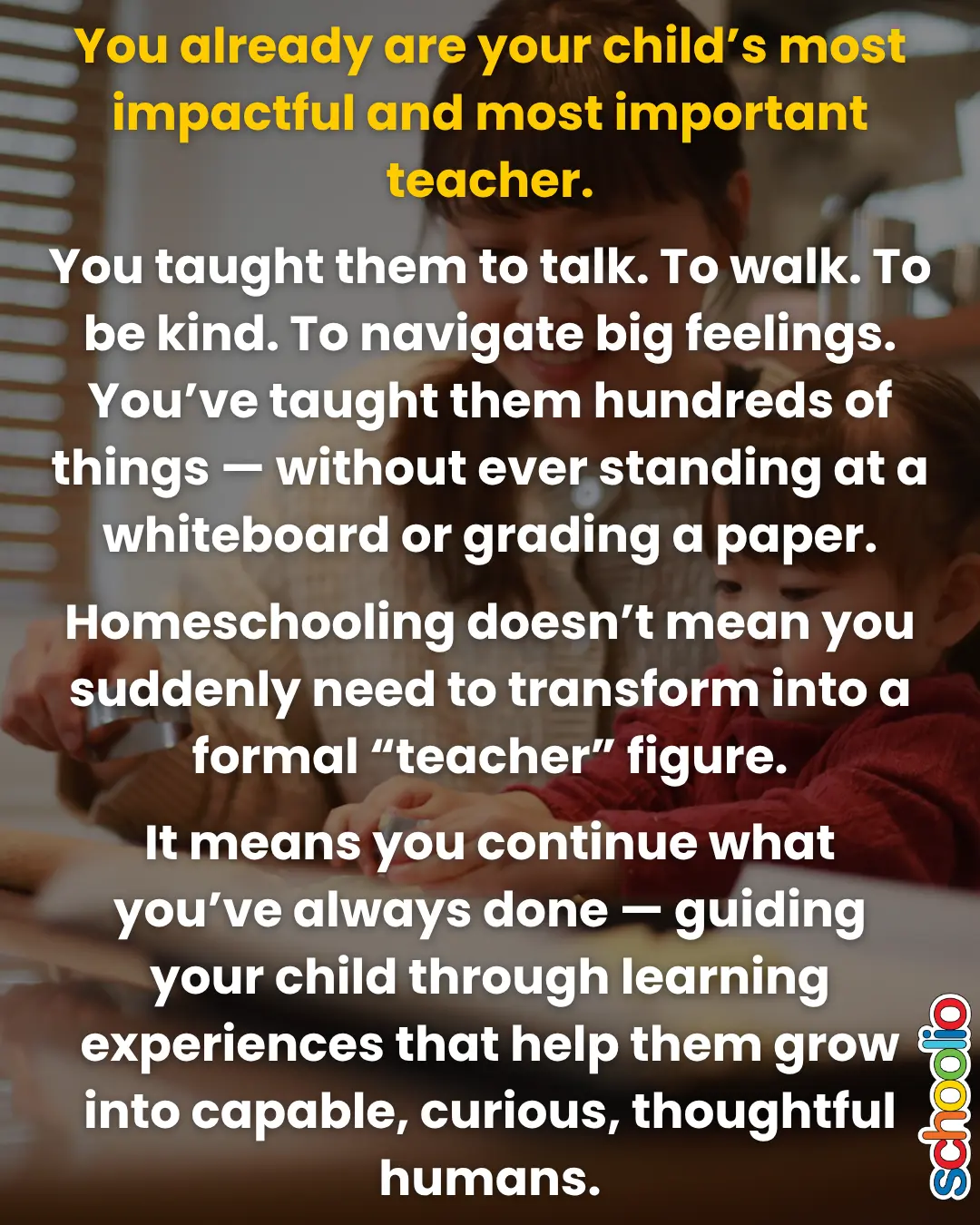
The truth is, you already are your child’s most impactful and most important teacher.

You taught them to talk. To walk. To be kind. To navigate big feelings. You’ve taught them hundreds of things — without ever standing at a whiteboard or grading a paper.

Homeschooling doesn’t mean you suddenly need to transform into a formal “teacher” figure with a desk, a whistle, and a lesson plan binder.

It means you continue what you’ve always done — guiding your child through learning experiences that help them grow into capable, curious, thoughtful humans.

Let go of the image of kids sitting in desks while you lecture at the front. That’s not homeschooling. That’s school-at-home — and that’s not what your kids need.

Kids aren’t empty vessels waiting to be filled with facts. They’re active participants in their own learning.

When you give your child autonomy and ownership, everything changes.

You stop being “the enforcer,” and start being their guide. Their mentor. Their teammate.

You’re not switching between roles — you’re expanding the one you’ve always had.

In real life, learning doesn’t have boundaries. It doesn’t only happen between 9 and 3, or only from someone with a degree. It happens everywhere, all the time, through curiosity and connection.

Your homeschool doesn’t need to mirror school.

It needs to mirror life.


? Lindsey

Certified Special Ed Educator & Co-Founder, Schoolio

You Can Have A Life Outside Of The Classroom

*GUEST POST: Chelsea (??) McLeod

You Can Have a Life Outside of the Classroom

You Don’t Have to Be Overwhelmed by Prep and Lesson Planning as a New Teacher with Schoolio.

That age-old idea that teachers have it easy, that all the lessons are planned out for them, and that they spend their time teaching from a book is deeply engrained in our culture. Nevertheless, this is a misconception that many people have about teaching, especially in Canada and the US. While this is the way it was many years ago, in recent years, there has been a shift in Outcomes-based Education (or Common Core as it’s called in the US). This means that each state or province has Outcomes and Indicators that must be achieved in each grade level, but the resources and the lessons that guide the students toward these goals are up to the Teachers. This shift in the world of K-12 Education has made the Teacher’s job distinctly different than that of our predecessors. It can lead to panic, overwhelm and burnout among those entering the profession. Does this sound like you? Schoolio can help! You can have a life outside of the classroom! 

Finally Landing the Job of Your Dreams, Now You Can Teach, Right?!

So, you have wanted to be a teacher for as long as you can remember, and finally, you are hired for your first teaching contract. Fantastic! You have dreamed about this day, worked so hard to get here, and you are so happy because now the hard part is over. The countless all-nighters, the endless hours reading textbooks, and the monotonous multi-page lesson planning will all have been worth it. Finally!

You are hired! Now you can relax, enjoy the job, and take pleasure in the goal you worked so hard to accomplish because Teachers have access to resources and lessons that student teachers do not. You have made it into the “club” and will be given all you need to teach, right?! Or at least that is what you thought would happen. You are not alone in this. We all thought this was the deal once we finally got that elusive teaching contract.

I mean, we grew up with the old way of teaching. When we went to school in the ’80s, 90s, and even early 2000s, there seemed to be minimal lesson planning; the teacher was given the resources package and books to follow. This style of teaching is often referred to as “teaching to the middle” the lessons and work were geared to the majority, but that didn’t leave room for enrichment or supporting students who needed more help. Over the last decade, there has been a significant shift in the how and why of teaching, so this is no longer the case. Now, what does that mean to you?

I’m Sorry, I Have to Prep for What?

Well, that means that once you are given your teaching load, realize that this is now where your lesson planning and prep work begins. You have not made it, not in the way you had previously thought. It would help if you planned topics, unit plans, lesson plans and assessments on your own to help students achieve their grade-level Outcomes. Now is when you begin to feel overwhelmed and start to panic. Who has time for all of this? Wait, you can have a life outside the classroom? How is one teacher supposed to do all this lesson planning while grading, connecting with parents and meeting all other deadlines? Because we all know that as a teacher, you are responsible for more than just what goes on within the four walls of your classroom. 

While you were prepared to lesson plan in university, it was only for some classes, not an entire grade of subjects and not for the scope and sequence planning of a whole year of curricula. So, with the knowledge that you may be in over your head, you try to dive headfirst into your Prep.  ELA, Math, Social, Science, etc., but what if you have a split grade? Well then, all these doubles, triples or even quadruples if you are in a rural setting. Teachers are also expected to teach to each student based on their individual needs, there is no such thing as a classroom of 3rd graders who all perform and read at a 3rd-grade level, but that is a post for another day. To meet all the needs and plan accordingly without losing your sanity, you spend hours on Pinterest looking for ideas or spend a fortune on TPT and still can’t keep up. Anyone in this situation can become so completely overwhelmed by the sheer amount of work that there aren’t enough hours in the day to do it all.

“Wouldn’t it be great if there was somewhere that I could go to get lessons and resources that I could just use?”

Schoolio Can Help!

What if I told you that there is a digital platform that can help? Schoolio has a digital platform bursting with resources you can use in your classroom! You do not have to do it all yourself. Schoolio has levelled resources for each grade, with lessons created by certified teachers and available to use right now. All this is at your fingertips; now you can. 

You can pick and choose the content you need based on the levels of your students and differentiate based on student interest. While there are other sites like TPT that you can purchase lessons and units on, it is often hard to sort through all the content to find what you need. Sometimes you must buy an entire unit or bundle just for one or two lessons; you can also purchase something only to find out it’s not what you had hoped since there isn’t a way to try anything out. Schoolio has set out to change this. Now you can use your time more intentionally and have a curriculum at your fingertips to support you in the classroom. And what’s more? For a limited time, you can try it out for free!


Help Your Child Process What Happened in Uvalde Texas

On May 24, 2022, we all saw the horrifying news of another mass shooting. This time, most casualties were children—innocent, sweet children going about their typical school day at Robb Elementary in Uvalde, Texas. The Uvalde, Texas, shooting claimed the lives of 19 children and two teachers. And is the most deadly shooting in the United States since the Sandy Hook Elementary shooting that claimed the lives of 20 children and six adults in 2012. Many children have seen the news and are now afraid to step foot in their schools. So, what can you do to help your child process what happened in Uvalde Texas? 

Less than ten days ago, we posted a blog entitled ‘Help Your Child Cope With News About Gun Violence,’ following the mass shooting at a Buffalo grocery store. Sadly, we are again writing another blog about another tragedy connected to gun violence in the United States. It seems like nowhere is safe, and it is tragic for our children to see these acts of violence happening around them. What can you do to help your child process what happened in Uvalde, Texas? And how can we help our children feel comfortable even with all of these tragedies?

Help your child process what happened in Uvalde, Texas.

It’s terrifying for anyone to think they could be killed simply for being in the wrong place at the wrong time. But especially so for children. Children shouldn’t have to feel afraid when they attend school; they shouldn’t have to do active shooter drills in their schools. But unfortunately, with tragedies like these happening more and more, our minds must think about the ‘what ifs.’ And must take action.

While I’d love to say that your children can somehow avoid the news of what happened in Uvalde, Texas, there is a significant chance that through friends, media, social media, or even family, they will learn about the horrific events that took place on May 24, 2022. So, how can you help your child process what happened in Uvalde, Texas?

When trying to help your child process what happened in Uvalde Texas, be there for them. 

The most important way that you can help your child process what happened in Uvalde, Texas, is to be there for them. What is happening to the world’s youth isn’t fair, and many of us cannot understand this type of horrific violent act against young people. This is why it’s essential to be there for your child when trying to process these tragic events.

Listen to their concerns.

If your child is struggling to process the news and events, openly listen to their worries and concerns about it. You likely don’t have all the answers because none of us do. But when they can share their anxieties, it helps them process and work through the emotions and big thoughts they are struggling to deal with.

Don’t force them to go to school.

Sending your kids to school when they’re struggling with anxiety regarding what happened isn’t a great idea. Yes, you’ll want your child to get back to everyday life and routine again, but when the news of such an event is so fresh, it’s ok to let your child have some time to process it and feel comfortable. There is nothing wrong with taking a day or two off of school to work through their feelings. Just be sure that you are there to help them, or another trusted adult is there to guide them through those thoughts and feelings so that they don’t spiral into something even more significant.

Avoid brushing it off like it was no big deal.

I believe that many of us brush things off to comfort ourselves. Saying things like, “Well, that’s not even close to us.” “Don’t worry about that; it would never happen here.” “The news always reports the worst of everything.” “Stop worrying about it; it didn’t happen here.” While these might be comforting things to say to ourselves, these dismissive words will likely only alienate our children from sharing how they feel in future situations. What happened is a big deal; it’s horrifying, disturbing, and something that should make you feel uncomfortable, even though it wasn’t necessarily close to you in proximity.

Encourage them to journal their thoughts.

Writing, drawing, and doodling are unique ways to release worries and stress caught in your mind. Encourage your child to indulge in some art, writing, or music to help them process those big thoughts that they’re struggling with.

Remind them that they are safe.

As mentioned in the previous blog about helping our children cope with gun violence, really emphasize reminding your child that they are safe. Right now, they are safe. And you will never put them into any dangerous situation. While you know that sometimes dangerous things happen, you don’t need to share those thoughts with them right now.

Be honest, but don’t overshare.

When your child asks you questions regarding the event, find out what they know. Be honest in answering their questions, but avoid oversharing details. Always be mindful of your child’s age and what they should and shouldn’t know.

Remind yourself that you are processing everything too.

We are often hardest on ourselves, especially when we assume that we should have it all figured out as parents. There is no handbook on how to deal with such a horrific event. So, don’t rush or suffocate your feelings. It’s ok to feel sad, struggle with what happened, or have difficulty processing it. Be patient with yourself because your children will learn that it’s ok to take time to process their thoughts and feelings too, and it’s ok to work through these events at their own pace.

Up-to-date information on Uvalde, Texas.

Lack of Support for Educators

There is a continued lack of support for educators, causing many educators to leave the profession altogether. Many educators report feeling exhausted and burnt out especially following two years of confusion related to online and pandemic learning. Sathish Bala, CEO and Co-Founder of Schoolio Learning, and Lindsey Casselman, co-founder and lead content writer, share their thoughts on this education crisis.

The lack of support for educators is causing an educational crisis.

“What do you think is happening? Is it all Covid related? Or was that the final push over the edge?” Asks Sathish during episode 5 of The Schoolio Live Q & A. “I think that teachers were already struggling and overworked, and Covid was the straw that broke the camels back in a lot of areas.” Shares Lindsey. The reality is, the more teachers that leave, the more pressure and stress is placed on the teachers that remain.

What can educators do to lessen that stress that is constantly being placed on them?

Lindsey shared in episode 5, that teachers don’t just teach during the day, and that’s it. They are working around the clock preparing materials for learning, lesson plans, and more. Everyone seems to be under the impression that teachers don’t have it so bad because they get to sign out at 4pm, have weekends off, and summers too. But the reality is that teachers are always working to ensure that their students are getting the most of their education. Then when they head to the classroom, they must find a way to teach 20+ children effectively. Most parents would agree from their time at home with virtual learning, that even just teaching one or two children can be challenging, now imagine teaching 20+ daily.

Tips for finding balance as an educator.

The lack of support for educators is truly causing a trickling-down effect that is now causing many students to slip through the cracks in the education system. If we help the teacher, we can help the students. So how can teachers find the balance and help that they need as educators?

1. Outsource your planning.

Many people don’t realize that teachers actually write and prepare most of their classroom content. Not only is that time-consuming, but it’s also draining. So why not utilize a curriculum that you can use again and again to help your students excel? Something like the Schoolio curriculum is perfect for teachers preparing lessons.

2. Assign simple tasks to your students.

When you have a large class size, it can become very overwhelming, pretty quick. So set up simple tasks for your students in the classroom, that way you aren’t doing it all.

3. Find some good mentors to help guide you.

Getting someone else’s opinion is important, especially when you have such an important job like teaching. Finding good mentors is very important to help guide you through the tough days and challenges that you will inevitably face.

Find out more on Episode 5 of The Schoolio Live Q & A with Sathish and Lindsey.

Click Here to Watch Episode 5! 


Are you looking for a curriculum to help your students excel? Then look no further than Schoolio Learning! 

We have a one-of-a-kind homeschooling curriculum for Kindergarten to Grade 8. 

Learn more about our curriculum and find out for yourself why it’s the best solution for all your learning needs. 

Click here to view our curriculum. 

Signs That Your Child Needs a Tutor.

Is your child struggling with their grades? Are they having constant meltdowns whenever they do homework? Does school cause them to feel immense amounts of stress? These may be clear signs that your child needs a tutor. Children everywhere benefit greatly from tutoring; some of these benefits are that tutoring can help boost their academic performance, and they have the opportunity to develop learning and study habits. So, how can you tell if your child needs a tutor?

Signs that your child needs a tutor.

Declining grades.

Have you noticed that your child’s grades are steadily declining? Whether that is in a particular subject, two, or all subjects. This is a clear indicator that your child needs help.

No progression in school.

Is your child struggling to keep up with what they’re learning in class? Has your teacher noted that your child is falling behind their level? If you’re homeschooling, have you noticed that your child can’t understand the concepts taught?

Taking too much time to complete assignments.

Does your child spend hours trying to complete a homework assignment? Even if it’s a simple assignment, that should take less time. This is another one of the signs that your child needs a tutor.

Constantly having tantrums and meltdowns when doing homework.

When it’s time to do homework, does your child have meltdowns? Are nightly homework assignments ending with your child hugely frustrated or in tears?

Lying about tests and homework assignments.

Does your child tell you they have no homework or upcoming tests to study for? As a result, they don’t study or complete homework assignments, which causes poor grades and concern from you and their teacher.

Having a poor attitude towards school.

Does your child dread going to school? Do they constantly say phrases like “I hate school”? Does your child not like a subject that they used to enjoy?

They are struggling to manage their time.

Are there not enough hours in the day for your child to finish their work and assignments? Are they having difficulty completing what they need to when needed?

Low self-esteem.

Does your child lack confidence when it comes to a particular subject? Or school in general? Have they stopped applying themselves to their schoolwork? Whether in class or at home?

Anxiety and meltdowns when going to school.

Are you finding that your child is getting very stressed, upset or anxious before school in the morning? Is your child complaining of headaches, stomach pains, or other symptoms that only occur before school?

Demonstrating signs of learning difficulty.

Is your child having difficulty writing, reading, math, or another area of study? Despite your efforts, are they still showing little to no improvement? Is your child having difficulty behaving or paying attention in the classroom or during learning?

Struggling with organization.

Do you know your child is intelligent and understands assignments but cannot prepare for what needs to be done? This could be another one of the signs that your child needs a tutor.

Doing an excellent job with homework but failing tests.

Getting high marks on papers, assignments or in-class participation but failing a test can cause significant frustration for your child. Test preparation is a skill; not every student can focus on what needs to be done before a test.

How tutoring can help.

A tutor can provide additional support that a teacher or parent may not be able to give them. Tutors can help slow things down by teaching your child how to adequately schedule their time, prioritize which assignments must be completed first and customize learning to meet your child’s needs. A good tutor will take the time to teach your child the skills they need. Tutors also have the unique ability to focus on one or two skills that can significantly impact the child’s education.

Not every child needs a tutor to succeed in school, but for some students, a tutor can make all the difference and help to change the outcome of your child’s education. Tutoring doesn’t need to be a permanent solution, as just a few sessions with a tutor can positively impact your child and provide them with the necessary tools.

Learn more about the Schoolio Digital Platform and how it can help your child get back on track. 

The Schoolio Digital Platform is the perfect addition to help children get back on track. Whether the child is working with a tutor, a parent, a teacher or independently, the Schoolio Digital Platform can help. With 4,000+ video lessons, worksheets and activities. Your child will thrive with this program. 

Click Here to learn more about the Schoolio Digital Platform. 


Aren’t sure where to begin? Book a Concierge Call.

If you aren’t sure how to get started or what programs would best suit your child’s learning needs, then you can chat with one of our experts on a one-on-one Concierge Call, completely free!
Click here to book a Concierge Call. 

Benefits of Tutoring

Many parents understand the frustrations of watching their child struggle in school. You are just unsure how to help them, so you take a closer look at tutoring. Only then you’re faced with questions like, “How do I choose a wholesome tutoring program that will work well for my child?” “How will tutoring help?” “And what are the benefits of tutoring?”

How does tutoring help a student?

Parents choose to get tutoring for their children for a variety of reasons. Some of them are that their child is struggling in school, they aren’t challenged enough, or they need a little extra help to master a particular concept. A personalized learning experience with the gift of one-on-one attention can give your child the support they need. This help translates into better study skills, a massive increase in their knowledge and a love for core subjects. While also igniting a passion for learning.

When deciding which tutor your child needs, it’s important to consider critical factors about your child, like their age, grade, and any diagnosed or undiagnosed learning disabilities. These all can impact what type of tutor your child needs. This is why it’s essential to get familiar with the tutoring company you are looking to use and meet with the tutor beforehand to discuss.

Which children need tutoring? And what kind of program should you use?

Tutoring isn’t just for children that are struggling in school. Most children can benefit from one-on-one tutoring. While it’s true that children struggling with a learning disability or struggling with a particular subject will benefit the most from tutoring, children who are doing well in school can also greatly benefit from the fantastic boost that tutoring will provide them with.

When looking for a suitable tutoring program for your child, you should look for one that focuses on your student’s needs. A program with customizable learning solutions and one-on-one sessions is essential. If your child is struggling in school, then it’s necessary to find a program that has a supportive environment. This way, they can have the freedom and flexibility to work through those complicated concepts in a specialized course that works for them. Avoid large classes with little to no one-on-one help because a program like that will only cause your child to struggle more and feel behind.

Programs like Schoolio After-School check all the right boxes (more information below).

Benefits of tutoring:

First, one-on-one attention.

A good tutor will get to know your child while learning about their learning style and needs. The tutor will then adapt their teaching strategy to match the child’s learning style. They are acting as your child’s private teacher.

Second, improved academic performance.

Your tutor has the skills to prepare your child for necessary tests and exams. While also working with your child’s problem areas. You will see an improvement in your child’s grades and understanding of the program subjects when working with their tutor.

Third, unique and individualized learning.

Through tutoring, your child will have the opportunity to receive an individualized learning experience. This unique experience isn’t always offered in a traditional classroom. Your child’s tutor will work to customize lessons and activities to meet your child’s needs.

Fourth, it significantly improves your child’s attitude toward learning and school.

Learning will become fun for your child when your child has access to one-on-one tutoring through a unique tutoring program like Schoolio After-School. The tutor will encourage and praise your child, which will help your child not feel frustrated and overwhelmed by school.

Fifth, it can encourage self-directed learning.

Your child will benefit from learning at their own pace. When working with a tutor, your child will learn how to take the initiative with their school. While also learning how to control their own learning pace.

Sixth, improved study and work habits.

Your child will learn critical study and work habits. These crucial habits will prove to be useful throughout their life. These skills will help prepare them to succeed when working to achieve their goals. These results will be seen both inside and outside of school.

Seventh, a positive impact on self-esteem and confidence.

When a tutor provides your child with the resources and skills they need to excel in school, you will boost your child’s self-esteem and confidence.

Eighth, responsibility and independence are encouraged.

One benefit of tutoring is the ability to do schoolwork independently. With a tutor’s help, your child will soon do school work independently while noticing their personal growth.

Ninth, creating a positive workspace for ideal learning.

An environment free of distractions, with fewer or no other students, will help create that positive workspace that your child needs. One without the disruptions the classrooms are usually full of. This will help your child to focus better on their learning.

Tenth gives your child the encouragement they need while helping them feel confident enough to ask questions.

Sometimes children may feel uncomfortable when asking questions in front of their peers. A tutor will work on helping your child feel comfortable about asking questions and doing so without feeling self-conscious.

Eleventh, it teaches them how to overcome learning obstacles.

Your child’s tutor will take note of the areas your child is struggling with the most, whether math, writing, or reading. Then your child’s tutor will target the learning area they are having the most trouble with.

Twelfth, it helps them improve their behavioural and social skills.

A good tutoring program will help your child develop better communication skills. While also allowing them to form better relationships with their peers. And help them to make more behavioural and social adjustments.

Thirteenth, it helps your child manage their learning.

Tutoring helps your child become more capable in their learning. While also allowing them to be more successful when managing their schoolwork.

Fourteenth, it helps children who are bored in school.

Some children may appear to struggle in school when they are bored and under-stimulated. One of the benefits of tutoring is that it will help your child reach their full potential.

Fifteenth, it can better prepare your child for what’s ahead.

One of the other benefits of tutoring is that it will help them prepare for what’s ahead by creating crucial study skills and learning superior time management skills for more advanced grade-level plans.

Try the Schoolio Digital Platform for free! 

The Schoolio Digital Platform has 4000+ videos and interactive lessons to help your child excel in their learning. Whether you are a parent, teacher or tutor, this program is the perfect fit. 

Sign up for your free 14-day trial today! 


Make Learning a Priority Despite School Closures.

Many parents are once again struggling with how to make learning a priority despite school closures. Chances are that you live in a location that has either just announced school closures again, or perhaps they are leaning that way due to the steady climb of Covid-19 cases, related to the new variant of concern.

You as a parent may find yourself stuck in the frustration of wanting to keep your child safe while also wanting to be sure they are getting the education that they need at this stage in their life. I don’t think any of us thought that the pandemic would continue for so long, or that school closures and lockdowns would continue to be the method used to combat it. Yet, here we are. So the question is, how can you help your child continue to thrive with their learning, or even catch up, despite the inevitable school closures?

This is a huge topic, yet there’s not a lot of information out there about it. Doing a quick Google search doesn’t really reveal anything substantial, or helpful. Which is ironic, because education truly is key. Yet, education is one thing that has continually been placed on the back burner during the duration of the pandemic thus far.

What can we as parents and caregivers do?

As I previously wrote, none of us thought that school closures and lockdowns would continue to take place, especially not after two years since the beginning of this pandemic. It really puts things into perspective when you think of how a Kindergartener in the spring of 2020 is now in grade 2, and struggling to read. Or how a grade 10 student in March of 2020 is now facing graduation, feeling completely unprepared for university.

The pandemic has caused all of us to suffer, but no one more than our children. So many life experiences and learning opportunities have been missed. Will life ever return to normal? What even is normal anymore? Is it normal for your child to be falling behind? Will they ever catch up? What can you as a parent or caregiver do to make learning a priority despite school closures and lockdowns?

The First Step: Just Be There.

I get it, you’re frustrated and overwhelmed. For many it’s not just education that is affected, but also finances and mental well-being. Your mind is likely wandering a mile a minute, as you try to come to some settlement of peace. So, take a deep breath. Focus on what really matters. Sure, life is a crazy mess. But right now, in this very moment, are you okay? Is your family safe? Are your kids okay? Really focus on being in the moment. Focus on the laughter of your children. Talk to them, help them, because they’re also struggling with big feelings too. Make being there for your children a priority.

The Second Step: Find Ways to Ease Stress.

We don’t often realize just how stressed our children can be. The sad reality is that the pandemic, school closures, chaos and financial uncertainties has also placed stress on our kids. We like to think of them as “just going to be okay” but often times they are silently watching as their world seems to be collapsing around them.

Which brings us to an important point. And that is: Children cannot properly learn when they’re under a large amount of stress. As you probably already know, virtual learning often causes children more stress than anything else. This results in a lack of wholesome learning because of the stress that your child is under when trying to learn. Which is why finding ways to calm that stress is imperative.

Some helpful stress relieving tips include:
  1. Answer their questions honestly, and have conversations about their feelings.
  2. Let them know that you recognize that they are feeling stressed, and that it’s okay to feel this way.
  3. Contact loved ones, grandparents, family and friends. Let your child connect with them.
  4. Demonstrate how to take care of your own feelings in a healthy way.
  5. Help them with a mindfulness activity.
  6. Offer plenty of hugs and cuddles.
  7. Sign up for a Mindfulness Activity or purchase a Mindfulness workbook.
  8. Teach your child about how to manage their thoughts and feelings.

The Third Step: Create a Healthy Routine

Having a healthy routine is extremely important. Especially if you are aiming to make learning a priority despite school closures. It can be so tempting to just let everything go and continue life like you’re on holidays. While somedays that may be okay, it’s important to snap out of it sooner rather than later. Children need routine, it helps them to feel safe, while also helping them to develop important life skills.

Your kids and yourself have absolutely no control over the pandemic, or school closures. So, help your child feel like they’re in a little more control with a routine. Let them add in parts of the routine that they think are important, and be sure to honour that.

Routines aren’t just good for kids, they also have huge benefits for you as the parent or care-giver. Having a healthy routine has been proven to help parents feel more organized while simultaneously reducing stress.

You can add structure to your child’s day by adding smaller routines to your larger daily routine.

Early Morning Routine: Wake up, get dressed, eat a healthy breakfast, brush teeth, and encourage active play for a bit before school work.

Late Morning – Early Afternoon Routine: This is when your child can work on their school work, whether that be virtual learning or workbooks. For many children their school board has scheduled times of the day around virtual learning. So, their routine might revolve around those time slots.

If you have decided to homeschool during the duration of another lockdown, you can use this time to work on two core subjects like Math and Science. Reserving this time for lesson time, work time and a learning activity.

Be sure to add in lunch, and snack times! And if your child is participating in virtual learning, then make lunch and break times a big deal! Have fun with lunch time, play some word games while you both eat sandwiches. Try your best to make it as positive as possible.

Afternoon/Evening Routine: Once education time is completed for the day, encourage them to play outside, or in their room while you get a tiny break. If they just want to be with you, then try to make a new recipe together for dinner. Having fun together is one of the best remedies for stress. At the dinner table, ask your child(ren) what their favourite part of the day was, then aim to include more of that in the next day.

Bedtime Routine: Now it’s time for brushing teeth and bath time. Once that’s complete, be sure to have some snuggles and reading time with your kids. It’s so important to continue to carve out time for reading with each other as it continues to strengthen your bond.

The Fourth Step: Evaluate the Learning Solutions.

Many parents hear the words “Virtual Learning” or “Online Learning” and instantly cringe. Because this form of education is anything but wonderful for both students and teachers. If you’ve recently learned that your child has to do online learning, and you know from experience that it will be a disaster. Then take some time to evaluate this form of learning by asking yourself these questions:

  1. Is this helping my child or hurting them?
  2. Are they still learning?
  3. Is the stress from this even worth it?
  4. Are there other options available for learning?

Once you’ve answered these questions you will have a more clear indication about whether or not this form of education is actually working for you and your child. If you’re still unsure, write out a list of pros and cons. What are the pros to virtual learning, and what are the cons? If you have no other learning choices, then find out what are some ways that you can work together with your child’s school to make it more bearable.

The Fifth Step: Research Alternative Learning Solutions.

If you’ve evaluated your child’s education method, and are finding that it’s causing more stress than learning. But you are determined to make learning a priority despite school closures, then you should look for alternative methods of education for your child. You could consider a home-learning option. Remember this doesn’t have to be permanent, this can be a temporary solution until circumstances level out.

Determining what type of in-home learning curriculum will best suit your family is really important. You can learn about how to choose in-home learning curriculum here.

Staying on track with their learning is essential, which is why finding a curriculum that follows their grade level standards, and is easy to follow/teach is really important. Be sure to look for a learning solution that reflects that.

The Sixth Step: Start Learning.

It’s imperative that you remind yourself that learning is always happening. There are so many life lessons to be learned during any given day. So, please don’t stress yourself thinking that learning must look a certain way, because it often doesn’t. That is one of the reasons why virtual learning can can cause so much stress for some students. Education can’t be crammed into a box. For many, learning is hands-on. Learning through a screen with twenty other children going on and off of mute, isn’t always going to give your child the whole learning experience that they need.

Read stories with your kids, dive into a Novel Study. Bake cookies, clean the house, do art work, watch an educational show together, and play learning games! Don’t stress about how learning should look, just let it happen naturally.

Figure out what areas your child needs the most help with and make that a priority. Being sure to add in the extra areas of their education here and there. Just be sure to never overwhelm your child with information, aim to keep lessons short, simple and to the point. Dragging out a lesson just because you feel like it needs to be longer, won’t help you or your student. If your child is struggling with a particular concept, then take a break and revisit it again later.

The Seventh Step: Let Go.

Life continues to not go according to plan. Holding onto your ideas of what it should look like, will only bring you more disappointment. Embrace the way life is, even if it’s messy. Because if you continue to hold onto this idea of what you wish life looked like, it will only make it worse for you and your child. Letting go of the original plan, and working together to come up with a new, brilliant plan will be extremely beneficial for your entire family.

Whether you choose to give virtual learning another go, or you feel like you need to dive head first into homeschooling. Just know that whatever choice you make, it will be a good one for your family. Yes, sometimes you will have bad days, sometimes things won’t go as planned. And yes, you will absolutely make some mistakes. But you’re trying your very best to make learning a priority despite school closures and that is truly what matters.

Take a deep breath, focus on what really matters, and move forward.