One of Homeschooling Quietest Strengths

One of Homeschooling Quietest Strengths


By Lindsey Casselman, special-ed teacher & homeschooling mom


When I first started homeschooling, I thought a “good homeschooler” had a tidy schedule. Wake up at 8, lessons by 9, neat little blocks of math, reading, and science lined up like ducks in a row.

But then reality stepped in: my kids aren’t ducks, and neither am I.

What I learned over time — and what research keeps confirming — is that one of the most powerful tools we have in homeschooling is also the simplest: sleep.

In traditional school, kids are often shaken awake by alarms, rushed through breakfast, dressed half-asleep, and hustled out the door before their brains have even had a chance to fully wake up. I remember my own school mornings feeling like chaos in fast-forward. But homeschooling gave us the freedom to slow down, and that’s when I noticed something life-changing.

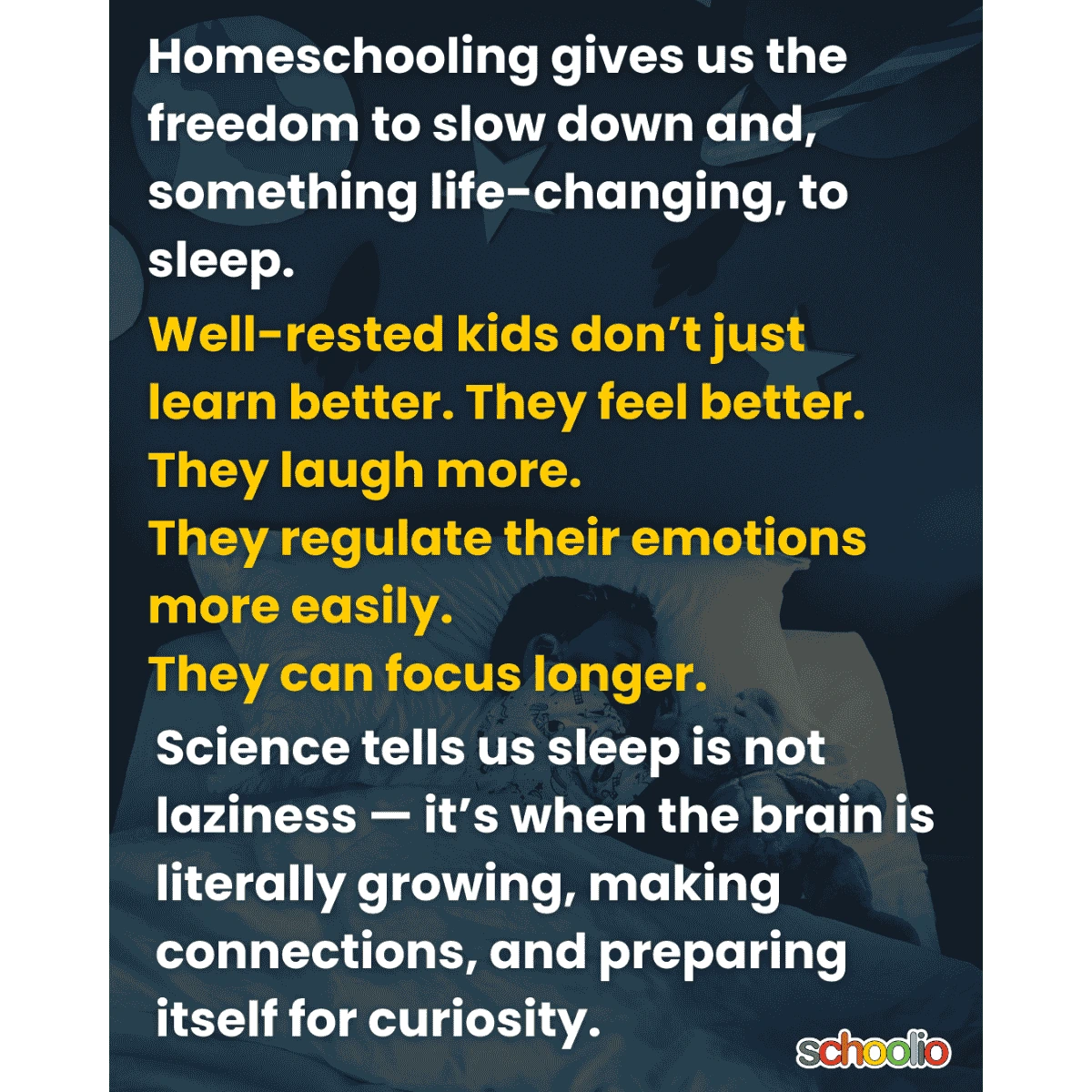
Well-rested kids don’t just learn better. They feel better. They laugh more. They regulate their emotions more easily. They can focus longer, without the constant battle against exhaustion. Science tells us sleep is not laziness — it’s learning in disguise. It’s when the brain is literally growing, making connections, and preparing itself for curiosity.


Here’s what that looked like in our homeschool:

  • Starting the day when my kids naturally woke up, not when a bus schedule dictated.
  • Protecting rest days after big field trips, instead of pushing through.
  • Building gentle morning and bedtime rhythms so transitions felt calming, not chaotic.
  • Letting rest be part of the curriculum, because restoration fuels curiosity.

And here’s the best part: this isn’t “falling behind.” It’s moving forward in a way that honors kids as whole humans — body, mind, and spirit.

So maybe the question isn’t, “Am I doing enough school hours?”

Maybe it’s, “Am I giving my child enough rest to flourish?”

Because the truth is, flexible sleep schedules aren’t a weakness of homeschooling. They’re one of its greatest strengths.


? Lindsey

Certified Special-Ed Educator & Co-Founder, Schoolio
The Harder Path Forward

The Harder Path Forward


customer feedback

I didn’t understand the courage it took until years later.

When my family immigrated to Canada, I was angry. I didn’t have the words for it at the time, but every part of me resisted this new life. I missed my friends, my neighbourhood, my routines. I was a teenager lost between two worlds—resentful of the change, and confused by the silence I had to carry with me in every classroom, every hallway, every awkward introduction.

People looked at me differently. Sometimes with curiosity, sometimes with judgment, but always with the weight of assumptions I hadn’t earned. The stereotypes followed me. So did the loneliness.

Back then, I thought my parents were wrong. I thought they didn’t understand what I had lost. But as I grew older—became a parent, built a life, listened to others—I began to see the truth I’d missed entirely.


It wasn’t an escape. It was a sacrifice.


They had uprooted everything they knew for a sliver of possibility—a better education, a safer life, a shot at something bigger than what we’d left behind. And they did it quietly. Without recognition. Without thanks. Without certainty. Just faith.

That story echoes again and again in the lives of homeschooling families we meet at Schoolio. While the world rushes to label them—too radical, too soft, too unqualified—what we see is something different. We see courage. We see parents choosing a harder path, not because it’s easier, but because it’s right for their child.

It’s not a summer experiment. It’s not a last resort. It’s a quiet, determined rebellion against a system that no longer fits.

And here’s the question we rarely stop to ask: if the traditional school system—funded, structured, and normalized—is so perfect, why are so many parents choosing to leave it behind?

Why are they willing to rebuild an entire learning experience from scratch?


Because sometimes love means walking uphill.


At Schoolio, we don’t see homeschoolers as fringe or fearful. We see them as architects of something new. Builders of bridges their children can walk across safely. Parents who are saying, “I will not wait for the world to catch up. I’ll start right here.”

And for those of us who have walked a harder path before, we know exactly how much strength that takes.

Sathish
still learning, still unlearning

When Does Learning End? For Me, It Was When My Father Went to Sleep

When Does Learning End? For Me, It Was When My Father Went to Sleep


This has been on my mind today…

I saw a post that simply said, “My son’s done with homeschooling in two hours.”

And just like that, I was back in Singapore — racing home from school, not for fun, but out of fear.

See, school for me ended close to 4pm.


school


My parents knew exactly how long it should take for me to get from the gates of the school to the door of our apartment.

If I was late, it wasn’t a missed bus or a slow walk — it was disrespect.

And there were consequences.

But the real weight?

School didn’t end when the bell rang.

It ended when my father went to sleep.

Usually around 6pm, he’d be home — and by then, we had to be seated, heads down, already into our homework or the next stack of extra workbooks.

Every day.

For years.

Twelve to fifteen hours a day spent studying.

Almost no play.

Very little conversation that wasn’t about performance, progress, or punishment.

That was childhood.

And even though I sent my own kids to public school, I made a quiet promise to do things differently.

School ended the minute they walked out of the building.

Evenings were for play.

For laughter.

For sitting together at the dinner table without a pencil in hand.

For movie nights and bike rides and not having to earn joy.

And yet — I see so many of my friends, especially fellow South Indian parents, unknowingly continuing the cycle.

Evenings and weekends filled with more learning.

Catch-up. Push ahead. Get into the best school. Stay ahead of the curve.

But the curve keeps shifting.

The truth is, the world our kids are stepping into will not reward them for how fast they finished a textbook.

It will reward them for their ideas.

For their empathy.

For how well they adapt and connect and create.

Jobs we know today won’t be around by the time they graduate.

Learning styles have changed.

Grades don’t mean what they used to.

Trade skills and entrepreneurship are on the rise.

And I’ll say it — homeschooling is where I’m seeing the balance emerge.

Not because it’s easier.

But because it’s more human.

It’s where a child can complete their day in two focused hours and spend the rest of their time living.

It’s where parents no longer feel the need to steal youth from their kids in the name of preparation.

It’s where play becomes part of the plan, not an afterthought.

And it’s where I’m learning — still learning — how to unlearn the things I was taught to fear.

If your evenings feel like an extension of school instead of a return to family, maybe it’s time for a new way.

Maybe it’s time to put the joy back into childhood.


Sathish

still learning, still unlearning

Why I Learned to Plan Our Homeschool in Pencil

Why I Learned to Plan Our Homeschool in Pencil

By Lindsey, certified special-ed educator & co-founder, Schoolio


This has been on my mind today…

When I first started homeschooling, I thought I needed a perfectly structured plan. Color-coded calendars. Long-term schedules. Daily checklists. If I could just organize everything, I told myself, then our homeschool would run smoothly.


And to be honest—I can make a banging plan. ADHD has given me that hyperfocus superpower. I can map out a schedule that looks incredible on paper. But sticking to it? Executing it with military precision day after day? That’s where things fall apart. My brain doesn’t thrive under that kind of rigidity. And neither do my kids.


I remember one day in particular. I had my agenda ready, subjects lined up, and a vision of us moving neatly through the day. Instead, I found myself still in pajamas, sipping my third cup of coffee, reading aloud from the couch while my kids snuggled beside me. That was “school” for the day. And honestly? It worked.


It took me about a year to unlearn the pressure of overplanning. Especially with neurodivergent kids, you never really know what a day will look like. I used to plan out weeks—sometimes months—at a time. But that just set me up for stress and disappointment when life inevitably didn’t go according to script.


Take field trips, for example. I’d schedule an outing with our homeschool friends, then expect the very next day to be a heavy academic “catch-up” day. But my autistic kiddos taught me something important: they needed two days for those big events. One day to go, explore, and engage. And another day to recharge quietly at home. Trying to push through the day after always ended in frustration for everyone.


So I learned to plan differently.


Now I plan in pencil. That’s both literal and metaphorical. I map out gentle rhythms, not rigid schedules. I leave space for flexibility, rest, and the unexpected. I don’t ask, “Are we keeping up?” anymore. I ask, “What do my kids need today?”


And that shift has changed everything.


The truth is, learning doesn’t only happen in neat blocks of time. It happens on the couch with a read-aloud, on a quiet day of rest, and yes—even in pajamas with a stack of coffee cups nearby. When I stopped treating our homeschool like something to control and started treating it like something to live, we all found more peace—and more learning, too.


So if you’re staring at your homeschool planner feeling like you’re always “behind,” I want to gently remind you: you don’t have to plan it all in ink. You don’t have to keep up with anyone else’s schedule. You can plan in pencil. And sometimes, those pajama days on the couch end up being the best days of all.