How Many Hours Should You Homeschool Each Day?

How Many Hours Should You Homeschool Each Day?

One of the first questions I hear from new homeschool families is this: “How many hours should we be doing every day?” It’s a question that often carries a lot of weight, as parents worry about whether they’re doing enough. And I always smile a little because the answer is often fewer hours than they’re expecting. Understanding how many hours are truly needed can bring a sense of relief and clarity to your homeschooling journey.


Why so much less than traditional school?

Think about what a six-hour school day actually looks like. There’s the morning routine — getting settled, taking attendance, announcements. Transitions between subjects, between classrooms, between activities. Lining up. Waiting. Bathroom breaks for the whole class. Behavior redirection when someone is off task — which in a class of thirty kids, is almost always someone. Lectures delivered to the whole group at a pace that works for the middle — too fast for some, too slow for others. Work periods where half the class is waiting for the other half to catch up. By the time you strip all of that away, the actual focused learning happening in a traditional school day is a fraction of the clock time.

At home, with one child — or even a few — you cut almost all of that out. No transitions. No waiting. No redirecting twenty-nine other kids. Just your child, you, and the lesson. That’s why two hours at home can cover what takes six hours at school. For example, a focused math lesson that might take an hour in a classroom can often be completed in 20 minutes at home.


What they taught me in teacher training

When I was getting my education degree, one of the most useful things my professors taught me was this: You can expect a child to give you their focused attention for as many minutes as they are years old. An eight-year-old? Eight minutes of genuine sustained attention. A six-year-old? Six minutes.

Now — that doesn’t mean a lesson is only that long. It means something needs to happen as a reset every few minutes. A change of location. A switch from listening to doing. A question asked and answered. A quick movement break. Anything that breaks the sustained attention and gives the brain a little refresh. Even traditional school isn’t six straight hours of focused learning. It’s dozens of tiny resets strung together across a day. Homeschool is no different — and once you understand that, the whole day starts to make a lot more sense.

For instance, a science experiment might involve a quick setup, a period of observation, and then a discussion. Each part offers a natural break and reset for the child’s attention.


So how long should homeschool actually take?

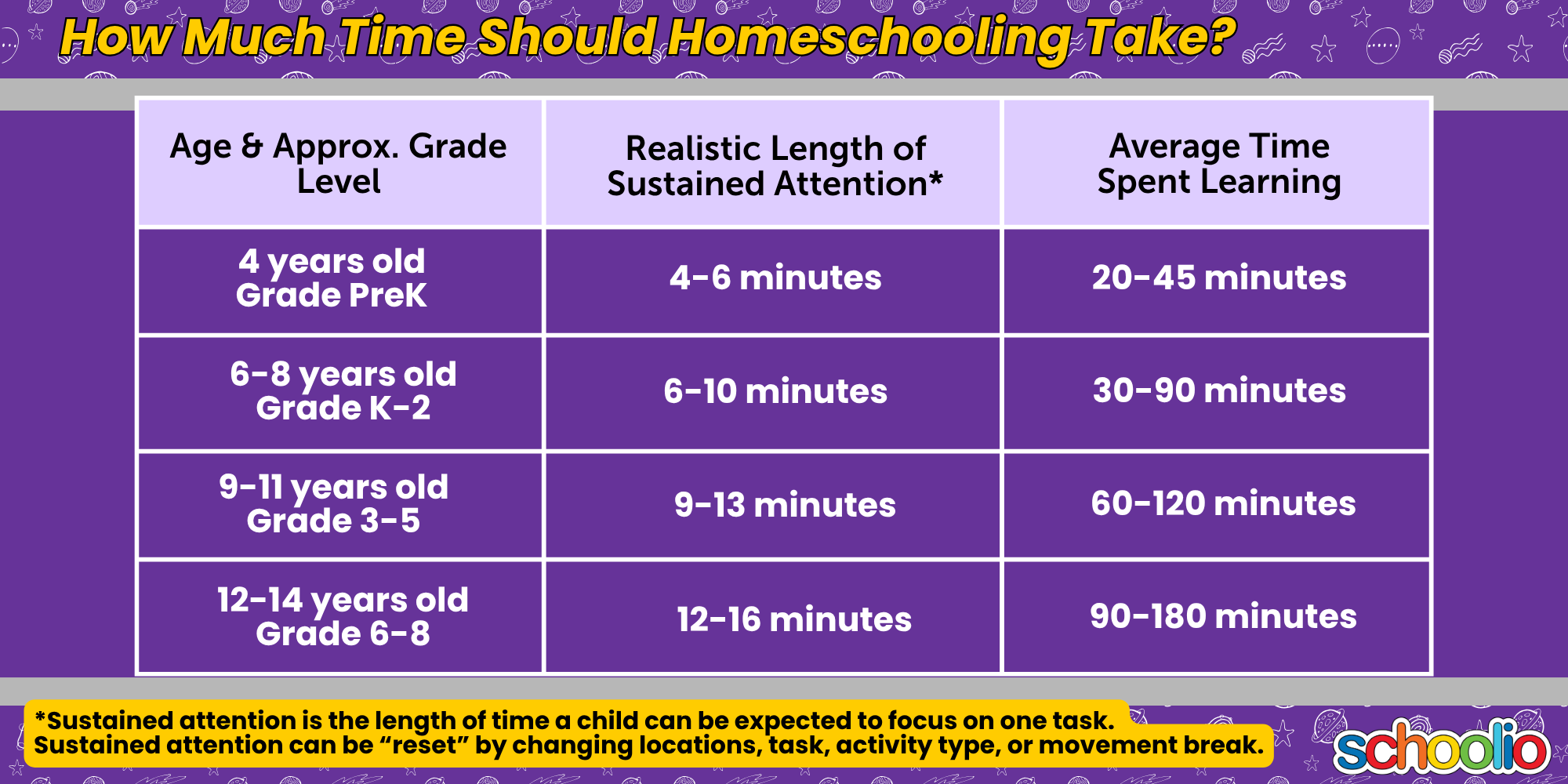
Here are some rough guidelines that the homeschool community has generally come to agree on. Think of these as a loose norm, not a rulebook. (See the chart below for a full breakdown by age and grade.)

PreK (Age 4) 20–45 minutes total. Sustained attention of just 4–6 minutes at a time. Play is the curriculum at this age. Keep it light, keep it moving. Activities might include storytelling, simple crafts, or a nature walk.

Kindergarten to Grade 2 (Ages 6–8) 30–90 minutes total. Sustained attention of 6–10 minutes. Short, varied activities work best. Reading, then building, then drawing — keep switching it up. A typical day might start with a reading session, followed by a hands-on math activity, and then a creative art project.

Grades 3–5 (Ages 9–11) 60–120 minutes total. Sustained attention of 9–13 minutes. Kids this age can handle a little more depth, longer projects, and starting to follow their own curiosity. You might introduce a research project on a topic of interest, encouraging independent learning.

Grades 6–8 (Ages 12–14) 90–180 minutes total. Sustained attention of 12–16 minutes. More independent work starts here — reading, research, writing — but it still shouldn’t feel like a grind. Consider incorporating a mix of structured lessons and self-directed study, like a science project or a book report.

TimeSpentLearning.png


A note for neurodivergent learners

If your child has ADHD, autism, or sensory processing differences, these numbers may look quite different — and that is completely okay. For many neurodivergent kids, sustained attention windows are shorter, and the need for resets is more frequent. That’s not a problem to fix. That’s information to work with. Twenty minutes of real engagement will always beat ninety minutes of struggle. Tailor your approach with flexible schedules and sensory-friendly activities.


The bottom line

Seat time is not the same as learning time. If your child is engaged, curious, and absorbing what you’re working on together — you’re doing it right. Even if it only took an hour. Even if it looked nothing like school. That’s kind of the whole point. Remember, the beauty of homeschooling is its flexibility and the ability to adapt to your child’s unique learning style and pace.

Homeschool Curriculum in Canada: A Comprehensive Guide

Choosing the right homeschool curriculum can feel overwhelming, especially when you’re trying to align it with the educational standards of Canada. Many parents find themselves stuck between wanting a comprehensive program and needing something flexible enough to fit their unique family dynamics. If you’re in this boat, you’re not alone, and there’s a way to navigate this with confidence.

Understanding Homeschool Curriculum in Canada

When it comes to selecting a homeschool curriculum in Canada, the first thing to understand is the provincial guidelines. Each province has its own educational standards, and while homeschooling allows for customization, it’s essential to ensure your curriculum aligns with these standards. This not only helps keep your children on track with their peers but also eases transitions should they ever enter or re-enter the public school system.

For instance, in Ontario, the curriculum guidelines emphasize language arts, mathematics, science, and social studies, while British Columbia includes a focus on indigenous education and environmental stewardship. Understanding these nuances can help tailor your homeschool curriculum to meet provincial expectations.

Several resources, like Schoolio’s Canadian curriculum, offer detailed guides to help you match your homeschooling efforts with provincial expectations. This is a great starting point for parents who want to feel confident in their educational approach.

Benefits of a Canadian-Focused Homeschool Curriculum

Opting for a Canadian-focused homeschool curriculum brings numerous benefits. Firstly, it ensures that your child learns about Canada’s history, geography, and cultural heritage in a way that’s relevant and meaningful. This is particularly important for social studies and history lessons, which can vary significantly from American curricula.

For example, a Canadian curriculum might include detailed studies of the Canadian Confederation, the role of the fur trade in Canadian history, and the significance of the Charter of Rights and Freedoms. These topics not only educate but also instill a sense of national identity and pride.

A Canadian curriculum also incorporates local currency, measurement systems, and environmental studies, making practical applications much easier for children to grasp. These relatable examples help children understand their world better and apply their learning to everyday situations. Imagine your child calculating change using Canadian coins or measuring ingredients for a recipe using metric units—these are practical skills that a Canadian curriculum can enhance.

Customizing Your Curriculum for Family Needs

One of the greatest advantages of homeschooling is the ability to tailor the curriculum to fit your family’s needs. Whether your child is a visual learner or thrives with hands-on activities, you can customize lessons to suit their learning style. This flexibility is particularly beneficial for families with children at different educational levels, allowing each child to progress at their own pace.

To start customizing your homeschool curriculum, consider these steps:

  • Identify your child’s learning style (visual, auditory, kinesthetic). For example, if your child is a visual learner, incorporate more diagrams, videos, and visual aids into their lessons.

  • Choose subjects that interest your child to boost engagement. If your child loves animals, consider including a unit on Canadian wildlife in your science curriculum.

  • Incorporate real-world learning experiences, like field trips and experiments. A trip to a local museum or a nature walk can bring lessons to life.

  • Adjust the pace according to your child’s comprehension and interest. If your child excels in math, allow them to advance quickly, while providing more time for subjects they find challenging.

Resources like Schoolio’s blog offer additional tips and ideas for customizing your curriculum.

Overcoming Common Homeschooling Challenges

Homeschooling presents its own set of challenges, but with the right mindset and resources, they are manageable. One common struggle is maintaining a structured schedule. It’s important to establish a routine that balances academic learning with breaks and extracurricular activities. This helps prevent burnout and keeps learning fresh and engaging.

Another challenge is finding a community. Connecting with other homeschooling families can provide support, ideas, and social interaction for your children. Many cities in Canada have homeschool groups that meet regularly, and online communities are also available. These groups can offer advice, organize group activities, and provide a sense of belonging.

Evaluating Your Child’s Progress

Assessing your child’s progress is fundamental in ensuring the effectiveness of your homeschool curriculum. Unlike traditional schools, where testing is often standardized, homeschooling allows for more personalized assessment methods. Consider using a mix of evaluations such as quizzes, projects, and oral presentations to gauge understanding.

It’s also important to have regular check-ins with your child about their learning experiences. This not only helps you understand their progress but also builds their self-assessment skills, which are valuable for lifelong learning. Encourage your child to reflect on what they’ve learned and discuss any challenges they face.

Choosing a solid homeschool curriculum in Canada doesn’t have to be overwhelming. With resources like Schoolio, you can craft an educational plan that’s both comprehensive and adaptable to your family’s needs. Check out Schoolio’s offerings to see how they can support your homeschooling journey with confidence.

Suggested internal links:

When “Grade-Level” Tests Make Homeschool Parents Feel Like Failures

When “Grade-Level” Tests Make Homeschool Parents Feel Like Failures


This has been on my mind today…

I talk to so many homeschooling parents who have had this moment:

They run a school-based diagnostic test to see if their child is “on grade level”.

They see a score they weren’t expecting.

And suddenly, their confidence collapses.

“I think my kids have fallen behind.”

“I feel like I’ve failed them.”

“Did homeschooling make them lose skills?”

Let me say this clearly, as both a former teacher and a homeschooling mom:

School-based testing does not measure your child’s intelligence.

And it absolutely does not measure the value of your homeschool.

Most of these assessments — especially the popular ones families use to “check grade level” — were designed for traditional classrooms. They measure a very specific thing: a child’s ability to memorize and recall the exact skills schools have decided are important, in the exact format they expect.

That’s it.

They usually test math and language.

They don’t test problem-solving.

They don’t test creativity.

They don’t test if your child is happier, more confident, or less anxious than they were in school.

They don’t test emotional regulation skills.

They don’t test adaptability, curiosity, persistence, or resilience.

And yet those are the very skills that matter most once school is over.

Here’s something else most parents don’t realize:

The human brain only retains information for two reasons.

  1. Intrinsic interest — the learner genuinely cares about the topic.
  2. Perceived usefulness — the learner understands why this information matters in their real life.

Everything else? The brain offloads.

This is why retention in public school is so low. It’s why every fall, teachers spend weeks “reviewing” material kids supposedly learned the year before — and most students swear they were never taught it. They were. Their brains just didn’t keep it.

We adults are no different.

If most of us took a grade 7 math test today, we’d struggle — unless we’re naturally “math people” (intrinsic interest) or use it regularly in our work (perceived usefulness). That doesn’t make us less intelligent than a seventh grader. It just means we’ve let go of information we don’t need.

Kids do the same thing.

So when a homeschool parent sees a test score and panics, what they’re often seeing isn’t “lost intelligence.”

They’re seeing a mismatch between how the brain actually learns and how schools measure learning.

Homeschooling offers something radically different — and far more valuable. It teaches kids how to learn. How to ask questions. How to find information when they need it. How to notice what interests them and pursue it deeply. How to persist through challenges without shame.

Those skills don’t show up on standardized diagnostics.

But they show up everywhere else in life.

Now, if it’s important to you that your child aligns closely with public school benchmarks, that’s okay. Homeschooling isn’t one thing — it’s yours to shape. You can absolutely use test results as information, identify gaps, and choose to work on specific skills.

What I don’t want you to do is let those numbers define your child — or yourself.

Your kids are not checkboxes.

Your homeschool is not a failure because it doesn’t mirror school.

And you are not doing this wrong because your child’s brain didn’t perform on demand for a system you intentionally stepped away from.

Please take school-based tests for what they are: limited tools, not verdicts.

You are building something bigger than scores.

Something more human.

And that matters far more than any diagnostic ever will.


? Lindsey

Certified Special-Ed Educator & Co-Founder, Schoolio

When “Bad Teacher” Comedy Isn’t a Laughing Matter

When “Bad Teacher” Comedy Isn’t a Laughing Matter


My social media feeds are full of education-related content. Lately, I’ve noticed an increase in comedians like Gerry Dee (Mr. D)—alongside a growing wave of TikTok and Instagram “former teacher” creators—who are building successful careers around the idea that being a bad teacher is funny, relatable, and ultimately harmless.

But today’s Mr. D video in my TikTok feed hit differently, as I had just finished sitting next to my daughter in the kitchen for over an hour while she painfully cried her way through an essay that an apathetic teacher assigned at the last minute as a “punishment” to the class for not paying enough attention to him- without any instruction around the skills needed for this essay. For my autistic and dyslexic child, who takes every word literally and straight to heart, and has loads of anxiety around handing in her absolute best work, this pressure and lack of support sent her into meltdown mode.

There are several comedians who’ve built entire lanes around “I was bad at my old job / the system was a joke / authority doesn’t matter” humor. My issue isn’t with comedy about work in general. It’s with ex-teachers making light of how poorly they did their jobs—and how little they cared while doing them.

That kind of humor punches down.

It celebrates apathy.

And it shows a complete lack of concern for who was harmed in the making of that joke: the vulnerable children they were responsible for.

Yes, I understand why these jokes land.

Most of us have had that teacher.

The disorganized one.

The checked-out one.

The one who survived the school day purely on sarcasm and vibes.

We’re conditioned to laugh and say, “Yep. That’s just school.”

But here’s the part that never makes it into the punchline:

For some kids—and some families—that teacher isn’t a funny memory.

They’re the reason everything fell apart.


Why “Bad Teacher” Comedy Is a Unique Problem

This is the core issue these jokes orbit around, whether intentionally or not.

Teaching is one of the only professions where:

  • The audience (kids) can’t leave
  • The harm is delayed and largely invisible
  • The most vulnerable are affected first
  • And society shrugs and says, “That’s just school.”

For neurodivergent kids in particular:

  • There is no buffer
  • No “later we’ll laugh about this”
  • No neutral experience

A teacher who is unstructured, dismissive, or proudly unprepared isn’t quirky—they’re destabilizing.

A chaotic classroom isn’t funny when your nervous system relies on predictability to feel safe.

Sarcasm isn’t clever when language is processed literally.

“Figure it out” isn’t empowering when executive function is already a daily battle.

So when a comedian builds a career celebrating that archetype, it doesn’t land as satire.

It lands as dismissal.


“That’s Just School” Is Not a Neutral Statement

One of the most damaging parts of this genre of humor is how effectively it reinforces the idea that bad teaching is a harmless rite of passage.

We laugh.

We relate.

We normalize it.

And in doing so, we erase the kids who couldn’t survive that environment.

I work with—and parent alongside—families whose children didn’t just dislike school.

They burned out.

They shut down.

They developed anxiety so intense they couldn’t enter the building.

These families didn’t leave school because they were anti-education.

They left because continuing would have meant sacrificing their child’s mental health.

So when we laugh at jokes about incompetence in classrooms, we’re not just laughing at a system—we’re laughing past the kids who were harmed by it.


The Line Being Crossed

This is the distinction that matters:

Comedy about systems failing = fair

Comedy about authority over powerless kids = requires responsibility

This isn’t about being unable to take a joke.

And it’s not about policing comedy.

My frustration isn’t with humor.

It’s with who the joke protects.

When the punchline is “I was terrible at my job,” the unseen collateral damage is the children who never had the option to leave, opt out, or laugh it off later.


Why This Hits Different for Our Community

For neurodivergent kids, bad teaching isn’t character-building.

It’s often the start of years of self-doubt, resistance to learning, and internalized shame.

So no—this kind of humor doesn’t feel harmless from where we’re standing.

It feels like another reminder of why so many of us chose a different path.

Why homeschooling wasn’t a lifestyle choice, but a lifeline.

Why “relatable” stories about bad teachers land very differently when you’ve seen the damage up close.

Good teaching matters.

Competent teaching matters.

Neurodivergent-aware teaching matters most of all.

And for families like ours, that truth isn’t funny at all.


Lindsey Casselman

Certified Special Ed Educator & Co-Founder, Schoolio

Homeschooling Isn’t a Competition — It’s an Alignment

Homeschooling Isn’t a Competition — It’s an Alignment


I saw this passage today and it hit me hard.


Your life will change when you understand this


“You are only ever competing against one thing — your own self-doubt.”

When I think about homeschooling families, this couldn’t be more true.

So many parents start this journey filled with doubt. Am I enough? Am I doing it right? What if my child falls behind?
But the families who thrive — the ones I see at Schoolio every day — aren’t necessarily the most organized, experienced, or well-resourced.

They’re simply the ones who believe they can do this.

Who trust that learning at home, in their own rhythm, is enough.
They drop the competition mindset. They stop comparing their kids to traditional classrooms. They stop chasing grades and start building connection.

Homeschooling isn’t about outperforming anyone. It’s about aligning — with your child, your values, and the kind of life you want to build together.

When families stop trying to “fit in” and start trusting themselves, everything changes.
What you seek — confidence, peace, connection — is already seeking you.

Sathish
Still learning, still unlearning

Why I’m Not Worried About “Sheltering” My Homeschooled Kids

Why I’m Not Worried About “Sheltering” My Homeschooled Kids


This has been on my mind today…

I used to brace myself every time someone said it. You know the line.

“But aren’t you sheltering your kids from the real world?”

At first, I tried to explain. Then I tried to debate. Now? I just smile — because the truth is, yes, I am.

I’m sheltering them from the pressure to fit in before they even know who they are.

From being teased in the cafeteria because they don’t wear the right shoes or laugh at the same jokes.

From classrooms that push every child through the same mold, at the same speed, regardless of how they learn best.

But I’m also preparing them for the world. For the real one — not the one that pretends standardized tests and silent rows teach life skills.

In our home, we talk about kindness. We wrestle with questions. We fall apart and rebuild.

We learn how to fail and keep going. We learn how to speak up and when to listen. We learn that who we are as unique individuals is important… and awesome. We build resilience and confidence- so they’re really ready for the “real world.”

They learn how to handle conflict, talk to cashiers and librarians, make friends of all ages, and advocate for themselves. They practice empathy daily because it’s not just a word on a poster — it’s part of our lessons.

Is that sheltering? Maybe. But it’s also strengthening.

Because when my child walks out into the world, I want them to know who they are.

Not just what they’ve memorized. Not just what other kids or teachers have told them they are.

I want them to feel confident enough to speak, not just raise their hand for permission.

I want them to see difference and not fear it — to question and not crumble.

So yes, we’re doing school differently. That doesn’t mean we’re hiding.

It means we’re building something deeper.

Not a bubble — but a bridge. And we’ll cross it together when it’s time.


With love,

Lindsey

Certified Special Ed Educator & Co-Founder, Schoolio

One of Homeschooling Quietest Strengths

One of Homeschooling Quietest Strengths


By Lindsey Casselman, special-ed teacher & homeschooling mom


When I first started homeschooling, I thought a “good homeschooler” had a tidy schedule. Wake up at 8, lessons by 9, neat little blocks of math, reading, and science lined up like ducks in a row.

But then reality stepped in: my kids aren’t ducks, and neither am I.

What I learned over time — and what research keeps confirming — is that one of the most powerful tools we have in homeschooling is also the simplest: sleep.

In traditional school, kids are often shaken awake by alarms, rushed through breakfast, dressed half-asleep, and hustled out the door before their brains have even had a chance to fully wake up. I remember my own school mornings feeling like chaos in fast-forward. But homeschooling gave us the freedom to slow down, and that’s when I noticed something life-changing.

Well-rested kids don’t just learn better. They feel better. They laugh more. They regulate their emotions more easily. They can focus longer, without the constant battle against exhaustion. Science tells us sleep is not laziness — it’s learning in disguise. It’s when the brain is literally growing, making connections, and preparing itself for curiosity.


Here’s what that looked like in our homeschool:

  • Starting the day when my kids naturally woke up, not when a bus schedule dictated.
  • Protecting rest days after big field trips, instead of pushing through.
  • Building gentle morning and bedtime rhythms so transitions felt calming, not chaotic.
  • Letting rest be part of the curriculum, because restoration fuels curiosity.

And here’s the best part: this isn’t “falling behind.” It’s moving forward in a way that honors kids as whole humans — body, mind, and spirit.

So maybe the question isn’t, “Am I doing enough school hours?”

Maybe it’s, “Am I giving my child enough rest to flourish?”

Because the truth is, flexible sleep schedules aren’t a weakness of homeschooling. They’re one of its greatest strengths.


? Lindsey

Certified Special-Ed Educator & Co-Founder, Schoolio

The Harder Path Forward

The Harder Path Forward


customer feedback

I didn’t understand the courage it took until years later.

When my family immigrated to Canada, I was angry. I didn’t have the words for it at the time, but every part of me resisted this new life. I missed my friends, my neighbourhood, my routines. I was a teenager lost between two worlds—resentful of the change, and confused by the silence I had to carry with me in every classroom, every hallway, every awkward introduction.

People looked at me differently. Sometimes with curiosity, sometimes with judgment, but always with the weight of assumptions I hadn’t earned. The stereotypes followed me. So did the loneliness.

Back then, I thought my parents were wrong. I thought they didn’t understand what I had lost. But as I grew older—became a parent, built a life, listened to others—I began to see the truth I’d missed entirely.


It wasn’t an escape. It was a sacrifice.


They had uprooted everything they knew for a sliver of possibility—a better education, a safer life, a shot at something bigger than what we’d left behind. And they did it quietly. Without recognition. Without thanks. Without certainty. Just faith.

That story echoes again and again in the lives of homeschooling families we meet at Schoolio. While the world rushes to label them—too radical, too soft, too unqualified—what we see is something different. We see courage. We see parents choosing a harder path, not because it’s easier, but because it’s right for their child.

It’s not a summer experiment. It’s not a last resort. It’s a quiet, determined rebellion against a system that no longer fits.

And here’s the question we rarely stop to ask: if the traditional school system—funded, structured, and normalized—is so perfect, why are so many parents choosing to leave it behind?

Why are they willing to rebuild an entire learning experience from scratch?


Because sometimes love means walking uphill.


At Schoolio, we don’t see homeschoolers as fringe or fearful. We see them as architects of something new. Builders of bridges their children can walk across safely. Parents who are saying, “I will not wait for the world to catch up. I’ll start right here.”

And for those of us who have walked a harder path before, we know exactly how much strength that takes.

Sathish
still learning, still unlearning

When Does Learning End? For Me, It Was When My Father Went to Sleep

When Does Learning End? For Me, It Was When My Father Went to Sleep


This has been on my mind today…

I saw a post that simply said, “My son’s done with homeschooling in two hours.”

And just like that, I was back in Singapore — racing home from school, not for fun, but out of fear.

See, school for me ended close to 4pm.


school


My parents knew exactly how long it should take for me to get from the gates of the school to the door of our apartment.

If I was late, it wasn’t a missed bus or a slow walk — it was disrespect.

And there were consequences.

But the real weight?

School didn’t end when the bell rang.

It ended when my father went to sleep.

Usually around 6pm, he’d be home — and by then, we had to be seated, heads down, already into our homework or the next stack of extra workbooks.

Every day.

For years.

Twelve to fifteen hours a day spent studying.

Almost no play.

Very little conversation that wasn’t about performance, progress, or punishment.

That was childhood.

And even though I sent my own kids to public school, I made a quiet promise to do things differently.

School ended the minute they walked out of the building.

Evenings were for play.

For laughter.

For sitting together at the dinner table without a pencil in hand.

For movie nights and bike rides and not having to earn joy.

And yet — I see so many of my friends, especially fellow South Indian parents, unknowingly continuing the cycle.

Evenings and weekends filled with more learning.

Catch-up. Push ahead. Get into the best school. Stay ahead of the curve.

But the curve keeps shifting.

The truth is, the world our kids are stepping into will not reward them for how fast they finished a textbook.

It will reward them for their ideas.

For their empathy.

For how well they adapt and connect and create.

Jobs we know today won’t be around by the time they graduate.

Learning styles have changed.

Grades don’t mean what they used to.

Trade skills and entrepreneurship are on the rise.

And I’ll say it — homeschooling is where I’m seeing the balance emerge.

Not because it’s easier.

But because it’s more human.

It’s where a child can complete their day in two focused hours and spend the rest of their time living.

It’s where parents no longer feel the need to steal youth from their kids in the name of preparation.

It’s where play becomes part of the plan, not an afterthought.

And it’s where I’m learning — still learning — how to unlearn the things I was taught to fear.

If your evenings feel like an extension of school instead of a return to family, maybe it’s time for a new way.

Maybe it’s time to put the joy back into childhood.


Sathish

still learning, still unlearning

Why I Learned to Plan Our Homeschool in Pencil

Why I Learned to Plan Our Homeschool in Pencil

By Lindsey, certified special-ed educator & co-founder, Schoolio


This has been on my mind today…

When I first started homeschooling, I thought I needed a perfectly structured plan. Color-coded calendars. Long-term schedules. Daily checklists. If I could just organize everything, I told myself, then our homeschool would run smoothly.


And to be honest—I can make a banging plan. ADHD has given me that hyperfocus superpower. I can map out a schedule that looks incredible on paper. But sticking to it? Executing it with military precision day after day? That’s where things fall apart. My brain doesn’t thrive under that kind of rigidity. And neither do my kids.


I remember one day in particular. I had my agenda ready, subjects lined up, and a vision of us moving neatly through the day. Instead, I found myself still in pajamas, sipping my third cup of coffee, reading aloud from the couch while my kids snuggled beside me. That was “school” for the day. And honestly? It worked.


It took me about a year to unlearn the pressure of overplanning. Especially with neurodivergent kids, you never really know what a day will look like. I used to plan out weeks—sometimes months—at a time. But that just set me up for stress and disappointment when life inevitably didn’t go according to script.


Take field trips, for example. I’d schedule an outing with our homeschool friends, then expect the very next day to be a heavy academic “catch-up” day. But my autistic kiddos taught me something important: they needed two days for those big events. One day to go, explore, and engage. And another day to recharge quietly at home. Trying to push through the day after always ended in frustration for everyone.


So I learned to plan differently.


Now I plan in pencil. That’s both literal and metaphorical. I map out gentle rhythms, not rigid schedules. I leave space for flexibility, rest, and the unexpected. I don’t ask, “Are we keeping up?” anymore. I ask, “What do my kids need today?”


And that shift has changed everything.


The truth is, learning doesn’t only happen in neat blocks of time. It happens on the couch with a read-aloud, on a quiet day of rest, and yes—even in pajamas with a stack of coffee cups nearby. When I stopped treating our homeschool like something to control and started treating it like something to live, we all found more peace—and more learning, too.


So if you’re staring at your homeschool planner feeling like you’re always “behind,” I want to gently remind you: you don’t have to plan it all in ink. You don’t have to keep up with anyone else’s schedule. You can plan in pencil. And sometimes, those pajama days on the couch end up being the best days of all.