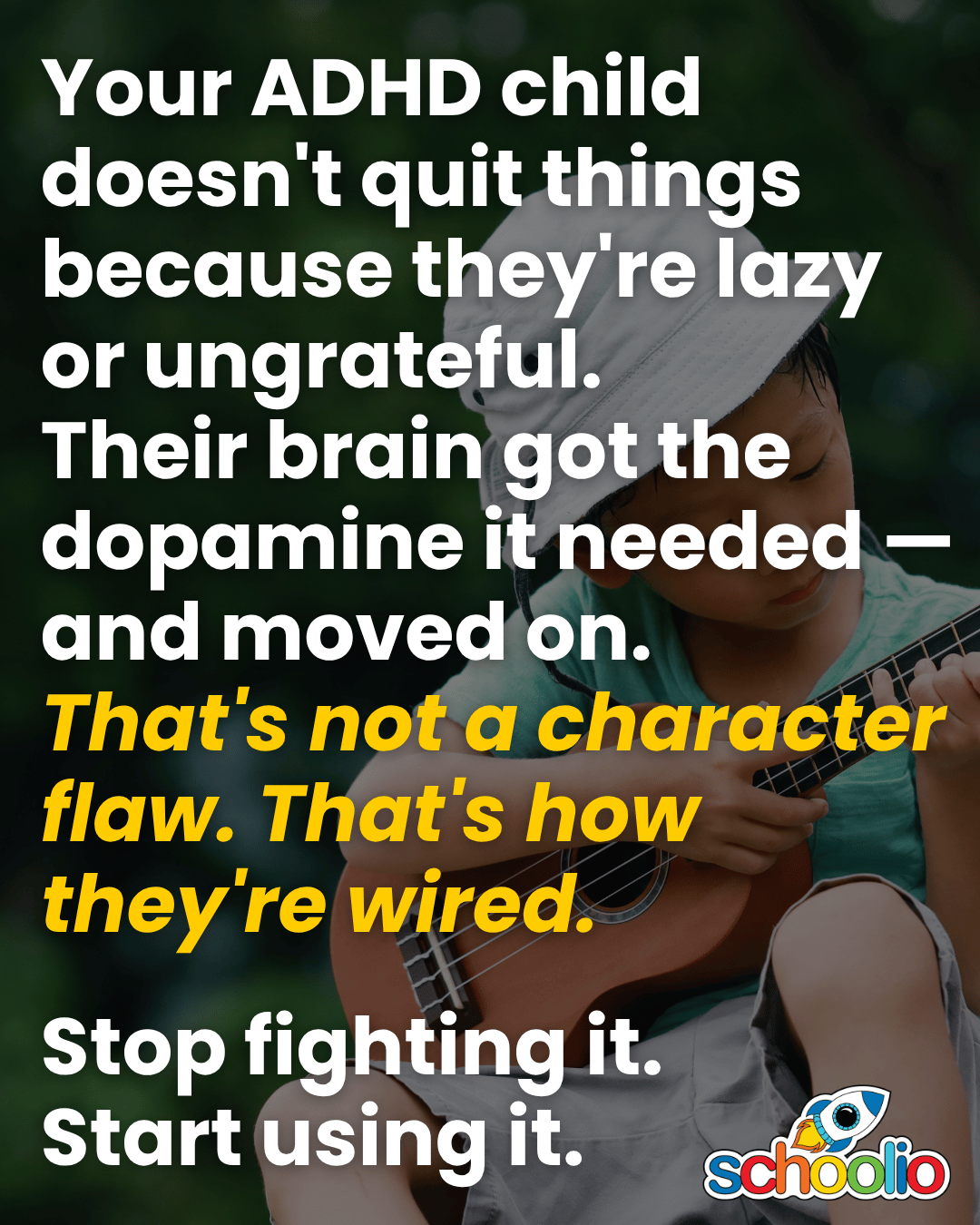
You bought the art supplies. They were obsessed for a week. Then came the request for a ukulele. Then a robotics kit. Then an inexplicable, all-consuming interest in competitive yo-yo. The art supplies are somewhere under the bed. If you’re parenting an ADHD child, you know this pattern intimately. It’s called shiny object syndrome. A new interest arrives like a lightning bolt — intense, electric, all-consuming. And then, just as suddenly, it’s gone. Replaced by the next shiny object.
It’s exhausting to keep up with. It can feel expensive. And if you’re homeschooling, it can make building any kind of consistent curriculum feel nearly impossible.
But here’s what’s important to understand before we talk about what to do:
This isn’t flakiness. It isn’t immaturity. It isn’t your child being ungrateful or difficult.
It’s how their brain is built.
What’s Actually Happening in the ADHD Brain with Shiny Object Syndrome
Shiny Object Syndrome — the unofficial name for this relentless pull toward newness — is rooted in the same dopamine differences that drive so many ADHD traits.
ADHD brains are novelty-seeking brains. When something is new, interesting, or exciting, dopamine surges. Focus sharpens. Energy arrives out of nowhere. Your child who couldn’t sit still for ten minutes suddenly spends four hours deep in a new interest without coming up for air.
That surge is real. That focus is real. And it feels amazing — for your child and, honestly, for you too. It’s one of the most magnetic things about ADHD kids. When they’re lit up, the whole room knows it.
The problem isn’t the surge.
It’s what happens after.
Once the novelty wears off — once the brain has extracted the dopamine hit that newness provides — the interest flatlines. Not because your child is lazy or fickle. Because their brain has moved on to find the next source of that same feeling.
This is the interest-based nervous system at work. We’ve written about it in the context of ADHD motivation before — the idea that ADHD brains aren’t unmotivated, they’re just motivated by a completely different set of drivers than neurotypical brains. Novelty is one of the most powerful of those drivers.
Shiny Object Syndrome is what novelty-seeking looks like in real life.
Why Fighting Shiny Object Syndrome Usually Backfires
The instinct, when we see this pattern, is to push through it.
You said you wanted to learn guitar. We bought the guitar. You’re going to stick with the guitar.
That’s a reasonable response. Commitment matters. Follow-through matters. We know that.
But forcing an ADHD child to stay engaged with something their brain has neurologically moved on from doesn’t build grit. It builds shame. It communicates — over and over — that the way their brain works is wrong. That they should be able to make themselves care about something they don’t care about anymore.
And they can’t. Not in the same way a neurotypical child might be able to white-knuckle through.
What they can do, with the right support, is learn to work with their novelty-seeking brain instead of against it.
Harnessing the Shiny Instead of Squashing It
The goal isn’t to eliminate Shiny Object Syndrome. The goal is to stop letting it run the show — while still honouring what it tells you about how your child learns best.
Here’s what that looks like in practice.
Let the interest be the vehicle, not the destination
When a new obsession arrives, the question isn’t how do I get them to stick with this? It’s what can I teach them through this while it’s hot?
Your child is into competitive yo-yo this week? That’s geometry, physics, fine motor skills, the history of toys, and YouTube content creation all waiting to happen. Lean into the interest hard while it’s alive. Extract as much learning from it as you can.
When it fades, you haven’t lost anything. You’ve gained a learning moment — and a data point about what kinds of things light your child up.
Create low-cost entry points for new interests
One of the practical realities of Shiny Object Syndrome is the financial toll of fully investing in every new passion. A useful rule of thumb: before committing to the full kit, the lessons, or the equipment, find the smallest possible version of the interest first.
Library books before the full supply haul. YouTube tutorials before the class. A borrowed instrument before the purchase.
This isn’t about doubting your child — it’s about building in a natural cooling-off period that lets you both figure out whether this interest has staying power before you’re fully committed.
Separate “exploring” from “committing”
ADHD kids often have a deeply stacked list of things they’ve started and not finished — and many of them carry quiet shame about that. It’s worth being explicit with your child that there’s a difference between exploring something and committing to it.
Trying things is good. Trying a lot of things is actually a strength. It’s how curious, creative, novelty-driven minds build a rich inner world. The goal over time is helping them learn to recognize the difference between a passing spark and a sustained interest — but that’s a skill that develops gradually, with practice and patience.
Build novelty into your routine on purpose
If you’re homeschooling, this is one of the most powerful things you can do: build novelty into your schedule intentionally, so the brain doesn’t have to go hunting for it.
Rotate learning formats. Change the environment. Mix subjects in unexpected combinations. Introduce new electives regularly. When novelty is part of the rhythm, the ADHD brain isn’t constantly seeking an escape hatch — because the stimulation it needs is already there.
At Schoolio, this is something we think about a lot. Our interest-based electives and flexible structure are designed specifically so that neurodivergent learners can follow what’s lighting them up — without losing the thread of core academics in the process.
What This Tells You About Your Child
Here’s the reframe that I keep coming back to.
A child who chases shiny objects relentlessly is a child with an active, curious, hungry mind. A child who gets genuinely lit up by things. A child who hasn’t yet had the spark beaten out of them by years of being told to sit still and stay on task.
That’s not something to fix.
That’s something to protect.
The work of parenting an ADHD child with Shiny Object Syndrome isn’t about teaching them to want less, or to care less, or to contain their enthusiasm to fit a more manageable box.
It’s about helping them build the scaffolding that lets all that energy go somewhere real.
That takes time. It takes flexibility. And it takes a learning environment willing to meet them where they are — not where a standardised curriculum expects them to be.
You’re already doing the most important part.
You’re paying attention.
Curious about the other ways ADHD motivation works differently? Read Understanding ADHD Motivation in Kids: It’s Not Broken, Just Different — and if the novelty-seeking is showing up around learning resistance too, our post on School Resistance and Refusal might resonate.