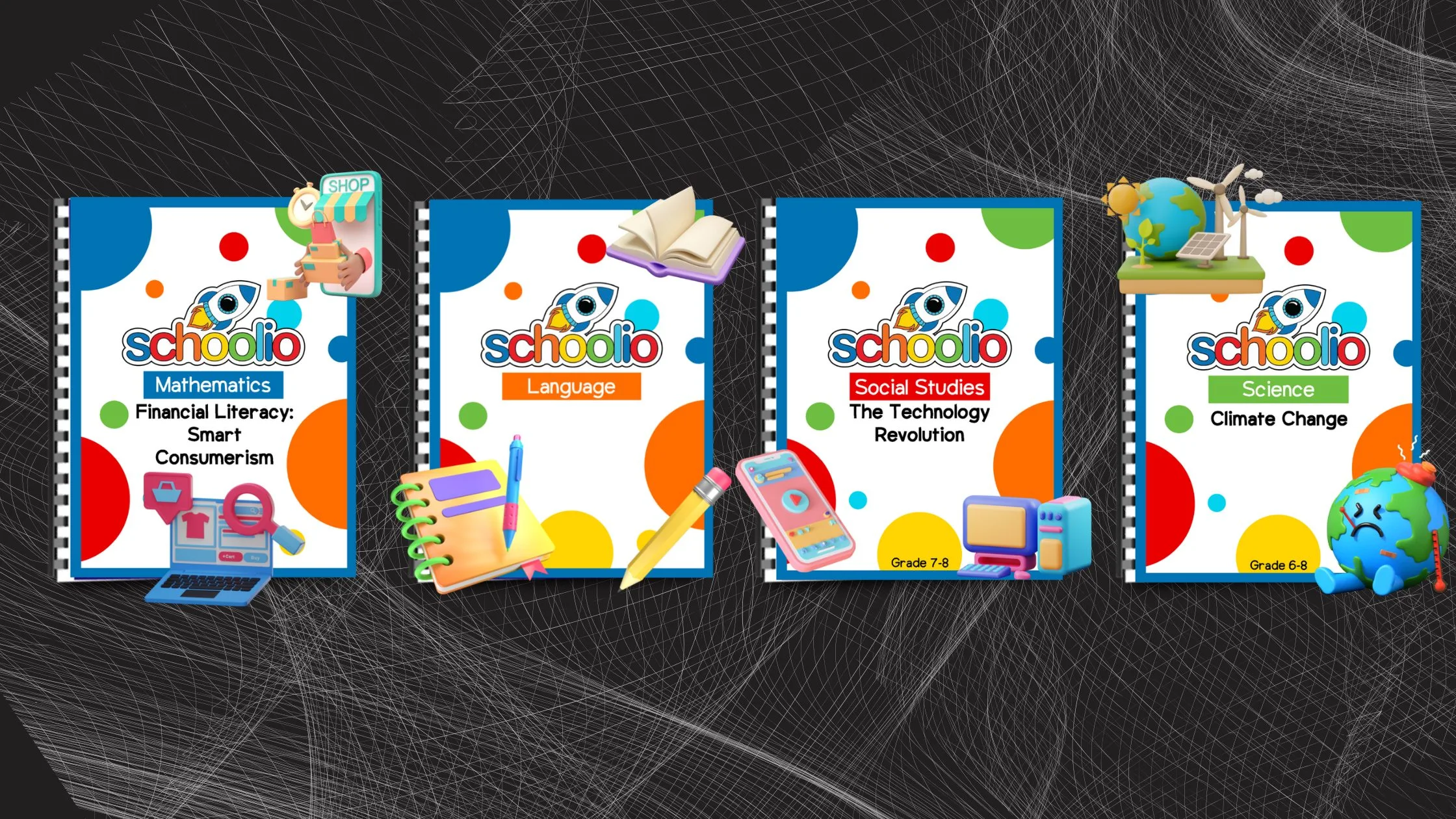
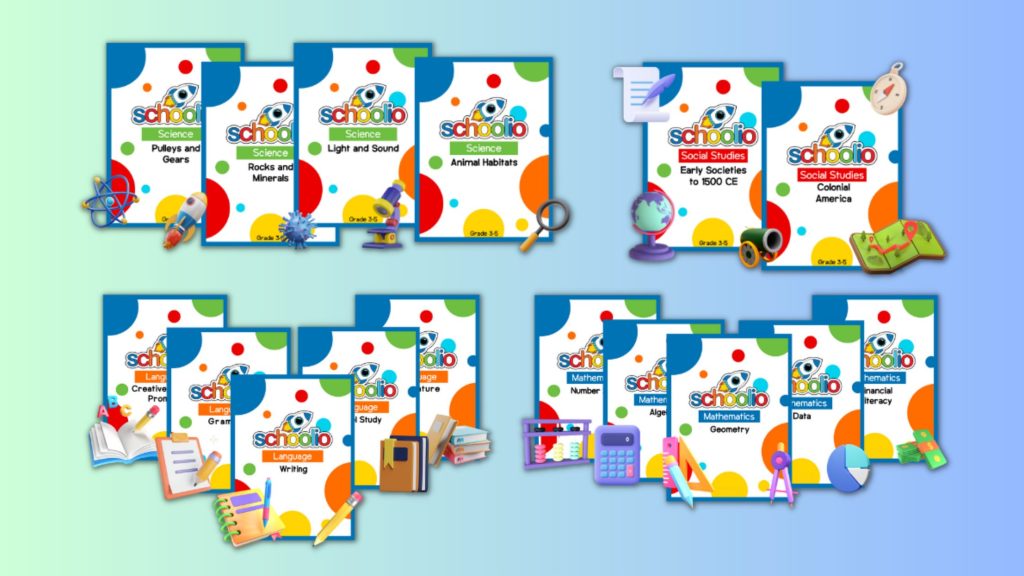
At Schoolio, we believe that education should be as diverse as the students it serves. Our commitment to providing a comprehensive learning experience is reflected in the wide array of curriculum options we offer, catering to students from kindergarten to eighth grade. Let’s start exploring Schoolio’s diverse curriculum options by delving into the three main categories that define Schoolio’s robust curriculum: Core Curriculum, Electives, and Social Emotional Learning (SEL).
Core Curriculum: Building Foundations for Success
Math
Schoolio’s core math curriculum is designed to build a strong foundation in mathematical concepts. From basic arithmetic to more advanced topics, our curriculum adapts to each student’s learning pace and style.
Science
In the realm of science, Schoolio excels in providing engaging lessons that cover a spectrum of subjects. Whether exploring the mysteries of the universe, conducting hands-on experiments, or understanding the delicate balance of ecosystems, our science curriculum sparks curiosity and critical thinking.
Social Studies
Our social studies curriculum takes students on a journey through history, geography, and cultures. From ancient civilizations to contemporary global issues, Schoolio fosters an appreciation for the world’s diversity and helps students develop a well-rounded worldview.
Language Arts
Language arts form the cornerstone of effective communication and critical thinking. Schoolio’s language arts curriculum encompasses reading, writing, grammar, and more, empowering students to express themselves eloquently and comprehend complex texts.
Electives: Unleashing Creativity and Passion
For students seeking to explore beyond the core curriculum, Schoolio boasts an extensive library of electives. These courses are designed to tap into students’ interests and passions, making learning an exciting adventure. Some of our standout electives include:
Candy Chemistry: Uncover the sweet science behind your favorite treats.
Earth’s Core: Journey to the center of the Earth and discover its mysteries.
All About Honeybees: Explore the fascinating world of these crucial pollinators.
Novel Studies: Dive into the pages of captivating stories and analyze literary elements.
Introduction to Art: Ignite creativity through hands-on artistic expression.
Introduction to Gymnastics: Foster physical fitness and coordination in a fun and supportive environment.
These electives provide a rich tapestry of knowledge that goes beyond traditional subjects, allowing students to pursue their passions and develop a well-rounded skill set.
Social Emotional Learning (SEL): Nurturing Holistic Growth
Recognizing the importance of emotional well-being, Schoolio integrates Social Emotional Learning (SEL) into our curriculum. The “Thoughts and Feelings” unit, tailored to different age groups, helps students navigate their emotions, build resilience, and foster positive relationships. Additionally, our SEL framework is designed to instill empathy. While also helping with self-awareness, and effective communication skills. Doing so to prepare students for success not only academically but also in the complexities of life.
Empowering Students to Thrive Academically and Emotionally
Schoolio’s commitment to a diverse and comprehensive curriculum ensures that every student finds a path to success that aligns with their unique strengths and interests. From the foundational core subjects to exciting electives and essential Social Emotional Learning, Schoolio empowers students to thrive academically and emotionally.
Join us on the Schoolio Learning Platform. Where education is not just about acquiring knowledge but also about fostering a lifelong love for learning.
The Importance of Financial Literacy for Your Middle Schooler
Equipping our children with essential life skills is so important. One of these crucial skills is financial literacy. As your middle schooler navigates the maze of education, it’s essential to integrate financial education into their curriculum. In this blog post, we’ll explore the importance of financial literacy for middle schoolers and how Schoolio, a comprehensive online learning platform, can play a pivotal role in their financial education.
Why Financial Literacy for Middle Schoolers Matters:
Building a Foundation for the Future:
Middle school is an opportune time to lay the groundwork for a solid financial foundation. Teaching your child about budgeting, saving, and investing at this stage can set them on the path to making informed financial decisions later in life.
Real-world Application of Math Skills:
Financial literacy integrates seamlessly with math curriculum, providing a real-world context for mathematical concepts. As middle schoolers delve into the complexities of mathematics, applying these skills to manage money fosters a practical understanding that goes beyond the classroom.
Cultivating Responsible Decision-Making:
Financial literacy encourages responsible decision-making. Through understanding the consequences of financial choices, middle schoolers learn to make informed decisions about spending, saving, and investing, fostering a sense of responsibility and accountability.
Preventing Future Financial Pitfalls:
Equipping your child with financial knowledge early on can help prevent common financial pitfalls in adulthood. Middle schoolers can grasp the concept of debt, credit, and the importance of saving, ensuring they enter adulthood with a strong financial footing.
Preparing for an Entrepreneurial Future:
In an era where entrepreneurship is celebrated, financial literacy empowers middle schoolers to explore their entrepreneurial spirit. Schoolio learning platform offers comprehensive education online, including specialized content on entrepreneurship, preparing your child for a dynamic future.
How Schoolio Facilitates Financial Literacy:
Tailored Homeschool Programs:
Schoolio recognizes the diverse needs of families, offering tailored homeschool programs that integrate financial literacy seamlessly. With a full year homeschool curriculum, your middle schooler can engage in comprehensive learning that includes essential financial education.
Engaging Home Education Programs:
Schoolio’s engaging home education program ensures that financial literacy is not a mundane topic. Interactive lessons and real-world scenarios keep middle schoolers captivated, making learning about money management an enjoyable experience.
Best Homeschool Program for Comprehensive Learning:
As you search for the best homeschool program, consider Schoolio for its comprehensive approach. The platform’s commitment to providing a well-rounded education includes a robust financial literacy curriculum that aligns with national standards.
Programs for Homeschooling That Prioritize Financial Education:
Schoolio stands out among programs for homeschooling by placing a significant emphasis on financial education. Through thoughtfully curated content and engaging activities, middle schoolers can develop a strong understanding of financial concepts.
Invest in Their Future
Incorporating financial literacy into your middle schooler’s education is an investment in their future. By leveraging the Schoolio learning platform, you ensure that your child receives a comprehensive education online, with a focus on essential life skills like financial literacy. Empower your middle schooler to make informed financial decisions and embark on a path towards financial success.
Navigating the Homeschooling Odyssey: Launching Your Journey with Confidence
Embarking on the homeschooling adventure can be both exhilarating and challenging. Whether you’re a seasoned educator looking for a change or a parent exploring alternative education options, the decision to homeschool is a transformative one. As you set sail on this educational odyssey, it’s natural to seek guidance on navigating the homeschooling odyssey with confidence.
Navigating the Homeschooling Odyssey: Steps to get started:
1. Cultivate a Learning Mindset
Your homeschooling journey begins with the cultivation of a learning mindset. Recognize that education extends far beyond textbooks and classrooms. Embrace the idea that learning happens in everyday experiences, from exploring nature to experimenting in the kitchen. By fostering a love for learning in your homeschool environment, you lay the foundation for a rich and engaging educational experience.
2. Design Your Homeschool Space
Create a dedicated and inspiring homeschooling space. This doesn’t necessarily mean you need a separate room; it could be a cozy corner or a mobile learning station. Equip it with essential supplies, age-appropriate materials, and tools that cater to your child’s unique learning style. Having a well-organized and comfortable space sets the stage for a positive learning environment.
3. Establish a Flexible Schedule
One of the beauties of homeschooling is the flexibility it offers. Tailor your schedule to align with your family’s rhythm, taking into account your child’s natural peak learning times. While structure is important, don’t be afraid to adapt and adjust as needed. Flexibility allows for spontaneous learning opportunities and ensures that both you and your child enjoy the journey.
4. Choose Curriculum Wisely
Selecting the right curriculum is a crucial aspect of successful homeschooling. Consider your child’s learning style, interests, and your own teaching preferences. Explore a variety of resources, from traditional textbooks to online platforms, and be open to experimenting until you find what works best for your family. Remember, the curriculum is a tool to facilitate learning, not a rigid framework.
5. Foster a Supportive Community
Connect with other homeschooling families in your area or online. Sharing experiences, resources, and insights with a like-minded community can provide invaluable support. Attend local homeschooling events, join online forums, and build relationships with fellow homeschoolers. Building a supportive network can be a source of encouragement and inspiration on your homeschooling journey.
6. Embrace Real-World Learning
Integrate real-world experiences into your curriculum. Field trips, community service, and guest speakers can bring subjects to life and provide a holistic education. Capitalize on opportunities to explore museums, historical sites, and local businesses. Engaging with the world outside your homeschool walls adds depth to your child’s learning experience.
7. Evaluate and Adjust
Regularly assess your homeschooling approach and be willing to make adjustments. Every child is unique, and what works for one may not work for another. Stay attuned to your child’s progress, interests, and any signs of burnout. The ability to adapt and evolve is key to a successful and sustainable homeschooling journey.
Embarking on the homeschooling odyssey requires courage, commitment, and confidence. By fostering a love for learning, creating a conducive environment, and building a supportive community, you set the stage for a rewarding and successful homeschooling experience. As you navigate this uncharted territory, remember that the journey is as important as the destination, and each day is an opportunity for growth and discovery. Happy homeschooling!
Incorporating Your Family Values into Homeschooling
With a myriad of homeschool programs available, parents now have the opportunity to tailor their children’s education to align with their family values. In this blog post, we will explore the importance of incorporating family values into homeschooling. And how diverse family principles can seamlessly integrate into various home education programs.
Understanding the Landscape of Homeschool Programs:
As the demand for flexible and customizable education rises, an array of homeschool programs has emerged. From traditional curricula to online learning platforms, families have more options than ever before to choose the best home school program for their children. It is essential to consider the values that matter most to your family when navigating this educational landscape.
Embracing Diversity in Family Values:
Every family is unique, with its own set of values and principles. Whether it’s a focus on academic excellence, fostering creativity, instilling a strong sense of community, or emphasizing individual growth, homeschooling allows families to weave these values into the fabric of their daily educational routines. Recognizing and embracing the diversity of family values is a key aspect of making homeschooling a truly enriching experience for both parents and children.
The Schoolio Family Plan: A Tailored Approach to Home Education:
One notable player in the homeschooling arena is the Schoolio learning platform, which offers a comprehensive education online through its innovative Schoolio family plan. This program understands that every family has its own unique values and strives to provide a flexible and personalized learning experience. Whether your family values hands-on learning, inclusivity, or a strong foundation in core subjects, the Schoolio family plan can be adapted to meet your specific needs.
Online Learning for Kids: Nurturing Values in a Digital Age:
The rise of online learning for kids has revolutionized the homeschooling landscape. Families can now access a wealth of resources and curricula that cater to diverse learning styles. Integrating family values into online learning is not only achievable but can also enhance the overall educational experience for children. Parents can curate content that aligns with their values and ensures a well-rounded and meaningful education.
Creating a Holistic Home Education Curriculum:
Building a home education curriculum that reflects your family values involves thoughtful planning and exploration. Whether you choose a structured curriculum or opt for a more eclectic approach, the key is to incorporate your values into every subject and activity. From science experiments that align with environmental stewardship to literature studies that promote empathy and understanding, the possibilities are endless.
Confidently Embrace Your Family Principles
Homeschooling provides a unique opportunity for families to create an educational environment that resonates with their values. With the diverse range of homeschool programs available, such as the Schoolio family plan. Parents can confidently embrace their family principles while offering a high-quality education to their children. By weaving values into the fabric of homeschooling, families can not only nurture academic excellence but also cultivate a strong sense of identity and purpose in their educational journey.
Unforeseen Detours: Navigating Homeschooling Amidst Work Project Challenges
Amidst the anticipation of completing a crucial work project for my boss, my attention was scattered across various responsibilities. Including our homeschooling routine. Engrossed in meeting work deadlines, I found myself unintentionally sidetracked from our daily academic focus. Let’s talk about unforeseen Detours: Navigating Homeschooling Amidst Work Project Challenges.
I usually excel at juggling multiple tasks.
As a committed homeschooling parent, I usually excel at juggling multiple tasks. However, on this particular day, my mind was preoccupied with meeting a looming work deadline, leading to an unintended and amusing incident in our homeschooling journey.
I handed my child what I believed to be a critical assignment – a science experiment exploring chemical reactions. Little did I know that this seemingly routine task would soon become a humorous anecdote in our homeschooling experience.
Where does the comedy come in?
Because, lost in thoughts about the impending work project, I mistakenly provided my child with instructions for a physics experiment involving simple machines. Imagine their confusion as they started gathering materials and realized the mismatch in scientific concepts. The irony of the “homeschool parent of the year award” was not lost on me.
Initially, I nonchalantly suggested re-checking the resources, assuming the curriculum might have covered both subjects. However, my child, baffled by unfamiliar terms and principles, insisted that this was uncharted territory in their lessons.
It wasn’t until I decided to review the curriculum materials more thoroughly that I discovered the truth. I had inadvertently handed my child the wrong set of instructions. The science experiment on chemical reactions was nowhere to be found in our curriculum.
Turning the mix up into a unique learning experience.
Apologizing for my oversight, we shared a good laugh over the unexpected detour into physics. We even incorporated the newfound knowledge of simple machines into our lessons, turning the incident into a unique learning experience.
Reflecting on this episode, I recognized the importance of staying focused during homeschooling sessions. Distractions, whether they involve looming work deadlines or other external factors, can lead to amusing detours in our academic plans.
In the end, the key takeaway was to embrace such moments with humor, learn from our mistakes, and approach homeschooling with a flexible mindset. After all, we’re only human, and occasional diversions can add a touch of unpredictability to our educational journey.
Here are some tips to help homeschool without distraction:
Establish a Dedicated Workspace:
Create a designated and organized learning space for your homeschooling activities. Having a dedicated area helps minimize external distractions and sets a focused atmosphere.
Set Clear Daily Goals:
Outline specific learning objectives for each day. Having a clear plan helps you stay on track and reduces the likelihood of getting sidetracked by external tasks or obligations.
Prioritize Time Management:
Allocate specific time slots for homeschooling, work, and personal tasks. Efficient time management allows you to balance responsibilities without feeling overwhelmed.
Use Technology Wisely:
Leverage technology to enhance the learning experience, but also establish guidelines to prevent unnecessary distractions. Consider setting specific times for educational screen time and breaks.
Communicate Boundaries:
If possible, communicate your homeschooling schedule and boundaries to family members or housemates. Clear communication helps create a supportive environment for focused learning.
Plan Breaks Strategically:
Integrate short breaks into your homeschooling routine. Scheduled breaks allow for necessary pauses without opening the door to prolonged distractions.
Utilize Productivity Techniques:
Explore productivity techniques, such as the Pomodoro Technique, to structure your homeschooling sessions. Breaking tasks into focused intervals with short breaks can enhance concentration.
Minimize External Interruptions:
Turn off non-essential notifications on your devices during dedicated homeschooling hours. Minimizing interruptions helps maintain focus and productivity.
Stay Organized:
Keep your homeschooling materials, resources, and schedules well-organized. A tidy workspace and a structured plan contribute to a smoother learning experience.
Flexibility and Adaptability:
While it’s crucial to minimize distractions, be flexible and adaptable when unexpected events occur. Embrace the fluid nature of homeschooling and find ways to turn diversions into valuable learning opportunities.
By implementing these strategies, you can create an environment conducive to focused and effective homeschooling, even in the face of potential distractions.
Why Canadians Need Canadian Learning Tools: A Crucial Emphasis on Homegrown Education for Canadian Children
In the realm of homeschooling, choosing the right curriculum is a pivotal decision that shapes a child’s educational journey. For Canadian families navigating the vast landscape of educational resources, the importance of incorporating Canadian learning tools cannot be overstated. From mathematics to social studies, embracing a curriculum tailored to the unique Canadian context ensures a well-rounded education that resonates with the experiences of our nation. Let’s delve into why Canadian homeschooling families should prioritize Canadian content, exploring various subjects, including the recent focus on Canadian Math.
Why Canadians Need Canadian Learning Tools:
1. Mathematical Context: From Kilometres to Celsius
Canadian Math, as highlighted in a previous blog, transcends numerical concepts; it embodies the practical application of these concepts in everyday life. Teaching measurements in kilometres, kilograms, and Celsius, instead of miles, pounds, and Fahrenheit. Respectively, aligns with the Canadian reality. By immersing children in a curriculum grounded in Canadian units, they develop a deeper understanding of their surroundings and the world they inhabit.
2. Social Studies and History: Nurturing Canadian Identity
A crucial aspect of Canadian education lies in imparting knowledge about our nation’s rich history and diverse culture. Canadian Social Studies and History provide children with a sense of identity. While also fostering pride in their country and a connection to its past. Learning about Canada’s indigenous peoples, multiculturalism, and historical milestones instills a deep appreciation for the unique tapestry that makes up the Canadian story.
3. Relevance to Daily Life: Connecting Learning to Experience
Canadian learning tools bring education closer to home, making it more relevant and relatable for children. When studying subjects infused with Canadian examples, children can easily connect theoretical concepts to their everyday experiences. This practical approach not only enhances comprehension but also instills a sense of pride in understanding and contributing to their community and country.
4. Cultural Diversity: Reflecting Canada’s Mosaic
Canada is celebrated for its cultural diversity, and this should be mirrored in the materials used for homeschooling. Canadian learning tools often incorporate a broad range of perspectives and cultural elements. Allowing children to appreciate the multitude of voices that contribute to the Canadian mosaic. This diversity is an essential component of education, promoting tolerance, empathy, and a global outlook.
5. Limited Availability of Canadian Curriculum: The Need for Change
While the homeschooling market is flooded with options, Canadian curricula face relative scarcity compared to their American counterparts. It is crucial to address this imbalance, as Canadian children benefit immensely from learning through materials that reflect their unique context. By supporting and advocating for more Canadian-centric educational resources. We contribute to the growth of a diverse and robust educational ecosystem.
Developing Canadian minds through Canadian materials.
Canadian homeschooling families stand to gain significantly by embracing a curriculum that aligns with the Canadian context. From mathematics to social studies, incorporating Canadian learning tools fosters a strong sense of identity and connection to community. While also helping craft an appreciation for the rich tapestry that is Canada. As we navigate the plethora of educational resources available. Let’s prioritize the development of Canadian minds through Canadian materials, ensuring a brighter and more informed future for our children.
The Importance of Choosing a Canadian Math Curriculum for Homeschooling
Canadian parents often find themselves faced with a crucial decision when it comes to selecting an appropriate educational path for their children. While the allure of American homeschool curriculums is undeniable, there exists a compelling case for embracing a Canadian approach to education. Let’s explore the importance of choosing a Canadian math curriculum for homeschooling.
Cultural Relevance Matters with Math:
Homeschooling goes beyond academics; it’s about instilling values, cultural awareness, and a sense of identity. When children are educated using a curriculum that reflects their own country’s values and context. They are more likely to develop a deep understanding of their roots. A Canadian math curriculum ensures that mathematical concepts are presented in a manner that resonates with the unique cultural nuances of Canada.
Differences in Canadian Math Curriculum:
Temperature Measurements: Celsius vs. Fahrenheit – A Canadian Perspective:
The choice of a Canadian math curriculum extends beyond numerical concepts into the practicalities of daily life. Canada, being a country that predominantly uses the Celsius scale for temperature measurement, underscores the importance of integrating this system into the educational fabric. By opting for a Canadian math program. Homeschooled children not only grasp mathematical concepts but also gain an intuitive understanding of temperature in degrees Celsius, aligning with the norms of their home country. This ensures that Canadian students can interpret and relate to weather forecasts, daily temperatures, and climate discussions in a way that reflects the reality of their environment.
Weight Measurements: Kilograms in Canada vs. Pounds in the US – Bridging the Gap:
In the pursuit of a comprehensive Canadian homeschool curriculum, the distinction in weight measurements cannot be overlooked. Canada predominantly uses the metric system, with kilograms as the standard unit of measurement. A Canadian math program, such as the one offered by Schoolio, incorporates this metric system seamlessly. By doing so, students not only become proficient in mathematical computations but also develop an innate understanding of weight in kilograms. This ensures that the weight-related concepts children encounter in their daily lives. From grocery shopping to scientific experiments, align with the Canadian measurement system.
Distance Measurements: Kilometres in Canada vs. Miles in the US – Navigating Canadian Spaces:
Another critical aspect that sets Canadian math curriculum apart is the inclusion of the metric system for distance measurements. Canada uses kilometres as its standard unit, a departure from the miles commonly used in the United States. The Schoolio learning platform recognizes this difference and incorporates it into its educational materials for kids. By learning distance in kilometres, Canadian homeschooled children not only acquire essential math skills but also develop a practical understanding of the distances they encounter in their daily lives. Making their education more relevant to the Canadian landscape and ensuring they navigate their surroundings with precision and accuracy.
Financial Literacy for Kids: A Crucial Aspect of Canadian Math:
Canadian homeschooled children need more than just mathematical proficiency; they need a solid foundation in financial literacy tailored to the Canadian economic landscape and currency. Schoolio’s curriculum integrates financial education seamlessly. Providing a holistic approach to math that prepares children for the financial realities they will face in their own country.
Math Homeschool Resources Designed for Canadian Minds:
The Schoolio math homeschool resources are crafted to align with Canadian educational standards. From foundational arithmetic to advanced algebra, these resources guide students through a curriculum. This curriculum is not only challenging but also imbued with Canadian examples and applications. This approach fosters a deeper understanding of mathematical concepts within the context of Canadian culture.
Schoolio Learning Platform: A Canadian Educational Beacon:
One of the standout options for Canadian homeschooling families is the Schoolio learning platform. Which provides full grade curriculum for American and Canadian learners. This platform not only provides educational materials for kids but also offers a comprehensive Canadian homeschool curriculum. By choosing Schoolio, parents can be confident that their children are receiving an education tailored to the Canadian context. Ensuring a more meaningful and relevant learning experience. Recognizing the importance of preparing children for the digital age, Schoolio incorporates coding lessons into its Canadian homeschool curriculum. Ensuring that children are equipped to thrive in a rapidly evolving global landscape.
The Schoolio Family Plan: Uniting Canadian Homeschooling Families:
Schoolio understands the importance of community and support in the homeschooling journey. The Schoolio Family Plan not only provides access to a robust Canadian home education curriculum. But also fosters a sense of belonging by connecting families across the nation. This collaborative approach enhances the homeschooling experience for both parents and students.
Choosing a Canadian math curriculum is not just a matter of academic preference; it’s a decision that shapes a child’s cultural identity. While prepareing them for the economic landscape, and equips them with skills relevant to their own country. Schoolio, with its emphasis on a Canadian homeschool curriculum, emerges as a beacon of educational excellence. Offering a holistic and culturally relevant learning experience for Canadian homeschooled children.
When Homeschooling Isn’t Working: Signs, Changes, and Support
Home education has become a popular choice for many families, offering a personalized approach to learning for children. However, like any educational method, homeschooling comes with its own set of challenges. As a homeschooling parent myself, I understand firsthand that sometimes things don’t go as planned. Whether your child is facing academic struggles, social difficulties, or if you’re feeling overwhelmed. It’s crucial to recognize when homeschooling isn’t working and take appropriate steps.
When homeschooling isn’t working: Identify the Indicators
Recognizing when homeschooling isn’t effective can vary for each family. However, some common signs include:
1. Limited academic progress
If your child is facing academic challenges and not progressing, it may indicate the need for a different learning approach.
2. Resistance to learning
A lack of enthusiasm for learning could be a signal that your child needs a change in the material or teaching method.
3. Social struggles
Isolation is a concern for some homeschooled children, making it important to ensure opportunities for social interaction with peers.
4. Difficulty with the curriculum
If you find it challenging to keep up with the curriculum, it may be time to reassess your homeschooling approach.
5. Burnout or feeling overwhelmed
Feeling burnt out or overwhelmed may indicate that homeschooling is not working for you or your child, highlighting the need for a shift.
Embrace Change Without Fear
If you observe these signs, don’t hesitate to make a change. Homeschooling is flexible, and adjustments are part of the process. Consider:
1. Enrolling your child in traditional school
Transitioning to public or private school can provide more social opportunities and exposure to diverse learning styles.
2. Exploring different homeschooling approaches or curriculums
Trying out various homeschooling methods or curriculums allows you to find the one that suits your child best through trial and error.
3. Seeking support through a tutor or homeschooling co-op
Hiring a tutor or joining a homeschooling co-op can provide academic support and opportunities for socialization and group learning.
4. Taking a break from homeschooling
If burnout is a concern, taking a break from homeschooling can provide the time needed to recharge and gain a fresh perspective.
Remember, what works for one family may not work for another; prioritize what’s best for your child and family.
Connect for Support
Homeschooling can be isolating, but seeking support from other homeschooling parents or online communities can provide valuable advice and encouragement. If academic challenges persist, consider consulting a professional tutor or educational therapist for targeted support and resources.
Persevere
Despite its challenges, homeschooling can be a fulfilling journey. If you ever feel discouraged, remember why you chose homeschooling. Take a break, regroup, and return with a renewed perspective. Homeschooling is a unique journey, and it’s about finding what works best for your child and your family. Remember, homeschooling has its complexities, and it’s acceptable to acknowledge when it isn’t working. Embrace change, seek support, and recall your initial reasons for choosing homeschooling. Armed with these insights, you’ll be better prepared to navigate the highs and lows of home education.
In recent years, homeschooling has gained significant popularity among Canadian families as an alternative to traditional education. This educational approach allows parents to tailor their children’s learning experiences to their individual needs and interests. As the understanding of homeschooling evolves, more families are exploring this option to provide a personalized education that nurtures creativity, critical thinking, and a love for learning. This guide will delve into the benefits of homeschooling in Canada, discuss the varying regulations across provinces and territories, and provide a detailed breakdown of the steps required to homeschool in each region.
What’s Canadian Curriculum and Do You Need to Use it?
In a recent statement, Lindsey Casselman, Co-founder of Schoolio Learning, provided insights into the nuanced understanding of the term ‘Canadian curriculum’ and its implications. Casselman clarified that the term primarily denotes a course of study aligned with Canadian educational standards, distinct from the often-misconceived provincial government expectations.
Casselman shared, “When we talk about technicalities, ‘Canadian curriculum’ refers to a comprehensive educational framework that adheres to Canadian standards. It’s important to differentiate this from the list of ‘government expectations,’ which outlines concepts that a chosen curriculum should encompass.”
Casselman went on to emphasize that this ‘expectations’ list, while significant, does not entail a rigid, prescribed program of study. “Surprisingly,” Casselman noted, “very few provinces offer a specific curriculum. What they provide is a set of expectations that highlights the concepts students should be exposed to. Importantly, the how, what, and with what resources these concepts are taught are left to the educators’ discretion.”
In the context of Schoolio Learning’s approach, Casselman highlighted, “For Schoolio, ‘Canadian Curriculum’ translates to a seamless and equitable learning experience for both Canadian and American customers. Our Canadian clients are ensured the same ease of use and access to learning materials, without the need for unit conversions or external resources. This ensures a comprehensive education, including subjects like rich Canadian history and geography.”
As the co-founder of Schoolio Learning, Casselman’s perspective underscores the importance of adapting educational standards to ensure a robust and enriching learning experience for students across borders.
Can Homeschooling Benefit Canadian Families?
Personalized Learning: Homeschooling allows parents to customize curriculum and teaching methods to suit their child’s learning style, pace, and interests.
Individual Attention: With a lower student-to-teacher ratio, homeschooling enables focused one-on-one instruction, fostering more profound understanding and stronger relationships.
Flexible Schedule: Families can design a flexible schedule that accommodates travel, family time, and extracurricular activities, providing a well-rounded education.
Tailored Values and Beliefs: Homeschooling enables parents to integrate their values, beliefs, and cultural background into the educational experience.
Enhanced Socialization: Homeschooled children often engage in diverse social interactions beyond their age group, building strong interpersonal skills.
Provincial Regulations for Homeschooling:
It’s important to note that each Canadian province and territory has its own set of regulations and requirements for homeschooling. While some provinces have detailed guidelines, others offer more flexibility. Below, we provide a breakdown of the homeschooling process in several provinces:
In Saskatchewan, homeschooling operates under The Education Act and The Home-Based Education Regulations. To homeschool in Saskatchewan, follow these steps:
Notify your local school board of your intent to homeschool.
Develop and submit a Written Education Plan that aligns with the provincial curriculum.
Maintain records of your child’s progress and submit an annual progress report.
Participate in an annual evaluation of your child’s progress with a certified teacher.
Homeschooling regulations in the territories vary but generally involve notifying the local education authorities, developing an educational plan, and adhering to assessment requirements. Specific steps may differ based on each territory’s education policies.
Navigating Homeschooling Across Canada.
As homeschooling gains traction across Canada, families can shape their children’s education to align with their values and priorities. However, it’s crucial to understand and adhere to the homeschooling regulations in your specific province or territory. By following the appropriate notification procedures, creating well-rounded educational plans, and maintaining accurate records, you can embark on a homeschooling journey that fosters a love for learning and empowers your child to succeed in their academic pursuits. Remember, each region’s educational authorities can provide detailed guidance to help you navigate the homeschooling process effectively.
Homeschooling has emerged as a beloved education choice for millions of parents worldwide. Over the years, this alternative approach to learning has gained popularity due to its unique advantages and the freedom it offers to families seeking a more personalized educational experience for their children. One of the primary reasons why homeschooling is increasingly favored is the flexibility it provides. Unlike traditional school systems, homeschooling allows parents and guardians to create customized curricula tailored to their child’s interests, abilities, and learning styles. This adaptability allows students to explore their passions at their own pace, fostering a love for learning that can last a lifetime. And while homeschooling may have become a favorite education choice for many, is it the right choice for you? Should you homeschool your child?
Finding Out Should You Homeschool Your Child? Or Look For a More Traditional Approach to Education?
When determining whether you should homeschool your child, it is essential to recognize that while homeschooling works wonders for some families, it may not be the best option for everyone. Homeschooling demands a considerable commitment from parents, as they assume the role of educators alongside their responsibilities as caregivers. Not all parents have the time, resources, or teaching skills to provide a well-rounded education. Additionally, homeschooling can be socially isolating for children if not supplemented with ample opportunities for social interaction. This lack of regular peer contact might hinder their social development and limit their exposure to diverse perspectives.
Here are some reasons why homeschooling might not be the right choice for a family:
1. Time and Resources:
Homeschooling demands a significant time investment from parents, which can be challenging if they have demanding work commitments or other responsibilities.
2. Teaching Skills:
Teaching requires a significant amount of patience, focus and direction.
3. Socialization:
In some situations, homeschooled children may have limited opportunities to interact with peers regularly. This can potentially affect their social development and interpersonal skills. This is why the parent or guardian needs to ensure there are socializing opportunities for their child.
4. Extracurricular Activities:
Traditional schools often provide various extracurricular activities, such as sports, arts, and clubs, so you will need to set up activities for your child and drive them to those activities.
Homeschooling Can Be Incredibly Beneficial.
Despite the potential challenges, homeschooling can be incredibly beneficial for many families. It allows parents to create a tailored learning environment that nurtures their child’s strengths and addresses their weaknesses. Moreover, the benefits of homeschooling extend beyond academics. The flexible schedule enables families to travel more frequently and immerse themselves in unique educational experiences. Homeschooled students often have a more profound sense of self and greater confidence as they are encouraged to pursue their passions actively.
If you are considering homeschooling for your child, here are some signs that it might be the right choice for your family:
1. Strong Parental Commitment:
You are willing to dedicate time and effort to plan and facilitate your child’s education.
2. Learning Preferences:
Your child thrives in an individualized learning environment and benefits from personalized instruction.
3. Freedom and Flexibility:
You desire the freedom to customize the curriculum to align with your child’s interests and values.
4. Positive Family Dynamics:
Homeschooling can strengthen family bonds, making it an excellent choice for families seeking to spend more time together.
5. Unique Needs:
If your child has special needs or interests not adequately met in traditional schools, homeschooling can offer a more supportive setting.
6. Safe and Nurturing Environment:
You aim to provide your child with a secure and comfortable space to learn and explore.
It’s a Big Decision But One That’s Worth Making.
Homeschooling can be an excellent educational option for families seeking more flexibility and customization in their child’s learning journey. However, it is essential to carefully weigh the pros and cons and consider your family’s specific circumstances before making this significant decision. Ultimately, the success of homeschooling depends on the commitment, dedication, and resources available to provide a well-rounded education that nurtures your child’s growth and development.
Summer break is in full swing, and the days are filled with outdoor adventures, laughter, and relaxation. While it may seem too early to think about the upcoming homeschooling year, the truth is, it’s never too soon to start preparing. Getting a head start can save you from the last-minute stress accompanying the back-to-school rush. By taking some time now to plan and organize, you’ll be setting yourself up for a successful and enjoyable homeschooling journey ahead. So, let’s find out how to get ready for homeschooling.
Let’s Look at Traditional and Not So Traditional Ways to Prepare for Your Homeschooling Year.
Having a list of simple things to do and out-of-the-box ideas for getting ready for homeschooling offers a comprehensive approach to preparing for the upcoming academic year. The list of simple things is a foundational guide, encompassing essential steps such as creating a dedicated learning space, setting goals, and selecting appropriate curricula. These fundamental tasks ensure a solid start and provide structure to the homeschooling journey.
On the other hand, the out-of-the-box list introduces unique and creative ideas that go beyond the conventional methods of homeschool preparation. These innovative suggestions inject excitement and inspiration into the learning process, promoting a dynamic and engaging educational experience for parents and children. By combining the practicality of the simple things with the ingenuity of the out-of-the-box ideas, families can strike a balance between structure and creativity, setting the stage for a successful and enriching homeschooling year.
10 Simple Things to Do to Get Ready for Homeschooling:
1. Create a Dedicated Space:
Set up a designated area in your home as a learning zone. Having a quiet, organized space solely for homeschooling will help your child focus and establish a clear boundary between school and playtime. That doesn’t mean you’ll always be using this space for homeschooling, somedays you might rotate to a different part of your home or even outside. But having a place where everything is organized helps your homeschooling year run smoothly.
2. Review Last Year’s Progress:
Take a look at your child’s achievements from the previous year. Assess what worked well and what could be improved to tailor the upcoming curriculum accordingly. Finding patterns in their learning will help you determine their unique learning style.
3. Establish Your Homeschool Goals:
Define your homeschooling goals for the year. What specific skills do you want your child to develop? What subjects do they need extra attention in? Having clear objectives will guide your teaching approach to meet their needs.
4. Plan a Flexible Homeschooling Routine:
Create a flexible daily or weekly routine that outlines study hours, breaks, and extracurricular activities. Flexibility is critical in homeschooling, so be prepared to adapt as needed.
5. Research Curriculum:
Explore different curricula and educational resources that align with your child’s learning style and your goals. Consider a comprehensive curriculum grade bundle from the Schoolio Bookstore for a well-rounded education.
Join online homeschooling communities or local homeschooling groups to connect with other homeschooling families. Sharing experiences and ideas can be a valuable source of support and inspiration. Additionally, you will have the opportunity to connect with experienced homeschoolers that can share first-hand knowledge of best practices for homeschooling.
7. Stock Up on Supplies:
Make a list of essential school supplies and materials, from textbooks to art materials, and take advantage of back-to-school sales to save money. Pro tip: Make sure you buy a lot of pencils!
8. Prepare for Technology Needs:
Ensure you have the technology and internet access for online learning if you plan to incorporate digital resources, like the Schoolio Digital Platform, into your homeschooling routine.
9. Plan Field Trips and Outings:
Research educational field trip opportunities and plan outings that align with your curriculum. Real-world experiences can significantly enhance the learning process. If you are connected with a local homeschooling community, there are often field trips, co-ops, and extracurricular activities planned by members of the homeschooling group.
10. Embrace a Positive Mindset:
Homeschooling can be challenging, and there will likely be some bumps along the road. However, maintaining a positive attitude and fostering a love for learning will create a supportive and encouraging environment for your child.
10 Out-of-the-Box Ways to Get Ready for Your Homeschool Year:
1. Garden Classroom:
Create a small garden space where your child can learn about plants, ecosystems, and sustainability firsthand—taking learning back to the roots!
2. Culinary Adventures:
Incorporate cooking and baking lessons into your curriculum to teach math, science, and cultural appreciation while providing essential life skills.
3. Art Integration:
Use art as a medium to explore various subjects. For example, create historical dioramas or illustrate scientific concepts using the gift of art.
4. Community Service Projects:
Engage in community service projects to instill empathy and social responsibility in your child. These can include senior center visits, fundraising events, food drives, cards for hospitalized children, park clean-ups, animal shelter assistance, and more.
5. Nature Journaling:
Encourage your child to keep a nature journal to document outdoor observations and foster a deeper connection with nature. Have them journal the weather for each day, including the temperature, how it made them feel and what activities they could do outside that day.
6. Virtual Museum Tours:
Take advantage of virtual museum tours and cultural exhibits to supplement your history and art lessons. Field trips are always fun, but sometimes as busy homeschoolers, it’s nice to have the opportunity to explore a unique location from the comfort of your home.
7. Living History Experiences:
Organize or participate in living history events where your child can interactively experience historical periods. Places like Living History Farms or Upper Canada Village are great places to start.
8. Book Club Adventures:
Start a book club with other homeschooling families to encourage reading and critical thinking. Allow the children to select the books they would like to explore together.
9. STEM Challenges:
Integrate hands-on STEM challenges using everyday materials to spark curiosity and problem-solving skills. Embrace opportunities like building a paper bridge, designing a marble run, balloon rockets, egg drop challenges, and more.
10. Utilize The Schoolio Digital Platform:
Use the comprehensive and all-in-one learning platform from The Schoolio Digital Platform to keep your homeschool on track throughout the school year. Traditional homeschooling gravitates toward curriculum workbooks; the Schoolio Digital Platform takes a different approach with learning videos, lessons assessments and worksheets. Covering all the core curriculum for the year, it’s a fast track to homeschooling success.
Remember, Every Homeschooling Families Journey is Unique.
Homeschooling can be a rewarding and fulfilling experience for parents and children. Preparing early and following the simple steps outlined in this guide can set the foundation for a successful homeschooling journey. Additionally, embracing out-of-the-box ideas and incorporating creative and hands-on activities can add excitement and depth to the learning process, making it an enjoyable adventure for the whole family. Whether you explore STEM challenges, embark on community service projects, or create unique learning experiences, remember that homeschooling provides the flexibility to tailor education to your child’s needs and interests.
So, as you embark on this educational voyage together, embrace the joys of discovery, the power of learning, and the countless cherished memories that homeschooling can offer. Remember that every family’s journey is unique. Embrace the flexibility and freedom that homeschooling offers, and most importantly, cherish the moments of learning and growth you’ll share with your child along the way. Happy homeschooling! Here’s to a fantastic and enriching homeschooling year ahead!
Lessons from Homeschoolers: Discovering a Balanced Education Journey
In recent years, homeschooling has gained popularity as an alternative to traditional schooling. While it may not be the right choice for everyone, homeschoolers have valuable lessons to share with the broader educational community. Beyond the academic aspect, they offer insights into the importance of socialization, the flexibility of homeschooling routines, and the power of minimizing stress. Let’s explore these valuable lessons from homeschoolers that can help reshape our perspective on education.
Lessons from Homeschoolers:
Socialization: A Natural Aspect of Homeschooling:
One of the most persistent misconceptions about homeschooling is the belief that children will lack socialization opportunities. However, homeschoolers often find that socialization comes more naturally in their unique environment. Freed from the constraints of large classrooms, they can interact with individuals of various age groups and backgrounds. Additionally, they engage in social activities such as co-ops, clubs, community organizations, and sports teams. Homeschoolers cultivate diverse social skills, empathy, and adaptability by fostering authentic connections.
Flexible Schedules for Efficient Learning:
Homeschoolers have long understood that education doesn’t need to follow the rigid structure of traditional school settings. They recognize that learning can occur beyond a specific timeframe or in unconventional settings. Homeschooling allows for tailored schedules that cater to individual learning styles and interests. Homeschoolers can optimize their time and focus on meaningful activities by embracing flexibility. Whether it’s a field trip, pursuing hobbies, or delving deeper into a subject of interest. They demonstrate that quality education isn’t solely dictated by hours spent at a desk.
The Power of Stress Reduction:
The pressure to excel academically is often a significant stressor for students in traditional schools. Homeschoolers have discovered that minimizing stress can lead to improved learning outcomes. By removing the constant comparison to peers and focusing on personal growth, they create a nurturing environment that fosters creativity, curiosity, and a genuine love for learning. Homeschoolers prioritize holistic development, recognizing that stress reduction is vital for mental and emotional well-being, ultimately enhancing their educational experience.
Homeschooling enables personalized education, allowing students to explore their passions and develop their strengths. Without the constraints of standardized curricula, homeschoolers can tailor their learning experiences. They can delve deeper into subjects of interest, develop specialized skills, and discover their unique talents. This individualized approach encourages self-motivation and cultivates a lifelong love for learning, ensuring a well-rounded education beyond traditional academic boundaries.
Embracing Lifelong Learning:
Homeschooling nurtures a love for lifelong learning by instilling in students the belief that education is a continuous journey. By encouraging curiosity and self-directed exploration, homeschoolers become adept at seeking knowledge independently. They learn to leverage resources such as libraries, online courses, and community experts to expand their understanding of the world. This mindset equips them with the necessary skills to adapt and thrive in an ever-changing society.
A Well-rounded Education Can be Achieved.
Homeschoolers offer valuable lessons that challenge the conventional notions of education. From emphasizing the importance of socialization to embracing flexible schedules and reducing stress, homeschoolers demonstrate that a well-rounded education can be achieved through personalized approaches. By learning from their experiences, we can reimagine education as a dynamic and inclusive journey that prioritizes individual growth, fosters curiosity, and nurtures lifelong learners. Let’s embrace these lessons from homeschoolers to shape a brighter future for education.