Navigating Legal Requirements for Homeschooling

Legal Requirements for Homeschooling- Embarking on the homeschooling journey can be an exciting adventure for families seeking a personalized education for their children. However, understanding and complying with the legal requirements is a crucial step. This guide will help you navigate the legal aspects of homeschooling and ensure your homeschool program meets local regulations.

Research Your Local Homeschooling Laws

Every region has its own homeschooling laws and regulations. It’s essential to start by researching the specific requirements in your area. Here are some steps to help you get started:

  • Visit Government Websites: Check your local education department’s website. They often provide detailed information about homeschooling laws and guidelines.
  • Join Homeschooling Associations: National and local homeschooling associations can be valuable resources. They offer legal advice, support, and up-to-date information on homeschooling regulations.
  • Consult Legal Experts: If you’re unsure about the legalities, consider consulting a legal expert specializing in education law. They can provide personalized advice to ensure your homeschool program is compliant.

Key Legal Aspects to Consider

When setting up your homeschool program, consider these key legal aspects:

  • Notification Requirements: Many regions require parents to notify the local school district or education department of their intent to homeschool. This notification may need to be submitted annually.
  • Homeschool Curriculum Standards: Some areas have specific curriculum standards that your homeschool program must meet. Ensure your chosen curriculum aligns with these requirements.
  • Record-Keeping: Keeping accurate records is crucial. This may include attendance logs, progress reports, and samples of your child’s work. These records may be requested by education authorities.
  • Homeschool Assessment Requirements: Certain regions require homeschooled students to undergo regular assessments or standardized testing. Familiarize yourself with these requirements to ensure compliance.

Finding Reputable Resources

To build a successful homeschool program, it’s important to use reputable resources. Here’s how you can find them:

  • Online Research: Use reliable websites dedicated to homeschooling, such as the Home School Legal Defense Association (HSLDA) and your local homeschooling association’s website.
  • Homeschooling Communities: Join online forums, social media groups, and local homeschooling co-ops. These communities often share valuable insights and resources.
  • Library and Bookstores: Look for books written by experienced homeschoolers and education experts. These can provide comprehensive guidance on setting up and maintaining a homeschool program.

Ensuring Compliance

Once you’ve gathered all the necessary information and resources, it’s time to ensure your homeschool program complies with local laws. Here’s a checklist to help you stay on track:

  • Submit Notifications: If required, submit your notice of intent to homeschool to the appropriate authorities.
  • Follow Curriculum Guidelines: Make sure your chosen curriculum meets local standards and covers all required subjects.
  • Maintain Records: Keep detailed records of your homeschooling activities, including attendance, grades, and examples of completed work.
  • Prepare for Assessments: Schedule any required assessments or standardized tests and ensure your child is prepared.

Understanding and navigating the legal requirements for homeschooling is an essential part of establishing a successful homeschool program. By researching local homeschooling laws, finding reputable resources, and ensuring compliance, you can create a strong educational foundation for your children. Remember, a well-structured homeschool program not only meets legal standards but also provides a supportive and enriching learning environment.

Ready to start your homeschooling journey with confidence? Visit Schoolio today to find the easiest and most effective homeschool program tailored to your family’s needs!

10 Ways to Learn About the Solar Eclipse with Your Kids

As homeschooling parents, we constantly seek unique and engaging ways to bring education to life. The upcoming solar eclipse offers a perfect opportunity to explore a range of subjects, from the science behind celestial events to their cultural significance around the world. Here are ten enriching and fun ways to learn about the solar eclipse with your kids.

1. Dive into the Science

Begin with the basics: what is a solar eclipse? This natural phenomenon occurs when the moon passes between the Earth and the sun, temporarily obscuring the sun from our view. Discuss the different types of solar eclipses – total, partial, and annular – and investigate the celestial mechanics in play. Simple models using a lamp (sun), a basketball (Earth), and a smaller ball (moon) can demonstrate the alignment needed for an eclipse.

2. Explore Historical and Cultural Perspectives

Solar eclipses have fascinated humanity for millennia, often interpreted as omens or significant spiritual events. Delve into stories from various cultures, such as the ancient Greeks, who believed eclipses were signs of angry gods, or the Vikings, who thought eclipses occurred when a wolf was attempting to eat the sun. This exploration offers a rich, interdisciplinary learning experience, merging astronomy with history and mythology.

3. Prioritize Safety

Emphasize the importance of never looking directly at the sun without proper protection, even during an eclipse. Discuss the science of why eclipse viewing can be dangerous and how to use eclipse glasses. Alternatively, demonstrate how to make a pinhole projector out of simple household items for safe viewing.

4. Get Creative with Art

Encourage your kids to express what they’ve learned or feel about the eclipse through art. They can draw or paint the eclipse as they imagine it, create a comic strip about the event, or even build a model. Artistic expression not only solidifies their learning but also allows them to connect emotionally with the event.

5. Write Inspired by the Eclipse

Invite your children to write poems, stories, or essays inspired by the eclipse. They could pen a narrative from the perspective of someone experiencing an ancient eclipse or compose a poem that captures the eerie beauty of the event. This activity enhances writing skills while deepening their engagement with the topic.

6. Conduct Hands-on Science Experiments

There are numerous experiments to illustrate concepts related to eclipses. For example, explore the properties of light and shadow by using objects of different shapes and sizes to cast shadows, simulating how the moon blocks sunlight during an eclipse. You can also experiment with lenses and mirrors to demonstrate how light can be bent and reflected, simulating the corona visible during a total solar eclipse.

7. Uncover the Mathematics

The predictability of eclipses is a mathematical marvel. Introduce older children to the basic principles of how astronomers use the Saros cycle to predict eclipses. For younger kids, simple activities involving counting, measuring time, or using geometric shapes to model an eclipse can make the Math tangible and engaging.

8. Share Eclipse Myths and Legends

Storytelling can be a powerful tool for learning. Share myths from different cultures that explain solar eclipses, such as the Vietnamese myth of a frog eating the sun. After exploring various stories, encourage your kids to create their own myth explaining an eclipse, blending creativity with cultural exploration.

9. Plan Your Eclipse Day

Make the day of the eclipse an educational event. Start with a themed breakfast, followed by a review of safety viewing practices. Then, watch the eclipse using your chosen safe viewing methods. After the eclipse, engage in reflection activities, discussing what you observed and felt. This approach turns the eclipse into an immersive educational experience.

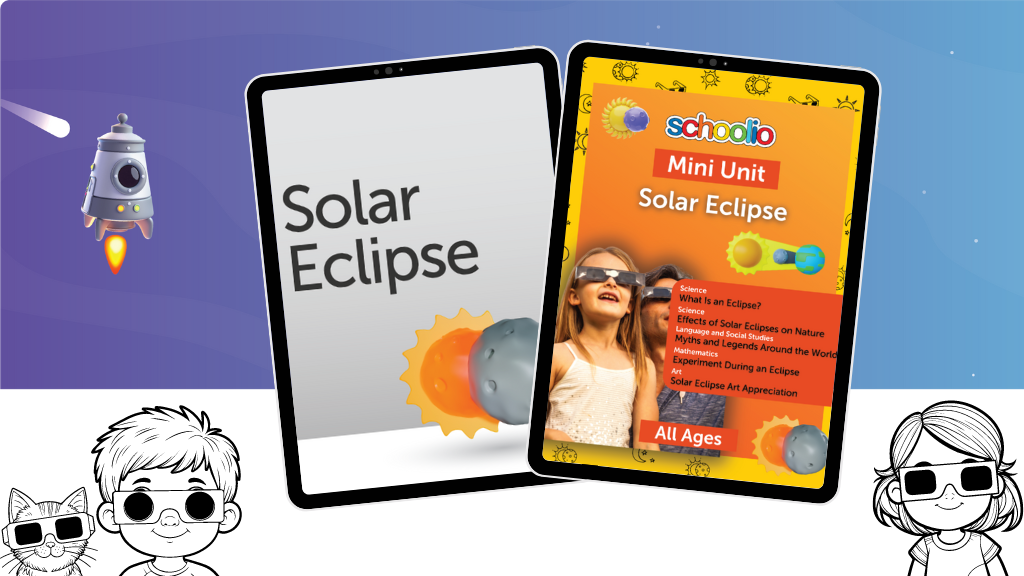
10. Download the FREE Schoolio Mini Unit

To ensure you have a well-rounded educational journey leading up to the eclipse, download the FREE Schoolio Mini Unit all about the Solar Eclipse. This resource is packed with ready-to-go lessons that cover the science, history, and cultural significance of solar eclipses. It’s an excellent way for your kids to get excited and informed about the event, providing structured learning alongside the activities suggested above.

Conclusion

Learning about the solar eclipse can be an enriching experience for both you and your children. By combining science, history, art, and storytelling, you can create a multidisciplinary curriculum that captivates their imagination and fuels their curiosity. Use this celestial event as a springboard for discovery, and don’t forget to download the Schoolio Mini Unit for a comprehensive guide to teaching about the eclipse. Happy learning, and clear skies for your eclipse day!

Spring Break Homeschool Hacks: 10 Ingenious Ways to Banish Boredom

As flowers bloom and the sun graces us with its warmth, spring break is here – a chance to rejuvenate and break free from the usual routine. But how can you maintain the excitement of homeschooling during this well-deserved break? Worry not! In this blog post, we’ve put together 10 creative ways to combat boredom and infuse your spring break with fun and excitement. Mystical Mini-Adventures: Turn your backyard into a realm of mystery! Plan mini-adventures like scavenger hunts or nature quests and awaken the inner explorer in your homeschool haven.

  1. DIY Science Extravaganza: Transform your kitchen into a science lab! Perform mind-blowing experiments with everyday items. Who would have thought that combining vinegar and baking soda could be so explosively entertaining?
  2. Literary Escape Rooms: Immerse yourself in the world of literature with themed escape rooms. Select a favorite book or a historical period, allowing your child’s imagination to soar as they solve puzzles and unlock the secrets of the past.
  3. Culinary Quests: Make the kitchen the epicenter of learning! Organize a culinary quest where your child can explore different cuisines, try their hand at cooking, and even document their culinary creations.
  4. Arts and Crafts Rendezvous: Ignite those creative sparks! Host an arts and crafts rendezvous where your child can unleash their artistic flair. From painting to crafting, the possibilities are endless.
  5. Virtual Travel Expedition: While physical travel might not be on the agenda, embark on a virtual travel expedition! Explore world wonders, museums, and historical sites online, all from the comfort of your homeschool haven.
  6. Mathematics Marvels: Infuse magic into math! Engage in interactive math games, puzzles, and challenges. Who knew numbers could be so much fun?
  7. Digital Story Slam: Cultivate a love for storytelling! Host a digital story slam where your child can create and share their tales through digital media. It’s a fusion of creativity and technology.
  8. Fitness Fiesta: Spring break calls for a fitness fiesta! Plan outdoor activities, family workouts, or even a dance party to keep everyone moving and grooving.
  9. Garden of Knowledge: Foster a love for nature! Transform gardening into a homeschool project. Plant seeds, study flora, and create a mini garden for an educational and therapeutic experience.

Spring break doesn’t have to be a pause from learning; instead, let it be an opportunity for exploration, creativity, and family bonding. With these 10 innovative ways to beat boredom, your homeschooling adventure will be anything but dull. Embrace the spirit of curiosity, and let the spring break adventure begin!

Bonus Hack: Schoolio Live Classes Extravaganza!

10. Dynamic Learning with Schoolio Live Classes: Elevate your spring break with Schoolio Live Classes, where vetted tutors bring exciting subjects to life! From engaging science experiments to interactive math challenges, our live classes add a whole new dimension to your homeschooling adventure. Explore subjects with experts and make learning an unforgettable experience. Say goodbye to boredom, and hello to dynamic learning with Schoolio Live Classes! ?? #SchoolioLive #SpringBreakLearning #DynamicHomeschooling

Outsource Learning Focus: Why It’s a Good Idea to Outsource Some Teaching

In the ever-evolving landscape of education, parents and caregivers are exploring innovative approaches to enhance their child’s learning experience. One such strategy gaining traction is the concept of outsourcing learning focus. In this blog post, we’ll delve into why outsourcing some teaching can be a game-changer for your child’s education.

The Changing Face of Education: Traditional learning environments, while effective, may not always cater to the individual needs and learning styles of each child. Recognizing this, parents are turning to outsourcing as a strategic solution to supplement and enrich their child’s educational journey.

Why Outsource Learning Focus?

  1. Specialized Expertise: Outsourcing allows your child to benefit from the specialized knowledge and expertise of professionals in specific subjects. Whether it’s advanced mathematics, foreign languages, or coding, outsourcing ensures that your child receives high-quality instruction.
  2. Diverse Learning Styles: Every child has a unique learning style. Outsourcing provides access to a variety of teaching methods and approaches, catering to different learning preferences and fostering a well-rounded educational experience.
  3. Time Management Skills: Learning to manage time effectively is a crucial life skill. By outsourcing certain aspects of teaching, your child can learn to balance their schedule, prioritize tasks, and develop essential time management skills that will serve them well in the future.
  4. Holistic Development: Outsourcing extends beyond traditional subjects. It includes extracurricular activities, sports, and creative pursuits. This holistic approach contributes to your child’s overall development, and nurturing skills such as teamwork, leadership, and creativity.

How to Integrate Outsourcing into Your Child’s Learning:

  1. Identify Learning Gaps: Assess your child’s strengths and weaknesses to identify areas where outsourcing could provide targeted support. This ensures a personalized approach tailored to your child’s needs.
  2. Research Trusted Resources: Explore reputable online platforms, educational services, and professionals that align with your child’s learning goals. Verified reviews, testimonials, and recommendations can guide you in making informed choices.
  3. Balanced Approach: Maintain a balance between outsourced learning and home-based instruction. Create a cohesive learning plan that integrates both, allowing your child to benefit from a diverse and comprehensive educational experience.
  4. Collaborative Projects: Schoolio’s collaborative project features, now enhanced with Live Classes, allow your child to work on assignments with fellow students and engage with vetted Tutors, promoting teamwork and communication skills. These projects simulate a classroom environment, providing a balance between individual learning and group interaction.

Outsourcing learning focus is not about replacing traditional education but enhancing it. Embracing this approach can open doors to a world of opportunities, providing your child with a customized, well-rounded education that prepares them for success. Consider the unique needs of your child, explore the vast resources available, and watch as outsourcing becomes a catalyst for their academic and personal growth.

In conclusion, the integration of social time into your homeschooling routine is crucial for your child’s holistic development. By leveraging Schoolio’s resources, including Live Classes with vetted Tutors, and fostering a balance between academics and socialization, you can create an enriching educational experience for your child. Embrace the power of social time, and watch as your child blossoms into a well-rounded individual. ?✨ #Homeschooling #EducationEvolved #SchoolioLiveClasses

Understanding Homeschooling Self-Efficacy: A Comprehensive Guide for Parents

Understanding Homeschooling Self-Efficacy: A Comprehensive Guide for Parents

Understanding Homeschooling Self-Efficacy

Homeschooling self-efficacy, or the confidence and belief parents have in their ability to educate their children at home, is a pivotal factor in the success of homeschooling. This self-assurance plays a significant role in shaping the educational approach and directly impacts children’s development. As parents are central to the homeschooling process, their understanding of self-efficacy is crucial. This comprehensive guide aims to equip parents with valuable insights into homeschooling self-efficacy and its profound influence on their children’s educational journey.

Reasons for Homeschooling

Flexibility and Individualized Learning

Homeschooling offers unparalleled flexibility, allowing parents to tailor learning experiences to meet the unique needs of each child. This personalized approach enables the creation of individualized curricula and the adaptation of teaching methods to align with the child’s specific learning style. The absence of rigid schedules and standardized lesson plans empowers parents to foster a learning environment that caters to their child’s pace, interests, and aptitudes.

Family Values and Beliefs

For many families, homeschooling serves as a means to instill and reinforce their deeply held values and beliefs within their children’s education. It provides an opportunity for parents to incorporate religious, moral, or cultural principles into their children’s learning experiences in a seamless and integrated manner. By integrating these foundational values into the educational journey, parents can ensure that their children receive holistic guidance aligned with the family’s core principles.

Legal Requirements and Considerations

Legal Regulations and Compliance

Understanding the legal requirements for homeschooling is paramount for parents embarking on this educational journey. Each state has its own set of regulations and compliance standards that homeschooling parents must adhere to. Familiarizing oneself with these legal aspects ensures that parents are meeting the necessary educational standards and obligations, safeguarding their children’s academic progress within the parameters of the law.

Documentation and Record-Keeping

Homeschooling parents are required to maintain meticulous documentation and records as part of their legal obligations in homeschooling. These records serve as tangible evidence of their children’s educational progress, ensuring compliance with regulatory requirements for homeschooling. Detailed documentation of academic achievements, extracurricular activities, and learning milestones is essential for providing a comprehensive overview of the homeschooling experience while meeting legal obligations.

By diligently adhering to legal requirements and maintaining thorough documentation, homeschooling parents can confidently navigate the regulatory landscape while demonstrating their commitment to providing a well-rounded education for their children.

Methods and Approaches in Homeschooling

Curriculum Selection and Design

When it comes to homeschooling, parents have the unique advantage of tailoring a curriculum that aligns precisely with their child’s interests, strengths, and learning objectives. This customization allows for the incorporation of diverse teaching methods and resources to enrich the child’s educational experience. By selecting or designing a curriculum that resonates with the child’s individuality, parents can actively engage their children in learning while nurturing their curiosity and passion for knowledge.

Learning Environment and Resources

Creating an optimal learning environment within the home is fundamental to the success of homeschooling. It involves leveraging a variety of educational resources such as online materials, educational games, and community activities to supplement the child’s learning journey. The integration of these resources fosters a holistic approach to education, providing children with opportunities for hands-on learning experiences that extend beyond traditional classroom settings.

In the words of renowned educator John Holt: “What is most important and valuable about the home as a base for children’s growth into the world is not that it is a better school than the schools but that it isn’t a school at all.” This underscores the significance of creating an environment where children can explore, discover, and learn in ways that resonate with their unique abilities and inclinations.

Teaching strategies for homeschooling, Educational approaches in home education, Instructional methods for homeschooling

Impact on Children’s Development

Academic Progress and Achievement

The effects of homeschooling on children’s growth are evident in their academic progress and achievement. Research consistently indicates that homeschooling can have a positive impact on children’s academic performance and learning outcomes. The personalized attention and tailored instruction provided in a homeschooling environment often contribute to enhanced academic achievement levels. With individualized teaching methods, children can thrive academically, mastering concepts at their own pace while receiving focused support from their parents.

Socialization and Emotional Well-Being

Homeschooling has a profound influence on kids’ development in home education, particularly concerning socialization and emotional well-being. Despite common misconceptions, homeschooling offers ample opportunities for social interaction and fosters strong emotional well-being in children. The supportive and nurturing environment of homeschooling provides a foundation for healthy social interactions, enabling children to develop robust emotional resilience and interpersonal skills essential for their overall well-being.

Understanding Homeschooling Self-Efficacy

Homeschooling self-efficacy is a cornerstone of parental confidence and belief in their ability to provide effective education at home. This self-assurance empowers parents to actively engage in their children’s academic journey, fostering an environment conducive to holistic development. Understanding the profound impact of homeschooling on children’s growth and learning is pivotal for parents as they navigate the educational landscape. By equipping parents with comprehensive knowledge and instilling confidence, this guide aims to facilitate their ability to address challenges and embrace the myriad benefits of homeschooling.

Empowering Parents: Homeschooling self-efficacy enables parents to take an active role in nurturing their children’s educational and personal growth, fostering a strong sense of self-confidence in homeschooling.

Fostering Understanding and Respect through Black History Month

Fostering Understanding and Respect through Black History Month

Fostering Understanding and Respect through Black History Month

In a world marred by division and misunderstanding, there exist powerful tools to bridge the gap between cultures, races, and backgrounds. One such tool is Black History Month, a time dedicated to celebrating the achievements and contributions of African Americans throughout history. Beyond celebration, however, Black History Month serves as a crucial platform for fostering understanding, empathy, and respect among individuals of all backgrounds. In this blog, we delve into the significance in promoting unity and fostering understanding and respect through Black History Month.

Acknowledging Historical Injustices:

Black History Month provides an opportunity to confront uncomfortable truths about the past. And also acknowledge the historical injustices faced by African Americans. From slavery and segregation to systemic racism and discrimination. The journey of African Americans in the United States has been fraught with obstacles and adversity. By shining a spotlight on this history, Black History Month encourages individuals to confront the legacy of oppression and work towards a more just and equitable society.

Schoolio Family Plan

Celebrating Achievements and Contributions:

While it is essential to acknowledge the challenges faced by African Americans. Black History Month also celebrates their remarkable achievements and contributions to society. From the pioneering work of civil rights activists like Martin Luther King Jr. and Rosa Parks. To the groundbreaking accomplishments of figures like Barack Obama, Maya Angelou, and Serena Williams. The impact of African Americans spans every facet of culture, politics, science, and the arts. By highlighting these achievements, Black History Month showcases the resilience, creativity, and brilliance of the African American community.

Promoting Cultural Exchange and Understanding:

Black History Month is not solely about commemorating the past; it is also about promoting cultural exchange and understanding in the present. Through educational initiatives, community events, and artistic expressions. Black History Month invites people of all backgrounds to engage with African American culture, history, and experiences. By fostering dialogue and empathy, Black History Month helps break down barriers and build bridges. Between individuals from diverse backgrounds, fostering a sense of unity and solidarity.

Schoolio e-books

Inspiring Future Generations:

Perhaps most importantly, Black History Month inspires future generations to pursue their dreams and make a positive impact on the world. By learning about the struggles and triumphs of those who came before them, young people are empowered to challenge injustice, pursue excellence, and contribute to a more inclusive society. Black History Month serves as a reminder that every individual has the power to effect change. And leave a lasting legacy, regardless of their background or circumstances.

In a world often divided by race, ethnicity, and cultural differences, Black History Month stands as a light of hope and unity. By honoring the past, celebrating achievements, and promoting understanding. Black History Month fosters respect and appreciation for the diverse tapestry of human experiences. As we commemorate Black History Month, let us recommit ourselves to the ongoing struggle for equality, justice, and mutual respect. Knowing that our collective journey towards a better future is strengthened by our shared understanding and appreciation of the past.

Schoolio Learning Resources

Building Critical Thinking Skills in Homeschooled Children

Building Critical Thinking Skills in Homeschooled Children

Building Critical Thinking Skills in Homeschooled Children

In the journey of home learning, parents have a unique opportunity to prioritize critical thinking skills in homeschooled children. While traditional schooling methods often prioritize rote memorization and standardized testing, homeschooling allows for a more personalized approach to education, emphasizing exploration, analysis, and problem-solving. In this environment, children can develop robust critical thinking abilities that will serve them well throughout their lives.

Importance of Critical Thinking Skills

Critical thinking is the cornerstone of effective learning and decision-making. It enables children to question assumptions, evaluate evidence, and form logical conclusions. In today’s complex and rapidly changing world, thinking critically is more valuable than ever. It empowers children to navigate information overload, adapt to new situations, and make informed choices.

Schoolio Family Plan

Simple Ways to Develop Critical Thinking Skills

Encourage Curiosity:

Foster your child’s natural curiosity by encouraging them to ask questions and explore interesting topics. Provide opportunities for hands-on learning experiences and field trips to stimulate their curiosity.

Promote Discussion:

Engage your child in discussions about various topics, encouraging them to express their opinions and listen to others’ perspectives. Ask open-ended questions that prompt them to think critically and consider different viewpoints.

Problem-Solving Activities:

Incorporate problem-solving activities into your homeschool curriculum, such as puzzles, brain teasers, and logic games. These activities challenge children to think creatively and develop strategies to overcome obstacles.

Real-World Applications:

Connect academic concepts to real-world scenarios to illustrate their relevance and encourage critical thinking. For example, involve your child in budgeting decisions or scientific experiments at home.

Multidisciplinary Learning:

Take advantage of homeschool programs that offer multidisciplinary learning opportunities, such as the Schoolio learning platform. This approach allows children to explore connections between different subjects and develop a holistic understanding of the world.

Use Diverse Resources:

Incorporate a variety of resources into your homeschool curriculum, including books, videos, online courses, and educational games. Exposing children to diverse perspectives and information sources enhances their critical thinking skills.

Rethinking traditional homeschooling methods? Click here!

Encourage Reflection:

Encourage your child to reflect on their learning experiences, encouraging them to consider what they have learned, how they learned it, and what they could do differently next time. This reflective practice fosters metacognitive skills and enhances critical thinking.

Schoolio e-books

Encourage Independent Inquiry:

Provide opportunities for your child to pursue independent inquiry projects based on their interests. Support them in researching topics, formulating questions, and presenting their findings, fostering autonomy and critical thinking skills.

Debate and Argumentation:

Organize debates or argumentation exercises where your child can practice presenting and defending their opinions using evidence and reasoning. This helps them develop persuasive communication skills and strengthens their critical thinking abilities.

Model Critical Thinking:

Lead by example by demonstrating critical thinking in your decision-making processes and discussions. Show your child how to analyze information critically, consider alternatives, and make reasoned judgments.

Flexibility and Resources are Available

By incorporating these strategies into your homeschooling approach, you can effectively nurture your child’s critical thinking skills and prepare them for success in an ever-changing world. With the flexibility and resources available through homeschool programs like Schoolio, parents have the opportunity to provide their children with a comprehensive education that prioritizes the development of critical thinking abilities alongside academic knowledge.

Schoolio Learning Resources

Top 5 Steps You Should Take Before Homeschooling

Top 5 Steps You Should Take Before Homeschooling

Top 5 Steps You Should Take Before Homeschooling

Have you been considering taking the leap into homeschooling? With the ever-changing landscape of education, many families are turning to homeschooling as a viable option for their children’s academic journey. Homeschooling offers a flexible and personalized approach to education, allowing parents to tailor curriculum and learning experiences to their child’s unique needs and interests. From full-year homeschool curriculum to online learning for kids, there’s a vast array of homeschooling resources available to support families in their educational endeavors. Let’s explore the top 5 steps you should take before homeschooling.

The Benefits of Homeschooling

Homeschooling provides numerous benefits for both parents and students alike. One of the most significant advantages is the ability to customize education according to individual learning styles and preferences. Unlike traditional classroom settings, where instruction may be standardized, homeschooling allows for personalized learning experiences tailored to each child’s strengths and weaknesses. Additionally, homeschooling offers the opportunity for one-on-one support, fostering deeper understanding and academic growth.

Incorporating e-learning for elementary students has become increasingly popular within homeschooling communities. Online learning for kids not only provides access to a wealth of educational resources but also allows for flexibility in scheduling and pacing. Whether utilizing popular homeschool programs or exploring the best homeschool programs available, homeschooling families have the freedom to choose curriculum and learning approaches that best suit their child’s needs.

Schoolio Family Plan

Navigating the Initial Challenges

While homeschooling can be a rewarding experience, many parents may feel overwhelmed or frazzled when first embarking on this educational journey. Transitioning from a traditional school setting to homeschooling requires careful planning and preparation.

Here Are the Top Five Steps You Should Take Before Homeschooling:

1. Research Home Education Curriculum Options

Before diving into homeschooling, take the time to research and evaluate different home education curriculum options. From comprehensive full-year homeschool curriculum packages to specialized subject-based resources, there’s a wide range of homeschooling materials available. Consider your child’s learning style, interests, and academic goals when selecting curriculum resources. Look for reputable homeschool learning programs that align with your educational philosophy and objectives.

2. Assess Your Homeschooling Resources

Assess your homeschooling resources to ensure you have everything you need to support your child’s learning journey. This includes not only curriculum materials but also educational supplies, such as textbooks, workbooks, and manipulatives. Additionally, consider the availability of online learning resources and technology tools to enhance your homeschooling experience. Investing in good homeschool programs and educational resources will help facilitate a well-rounded and engaging learning environment for your child.

3. Establish a Homeschooling Routine

Creating a consistent homeschooling routine is essential for maintaining structure and organization. Establish a daily schedule that incorporates dedicated time for academic lessons, hands-on activities, and breaks. Be flexible and adaptable, allowing room for spontaneity and exploration within your homeschooling routine. Encourage independence and self-directed learning skills while providing guidance and support as needed.

4. Connect with Homeschooling Communities

Reach out to local homeschooling communities and online support networks to connect with other homeschooling families. Networking with fellow homeschoolers provides valuable opportunities for sharing resources, exchanging ideas, and seeking advice. Attend homeschooling events, workshops, and co-op programs to cultivate friendships and build a supportive community around your homeschooling journey.

Schoolio e-books

Familiarize yourself with the legal requirements and regulations governing homeschooling in your area. Research state-specific homeschooling laws and procedures for compliance. This may include filing paperwork, submitting educational plans, or participating in homeschooling evaluations or assessments. By understanding and adhering to legal requirements, you can ensure a smooth and successful homeschooling experience for you and your child.

Here’s the importance of building critical thinking skills

Embracing the Homeschooling Journey

Embarking on the homeschooling journey can be both exciting and challenging. By taking proactive steps to research curriculum options, assess resources, establish routines, connect with communities, and fulfill legal requirements, you can lay the foundation for a fulfilling and enriching homeschooling experience. With dedication, creativity, and support, homeschooling offers endless possibilities for educational growth and exploration. Embrace the opportunity to nurture your child’s curiosity, ignite their passion for learning, and cultivate a lifelong love of knowledge through homeschooling.

Is your child struggling with reading? Click here!

Schoolio Learning Resources

Tips for Balancing Homeschooling with a Busy Family Schedule

Tips for Balancing Homeschooling with a Busy Family Schedule

Tips for Balancing Homeschooling with a Busy Family Schedule

Do you find yourself juggling a hectic schedule while attempting to manage homeschooling for your kids? Balancing the demands of a busy family life, complete with extracurricular activities, sports events, and other commitments, can be a daunting task. As parents, you’re already wearing multiple hats, and the addition of overseeing your child’s education at home can make things even more challenging. Fear not; there are effective strategies to strike a balance and ensure that both your family’s activities and your child’s education thrive. Here are the best tips for balancing homeschooling with a busy family schedule.

Tips For Balancing Homeschooling with a Busy Family Schedule:

Prioritize and Organize:

The key to successfully managing a busy family schedule is effective prioritization and organization. Develop a master schedule that includes both homeschooling hours and other family commitments. Prioritize tasks and allocate dedicated time slots for each, ensuring that your child’s education doesn’t get sidelined amidst the hustle and bustle.

Schoolio Family Plan

Choose the Right Homeschool Program:

Investigate different homeschool programs available to find the one that best suits your family’s needs. Look into good homeschool programs that offer flexibility, interactive learning, and a comprehensive curriculum. A well-rounded homeschool program like Schoolio Learning, can streamline your teaching efforts and provide a structured framework for your child’s education.

Utilize Full Year Homeschool Curriculum:

Opting for a full-year homeschool curriculum can be a game-changer. It provides continuity in learning and allows you to plan breaks strategically, aligning with your family’s schedule. A consistent educational approach can ease the burden of frequent curriculum adjustments and create a smoother learning experience for your child.

Flexibility in Learning Spaces:

Embrace the flexibility that homeschooling offers by creating multiple learning spaces within your home. This way, even if you’re on the go, your child can continue learning. Invest in portable educational resources and make the most of technology to ensure that learning can happen anywhere, anytime.

Incorporate Extracurricular Learning:

Seamlessly integrate educational components into your family’s extracurricular activities. For instance, if your child is involved in sports, incorporate math by calculating scores or include historical context during downtime. This way, learning becomes a holistic part of your family’s lifestyle.

Collaborative Learning with Other Families:

Join forces with other homeschooling families to create a supportive network. Collaborative learning sessions not only offer social interaction for your child but also allow you to share responsibilities. Consider programs like the Schoolio family plan that facilitate group learning and cooperative educational experiences.

Schoolio e-books

Set Realistic Goals:

Establish achievable academic goals for your child and acknowledge the limitations of your family’s schedule. Setting realistic expectations ensures that your child receives a quality education without overwhelming your already packed routine.

Utilize Technology for Efficiency:

Leverage educational technology to enhance efficiency in homeschooling. Explore online resources, interactive learning platforms, and educational apps that can supplement your curriculum and engage your child in meaningful ways.

Block Scheduling for Productivity:

Implement block scheduling to enhance productivity. Assign specific time blocks for focused learning, breaks, and extracurricular activities. This structured approach helps maintain a balance between educational pursuits and family commitments.

Regularly Reassess and Adjust:

The key to maintaining balance is regular reassessment. Periodically evaluate your family’s schedule and adjust your homeschooling strategies accordingly. Flexibility and adaptability are crucial components of a successful homeschooling journey within a busy family schedule.

Strike a Harmonious Balance Between Your Family’s Activities and Your Child’s Education

Successfully homeschooling amidst a busy family schedule requires strategic planning, flexibility, and the right resources. By prioritizing, choosing suitable homeschool programs, and adding efficient strategies, you can strike a harmonious balance between your family’s activities and your child’s education. Embrace the diverse opportunities that homeschooling presents and create a learning environment that aligns seamlessly with your dynamic family life.

Schoolio Learning Resources

Utilizing Schoolio for a Well-Rounded Homeschooling Experience

Utilizing Schoolio for a Well-Rounded Homeschooling Experience

Utilizing Schoolio for a Well-Rounded Homeschooling Experience

Are you searching for the perfect solution to tailor your child’s educational journey? In the dynamic realm of homeschooling, where customization is key, the Schoolio Learning Platform emerges as a game-changer. With the ability to adapt to diverse learning preferences, Schoolio opens the door to a well-rounded homeschooling experience. Whether your child thrives in a digital learning environment, prefers the tangible feel of printed materials, or seeks a hybrid approach. Schoolio provides the flexibility needed to meet individual needs. Let’s delve into a world where education becomes a personalized adventure tailored to your child’s unique learning style by utilizing Schoolio for a well-rounded homeschooling experience.

Tailoring Education with Schoolio

Here are some ways you can start utilizing Schoolio for a well-rounded homeschooling experience.

Schoolio Family Plan

How Schoolio Can Be Adapted to Meet Your Child’s Learning Style:

Digital Learning for the Tech-Savvy Learners

For students who thrive in a digital environment, the Schoolio Learning Platform is a game-changer. It provides access to a wide array of lesson videos, assessments, and worksheets. And these are all accessible through a user-friendly online interface. This not only caters to the needs of tech-savvy learners but also facilitates a more interactive and engaging educational experience.

The platform allows students to annotate directly on the digital worksheets, fostering a dynamic learning environment. This feature encourages active participation, enabling students to express their thoughts and engage with the material in a way that suits their learning style.

Embracing Traditional Learning with Printed Ebooks

Some students prefer the tangible feel of a book in their hands. Schoolio understands this and provides an innovative solution – the option to purchase ebooks and have them printed. This blend of traditional and modern learning methods ensures that no student is left behind. By accommodating those who resonate with the familiarity of physical materials.

Schoolio e-books

Parents can choose from a diverse range of ebooks covering various subjects, allowing for a comprehensive and adaptable homeschooling curriculum. This flexibility is key to meeting the diverse learning needs of children.

Are you looking for fun STEM education activities? Click here!

Hybrid Approach for the Best of Both Worlds

Recognizing that each child is unique, Schoolio offers a hybrid approach to homeschooling. Parents can use the Schoolio Learning Platform and leverage the benefits of digital lesson videos, assessments, and worksheets. Simultaneously, they have the option to print the worksheets for a more tactile learning experience.

Top 5 Steps You Should Take Before Homeschooling

This hybrid model ensures that students can switch seamlessly between digital and physical formats based on their preferences and needs. It’s a holistic approach that acknowledges the importance of catering to the individual learning styles of each child.

Unlocking the Full Potential with Schoolio Membership Benefits

The Schoolio Family Plan takes homeschooling affordability and simplicity to new heights. Recognizing the challenges faced by families with multiple children. This plan enables parents to enroll numerous students under a single subscription, streamlining the management of educational resources.

Accessing a comprehensive library of resources, parents can craft a curriculum that goes beyond the basics. From core subjects to enriching electives, Schoolio ensures that children receive a well-rounded education that caters to their unique interests and talents.

Whether your child thrives in a digital setting, prefers the familiarity of printed materials, or benefits from a hybrid approach, Schoolio caters to diverse learning styles. With a commitment to financial literacy, a range of membership benefits, and a comprehensive library of educational materials, Schoolio emerges as a holistic homeschooling platform. It empowers parents to nurture their children’s unique talents and potential, creating an educational journey that is as unique as each child.

Transitioning to homeschool? Click here

Schoolio Learning Resources

Click here for tips for balancing homeschooling with a busy family schedule.

Navigating Socialization for Homeschooled Kids: Unlocking the Power of Connection

Navigating Socialization for Homeschooled Kids: Unlocking the Power of Connection

Navigating Socialization for Homeschooled Kids: Unlocking the Power of Connection

Are you worried that your child won’t be socialized if they are homeschooled? It’s a common concern among parents who choose the path of homeschooling for their children. However, contrary to popular belief, homeschooled kids often have unique opportunities for socialization that can surpass those available in traditional school settings. Let’s learn about navigating socialization for homeschooled kids.

Embracing the Homeschool Advantage

There are many advantages to socialization while homeschooling, but how do you start navigating socialization for homeschooled kids?

Homeschool Co-ops: Building Communities

One of the greatest assets for homeschooled kids is the existence of homeschool co-ops. These are groups of families who come together to share resources, expertise, and experiences. Co-ops provide a supportive environment for both parents and children, fostering lasting friendships and learning opportunities.

Schoolio Family Plan

Online Homeschooling Communities: Connecting Virtually

In today’s digital age, the online world offers a vast array of homeschooling communities. From forums to social media groups, parents can connect with like-minded individuals, sharing ideas, resources, and organizing meet-ups. Virtual connections can be just as enriching as face-to-face interactions.

Participating in Extracurricular Activities: Exploring Interests

Homeschooled children often have more flexibility to pursue their passions. Enrolling in extracurricular activities such as sports, arts, or music classes not only allows them to explore their interests but also provides ample opportunities to meet and interact with peers who share similar hobbies.

Volunteering: Learning Empathy and Social Responsibility

Volunteering in the community is an excellent way for homeschooled kids to develop social skills while contributing to the greater good. Engaging in volunteer work fosters empathy, teamwork, and a sense of social responsibility.

Field Trips and Educational Outings: Learning Beyond the Classroom

Homeschooling allows for a more dynamic learning experience, often involving field trips and educational outings. These excursions not only enhance academic understanding but also offer chances for socialization as kids explore museums, nature reserves, and historical sites with their peers.

Schoolio e-books

The Power of Choice in Homeschooling Programs

Tailoring Education to Individual Needs: Customizing Socialization

Homeschooling provides the flexibility to tailor the educational experience to a child’s individual needs. By doing so, parents can create an environment that nurtures social skills, emphasizing collaboration, communication, and teamwork.

Integrated Social Learning: Making Connections Naturally

Unlike the structured social hierarchy found in traditional schools, homeschooled kids often interact with a diverse range of age groups. This integrated social learning environment allows for more natural and authentic connections, breaking down traditional barriers.

Schoolio’s Socialization Recorder: Keeping It Fun and Easy!

Navigating socialization for homeschooled children can be an exciting journey, and now, Schoolio is making it even easier with the introduction of the “Socialization Recorder.” This free download is designed to help parents keep track of their child’s social experiences, ensuring a well-rounded and enriching homeschooling experience.

The Socialization Recorder from Schoolio provides a user-friendly platform to log and organize co-op meetings, online community interactions, extracurricular activities, field trips, and volunteer experiences. By using this tool, parents can ensure that their homeschooled child is not only excelling academically but also thriving socially.

Homeschooling is not a barrier to socialization; rather, it opens doors to a wealth of unique opportunities for connection and community building. By embracing the diverse avenues available, parents can foster social skills and create an enriching environment where their homeschooled child can truly thrive. And with Schoolio’s Socialization Recorder, the journey becomes even more manageable and enjoyable. Happy homeschooling!

Schoolio Learning Resources

The Benefits of Homeschooling: A Comprehensive Guide

The Benefits of Homeschooling: A Comprehensive Guide

The Benefits of Homeschooling: A Comprehensive Guide

Parents are increasingly opting to take a more active role in their children’s education, seeking the flexibility and personalized learning experience that homeschooling offers. This comprehensive guide explores the benefits of homeschooling, shedding light on why more families are choosing this educational path for their children.

Benefits of Homeschooling:

Individualized Learning Plans:

One of the primary advantages of homeschooling is the ability to tailor education to the unique needs and learning styles of each child. Unlike traditional classrooms where teachers must cater to a diverse group, homeschooling allows parents to create individualized learning plans that cater to their child’s strengths and address their weaknesses.

Schoolio Family Plan

Flexible Schedules:

Homeschooling provides families with the flexibility to design schedules that suit their lifestyle. This flexibility allows for travel, extended vacations, or adapting the school day to accommodate a child’s peak learning hours. This adaptability is particularly beneficial for families with unconventional work schedules or children involved in extracurricular activities.

Worried about socialization for your homeschooled child? Click here!

Customized Curriculum:

Parents have the freedom to choose or create a curriculum that aligns with their values, beliefs, and educational goals. This customization ensures that children receive a well-rounded education that encompasses not only core subjects but also areas of interest, such as arts, music, or foreign languages.

Emphasis on Practical Life Skills:

Homeschooling allows for the incorporation of practical life skills into daily lessons. From cooking and budgeting to time management and critical thinking, homeschooling provides an opportunity to foster real-world skills that extend beyond the confines of traditional academic subjects.

Stronger Family Bonds:

The homeschooling environment fosters stronger family bonds as parents actively engage in their child’s learning journey. The shared experiences of exploring new topics, overcoming challenges, and celebrating achievements create a unique bond that extends beyond the traditional parent-child relationship.

Personalized Pace of Learning:

In a homeschool setting, children can progress at their own pace. Those who excel in a particular subject can move ahead, while those who need additional support can take the time required to fully grasp concepts. This individualized approach promotes a deeper understanding of the material and reduces the likelihood of children falling behind.

Schoolio e-books

Reduced Social Pressures:

Homeschooled children often experience reduced social pressures. This allows them to focus on their studies without the distractions and potential negative influences present in traditional school settings. This can contribute to improved mental health and a more positive attitude towards learning.

Safe Learning Environment:

Concerns about bullying, peer pressure, and safety are alleviated in a homeschooling environment. Parents can create a safe and nurturing space for their children to learn and explore. Without the potential negative influences found in traditional schools.

A Growing Education Option

Homeschooling is not without its challenges, but the benefits it offers are compelling for many families. From personalized learning plans to flexible schedules and stronger family bonds. Homeschooling provides an alternative educational model that suits the diverse needs of today’s families. As more parents recognize the advantages of homeschooling, it’s likely to continue growing as a viable and enriching educational option for children around the world.

Schoolio Learning Resources

Looking for a well-rounded homeschooling experience, click here!