Self-Regulation Over Bans

Self-Regulation Over Bans

This has been on my mind today…

I keep seeing the same debate come up in different forms. Ban the phones. Lock them away. Remove the distraction.

And I understand the instinct.

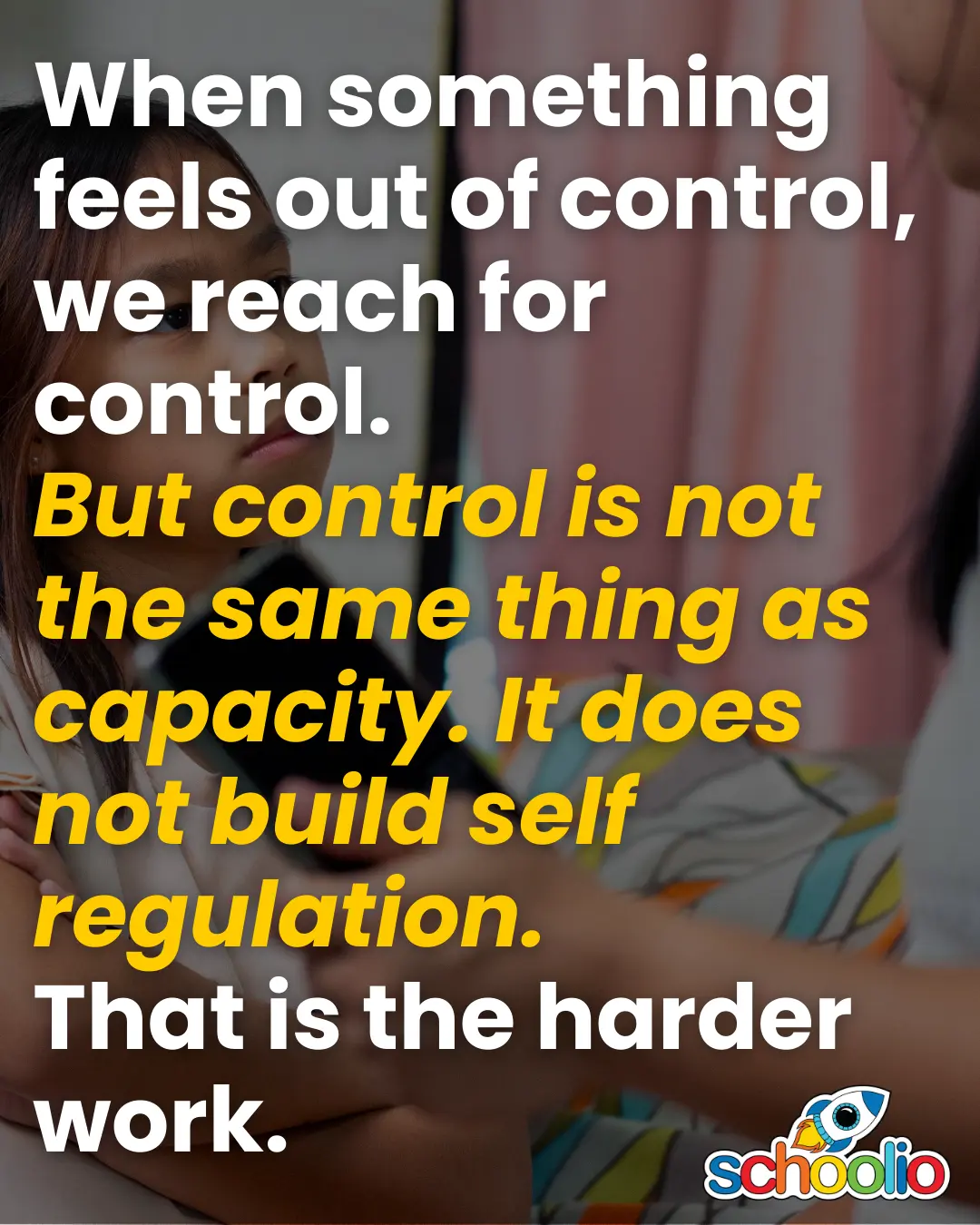
When something feels out of control, we reach for control.

But I am not sure control is the same thing as capacity.

As parents, especially homeschooling parents, we are not just trying to create quiet rooms. We are trying to raise children who can function in a loud world. And the world they are growing into is not analog. It is always on. Always connected. Always competing for attention.

Banning a device can create temporary calm. But it does not automatically build self regulation.

That is the harder work.

The truth is, the system most of us grew up in was not designed for devices in every pocket. Technology was layered on top of a structure that was built for scarcity of information. So of course there is friction.

But pretending devices are purely harmful ignores reality. This generation learns, connects, creates, and even earns through digital tools. The issue is not technology itself. It is distraction. It is design. It is intention.

There is a difference between a child using a math app for 20 focused minutes and scrolling an algorithm built to hijack attention.

One builds skill.

The other fragments it.

In a homeschool setting, we have something powerful that traditional systems often lack. Flexibility. We can decide not just if a device is used, but how and why.

Instead of asking, “How do I eliminate screens?” maybe the better question is, “How do I teach my child to manage them?”

That might look like:

Clear time boundaries.

Purpose driven usage.

Conversations about how algorithms work.

Practicing focus in short, intentional blocks.

Because self regulation is not learned in isolation. It is learned in context.

The real goal is not to control every input. It is to build internal strength. If our kids are going to function in a digital world, they have to practice focus within it, not be shielded from it entirely.

That takes nuance. It takes patience. And it takes modeling the habits we want them to build.

Homeschooling gives us the space to rethink these patterns instead of reacting to them.

And maybe that is the opportunity. Not panic. Not total bans. But thoughtful capacity building in a world that is not slowing down.

Sathish

still learning, still unlearning
When Kids Solve Real Problems, Something Shifts

When Kids Solve Real Problems, Something Shifts


This has been on my mind today…

When kids solve real problems, something shifts.

Not on a report card.

Not in a percentage.

In themselves.

When they fix something broken.

When they build something useful.

When they grow something and watch it thrive.

They begin to believe they can solve bigger problems.

They start to see themselves as capable.

And that belief is not graded. It is felt.

I think this is where many kids quietly disconnect from school.

Not because they are lazy.

Not because they are incapable.

But because so much of what they are asked to do feels disconnected from their living reality.

Pages of theory.

Lessons without context.

Concepts without application.

When learning does not connect to life, it starts to feel performative. Do this to get the mark. Memorize this to pass the test. Complete this because it is assigned.

But this generation is different.

More than ever, they want to know why first.

Why are we learning this?

Where does this show up in the real world?

How does this matter?

If that question is not answered, attention drifts. Motivation fades. Learning becomes compliance instead of curiosity.

We have designed school for efficiency. For scale. For managing large groups. That worked when information was scarce and the classroom was the gateway.

But now information is everywhere.

What is scarce is meaning.

When a child can see how math helps them measure wood for a project, it sticks. When writing helps them communicate an idea they care about, it matters. When science explains something they experience, it connects.

Real work grounds learning in purpose.

And purpose fuels effort.

When kids experience that connection, they do not just complete assignments. They engage. They take ownership. They ask better questions.

Because they are no longer learning for the grade.

They are learning because it makes sense.

If we want more engagement, we cannot just adjust the curriculum. We have to reconnect learning to life.

Because when kids solve real problems, they begin to believe they can solve bigger ones.

And that belief might be the most important outcome of education.


Sathish

still learning, still unlearning


What Non Homeschoolers Need to Understand

What Non Homeschoolers Need to Understand


This has been on my mind today…

I saw a post that said homeschooling ends bullying, pointless peer pressure, and the undermining of family values.

Strong statement.

Whether someone agrees or not, here is what I think non homeschoolers need to understand.

For many families, this decision is not ideological. It is protective.

When I was growing Schoolio, I spoke to thousands of parents. Not angry parents. Not radical parents. Exhausted parents. Parents watching their child shrink. Parents watching anxiety spike. Parents watching confidence erode.

Bullying is real. Social pressure is real. Feeling misaligned with the environment is real.

Does homeschooling magically eliminate all of that? No.

But for some families, it changes the environment enough that their child can breathe again.

And that is what often gets missed in the debate.

It is easy to critique homeschooling from the outside. It is harder to sit across from a parent whose child dreads every morning.

You do not have to choose homeschooling to appreciate why someone else does.

At its best, it is not about escaping school.

It is about restoring stability, identity, and confidence in a child who was struggling inside a system that did not fit.

That deserves more understanding, even from those who would never choose it themselves.

Sathish

still learning, still unlearning
How We Took the Fear Out of Math (Without Making It a Game Show)

How We Took the Fear Out of Math (Without Making It a Game Show)

Math has a reputation in a lot of neurodivergent households.
 
Tears.
Avoidance.
Stomach aches.
Instant shutdown.
 
And I get it.
 
When numbers don’t click easily — especially with dyscalculia, ADHD, processing differences, or math anxiety layered on top — math can feel like a daily threat instead of a skill.
 
For a long time, I thought the solution was to make math “fun.”
 
More games.
More flashy activities.
More attempts to disguise it.
 
But here’s what I learned: Math doesn’t need to be a circus.
 
It needs to feel safe.
 
The Week We Slowed Fractions Way Down
 
One year, we were working on fractions. We were struggling. The kids didn’t get it. I don’t blame them, I’m not great at it either.
 
Instead of continuing to push at that one lesson, I decided we needed to slow everything down and turn one Schoolio lesson and a worksheet, into a full week of understanding.
 
Monday:
We watched the lesson video. Just the concept. No pressure to perform.
 
Tuesday:
We made mini pizzas in the kitchen.
Cut them into halves. Quarters. Eighths.
 
We talked about which pieces were bigger. Which were smaller. Added pieces together.
 
We ate the evidence.
 
Wednesday:
We did the printable worksheet.
Nothing fancy. Low pressure. On the couch. Just gentle practice.
 
Thursday:
We pulled out the Lego.
Built wholes. Broke them into parts. Compared pieces.
 
Friday:
We went back to the original lesson and did the quiz.
Not as a threat — but as a check-in.
 
Did it stick?
Sometimes yes.
Sometimes we needed another week.
And that was okay.
 
Concrete First. Abstract Later.
 
For a lot of neurodivergent kids, abstract math feels slippery.
Numbers on a page don’t mean much.
 
But pizza does.
Lego does.
Cutting something real into real pieces makes fractions tangible.
And once something is tangible, it’s less scary.
 
Less scary means less resistance.
Less resistance means more learning.
 
Predictability Lowers Anxiety
 
The other thing that helped?
Predictability.
 
Math wasn’t a surprise attack.
 
It wasn’t:
“Quick, do this worksheet before you melt down.”
 
It had rhythm.
 
Concept → hands-on → practice → reinforce → assess.
 
That pattern lowered anxiety because they knew what was coming.
 
When the nervous system isn’t bracing for impact, the brain has space to think.
 
It Doesn’t Have to Be Entertaining to Be Gentle
 
Here’s something important:
We didn’t turn math into a game show.
There were no prizes. No countdown clocks. No glitter explosions.
 
We just slowed it down.
We made it concrete.
We made it predictable.
And we removed the pressure to rush.
 
Math doesn’t need to be constantly “fun.” It’s ok to teach our kids that some things in life are hard, but still worth doing.
 
But it should never feel like trauma.
 
There’s a huge difference between effort and fear.
 
I’m okay with effort.
I’m not okay with fear.
 
The Goal Isn’t Speed
 
In traditional classrooms, math often moves fast.
 
New concept. Practice. Test. Move on.
 
But when a child struggles with numbers, speed becomes the enemy.
 
So we changed the metric.
Not: “How fast can you get this done?”
But: “Do you understand it?”
 
And if the answer was no?
 
We stayed.
No shame.
No panic.
No race.
Just peaceful.
 
Because confidence in math doesn’t come from getting everything right.
 
It comes from surviving hard concepts and realizing you can figure them out. Even if it takes time. Even if it’s hard. It’s learning that slowing down isn’t an enemy of progress.
 
If math feels heavy in your house, try this:
 
Stretch one concept across a week.
Touch it. Build it. Eat it. Break it apart.
 
Lower the pace before you try to raise engagement.
 
Sometimes the fear leaves first.
And learning follows.
 
? Lindsey
 
certified special-ed educator, homeschool mom, & co-founder of Schoolio


Curiosity Cannot Be Forced. It Has To Be Sparked.

Curiosity Cannot Be Forced. It Has To Be Sparked.


This has been on my mind today…

I think about curiosity all the time.

As a dad. As a CEO at Schoolio.

Academics can be taught. With enough repetition, most kids can memorize what they need to pass a test. The system is built for that.

But curiosity is different.

Curiosity cannot be forced. It cannot be assigned. It cannot be graded into existence.

It has to be sparked. And once it is sparked, it has to be protected.

Growing up South Asian, curiosity was not exactly encouraged. The path was clear. Study hard. Choose the right career. Do not wander. Wandering looked risky. Distracting. Like falling behind.

Curiosity pulls you sideways. The system pulls you forward.

That tension shapes a lot of childhoods.

We designed Schoolio to spark curiosity. Short lessons. Flexible pacing. Space to explore. Room to ask why.

But here is the real tension.

If parents do not embrace curiosity as the goal, we drift back to measuring the wrong thing. We focus on the grade. The percentage. The transcript.

Grades are easy to track. Curiosity is not.

And yet, as adults, it is curiosity that drives innovation. It builds companies. It fuels reinvention. It is what pushes someone to keep learning long after school is over.

No one asks what your grade was in middle school science.

But the ability to ask better questions. That follows you for life.

At Schoolio, academics matter. Mastery matters.

But curiosity is the engine.

Our job is not just to help kids pass.

It is to help them stay curious long enough to build something meaningful with what they learn.


Sathish

still learning, still unlearning
Don’t Let School Convince You You’re Not Smart

Don’t Let School Convince You You’re Not Smart


My daughter and I spent several hours tonight studying for her math test tomorrow.

She’s neurodivergent. She struggles in math and English because of dyslexia and dyscalculia. There were a lot of tears. And at one point she said something that broke my heart:

“I wish I could just be as smart as everyone else.”

?

So I told her the truth.

Sweetie, everyone has hard things and easy things. Everyone.

This is your hard thing. Reading and numbers are harder for you. They just are. But that doesn’t mean you aren’t smart.

Here’s what no one tells you about school:

School is centered around reading and numbers.

Independent reading is how one adult manages thirty kids in a classroom. Tests are how large groups are measured quickly. The whole structure depends on literacy and numerical processing.

So if reading and numbers are your hard things, school will feel hard.

That doesn’t mean you’re not smart.

It means the system is built around your area of challenge.

And here’s another truth about school:

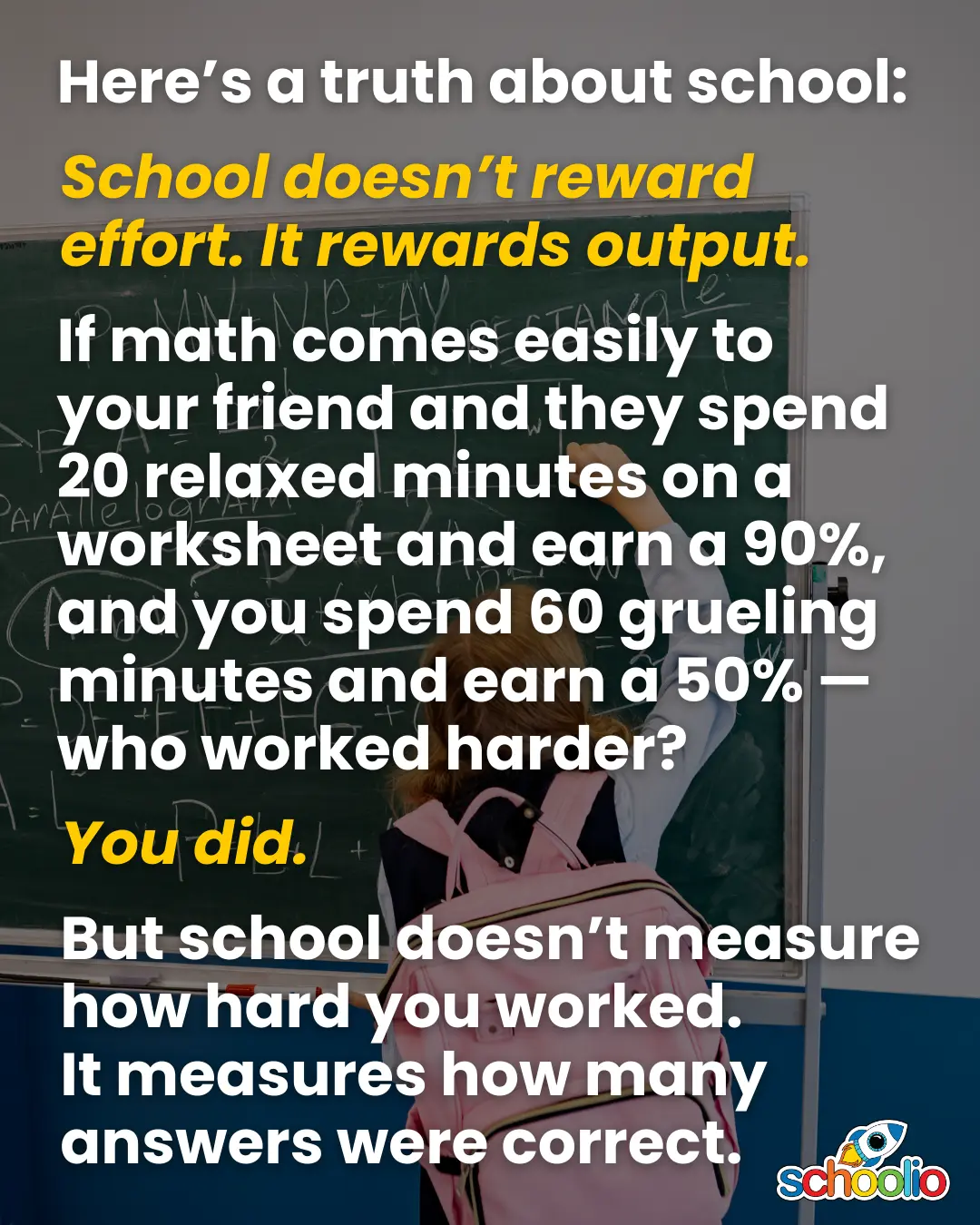
School doesn’t reward effort. It rewards output.

If math comes easily to your friend and she spends 20 relaxed minutes on a worksheet and earns a 90%, and you spend 60 grueling minutes and earn a 50% — who worked harder?

You did.

But school doesn’t measure how hard you worked.

It measures how many answers were correct.

Now imagine something different.

If school were centered around creativity…

or engineering-thinking…

or musical instinct…

or empathy and thoughtfulness…

or responsibility and trustworthiness…

You would be at the top of the class.

You would be absolutely crushing it.

But school doesn’t prioritize those traits.

But guess what? The real world does.

The real world cares that you show up on time.

That you think outside the box.

That you treat people with kindness.

That you keep going when things are hard.

The real world doesn’t care if you use a calculator to figure out a tip.

It doesn’t care if you prefer audiobooks over printed pages.

It doesn’t care how quickly you finish a worksheet.

The most powerful skill you’ll carry into adulthood isn’t mental math.

It’s perseverance.

It’s knowing how to work hard at something that doesn’t come easily.

So please — don’t let school convince you that you’re not smart just because it has a narrow definition of what counts.

Don’t let it shrink how you see yourself.

Don’t let it break your spirit.


? Lindsey

certified special-ed educator, homeschool mom, & co-founder of Schoolio

When a Mom in Our Community Answered a Simple Question with One Word.

When a Mom in Our Community Answered a Simple Question with One Word.


This has been on my mind today…

A mom in our community answered a simple question with one word.

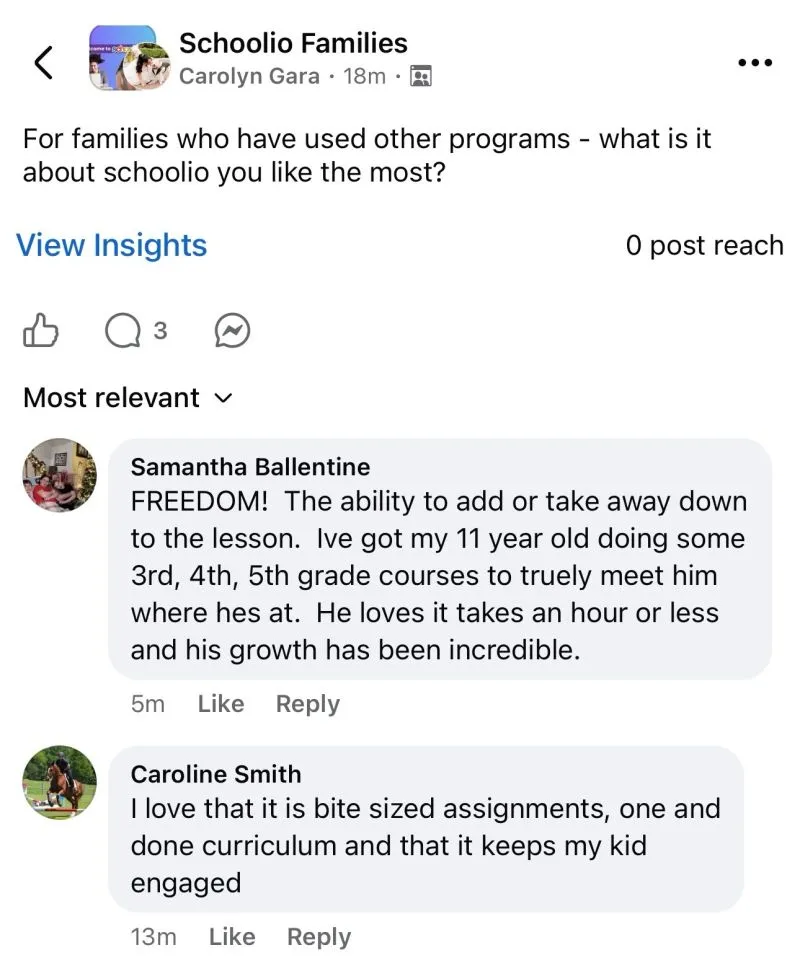
Freedom.

Not freedom from learning. Freedom inside learning.

One parent shared that her eleven year old moves between third, fourth, and fifth grade work depending on the subject. Not because he is behind. Not because he is ahead. Because that is where he is.

Another said she loves the bite sized, one and done lessons. Her child stays engaged. It takes less than an hour. Growth has been incredible.

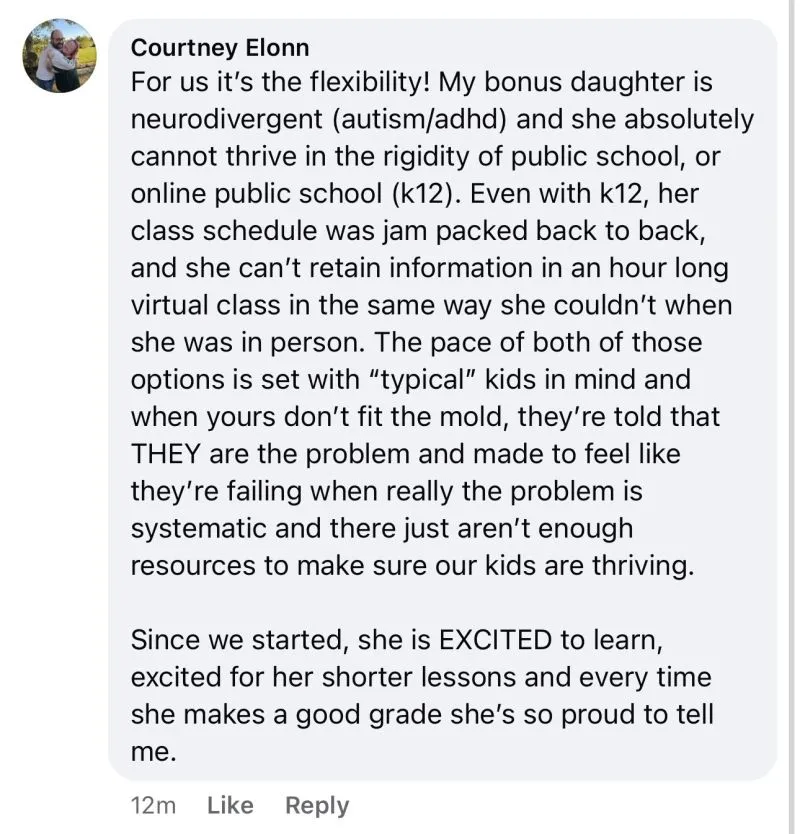
And then a mom of a neurodivergent daughter said something that hit hard. In public school and even online public school, the pace was built for typical kids. When her child could not keep up, she was made to feel like the problem.

Since switching, her daughter is excited to learn. Proud of her grades. Thriving.

This is why homeschooling is becoming more normal across the world.

It is not about escaping school. It is about building systems that adapt to kids instead of asking kids to adapt to systems.

When parents say freedom, what they mean is their child finally fits.


Sathish

still learning, still unlearning
 

If You Want Your Child To Be Social, Do Not Homeschool.

If You Want Your Child To Be Social, Do Not Homeschool.

This has been on my mind today…

I still see this stereotype floating around.

If you want your child to be social, do not homeschool.

It is an old argument built on an outdated picture of what homeschooling looks like.

The idea assumes that socialization only happens in a classroom of same age peers, sitting in rows, moving together by bell schedule. That is not how real life works. Adults are not grouped by birth year. We collaborate across ages, backgrounds, and interests every day.

Modern homeschooling rarely looks like isolation.

Kids are in co ops, sports teams, music groups, church communities, neighborhood pods, volunteer programs, online collaborations, and microschools. Many interact with more diverse age groups than they would inside a single grade classroom.

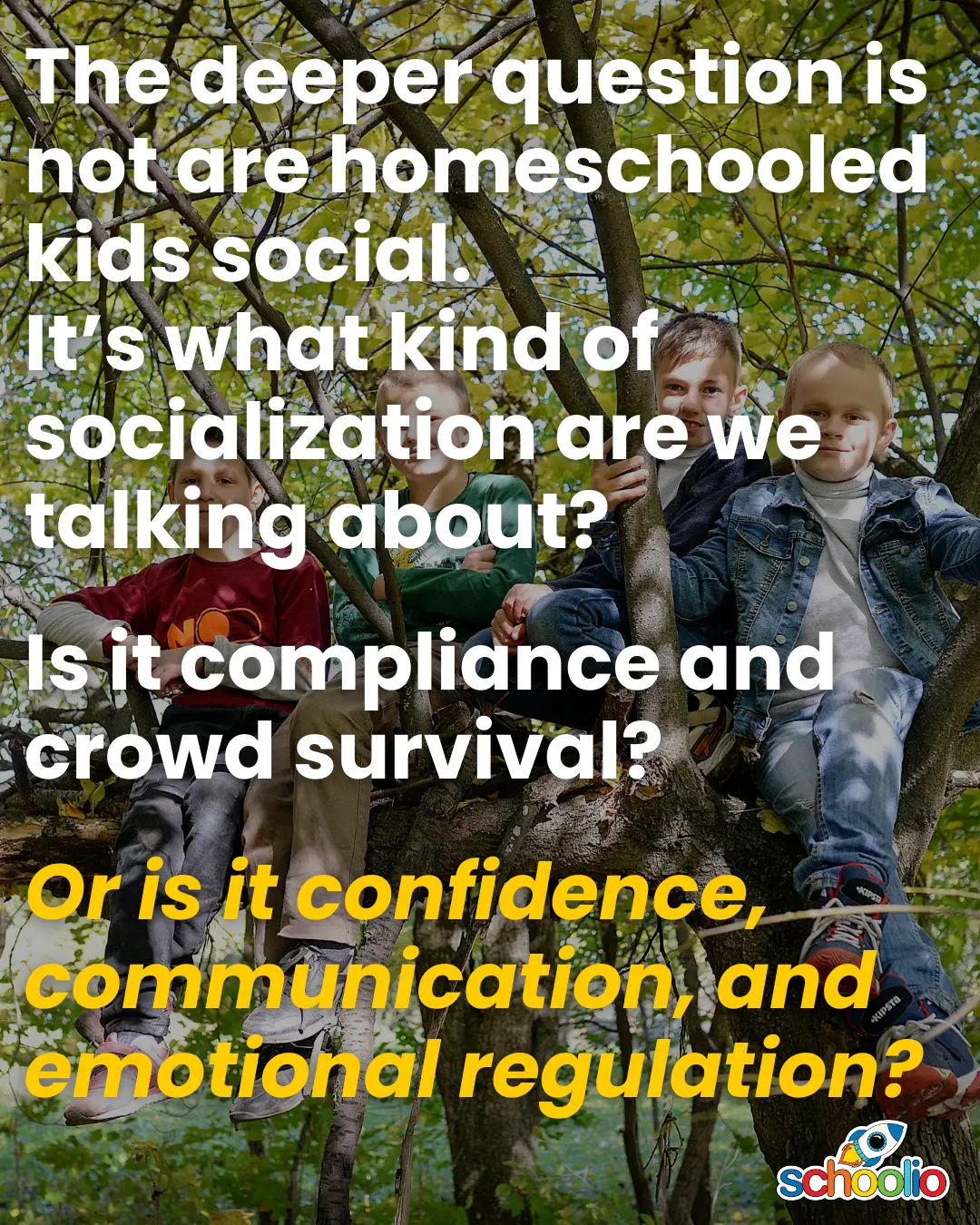
The deeper question is not are homeschooled kids social.

It is what kind of socialization are we talking about.

Is it compliance and crowd survival?

Or is it confidence, communication, and emotional regulation?

I have seen kids who struggled in traditional school labeled antisocial. In reality, they were overwhelmed. Remove the rigidity. Adjust the pace. Give them agency. They open up.

Homeschooling is not anti social. It is intentional social.

The stereotype lingers because it is easy. The reality is more nuanced.

Sathish

still learning, still unlearning
Source: **https://thegatewayonline.ca/2026/02/how-to-be-a-social-person-dont-homeschool/**


Stimming, Fidgets, and Movement in ADHD and Autistic Kids: What It Really Means

Stimming, Fidgets, and Movement in ADHD and Autistic Kids: What It Really Means


If you’ve ever found yourself saying:

“Can you sit still for five minutes?”
“Why are you rocking like that?”
“Stop tapping.”
“Do you have to make that noise right now?”

You are not alone.

Almost every parent of an ADHD or autistic child has had that moment — the one where the movement feels constant. The noise feels repetitive. The fidget feels distracting.

And underneath it all is that quiet question:

Why can’t they just sit still?

Let’s gently flip that question.

What if sitting still isn’t neutral?

What if sitting still actually costs them something?

What Is Stimming?

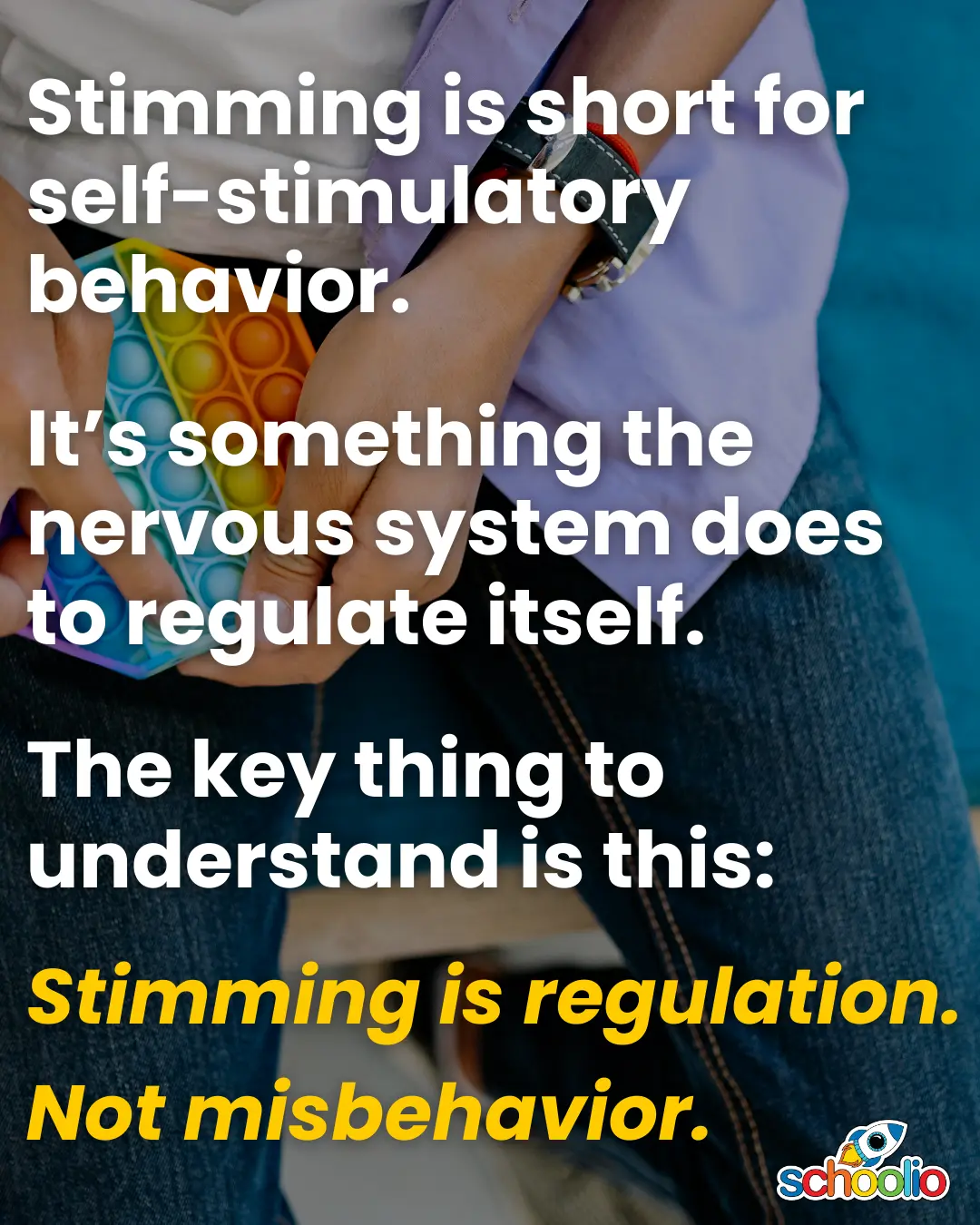
Stimming is short for self-stimulatory behavior.

That phrase sounds clinical, but the meaning is simple:

It’s something the nervous system does to regulate itself.

Everyone stims.

Neurotypical adults:

  • bounce their leg in meetings
  • click pens
  • chew gum
  • scroll their phone when anxious 

Neurodivergent kids often stim more frequently or more visibly — not because they lack discipline, but because their nervous systems require more input to stay balanced.

Stimming can look like:

Rocking.
Flapping.
Pacing.
Spinning.
Humming.
Tapping.
Chewing.
Repeating phrases.

It can also be completely internal — like song loops or counting.

The key thing to understand is this:

Stimming is usually regulation.

Not misbehavior.

Why ADHD and Autistic Brains Move More

ADHD brains are often dopamine-seeking.

Movement increases dopamine.

Autistic nervous systems are often highly sensitive — either seeking more sensory input or trying to regulate overwhelming input.

Movement organizes the body.

Movement grounds the brain.

Movement creates rhythm.

And rhythm stabilizes the nervous system.

When you see your child:

  • leaning upside down in a chair
  • sitting in “weird” positions
  • pacing during lessons
  • needing to move constantly 

You’re likely watching their vestibular system at work (that internal balance and movement system).

They aren’t moving to annoy you.

They’re moving because their brain functions better that way.


Fidgets Aren’t Distractions. They’re Tools.

There’s a common fear among adults that fidgets “distract” children.

But for many neurodivergent kids, the opposite is true.

A small amount of movement can:

  • increase attention
  • reduce anxiety
  • prevent escalation
  • improve working memory
  • support listening 

When the body gets the input it needs, the brain can focus on the lesson.

Think of it like this:

Some brains focus best in stillness.
Some brains focus best in motion.

If we demand stillness from a brain that needs motion, we’re working against biology.

When Stimming Is Suppressed

Here’s the part we don’t talk about enough.

Many neurodivergent kids learn to suppress their stims.

They learn:
“That’s weird.”
“Stop doing that.”
“People are annoyed by you.”

They mask.

And masking takes energy.

Sometimes the child who looks “calm and still” at school comes home and melts down — not because they’re dramatic, but because they’ve been suppressing regulation all day.

Movement that looks disruptive might actually be preventing collapse.

But What If It’s Too Much?

Of course, there are moments when stimming interferes — when it’s loud during a lesson, or physically unsafe, or escalating instead of calming.

The goal isn’t “allow everything always.”

The goal is to ask:

Is this regulating or dysregulating?

If it’s regulating, we support it or modify it.

If it’s dysregulating, we help redirect it to something safer or more grounding.

Instead of saying, “Stop.”

We might say, “Looks like your body needs input. Let’s find a way to help.”

Chewelry instead of hoodie strings.
A wobble cushion instead of tipping the chair.
Pacing while memorizing instead of forcing stillness.

We shift from control to collaboration.

The Homeschool Advantage

This is where homeschooling becomes powerful.

In traditional classrooms, stillness is often equated with compliance.

At home, you get to redefine what learning looks like.

Math while bouncing (we used to do math on the trampoline a lot, especially for rote memorization tasks like multiplication facts!)
Spelling while pacing.
History while building with LEGO.
Audiobooks while swinging.

Movement doesn’t mean they aren’t learning.

Sometimes it’s the only reason they can.

The Bigger Reframe

If you take nothing else from this, take this:

Stimming, fidgets, and movement are not character flaws.

They are nervous system strategies.

And when we understand them that way, we stop asking:

“How do I make this stop?”

And start asking:

“How do I support this safely?”

That shift alone can change the tone of your home.

Once you understand stimming as regulation, everything else makes more sense.

And when parents understand, kids feel safer.

And when kids feel safer, they regulate better.


Focus on Emotional Readiness Before Academics

Focus on Emotional Readiness Before Academics

This has been on my mind today…


I read about a mom in Queen Creek homeschooling her four kids using what she calls a more progressive approach. What stayed with me was not the label. It was the quiet confidence in how she trusted her children instead of managing them.

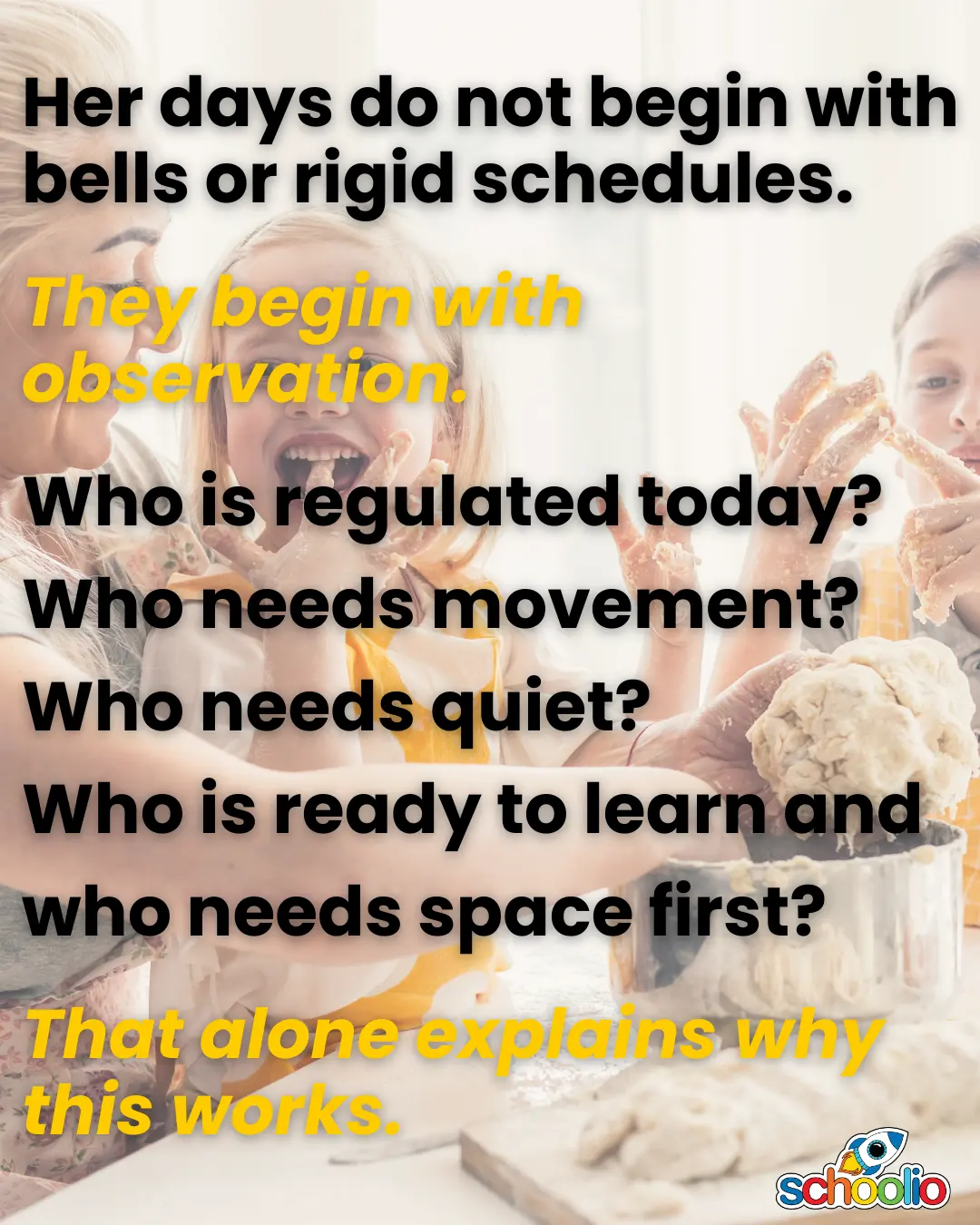
Her days do not begin with bells or rigid schedules. They begin with observation. Who is regulated today. Who needs movement. Who needs quiet. Who is ready to learn and who needs space first. That alone explains why this works.

She uses curriculum, but it is not the authority. It is a tool. Math might happen early for one child and later for another. Reading might be independent one day and shared the next. If something is not landing, she does not push harder. She pivots.

That is the part most systems struggle with. They confuse consistency with rigidity. They confuse pressure with progress.

What stood out most was her focus on emotional readiness before academics. She noticed that when her kids felt safe and calm, learning followed naturally. When they felt rushed or judged, everything shut down. Any parent of a neurodivergent or sensitive child knows this truth deeply, even if they have been told to ignore it.

This approach gives kids permission to go deep instead of wide. One child can stay with science longer without being rushed to keep pace. Another can take extra time with reading without being labeled behind. There is no artificial race. There is only progress that matches the child.

This is not chaos. It is intentional flexibility. It is structure that bends instead of breaks.

For neurodivergent kids especially, this matters. Many of them are not incapable. They are overwhelmed. They are not behind. They are overstimulated. When the environment adapts to them instead of forcing compliance, something powerful happens. Confidence returns. Curiosity comes back. Learning becomes possible again.

And here is where I get more opinionated.

Too many children are being pushed through systems that were never designed for how they think, feel, or regulate. When they struggle, the system calls them broken. This mom did the opposite. She changed the system around her kids instead of asking her kids to change who they are.

The result was not just better learning. It was a healthier home. Fewer battles. More willingness to try hard things. Less fear around mistakes. School stopped being something to survive and became something they could participate in.

That is the part we do not talk about enough.

For parents reading this and wondering what the takeaway is, it is not that you need to homeschool. It is that learning works best when your child feels seen first. Whether you are supplementing, transitioning, or rethinking school entirely, the question to ask is simple.

Is this environment helping my child feel capable or constantly reminding them they are not.

We see families arrive at schoolio from this exact moment. Not angry. Not anti school. Just deeply aware that their child needs something more responsive and more human. Especially neurodivergent kids who have spent years being told to try harder in systems that refuse to adapt.

Stories like this remind me that homeschooling does not have to be extreme or reactive. It can be thoughtful. Calm. Grounded in trust. Built around the child you have, not the one a system expects.

And when education starts there, kids do not just learn more. They believe more in themselves.


Sathish

still learning, still unlearning


Source:

Queen Creek mom of 4 takes a more progressive approach to homeschooling

KJZZ Phoenix

https://www.kjzz.org/the-show/2026-01-13/queen-creek-mom-of-4-takes-a-more-progressive-approach-to-homeschooling

You’re Not Doing It Wrong. You’re Parenting a Neurodivergent Child.

You’re Not Doing It Wrong. You’re Parenting a Neurodivergent Child.


If you’re homeschooling a neurodivergent child, there’s a moment most of us hit where the doubt gets loud.

Your child is bright. Creative. Curious. And yet… school didn’t work. Public school didn’t work. Private school didn’t work. And now, even homeschooling can feel heavy some days.

You start wondering if you’re missing something. If you picked the wrong program. If you should be doing more. If the anxiety around math or reading means you’ve somehow failed them.

I want to say this clearly, because so many parents need to hear it:

You’re not doing it wrong. You’re parenting a neurodivergent child in a world that wasn’t built for them.

So many of the families I talk to are raising kids who are Autistic, ADHD, PDA, dyslexic, anxious or combinations. These are kids with incredible strengths — but they don’t respond well to rigid systems, constant demands, or learning environments that prioritize compliance over safety.

When learning comes with pressure, their nervous systems go into protection mode. Anxiety rises. Resistance shows up. And suddenly the focus isn’t learning anymore — it’s survival.

That doesn’t mean your child is “behind.”

It means the environment hasn’t fit them yet.

One of the hardest parts of homeschooling neurodivergent kids is letting go of the idea that learning should look linear. Or quiet. Or efficient. These kids often learn in bursts. In spirals. In intense interest-driven deep dives, followed by periods where they need rest and regulation more than content.

And that’s not a flaw — it’s information.

A child who struggles with math anxiety isn’t refusing because they’re lazy. A child who avoids reading isn’t failing because they don’t care. A child with PDA isn’t being oppositional — they’re protecting their autonomy because demands feel unsafe in their body.

When we understand that, everything shifts.

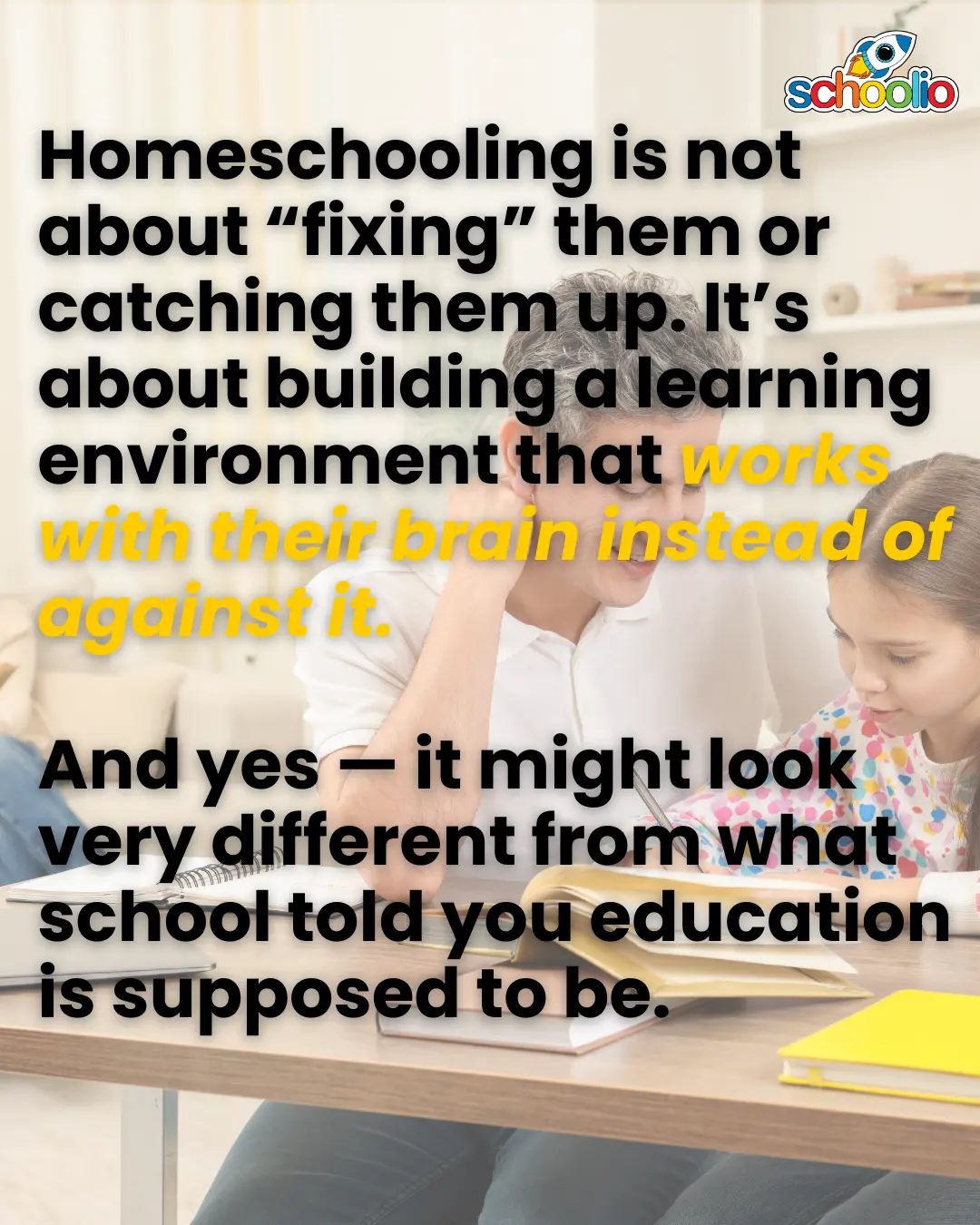
Homeschooling stops being about “fixing” them or catching them up, and starts becoming about building a learning environment that works with their brain instead of against it.

That might mean slowing down.

It might mean breaking lessons into smaller pieces.

It might mean offering more choice.

It might mean focusing on engagement and confidence before academics.

And yes — it might look very different from what school told you education is supposed to be.

But different doesn’t mean wrong.

If you’re showing up, adjusting, listening, and trying to understand your child — you’re already doing the most important part of this work. Neurodivergent kids don’t need perfect plans. They need adults who see them, trust them, and are willing to learn alongside them.

You’re not failing.

You’re learning.

And that’s exactly what your child needs from you.


? Lindsey

certified special-ed educator & co-founder, Schoolio

Why More Parents Are Choosing Homeschooling Even When It Was Never the Plan

Why More Parents Are Choosing Homeschooling Even When It Was Never the Plan


This has been on my mind today…

I read a story recently about a parent who never planned to homeschool. It was not ideological. It was not a protest. It was not about rejecting school. It was simply about responding to a child who was struggling in ways that could no longer be ignored.

That story keeps echoing because it sounds like so many families I speak to.

The decision to homeschool is often framed as a bold choice or a radical one. In reality, for many parents, it is a quiet pivot. A moment where they realize that what is supposed to be working simply is not. Their child is anxious. Or exhausted. Or shutting down. Or falling behind while being told they are doing fine.

What struck me most was how ordinary the story was. No dramatic failure. No single breaking point. Just a slow accumulation of signs that school was costing more than it was giving.

This is something we do not talk about enough.

We talk about grades. We talk about outcomes. We talk about standards. But we rarely talk about the emotional tax school can take on a child who learns differently or feels out of place. We rarely talk about how long parents sit with doubt before making a change. Or how much guilt comes with admitting that the default path might not be the right one for your child.

Homeschooling, in these stories, is not about pulling kids away from the world. It is about bringing learning closer to who they are. It is about restoring confidence. It is about slowing things down long enough for curiosity to return.

Many of these parents still value structure. They still value rigor. They still care deeply about education. They are not opting out. They are opting in differently.

What keeps coming up is this idea of safety. Not physical safety, but emotional safety. The freedom to ask questions without fear. The space to make mistakes without labels. The ability to learn at a pace that does not constantly signal failure.

This is where homeschooling becomes less about location and more about intention.

At schoolio, we see this pattern over and over. Families who did not start out wanting to homeschool. Families who simply wanted their child to feel capable again. Families who wanted learning to stop being a daily battle.

Homeschooling is not a punishment. It is not giving up. It is not settling for less. For many families, it is a way to rebuild trust in learning itself.

Every child has a relationship with education. When that relationship is damaged, it needs care. Sometimes that care looks like staying and advocating. Sometimes it looks like stepping back and rebuilding at home.

What matters most is that we stop pretending there is only one right way.

Homeschooling is not for everyone. But for the families who choose it, often unexpectedly, it is not about escaping school. It is about choosing their child.


Sathish

still learning, still unlearning