When Kids Solve Real Problems, Something Shifts

When Kids Solve Real Problems, Something Shifts


This has been on my mind today…

When kids solve real problems, something shifts.

Not on a report card.

Not in a percentage.

In themselves.

When they fix something broken.

When they build something useful.

When they grow something and watch it thrive.

They begin to believe they can solve bigger problems.

They start to see themselves as capable.

And that belief is not graded. It is felt.

I think this is where many kids quietly disconnect from school.

Not because they are lazy.

Not because they are incapable.

But because so much of what they are asked to do feels disconnected from their living reality.

Pages of theory.

Lessons without context.

Concepts without application.

When learning does not connect to life, it starts to feel performative. Do this to get the mark. Memorize this to pass the test. Complete this because it is assigned.

But this generation is different.

More than ever, they want to know why first.

Why are we learning this?

Where does this show up in the real world?

How does this matter?

If that question is not answered, attention drifts. Motivation fades. Learning becomes compliance instead of curiosity.

We have designed school for efficiency. For scale. For managing large groups. That worked when information was scarce and the classroom was the gateway.

But now information is everywhere.

What is scarce is meaning.

When a child can see how math helps them measure wood for a project, it sticks. When writing helps them communicate an idea they care about, it matters. When science explains something they experience, it connects.

Real work grounds learning in purpose.

And purpose fuels effort.

When kids experience that connection, they do not just complete assignments. They engage. They take ownership. They ask better questions.

Because they are no longer learning for the grade.

They are learning because it makes sense.

If we want more engagement, we cannot just adjust the curriculum. We have to reconnect learning to life.

Because when kids solve real problems, they begin to believe they can solve bigger ones.

And that belief might be the most important outcome of education.


Sathish

still learning, still unlearning


“Not Educable”? Or Just Not Understood?

“Not Educable”? Or Just Not Understood?


This has been on my mind today…


I was in a private “teachers only” Facebook group recently — don’t ask me how I got in ? — and one comment stopped me cold.

“Some of these kids just aren’t educable.”

It triggered me. Deeply.

Because I’ve been that kid.

Because I’ve raised a child labeled “lazy” for not learning the way others expected.

Because I’ve built a company, Schoolio, for the very kids traditional systems are too quick to write off.

When a teacher — someone trained to unlock potential — says a child can’t be educated, what they’re really saying is: “I don’t know how. And I’m not willing to try.” But no child is uneducable. Some are misunderstood.

Some are neurodivergent.

Some are traumatized.

Some are learning in a way you weren’t trained to see.

Education is a relationship, not a one-way delivery service. It’s not just about curriculum — it’s about care, creativity, and compassion.

What we can’t do is confuse a system’s failure with a child’s inability. The system was never designed to serve every child — especially those who learn differently.

And that’s why Schoolio exists.

We don’t believe in “bad kids.”

We believe in bad assumptions, outdated frameworks, and a desperate need for empathy in education. Because when you tell a child they’re uneducable, you’re not describing them — you’re indicting yourself.

So the next time a student struggles… pause.

Ask what’s missing.

Ask how you can adapt.

Ask what support might unlock their potential.

Because learning isn’t a light switch. It’s a spark. You just have to be willing to see it.


Sathish
Still learning, still unlearning


One of Homeschooling Quietest Strengths

One of Homeschooling Quietest Strengths


By Lindsey Casselman, special-ed teacher & homeschooling mom


When I first started homeschooling, I thought a “good homeschooler” had a tidy schedule. Wake up at 8, lessons by 9, neat little blocks of math, reading, and science lined up like ducks in a row.

But then reality stepped in: my kids aren’t ducks, and neither am I.

What I learned over time — and what research keeps confirming — is that one of the most powerful tools we have in homeschooling is also the simplest: sleep.

In traditional school, kids are often shaken awake by alarms, rushed through breakfast, dressed half-asleep, and hustled out the door before their brains have even had a chance to fully wake up. I remember my own school mornings feeling like chaos in fast-forward. But homeschooling gave us the freedom to slow down, and that’s when I noticed something life-changing.

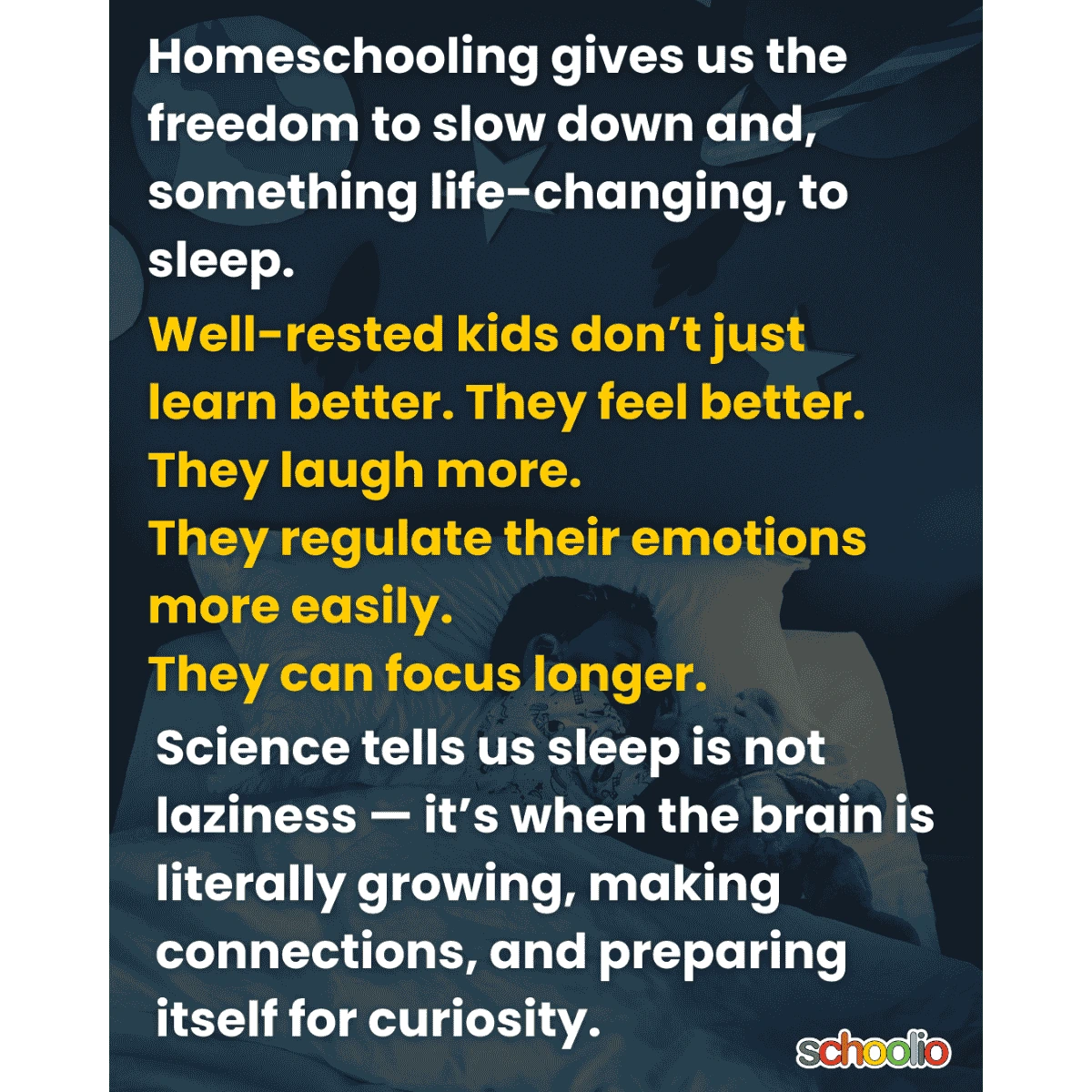
Well-rested kids don’t just learn better. They feel better. They laugh more. They regulate their emotions more easily. They can focus longer, without the constant battle against exhaustion. Science tells us sleep is not laziness — it’s learning in disguise. It’s when the brain is literally growing, making connections, and preparing itself for curiosity.


Here’s what that looked like in our homeschool:

  • Starting the day when my kids naturally woke up, not when a bus schedule dictated.
  • Protecting rest days after big field trips, instead of pushing through.
  • Building gentle morning and bedtime rhythms so transitions felt calming, not chaotic.
  • Letting rest be part of the curriculum, because restoration fuels curiosity.

And here’s the best part: this isn’t “falling behind.” It’s moving forward in a way that honors kids as whole humans — body, mind, and spirit.

So maybe the question isn’t, “Am I doing enough school hours?”

Maybe it’s, “Am I giving my child enough rest to flourish?”

Because the truth is, flexible sleep schedules aren’t a weakness of homeschooling. They’re one of its greatest strengths.


? Lindsey

Certified Special-Ed Educator & Co-Founder, Schoolio

When Science Turned Into a Betta Fish

When Science Turned Into a Betta Fish


By Lindsey Casselman, special-ed teacher & homeschooling mom


One of the things I love most about homeschooling is how easily learning can connect to real life. Sometimes the best projects don’t come from a curriculum guide — they come from your child’s heart.

When my daughter was seven, she desperately wanted a Betta fish. Like many parents, my first instinct was to say, “That’s a lot of responsibility — are you sure you’re ready for that?” But instead of just saying no, I turned it into an opportunity for learning.

We made it her science project. She had to create the classic tri-board presentation — research, write, and present — all about Betta fish. She learned where they live in the wild, what they eat, how to set up the right tank environment, and common mistakes people make in caring for them. But the project didn’t stop at facts. She also had to make the case for why she was ready to take care of one.

I’ll never forget watching her stand in front of that board, confidently explaining filtration systems, water temperatures, and feeding schedules. This wasn’t just a science lesson anymore. It was research skills. Public speaking. Persuasive writing. Responsibility.

And it was driven entirely by her motivation. Because she wanted that fish, she owned the project. She went deeper than she would have if I had assigned “Chapter 3: Aquatic Life.” She wasn’t just doing school — she was preparing for real life.

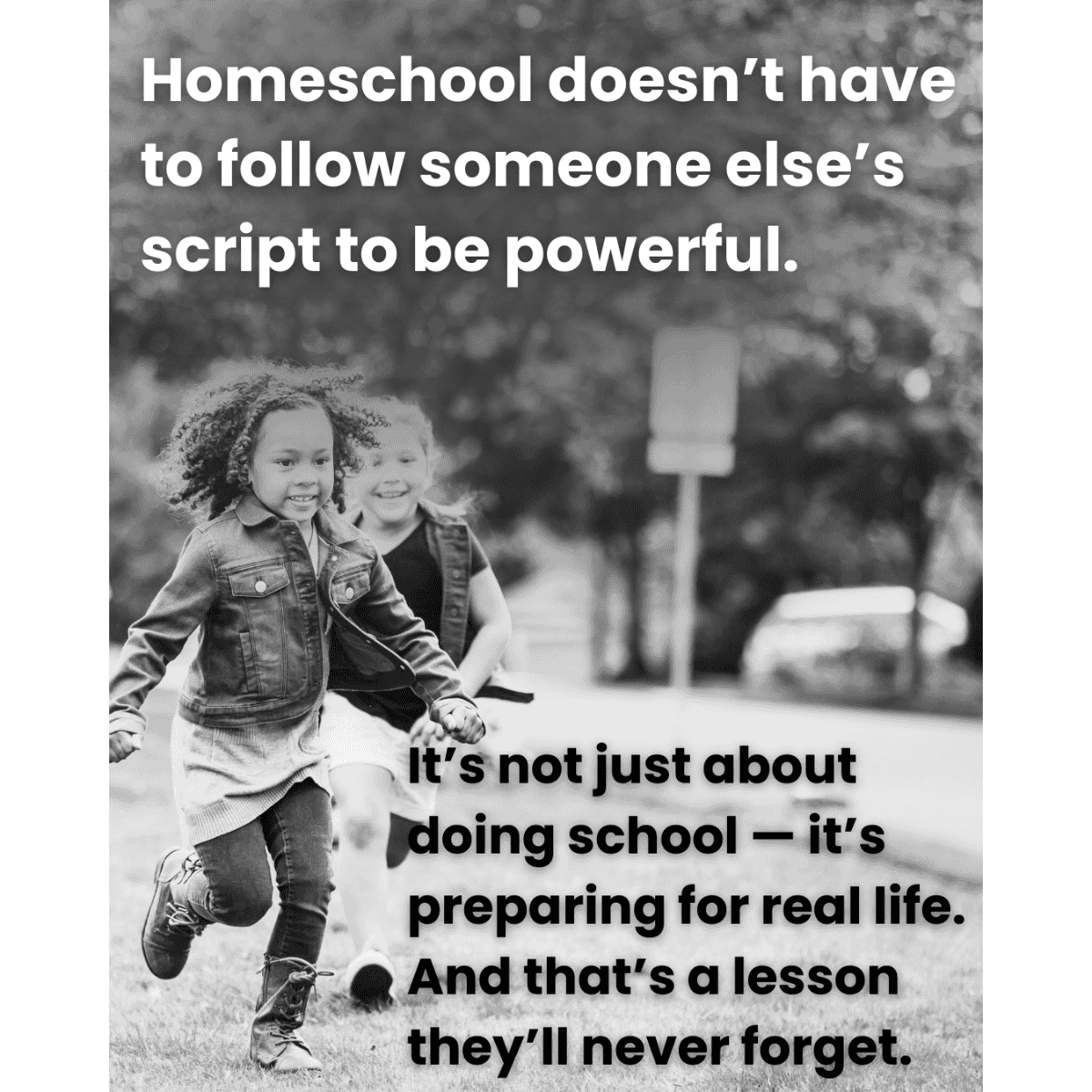
In the end, she did get her Betta fish. But honestly, the project itself was the real win. She learned that with research and preparation, she could rise to a challenge. And I learned (again) that homeschool doesn’t have to follow someone else’s script to be powerful.

And apparently, I also set a precedent in our house without realizing it. Fast forward a few years, and Grace — now 13 — wanted a new pet. Out of nowhere, I found myself sitting on the couch watching a full PowerPoint presentation on why she should be allowed to get a snake. I hadn’t asked for it, and I hadn’t suggested it. She just knew she needed to convince me in a smart and prepared way.

So fair warning: this approach works beautifully for learning… but it may also get you into more pets than you imagined! ?

? Lindsey

Certified Special-Ed Educator & Co-Founder, Schoolio

Why Different Isn’t Wrong

Why Different Isn’t Wrong

I’ve been called a lot of things growing up. Dumb. Stupid. Social butterfly. But the one that stuck with me the most was weird. That word followed me through school hallways, into classrooms, and even outside of school. Most of the time, people didn’t say it to hurt me. They just didn’t understand me. I saw the world differently, noticed things others didn’t, and asked questions that didn’t have simple answers. And I wasn’t trying to fit in. I just didn’t feel like I needed to.

For a long time, I thought being different meant something was wrong with me. I believed the labels. I thought maybe I really was all those things. But over time, I began to realize that the problem wasn’t me. People often label what they can’t understand. It helps them feel like they’ve figured something out. Like sorting clothes into piles when you don’t know where something belongs. It doesn’t mean the clothes are bad. It just means you’re not sure where they fit.

As I got closer to the families who use Schoolio, I started to see pieces of myself in the children they were teaching. I saw it in the kids who struggled to sit still. In the ones who asked more questions than most teachers had time to answer. In the learners who didn’t follow the same path as everyone else. These kids weren’t broken or difficult. They were just full of a different kind of energy. The kind that doesn’t always show up the way school expects it to.

And the parents who choose to homeschool these children are some of the bravest people I’ve met. They don’t take the easy path and don’t choose homeschooling because it’s convenient. Parents do it because they want their child to feel seen and because they believe there’s more than one way to learn. They do it because their child needs something different, and they’re willing to build it themselves.

I think about how far I’ve come. From the kid who didn’t fit in, to someone who gets to support other kids who feel the same way. It’s not about fixing them—it’s about walking alongside them. Being different isn’t something to hide; it’s a part of who they are. And most of all, it’s something to be proud of.

At Schoolio, we get to be a small part of that journey. We get to help children feel understood. And we get to remind parents that their choice to take the road less travelled matters. Because sometimes, that road leads to the most incredible places.


Sathish

still learning, still unlearning

When Does Learning End? For Me, It Was When My Father Went to Sleep

When Does Learning End? For Me, It Was When My Father Went to Sleep


This has been on my mind today…

I saw a post that simply said, “My son’s done with homeschooling in two hours.”

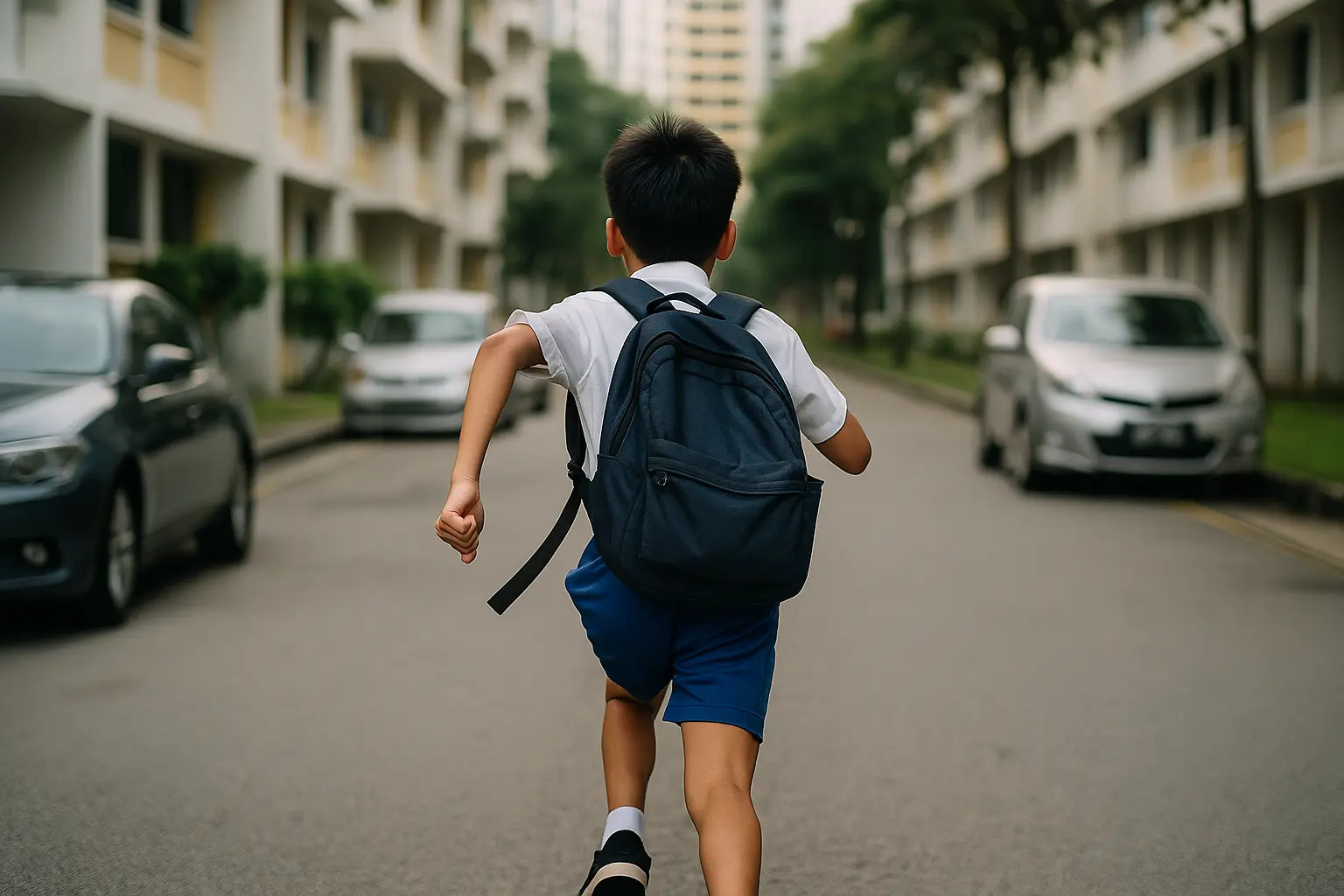
And just like that, I was back in Singapore — racing home from school, not for fun, but out of fear.

See, school for me ended close to 4pm.


school


My parents knew exactly how long it should take for me to get from the gates of the school to the door of our apartment.

If I was late, it wasn’t a missed bus or a slow walk — it was disrespect.

And there were consequences.

But the real weight?

School didn’t end when the bell rang.

It ended when my father went to sleep.

Usually around 6pm, he’d be home — and by then, we had to be seated, heads down, already into our homework or the next stack of extra workbooks.

Every day.

For years.

Twelve to fifteen hours a day spent studying.

Almost no play.

Very little conversation that wasn’t about performance, progress, or punishment.

That was childhood.

And even though I sent my own kids to public school, I made a quiet promise to do things differently.

School ended the minute they walked out of the building.

Evenings were for play.

For laughter.

For sitting together at the dinner table without a pencil in hand.

For movie nights and bike rides and not having to earn joy.

And yet — I see so many of my friends, especially fellow South Indian parents, unknowingly continuing the cycle.

Evenings and weekends filled with more learning.

Catch-up. Push ahead. Get into the best school. Stay ahead of the curve.

But the curve keeps shifting.

The truth is, the world our kids are stepping into will not reward them for how fast they finished a textbook.

It will reward them for their ideas.

For their empathy.

For how well they adapt and connect and create.

Jobs we know today won’t be around by the time they graduate.

Learning styles have changed.

Grades don’t mean what they used to.

Trade skills and entrepreneurship are on the rise.

And I’ll say it — homeschooling is where I’m seeing the balance emerge.

Not because it’s easier.

But because it’s more human.

It’s where a child can complete their day in two focused hours and spend the rest of their time living.

It’s where parents no longer feel the need to steal youth from their kids in the name of preparation.

It’s where play becomes part of the plan, not an afterthought.

And it’s where I’m learning — still learning — how to unlearn the things I was taught to fear.

If your evenings feel like an extension of school instead of a return to family, maybe it’s time for a new way.

Maybe it’s time to put the joy back into childhood.


Sathish

still learning, still unlearning

When Grief Stopped Our Homeschool, and Yet the Kids Didn’t End Up “Behind”

When Grief Stopped Our Homeschool, and Yet the Kids Didn’t End Up “Behind”

This has been on my mind today…

In the fall of 2020, we had a death in the family. The kids were struggling. I was wrecked. And academic learning came to a screeching halt.

I want to be clear: learning never really stops—kids are always learning. But “schoolwork”? That stopped completely. Instead, the kids played with toys. We read books before bed. They watched a lot of TV. We just… existed together.

By February, the fog of grief had lifted only enough for me to feel the heavy weight of guilt. I felt like I had failed my kids that year. I knew I should restart, but I couldn’t find the energy. That guilt eventually pushed me toward my first experiences with online learning. I signed up for a math program, a typing platform, a science video subscription. None of it was structured or connected—I just needed to feel like the kids were doing something. To be honest, I wasn’t really paying attention.

Fast forward to the next year. We started a new grade. I had no idea what they had learned—or not learned—the year before. So I thought, let’s just start fresh and see what happens. And wouldn’t you know it? They were fine. We backfilled here and there, but there wasn’t the gaping hole in their knowledge that I’d been bracing for.

I once read a story from someone who had grown up as a refugee. They had missed three years of formal schooling. When they came to America, they were placed in the grade that matched their age, not their transcripts. And you know what? They did just fine.

That stuck with me. Because the truth is: kids in school aren’t learning as much as we assume. And our kids at home are learning so much more than we realize—even when we think we aren’t “teaching.”

Looking back, I really believe that the space homeschooling gave us to grieve properly—as a family, at our own pace—helped us heal faster and carry less long-term pain. If we had been tied to public school’s “back to normal” timeline, I think the scars would have run deeper.

So if you’re in the middle of a big life change—grief, divorce, a move, a season that shakes your family—please don’t stress about schoolwork. Take care of yourselves. Focus on healing. The academics can wait. And I promise: your kids will be just fine.

Lindsey
certified special-ed educator & co-founder, Schoolio

Homeschooling Is Parenting, Just a Little Louder

Homeschooling Is Parenting, Just a Little Louder

This has been on my mind today…

When we first pulled our kids out of school, I wasn’t sure I had what it took. I had the usual fears. Would I mess up their education? Could I keep up with all the subjects? What if I missed something big?

But over time, something quiet and powerful started to sink in. I wasn’t stepping into a classroom role. I was just continuing what I’d always done as their mom — helping them learn. Teaching them to tie shoes. To ask for help. To apologize. To be kind. Homeschooling, it turns out, is just an extension of parenting.

There’s this quote I came across recently that stopped me in my tracks:

“Educating a child is a natural process. Homeschooling is nothing more than an extension of parenting.”

—John Taylor Gatto

It made me pause because that’s what homeschooling has become for us. It’s not school at home. It’s life at home, full of learning.

The structure looks different, of course. We have a curriculum (Schoolio made that piece so much easier). We have rhythms that feel like school hours some days. But at the heart of it, it’s still me parenting — noticing what lights my child up, what challenges them, what makes them pull away or lean in.

And because it’s just an extension of parenting, the learning is so much more natural. Conversations at lunch become lessons in geography. A baking mess turns into math. A walk in the neighborhood ends up being a discussion about community and kindness and nature.

If you’re feeling unsure about starting homeschooling, or doubting if you’re “qualified,” let me gently tell you this: you’ve already been doing it. Since the day your child was born, you’ve been their guide. Their teacher. Their advocate. Homeschooling doesn’t change that. It just adds a little structure, a little support, and a whole lot of flexibility.

Let’s stop thinking of homeschooling as this big, scary shift. It’s simply parenting — just a little louder, a little more curious, and a lot more present.

Lindsey

certified special-ed educator & co-founder, Schoolio

When Little Things Feel Too Big: Frustration Intolerance in ADHD & Autistic Kids

When Little Things Feel Too Big: Frustration Intolerance in ADHD & Autistic Kids

Does your child melt down the moment something doesn’t go their way? Maybe a math problem is “too hard,” or the Wi-Fi glitches during their game, and suddenly you’re facing tears, yelling, or complete shutdown.

For many ADHD and autistic kids, this isn’t just “having a short fuse.” It’s called frustration intolerance — a real struggle where even small challenges feel unbearable. And if you’re parenting or homeschooling a child who experiences it, you know how exhausting (and heartbreaking) it can be.


What Is Frustration Intolerance?

Frustration intolerance means struggling to cope with situations that are difficult, unpleasant, or don’t go as planned. Instead of “pushing through,” kids may:

  • Explode in anger or tears.
  • Refuse to keep going (“I quit!”).
  • Withdraw completely and shut down.

It’s not about being dramatic. It’s about their brain hitting a wall — and not yet knowing how to climb over it.


Why Neurodivergent Kids Struggle More

For ADHD and autistic kids, frustration intolerance often shows up bigger and louder because of how their brains process the world. Here’s why:

1. Executive Functioning Differences

Planning, organization, emotional control — all of these “thinking skills” are harder for many ND kids. When a task feels overwhelming, their ability to regulate frustration can collapse fast.

2. Sensory Sensitivities

Bright lights, loud noises, scratchy clothes — sensory overload lowers tolerance. Once they’re maxed out, even a tiny frustration feels huge.

3. Dopamine and Motivation

For kids with ADHD, dopamine regulation plays a big role. Tasks that feel boring, slow, or unrewarding become almost impossible to stick with, triggering fast frustration.

4. Rigid Thinking

For many autistic kids, when things don’t go as expected, it’s hard to adapt. A simple change — like math problems being harder than yesterday — can cause them to feel stuck and defeated.


How It Shows Up in Daily Life

Parents of frustration-intolerant kids often see:

  • Homework battles that spiral into tears.
  • Meltdowns over minor inconveniences.
  • Avoidance of activities that might be “too hard.”
  • Perfectionism or quitting early to avoid failure.

If this sounds like your child, you’re not alone. And there are ways to help.


Helping Your Child Cope With Frustration

The good news? Kids can learn to tolerate frustration better — with support, practice, and patience. Here are some strategies you can start using today:

1. Teach Emotional Regulation Tools

Breathing exercises, mindfulness, or fidgets help kids calm their nervous system before frustration takes over. Practice during calm moments so the tools are ready when needed.

2. Break Tasks Into Smaller Steps

Instead of “Write your essay,” try “Brainstorm three ideas.” Smaller steps feel doable — and success builds momentum.

3. Set Realistic Expectations

Match goals to your child’s current capacity. Celebrate small wins and progress, not just the final result.

4. Create a Calm Space

Reduce sensory overload by offering a quiet, comfortable spot for learning or calming down.

5. Use Visual Supports

Schedules, checklists, and timers help make tasks concrete and predictable. Kids feel less overwhelmed when they can see what’s happening and what’s next.

6. Model Problem-Solving

Show them how you handle frustration. Talk through challenges out loud: “This isn’t working. Let’s try another way.” Role-play different solutions together.

7. Stay Patient and Supportive

Setbacks are part of the process. When your child is overwhelmed, validate their feelings: “I can see you’re frustrated. That’s okay.” Then gently guide them toward coping strategies.


Why This Matters

Frustration intolerance doesn’t just impact schoolwork — it shapes how kids see themselves. Without support, they may start believing: “I can’t do hard things.” But with the right tools, they learn that challenges aren’t the enemy — they’re opportunities to grow.


A Hopeful Reminder

If your child struggles with frustration, it doesn’t mean they’re lazy, dramatic, or incapable. It means their brain needs extra scaffolding to build tolerance. And as a parent — especially a homeschooling parent — you have the unique chance to create a space where frustration isn’t the end of the story, but the beginning of resilience.

✨ Want to learn more about frustration intolerance and how it connects to executive dysfunction in neurodivergent kids? Read the full article here ? https://schoolio.com/blog/frustration-intolerance-in-adhd-and-austistic-kids/.
No, I’m Not Sheltering My Kids. I’m Preparing Them Differently.

No, I’m Not Sheltering My Kids. I’m Preparing Them Differently.

This has been on my mind today…

When people hear I homeschool, the first thing they say isn’t about academics. It’s usually something like,

“But how will your kids learn to handle the real world?”

And I get it. I used to ask the same thing.

It took me a while to realize that what we call the “real world” — the world of comparison, competition, cliques, and compliance — isn’t the one I want my kids trained to survive in.

I want them prepared to thrive in the world. And there’s a difference.

I don’t want my children to practice ignoring their needs just to fit in. I don’t want them to believe that being bullied is normal or that stress is a requirement of achievement.

I want them to know how to self-regulate. To set boundaries. To ask big questions. To speak kindly. To be confident in who they are without needing a grade to prove it.

That’s what we’re building at home.

No, we don’t have the same “socialization” that school provides. But you know what we do have?

Conversations that go deep.

Friendships that aren’t based on age.

Time for rest and play.

A learning path that honors their needs, not their test scores.

I’m not sheltering my kids from the world. I’m preparing them to enter it with strength, empathy, and a sense of self that isn’t shaken the first time someone tells them they’re not good enough.

And if that looks different than what most people expect — I’m okay with that.

With love,

Lindsey

Certified Special Ed Educator & Co-Founder, Schoolio

The 4 Things No One Tells You About Pulling Your Kid from Public School

The 4 Things No One Tells You About Pulling Your Kid from Public School

By Sathish Bala

This has been on my mind today…

When we think about homeschooling, we usually focus on the moment of decision — the bold step to withdraw your child from public school. But what no one really prepares you for is what comes next. The emotional rollercoaster. The fear. The freedom. The judgement. And sometimes, the deep, healing relief.

I remember sitting across the table from a group of school officials — a counselor, a legal advisor, the principal. All of them there with one clear message. They believed my daughter needed ADHD medication, and they were pushing hard. Not because we had explored every alternative. Not because she was in danger. But because the system didn’t know what else to do.

I was scared. I felt cornered. As a parent, I questioned everything in that moment — am I wrong? Am I risking her future? What happens if I say no?

But I did say no. I refused to medicate my daughter just to make her more “school ready.” I wanted her to grow up understanding her own mind and body. I wanted her to make choices as an adult with full awareness of the consequences — not be forced into something because a system didn’t have the tools to support her.

That moment was a turning point. It made me realize how many families are pushed toward homeschooling not because they planned to, but because they’re trying to protect their child from a system that won’t bend. And once they do take the leap, here’s what they often discover — the things no one tells you.

1. You’ll grieve what you thought school was supposed to be.

Even when school has been hard or harmful, there’s still a sense of loss. You grieve the routine, the friendships, the path you thought your child would follow. That’s normal. You’re not just changing schools — you’re changing your vision of the future. And that takes time.

2. Your child might decompress in ways you didn’t expect.

When kids leave a stressful school environment, they don’t always bounce back right away. Some become withdrawn. Others act out. Some sleep for days or resist any structure. This isn’t failure. It’s healing. You’ve given them space to feel safe — and that space will eventually be filled with curiosity and confidence again.

3. People will question your decision — sometimes harshly.

Friends, family, even strangers might ask, “Are you sure this is a good idea?” or “But what about socialization?” These questions sting, especially when you’re still figuring things out. But over time, you’ll grow more confident in your path — and your results will speak louder than any opinion.

4. You’ll start to see your child clearly — and that changes everything.

One of the most surprising and beautiful parts of homeschooling is how it reconnects you with your child. You notice their quirks, their strengths, their rhythms. You stop measuring them against someone else’s expectations. And you finally see them — not as a student to fix, but as a whole person with so much potential.


I’ve spoken to hundreds of families now who have made this jump. Some were pushed by crisis. Others chose it proactively. But every one of them, at some point, went through this quiet storm of feelings after leaving the public school system.

If that’s you, I just want to say — you’re not alone. This path isn’t easy, but it’s powerful. And your courage will shape your child’s life in ways no traditional system ever could.

Sathish

still learning, still unlearning

When My Daughter Hyperfocused on Dragons, This Is What I Did

When My Daughter Hyperfocused on Dragons, This Is What I Did

by Lindsey Casselman

From the moment I introduced 8-year-old Grace to the How to Train Your Dragon universe, she become OBSESSED with dragons. This wasn’t just an interest in the movies, it was a full-blown SPIN (special interest).

Dragons. Morning to night. Drawing them. Reading about them. Talking about them. Playing with the toys. Watching the movies. Wearing her dragon costume and sleeping with her dragon stuffies.

But dragons are not real, and not on the list of things to study in our homeschool. We were supposed to be learning about physical geography in Social Studies at that time, and frankly, no one was very excited about it.

Riveting stuff like landforms and regions of North America: plains vs. mountains, the Arctic vs. the Maritimes. The Schoolio course had an ongoing activity throughout where we were creating a booklet as we went through each region, one at a time. Learn the geography. Record the land features, water sources, vegetation, and animals for each.

She had zero interest.

To be honest? Neither did I.

But I’ve been at this long enough to know when it’s time to toss the plan and follow the spark instead. So one day, after reading the lesson to her aloud, I looked at her and said:

“What kind of dragon would live here?”

That was all it took.

Every lesson from that point on was golden. For each region, she studied the environment and designed a dragon that could survive there — down to the smallest detail.

The plains dragon was a dusty yellow and burrowed in wheat fields. It lived in underground dens and hunted at dusk, camouflaging in the tall grasses.

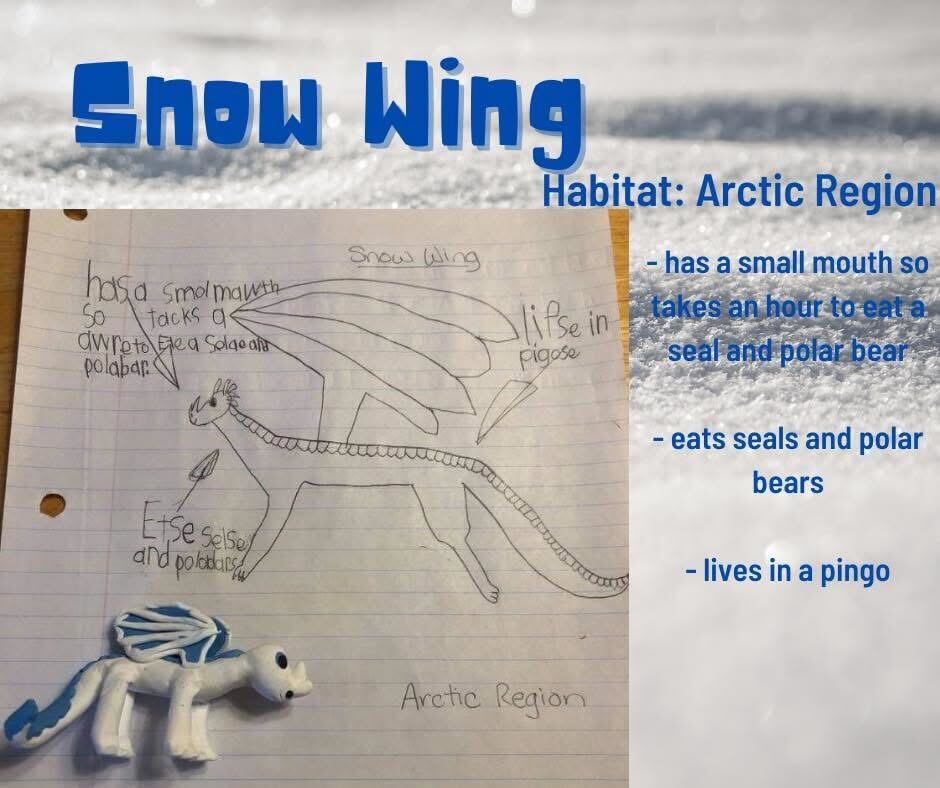
The Arctic dragon was brilliant white, blending into the snow and ice. It was slow-moving, conserving energy in the cold, and had thick scales to withstand frigid temperatures.

Snow wing
Snow Wing Dragon

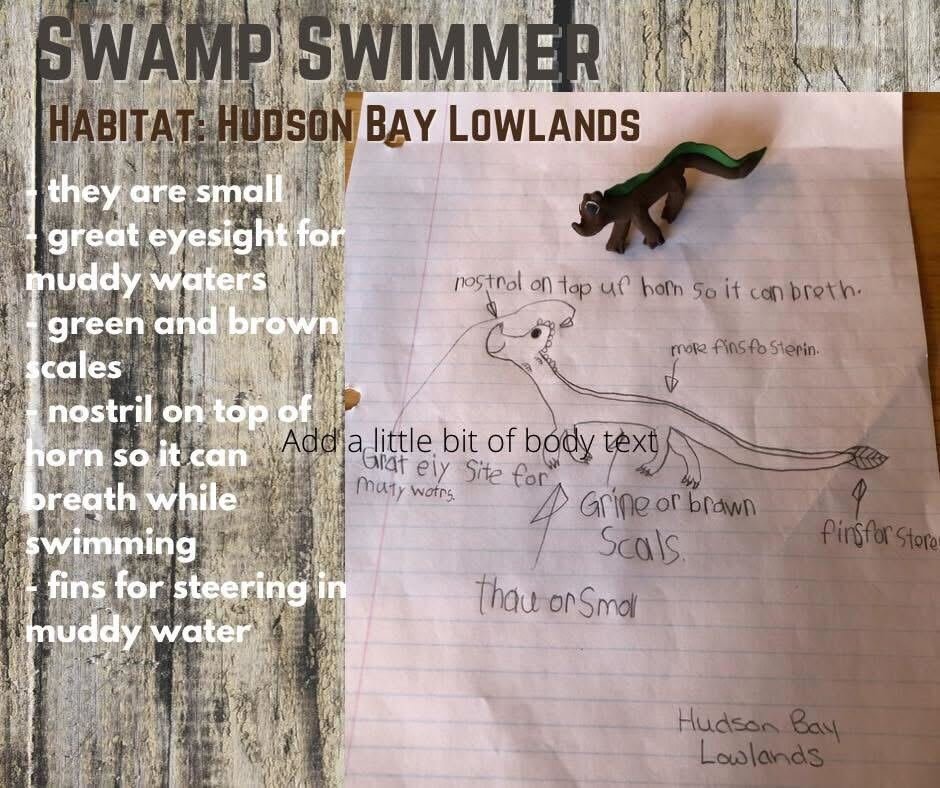
The Maritime dragon? A shimmering blue sea serpent, waterbound and fast, feeding on fish and crustaceans, curled up in coastal caves during storms.

Swamp Swimmer
Swamp Swimmer Dragon

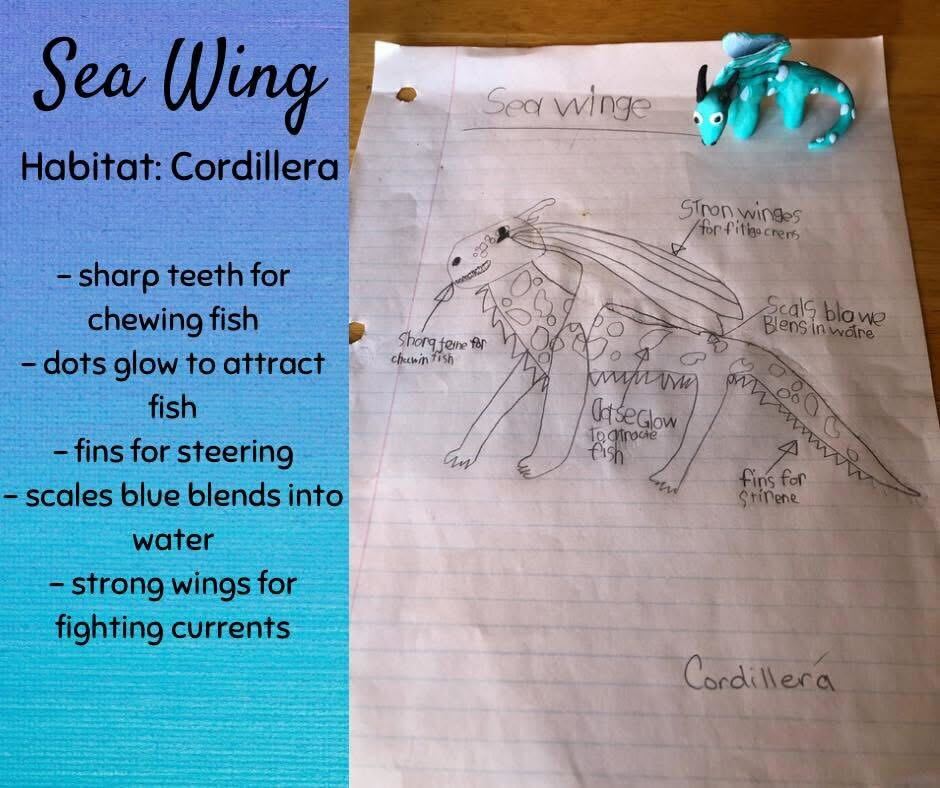
The mountain dragon was stone-grey and jagged, with thick claws that helped it cling to steep cliffs. She told me it would “echo-roar” through the valleys when it was angry.

Sea Wing
Sea Wing Dragon

She even brought out the clay and sculpted each of them — every single one. We had an entire dragon ecosystem on our homeschool table by the end of the week.

And she remembered everything.

Not just the dragons — the geography. The climate. The vegetation. The animals. The features of each region. It stuck.

Because when learning is connected to something meaningful — even something mythical — it matters. It lands. It lives in their brains and bodies in a way a worksheet never could.

We didn’t abandon the curriculum. We just used it differently. And isn’t that the whole point of homeschooling?

To follow the spark. To shift when something’s not working. To take a kid’s hyperfocus and say, “Yeah, let’s go there.”

Dragons and all.

? Lindsey

certified special-ed educator & co-founder, Schoolio