From Homeschooling to Public School: A Success Story

This is my daughter, Grace. This kid… let me tell you about how she CRUSHED it in her first year in public school…

Grace has been homeschooled since Kindergarten, using Schoolio for her academics of course! 

This year, she transitioned into public school for 7th grade. 

Homeschooling to Public School- Public school wasn’t our initial intention for this year, so she ended up starting mid-year, which is hard. It’s not easy to be the new kid arriving part way through the year. In addition, within two weeks of starting, her teacher went out on medical leave and her class had a series of subs. 

It was a busy classroom. 32 kids, only 8 girls, and several unique needs. 

New people. New routines. New world.

How Did She Do?

She finished yesterday, and here’s a recap:

? Won 1st place in a school-wide art contest (peer voting).

? Won 2nd place in the grade 7/8 stock market simulation contest for the year (thank you Schoolio Financial Literacy!).

? Won 1st place in the intermediate music competition.

? Straight A’s (except for French, which was a B+ despite having never taken it before when her peers started in 1st grade).

But there’s so much more to success than academics and accolades…

? She self-advocated in a busy classroom for her needs, even when it was hard.

? She worked her butt off and independently studied for tests, worked on projects, and brought things home when needed.

? She communicated and set boundaries despite being naturally shy.

? She sought help when she needed it from both school staff and her parents.

? She maintained her integrity and did not waver in the face of peer pressure or the treatment she is deserving of. She even said to me that she wished I could come to her school and teach her classmates all the Schoolio Social-Emotional Learning I’ve taught her! 

? She ran TWO petitions in an effort to improve the school environment. Despite being new, she immediately got involved and activated in the community. 

Y’all, she is a FORCE. I met with her teachers and the principal this week and they said not only is she one of the strongest academically, she’s also the most mature in the class.?

Homeschooling to Public School- THIS is homeschooling my friends. This is the result. Are they academically on-par with other kids their age? For sure. Is that even the most important thing? No! She’s well-adjusted, she knows who she is and what she stands for. She’s independent and hardworking. And she has a strong family foundation to help her when things are tough. 

The transition wasn’t always smooth. She had struggles. But she persevered and handled everything so well. 

If this is what a “weird“, “unsocialized“, and “uneducated” homeschooler looks like, then I’m #TeamWeird all day long.

I couldn’t be prouder of my girl. ❤️ I hope that you are all experiencing success, and I want you to know that even though you worry all the time about whether or not you’re doing “enough” (I worried too!), I promise you that you are. 

Congratulations to every homeschooling parent out there. The gift of the homeschooling experience is worth so much more than just the academics you cover every day. You’re doing amazing.

Embracing Neurodiversity: Creative Learning Approaches for Homeschooled Children

Creative Learning- As a homeschooling family navigating the world of neurodivergent homeschooling, you understand the profound importance of tailoring your child’s educational experience to their unique needs, strengths, and challenges. Every child is wired differently, and those with learning differences such as dyslexia, ADHD, or autism spectrum disorders may require innovative and creative approaches to unlock their full potential.

At Schoolio, we celebrate neurodiversity and are committed to providing resources and support that empower families to embrace their child’s exceptional mind. Our approach to neurodivergent homeschooling emphasizes creativity, adaptability, and a deep understanding of each child’s distinct learning style.

Multisensory Creative Learning for Diverse Needs

One of the most effective strategies in neurodivergent homeschooling is the incorporation of multisensory learning techniques. By engaging multiple senses simultaneously, children with learning differences can better process and retain information, making the learning experience more immersive and impactful.

Schoolio’s extensive collection of resources includes a wide range of multisensory materials, from interactive simulations and tactile manipulatives to audiovisual presentations and hands-on experiments. Whether your child is a visual learner, an auditory processor, or a kinesthetic explorer, our flexible approach ensures that their unique learning style is accommodated and celebrated.

Personalized Pacing and Adaptive Curricula

Every child learns at their own pace, and in neurodivergent homeschooling, it’s crucial to embrace a flexible and adaptive approach to curriculum delivery. By tailoring the pace and structure of your child’s education, you can create an environment that nurtures their strengths while providing the necessary support and accommodations for their challenges.

Schoolio’s neurodivergent homeschooling resources include personalized learning plans, customizable curricula, and adaptive assessments that allow you to adjust the pace, delivery method, and content to meet your child’s evolving needs. Our knowledgeable educational consultants are also available to provide guidance and support as you navigate this personalized journey.

Strength-Based Learning and Passion Projects

One of the foundational principles of neurodivergent homeschooling is the recognition that every child possesses unique strengths and talents. By focusing on these strengths and nurturing their passions, you can create a learning environment that fosters motivation, self-confidence, and a love for lifelong learning.

Schoolio’s resources encourage strength-based learning and the integration of passion projects into your child’s educational journey. Whether your child excels in creative arts, technology, or analytical thinking, our materials and support empower you to create learning experiences that celebrate their gifts and fuel their curiosity.

Building Essential Life Skills

While academic achievement is undoubtedly important, neurodivergent homeschooling also emphasizes the development of essential life skills that will serve your child well beyond the classroom. Skills such as self-advocacy, emotional regulation, executive functioning, and social interaction are woven into our neurodivergent homeschooling resources, ensuring a holistic approach to your child’s growth and development.

Through interactive simulations, role-playing activities, and real-world scenarios, your child will have the opportunity to practice and refine these critical life skills in a supportive and nurturing environment, preparing them for a future of independence and self-empowerment.

Inclusive Homeschooling Resources

Inclusivity is at the heart of effective neurodivergent homeschooling. Schoolio offers a variety of inclusive homeschooling resources designed to meet the diverse needs of all students. These resources provide strategies for homeschooling children with ADHD, dyslexia, and autism, ensuring that every child has access to a high-quality, personalized education.

Innovative Homeschooling Methods

To keep learning engaging and effective, it’s essential to incorporate innovative homeschooling methods. Schoolio’s approach includes creative learning approaches that integrate technology, hands-on activities, and collaborative projects. This not only makes learning fun but also helps children develop a wide range of skills.

Tailored Education for Neurodiverse Children

At Schoolio, we believe in the power of tailored education plans. Our resources are designed to meet the specific needs of neurodiverse children, offering adaptive curricula that can be adjusted to fit each child’s learning style and pace. This personalized approach ensures that every child can thrive in their homeschooling environment.

At Schoolio, we understand that neurodivergent homeschooling is a journey of discovery, adaptation, and celebration. Our commitment to providing creative and innovative resources, coupled with our supportive community of educators and fellow homeschoolers, ensures that you have the tools and guidance you need to unlock your child’s full potential.

Embrace the beauty of neurodiversity, and let Schoolio be your trusted partner in crafting a homeschooling experience that celebrates your child’s exceptional mind. Together, we can create a learning environment that fosters confidence, curiosity, and a lifelong love for exploration.

How the COVID-19 Pandemic Changed Schooling

Hey there! Have you ever wondered how the COVID-19 pandemic changed the way kids go to school? Well, let’s dive into what happened and how families are thinking about school differently now.

The Big Shift in School Enrollment

Four years after the pandemic started, many schools are still feeling the effects. In the 2022-23 school year, more kids went back to traditional public schools (TPS), but it’s still not like it was before the pandemic. Before COVID-19, lots of students were already attending TPS. Now, the numbers are about 4% lower than they were in 2019-20.

So, why are some families looking for different options? It’s not just because the population changed or more kids are going to charter schools. There are other reasons too.

Families Exploring New Options

During the pandemic, many parents got a closer look at what their kids were learning because schools moved to online classes. Some parents liked what they saw, but others thought they could find better ways to teach their kids. This led families to explore options like homeschooling or enrolling their kids in private or charter schools.

Perceived School Quality

Parents’ opinions about school quality have changed a lot since COVID-19. In New York City, many parents said they were less happy with their kids’ schools after the pandemic than they were before. This dissatisfaction made some families decide to try different schooling methods.

To get a better understanding, we looked at family satisfaction surveys from New York City Public Schools. These surveys showed that many parents were less satisfied with the education their children received after COVID-19. They felt that schools weren’t preparing their kids well enough for college, careers, and life in general.

The Rise of Homeschooling

Homeschooling became much more popular during the pandemic. In 2019, only about 3.7% of kids were homeschooled. By the fall of 2020, this number jumped to 11.1%. Some families found that homeschooling worked well for them and decided to stick with it even after schools reopened.

Different Reasons for Homeschooling

Before the pandemic, many families homeschooled for religious or moral reasons. After the pandemic, more families started homeschooling because they wanted to give their kids a better or faster-paced education. Some parents felt that their kids needed more help catching up, while others thought their kids could learn more quickly than in a traditional school setting.

Non-Classroom-Based Learning

Not all homeschooling is done completely by parents alone. Some families join groups where they share teaching responsibilities or hire a teacher to help. Others enroll in non-classroom-based charter schools, which allow kids to learn from home but still get support from teachers and access to educational resources.

In these charter schools, students can learn at their own pace while still meeting state education requirements. They are assigned a teacher who checks in regularly to make sure they are progressing well. This option has become popular in states like California and Alaska.

Benefits and Challenges

Homeschooling and non-classroom-based learning have their benefits and challenges. One big advantage is flexibility. Kids can learn at times that work best for them, and parents can tailor lessons to their child’s needs. However, it can also be challenging for parents who have to balance teaching with other responsibilities.

Another benefit is the sense of community that can come from joining homeschooling groups or charter school networks. Kids can still have social interactions through group activities and co-learning sessions. This helps prevent the isolation that some might worry about with homeschooling.

What’s Next for Schools?

The pandemic showed many families that there are different ways to learn. This could mean big changes for traditional public schools in the future. If more families keep choosing other options, some schools might have to close or combine with others.

Public schools will need to adapt to these changes. They might offer more flexible learning options or improve their online learning platforms to meet the needs of students and parents. Schools could also focus on improving communication with families to ensure they feel more satisfied with the education provided.

The COVID-19 pandemic presented a unique opportunity for families to explore different learning approaches. From homeschooling to private and charter schools, many discovered new and exciting ways to help their children flourish. By understanding these diverse experiences, we can shape a future of education that caters to a wider range of learning styles and needs. So, if you could customize your ideal learning experience, what would it look like? The future of education is brimming with possibilities, and it’s up to us to shape it in a way that benefits all learners!

Empowering Parents: The Rise of Homeschooling


Homeschool Programs: Unlocking a World of Personalized Learning

The shift toward homeschooling is reshaping how we think about education, turning homes into dynamic classrooms and parents into educators. This change isn’t just about bringing the classroom home—it’s about reimagining it entirely. Let’s dive into how homeschool programs are empowering families to craft a learning journey as unique as each child.

The Heart of Homeschooling

At the core of the homeschool movement is a simple idea: education can be deeply personal and incredibly flexible. This isn’t just about following a set curriculum; it’s about mixing and matching, experimenting, and finding what truly lights up your child’s curiosity. Whether it’s the arts, sciences, or the magic of the written word, homeschooling allows you to tailor the learning experience, making every lesson resonate with your child’s interests and pace.

Why Families Are Choosing Homeschool Programs

Families flock to homeschooling for its customizability and the quality time it offers. Imagine designing a school day that aligns perfectly with your child’s natural rhythms, interests, and needs. From the early years, where play lays the foundation for learning, to high school, where education becomes a launchpad for future dreams, homeschool programs offer a spectrum of possibilities.

Flexibility and Freedom

One of the standout features of homeschooling is its unparalleled flexibility. No more rigid schedules or one-size-fits-all lessons. Instead, learning happens anytime, anywhere—be it during a morning walk, a visit to the museum, or a hands-on science experiment in the kitchen. This freedom transforms education into a series of adventures, where every day is a chance to explore something new.

Choosing the Right Program

The beauty of homeschooling lies in the sheer variety of programs available. Looking for something budget-friendly? There are options. Need a program for a curious three-year-old? You’re covered. From home study programs that delve deep into specific subjects to comprehensive packages that cover all the bases, there’s a homeschooling solution for every family.

A Future Tailored to Your Child

As more families embrace homeschooling, the education landscape is evolving, becoming more inclusive and adaptable. This movement isn’t just a trend; it’s a testament to the power of personalized education. By stepping into the role of both parent and educator, you’re not just overseeing your child’s education; you’re actively shaping it, ensuring it aligns with their dreams, interests, and strengths.


So, if you’re pondering the path of homeschooling, know that it’s more than a choice. It’s an opportunity to redefine education on your terms, to foster a love of learning in your child that goes beyond textbooks and tests. Homeschooling isn’t just about teaching; it’s about discovering together, growing alongside your child, and watching them flourish on a path that you’ve crafted side by side. Welcome to the journey—it’s going to be an amazing ride.

Rethinking Traditional Homeschooling Methods

Rethinking Traditional Homeschooling Methods

Rethinking Traditional Homeschooling Methods

Should homeschooling only be done with books? The answer is a resounding no. While traditional homeschooling often offers images of a vast library of giant homeschool books. The reality is that every homeschool family has their own rhythm, preferences, and needs. With the rise of technology and innovation in education, homeschooling options have expanded far beyond the confines of printed texts. From online resources to interactive platforms, families now have access to a variety of cost-effective learning resources. That are tailored to their unique circumstances which is causing many to begin rethinking traditional homeschool methods.

Diverse Options for Home Education Curriculum

One such option is Schoolio, a comprehensive home education curriculum provider offering a diverse range of materials to support homeschooling families. Unlike the one-size-fits-all approach of traditional textbooks. Schoolio recognizes that flexibility is key in meeting the diverse needs of learners. Whether families prefer ebooks for easy access and portability, printed workbooks for tactile learning experiences. Or a dynamic online platform complete with lesson videos, downloadable worksheets, and assessments, Schoolio caters to various learning styles and preferences.

Schoolio Family Plan

Finding the Best Homeschool Programs

For families seeking a full year homeschool curriculum, Schoolio’s offerings are particularly enticing. With a focus on quality content aligned with educational standards, parents can rest assured that their children are receiving a robust education without breaking the bank. Moreover, Schoolio’s emphasis on engaging, interactive learning ensures that students remain motivated and eager to explore new concepts.

Exploring Online Learning for Kids

In addition to Schoolio, there are many other homeschool programs and resources available to families looking to embark on the home education journey. Online learning for kids has become increasingly popular. With platforms offering interactive lessons, educational games, and virtual field trips to supplement traditional coursework. From math and science to language arts and history, the options are virtually endless. Which allows parents to tailor their child’s education to their interests and strengths.

Schoolio e-books

The Convenience of Schoolio Family Plan

For those looking rethinking traditional homeschooling methods. That are looking for a comprehensive solution, the Schoolio family plan offers access to a wide range of educational materials for kids at an affordable price. With the convenience of online access and the flexibility to customize learning paths, the Schoolio family plan is ideal for families seeking a cost-effective and convenient homeschooling solution.

Embracing the Diversity of Learning Resources

While traditional homeschooling methods may still have their place, the wealth of resources available in today’s digital age has revolutionized the way we approach home education. With options ranging from online programs to interactive platforms like Schoolio. Families have more choices than ever before when it comes to crafting a tailored learning experience for their children. By leveraging these cost-effective resources, homeschooling families can provide their children with a high-quality education that meets their unique needs and prepares them for success in the modern world.

Schoolio Learning Resources

Rethinking Homework with ChatGPT

Rethinking Homework with ChatGPT

Rethinking Homework with ChatGPT

As students, the burdensome nature of traditional homework is an experience we all share. The struggle to complete assignments outside of class hours, often without teacher or peer support, can be a source of frustration. Fortunately, with innovations like ChatGPT and the Schoolio Learning Platform, a paradigm shift in the way we approach homework is on the horizon. Let’s start by rethinking homework with ChatGPT.

The Drawbacks of Traditional Homework

Homework, a long-standing educational practice, has been both a cornerstone and a source of stress for students. Completing assignments at home, detached from teacher guidance and peer interaction, often leads to confusion and frustration. Additionally, traditional homework can be time-consuming, leaving little room for students to explore other interests or hobbies.

Moreover, it perpetuates inequality, with students from disadvantaged backgrounds lacking the resources and support needed to excel. This contributes to a widening achievement gap among students from different socioeconomic backgrounds.

Schoolio Family Plan

ChatGPT and In-Class Homework on the Schoolio Learning Platform

Enter ChatGPT, an AI-powered chatbot, specifically designed to assist students with their homework. What sets ChatGPT apart is its real-time ability to generate unique questions and solutions.

Utilizing ChatGPT in this manner ensures that all students have the opportunity to complete assignments and seek clarification during class, rendering traditional homework obsolete. This approach not only alleviates the stress associated with homework but also enables teachers to offer immediate feedback and support.

The Advantages of In-Class Homework with ChatGPT

In-class homework, facilitated by the Schoolio Learning Platform, brings forth numerous benefits. The presence of teacher and peer support increases the likelihood of assignment completion. Fostering better learning outcomes and heightened engagement. Real-time assessment of student learning provides valuable insights for teachers to adapt their teaching approaches.

Schoolio e-books

Furthermore, in-class homework becomes a powerful tool for differentiation. Using ChatGPT, teachers can generate questions of varying difficulty levels, catering to both advanced and struggling students. This ensures that all students are actively engaged and appropriately challenged, regardless of their ability level.

Embracing the Future of Education

ChatGPT, coupled with the Schoolio Learning Platform, has the potential to revolutionize our approach to homework. By replacing traditional homework with in-class assignments, we create a more engaging and supportive learning environment for students. This transformative shift levels the playing field for learners from diverse backgrounds, eliminating the struggle with homework and providing equal access to support and resources.

The integration of ChatGPT in classrooms not only transforms the learning experience but also enhances teacher-student relationships. Immediate feedback and support foster stronger connections, contributing to a positive and encouraging educational atmosphere. It’s time for educators to embrace the transformative potential of ChatGPT and the Schoolio Learning Platform, ushering in a new era in education.

Schoolio Learning Resources

Mastering Math: A Step-by-Step Guide on How to Use Schoolio’s Math Assessments

Mastering Math: A Step-by-Step Guide on How to Use Schoolio’s Math Assessments

Mastering Math

Hey there, fantastic homeschooling families! Exciting news in the homeschooling world – Schoolio’s Learning Platform just levelled up with the introduction of Math Assessments. Co-founder Lindsey Casselman is over the moon about it, describing these assessments as “existential yet accessible” – a perfect fit for the best homeschool program out there! Let’s start mastering math with this step-by-step guide on how to use Schoolio’s Math Assessments!

Unwrapping the Math Magic

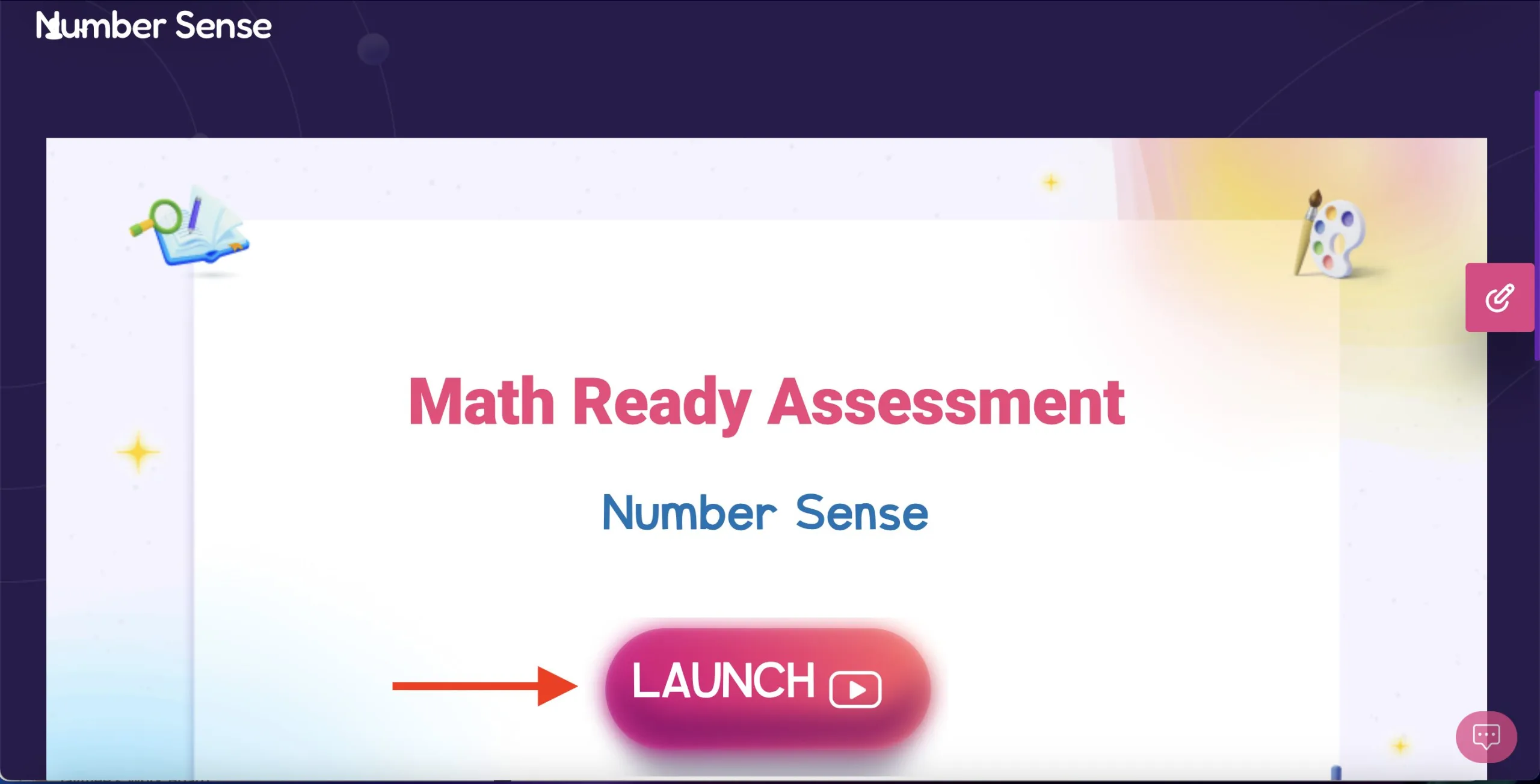
Let’s kick things off with the Readiness Assessment – your secret weapon in understanding your learner’s math universe. It’s like a friendly guide, helping you tailor their math adventure based on where they’re at. No more math mysteries – just a clear path for your homeschooling superhero!

But wait, there’s more to this homeschooling delight! The Final Math Assessment is the grand finale – a chance to celebrate your learner’s math journey throughout the year. It’s like a report card, but way more fun and insightful!

Schoolio Family Plan

Mix, Match, and Personalize

What sets Schoolio’s Math Assessments apart is the ability to mix and match levels. It’s like having a personalized curriculum for your child! Adjust the difficulty, explore challenging concepts, and ensure your learner gets the support they need – all within the comfort of your homeschool haven. Now, let’s dive into the nitty-gritty of adding these fabulous Math Assessments to your homeschooling routine:

Step-by-Step Guide to Adding Schoolio Math Assessments:

Step 1: Log into the Parenting Portal

Head to the Schoolio Learning Platform and log into the Parenting Portal using your credentials.

Step 2: Select your learner

Choose the student you want to add math assessments for – each learner’s journey is unique!

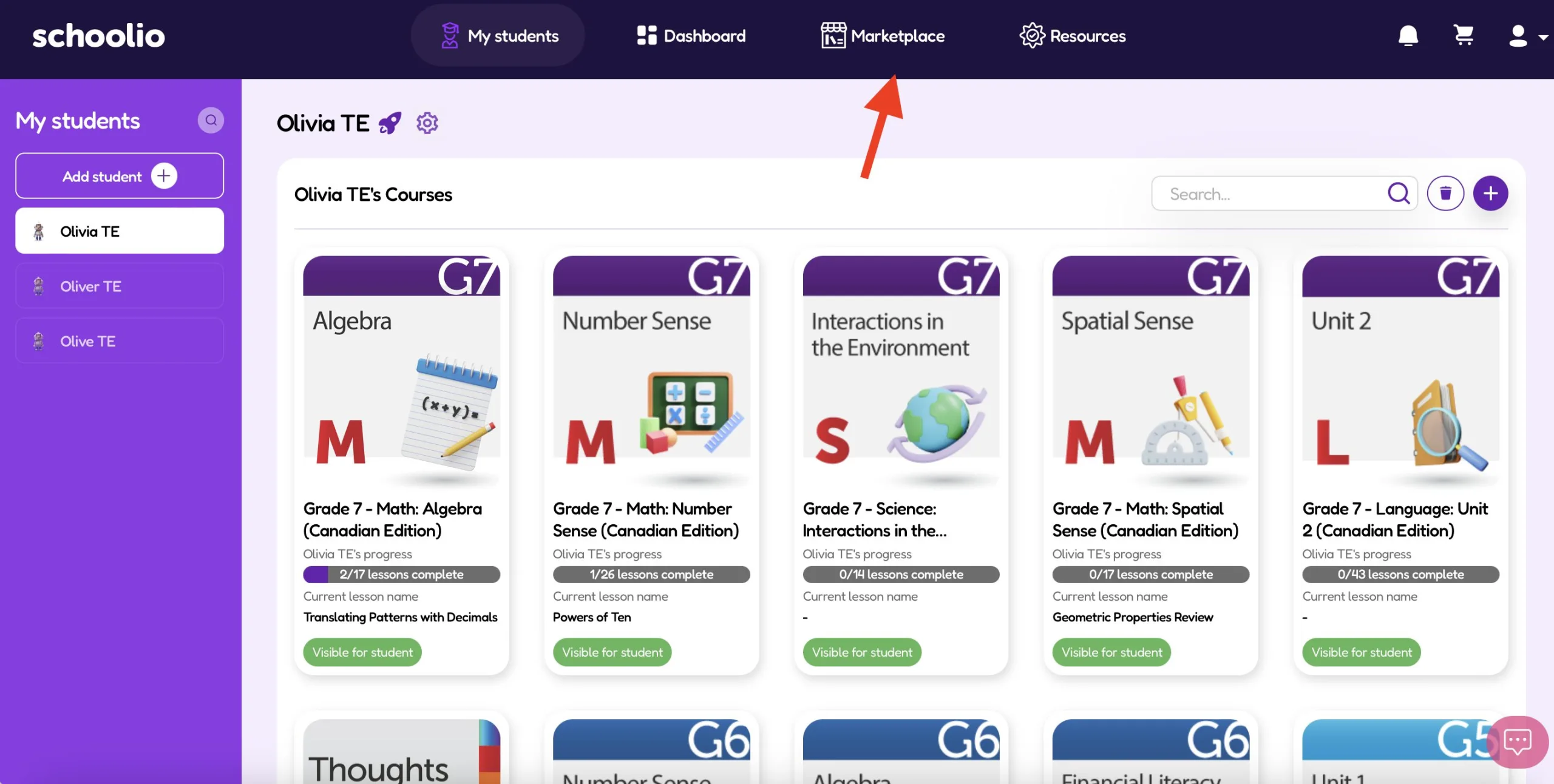
Step 3: Navigate the Marketplace

Navigate the marketplace

Click on “Marketplace” at the top of the screen. This is your gateway to a treasure trove of educational gems.

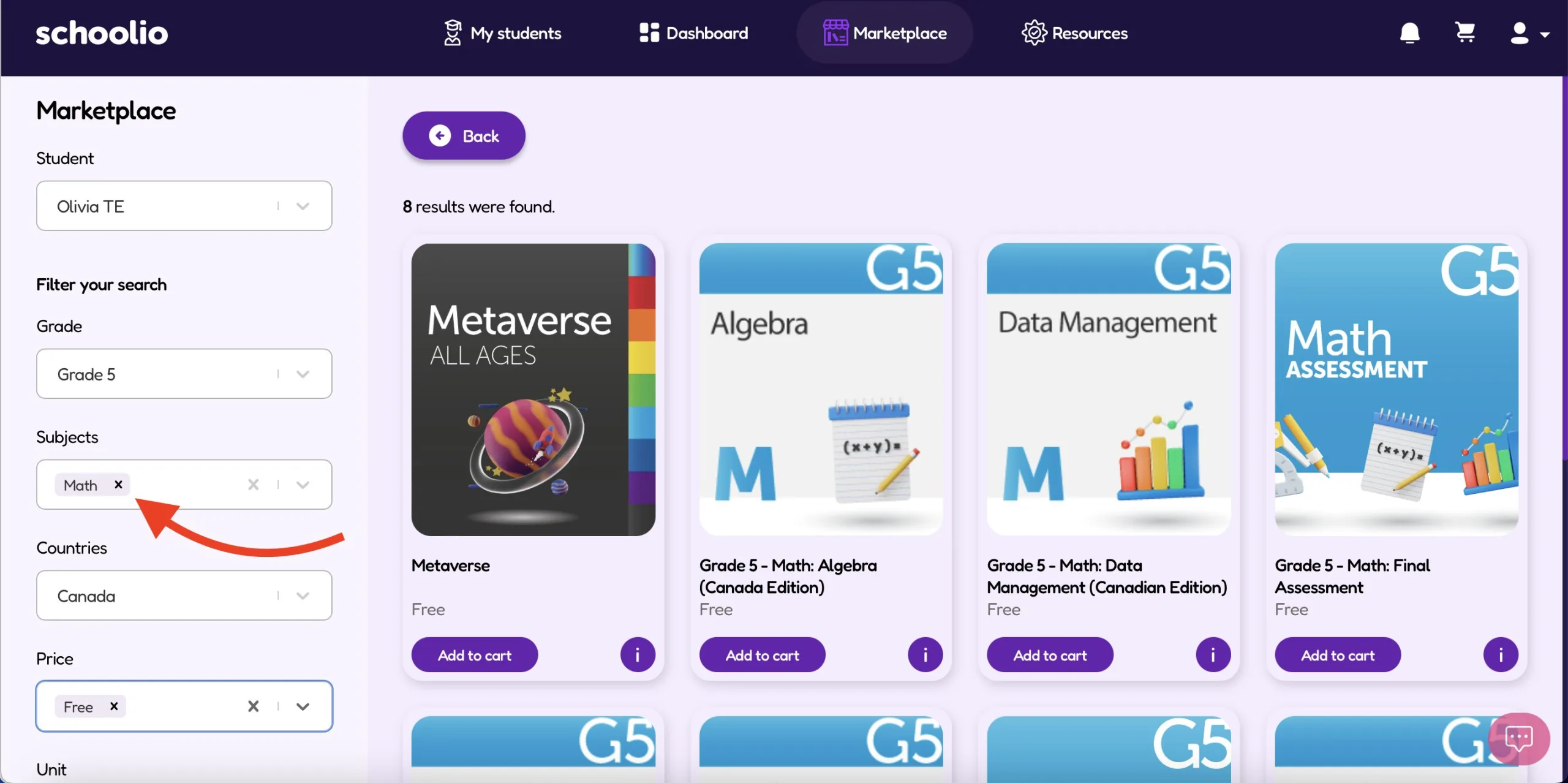
Step 4: Filter for Grade Level and Select Math

Schoolio Marketplace

Adjust the filters to match your child’s grade level and select the magical realm of math.

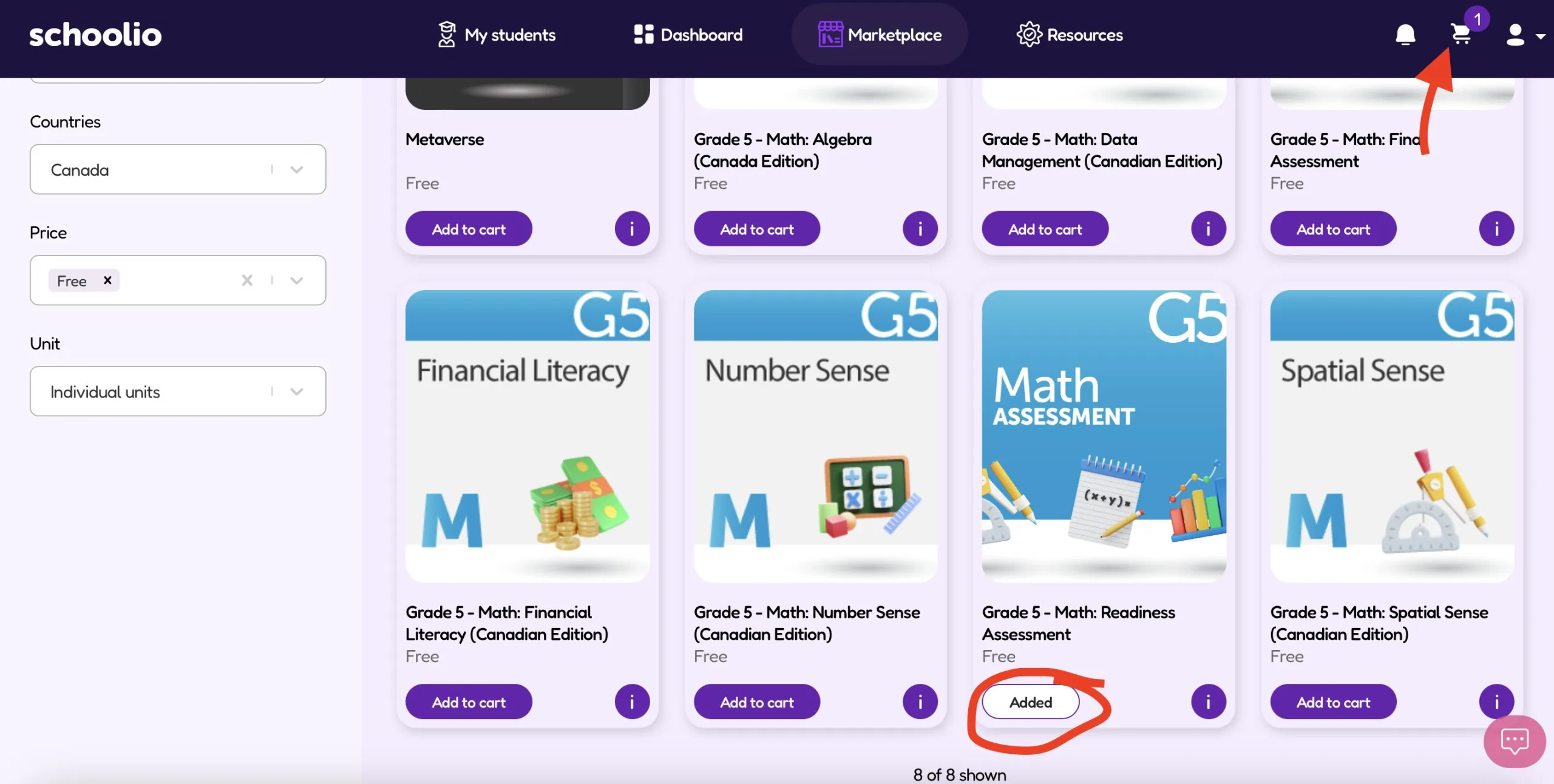
Step 5: Choose Readiness or Final Assessment

Depending on your goals, select either the Readiness or Final Assessment – or both for the ultimate math exploration!

Step 6: Add to Cart and Checkout (but don’t worry they’re included with your subscription)

Final Math Assessment

Click “Add to Cart,” review your selections, and then click ‘Add.’ It’s like creating your own curriculum shopping cart! But again, don’t worry – math assessments are included in your monthly, annual or family plan subscription.

Step 7: Schedule the Assessment or Choose Open Exploration

If your child follows a schedule, make sure to schedule the math assessment. For those on open exploration, ensure the assessments are visible.

Schoolio e-books

Step 8: Log into Your Child’s Account

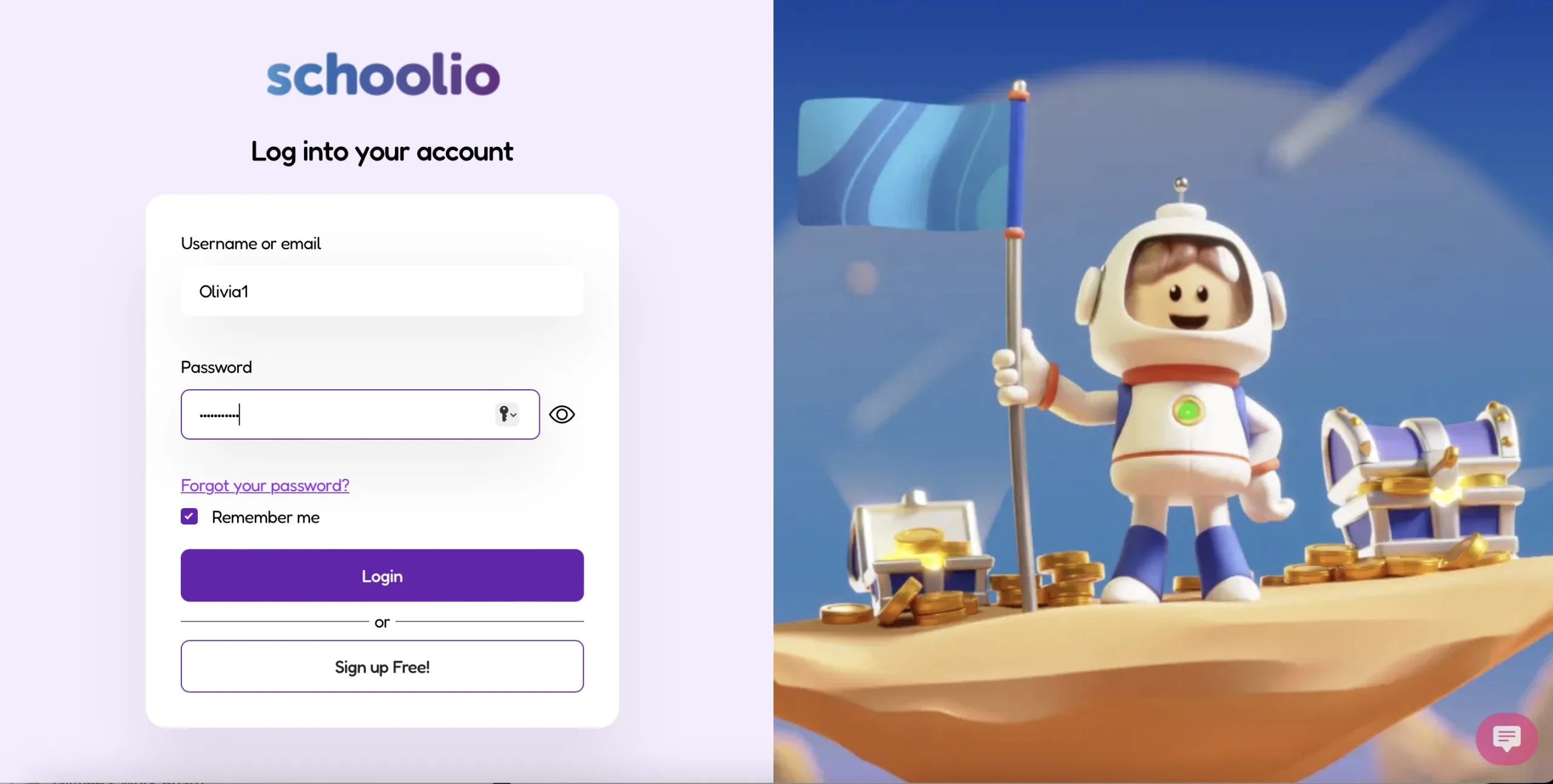
Schoolio student log in

Switch to your child’s account using their username and password. If you share a device, log out of the Parenting Portal first.

Step 9: Take the Math Assessment

It’s showtime! Let your child embark on the math adventure and complete the assessment.

Step 10: Check Results in the Parenting Portal

Parenting Portal

Once done, head back to the Parenting Portal. Voila! The magic unfolds as you see the results and insights from your learner’s math journey.

And there you have it – a seamless way to integrate Schoolio’s Math Assessments into your homeschooling adventure!

Video Tutorial for Extra Fun!

We know diving into new things can be a bit overwhelming, so we’ve got your back! Check out our detailed video tutorial for a friendly walkthrough on how to make the most of the Math Assessments.

Watch this step-by-step guide.

Ready to get started with math assessments for your learner? Dive into the Schoolio Family Plan today – because every homeschooling journey deserves that extra touch of magic!

Schoolio Learning Resources

Why You Should Be Using the Schoolio Digital Platform for Your Homeschool

Why You Should Be Using the Schoolio Digital Platform for Your Homeschool

Why You Should Be Using the Schoolio Digital Platform for Your Homeschool

In the ever-evolving landscape of education, homeschooling has emerged as a dynamic and effective way to nurture the love of learning in children. However, designing a comprehensive curriculum and ensuring a personalized learning experience can be daunting for homeschooling parents. Enter the Schoolio Digital Platform – an all-in-one, grade 1-8 learning solution that aims to revolutionize homeschooling by providing unparalleled customization, engagement, and convenience. In this blog, we will explore why you should be using the Schoolio Digital Platform for your homeschool. And how it will transform your homeschooling journey and create a seamless, enriching experience for your young learners.

Transform Your Homeschool:

When it comes to homeschooling, every parent seeks a comprehensive and personalized solution that nurtures their child’s passion for learning. Look no further than the Schoolio Digital Platform, a game-changing tool designed to revolutionize your homeschooling journey. With its versatile features and cutting-edge capabilities, Schoolio is set to transform how you homeschool your child.

17 Reasons Why You Should Be Using the Schoolio Digital Platform For Your Homeschool:

1. Comprehensive and Up-to-Date Curriculum:

Comprehensive curriculum

One of the most significant advantages of the Schoolio Digital Platform is its comprehensive and up-to-date curriculum. Parents can ensure their children access high-quality educational materials aligned with the latest educational standards. From core subjects like Mathematics, Science, Language Arts, and Social Studies to enriching subjects like Arts and Social Emotional Learning, the platform covers it all, ensuring a well-rounded and robust education.

2. Flexibility to Suit Your Needs:

Homeschooling requires flexibility, and Schoolio understands that. The platform offers two modes of learning – entirely online or partially offline. Parents can choose the option that fits their family’s lifestyle and connectivity requirements. Whether you’re on the go or prefer a more traditional approach, Schoolio adapts to your preferences, making homeschooling an accessible and adaptable choice.

3. Simplified Planning:

Gone are the days of overwhelming planning and organizing. With the Schoolio Digital Platform, parents can plan an entire year of learning with just one click. The platform provides a structured and well-paced curriculum, saving parents time and effort in designing a cohesive educational journey. This streamlined approach allows parents to focus on facilitating learning and spending quality time with their children.

4. Bite-Sized Multimedia Content:

Bite-sized multimedia content

The platform’s bite-sized multimedia content makes learning fun and manageable for young learners. Concepts are broken down into easily digestible units, ensuring students grasp the material effectively. Engaging videos, interactive quizzes, and visual aids create an immersive learning experience that appeals to diverse learning styles.

5. Daily Comprehension Practice and Testing:

Daily Comprehensive practice and testing

Schoolio incorporates daily comprehension practice and testing to reinforce learning and assess progress. Regular assessments help identify areas where additional support may be needed and celebrate achievements, motivating students to strive for excellence.

6. Mix-and-Match Subjects and Grades:

With the Schoolio Digital Platform, homeschooling isn’t restricted by conventional grade levels. Parents can mix and match subjects and grades, allowing students to progress at their own pace. Advanced learners can delve into more challenging content, while others can revisit concepts they find challenging until they master them.

7. Insights into Your Learner’s Daily Mood:

Insights into your learners daily mood

Unlike other learning platforms like IXL, Time4Learning, Prodigy and others Schoolio offers the Vibe Check. With Schoolio’s innovative Vibe Check feature, you gain valuable insights into how your learner is feeling every day. Understanding their emotional state allows you to adapt the learning environment accordingly, ensuring optimal productivity and emotional well-being.

8. Efficient Progress Tracking:

Schoolio simplifies the process of tracking grades, assignments, and completion across all subjects. By providing a centralized dashboard, you can effortlessly monitor your learner’s progress at a glance, making it easier to identify areas that require additional attention or celebration for their achievements.

9. Manage Multiple Learners with Ease:

Manage multiple students with ease

Schoolio offers a user-friendly interface for families with multiple learners that allows you to seamlessly manage all learners’ progress. With just a few clicks, you can view individual progress, making homeschooling a breeze for the entire family.

10. AI-Driven Personalization:

The power of artificial intelligence comes to life with Schoolio’s personalized content and lesson scheduling recommendations. The platform adapts to your learner’s strengths, weaknesses, and interests, delivering a tailor-made learning experience that fosters engagement and academic growth.

11. Abundant Subject Resources:

Abundant Subject Resources

Schoolio boasts an extensive library of thousands of lessons across core subjects, including Mathematics, Language Arts, Science, and Social Studies. These comprehensive resources cater to various learning styles, ensuring your child grasps concepts effectively.

12. Flexible Scheduling and Curriculum:

With Schoolio, you can bid farewell to rigid schedules and one-size-fits-all curricula. The platform enables flexible scheduling based on your learner’s progress and understanding level, allowing them to advance at their own pace and delve deeper into areas of interest.

13. Versatile Learning Formats:

Versatile Learning Formats

Schoolio accommodates various learning preferences by offering audio, video, and printable resources. Whether your child learns best through visual aids or hands-on activities, Schoolio has you covered.

14. Mix-and-Match Grade Levels:

With the freedom to mix and match grade levels, Schoolio caters to learners with varying skill levels. Advanced learners can tackle more challenging content, while others can reinforce foundational knowledge.

15. Digital or Handwritten Practice:

Digital or Handwritten

Schoolio recognizes that learners have unique preferences, allowing you to choose between digital or handwritten practice. This flexibility ensures your child’s comfort while engaging with the material.

16. Comprehensive Secular Curriculum:

Schoolio provides all your secular curriculum needs in one place, offering a well-rounded education for your child. Choose between online or offline access to suit your family’s preferences.

17. 365 Days of Homeschooling Support:

With Schoolio’s unwavering 1:1 homeschooling support, you never have to navigate your homeschooling journey alone. The platform is here for you every step of the way, offering guidance and assistance throughout the year.

Are You Ready to Enhance Your Homeschool?

Why You Should Be Using the Schoolio Digital Platform for Your Homeschool

The Schoolio Digital Platform is a homeschooling game-changer, offering many benefits that cater to your child’s unique learning needs. From personalized AI-driven content and flexible scheduling to abundant subject resources and engaging electives, Schoolio empowers you to create a homeschooling experience that is both enriching and enjoyable. Embrace the future of homeschooling with Schoolio, and watch your child’s passion for learning soar to new heights.

The Metaverse and AI: What Parents Need to Know

The Metaverse and AI: What Parents Need to Know

The Metaverse and AI: What parents need to know

The Metaverse, a virtual world where people interact using digital avatars, and Artificial Intelligence (AI) are two powerful technologies transforming businesses’ operations and innovation. As parents, it’s essential to understand how these developments might impact the future job market and the skills your children need to succeed. Let’s discuss the Metaverse and AI: What parents need to know. 

Combining the Metaverse and AI opens new business growth, collaboration, and innovation possibilities. Companies can leverage these technologies to create immersive customer experiences. While also streamlining operations, and develop innovative products and services. As the business landscape evolves, the demand for professionals with expertise in the Metaverse, AI, and related technologies will grow.

The impact of these technologies on education.

Sathish Bala, CEO of Schoolio.com, emphasizes the impact of these technologies on education: “Today’s children are already exploring the limitless potential of AI through platforms like Roblox. As schools integrate these technologies over the next decade, the boundaries between play and learning will blur, unlocking new and exciting possibilities. In the next ten years, we’ll witness the emergence of entirely new careers that we can’t even imagine yet, and it’s our responsibility to prepare our children for this incredible future.”

For parents, this means preparing their children for a future where the Metaverse and AI play a significant role in the job market. Encouraging your children to develop technology, programming, and creative problem-solving skills will be vital to their future success. In addition, nurturing their curiosity and adaptability can help them thrive in a rapidly changing world.

Artificial Intelligence: What parents need to know

Encouraging children to develop technology and problem-solving skills can be done in several ways. Here are some suggestions:

1. Provide access to technology:

Ensure that your children have access to age-appropriate technology devices. Such as computers, tablets, or coding toys. Encourage them to explore different digital tools, apps, and software that promote problem-solving and critical thinking.

2. Introduce coding and programming:

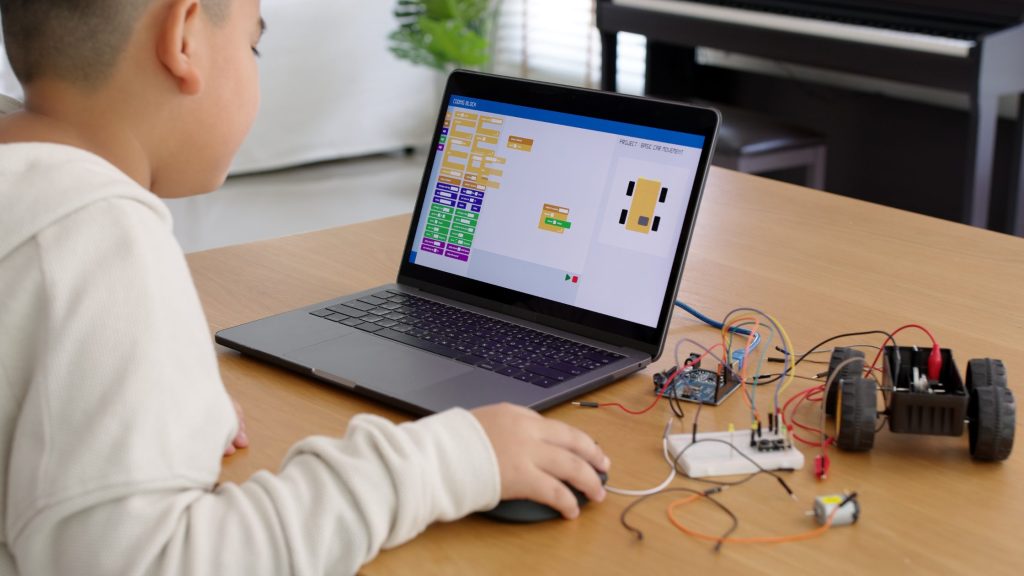
Introduce your children to coding and programming concepts early on. There are various resources available. Such as coding games, online tutorials, and programming languages specifically designed for children, like Scratch or Blockly. These platforms make learning to code fun and interactive.

3. Engage in hands-on projects:

Encourage your children to engage in hands-on projects that require problem-solving. This can involve building and programming robots, creating circuits, or working on DIY electronics kits. Such activities foster creativity, logical thinking, and problem-solving skills.

4. Support their curiosity:

Cultivate your children’s curiosity about technology by answering their questions. While also discussing new technologies, and exposing them to inspiring stories of inventors and innovators. It’s also important to foster an environment where they feel comfortable exploring, experimenting, and asking questions.

5. Encourage critical thinking and problem-solving:

Guiding your children to think critically and approach problems analytically. While also helping them to break down complex problems into smaller, manageable parts and brainstorm potential solutions. And support them in developing problem-solving strategies. Then guide them through the process when they encounter difficulties.

Critical thinking for kids

6. Promote collaboration and teamwork:

Encourage your children to work on technology-related projects with their peers or siblings. Collaboration and teamwork help develop communication skills, foster creativity, and provide opportunities for learning from others.

7. Attend technology-focused events and workshops:

Look for technology-related events, workshops, or camps in your community or online. These can provide your children with exposure to new technologies, opportunities to learn from experts, and chances to interact with like-minded peers.

8. Be a role model:

Demonstrate your own enthusiasm for technology and problem-solving by sharing your own experiences and projects. While also engaging in discussions with your children about technological advancements. And show them how you use technology to solve problems or pursue your own interests.

Remember, it’s essential to strike a balance between technology and other activities. Such as physical play, social interactions, and creative pursuits. Encouraging a well-rounded approach to learning and development will help your children cultivate a broad range of skills and interests.

What parents need to know about ChatGPT

Understanding the responsibility of using these technologies.

As the Metaverse and AI become more prevalent in the business world. It is also essential to be mindful of the potential ethical and societal implications. This is why parents should discuss the importance of data privacy, responsible AI development, and digital citizenship with their children. Doing so to ensure they understand the responsibilities of using these technologies.

The Metaverse and AI are powerful tools that reshape the business landscape. By offering new opportunities for growth and innovation. Parents should be aware of these developments and help their children develop the skills and knowledge necessary to succeed in a world increasingly influenced by these technologies.

How do you teach your child about ChatGPT?

ChatGPT is an exciting tool for anyone interested in natural language processing and AI. But where does ChatGPT fit with education? And how can you teach your child about ChatGPT and this new advancement in technology?

Pick up the Introduction to ChatGPT & Natural Language Processing unit.

Are you ready to show your learner the latest innovative tools? Do you want your learner prepared for a future that may look very different than today? The Schoolio Introduction to ChatGPT & Natural Language Processing course is for you! This unit is perfect for learning together, so don’t be intimidated if the topic is new to you as a teacher!

Introduction to ChatGPT
How to teach ChatGPT to students

Will ChatGPT Change Education?

Will ChatGPT Change Education?

If you have access to the internet, you’ve probably heard of ChatGPT. When people discuss or are asked questions about ChatGPT, you’ll hear a mix of positivity and negativity. Some feel optimistic about the potential this technology brings to the table. For others, there is a fear that technology is advancing too quickly and rapidly changing how things have been. We already see the impacts ChatGPT is having on many different industries, but what about education? Will ChatGPT change education?

What exactly is ChatGPT?

ChatGPT is an artificial intelligence chatbot developed by OpenAI. It is trained on data sources such as books, websites and other text-based materials to recognize patterns in language and generate appropriate responses based on the given input. ChatGPT can respond to conversational text prompts as a natural language processing model. Doing so by providing users with the most likely response based on historical data. However, it is essential to note that the bot’s responses should not be taken as absolute truth. Users should use human discernment, analysis and creativity to use AI outputs ethically and responsibly.

How are different industries using ChatGPT?

ChatGPT and similar AI tools are used in various industries, such as journalism, customer support, and marketing. Companies use these tools in journalism to write articles and generate news headlines. Some companies use ChatGPT to automate responses to common questions and inquiries in customer support. Chatbots are also used in marketing to generate personalized product recommendations and assist in lead generation.

Industries using ChatGPT

In addition, ChatGPT is also being used in the legal industry to assist with contract review and to help lawyers with other legal research tasks. The potential uses for ChatGPT and other AI tools are vast and varied. And as technology advances, we can expect to see even more applications in the future.

Is ChatGPT already being used in education?

Not many people realize that ChatGPT is already playing an active role in education. Here are some examples:

On-Demand Knowledge:

ChatGPT is actively used as a resource for on-demand knowledge in some classrooms and beyond. Students can access ChatGPT through various platforms, such as educational websites or dedicated chat interfaces, which helps them obtain quick answers and explanations to their questions under teacher supervision. Some educators are integrating ChatGPT into their teaching methods, encouraging students to use the AI model to supplement their learning experience. 

Language Learning Companion:

ChatGPT can be used as a language-learning companion in classrooms and language-learning platforms. Students can practice their language skills by conversing with ChatGPT and receiving instant feedback and guidance on their pronunciation, grammar, and vocabulary usage. Language teachers leverage ChatGPT to create interactive lessons, exercises, and simulations, enabling students to develop their language proficiency dynamically and engagingly.

Writing Mentor:

In writing-intensive subjects, ChatGPT serves as an active writing mentor for students. Students can receive real-time feedback on their writing through integrated interfaces or dedicated writing tools, including grammar suggestions, sentence structure improvements, and style recommendations. This immediate assistance helps students refine their writing skills, strengthen their arguments, and produce higher-quality written work.

Is ChatGPT being used in education?

Tutoring and Personalized Learning:

ChatGPT has been used in personalized tutoring and adaptive learning environments. In one-on-one or small group settings, students can converse with ChatGPT to receive personalized instruction and explanations tailored to their needs. The AI model adapts its responses based on the student’s progress, providing targeted support to address areas of difficulty and promote conceptual understanding.

Research and General Knowledge:

Some students and researchers actively utilize ChatGPT as a resource for conducting research and accessing general knowledge, from gathering background information for projects and assignments to exploring complex topics. ChatGPT offers reliable and comprehensive answers (while these answers should be double-checked for accuracy). Students can ask questions, seek clarification, and delve deeper into subjects of interest, expanding their understanding beyond what is traditionally available in textbooks or limited resources.

So, will ChatGPT change education as we know it? 

Education is a dynamic field that is always embracing advancements in technology. Among these innovations, ChatGPT has emerged as a powerful tool for reshaping the learning landscape. As an AI language model, ChatGPT has already made a significant impact on education. However, its potential to further change education is even more promising. In this blog post, we’ll explore how ChatGPT could revolutionize education and transform how students learn, and educators teach.

Is ChatGPT changing education?

Personalized Learning at Scale:

ChatGPT has the potential to deliver personalized learning experiences to a large number of students. By leveraging adaptive algorithms and user data, ChatGPT can analyze individual learning patterns. While also identifying knowledge gaps and tailoring instruction to meet each student’s unique needs. This personalized approach ensures students receive targeted support and resources, promoting better engagement, improved comprehension, and enhanced academic outcomes.

Virtual Classroom Assistance:

Imagine a virtual classroom where ChatGPT seamlessly integrates with video conferencing platforms, providing real-time assistance to students and educators. ChatGPT can actively participate in discussions, answer questions, provide additional examples or explanations, and facilitate student collaboration. This virtual classroom assistant can alleviate the workload on educators, foster student engagement, and create an inclusive learning environment.

Adaptive Assessments and Feedback:

ChatGPT’s language processing capabilities enable it to assess student work and provide valuable feedback. It can automatically grade assignments, essays, and quizzes, considering factors beyond mere correctness. Such as creativity, critical thinking, and clarity of expression. This adaptive assessment and feedback system saves time and provides students with detailed insights into their strengths and areas for improvement, fostering self-directed learning and growth.

Multilingual and Culturally Diverse Education:

With its language proficiency, ChatGPT has the potential to transcend language barriers and enable multilingual and culturally diverse education. It can provide language support for students learning their non-native language. While also facilitating language exchange programs and offering insights into different cultures and perspectives.

AI-Assisted Curriculum Development:

ChatGPT can assist educators in curriculum development by analyzing vast amounts of educational content. And also provide recommendations for improving curriculum design. By leveraging its knowledge base and understanding of educational objectives. ChatGPT can identify gaps, suggest new topics, and even predict emerging areas of study. This AI-assisted curriculum development ensures that educational institutions stay at the forefront of knowledge. While also adapting to the changing needs of learners.

What are the experts saying? 

Janeen Peretin, Director of Communication, Innovation and Advancement, Baldwin-Whitehall School District. Shared with EdTech Magazine that it’s crucial students use the tool to help understand the concept they are struggling with. Not simply copy and paste the solution. Peretin also shared that the ChatGPT tool can be useful for students struggling with their homework. She stated that the tools could be “a springboard to help the student move beyond the hurdle that is before them and continue with an assignment,” Peretin says.

“In this case, it is important that the student use the tool to help understand the concept that they were struggling with and not simply cut and paste the solution. Here, I can see generative AI tools as liberators and confidence boosters for anyone needing assistance outside of normal school hours. These tools can also help provide feedback on an original piece of writing that students can use to modify and enhance their compositions.”

A recent poll on ChatGPT and generative AI Showed:

Even with all the challenges and worries about ChatGPT. A recent EDUCAUSE QuickPoll showed more than half of participants (54 percent) actually felt optimistic and even very optimistic about generative AI. With only 12 percent feeling pessimistic or very pessimistic.

ChatGPT in education, a helpful tool or a hindrance? 

Ultimately, integrating AI, such as ChatGPT, in education represents an opportunity for change. While also enhancing and reshaping the learning experience. While opinions may vary, there is a consensus that AI has the potential to provide personalized support, expand access to knowledge, and promote engagement and critical thinking. However, ethical considerations, concerns about limitations, and the need for human guidance remain essential aspects of the discussion.

The answer is balance.

The key lies in finding a balanced approach that leverages AI as a valuable tool to complement human educators rather than replace them. Collaboration between AI and educators can lead to innovative teaching methods, adaptive learning environments, and improved educational outcomes. Continued research and evaluation are needed to understand the impact, address limitations, and ensure the responsible integration of AI in education.

The key is balance

The most important goal is to create a learning ecosystem that combines the strengths of AI technology with the human touch. And at the same time, fostering a holistic and inclusive education that empowers learners to thrive in an ever-evolving world. Suppose we embrace the potential of AI in education and approach it carefully. In that case, we have the potential to unlock new possibilities while also creating a brighter future for learners worldwide.

Check out this unique unit for teaching ChatGPT to your students!

Introduction to ChatGPT & Natural Language Processing

How to Teach Your Students about ChatGPT

How to teach your students about ChatGPT.

ChatGPT is an AI language model that uses machine learning to generate human-like responses to text inputs. It is trained on a large corpus of text data and can be used for various applications, such as chatbots, language translation, and content generation. ChatGPT is one of the most advanced language models available and is constantly being updated and improved by its developers. ChatGPT is an exciting tool for anyone interested in natural language processing and AI. But where does ChatGPT fit with education? Are you wondering how to teach your students about ChatGPT?

Teaching your students about ChatGPT can prepare them for the rapidly changing world.

Technology is rapidly improving and changing how we live, work, and learn. With advancements in AI and machine learning, we see an increasing number of intelligent systems that can help us accomplish tasks more efficiently and accurately.

For example, ChatGPT is one such tool that is helping to revolutionize how we interact with technology. As teachers, it is vital to keep up with these technological advancements and to understand how they can be used to enhance the learning experience for our students. By incorporating tools like ChatGPT into our classrooms, we can help our students become more familiar with the latest technology and prepare them for the rapidly changing world.

Benefits of incorporating technology in your classroom. 

Education and ChatGPT

Incorporating technology in your classroom has numerous benefits. It can help students engage with the subject matter in new and exciting ways, as well as facilitate collaboration and communication between students. Technology can also help to level the playing field for students who may have different learning styles or needs, allowing them to access the content in a way that works best for them.

Additionally, technology can help to streamline administrative tasks, such as grading and attendance, freeing up more time for teachers to focus on teaching. Overall, incorporating technology in your classroom can help to enhance the learning experience for your students and prepare them for the digital world they will encounter outside of school.

Should students use ChatGPT? 

ChatGPT is constantly being updated and improved by its developers. And as a result, its capabilities are advancing at an incredible pace. What was once considered cutting-edge technology just a few years ago is now becoming commonplace. As the field of natural language processing continues to evolve, we can expect ChatGPT to become even more sophisticated and capable of performing a wider range of tasks. Keeping up with these advancements and incorporating them into the classroom can help to ensure that students are prepared for the future and have the skills they need to succeed in an increasingly digital world. What are some benefits of students using ChatGPT?

Benefits of students using ChatGPT:

  1. Students can learn from a personalized experience: With ChatGPT, students can ask questions and receive immediate answers tailored to their unique learning needs. This personalized experience can help students learn more effectively and efficiently.
  2. Students can practice language skills: ChatGPT is a powerful language model that can help students practice their language skills. By interacting with ChatGPT, students can improve their vocabulary, grammar, and sentence structure.
  3. Students can develop critical thinking skills: ChatGPT can help students develop critical thinking skills by prompting them to ask questions and consider different perspectives. By engaging with ChatGPT, students can learn how to analyze information and evaluate arguments.
  4. Students can prepare for the future: ChatGPT is a cutting-edge technology becoming increasingly important in many fields. By learning how to use ChatGPT now, students can prepare themselves for the future and gain valuable skills in high demand.
ChatGPT and education

Incorporating ChatGPT into the classroom can help to enhance the learning experience for students. While also preparing them for the digital world they will encounter outside of school.

The negatives of teaching your students about ChatGPT. 

Teaching your students about ChatGPT can have many benefits, as we have discussed. However, it is important to also consider the potential drawbacks of introducing this technology in the classroom. Here are some potential cons of teaching students about ChatGPT:

  1. It may discourage critical thinking: If students become too reliant on ChatGPT for answers, they may not develop critical thinking skills. Which are necessary to evaluate information and make informed decisions.
  2. It may perpetuate biases: Like any language model, ChatGPT is only as unbiased as the data it was trained on. If the data contains biases, ChatGPT may perpetuate those biases in its responses.
  3. It may be too advanced for some students: ChatGPT is a complex technology that may be difficult for some students to understand. This could lead to frustration and disengagement.
  4. It may raise ethical concerns: As with any AI technology, there are ethical concerns around using ChatGPT. These concerns include issues around privacy, accountability, and transparency.
Should you use ChatGPT with education?

Should you still use ChatGPT?

While these potential cons should be taken into account. It is important to note that they can be mitigated through careful instruction and guidance from teachers. By teaching students about ChatGPT in a responsible and thoughtful manner – we can ensure that they are prepared for the future while also addressing any potential drawbacks.

Here are some different ways to teach your students about ChatGPT:

Interactive demonstrations:

One of the best ways to teach students about ChatGPT is to let them interact with it directly. You can set up a demonstration where students can ask ChatGPT questions and see how it responds. This can help students understand how ChatGPT works and what it is capable of.

Assignments and projects:

You can also incorporate ChatGPT into assignments and projects. For example, you could have students write a short story and then use ChatGPT to generate additional paragraphs. This can help students understand how ChatGPT can be used for content generation.

Group discussions:

Another way to teach students about ChatGPT is to have group discussions about its capabilities and limitations. You can ask students to consider questions such as: What are the potential benefits and drawbacks of using ChatGPT? How might ChatGPT be used in different fields, such as healthcare or finance?

Case studies:

You can also use case studies to teach students about ChatGPT. For example, you could have students read about how ChatGPT is being used in a particular industry and then discuss its potential impact.

Schoolio’s Introduction to ChatGPT unit:

The Schoolio Introduction to ChatGPT unit is designed to teach students about the basics of AI and natural language processing. As well as the potential applications of ChatGPT. The unit includes interactive demonstrations, assignments, and group discussions. This help students understand how ChatGPT works and what its capabilities and limitations are.

By the end of the unit, students should have a basic understanding of how ChatGPT can be used for content generation, language translation, and chatbots. They will also have the opportunity to consider the potential benefits and drawbacks of using ChatGPT. As well as to think critically about the ethical concerns surrounding the use of AI.

Pick up your copy of the Schoolio’s Introduction to ChatGPT unit today.

Prepare your students for the future.

Learning with ChatGPT

There are many different ways to teach your students about ChatGPT. By incorporating this exciting technology into your classroom, you can help your students become more familiar with the latest advancements in AI and prepare them for the rapidly changing world ahead.

Can ChatGPT Do Your Child’s Homework?

Can ChatGPT Do Your Child’s Homework?

Can ChatGPT do your child's homework?

As technology advances, it has become easier for students to complete their homework with the help of artificial intelligence. ChatGPT is a language model that uses deep learning techniques to generate human-like text. It has assisted students in completing their assignments, making homework more accessible than ever. So, can ChatGPT do your child’s homework? 

What is ChatGPT?

ChatGPT is an artificial intelligence language model that uses deep learning techniques to generate human-like text. It was created by OpenAI and is based on the GPT (Generative Pre-trained Transformer) architecture. The model has been pre-trained on a large corpus of text. ChatGPT can generate coherent and contextually appropriate text responding to a given prompt. This has made it a popular tool for natural language processing tasks. Such as language translation, question answering, and text generation. With the help of ChatGPT, students can quickly complete their homework and assignments.

How does ChatGPT work? 

ChatGPT is based on the GPT (Generative Pre-trained Transformer) architecture. It uses a deep learning technique called a transformer network to generate text. The model has been pre-trained on a large corpus of text and can generate coherent and contextually appropriate text in response to a given prompt.

The model works by predicting the next word in a sequence of text based on the previous words. It uses a multi-head attention mechanism to weigh the importance of different parts of the input sequence and a feedforward neural network to process the information. This allows the model to generate grammatically correct and semantically meaningful text.

ChatGPT can be fine-tuned on specific tasks by training it on a smaller dataset of examples. This allows it to generate text tailored to a specific domain or task. For example, it could be trained to generate summaries of scientific articles or to answer questions about a particular topic. With its ability to generate human-like text, ChatGPT has the potential to revolutionize the way students complete their homework and assignments.

What the experts are saying.

LifeWire did a series of interviews with educators and tech entrepreneurs about using ChatGPT in education. Founder of Schoolio Learning, Sathish Bala, shared that “Over-reliance on AI may prevent students from developing critical thinking and research skills. Which are crucial for academic success.” Bala continued, “Therefore, it is crucial to provide students with homework that encourages them to keep honing these skills. While also teaching them how to use AI tools effectively.” in his interview with Lifewire.

Marnix Broer, CEO of Studocu, an online resource centre for children. Shared with Lifewire that “AI can help students learn and complete homework faster. So they can focus more on knowledge-building tasks, like studying, than on data search or organization,” Broer said. “AI can also prevent students from getting ‘stuck’ when working through problems at home. Since they don’t have the help of a teacher close by. Students can use AI to find the answers they need. This extra support can also help even the playing field for students that might not have as much access to parental help as others.”

Read the full article here

How can ChatGPT help students? 

ChatGPT can help students in many ways. One of the most significant benefits is that it can generate grammatically correct and contextually appropriate text. Students can use ChatGPT to complete their homework and assignments quickly and easily. Students struggling to write an essay on a particular topic can use ChatGPT to generate a starting point or complete the entire essay.

Another benefit of ChatGPT is that it can be fine-tuned on specific tasks by training it on a smaller dataset of examples. This allows it to generate text tailored to a specific domain or task. For example, it could be trained to generate summaries of scientific articles or to answer questions about a particular topic.

Ultimately, ChatGPT has the potential to revolutionize the way students complete their homework and assignments. With its ability to generate human-like text, students can use ChatGPT to learn more effectively and efficiently.

What are the cons of using ChatGPT?

While ChatGPT can be a helpful tool for students, there are also potential downsides to using it. One concern is that students may become too reliant on the tool and not develop their writing skills. Additionally, plagiarism is risky if students use ChatGPT to generate entire assignments without adequately citing their sources. It’s also important to note that ChatGPT may not always generate accurate or appropriate responses. It is still an artificial intelligence model, not a human.

How should educators and students use ChatGPT?

Teachers and ChatGPT

There are several ways that students and educators can use ChatGPT effectively.

First, it can help students generate ideas or starting points for assignments. For example, a student struggling to develop a thesis statement for an essay could input their topic into ChatGPT and generate a few options to consider.

Second, ChatGPT can be used to help students learn how to write more effectively. By inputting their writing into ChatGPT, students can receive feedback. This includes feedback on their writing style and grammar, helping them improve their skills.

Finally, educators can use ChatGPT to help students learn how to identify and avoid plagiarism. By inputting passages from existing texts into ChatGPT, students can identify whether their writing is too similar to existing texts and how to cite their sources properly.

Overall, ChatGPT has the potential to be a valuable tool for both students and educators. But it is essential to use it responsibly and in conjunction with other learning resources.

Rethinking homeschool with ChatGPT?