Oral Stims, Echolalia, Song Loops, and Counting: What Your Neurodivergent Child Is Actually Doing

Oral Stims, Echolalia, Song Loops, and Counting: What Your Neurodivergent Child Is Actually Doing


Last week my daughter asked me something that stopped me mid-laundry.

“What’s the difference between an oral stim and echolalia?”

Then she added, almost as an afterthought:

“And why do I get a little piece of a song stuck in my head when I’m stressed? Is that a stim too?”

If you’re parenting a neurodivergent child, you’ve probably seen versions of all of this.

The humming.
The repeating lines from shows.
The constant chewing.
The whispering under their breath.
The same five seconds of a song looping again and again.

Maybe you’ve wondered if you should stop it.
Maybe someone has told you it’s “annoying.”
Maybe you’ve corrected it without even thinking.

Before we decide what to do about it, we need to understand what it is.

Because most of the time?

It’s regulation.

What Is a Stim, Really?

Stimming is short for self-stimulatory behavior.

That sounds clinical. But in real life, it just means this:

The nervous system doing something to help itself stay balanced.

Everyone stims.

Some people bounce their leg.
Some twirl their hair.
Some chew ice.
Some scroll when they’re overwhelmed.

Neurodivergent kids often stim more visibly — or more frequently — because their nervous systems require more input to stay regulated.

Stims can be physical.
They can be verbal.
They can be oral.
They can be completely internal.

They are not “bad habits.”

They are tools.

Oral Stims: The Mouth as a Regulation Tool

An oral stim involves the mouth.

Chewing hoodie strings, sleeves, lips, even hair.
Biting pencils. Biting nails.
Humming.
Clicking their tongue.
Needing gum constantly. Needing a snack to emotionally settle.

The mouth has a high density of nerve endings. Oral input can calm the nervous system. It can increase alertness. It can improve focus. For many ADHDers especially, oral input provides a small dopamine boost — and dopamine is often in short supply in ADHD brains.

What looks like “why are you chewing again?” might actually be the brain saying:

“I need input to stay steady.”

It isn’t random.
It isn’t defiant.
It’s neurological.

Echolalia: Repeating Words Is Not Meaningless

Echolalia is the repetition of words, phrases, or sounds.

It can be immediate — repeating what you just said or a sound they just heard.

Or delayed — quoting a line from a show hours later, sometimes in a completely different context.

Echolalia is most commonly associated with autism, but ADHDers can also repeat language for regulation or processing.

And here’s the important part:

It’s often communication.

Echolalia can be:

  • language processing

  • rehearsal

  • self-soothing

  • emotional expression

  • nervous system regulation

Sometimes a child repeats a phrase not because they’re “stuck,” but because that phrase carries a feeling they don’t yet have the words for.

It overlaps with scripting. Scripting involves mentally preparing or replaying conversations for safety. Echolalia can serve a similar purpose. It gives structure to social language that otherwise feels unpredictable.

It isn’t empty repetition.

It’s scaffolding.

The Song That Won’t Leave: Musical Looping

Now let’s talk about the tiny piece of music that won’t stop playing.

That five-second line.
Over and over.

This is sometimes called musical looping. You might also hear it described as auditory stimming or cognitive stimming. Outside neurodivergent spaces, people casually call them “earworms,” but that word often dismisses what’s actually happening.

For many neurodivergent kids, that looping music can function as a mental stim.

When stress rises, the nervous system looks for predictability.

Music is predictable.
It has rhythm.
It has repetition.
It doesn’t suddenly criticize or overwhelm.

So the brain grabs something familiar and plays it again.

Not because it’s broken.

Because it’s building stability.

Sometimes the loop stays internal.
Sometimes it turns into humming.

Either way, it can be regulation — not distraction.

What About Counting in Your Head?

Sometimes it isn’t a song.

Sometimes it’s counting.

Counting steps.
Counting ceiling tiles.
Counting backwards from 100.
Counting in patterns.

Parents often ask, “Is that an auditory stim?”

It can be.

But more specifically, counting in your head is usually what we’d call a cognitive stim or an internal verbal stim.

If your child “hears” the numbers in their mind, it’s engaging the verbal/auditory system. If they see the numbers visually, it may lean more cognitive or visual.

But the function is often the same.

Counting creates rhythm.

And rhythm stabilizes the nervous system.

When emotions feel chaotic, numbers move in order. They don’t judge. They don’t escalate. They don’t surprise.

So the brain uses them.

And here’s where we stay curious.

If counting helps your child calm down or focus, it’s serving them.

If counting feels urgent, rigid, or distressing when interrupted, that may point toward anxiety underneath it.

The behavior isn’t the whole story.

The nervous system underneath it is.

Why This Matters So Much

Neurodivergent kids are corrected constantly.

“Stop making that noise.”
“Why do you keep repeating that?”
“That’s annoying.”
“Just sit normally.”

But what if the humming is preventing a meltdown?

What if the repetition is organizing language?

What if the counting is blocking intrusive thoughts?

What if the song loop is holding back a wave of overwhelm?

By age 12, ADHD kids have often heard tens of thousands more negative comments than their neurotypical peers.

What if we stopped correcting regulation?

What if we started understanding it instead?

When we shift from:

“What’s wrong with this behavior?”

to

“What is this behavior helping them manage?”

Everything changes.

You Don’t Have to Eliminate Every Stim

Of course, if a stim is physically harmful or significantly interfering, we gently redirect.

But redirection is different from shame.

Instead of “Stop that,” we might say:

“It looks like your body needs input. Let’s find something that helps.”

Chewelry instead of hoodie strings or hair.
Quiet humming instead of loud repetition.
A fidget during lessons instead of suppression.

The goal isn’t silence.

The goal is regulation.

The Bigger Picture

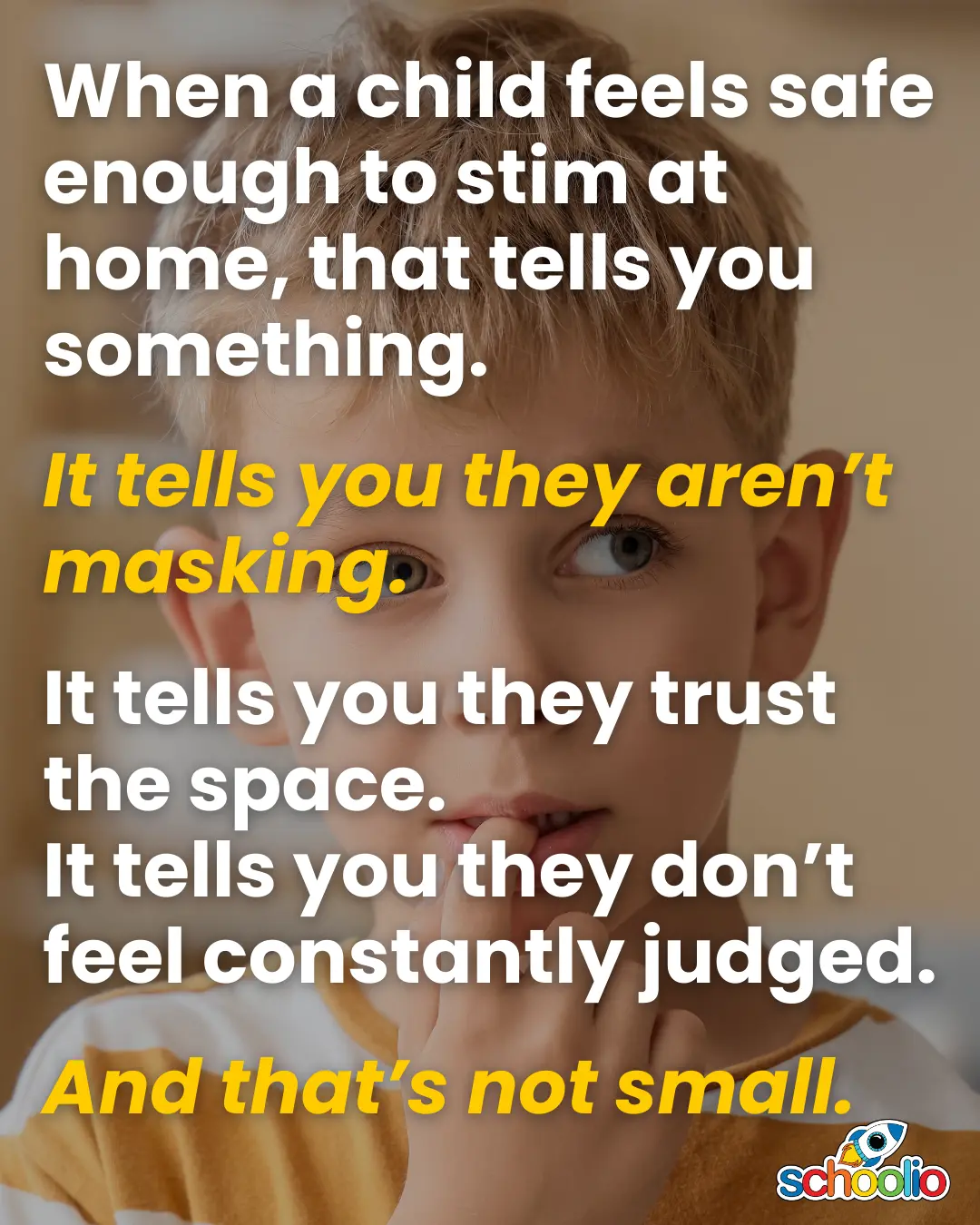
When a child feels safe enough to stim at home, that tells you something.

It tells you they aren’t masking.

It tells you they trust the space.

It tells you they don’t feel constantly judged.

And that’s not small.

Sometimes the most powerful thing we can do isn’t teaching our kids how to stop stimming.

It’s helping them understand why they do it.

Because when a child understands their nervous system, they stop feeling broken.

And when they stop feeling broken, they start building regulation from the inside out.
Stimming, Fidgets, and Movement in ADHD and Autistic Kids: What It Really Means

Stimming, Fidgets, and Movement in ADHD and Autistic Kids: What It Really Means


If you’ve ever found yourself saying:

“Can you sit still for five minutes?”
“Why are you rocking like that?”
“Stop tapping.”
“Do you have to make that noise right now?”

You are not alone.

Almost every parent of an ADHD or autistic child has had that moment — the one where the movement feels constant. The noise feels repetitive. The fidget feels distracting.

And underneath it all is that quiet question:

Why can’t they just sit still?

Let’s gently flip that question.

What if sitting still isn’t neutral?

What if sitting still actually costs them something?

What Is Stimming?

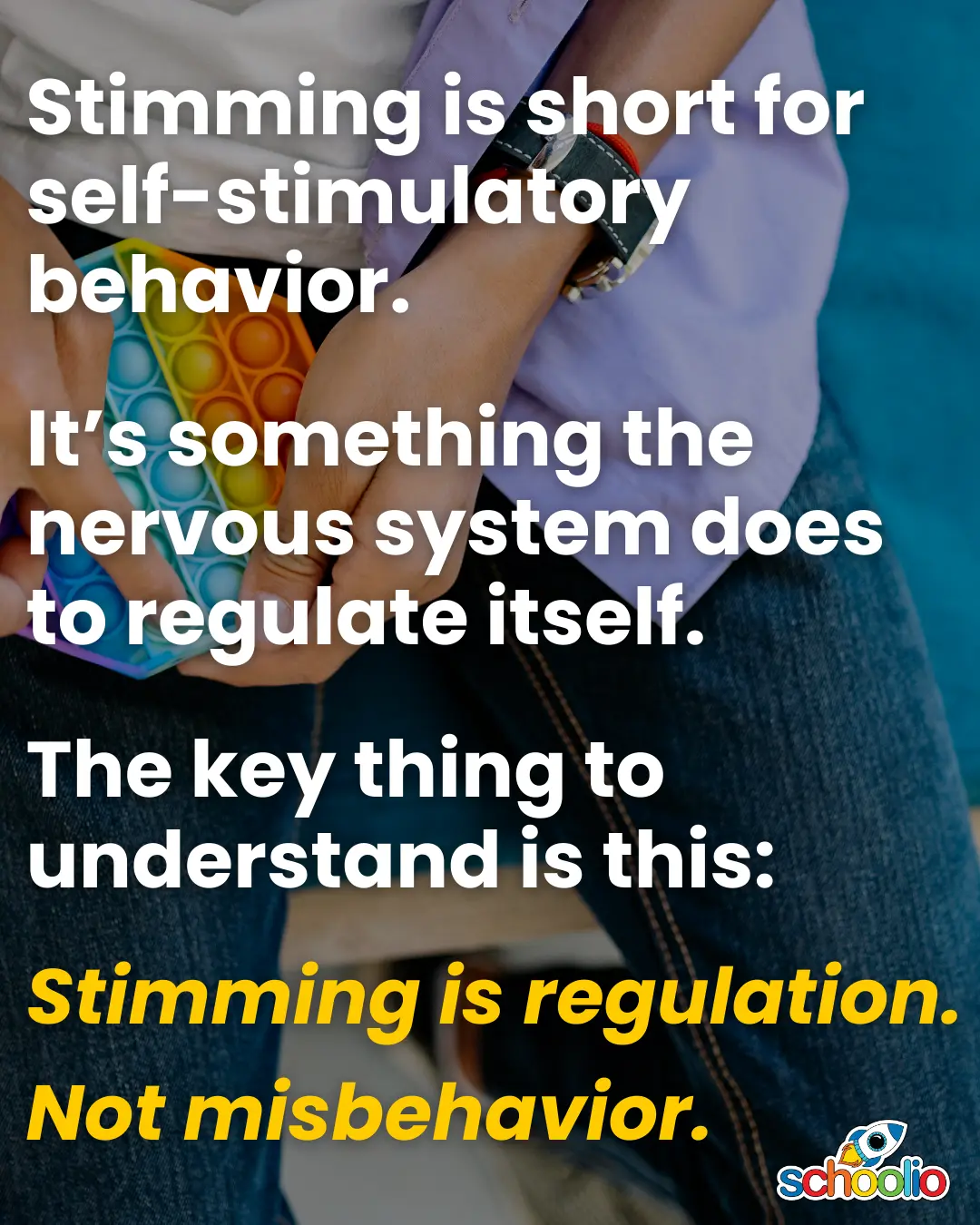
Stimming is short for self-stimulatory behavior.

That phrase sounds clinical, but the meaning is simple:

It’s something the nervous system does to regulate itself.

Everyone stims.

Neurotypical adults:

  • bounce their leg in meetings
  • click pens
  • chew gum
  • scroll their phone when anxious 

Neurodivergent kids often stim more frequently or more visibly — not because they lack discipline, but because their nervous systems require more input to stay balanced.

Stimming can look like:

Rocking.
Flapping.
Pacing.
Spinning.
Humming.
Tapping.
Chewing.
Repeating phrases.

It can also be completely internal — like song loops or counting.

The key thing to understand is this:

Stimming is usually regulation.

Not misbehavior.

Why ADHD and Autistic Brains Move More

ADHD brains are often dopamine-seeking.

Movement increases dopamine.

Autistic nervous systems are often highly sensitive — either seeking more sensory input or trying to regulate overwhelming input.

Movement organizes the body.

Movement grounds the brain.

Movement creates rhythm.

And rhythm stabilizes the nervous system.

When you see your child:

  • leaning upside down in a chair
  • sitting in “weird” positions
  • pacing during lessons
  • needing to move constantly 

You’re likely watching their vestibular system at work (that internal balance and movement system).

They aren’t moving to annoy you.

They’re moving because their brain functions better that way.


Fidgets Aren’t Distractions. They’re Tools.

There’s a common fear among adults that fidgets “distract” children.

But for many neurodivergent kids, the opposite is true.

A small amount of movement can:

  • increase attention
  • reduce anxiety
  • prevent escalation
  • improve working memory
  • support listening 

When the body gets the input it needs, the brain can focus on the lesson.

Think of it like this:

Some brains focus best in stillness.
Some brains focus best in motion.

If we demand stillness from a brain that needs motion, we’re working against biology.

When Stimming Is Suppressed

Here’s the part we don’t talk about enough.

Many neurodivergent kids learn to suppress their stims.

They learn:
“That’s weird.”
“Stop doing that.”
“People are annoyed by you.”

They mask.

And masking takes energy.

Sometimes the child who looks “calm and still” at school comes home and melts down — not because they’re dramatic, but because they’ve been suppressing regulation all day.

Movement that looks disruptive might actually be preventing collapse.

But What If It’s Too Much?

Of course, there are moments when stimming interferes — when it’s loud during a lesson, or physically unsafe, or escalating instead of calming.

The goal isn’t “allow everything always.”

The goal is to ask:

Is this regulating or dysregulating?

If it’s regulating, we support it or modify it.

If it’s dysregulating, we help redirect it to something safer or more grounding.

Instead of saying, “Stop.”

We might say, “Looks like your body needs input. Let’s find a way to help.”

Chewelry instead of hoodie strings.
A wobble cushion instead of tipping the chair.
Pacing while memorizing instead of forcing stillness.

We shift from control to collaboration.

The Homeschool Advantage

This is where homeschooling becomes powerful.

In traditional classrooms, stillness is often equated with compliance.

At home, you get to redefine what learning looks like.

Math while bouncing (we used to do math on the trampoline a lot, especially for rote memorization tasks like multiplication facts!)
Spelling while pacing.
History while building with LEGO.
Audiobooks while swinging.

Movement doesn’t mean they aren’t learning.

Sometimes it’s the only reason they can.

The Bigger Reframe

If you take nothing else from this, take this:

Stimming, fidgets, and movement are not character flaws.

They are nervous system strategies.

And when we understand them that way, we stop asking:

“How do I make this stop?”

And start asking:

“How do I support this safely?”

That shift alone can change the tone of your home.

Once you understand stimming as regulation, everything else makes more sense.

And when parents understand, kids feel safer.

And when kids feel safer, they regulate better.


Modulated Noise, Binaural Beats, and “Sensory Audio”: What Actually Helps Neurodivergent Kids (and What Doesn’t)

Modulated Noise, Binaural Beats, and “Sensory Audio”: What Actually Helps Neurodivergent Kids (and What Doesn’t)


If you’ve ever searched focus music for ADHD or “calming sounds for autistic kids,” you’ve probably fallen down a rabbit hole of options:

White noise.

Brown noise.

Binaural beats.

8D audio.

Spatial soundscapes.

“Roman café sounds.”

And if you’re anything like most neurodivergent parents, you’ve probably asked yourself:

Is this actually helping my kid… or is this just another thing I’m supposed to try?

Let’s slow this down and talk about what these sounds actually are, what the research does (and doesn’t) say, and how to use audio support in a way that’s regulating instead of overwhelming.


First: Why Sound Matters So Much for Neurodivergent Kids

For many ADHDers and autistic kids, sound isn’t just background — it directly impacts the nervous system.

Noise can:

  • help the brain stay regulated
  • reduce sensory overload
  • support focus and task initiation
  • or… do the exact opposite

There is no one “best” audio solution. What helps one child focus might send another into shutdown or agitation. And that’s not a failure — it’s information.


Modulated Noise (White, Pink, Brown Noise)

Let’s start with the most evidence-supported category.

Modulated noise refers to steady, non-intrusive sound that masks environmental distractions.

  • White noise: equal intensity across frequencies (static-like)
  • Pink noise: softer, more balanced (often better tolerated)
  • Brown noise: deeper, lower tones (frequently preferred by ADHDers)

Why this can help

For ADHD brains especially, background noise can actually increase focus by:

  • boosting dopamine slightly
  • reducing sudden auditory interruptions
  • giving the brain “just enough” stimulation

Many ADHD kids work better with noise than in silence — silence can feel loud.

Watch for:

  • irritation or headaches
  • increased agitation
  • sensory fatigue over long periods

If it helps, great. If it doesn’t, don’t force it.


Sensory & Ambient Audio (Rain, Cafés, “Roman Sounds”)

These are layered soundscapes meant to feel immersive or comforting.

Rain.

Fireplaces.

Cafés.

Nature.

Ancient city ambience.

Despite the fancy names, these are not therapeutic frequencies — they’re sensory environments.

Why they help some kids

  • provide predictable auditory input
  • mask unpredictable household noise
  • feel emotionally grounding or familiar

For autistic kids especially, this kind of audio can create a sense of place safety.

When they don’t help

  • too many layers can overload sensory processing
  • looping sounds can become irritating
  • immersive tracks may pull attention away from learning

These work best for:

  • calming
  • transitions
  • background regulation — not always active learning

Spatial Audio & “8D Sound”

Spatial or “8D” audio uses headphones to simulate sound moving around the head.

This is not a medical or therapeutic category, despite how it’s marketed.

Potential benefits

  • novelty-driven engagement (especially for ADHDers)
  • immersive listening for short periods

Potential issues

  • can be disorienting
  • may increase sensory overload
  • often distracting rather than regulating

This is very individual. Some kids love it. Many don’t.


Rhythm-Based Music (Often the Unsung Hero)

This is one of the most overlooked — and often most effective — tools.

Music with:

  • steady tempo
  • predictable rhythm
  • minimal variation

Think lo-fi beats, instrumental tracks, slow drumming.

Why this works

Rhythm helps regulate the nervous system by:

  • supporting pacing
  • aiding task initiation
  • providing structure without demand

For many autistic kids, this is far more tolerable than binaural or modulated sounds.


Binaural Beats (The Most Misunderstood)

Binaural beats use two different tones, one in each ear, to create a perceived frequency difference in the brain.

Yes — there is some research suggesting potential effects on brainwave states.

No — it is not consistent, not universal, and not a magic solution.

Important things parents should know

  • Headphones are required
  • Many autistic people find them uncomfortable or distressing
  • Effects vary wildly between individuals
  • Some kids report headaches or agitation

If they help your child regulate — that’s valid.

If they don’t — also valid.


Isochronic Tones (Often Labeled Incorrectly)

These are single tones that pulse rhythmically.

They do not require headphones and are sometimes better tolerated than binaural beats — or sometimes much worse.

Again: individual response matters more than theory.


What These Sounds Are Actually Doing

None of these sounds “fix” ADHD or autism.

What they can do is:

  • support nervous system regulation
  • reduce sensory stress
  • help the brain reach a more workable state

Think of them like external supports, not treatments.

Just like glasses don’t fix eyesight — they help the world feel manageable.


How to Use Audio Supports Without Overwhelm

Here’s the most important part.

Start with regulation, not productivity

Ask:

Does this help my child feel calmer, safer, or more settled?

Focus comes after regulation.


Offer choice whenever possible

Control matters — especially for neurodivergent kids.

Let them choose:

  • the sound
  • the volume
  • when it’s on or off

Choice = nervous system safety.


Keep volume lower than you think

If it’s too loud, the brain stays in alert mode.

Quiet, steady, predictable sounds work best.


Use audio as a tool, not a rule

No child needs to “get used to” a sound that dysregulates them.

If today it works and tomorrow it doesn’t — that’s okay.


A Gentle Reminder for Parents

If your child needs sound to focus, calm, or learn:

That’s not a bad habit.

That’s not avoidance.

That’s not dependence.

That’s self-regulation.

Neurodivergent kids aren’t broken for needing external supports — their nervous systems simply work differently.

And when we work with that difference instead of against it, learning gets easier… for everyone.

Interoception in Neurodivergent Kids: Why Your Child May Not Know What Their Body Is Telling Them

Interoception in Neurodivergent Kids: Why Your Child May Not Know What Their Body Is Telling Them


“Are you hungry?”

“I don’t know.”

“Do you need the bathroom?”

“No.” (…five minutes later: emergency.)

“Wow look at that bruise- didn’t that hurt?”

“No. I didn’t notice.”

If this sounds familiar, you’re not alone — and it’s not defiance, avoidance, or lack of self-awareness. For many neurodivergent kids, the issue lies in something called interoception.

Understanding interoception can completely change how you interpret your child’s behavior, emotional regulation, and even their resistance to basic self-care tasks.


What Is Interoception?

Interoception is the body’s ability to sense internal signals.

It includes things like:

  • Hunger and thirst
  • Heart rate and breathing
  • Body temperature
  • Pain or discomfort
  • Fatigue
  • Emotional signals (like anxiety, excitement, or overwhelm)

Interoception is how we know what’s happening inside our body — and what we need to do about it.

For most neurotypical people, this system works quietly and automatically. But for neurodivergent kids — especially ADHDers and autistic kids — interoception can work very differently.


Why Interoception Matters So Much

Interoception is foundational to:

  • Self-regulation (knowing when you’re calm vs. stressed)
  • Meeting basic needs (sleep, food, hydration, rest)
  • Emotional awareness (naming feelings based on body cues)
  • Self-advocacy (“I need a break,” “I’m overwhelmed”)

When interoception is unreliable or muted, kids aren’t ignoring their needs — they genuinely may not feel them clearly.


What Interoceptive Differences Look Like in Neurodivergent Kids

Many neurodivergent kids experience interoceptive differences, meaning the signals from their body are delayed, muted, overwhelming, or confusing.

This can look like:

  • Not realizing they’re hungry until they’re hangry
  • Missing early signs of needing the bathroom
  • Becoming exhausted without noticing fatigue building
  • Stimming or fidgeting until it causes injury that they don’t notice.

To parents, it can feel baffling. To the child, it can feel like body needs just happen to them instead of being something they can anticipate or manage.


Interoception and Emotional Regulation

We often expect kids to name their feelings:

“Use your words.”

“Tell me what you’re feeling.”

But emotional awareness depends on interoception.

If a child can’t recognize:

  • tightness in their chest
  • a racing heart
  • clenched muscles
  • stomach discomfort

then they may not realize they’re anxious, overwhelmed, or overstimulated until they’re already dysregulated.

This is why many neurodivergent kids struggle with emotional regulation — not because they don’t care, but because their body’s early warning system is unreliable.


Why This Isn’t a Failure — It’s a Difference

Interoceptive differences aren’t laziness, manipulation, or lack of responsibility.

They mean your child may need:

  • external reminders for basic needs
  • support identifying body cues
  • help connecting physical sensations to emotions

Expecting independent self-regulation without interoception is like expecting a child to read without learning letters first.


How Parents Can Support Interoception at Home

The goal isn’t to force independence — it’s to build awareness gently over time.

1. Externalize Body Needs

Instead of asking open-ended questions like “Are you hungry?”, try:

  • “It’s been two hours since you ate — let’s check in with your body.”
  • “Your body usually needs a snack around this time.”

This reduces pressure and builds pattern recognition.


2. Name Body Signals Out Loud

Help your child make connections:

  • “Your fists are tight — that can mean your body is feeling stressed.”
  • “Your voice got louder; sometimes that means you’re getting overwhelmed.”

This models interoceptive awareness without judgment.


3. Build Predictable Routines

Consistent meals, rest times, and movement reduce reliance on internal signals that may be unreliable.

Routine acts as an external interoceptive support.


4. Use Visual and Sensory Tools

  • Visual schedules for meals, breaks, and rest
  • Body check-in charts (“tired,” “hungry,” “wiggly,” “calm”)
  • Emotion charts tied to physical sensations

These tools make the invisible visible.


5. Teach Body-Based Emotional Language

Instead of focusing only on emotion words, try:

  • “Where do you feel that in your body?”
  • “Does your body feel fast or slow right now?”

This builds emotional literacy from the inside out.


Can Interoception Always Be Taught?

Here’s something that doesn’t get said often enough:

Not every child can “learn” interoception in the way we expect — and that’s okay.

Interoception isn’t a skill like reading or math. It’s a sensory system. And just like vision or hearing, some people will never have fully reliable internal signals — no matter how much practice or support they receive.

Some neurodivergent kids may learn to recognize patterns over time (“I usually get cranky when I forget to eat”), but they may never feel hunger, bathroom needs, fatigue, or emotional escalation early enough to act on it.

That doesn’t mean they’ve failed.

It means their brain works differently.


Awareness vs. Accuracy

It helps to separate interoception into two parts:

  • Interoceptive awareness – learning to understand body patterns after the fact
  • Interoceptive accuracy – the brain reliably sending early, usable signals

Some kids can build awareness with support.

Some kids will always struggle with accuracy.

And for those kids, the goal isn’t “listen to your body” — it’s manage your needs externally.


Management Is Not a Step Back — It’s an Accommodation

For children with consistently weak interoceptive signals, independence often looks like this:

  • Using timers to remember bathroom breaks
  • Eating on a schedule, not when hunger appears
  • Drinking water because the alarm says so
  • Taking breaks because it’s part of the routine
  • Checking charts or schedules instead of body cues

They don’t wait to feel the need.

They meet the need because the system supports them.

This is not dependence.

This is adaptive intelligence.

Just like glasses replace poor eyesight, external supports replace unreliable internal signals.


What Matters Most

The goal of interoception support is not to make a child “typical.”

The goal is:

  • needs being met
  • reduced distress
  • fewer meltdowns and emergencies
  • dignity and autonomy

If a child uses timers and checklists into adulthood, that’s not a failure — that’s success.

Many kids feel enormous relief when they learn:

“My body doesn’t always give me clear signals — so I use tools.”

That understanding replaces shame with self-trust.

Interoception isn’t about perfectly feeling your body.

For many neurodivergent kids, it’s about learning how to care for their body in different ways — and that is just as valid.


The Homeschooling Advantage

Homeschooling allows you to support interoception in ways traditional school often can’t.

You can:

  • Pause learning to meet body needs
  • Normalize movement, rest, and snacks
  • Teach emotional awareness without rushing
  • Respond to dysregulation with curiosity instead of consequences

When a child feels supported in understanding their body, self-regulation becomes possible — not forced.


The Big Takeaway

Interoception is the bridge between body, emotion, and behavior.

When neurodivergent kids struggle with self-care, emotional regulation, or recognizing their needs, it’s often not because they won’t — it’s because they can’t yet.

With patience, modeling, and external supports, interoceptive awareness can grow.

And when kids learn to understand what their body is telling them, they gain something powerful:

self-trust.

Why Our “First Day of School” Looks Nothing Like Theirs — and Why I Wouldn’t Trade It

Why Our “First Day of School” Looks Nothing Like Theirs — and Why I Wouldn’t Trade It


This has been on my mind today…

The hardest part of the homeschool year for me wasn’t math lessons, or planning, or juggling the day-to-day chaos. It was the first day of public school.

Every September, my social media feeds would flood with photos of smiling kids at the end of the driveway — shiny shoes, new backpacks, parents buzzing with excitement. I would feel it in my chest, that little ache of missing out. Was I depriving my kids of this milestone? Was our homeschool missing something?

But then, something shifted. I realized those photos were it. The moment. The kids posed for a quick picture, then disappeared into a classroom to sit under fluorescent lights, being taught by a stranger for the rest of the day.

So one year, I decided to do something different. I started our own tradition.

That morning, I snapped a “first day of school” photo of my kids… still asleep. Because that’s the beauty of homeschooling: they wake when their bodies are rested, not when a bus pulls up.


Then, just for myself, I kept taking pictures throughout the day. Hour by hour.

? Pancakes in pajamas.

? Jumping on the trampoline after math.

? Reading aloud together on the couch.

? Baking cookies in the kitchen.

? Building sandcastles at a beach we had all to ourselves.

? A social studies lesson with a cat curled up in their lap.

? Walking the dog in the late summer sun.


And when I scrolled through those photos at the end of the day, I finally saw it: this was more.

It wasn’t just about lessons and curriculum (though those happened too). It was about time. About laughter. About siblings who actually enjoy each other. About kids who get to learn at their own pace and still have energy left to play, imagine, and connect. About a childhood that isn’t rushed out the door.

That was the day I stopped feeling wistful about the back-to-school buzz on my feed. Because the truth is, I wasn’t depriving my kids of anything. I was giving them something different. Something richer.

So now, every September, we take our first-day photos too. They just don’t look like everyone else’s. And I’m okay with that.

With love,

? Lindsey

Certified Special Ed Educator & Co-Founder, Schoolio

From Survival Mode to Success: How Homeschooling Helps Kids Recover from Public School Burnout

From Survival Mode to Success: How Homeschooling Helps Kids Recover from Public School Burnout

By Lindsey, certified special-ed educator and homeschooling parent


Let’s talk about burnout.

Not yours (although that’s real too), but your child’s.

We don’t always recognize it at first — that slow unraveling that happens when a child is pushed too hard, too fast, or in the wrong environment for too long. But once you’ve seen it, you know.

The spark is gone.

The joy is missing.

School becomes a trigger — not a place of growth.

And for many families, burnout is the reason they start homeschooling.

Not because they always planned to.

But because they needed suddenly needed to.

Their child needed saving.


What Burnout Looks Like in Kids

It doesn’t always look dramatic. Sometimes it looks like:

  • Refusing to do any schoolwork
  • Saying things like “I’m stupid” or “I hate school”
  • Meltdowns over math problems
  • Constant headaches or stomachaches
  • Feeling defeated before they even start

Often, these reactions aren’t about laziness or attitude.

They’re about exhaustion.

They’re about a nervous system that’s been in overdrive, sometimes for years.

When a child reaches that point, what they need isn’t more pressure.

They need a reset.

Maybe now you’ve taken the first step and pulled them out. You’re probably feeling like you don’t know what to do next.


Here’s where I recommend you focus your attention for the next few weeks:

1. Focus on Relationship

The first goal isn’t academics, it’s connection.

Use this time to listen, play, talk, and just be together.

Remind your child that they are safe. That learning is no longer tied to stress or punishment.


2. Focus on Regulation

What helps your child feel calm?

That might look like daily walks, sensory play, quiet reading time, or lots of movement breaks.

Build your days around those regulating activities first, then gently add in small moments of structured learning when they’re ready. Remember that a dysregulated person cannot learn. Don’t try to force it.


3. Keep Learning Gentle and Flexible

For now, avoid tight schedules or packed plans. Start with short lessons and engaging, hands-on topics.

Follow their interests. Bake together. Do science experiments in the kitchen. Read out loud. Keep it light and meaningful.

Build confidence. If you only do their favorite subjects for a little while that’s totally fine. If you bump them down a grade or two (or as many as you need) to find a spot where they’re experiencing regular success and building their confidence in their own abilities, that’s where you need to be right now.


4. Let Rest Be Part of the Plan

Your child may need more sleep. More down time. More freedom. That’s not slacking, that’s burnout recovery.

You’re not falling behind. You’re laying the foundation for real, lasting learning. Let them sleep. Let them play. Let them be outside. Mostly, just let them be.


5. Watch for Small Signs of Re-engagement

You may not get a big “aha” moment. But you might notice them asking more questions. Smiling during a lesson. Picking up a book on their own.

Celebrate those small steps- they’re signs the spark is coming back!


A Gentle Reminder

If your child is in survival mode right now, you might be seeing some behaviors that are hard to handle. Avoidant, angry, overwhelmed. Remember that it doesn’t mean you’ve made the wrong choice, it means your child feels safe in your presence to let their emotions out.

It means they need time.

And homeschooling gives you that time.

Time to rest.

Time to reconnect.

Time to slowly reintroduce learning, in ways that feel safe and meaningful.

Eventually, the spark comes back.

The light returns to their eyes.

And you’ll realize: this isn’t just about school.

It’s about giving your child a soft place to land when the world became too much.

And that? That’s success.


Lindsey

certified special-ed educator and homeschooling parent

Download our Free Guide “Deschooling: The First 30 Days After Leaving Public School” with coupon code DESCHOOL.

https://schoolio.com/product/schoolio-understanding-deschooling/?wmc-currency=USD

Why Schoolio Is a Better Choice Than MiAcademy for Most Homeschool Families

Why Schoolio Is a Better Choice Than MiAcademy for Most Homeschool Families

MiAcademy is a popular homeschool program that’s been around for more than 20 years. It’s familiar. It’s easy. And if you’re looking to replicate traditional school at home with a little fun and games mixed in, it has a straightforward setup, a full list of core subjects, and a digital interface that feels familiar to kids coming out of the classroom.

But most families don’t start homeschooling because they want to recreate the classroom. They do it because the classroom wasn’t working.

You want something better for your kids.

Something more flexible, more purposeful, more in tune with your child’s unique needs, and something that gives you, the parent, more control to design the perfect program for your unique child and your unique family, especially those raising neurodivergent, curious, or outside-the-box learners.

That’s where Schoolio stands apart.

Both Schoolio and MiAcademy are digital homeschool programs, but they have some important differences. MiAcademy is a solid choice for families who want to follow a school-at-home model and aren’t bothered by having to supplement with other programs where digital learning falls short.

Schoolio is different.

It’s a whole new way to homeschool, built from the ground up by real homeschoolers, with modern families and neurodivergent learners in mind.

If you’re looking for a truly complete program with real customization, neurodivergent-friendly content, offline learning options, and the kind of future-ready education that will help your child thrive in the future, Schoolio is the clear winner.

Here are the top 5 reasons why Schoolio is a better choice than MiAcademy:


1. MiAcademy Courses Mirror School. Schoolio Builds Future-Ready Kids.

MiAcademy keeps things fairly simple when it comes to course offerings. Their non-core options are limited to Music & Art, World Languages, Life Skills, and Biblical Studies. And that’s pretty much it.

Schoolio goes far beyond that and offers hundreds of courses across a much broader range of subjects. We also offer an entire library of Future Readiness content, our one-of-a-kind collection you won’t find anywhere else.

Our Future Readiness courses include:

  • Financial Literacy (because balancing a budget is more useful than memorizing Pythagorean theorem)
  • Emotional Intelligence (because kids who understand themselves and others do better in life)
  • Emerging Technologies (because our kids are growing up in an digital-first world, and they need to understand how it works)

These courses are built with real-world relevance in mind, helping your child develop both academic skills and practical, future-ready thinking. This isn’t filler content. It’s the future. And it’s only at Schoolio.


2. Schoolio Is Designed for Neurodivergent Learners

This one’s huge, and it’s where many online programs miss the mark entirely.

If you have an ADHD or Autistic child, you already know that most educational platforms weren’t built with them in mind. MiAcademy, while decent in terms of simplicity and structure, doesn’t offer any specialized support for neurodivergent learners.

Schoolio does.

In fact, we’re the only homeschool curriculum platform intentionally designed to support and accommodate neurodivergent students.

We built our content and platform to maximize short attention spans, reduce redundancy, limit cognitive overwhelm, and allow for the flexibility neurodivergent learners often need. We have multiple ways to engage, and allow parents to switch between Scheduling Mode (for routine and structure) and Exploration Mode (for flexibility and curiosity-driven learning).

Our goal? To help families find what works, without power struggles or meltdowns. When your child feels successful and supported, everything changes.


3. Schoolio Costs Less and Delivers Way More

Let’s talk money.

Homeschooling families are often working with tight budgets, we understand, we’ve been there. At the end of the day, cost matters. MiAcademy’s pricing at $42/month per child is higher than our complete digital package (including every Schoolio course and every grade level) at just $39.99/month. And we offer 30% off for siblings, and a military discount too. Want to save even more? We also have discounted annual plans.

More flexibility. More content. Less money. It’s a no-brainer.


4. Schoolio’s ELA Program Crushes MiAcademy’s Lightweight Approach

ELA (English Language Arts) is often where fully online programs fall short, and MiAcademy is no exception.

Yes, they cover the basics: vocabulary, some reading comprehension, and grammar. But let’s be honest, a few vocab games and short reading passages won’t help your child become a thoughtful, articulate writer.

At Schoolio, we believe a strong ELA program must include:

  • Real novel studies
  • Essay and research writing
  • Creative writing and structured reflection
  • Oral communication and presentation skills

Our ELA curriculum goes far beyond multiple choice and true or false questions. We help your child build the writing, reading, and critical thinking skills they need to express themselves clearly and powerfully while building a love of reading and writing.

Our ELA program has been praised by homeschool parents as being simultaneously robust in its coverage and easy to implement for resistant writers and neurodivergent kiddos.


5. The Adaptive Learning Model: Offline + Online = Smarter Homeschooling

MiAcademy offers optional printable PDFs, but they’re not designed to be part of the main program flow, more as an optional add-on, and they’re not annotatable or savable, you have to print or save them and use a different program to annotate, then keep those for your records somewhere else. In other words, they’re a nice-to-have, not a core feature.

At Schoolio, we do things differently.

Our [Adaptive Learning Model](https://schoolio.com/programdesign/?) blends the best of both worlds: online tools and offline learning. You and your child get all the benefits of digital education: interactive lessons, flexible scheduling, auto-grading, and a dashboard to track progress. But that’s just the beginning.

We believe screen time should support learning, not dominate it.

That’s why every Schoolio course includes offline activities that often include hands-on activities such as:

  • Science experiments
  • Art projects
  • Outdoor exploration
  • Critical thinking and reflection
  • Opinion writing and research
  • Speeches and oral presentations

These aren’t just extras, they’re built into the curriculum intentionally, because we know kids learn best when they can connect ideas to the real world.

MiAcademy gives you a browser tab and calls it a day.

Parents love the balance. Kids love the variety. And everyone gets a break from staring at screens all day.


The Bottom Line: MiAcademy Imitates. Schoolio Innovates.

If you want to recreate the classroom on a screen, MiAcademy will check the boxes.

But if you’re homeschooling because your child deserves something better — something more human, more flexible, more real — Schoolio is your answer.

  • More future-focused content
  • Built-in neurodivergent support
  • Comprehensive ELA
  • True hybrid learning
  • All for less money

And if that weren’t enough, Schoolio is now WASC accredited, supports microschools around the world, and continues to launch new courses and innovative features to serve today’s learners, not yesterday’s model.


Experience the difference for yourself.

? Learn About Schoolio’s Mission and Founders

? Start your 7-day free trial

Schoolio vs. IXL: Why Relentless Quizzing Isn’t Enough for a Real Homeschool Education

Schoolio vs. IXL: Why Relentless Quizzing Isn’t Enough for a Real Homeschool Education

IXL is a familiar name in education. It’s used in thousands of schools across North America as a diagnostic tool, helping teachers assess students, assign drills, and place them based on grade-level standards.

And it does that job well.

But , you’re not a school.

IXL was built for schools, not homeschoolers.

If you’re homeschooling, your needs, and your child’s needs, are completely different than a classroom. You’re not trying to sort your child into a percentile or optimize for standardized test scores. You’re trying to create a meaningful, personalized education that actually helps your child learn, grow, and be ready for their future.

Schoolio was built for that.

Schoolio a full curriculum made by real homeschoolers who know what works, especially for neurodivergent and outside-the-box learners.

If you’re using IXL right now and it’s working as a supplemental tool, that’s great. But if you’re trying to use it as your primary curriculum- or if you’re wondering what else is out there- here are the top five reasons why Schoolio is a better fit for most homeschool families:


1. Complete Curriculum vs. Just Practice

Let’s get this out in the open: IXL doesn’t actually teach. It drills.

What is curriculum? Curriculum is a program of learning. It’s different than a workbook of pages of practice or, in the case of IXL, endless quizzing on concepts. Real curriculum includes lessons that teach those concepts, along with activities to help solidify the knowledge. All of this happens before we can quiz a child on what they’ve learned (if we even want to quiz them, which lots of homeschoolers do not.)

IXL has no lessons, no step-by-step teaching content, no built-in scaffolding. It’s designed for review, not instruction, and that means you’re left to fill in the gaps yourself.

“It’s straight drill practice… no teaching.”

Parent on the Well-Trained Mind Forum

“We use IXL for practice and reinforcement, but it wouldn’t work as our only curriculum. It would be frustrating and boring.”

Reddit homeschooling parent

Schoolio gives you everything in one place. Each course includes online lessons, hands-on learning activities, and digital quizzing- the complete package. You’re not piecing things together with Schoolio, you’re following a creating a learning path that adapts to your family’s needs.


2. Deep Learning: Online + Offline, Not All Screen

IXL is entirely online. That might seem convenient at first, until your child is zoning out after an hour of endless question banks, losing motivation, or worse- feeling frustrated because they’re being drilled on concepts they weren’t taught.

Schoolio takes a blended model approach that blends interactive digital lessons with hands-on offline activities, so your child isn’t missing out on the joyful learning moments that come from science experiments, art projects, outdoor exploration, and critical thinking tasks.

It’s called the Adaptive Learning Model, and it was created to help kids:

  • Build digital literacy
  • Learn through experience
  • Avoid screen fatigue

Because when we talk to parents, most of them don’t actually want their entire homeschool day to happen on a screen.


3. An Actual ELA Program

English Language Arts is where the cracks in most online platforms really start to show, and IXL is no different.

Yes, IXL covers grammar and vocabulary. But that’s about it. There’s no deep literature studies, no writing instruction, and certainly no space for creativity or self-expression.

Schoolio’s ELA program is a different story. Your child won’t just memorize grammar rules and vocab words, they’ll learn to use and love reading and writing. We cover:

  • Novel studies that take them deeper into literature, forming opinions and connections and drawing ideas and conclusions,
  • Essays, narrative writing, persuasive writing, research projects, and more
  • Creative and reflective writing
  • Oral communication and presentation skills

We’re here to raise confident communicators, not just kids who know where the comma goes.


4. Future-Ready Education, Because the Future Is Coming Fast, and Our Kids Need to Be Ready

IXL sticks to traditional core subjects: math, language arts, science, and social studies.

That’s fine, but it’s not enough.

Our kids are growing up in a world that’s evolving fast. They need life skills, emotional awareness, and tech fluency to succeed.

Schoolio offers Future Readiness courses you won’t find anywhere else, including:

  • Financial Literacy
  • Social Skills & Emotional Intelligence
  • Emerging Technologies

This is real-world learning for real-world kids. No drill platform can do that.


5. Designed with Neurodivergent Learners in Mind

This might be the biggest one of all.

IXL is known to be frustrating for neurodivergent learners. The “smart score” system penalizes mistakes and can create intense anxiety for kids who don’t test well or who struggle with working memory or processing speed. There’s no option to adjust pacing, remove streaks, or present content differently.

“My kid was crying after getting one wrong and losing points. This is not how learning should feel.”

Reddit parent

Schoolio was intentionally designed to support ADHD and Autistic learners.

From our uncluttered layout and short lesson formats to our flexible learning modes (Scheduling Mode for routine, Exploration Mode for curiosity), everything is created to reduce overwhelm and increase success.

We also recognize that neurodivergent kids often have uneven skill profiles and can be advanced in one area and behind in another. Our platform makes it easy to mix and match grade levels across subjects, include subjects that are of interest to your child, and set your own schedule, pacing, and intensity.


Bonus: What About IXL as a Diagnostic Tool?

If you’re curious how your child compares to public school grade levels, IXL can be a helpful diagnostic tool. Some homeschool families use it for that reason.

But please be careful not to use public school as your gold standard, especially for neurodivergent learners, who often underperform on traditional tests despite having deep knowledge and insight in specific areas.

A better approach? Use IXL occasionally if it helps you feel anchored, but don’t let it replace a real curriculum, and please don’t let it make you feel inadequate in your homeschooling. If you’re worried about your child’s progress, book a one-on-one call with a Schoolio Teacher who has also homeschooled and get real advice and support on your journey.

Your child deserves more from their education, homeschool experience, and childhood than just a drill-and-score routine.


The Bottom Line: Drill vs. Depth

Feature IXL Schoolio
Full Curriculum
Teaching + Instruction
Offline Learning
Future-Readiness Courses
ND-Friendly Design

IXL was made for the classroom. Schoolio was made for you.

If you’re homeschooling because school wasn’t working, if you want something built for your child’s strengths, struggles, and future, then Schoolio is your better option.


Ready to experience the difference?

Start your free trial or explore our full library today:

? Explore the Program Design

? Start Free Trial

? See How We Support Neurodivergent Learners

Why Homeschooling Is the Future of Education

Why Homeschooling Is the Future of Education

This has been on my mind today…

I grew up in Singapore in the 1980s, where school felt more like an assembly line than a place for learning. Back then, your academic score was the only measure of your potential. If you didn’t perform well, you were pushed aside—discarded like a bruised fruit, judged unworthy by the smallest mark of imperfection.

I remember sitting in class, knowing the answers but afraid to speak. I remember the sting of being called slow, stupid, or lazy. I remember walking home with my report card, knowing I’d be met with disappointment, not support. It was a system that didn’t care who you were—it only cared how well you fit the mold. And I didn’t fit.

What I needed wasn’t more pressure. I needed someone to look at me and say, “You learn differently, and that’s okay.” I needed someone to help me discover my strengths. I needed someone to believe in my potential before I could believe in it myself. But that wasn’t the culture I grew up in. I was sorted and labeled, and I carried those labels for years.

Now, decades later, I see parents doing exactly what I once needed—they’re choosing homeschooling. And not just as a last resort. They’re choosing it because it allows them to give their kids something that traditional systems often can’t: flexibility, safety, confidence, and a learning experience that fits who their child truly is.

Homeschooling isn’t just growing—it’s evolving. It’s no longer limited to families with specific ideologies or one-income households. Today’s homeschoolers are often working parents, digital entrepreneurs, community builders, and curious learners who want to raise curious kids. They’re embracing online homeschool programs, customizing homeschooling curriculum, and using tools like homeschool planners to structure their days without replicating the stress of traditional school.

Is homeschooling effective? Ask the parent whose child went from meltdown to motivation because they finally felt understood. Ask the family whose neurodivergent teen now builds robots at home after being told he was disruptive in class. Ask the mom who finally sees her daughter smiling during a math lesson—not because the worksheet is easier, but because the environment is kinder.

I believe homeschooling is the future of education because it starts with trust—not in the system, but in the child. It recognizes that every learner is different, and that the best learning doesn’t always happen at a desk. It happens when a child feels safe enough to take risks, ask questions, and fail without shame. It happens when a parent is empowered to say, “I know what my child needs, and I can help provide it.”

If I had access to something like homeschooling as a kid, maybe I would’ve found my voice sooner. Maybe I wouldn’t have spent so many years doubting my worth. Maybe I would’ve seen myself not as broken, but simply different.

That’s what so many homeschooling parents are giving their kids today. And that’s why I believe it’s not just an alternative—it’s a model worth building the future on.

Sathish

still learning, still unlearning

Fear Doesn’t Always Announce Itself with a Loud Bang

Fear doesn’t always announce itself with a loud bang. Sometimes, it whispers. Sometimes, it hides behind uncertainty, camouflaged in the endless tabs we open at midnight searching for answers. For many parents, the decision to homeschool isn’t driven by rebellion against the school system, but by love—a deep, unwavering desire to do what’s best for their child. And yet, that love often collides headfirst with fear. Not fear of teaching, but fear of not knowing how to start.

There’s a quiet vulnerability that comes with stepping away from something familiar, even if that familiarity no longer fits. Traditional schooling, with its bells and classrooms, offers predictability. Homeschooling, on the other hand, feels like stepping into the unknown. What if I mess it up? What if my child falls behind? What if I’m not enough?

This is the inner monologue we hear from families all the time. It’s not doubt in their children—it’s doubt in themselves. The moment you remove the scaffolding of a school system that’s dictated your child’s learning path for years, you’re left with a blank canvas. And while that can feel freeing, it also feels heavy. That fear is real. It’s the same feeling I had the first time I tried to build IKEA furniture without the manual—confused, overwhelmed, surrounded by pieces that didn’t yet make sense.

At Schoolio , we don’t dismiss that fear. We honor it. Because hidden within that uncertainty is the beginning of something powerful. Our platform wasn’t built just to deliver curriculum—it was built to guide. To hold your hand through those first awkward steps. To whisper back at your fears, “It’s okay not to know yet. You’re not alone.” That’s why onboarding is such a core part of what we do. It’s not just about logging in and choosing a subject—it’s about gently easing parents and students into a rhythm, giving them the courage to find their own way.

We believe homeschooling isn’t just an educational choice—it’s a decision to reclaim trust in yourself as a parent and in your child as a learner. And trust doesn’t come from flashy promises or academic jargon. It comes from experience, support, and one small win at a time. From watching your child grasp a concept you taught them. From discovering that learning can happen at the kitchen table, in the backyard, or curled up with a book in bed.

So no, it’s not the fear of homeschooling that holds people back—it’s the fear of starting. And the only way to quiet that fear is to take that first small step. At Schoolio, we’ve designed every part of our platform to make that step feel less daunting. Because we know that once you begin, once you feel that shift from fear to confidence, everything changes. Not just for your child, but for you.

And that’s when homeschooling stops being scary—and starts becoming home.

You've been crafting a homeschooling lifestyle that goes beyond the ordinary.

Reimagining Education: Schoolio’s AI-Powered Roadmap to Personalized Learning

In a world where education systems are crumbling under outdated models and rising demands, Schoolio is stepping into the future with a bold new vision: personalized, AI-driven education that meets every child where they are.

As we prepare to publicly launch in 2025, our mission remains clear—empower families around the globe with tools that make learning more accessible, engaging, and emotionally intelligent. At the heart of this transformation is our AI roadmap, designed not just to support academic growth but to fuel a full-circle learning experience that addresses emotional well-being, flexibility, and inclusion.


? Why This Matters

Traditional classrooms were never built to serve the diverse needs of today’s learners. Parents and educators are left juggling fragmented tools, overwhelmed with planning, and constantly trying to bridge learning gaps on their own.

Schoolio is changing that narrative. We’re building the only K-8 platform that combines a digital + print hybrid, neurodivergent-friendly design, and now—cutting-edge AI to enhance learning outcomes and support emotional development.

? What We’re Building

Here’s a glimpse at how we’re redefining what education can look like:

✅ AI Quiz Generator

Teachers and parents can upload any lesson (PDFs, videos, or web links), and our AI will generate personalized quizzes on the spot, tailored to student progress and learning style. Mastery-based learning meets engagement—complete with fun, themed quiz options (like superheroes or sports).

✅ AI Chat-Based Tutor

Think of it as a personal learning coach that works 24/7. Our AI Tutor provides real-time, dynamic instruction—breaking down difficult concepts, reinforcing understanding, and helping students grow at their own pace. It’s adaptive, positive, and confidence-building.

✅ Schoolio Vibe Check

We’re pioneering emotional intelligence in edtech. This tool quietly tracks a student’s energy, frustration, or anxiety—and responds. From mindfulness breaks to flagging parents and teachers, Vibe Check ensures the whole child is supported.

✅ AI-Powered Learning Worlds

Through intelligent NPCs (non-player characters), students can interact with dinosaurs, explore space, or learn history—all in an immersive, age-appropriate virtual world that’s responsive and educational.

?️ Our Timeline

2025: Build and test AI Quiz Generator and AI Tutor prototypes. Launch by year-end.

2026: Introduce Vibe Check and immersive NPCs. Beta test, iterate, and launch.

Beyond: Scale globally, continuously innovate, and support families wherever they are.

? A Message from Our CEO

“We didn’t build AI into Schoolio just to follow a trend—we built it to transform how children learn. Our tools are intentionally designed to enhance engagement, understanding, and emotional well-being, not to replace human interaction. It’s AI with purpose—and that purpose is student success.”

Sathish Bala, CEO & Co-Founder, Schoolio

? Why This Matters to Investors

With over 100 million students expected to leave traditional school systems in the next decade, families are demanding alternatives that actually work. Yet most solutions don’t go far enough.

Schoolio is uniquely positioned at the intersection of:

•Education innovation

•AI-driven personalization

•Neurodivergent inclusion

•Global scalability

Our tools reduce teacher/parent burnout, boost student retention and engagement, and make it possible to scale high-quality education affordably—both locally and globally.

? Challenges We’re Solving

Ethics & Privacy: Data-safe, student-first AI policies.

Accessibility: Tools that work even on low-bandwidth connections.

Emotional Intelligence: Designed in consultation with educators and child psychologists.

? The Opportunity

We’re not just another edtech platform—we’re building a movement. A learning ecosystem that finally puts students, families, and educators in control.

This is your invitation to invest in the future of learning.

? Let’s Connect

Want to help us transform education for millions of families?

? Explore: https://digital.schoolio.com

“We believe homeschooling families are some of the most courageous in the world. With Schoolio, we’re making sure they have the tools, choice, and support they need to help their children thrive.”

Sathish Bala, CEO & Co-Founder, Schoolio

FOR IMMEDIATE RELEASE: The Future of Homeschooling is Here: Schoolio Announces Public Launch

Revolutionary K-8 Platform Empowers Families with Customizable, AI-Driven Learning

[March 19th]Schoolio, the fastest-growing homeschooling platform in North America, is officially launching to the public, bringing innovative, structured, and flexible learning solutions to families, microschools, and educators across the U.S. and Canada. With over 10,000 families already using Schoolio, this milestone marks a new era of accessible, high-quality education designed to put students first.

Schoolio’s all-in-one platform bridges the gap between traditional education and the personalized learning movement, offering families a hybrid digital + print curriculum, AI-powered tools, and fully customizable courses. Parents and educators now have the ability to create their own custom courses within Schoolio, tailoring learning to each child’s unique needs and interests—all within an intuitive and seamless experience.

Why Families Are Choosing Schoolio

Preloaded K-8 Curriculum – Aligned with US and Canadian standards

Create Custom Courses – Tailor lessons for student interests, skill levels, and learning needs

Hybrid Learning Model – Seamlessly switch between digital learning and printable lessons

AI-Powered Personalization – Smart tools help track progress, adapt pacing, and support neurodivergent learners

Future-Ready Education – Courses in financial literacy, emotional intelligence, and life skills

“We built Schoolio to give homeschooling families the confidence and flexibility they deserve,” says Sathish Bala, CEO of Schoolio. “Education should be built around the student, not the system. With our public launch, we’re empowering families with the ability to create their own courses, customize learning, and seamlessly blend digital and offline education like never before.”

With homeschooling enrolment skyrocketing and more families seeking flexible, self-directed education options, Schoolio is uniquely positioned to lead the movement.

? Start a 7-day free trial today at  digital.schoolio.com

About Schoolio

Founded in 2019, Schoolio is on a mission to make homeschooling stress-free and accessible for all families. Co-founders Sathish Bala and Lindsey Casselman bring over 30 years of experience in education, technology, and curriculum development to create a platform that combines structure, flexibility, and innovation.

? For media inquiries or interview requests, please contact:

? Sathish Bala – sathish@schoolio.com

? www.Schoolio.com