Why More Parents Are Choosing Homeschooling Even When It Was Never the Plan

Why More Parents Are Choosing Homeschooling Even When It Was Never the Plan


This has been on my mind today…

I read a story recently about a parent who never planned to homeschool. It was not ideological. It was not a protest. It was not about rejecting school. It was simply about responding to a child who was struggling in ways that could no longer be ignored.

That story keeps echoing because it sounds like so many families I speak to.

The decision to homeschool is often framed as a bold choice or a radical one. In reality, for many parents, it is a quiet pivot. A moment where they realize that what is supposed to be working simply is not. Their child is anxious. Or exhausted. Or shutting down. Or falling behind while being told they are doing fine.

What struck me most was how ordinary the story was. No dramatic failure. No single breaking point. Just a slow accumulation of signs that school was costing more than it was giving.

This is something we do not talk about enough.

We talk about grades. We talk about outcomes. We talk about standards. But we rarely talk about the emotional tax school can take on a child who learns differently or feels out of place. We rarely talk about how long parents sit with doubt before making a change. Or how much guilt comes with admitting that the default path might not be the right one for your child.

Homeschooling, in these stories, is not about pulling kids away from the world. It is about bringing learning closer to who they are. It is about restoring confidence. It is about slowing things down long enough for curiosity to return.

Many of these parents still value structure. They still value rigor. They still care deeply about education. They are not opting out. They are opting in differently.

What keeps coming up is this idea of safety. Not physical safety, but emotional safety. The freedom to ask questions without fear. The space to make mistakes without labels. The ability to learn at a pace that does not constantly signal failure.

This is where homeschooling becomes less about location and more about intention.

At schoolio, we see this pattern over and over. Families who did not start out wanting to homeschool. Families who simply wanted their child to feel capable again. Families who wanted learning to stop being a daily battle.

Homeschooling is not a punishment. It is not giving up. It is not settling for less. For many families, it is a way to rebuild trust in learning itself.

Every child has a relationship with education. When that relationship is damaged, it needs care. Sometimes that care looks like staying and advocating. Sometimes it looks like stepping back and rebuilding at home.

What matters most is that we stop pretending there is only one right way.

Homeschooling is not for everyone. But for the families who choose it, often unexpectedly, it is not about escaping school. It is about choosing their child.


Sathish

still learning, still unlearning

What Exactly Are “Strands” in Schoolio Academics? Let’s Break It Down

What Exactly Are “Strands” in Schoolio Academics? Let’s Break It Down


One thing that can be tricky for parents new to homeschooling is understanding what’s covered under the “umbrella” of a subject. Names like “Language Arts” and “Science” are important but we know there’s so many topics that fall under each.

Okay so… what does each subject actually include?!

“Math” isn’t just fractions.

“Science” isn’t just biology.

“Language Arts” isn’t just reading books.

Every core subject is actually made up of strands — smaller categories that build specific skills and knowledge.

And understanding those strands?

It helps you see what your child is really learning, what might need extra focus, and what they’re already mastering.


? At Schoolio, Here’s How We Break It Down:

We’ve organized our curriculum by subject and strand — so you’re not guessing what’s inside a course, or whether something’s missing. This is also part of our neurodivergent-friendly design, because when strands are separated into individual courses, you can mix & match grade levels between them.

Here’s what’s covered:

➗ Math

  • Number Sense & Numeration
  • Algebra, Patterning & Coding
  • Geometry & Spatial Sense
  • Data Management & Probability

? What this means: It’s not just computation. Your child also learns how to spot patterns, organize data, and apply logic in real-world scenarios.

? English Language Arts (ELA)

  • Writing Skills
  • Literature Study & Reading Comprehension
  • Grammar Foundations
  • Spelling

? What this means: Reading and writing are treated as distinct (and equally important!) skills — with grammar, vocabulary, and reading analysis woven in naturally.

? Science

  • Biology & Life Systems
  • Structures, Mechanisms & Engineering
  • Earth & Space Systems
  • Matter & Energy Systems

? What this means: Your child gets hands-on exposure to all areas of science — not just life science. And yes, there’s plenty of room for rockets and slime.

? Social Studies

  • History, Heritage & Citizenship
  • Geography, People & Cultures

? What this means: Learning about the world and our place in it — from past to present, and here to everywhere.

? Future Readiness (only at Schoolio)

This is our favorite subject — and one that most public schools completely overlook.

Strands include:

  • Social Skills & Emotional Intelligence
  • Financial Literacy & Money Sense
  • Business Studies
  • Emerging Technologies

? What this means: We’re not just preparing kids to pass a test. We’re preparing them for life.

From understanding how to budget or start a business…

To learning how AI and tech are shaping the future…

To building communication and emotional skills

— these are the lessons that stick.

? Electives

We also include:

  • Visual Arts, Music, and Drama
  • Sports and Physical Education

Because yes — creativity and movement matter, too.

? Why Strands Matter

When you break subjects into strands, a few amazing things happen:

  • You can see progress more clearly (“We’ve nailed Number Sense but need more Geometry practice”)
  • You can mix and match based on your child’s needs
  • You can build a balanced learning plan that doesn’t leave gaps
  • You can breathe easier, knowing you’re covering everything — without overloading

At Schoolio, we design with this in mind — so your homeschool isn’t a guessing game.

Instead, it’s clear, organized, and customizable — just like it should be.


? Lindsey

Certified Special-Ed Educator & Co-Founder, Schoolio

Parents Do Not Choose Homeschooling for Novelty

Parents Do Not Choose Homeschooling for Novelty


This has been on my mind today…


I read about one of Afghanistan’s most iconic girls’ schools being turned into an empty shell. Classrooms that once held ambition and possibility now sit silent. Not because girls stopped wanting to learn. But because power decided who gets access to education and who does not.

What stayed with me was how fragile education really is. We like to believe progress always moves forward, but history keeps proving otherwise. When systems fail or fear takes over, learning is often the first thing taken away.

It reminded me that schooling and learning are not the same thing. Schools can close. Buildings can be taken. But the desire to learn lives inside people. When doors shut, that desire looks for another way in.

This is something homeschooling families understand deeply. Learning can happen anywhere. Around a kitchen table. Through conversation. Through curiosity. Through care. Homeschooling is not about opting out. It is often about protecting a child’s right to grow when the system cannot or will not support them.

At Schoolio, we work with families who did not choose an alternative path for novelty. They chose it for safety, dignity, and confidence. Children pushed out or worn down by systems that could not see them. Parents trying to hold onto their child’s love of learning.

Education poverty is not just about access to schools. It is about access to dignity and possibility. When a child is denied the right to learn freely, the damage goes far beyond missed lessons.

This story was a reminder of why flexible, resilient learning matters. Learning that travels with the child. Learning that adapts. Learning that cannot be shut down by a single decision.

Learning your way is not a luxury. For many families, it is survival. And protecting that right is work worth doing.


Sathish

still learning, still unlearning


When “Grade-Level” Tests Make Homeschool Parents Feel Like Failures

When “Grade-Level” Tests Make Homeschool Parents Feel Like Failures


This has been on my mind today…

I talk to so many homeschooling parents who have had this moment:

They run a school-based diagnostic test to see if their child is “on grade level”.

They see a score they weren’t expecting.

And suddenly, their confidence collapses.

“I think my kids have fallen behind.”

“I feel like I’ve failed them.”

“Did homeschooling make them lose skills?”

Let me say this clearly, as both a former teacher and a homeschooling mom:

School-based testing does not measure your child’s intelligence.

And it absolutely does not measure the value of your homeschool.

Most of these assessments — especially the popular ones families use to “check grade level” — were designed for traditional classrooms. They measure a very specific thing: a child’s ability to memorize and recall the exact skills schools have decided are important, in the exact format they expect.

That’s it.

They usually test math and language.

They don’t test problem-solving.

They don’t test creativity.

They don’t test if your child is happier, more confident, or less anxious than they were in school.

They don’t test emotional regulation skills.

They don’t test adaptability, curiosity, persistence, or resilience.

And yet those are the very skills that matter most once school is over.

Here’s something else most parents don’t realize:

The human brain only retains information for two reasons.

  1. Intrinsic interest — the learner genuinely cares about the topic.
  2. Perceived usefulness — the learner understands why this information matters in their real life.

Everything else? The brain offloads.

This is why retention in public school is so low. It’s why every fall, teachers spend weeks “reviewing” material kids supposedly learned the year before — and most students swear they were never taught it. They were. Their brains just didn’t keep it.

We adults are no different.

If most of us took a grade 7 math test today, we’d struggle — unless we’re naturally “math people” (intrinsic interest) or use it regularly in our work (perceived usefulness). That doesn’t make us less intelligent than a seventh grader. It just means we’ve let go of information we don’t need.

Kids do the same thing.

So when a homeschool parent sees a test score and panics, what they’re often seeing isn’t “lost intelligence.”

They’re seeing a mismatch between how the brain actually learns and how schools measure learning.

Homeschooling offers something radically different — and far more valuable. It teaches kids how to learn. How to ask questions. How to find information when they need it. How to notice what interests them and pursue it deeply. How to persist through challenges without shame.

Those skills don’t show up on standardized diagnostics.

But they show up everywhere else in life.

Now, if it’s important to you that your child aligns closely with public school benchmarks, that’s okay. Homeschooling isn’t one thing — it’s yours to shape. You can absolutely use test results as information, identify gaps, and choose to work on specific skills.

What I don’t want you to do is let those numbers define your child — or yourself.

Your kids are not checkboxes.

Your homeschool is not a failure because it doesn’t mirror school.

And you are not doing this wrong because your child’s brain didn’t perform on demand for a system you intentionally stepped away from.

Please take school-based tests for what they are: limited tools, not verdicts.

You are building something bigger than scores.

Something more human.

And that matters far more than any diagnostic ever will.


? Lindsey

Certified Special-Ed Educator & Co-Founder, Schoolio

Kintsugi

Kintsugi


This has been on my mind today…

There is a Japanese art form called Kintsugi. When a bowl or cup breaks, it is not thrown away. The pieces are carefully put back together, and the cracks are filled with gold. The repair is not hidden. It is highlighted. The object becomes more valuable because it has been broken and repaired with care. The story becomes part of its beauty.

I think about that a lot when I reflect on my own life. I also think about it when I look at the families we support through homeschooling and the work we are building at Schoolio.

Too many children move through school systems quietly absorbing a message that they are broken. Not always through words, but through looks, labels, meetings, and expectations. They are told to sit still when their bodies want to move. To keep up when they need time. To fit into systems that were never designed for how they learn. Eventually, many of them begin to believe that something is wrong with them.

When those children come home, something different can happen. With patience, care, and attention, the pressure starts to lift. Confidence begins to return. Curiosity peeks back out. Learning feels possible again. Not rushed. Not forced. Just human.

But here is the part that matters most to me. Healing should never feel like hiding.

Homeschooling should not feel like punishment or retreat. It should not feel like we are sweeping children out of sight. It should feel like kintsugi. A celebration of the whole child. A recognition that learning differently does not mean learning less. It means learning in a way that honors who they are.

At Schoolio, we see this every day. Children who were once labeled as struggling begin to thrive when the pressure is removed and the support is real. When learning adapts to them instead of asking them to adapt to it. When their cracks are not erased, but respected.

Every student who leaves a system that did not serve them carries an incredible story. Those cracks are not flaws. They are experiences. When they are filled with care, trust, and belief, something stronger is created. Something more meaningful than what existed before.

That is what homeschooling can be.

That is what Schoolio is working toward.

Not fixing children, but honoring them.


Sathish

still learning, still unlearning

Anxiety in Neurodivergent Kids: When Behavior Is Really a Nervous System Response

Anxiety in Neurodivergent Kids: When Behavior Is Really a Nervous System Response


Anxiety in neurodivergent kids doesn’t always look like worry, tears, or saying “I’m anxious.”

More often, it looks like:

  • Arguing over small requests
  • Avoiding work until the very last minute
  • Staring off into space when asked a question
  • Melting down over something that seems minor
  • Saying “sorry” over and over again

And because it doesn’t look like anxiety, it’s often misunderstood as defiance, laziness, disinterest, or immaturity.

But for ADHDers and autistic kids, anxiety is frequently a body response, not a thought problem. Their nervous system is reacting to perceived threat — even when there’s no obvious danger.

To understand this, we need to talk about the four stress responses.

The Four “F” Responses: How Anxiety Shows Up in ND Kids

When the nervous system detects a threat, it doesn’t stop to ask whether the threat is logical. It reacts automatically. For neurodivergent kids — whose brains already process the world more intensely — everyday situations can trigger these responses more easily.

These aren’t signs of dysfunction.

They are adaptive survival responses.

1. Fight

What parents often see:

  • Verbal outbursts
  • Argumentative or oppositional behavior
  • Clenched jaw or fists
  • Explosive reactions to small requests

What’s actually happening:

The child’s body feels under attack — by pressure, overwhelm, sensory overload, or loss of control. The nervous system shifts into defense mode.

Fight isn’t about wanting conflict.

It’s about protecting oneself when escape doesn’t feel possible.

Common triggers for ND kids:

  • Being rushed
  • Feeling misunderstood
  • Too many demands at once
  • Sensory overload (noise, light, touch)

2. Flight

What parents often see:

  • Leaving the room
  • Avoiding tasks
  • Procrastination
  • Excessive bathroom breaks
  • Daydreaming or “checking out”

What’s actually happening:

The nervous system has decided, I need to get away from this.

Flight doesn’t always mean physically running. It often shows up as mental escape — zoning out, scrolling, disappearing into imagination, or putting tasks off indefinitely.

For ND kids, flight is common when:

  • A task feels too big or unclear
  • Failure feels likely
  • The environment feels overwhelming

Avoidance isn’t laziness.

It’s anxiety trying to reduce harm.


3. Freeze

What parents often see:

  • Blank stares
  • Non-responsiveness
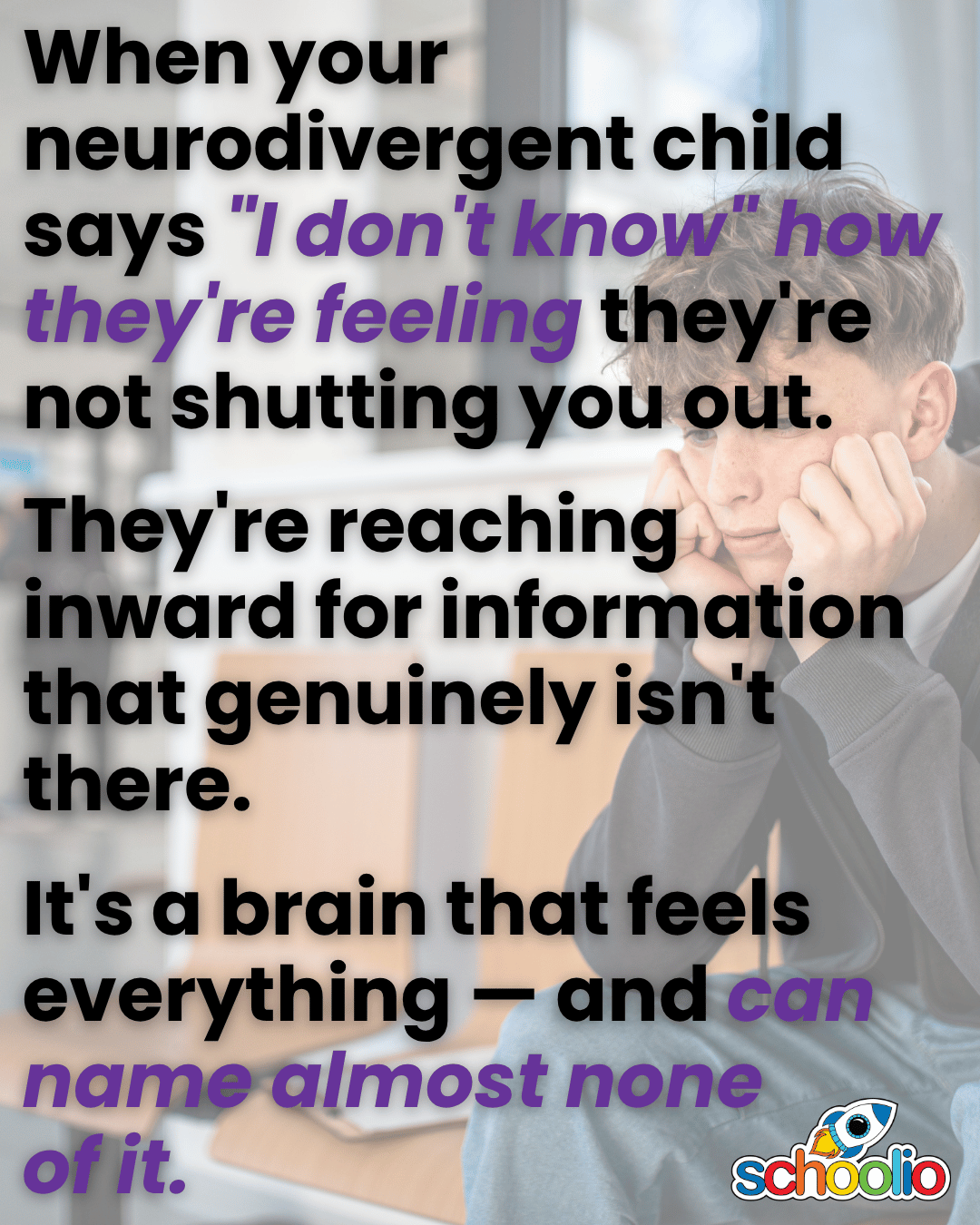
  • “I don’t know” repeated over and over
  • Difficulty starting tasks
  • Seeming shut down or slow

What’s actually happening:

The nervous system is overloaded and hits pause.

Freeze happens when fight and flight both feel unsafe or unavailable. The brain goes offline to protect itself.

This is especially common in neurodivergent kids with:

  • Executive dysfunction
  • Auditory processing challenges
  • High emotional sensitivity

To a parent, it may look like refusal.

To the child, it feels like their brain just… stopped.


4. Fawn

What parents often see:

  • Over-accommodating behavior
  • Difficulty setting boundaries
  • Excessive apologizing
  • People-pleasing
  • Fear of disappointing others

What’s actually happening:

The nervous system believes safety comes from keeping others happy.

Fawn responses often develop in ND kids who have learned — consciously or unconsciously — that being “easy,” compliant, or agreeable reduces conflict or criticism.

This response is frequently seen in:

  • Girls and AFAB neurodivergent kids
  • Kids who mask heavily
  • Kids with rejection-sensitive dysphoria

It looks calm on the outside, but it’s often driven by deep anxiety.


Why Neurodivergent Kids Are More Vulnerable to Anxiety

Neurodivergent kids experience the world as louder, faster, brighter, and more demanding.

Their anxiety is often triggered by:

  • Sensory overload (noise, lighting, textures)
  • Social pressure (expectations to behave “normally”)
  • Environmental mismatch (settings not designed for their brain)
  • Constant correction or criticism
  • Unclear expectations or sudden changes

When a child’s nervous system is constantly bracing for overwhelm, anxiety becomes a baseline — not an occasional emotion.


Reframing Behavior Through a Nervous System Lens

When parents shift from “How do I stop this behavior?” to “What is my child’s nervous system responding to?”

Everything changes.

Instead of punishment, we move toward regulation.

Instead of control, we build safety.

Instead of power struggles, we create connection.


How Parents Can Support Anxiety in ND Kids

1. Reduce Perceived Threat

Lower the emotional intensity around tasks.

  • Fewer words
  • Softer tone
  • More time

Pressure escalates anxiety. Safety reduces it.


2. Name What You See

“You’re not in trouble. I think your body feels overwhelmed right now.”

Naming the response helps kids feel understood instead of ashamed.


3. Offer Regulation Before Expectation

A regulated child can learn.

A dysregulated one cannot.

Movement, quiet time, deep pressure, or sensory breaks often need to come before problem-solving.


4. Build Predictability

Consistency lowers anxiety for ND kids.

  • Clear routines
  • Visual schedules
  • Advance warning for changes

Predictability tells the nervous system: you’re safe here.


5. Avoid Moralizing Anxiety Responses

These responses are not choices.

They are reflexes.

Your child isn’t being dramatic, manipulative, lazy, or rude.

Their nervous system is doing exactly what it evolved to do.


The Takeaway

Fight, flight, freeze, and fawn aren’t flaws.

They’re signals.

When we recognize anxiety behaviors in neurodivergent kids as adaptive responses to perceived threat, we stop trying to fix the child — and start fixing the environment.

And that’s where real healing begins.

When “Bad Teacher” Comedy Isn’t a Laughing Matter

When “Bad Teacher” Comedy Isn’t a Laughing Matter


My social media feeds are full of education-related content. Lately, I’ve noticed an increase in comedians like Gerry Dee (Mr. D)—alongside a growing wave of TikTok and Instagram “former teacher” creators—who are building successful careers around the idea that being a bad teacher is funny, relatable, and ultimately harmless.

But today’s Mr. D video in my TikTok feed hit differently, as I had just finished sitting next to my daughter in the kitchen for over an hour while she painfully cried her way through an essay that an apathetic teacher assigned at the last minute as a “punishment” to the class for not paying enough attention to him- without any instruction around the skills needed for this essay. For my autistic and dyslexic child, who takes every word literally and straight to heart, and has loads of anxiety around handing in her absolute best work, this pressure and lack of support sent her into meltdown mode.

There are several comedians who’ve built entire lanes around “I was bad at my old job / the system was a joke / authority doesn’t matter” humor. My issue isn’t with comedy about work in general. It’s with ex-teachers making light of how poorly they did their jobs—and how little they cared while doing them.

That kind of humor punches down.

It celebrates apathy.

And it shows a complete lack of concern for who was harmed in the making of that joke: the vulnerable children they were responsible for.

Yes, I understand why these jokes land.

Most of us have had that teacher.

The disorganized one.

The checked-out one.

The one who survived the school day purely on sarcasm and vibes.

We’re conditioned to laugh and say, “Yep. That’s just school.”

But here’s the part that never makes it into the punchline:

For some kids—and some families—that teacher isn’t a funny memory.

They’re the reason everything fell apart.


Why “Bad Teacher” Comedy Is a Unique Problem

This is the core issue these jokes orbit around, whether intentionally or not.

Teaching is one of the only professions where:

  • The audience (kids) can’t leave
  • The harm is delayed and largely invisible
  • The most vulnerable are affected first
  • And society shrugs and says, “That’s just school.”

For neurodivergent kids in particular:

  • There is no buffer
  • No “later we’ll laugh about this”
  • No neutral experience

A teacher who is unstructured, dismissive, or proudly unprepared isn’t quirky—they’re destabilizing.

A chaotic classroom isn’t funny when your nervous system relies on predictability to feel safe.

Sarcasm isn’t clever when language is processed literally.

“Figure it out” isn’t empowering when executive function is already a daily battle.

So when a comedian builds a career celebrating that archetype, it doesn’t land as satire.

It lands as dismissal.


“That’s Just School” Is Not a Neutral Statement

One of the most damaging parts of this genre of humor is how effectively it reinforces the idea that bad teaching is a harmless rite of passage.

We laugh.

We relate.

We normalize it.

And in doing so, we erase the kids who couldn’t survive that environment.

I work with—and parent alongside—families whose children didn’t just dislike school.

They burned out.

They shut down.

They developed anxiety so intense they couldn’t enter the building.

These families didn’t leave school because they were anti-education.

They left because continuing would have meant sacrificing their child’s mental health.

So when we laugh at jokes about incompetence in classrooms, we’re not just laughing at a system—we’re laughing past the kids who were harmed by it.


The Line Being Crossed

This is the distinction that matters:

Comedy about systems failing = fair

Comedy about authority over powerless kids = requires responsibility

This isn’t about being unable to take a joke.

And it’s not about policing comedy.

My frustration isn’t with humor.

It’s with who the joke protects.

When the punchline is “I was terrible at my job,” the unseen collateral damage is the children who never had the option to leave, opt out, or laugh it off later.


Why This Hits Different for Our Community

For neurodivergent kids, bad teaching isn’t character-building.

It’s often the start of years of self-doubt, resistance to learning, and internalized shame.

So no—this kind of humor doesn’t feel harmless from where we’re standing.

It feels like another reminder of why so many of us chose a different path.

Why homeschooling wasn’t a lifestyle choice, but a lifeline.

Why “relatable” stories about bad teachers land very differently when you’ve seen the damage up close.

Good teaching matters.

Competent teaching matters.

Neurodivergent-aware teaching matters most of all.

And for families like ours, that truth isn’t funny at all.


Lindsey Casselman

Certified Special Ed Educator & Co-Founder, Schoolio

When Homeschooling is Healing, Not “Fixing”

When Homeschooling is Healing, Not “Fixing”


This has been on my mind today…

There is a Japanese art form called kintsugi. When a bowl or cup breaks, it is not thrown away. The pieces are carefully put back together, and the cracks are filled with gold. The repair is not hidden. It is highlighted. The object becomes more valuable because it has been broken and repaired with care. The story becomes part of its beauty.

I think about that a lot when I reflect on my own life. I also think about it when I look at the families we support through homeschooling and the work we are building at Schoolio.

Too many children move through school systems quietly absorbing a message that they are broken. Not always through words, but through looks, labels, meetings, and expectations. They are told to sit still when their bodies want to move. To keep up when they need time. To fit into systems that were never designed for how they learn. Eventually, many of them begin to believe that something is wrong with them.

When those children come home, something different can happen. With patience, care, and attention, the pressure starts to lift. Confidence begins to return. Curiosity peeks back out. Learning feels possible again. Not rushed. Not forced. Just human.

But here is the part that matters most to me. Healing should never feel like hiding.

Homeschooling should not feel like punishment or retreat. It should not feel like we are sweeping children out of sight. It should feel like kintsugi. A celebration of the whole child. A recognition that learning differently does not mean learning less. It means learning in a way that honors who they are.

At schoolio, we see this every day. Children who were once labeled as struggling begin to thrive when the pressure is removed and the support is real. When learning adapts to them instead of asking them to adapt to it. When their cracks are not erased, but respected.

Every student who leaves a system that did not serve them carries an incredible story. Those cracks are not flaws. They are experiences. When they are filled with care, trust, and belief, something stronger is created. Something more meaningful than what existed before.

That is what homeschooling can be.

That is what schoolio is working toward.

Not fixing children, but honoring them.


Sathish

still learning, still unlearning

Why Your ADHD or Autistic Child “Practices” Conversations (and Why That’s Not a Bad Thing)

Why Your ADHD or Autistic Child “Practices” Conversations (and Why That’s Not a Bad Thing)


Have you ever noticed your child repeating the same sentence over and over before a phone call?

Or whispering what they’re going to say before walking into a room?

Or replaying conversations long after they’re over, worrying they said the “wrong” thing?

If so, you’re likely seeing scripting — a very common and very human coping strategy for autistic and ADHD kids.

And no, it’s not something you need to stop or “fix.”


What Is Scripting, Really?

Scripting is when someone mentally rehearses words, phrases, or entire conversations ahead of time. For neurodivergent kids, especially autistic and ADHD kids, it’s a way to prepare for social situations that feel unpredictable, overwhelming, or high-stakes.

Think of it like this:

Most people can improvise socially without much effort. For neurodivergent kids, social interactions often require conscious processing. Tone, timing, facial expressions, word choice — it’s a lot to manage all at once.

Scripting helps reduce that load.


Why Neurodivergent Kids Script

Scripting isn’t about being robotic or inauthentic. It’s about safety.

Many ADHD and autistic kids have experienced:

  • Being misunderstood
  • Saying the “wrong” thing and being corrected or teased
  • Feeling embarrassed or rejected after social interactions

Over time, their brains learn: Preparation feels safer than guessing.

Scripting gives them:

  • A sense of control
  • Predictability in an unpredictable world
  • Time to organize thoughts before speaking
  • A way to reduce anxiety before social demands

For some kids, scripting is the difference between engaging socially and avoiding it altogether.


What Scripting Feels Like for Kids

From the inside, scripting often feels like:

  • “If I practice, I won’t mess this up.”
  • “If I know what to say, I won’t get in trouble.”
  • “If I’m prepared, I’ll be less embarrassed.”

It’s not about manipulation or performance — it’s about self-protection.

And for kids who already struggle with emotional regulation, rejection sensitivity, or social anxiety, that protection matters.


When Scripting Is Helpful

Scripting can be incredibly supportive when it:

  • Reduces anxiety before social interactions
  • Helps kids advocate for themselves
  • Allows them to participate when they otherwise might shut down
  • Builds confidence through successful interactions

Many kids use scripting to:

  • Practice greetings
  • Prepare for phone calls
  • Navigate classroom discussions
  • Rehearse how to ask for help

In these cases, scripting is a tool, not a problem.


When Scripting Can Become Stressful

Like any coping strategy, scripting can become overwhelming if it turns rigid.

Some kids may struggle when:

  • Conversations don’t follow the “planned” path
  • Someone responds unexpectedly
  • They feel pressure to say things exactly right

When that happens, you might see:

  • Increased anxiety or shutdowns
  • Frustration when plans change
  • Avoidance of social situations altogether

This doesn’t mean scripting caused the problem — it means the need for safety is still very high.


How Parents Can Support Scripting (Without Making It Worse)

The goal isn’t to eliminate scripting — it’s to support it gently while building flexibility over time.

1. Normalize It

Let your child know scripting is okay.

“You’re practicing because you want it to go well. That makes sense.”

Shame increases anxiety. Normalization reduces it.


2. Practice Together

Role-play conversations in a low-pressure way.

  • Practice asking questions
  • Practice different responses someone might give
  • Practice what to do if things don’t go as planned

This builds flexibility without removing safety.


3. Teach “Backup Plans,” Not Perfection

Instead of perfect scripts, help your child develop:

  • A few flexible phrases
  • Exit strategies (“I need a minute”)
  • Repair phrases (“Can I try saying that again?”)

These tools reduce panic when conversations shift.


4. Don’t Force Spontaneity

Pushing kids to “just go with the flow” often backfires. Spontaneity grows naturally when safety increases — not when pressure does.


5. Celebrate the Effort

Scripting takes mental energy. Acknowledge that.

“I know that took courage.”

“You worked really hard to prepare for that.”

Feeling seen matters.


The Big Picture

Scripting isn’t a sign that your child lacks social skills.

It’s a sign that they’re working very hard to connect.

When supported with empathy, scripting can:

  • Increase confidence
  • Reduce anxiety
  • Serve as a bridge toward more flexible communication

Your child isn’t broken for needing extra preparation. They’re adapting — and that’s something worth honoring.

The Magic in the Daily

The Magic in the Daily


This has been on my mind today…

“Why?” he would ask.

And I’d answer.

“Why?” he’d ask again.

And I’d stop whatever I was doing to explain another thing that caught his attention. He was five. Curious about everything. I loved answering his million questions a day.

As we get older, we forget that feeling. We take the everyday things for granted. But through the eyes of a five-year-old, everything is magical. The TV remote is magical. The spoon is magical. The window light feels magical.

I miss that. The magic in the daily.

There’s so much noise now. So much to focus on, worry about, manage. And for parents who have taken on the incredible task of homeschooling, I see you. You are some of the most courageous people I’ve met through Schoolio. You are re-learning curiosity alongside your kids, rebuilding connection in the middle of chaos.

At Schoolio, that’s what we try to bring back — the why. The spark that makes learning feel alive again. Not because it’s perfect, but because it’s personal. Because when learning feels magical, kids don’t just remember the lesson. They remember how it made them feel.

That’s what matters. That’s what we’re building.


Sathish
still learning, still unlearning

Will They Be Alright?

Will They Be Alright?


This has been on my mind today…

Lately, I’ve been thinking a lot about the world we’re living in. The noise of politics, the chaos of AI, the constant scroll of news about conflict, anxiety, and the growing mental health crisis. Sometimes it feels like humanity is sprinting faster than it can breathe.

And in quiet moments, when I look at my two kids, a single question keeps coming back. Will they be alright?

It’s a question I’ve heard from so many parents — on calls, in messages, and in conversations that start with school but end in fear. It’s not just worry. It’s the quiet recognition that the world is changing faster than we can make sense of it. Like holding on to a fast-moving train, hoping it’s heading somewhere safe, but not really sure.

When my parents raised me, their worries were simpler — education, stability, respect. Now, the world feels heavier. AI is rewriting jobs, politics divides homes, and even rest feels like a luxury. The pace of it all makes you wonder if we’ve traded depth for speed, wisdom for convenience.

That’s why I see homeschooling through a different lens. Homeschoolers have a quiet advantage. They don’t have to play by someone else’s rulebook. They can pause when life demands it. They can teach what matters — not just what’s printed in a textbook. They can spend the hours that most parents lose to commutes and schedules on connection, curiosity, and conversation.

And maybe that’s what our kids need most right now. Less rush. More roots.

So when I ask myself will they be alright, I remind myself that being alright isn’t about grades or university acceptance letters. It’s about raising kids who are thoughtful, kind, adaptable, and brave enough to navigate a world that’s still figuring itself out.

If we can give them that, they’ll be more than alright.


Sathish

still learning, still unlearning

But What About Socialization? (Let’s Talk About It.)

But What About Socialization? (Let’s Talk About It.)


Ah yes… the classic question that every homeschooler has heard (probably a few dozen times):

“But… what about socialization?”

It’s asked by grandparents. Aunts and uncles. Curious friends. Grocery store strangers.

And yes, we’ve seen the memes. We’ve done the eyerolls. We’ve even — on occasion — offered a snarky reply.

But truthfully? I don’t mind the question. I like giving people a better picture of what homeschooling really looks like.

And when it comes to socialization, I answer it in two parts — because most people are actually asking the wrong thing.


?️ Part 1: Yes, My Kids Socialize

Let’s start with the easy answer.

Do my kids spend time with other kids?

Do they have friends? Go to activities? Go on field trips?

YES. Yes. And yes.

My kids were always part of our local homeschool group.

Here’s what my kids do with their homeschool group:

  • Soccer
  • Gymnastics
  • Swimming
  • Skating
  • Art lessons
  • Track and field
  • Academic co-op (monthly)
  • PE co-op (twice a month in winter)
  • Holiday parties & themed events
  • Weekly summer park meetups
  • 3 field trips per month (far more than they ever got in public school!)

And best of all — these are the same kids they see over and over again. The friendships are deep and real. The connections are consistent. The community is strong.

We even text each other to coordinate sign-ups for events, just like any other friend group would.

So yes. My kids socialize. A lot.


? Bonus Perk: Our Evenings and Weekends Are Peaceful

Because our extracurriculars happen during the day (with our homeschool group), we’re not cramming activities into busy evenings or rushing around on weekends.

We eat dinner together.

We go to bed at reasonable times.

We rest.

Homeschooling has given us the gift of balance — and that’s good for everyone’s mental health.


? Part 2: Let’s Talk About Socialization (The Real Kind)

Now for the word people use… without really understanding it.

Socialization is the process of learning how to function in society — how to communicate, cooperate, handle conflict, and understand social norms.

And here’s a question for you:

Who’s better suited to teach your child social values —

other 8-year-olds on the playground…

or loving, emotionally mature adults?

When my child is at a homeschool event and has a conflict with a friend, they can come to me right away for support and coaching.

I help them understand the situation, plan a response, and reflect on how it went.

That means they’re learning social skills in real time, with guidance.

It’s not “helicopter parenting.” It’s real mentorship.

The result? Even very young homeschooled kids learn to resolve conflict with kindness and maturity.


? Homeschooled Teens Are (Surprise!) Really Cool

If you’ve ever had a full conversation with a homeschooled teen, you know what I mean.

They’re articulate.

Confident.

Curious.

Engaging.

Not sullen or withdrawn. Not afraid to talk to adults. Not obsessed with fitting in. Just… lovely humans.

No weird stereotypes. No Stepford vibes. Just kids who’ve had space to grow up at their own pace, in their own way.


? Public School Culture Is Not the Social Utopia People Think It Is

Yes, some kids enjoy the social side of school.

But many don’t — and for good reason.

Here’s what socialization looks like in most public schools:

  • Friend groups sorted by birth year only (not interest or personality)
  • Pressure to conform or risk bullying and isolation
  • Toxic norms that teach kids not to trust or confide in adults
  • A culture where “fitting in” > being yourself

Even kids who succeed socially often do so by constantly managing their behavior to meet those unwritten rules — and it’s exhausting.

We wonder why so many kids are anxious. But is it any surprise when the stakes of every interaction feel this high?


?‍♀️ “But School Prepares Them for the Real World…”

Here’s the thing:

Being trapped in a toxic environment with no way out is not “real world prep.”

Yes, adults deal with difficult coworkers. But as adults, we have:

  • Control over our environment
  • Emotional regulation
  • Resources
  • Options

Children don’t.

When a kid is being bullied at school, school is their entire world.

They often feel trapped, unsupported, and completely alone.

That’s not “character building.” That’s trauma.


✅ So Let’s Wrap It Up

Do my kids socialize? Yes. Joyfully, regularly, and with a diverse group of friends.

Are they socialized? Yes. In ways that are healthy, supported, and guided by loving adults.

And honestly?

They’re thriving — not despite homeschooling, but because of it.


Lindsey

Certified Special Ed Educator & Co-Founder, Schoolio