The Itchy Brain: What ADHD Boredom Actually Feels Like (And Why It’s Not What You Think)
Have you ever watched your child cycle through every single thing in the house, experiencing ADHD boredom that actually feels like restlessness?
TV on. TV off. Video game for two minutes. Put down the controller. Stare at the bookshelf. Pick up a book. Put it back. Flop onto the couch. Pick up their phone. Put it down. Announce that they’re bored.
And you’re standing there thinking — how are you bored? You have everything.
You might have even said it out loud.
And the frustrating, confusing truth is that they weren’t lying. They genuinely couldn’t find anything to do. But what was happening in that moment had almost nothing to do with boredom in the way you and I understand it.
ADHD Boredom Actually Means Restlessness
Neurotypical boredom is pretty simple. There’s nothing interesting happening, so the brain seeks stimulation. Find something engaging, problem solved.
ADHD boredom is a completely different animal.
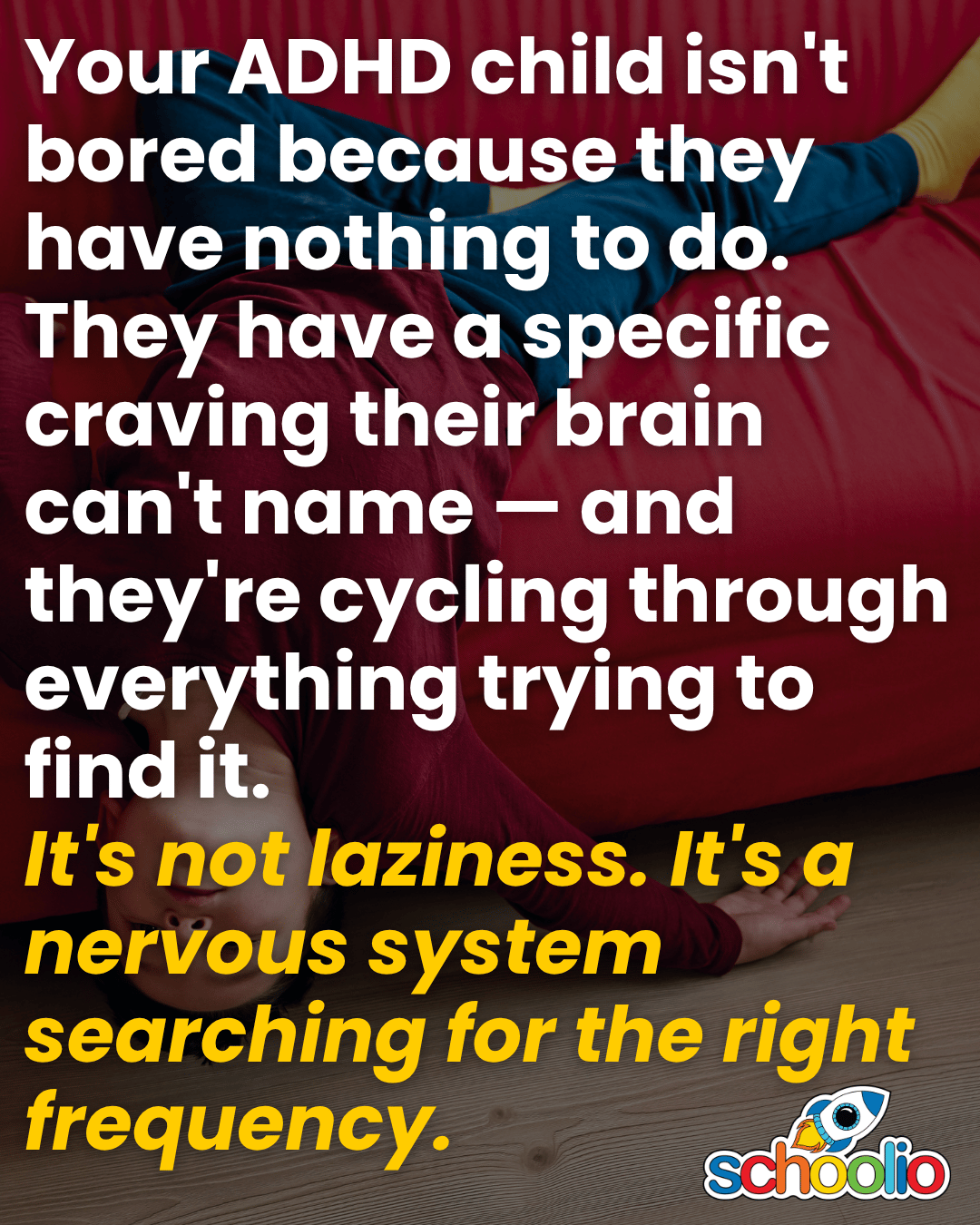
A better word for it — one that ADHDers themselves often land on — is restlessness. Or an itch. A specific, experiential craving for a particular type of stimulation that the brain can’t quite name or locate, but desperately needs to find.
The ADHD brain isn’t under-stimulated because there’s nothing to do.
It’s under-stimulated because nothing available is hitting the right frequency.
Think of it like being hungry for something specific — but you don’t know what it is. You open the fridge. Nothing looks right. You check the pantry. Nope. You make toast and it doesn’t touch it. You’re not being picky for the sake of it. Your body is craving something specific and won’t be satisfied until it gets it — even if you can’t identify what it is.
That’s what your child is doing when they cycle through every screen, every toy, every activity in the house and still can’t settle.
They’re not being difficult.
They’re searching.
What It Feels Like From the Inside
This is the part that most parents never get to hear — because most kids don’t have the language for it yet.
ADHDers who’ve learned to describe it talk about a kind of vibrating, itchy feeling. An unbearable internal restlessness that takes enormous mental energy to sit with. Sometimes it’s emotional — a low-grade agitation that makes everything feel slightly wrong. Sometimes it’s almost physical — a feeling that their bones are restless, that they need to move or do but don’t know what moving or doing would actually help.
It’s not laziness. It’s not ingratitude. It’s not a failure of imagination.
It’s a nervous system signalling that something is off — loudly, persistently, and without giving any useful information about what would fix it.
For a child who doesn’t yet have the words for this, that experience often comes out as:
“I’m bored.”
Or irritability. Or picking fights. Or suddenly deciding they desperately need something they don’t have. Or a meltdown that seems to come from nowhere but was actually building for hours.
You weren’t imagining the tension in the room.
You were watching a nervous system in distress.
Why the ADHD Brain Gets Here
The same dopamine differences that drive so much of the ADHD experience are at the root of this too.
The ADHD brain requires a higher level of stimulation to feel regulated and settled. When that stimulation isn’t present — or when the available options aren’t novel, interesting, or engaging enough to activate the dopamine system — the brain enters a kind of seeking state. It knows something is missing. It just can’t tell you what.
This is also why screen time can become such a pull during these moments. Screens — especially fast-paced games and short-form video — deliver dopamine in quick, reliable hits. They’re not the only answer, but for a brain that’s desperately seeking regulation, they’re often the most accessible one.
It’s not a screen addiction problem.
It’s a regulation problem.
And understanding the difference changes everything about how you respond to it.
What Parents Can Do
The goal here isn’t to fix the restlessness — it’s to help your child move through it. And that starts with naming it.
Give it a name together. When your child is calm, talk about the itchy brain feeling. Describe it. Ask if they recognize it. Kids who have language for what’s happening inside them are so much better equipped to communicate it — and to ask for help — in the moment.
Help them build a “hits the right frequency” list. Not a list of things they could do — a specific list of things that have actually worked in the past to scratch the itch. For some kids it’s physical: jumping on a trampoline, going for a bike ride, doing something with their hands. For others it’s creative, or social, or involves a specific kind of challenge. This list is personal and it takes time to build — but it becomes genuinely useful.
Don’t try to logic them out of it. Pointing out everything they have to do or play with isn’t going to land when their nervous system is in seeking mode. Their brain already knows the options. The options aren’t the problem.
Reduce the demand. Sometimes the most helpful thing is to just be present with them. Sit nearby. Put something on in the background. Offer to do something with them rather than pointing them toward something to do alone. Co-regulation — your regulated nervous system helping to settle theirs — is often what actually moves the needle.
A Note for Homeschooling Families
If you’re homeschooling, you’re seeing this up close in a way school parents often don’t. And that can feel overwhelming — especially on the days when the restlessness arrives before you’ve even started your morning.
But here’s the flip side: you have something schools don’t. You have the flexibility to respond to it.
You can build movement into your mornings before academics. You can follow the interest when it finally arrives instead of forcing the schedule. You can recognise the itchy brain days for what they are — high nervous system days — and adjust accordingly rather than pushing through and escalating everything.
At Schoolio, our flexible, interest-led structure is built specifically for kids whose nervous systems don’t run on a fixed timetable. The lesson will still be there when your child is regulated enough to actually absorb it.
That’s not giving up on the day.
That’s reading your child.
What Your Child Needs You to Know
They’re not doing this at you.
They’re not bored because you’ve failed to provide enough. They’re not cycling through activities to make you feel guilty or to avoid the work. They’re not being dramatic.
They have an itchy brain that hasn’t found the right scratch yet.
And the moment you stop reading it as a behaviour problem and start reading it as a nervous system signal — everything about how you respond changes.
That shift?
That’s where the connection lives.
To understand more about how dopamine drives your ADHD child’s experience, read Understanding ADHD Motivation in Kids: It’s Not Broken, Just Different. And if this restlessness is showing up as resistance to starting the school day, our post on After School Restraint Collapse might help explain what’s happening after hours too.