When “Bad Teacher” Comedy Isn’t a Laughing Matter
My social media feeds are full of education-related content. Lately, I’ve noticed an increase in comedians like Gerry Dee (Mr. D)—alongside a growing wave of TikTok and Instagram “former teacher” creators—who are building successful careers around the idea that being a bad teacher is funny, relatable, and ultimately harmless.
But today’s Mr. D video in my TikTok feed hit differently, as I had just finished sitting next to my daughter in the kitchen for over an hour while she painfully cried her way through an essay that an apathetic teacher assigned at the last minute as a “punishment” to the class for not paying enough attention to him- without any instruction around the skills needed for this essay. For my autistic and dyslexic child, who takes every word literally and straight to heart, and has loads of anxiety around handing in her absolute best work, this pressure and lack of support sent her into meltdown mode.
There are several comedians who’ve built entire lanes around “I was bad at my old job / the system was a joke / authority doesn’t matter” humor. My issue isn’t with comedy about work in general. It’s with ex-teachers making light of how poorly they did their jobs—and how little they cared while doing them.
That kind of humor punches down.
It celebrates apathy.
And it shows a complete lack of concern for who was harmed in the making of that joke: the vulnerable children they were responsible for.
Yes, I understand why these jokes land.
Most of us have had that teacher.
The disorganized one.
The checked-out one.
The one who survived the school day purely on sarcasm and vibes.
We’re conditioned to laugh and say, “Yep. That’s just school.”
But here’s the part that never makes it into the punchline:
For some kids—and some families—that teacher isn’t a funny memory.
They’re the reason everything fell apart.
Why “Bad Teacher” Comedy Is a Unique Problem
This is the core issue these jokes orbit around, whether intentionally or not.
Teaching is one of the only professions where:
- The audience (kids) can’t leave
- The harm is delayed and largely invisible
- The most vulnerable are affected first
- And society shrugs and says, “That’s just school.”
For neurodivergent kids in particular:
- There is no buffer
- No “later we’ll laugh about this”
- No neutral experience
A teacher who is unstructured, dismissive, or proudly unprepared isn’t quirky—they’re destabilizing.
A chaotic classroom isn’t funny when your nervous system relies on predictability to feel safe.
Sarcasm isn’t clever when language is processed literally.
“Figure it out” isn’t empowering when executive function is already a daily battle.
So when a comedian builds a career celebrating that archetype, it doesn’t land as satire.
It lands as dismissal.
“That’s Just School” Is Not a Neutral Statement
One of the most damaging parts of this genre of humor is how effectively it reinforces the idea that bad teaching is a harmless rite of passage.
We laugh.
We relate.
We normalize it.
And in doing so, we erase the kids who couldn’t survive that environment.
I work with—and parent alongside—families whose children didn’t just dislike school.
They burned out.
They shut down.
They developed anxiety so intense they couldn’t enter the building.
These families didn’t leave school because they were anti-education.
They left because continuing would have meant sacrificing their child’s mental health.
So when we laugh at jokes about incompetence in classrooms, we’re not just laughing at a system—we’re laughing past the kids who were harmed by it.
The Line Being Crossed
This is the distinction that matters:
Comedy about systems failing = fair
Comedy about authority over powerless kids = requires responsibility
This isn’t about being unable to take a joke.
And it’s not about policing comedy.
My frustration isn’t with humor.
It’s with who the joke protects.
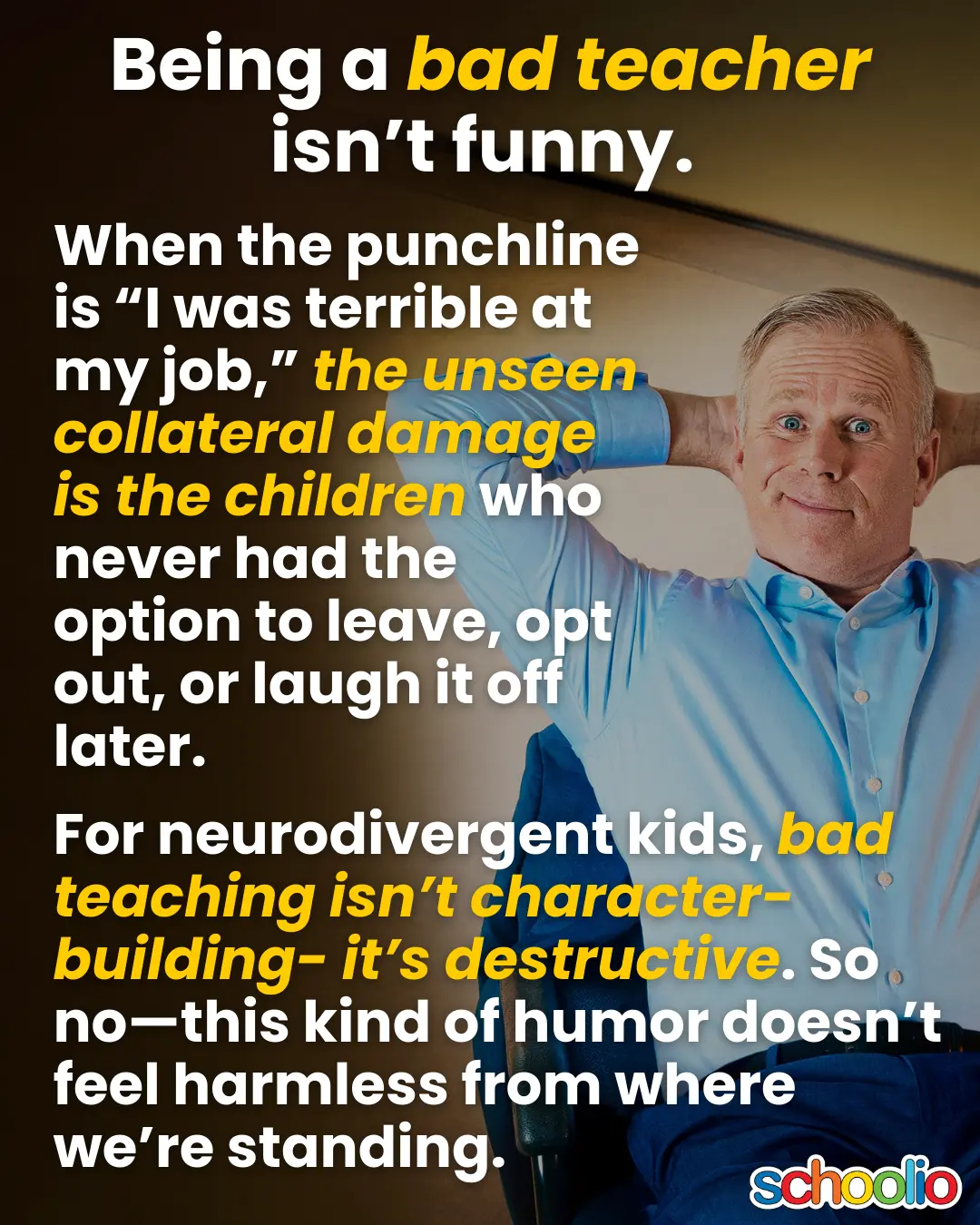
When the punchline is “I was terrible at my job,” the unseen collateral damage is the children who never had the option to leave, opt out, or laugh it off later.
Why This Hits Different for Our Community
For neurodivergent kids, bad teaching isn’t character-building.
It’s often the start of years of self-doubt, resistance to learning, and internalized shame.
So no—this kind of humor doesn’t feel harmless from where we’re standing.
It feels like another reminder of why so many of us chose a different path.
Why homeschooling wasn’t a lifestyle choice, but a lifeline.
Why “relatable” stories about bad teachers land very differently when you’ve seen the damage up close.
Good teaching matters.
Competent teaching matters.
Neurodivergent-aware teaching matters most of all.
And for families like ours, that truth isn’t funny at all.
Certified Special Ed Educator & Co-Founder, Schoolio