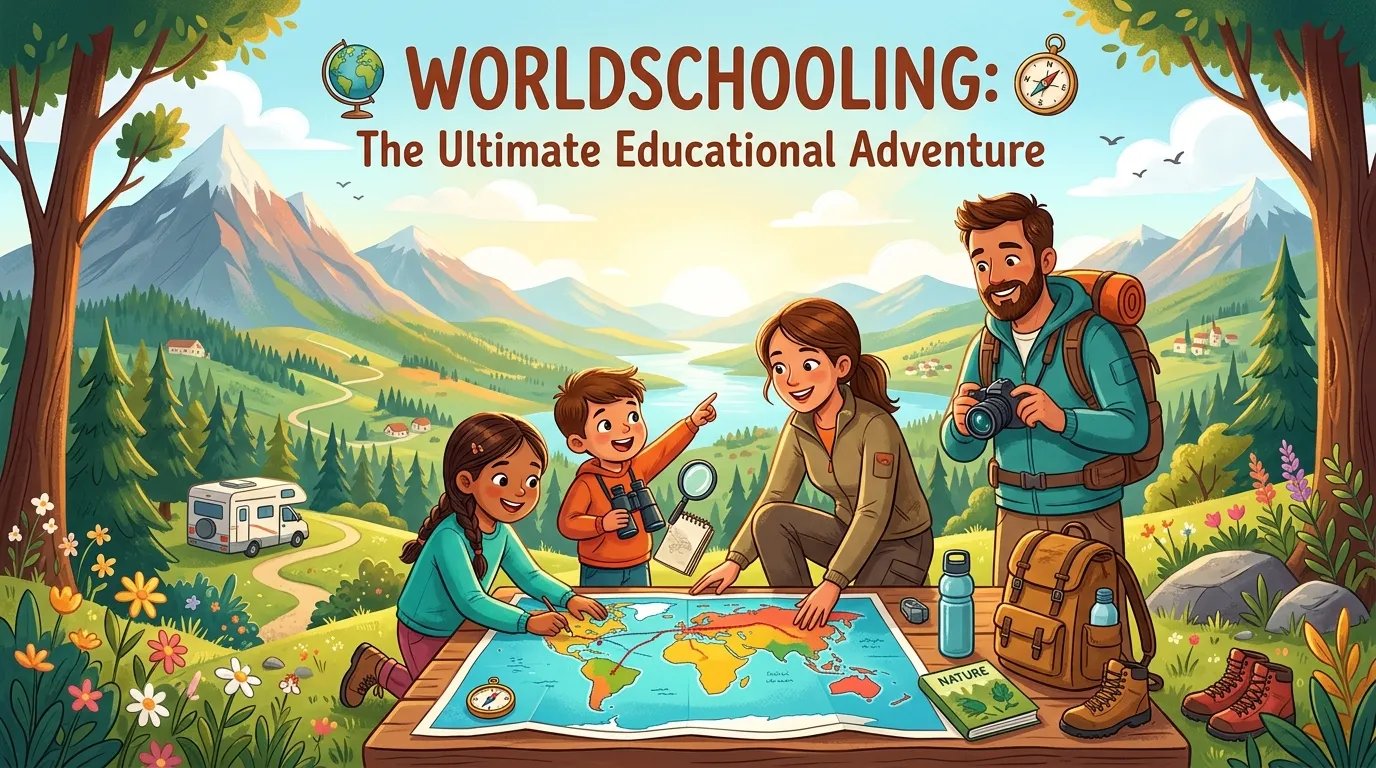
Worldschooling: Turning the Globe into Your Child’s Classroom

Why confine learning to a desk when the world can be your curriculum? Worldschooling is a rapidly growing movement of families who travel and learn simultaneously, breaking free from the rigid 7-hour public school workday. Whether you are living in an RV traversing national parks, operating as digital nomads across Europe, or simply taking extended family trips during the traditional academic year, learning doesn’t have to stop when you leave your house. In fact, that’s precisely when the most impactful learning begins.

The concept of worldschooling is beautifully simple but profoundly transformative: the world itself is the classroom. Every museum, every hiking trail, every interaction at a local market becomes a tangible lesson in history, science, geography, or economics. If you have been feeling the burnout of standard education or seeking a way to merge family travel with academic excellence, the worldschooling lifestyle might be the perfect fit.

The Philosophy Behind Worldschooling

Traditional schooling requires strict adherence to a specific location, a standardized timetable, and an inflexible curriculum. Worldschooling flips this paradigm completely on its head. Instead of reading about the Colosseum in a dry textbook, a worldschooling child walks its ancient steps and touches the stone. Instead of memorizing biology facts from a whiteboard, they explore tide pools in Costa Rica, observe ecosystems firsthand, or track animal footprints in the Rocky Mountains. Education becomes a living, breathing experience.

This experiential learning cements knowledge far deeper than rote memorization ever could. According to resources on neurodevelopment and learning, such as the Child Mind Institute, hands-on, multisensory learning experiences significantly improve retention and engagement, particularly for neurodivergent children. When a child can see, touch, and experience the subject matter, the abstract becomes concrete.

Micro-Bursts and the End of the 7-Hour Grind

A common fear among prospective traveling families is how to fit “school” into a busy travel itinerary. “How will we have time to explore if we have to do school for 7 hours a day?” The secret lies in abandoning the 7-hour public school model altogether. When you remove classroom management, roll call, transitions, cafeteria time, and busywork, a child’s core academic needs—math, reading, and writing—can often be completed in about two hours.

By utilizing 15-minute micro-bursts of high-intensity learning, a child can complete their math lesson while waiting for a train, read their language arts passage at a café, or practice phonics on a long car ride. The rest of the day is spent immersed in the culture and environment around them. This approach prevents burnout and preserves the joy of exploration, ensuring that learning remains a seamless part of the day rather than a tedious chore.

Logistics: How to Manage Curriculum on the Road

Carrying heavy textbooks, workbooks, and binders across international borders or in a cramped RV is simply not feasible. Baggage limits and space constraints make physical curriculum a logistical nightmare. This is where a robust digital platform becomes the worldschooler’s best friend.

Schoolio’s digital platform is built exactly for this kind of extreme flexibility. Because our platform tracks progress automatically, parents don’t need to worry about losing paperwork, grading quizzes manually, or carrying heavy teacher guides. Your child logs in, completes their daily core subjects, and logs off. It’s truly open-and-go from anywhere with a Wi-Fi connection.

If you want to review what subjects are covered, you can explore Schoolio’s comprehensive Academics to see how our curriculum scales from Kindergarten through Grade 8, no matter where in the world you are located.

The Ultimate Form of Socialization

One of the most persistent questions any homeschooling family faces is, “But what about socialization?” Critics often assume that learning outside a traditional classroom leads to isolation. In reality, worldschooling provides the ultimate socialization.

Children learn to interact with people of all ages, cultures, and backgrounds. They aren’t limited to socializing only with peers born in the exact same twelve-month window. They learn to navigate language barriers, understand diverse cultural norms, and engage with the world confidently. They develop empathy, global awareness, and adaptability—critical soft skills that are essential for success in the modern world but are rarely taught in a traditional classroom setting.

Navigating Costs and Accessibility

Many families assume that worldschooling requires a massive trust fund or lottery win. While travel certainly involves costs, blending education and lifestyle often allows families to embrace geographic arbitrage—living in areas where the cost of living is significantly lower than their home country.

When it comes to the educational materials themselves, flexibility shouldn’t break the bank. You can check out Schoolio’s flexible Pricing Plans to see how an all-in-one digital solution can replace thousands of dollars worth of physical textbooks and supplementary tutors.

Ready to Pack Your Bags?

Worldschooling is more than an educational choice; it is a lifestyle commitment. It demands flexibility, curiosity, and a willingness to step outside the conventional boundaries of what “school” looks like. But for the families who embrace it, the rewards are immeasurable. A child raised as a global citizen possesses a breadth of knowledge and a depth of character that will serve them for a lifetime.

If you are ready to take the leap, equip yourself with the right tools. An open-and-go curriculum paired with a sense of adventure is all you really need to turn the entire globe into your child’s classroom.


“Education shouldn’t be confined to four walls and a rigid bell schedule. By abandoning the 7-hour grind and embracing micro-bursts of learning, worldschooling families are proving that the most profound education happens out in the real world.”
— Lindsey Casselman, Co-Founder of Schoolio

Related Reading: Homeschool Travel: A New Way to Learn Beyond the Classroom | Embracing the Nomadic Lifestyle: A Conversation with Megan
Why We Need to Redefine What ‘Progress’ Looks Like in Homeschooling

Why We Need to Redefine What ‘Progress’ Looks Like in Homeschooling

Voice: Sathish

This has been on my mind today…

The word “progress” shows up a lot when we talk about education. Are they on grade level? Are they reading at the right age? Are they behind? Ahead? Caught up? We use these markers like a ruler held up against our kids — even when we know, deep down, that learning doesn’t work that way.

I’ve spoken to so many families who felt pressure to make their homeschool look like school. If their child wasn’t hitting the same pace or benchmarks, something must be wrong. But more and more I’m hearing stories from parents that flip that narrative completely.

Like Suzanne. Her son is autistic and in grade 6. They were searching for something — anything — that would actually work for him. She called finding Schoolio a “game changer.” For the first time, her son is doing really well. Not just keeping up — thriving. Not because someone pushed him through a one-size-fits-all curriculum, but because they finally found a platform that met him where he was.

Or Holly, who told us her daughter was developmentally behind and struggling to understand things. Public school left her confused and overwhelmed. But now? With Schoolio lessons, she’s finally understanding. She’s gaining confidence. She’s calm and learning. And Holly said, “I couldn’t be happier.”

These stories remind me that real progress isn’t always loud. It doesn’t always show up on a test score. Sometimes progress is your child smiling during a lesson instead of crying. Sometimes it’s the first time they ask to keep going. Or the first time they feel safe enough to say, “I don’t get it,” and actually get the support they need.

We have to unlearn the idea that speed equals success. Learning isn’t a race. If your child needs more time to grasp a concept, that’s not failure — that’s human. Especially for neurodivergent learners or kids recovering from years of being overwhelmed by noise, rules, and fast-paced instruction.

Progress can be your child doing less… but doing it with joy. It can be fewer meltdowns. More calm. Asking questions again. Finding confidence. Progress might not be a straight line. But when we build learning around the child — not the system — it shows up in ways that actually matter.

So if you’re homeschooling and worried that your child is “behind,” take a breath. Ask yourself — are they more curious? More relaxed? Starting to enjoy learning again?

That might be the most important kind of progress there is.

Sathish

still learning, still unlearning


Homeschool Travel: A New Way to Learn Beyond the Classroom

What Is Homeschool Travel?

Homeschool travel, also called worldschooling, is an innovative approach to education where learning happens on the move. Instead of staying confined to a traditional classroom, families explore new countries, cultures, and environments while using flexible homeschooling tools to ensure their child’s academic growth.

For first-time homeschoolers and digital nomad families, this lifestyle offers the chance to turn the world into a living classroom.


Why More Families Are Choosing Homeschool Travel

In an age of remote work and flexible learning, more families are embracing the freedom to live and learn on their own terms. Here’s why homeschool travel is gaining popularity.

1. Flexible Schedules and Remote Work

As remote work becomes more common, parents no longer have to choose between careers and education. They can work online while guiding their children’s learning from anywhere in the world.

2. A Personalized Approach to Education

Every destination offers something new to explore, whether it’s marine biology in Thailand or Roman history in Italy. With the right curriculum, you can teach core subjects while aligning lessons with real-world experiences.

Tip: Use Schoolio’s scope and sequence to map your learning path and ensure academic consistency.

3. Real-World, Hands-On Learning

From visiting ancient ruins to trying new languages in local markets, homeschool travel turns everyday life into an educational opportunity. These experiences foster critical thinking, adaptability, and a deep understanding of global cultures.


What Kids Learn Through Homeschool Travel

Learning Area

Real-Life Experience Example

Science

Studying coral reefs while snorkeling in Belize

Geography

Navigating public transit in Tokyo

History

Exploring Egyptian pyramids and learning their stories

Language

Practicing Spanish while shopping in Mexico

Social Studies

Attending local festivals and observing traditions

These lessons stay with children far longer than worksheets or lectures.


The Hidden Benefits of Homeschool Travel

Beyond academics, families often find that homeschool travel strengthens family bonds and builds emotional intelligence.

  • Cultural empathy: Kids grow up respecting differences and appreciating diversity.

  • Problem-solving: Travel presents real-world challenges like missed buses, language barriers, or new routines that build resilience.

  • Stronger family connections: Shared experiences create lasting memories and deeper relationships.


What About Structure?

Worried about keeping your child on track while traveling?

At Schoolio, we’ve built a flexible curriculum designed to travel with you. Whether you’re planning a month-long trip or a year-long journey, our digital and printable lessons give you structure without limiting your freedom.

Explore our grade-by-grade roadmap here:

Schoolio Scope and Sequence


How to Start Your Homeschool Travel Journey

  1. Clarify Your Why: Do you want cultural immersion, academic freedom, or lifestyle flexibility?

  2. Choose a Curriculum: Look for one that’s portable, flexible, and easy to follow on the road, like Schoolio.

  3. Plan Your Route: Start with destinations that are safe, affordable, and education-rich.

  4. Set Realistic Goals: Combine learning with exploration. A lesson a day can go a long way.

  5. Join the Community: Connect with other homeschool travelers via social media, forums, or Schoolio’s parent groups.


Final Thoughts: Education That Goes Beyond Borders

Homeschool travel is not just a trend. It is a movement focused on raising adaptable, curious, and globally aware children. Whether you’re exploring the world full-time or starting small with weekend trips, the possibilities for learning are endless.

You don’t have to do it alone.

With Schoolio, you get the support, curriculum, and flexibility to turn travel into a meaningful educational journey for your family.


Ready to Pack Learning Into Your Suitcase?

Explore our complete homeschool curriculum and start your travel learning adventure today.

View Scope and Sequence

Exploring the World Together: Why Traveling with Kids Matters

In the grand adventure of life, there’s a unique joy that comes from exploring the world with our children. As parents, we embark on journeys not just to see new places but to open the doors of understanding and curiosity for our little ones. Let’s delve into the reasons why parents travel with their kids and the incredible benefits of introducing them to diverse cultures and languages.

1. Opening Windows to the World: Traveling with kids serves as a magical window through which they witness the beauty, diversity, and richness of the world. Experiencing different cultures firsthand fosters a sense of appreciation for the vast tapestry of humanity.

2. Cultivating Global Awareness: By immersing children in various cultures, parents cultivate a global perspective that goes beyond textbooks. This awareness helps kids appreciate differences, celebrate diversity, and develop a more profound understanding of the interconnected world we live in.

3. Language Learning Made Fun: Traveling exposes children to different languages in authentic settings, making language learning an exciting adventure. Kids naturally pick up phrases, greetings, and expressions, laying the foundation for a broader linguistic understanding.

4. Building Empathy and Tolerance: Exposure to diverse cultures encourages empathy and tolerance. Kids learn to embrace different perspectives, understand that there’s more than one way to live, and appreciate the beauty in our global tapestry.

5. Creating Lasting Memories: Family travels create indelible memories that last a lifetime. These shared experiences become a foundation for strong family bonds, creating a treasure trove of stories that children carry into adulthood.

How Schoolio Learning Expands Horizons:

Enter Schoolio Learning, a platform designed to nurture young minds and broaden their understanding of the world. Through captivating e-books, Schoolio Learning introduces wonderful topics about different countries, sparking curiosity and encouraging exploration.

? Discover the World Through E-Books: Schoolio Learning’s e-books transport children to far-off lands, exploring cultures, traditions, and the wonders of our planet. With topics ranging from the pyramids of Egypt to the rainforests of Brazil, these e-books make learning about different countries engaging and fun.

? Cultivating Lifelong Learners: Schoolio Learning goes beyond traditional learning, instilling a love for discovery and a curiosity about the world. The Schoolio Learning e-books become companions on a journey of exploration, helping children understand and appreciate the rich tapestry of our global community.

In conclusion, as we travel with our kids, we not only show them the world but also equip them with the tools to understand and embrace it. With Schoolio Learning’s e-books, we open up new realms of knowledge, ensuring our children become curious, empathetic, and globally aware citizens. The journey of exploration begins now, and the world is their classroom! ??

#SchoolioLearning #WorldExplorers #CulturalUnderstanding

World-schooling Education Without Borders: Nurturing Minds on the Move with Schoolio

World-schooling Education Without Borders: Nurturing Minds on the Move with Schoolio

World-schooling Education Without Borders: Nurturing Minds on the Move with Schoolio

Embarking on a journey across borders, digital nomad families are redefining the way their children learn, turning the world into their classroom. In this age of exploration and connectivity, World-schooling has emerged as a transformative approach to education for families constantly on the move. This blog explores world-schooling education without borders. And the adventures and challenges faced by Nomad Families and introduces Schoolio, a pioneering solution catering to the unique needs of these globetrotting learners.

World-schooling: Where Learning Knows No Boundaries

World-schooling stands as a beacon for families who crave a holistic approach to learning. Nomad Families, fuelled by the desire for cultural immersion and a non-traditional educational experience, are embracing the nomadic lifestyle. As they traverse the globe, their children absorb knowledge not just from textbooks but from the rich tapestry of the world around them.

Nomad Families: Life on the Road

The term “Nomad Families” evokes images of exploration, discovery, and the freedom to learn beyond the confines of traditional classrooms. These families, equipped with a sense of adventure and a commitment to unconventional education, are rewriting the narrative of what it means to be a student.

Schoolio Family Plan

Traveling Family Education: The Classroom Without Walls

For these families, every city, beach, and mountain becomes a potential classroom. Learning isn’t limited to the pages of a textbook; instead, it unfolds through real-life experiences, language immersion, and cultural exchanges. The world becomes the curriculum, offering lessons in geography, history, and social dynamics that are impossible to replicate within the four walls of a conventional classroom.

Education Program for Nomads: Bridging Gaps with Remote Homeschool Programs

Despite the allure of world travel, Nomad Families face the challenge of maintaining a consistent and high-quality education for their children. This is where remote homeschool programs play a pivotal role. These programs enable families to follow a structured curriculum while allowing the flexibility required for a life on the road.

Homeschooling Curriculum: Tailoring Education to Nomadic Lifestyles

Crafting a curriculum for Nomad Families involves striking a balance between academic rigor. And the flexibility needed for a constantly changing environment. Homeschooling becomes a dynamic journey, adapting to different time zones, cultural shifts, and unique learning opportunities. That arise during the family’s travels.

Schoolio e-books

Introducing Schoolio: Empowering Nomad Families with Learning Solutions

Amidst the challenges faced by Nomad Families, Schoolio emerges as a beacon of support. This innovative platform offers a comprehensive homeschooling curriculum designed for the digital age. Schoolio understands the diverse needs of nomadic learners and provides a flexible, technology-driven solution that caters to the ever-changing nature of their educational journey.

Schoolio Learning: Navigating the World, Mastering Education

Schoolio’s approach to education aligns seamlessly with the nomadic lifestyle. With a user-friendly interface and a wealth of resources. Schoolio allows families to access lessons, track progress, and engage with educators from anywhere in the world. The platform’s adaptive nature ensures that learning remains a constant companion, evolving with the family as they explore new horizons.

Nomad Families find in Schoolio not just an educational platform but a steadfast companion on their global journey. Together, they redefine education without borders, proving that the world is not only a classroom. But an infinite source of inspiration for those with a thirst for knowledge and a passion for exploration.

Learn more about homeschooling for digital nomad families

Schoolio Learning Resources