Focus on Emotional Readiness Before Academics

Focus on Emotional Readiness Before Academics

This has been on my mind today…


I read about a mom in Queen Creek homeschooling her four kids using what she calls a more progressive approach. What stayed with me was not the label. It was the quiet confidence in how she trusted her children instead of managing them.

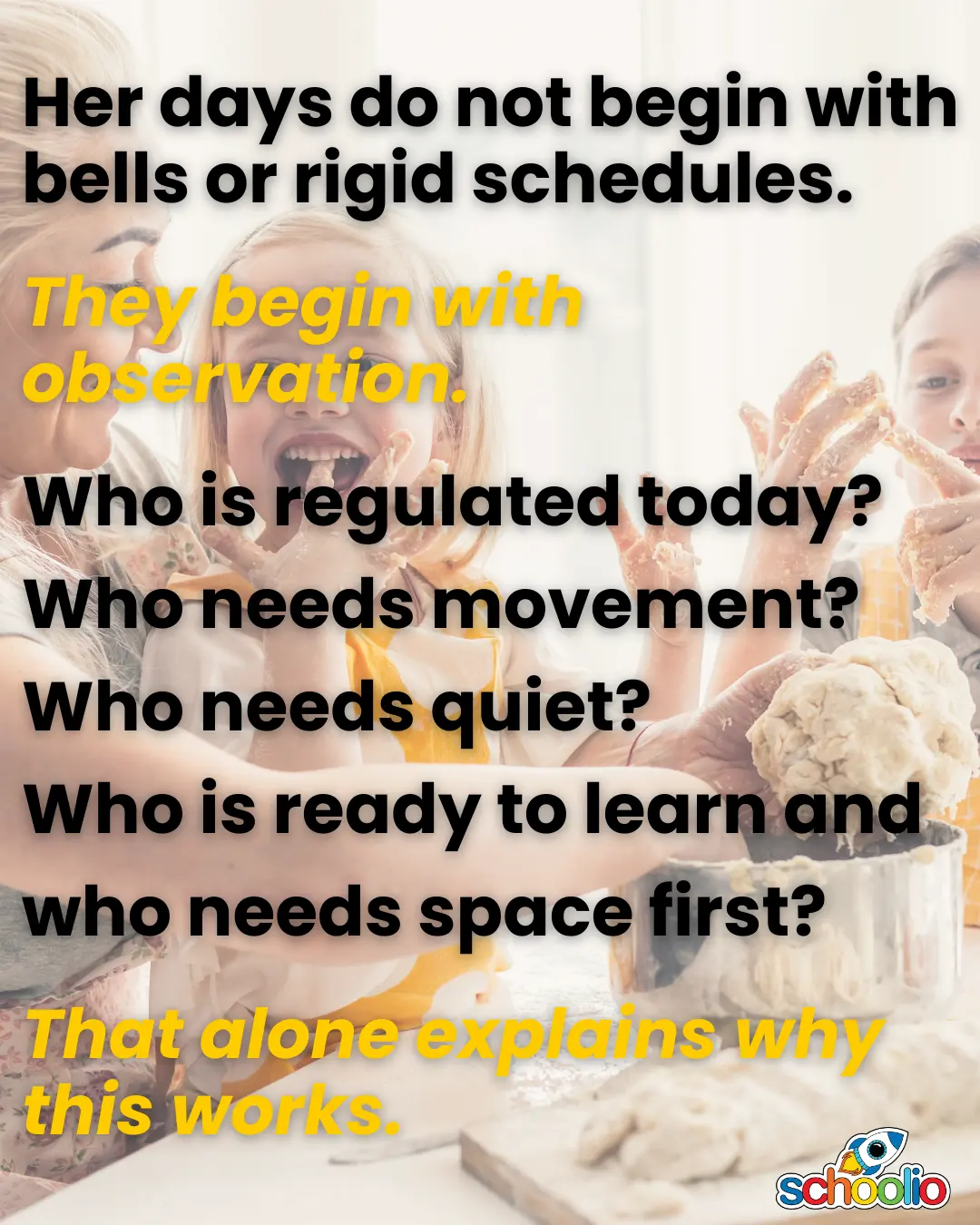
Her days do not begin with bells or rigid schedules. They begin with observation. Who is regulated today. Who needs movement. Who needs quiet. Who is ready to learn and who needs space first. That alone explains why this works.

She uses curriculum, but it is not the authority. It is a tool. Math might happen early for one child and later for another. Reading might be independent one day and shared the next. If something is not landing, she does not push harder. She pivots.

That is the part most systems struggle with. They confuse consistency with rigidity. They confuse pressure with progress.

What stood out most was her focus on emotional readiness before academics. She noticed that when her kids felt safe and calm, learning followed naturally. When they felt rushed or judged, everything shut down. Any parent of a neurodivergent or sensitive child knows this truth deeply, even if they have been told to ignore it.

This approach gives kids permission to go deep instead of wide. One child can stay with science longer without being rushed to keep pace. Another can take extra time with reading without being labeled behind. There is no artificial race. There is only progress that matches the child.

This is not chaos. It is intentional flexibility. It is structure that bends instead of breaks.

For neurodivergent kids especially, this matters. Many of them are not incapable. They are overwhelmed. They are not behind. They are overstimulated. When the environment adapts to them instead of forcing compliance, something powerful happens. Confidence returns. Curiosity comes back. Learning becomes possible again.

And here is where I get more opinionated.

Too many children are being pushed through systems that were never designed for how they think, feel, or regulate. When they struggle, the system calls them broken. This mom did the opposite. She changed the system around her kids instead of asking her kids to change who they are.

The result was not just better learning. It was a healthier home. Fewer battles. More willingness to try hard things. Less fear around mistakes. School stopped being something to survive and became something they could participate in.

That is the part we do not talk about enough.

For parents reading this and wondering what the takeaway is, it is not that you need to homeschool. It is that learning works best when your child feels seen first. Whether you are supplementing, transitioning, or rethinking school entirely, the question to ask is simple.

Is this environment helping my child feel capable or constantly reminding them they are not.

We see families arrive at schoolio from this exact moment. Not angry. Not anti school. Just deeply aware that their child needs something more responsive and more human. Especially neurodivergent kids who have spent years being told to try harder in systems that refuse to adapt.

Stories like this remind me that homeschooling does not have to be extreme or reactive. It can be thoughtful. Calm. Grounded in trust. Built around the child you have, not the one a system expects.

And when education starts there, kids do not just learn more. They believe more in themselves.


Sathish

still learning, still unlearning


Source:

Queen Creek mom of 4 takes a more progressive approach to homeschooling

KJZZ Phoenix

https://www.kjzz.org/the-show/2026-01-13/queen-creek-mom-of-4-takes-a-more-progressive-approach-to-homeschooling

My Child Is Not an Adult in Training

My Child Is Not an Adult in Training


A home educator dares to imagine an education that matters to the child as a child, not just as an adult in training.” — Julie Bogart


This has been on my mind today…

Somewhere along the way, education stopped being about childhood. It became about adulthood. Test scores. GPAs. College readiness. Career prep.

But what about being ready to be a child?

When I started homeschooling, I thought I was just taking on a different method of schooling. What I didn’t expect was how quickly my kids began to reclaim parts of themselves that had been rushed, quieted, or overlooked.

They became more playful. More curious. They asked more questions. They stopped trying to always be “on” or “perfect” or older than they were.

And I realized something. So much of traditional education is focused on preparing kids for a future life that it forgets they are living one right now.

School culture pushes kids to grow up faster than they’re ready to. To give up play for “coolness” or “serious work”.

They are not adults in training. They are kids. With real thoughts. Real emotions. Real learning rhythms that don’t always fit neat timelines.

Homeschooling gives us the chance to slow it all down.

To build a world around them that says “you matter” without needing to add “when you grow up”, let them rest when they’re tired, and let them chase the weird, wild ideas they can’t stop thinking about.

To let them enjoy learning instead of fearing it.

Let them play.

This doesn’t mean we don’t care about their futures. It means we believe that honoring their present is part of preparing them for it.

I want my kids to grow into capable, wise, thoughtful adults. But I also want them to have a childhood they can look back on with joy — not burnout.

That’s the gift homeschooling gave us. And I’ll never regret choosing it.

With love,

Lindsey

Certified Special Ed Educator & Co-Founder, Schoolio

The Psychology of Performance: Mental Well-being for Child Actors

The Psychology of Performance: Mental Well-being for Child Actors

The Psychology of Performance: Mental Well-being for Child Actors

In the glitzy world of showbiz, child actors often find themselves navigating a unique set of challenges. While their talent and charisma may captivate audiences, behind the scenes, these young performers grapple with the pressures of fame, intense schedules, and the constant demand for perfection. Amidst this whirlwind, prioritizing their mental well-being becomes paramount. Social Emotional Learning (SEL) emerges as a crucial tool in nurturing the holistic development of child actors, offering them the resilience and emotional intelligence needed to thrive both on and off the stage. Let’s talk about the psychology of performance: mental well-being for child actors.

Understanding the Unique Challenges

Schoolio Family Plan

Child actors face a myriad of challenges that can significantly impact their mental health. The competitive nature of the entertainment industry, coupled with the scrutiny of public opinion, places immense pressure on these young individuals. From auditions to rehearsals to performances, their lives are often filled with high-stakes situations that demand unwavering focus and composure. Moreover, the unpredictable nature of the industry can lead to feelings of instability and insecurity, as young actors navigate fluctuating career opportunities and the constant pursuit of success.

The Importance of Social Emotional Learning

Recognizing the need to support the emotional well-being of child actors, many parents and educators are turning to Social Emotional Learning (SEL) as a cornerstone of their education. SEL equips young performers with essential skills such as self-awareness, self-regulation, empathy, and interpersonal communication. By fostering these competencies, SEL empowers child actors to navigate the complexities of their profession with grace and resilience.

Schoolio e-books

Comprehensive Curricula Integrating SEL

Homeschooling emerges as a popular choice for young actors, offering a flexible and tailored approach to education that accommodates their demanding schedules. Platforms like Schoolio provide comprehensive curricula that integrate SEL seamlessly into academic learning, ensuring that young performers receive a holistic education that prioritizes their emotional development. Additionally, specialized resources and programs specifically designed for child actors offer targeted support in areas such as stress management, coping strategies, and building healthy relationships.

The world of child acting presents unique challenges that can take a toll on young performers’ mental health. By prioritizing Social Emotional Learning and adopting tailored approaches to education, we can empower child actors to navigate the demands of their profession while fostering their overall well-being. As we celebrate their talent and achievements, let us also commit to providing the support and resources they need to thrive both on and off the stage.

Schoolio Learning Resources

Click here for Parenting Tips for Supporting Child Actors

Exploring Schoolio’s Diverse Curriculum Options

Exploring Schoolio’s Diverse Curriculum Options

Exploring Schoolio’s Diverse Curriculum Options

At Schoolio, we believe that education should be as diverse as the students it serves. Our commitment to providing a comprehensive learning experience is reflected in the wide array of curriculum options we offer, catering to students from kindergarten to eighth grade. Let’s start exploring Schoolio’s diverse curriculum options by delving into the three main categories that define Schoolio’s robust curriculum: Core Curriculum, Electives, and Social Emotional Learning (SEL).

Core Curriculum: Building Foundations for Success

Math

Schoolio’s core math curriculum is designed to build a strong foundation in mathematical concepts. From basic arithmetic to more advanced topics, our curriculum adapts to each student’s learning pace and style.

Science

In the realm of science, Schoolio excels in providing engaging lessons that cover a spectrum of subjects. Whether exploring the mysteries of the universe, conducting hands-on experiments, or understanding the delicate balance of ecosystems, our science curriculum sparks curiosity and critical thinking.

Social Studies

Our social studies curriculum takes students on a journey through history, geography, and cultures. From ancient civilizations to contemporary global issues, Schoolio fosters an appreciation for the world’s diversity and helps students develop a well-rounded worldview.

Language Arts

Language arts form the cornerstone of effective communication and critical thinking. Schoolio’s language arts curriculum encompasses reading, writing, grammar, and more, empowering students to express themselves eloquently and comprehend complex texts.

Electives: Unleashing Creativity and Passion

For students seeking to explore beyond the core curriculum, Schoolio boasts an extensive library of electives. These courses are designed to tap into students’ interests and passions, making learning an exciting adventure. Some of our standout electives include:

  • Candy Chemistry: Uncover the sweet science behind your favorite treats.
  • Earth’s Core: Journey to the center of the Earth and discover its mysteries.
  • All About Honeybees: Explore the fascinating world of these crucial pollinators.
  • Novel Studies: Dive into the pages of captivating stories and analyze literary elements.
  • Introduction to Art: Ignite creativity through hands-on artistic expression.
  • Introduction to Gymnastics: Foster physical fitness and coordination in a fun and supportive environment.

These electives provide a rich tapestry of knowledge that goes beyond traditional subjects, allowing students to pursue their passions and develop a well-rounded skill set.

Social Emotional Learning (SEL): Nurturing Holistic Growth

Recognizing the importance of emotional well-being, Schoolio integrates Social Emotional Learning (SEL) into our curriculum. The “Thoughts and Feelings” unit, tailored to different age groups, helps students navigate their emotions, build resilience, and foster positive relationships. Additionally, our SEL framework is designed to instill empathy. While also helping with self-awareness, and effective communication skills. Doing so to prepare students for success not only academically but also in the complexities of life.

Empowering Students to Thrive Academically and Emotionally

Schoolio’s commitment to a diverse and comprehensive curriculum ensures that every student finds a path to success that aligns with their unique strengths and interests. From the foundational core subjects to exciting electives and essential Social Emotional Learning, Schoolio empowers students to thrive academically and emotionally.

Join us on the Schoolio Learning Platform. Where education is not just about acquiring knowledge but also about fostering a lifelong love for learning.

Schoolio is Transforming K-8 Education with an Innovative and Holistic Approach

Schoolio is Transforming K-8 Education with an Innovative and Holistic Approach

Schoolio is Transforming K-8 Education with an Innovative and Holistic Approach

Schoolio empowers Parents and Teachers with incredible educational resources. The groundbreaking educational startup Schoolio is revolutionizing learning. Doing so by making it accessible, engaging and holistic for children and parents across the USA and Canada. Aligned with Canadian & US educational standards, Schoolio is Transforming K-8 Education with an Innovative and Holistic Approach by empowering parents to take charge of their children’s education, ensuring they
have the right resources at their fingertips.

A Comprehensive Curriculum


Focused on students enrolled from Pre-Kindergarten, Kindergarten till 8th Grade, Schoolio offers a comprehensive curriculum encompassing math, language, science, and social studies. That caters to the needs of both homeschooled and traditionally schooled students. The curriculum has been designed with a holistic approach to education by the inclusion of Social-emotional learning (SEL), physical and mental health, cutting-edge technologies, and financial literacy topics.

Social-Emotional Learning (SEL) and Electives

Schoolio realized the need for Social and emotional learning (SEL), especially during the COVID-19 pandemic. A recent survey revealed that 70% of youth rate their ability to cope with challenges as medium to very low. This clearly makes SEL more critical than ever. In addition to the core curriculum, Schoolio boasts a vibrant electives library. From where parents and students can explore a wide array of interest-based courses that keep young minds excited about learning through hands-on activities and engaging videos. Doing so brings vibrance for learning to basic concepts like multiplication, the water cycle, division, and vocabulary.

Schoolio is Transforming K-8 Education with an Innovative and Holistic Approach Using Various Metrics

Their content delivery approach, other than live or pre-recorded, for self-paced learning, audio and/or video modes extend to cutting-edge technologies like AR (Augmented Reality) and VR (Virtual Reality). Similarly, realizing the importance of diverse modes of assessments, evaluations are made using various metrics rather than relying solely on standardized testing methods. Ensuring that education is accessible to all through an engaging experience. Schoolio has been joined by more than 5,000 parents across Canada and the US, benefiting from Schoolio’s offerings and the flexibility it offers. Schoolio’s emphasis on community is another key factor in their homeschooling success.

Education Should Adapt to the Student’s Needs

The team behind Schoolio firmly believes that education should adapt to the needs of the individual student, and their approach to learning caters to this principle. Schoolio also stresses reward-based learning, ensuring that students are rewarded and appreciated for their valiant efforts and have the full opportunity to control the content they engage with. “We are redefining education,” says Sathish Bala, CEO and Founder of Schoolio. “We believe that the role of the school is to provide a diverse range of educational content and opportunities to learners using a variety of acquisition methods. It is essential that all stakeholders, including parents, teachers, tutors, coaches, and the learners themselves, actively participate in shaping the educational journey”.

Tailored Programs is Another Way Schoolio is Transforming K-8 Education


Furthermore, Schoolio also offers tailored programs to address the unique learning needs of neurodivergent children. Their services in this regard include grade-level customization, bite-sized learning sessions for maximum engagement and alternative learning strategies and knowledge demonstration methods. Schoolio’s dedication to reimagining education and providing holistic, flexible, and rewarding learning experiences is transforming the way Canadian and US parents
approach K-8 education.

Learn about the importance of teaching history to your kids.

To learn more about Schoolio and its innovative solutions, visit their website at
http://schoolio.com or send an email to sathish@schoolio.com.

For updates, follow Schoolio on social media:
Facebook: https://www.facebook.com/schooliolearning
Instagram: https://www.instagram.com/schooliolearning
Linktree: https://linktr.ee/Schooliolearning

Media Contact
Company Name: Schoolio
Contact: Sathish Bala, CEO
Email: sathish@schoolio.com
Website: www.schoolio.com
City: Toronto
State: Ontario
Country: Canada

Schoolio: A Pragmatic Approach to Amplifying Your Child’s K-8 Education

Learn interesting facts about Online Learning!

How to Teach Social-Emotional Learning in the Classroom

How to Teach Social-Emotional Learning in the Classroom.

Teaching Social-Emotional Learning

In recent years, educators and researchers have recognized the importance of social-emotional learning (SEL) in fostering students’ overall well-being and academic success. Teaching SEL skills equips students with valuable tools to navigate their emotions, develop empathy, build positive relationships, and make responsible decisions. By integrating SEL into the classroom, educators can create a supportive environment that promotes students’ emotional growth and cultivates a strong sense of community. This blog will explore practical strategies about how to teach social-emotional learning in the classroom effectively.

Benefits of Adding Social-Emotional Learning to Your Classroom:

Integrating social-emotional learning (SEL) into your classroom offers numerous benefits that extend beyond academic achievement. By prioritizing SEL, educators can help students develop a range of skills that contribute to their overall well-being and success in various aspects of life. SEL provides students with the tools to manage their emotions effectively, develop self-awareness, establish healthy relationships, and make responsible decisions.

These skills are essential for personal growth, building resilience, fostering empathy and understanding, and preparing students for the challenges of the 21st century. Moreover, research has shown that incorporating SEL into the curriculum leads to improved classroom behavior, increased student engagement, reduced bullying, and higher academic performance. By investing in social-emotional learning, educators lay a strong foundation for their students’ long-term happiness, success, and positive contributions to society. Learn more about why you should teach SEL in your classroom.

Simple Tips About How to Teach Social-Emotional Learning in the Classroom:

1. Create a Positive Classroom Climate:

Establishing a positive classroom climate is crucial for fostering social-emotional learning. Encourage open communication, active listening, and respect among students. Model empathy and understanding to create a safe space where students feel comfortable sharing their thoughts and feelings. By setting clear expectations for behavior and promoting inclusivity, you can create an environment that supports SEL growth.

Create a Positive Learning Environment

2. Integrate SEL into the Curriculum:

Integrating SEL into your daily curriculum helps students see the relevance of these skills in their academic pursuits. Infuse SEL concepts into various subjects, such as literature discussions, history lessons, or science experiments. For example, analyze characters’ emotions in a novel, explore historical events from different perspectives, or promote teamwork during group projects. This interdisciplinary approach allows students to practice SEL skills in different contexts.

3. Teach Self-Awareness and Self-Management:

Self-awareness and self-management are fundamental aspects of SEL. Help students identify and understand their emotions by incorporating activities like journaling, mindfulness exercises, or reflection prompts. Encourage them to recognize triggers, manage stress, and regulate their emotions effectively. Provide guidance on goal-setting, decision-making, and problem-solving to empower students to make responsible choices.

4. Develop Empathy and Perspective-Taking:

Empathy is a cornerstone of healthy relationships and social interactions. Teach students to understand and respect diverse perspectives by incorporating activities that promote empathy and perspective-taking. Encourage discussions on real-world issues, role-playing scenarios, or engaging with literature that explores different cultures and experiences. By developing empathy, students become more compassionate and tolerant individuals.

Social-Emotional Learning Schoolio

5. Nurture Positive Relationships:

Building positive relationships within the classroom is essential for a supportive learning environment. Encourage teamwork, cooperation, and respect through group projects, collaborative discussions, or peer mentoring. Create opportunities for students to share their thoughts, provide constructive feedback, and support each other’s growth. By fostering a sense of belonging, students feel valued and develop stronger interpersonal skills.

6. Encourage Conflict Resolution:

Teaching students how to resolve conflicts peacefully is a vital aspect of SEL. Provide strategies and frameworks for effective conflict resolution, such as active listening, compromise, and negotiation. Encourage students to express their viewpoints respectfully and help them find common ground. By promoting healthy conflict resolution skills, students learn to navigate disagreements and maintain positive relationships.

7. Engage Families and the Community:

Collaboration with families and the wider community enhances the impact of SEL. Involve parents in SEL initiatives through workshops, newsletters, or family activities that reinforce SEL skills at home. Engage community organizations, such as local mental health providers or non-profits, to provide additional resources and support for SEL initiatives. By fostering a cohesive network, students receive consistent SEL messages across various settings.

Adding Social-Emotional Learning to your classroom

Adding Social-Emotional Learning to the Classroom can be Transformative.

Integrating social-emotional learning into the classroom is a transformative approach that equips students with essential life skills. By creating a positive classroom climate, integrating SEL into the curriculum, and focusing on self-awareness, empathy, and relationship-building. Educators can then help students develop into well-rounded individuals. Who are capable of navigating their emotions, fostering positive relationships, and making responsible decisions.

Benefits of Adding Schoolio Learning’s Social-Emotional Learning Materials to Your Classroom:

Incorporating Schoolio Learning’s Social-Emotional Learning materials into your classroom brings a host of benefits to educators and students alike. Developed by experts in the field of social-emotional learning, this comprehensive program offers a structured and evidence-based approach to fostering students’ emotional intelligence and well-being.

Social-Emotional Learning

Schoolio’s Social-Emotional Learning materials provide a wide range of engaging and age-appropriate resources. Including lesson plans, activities, worksheets, and interactive multimedia materials. These resources are designed to address key SEL competencies such as self-awareness, self-management, social awareness, relationship skills, and responsible decision-making.

Gain Access to a Well-Organized Social-Emotional Learning Curriculum.

By implementing Schoolio Learning’s Social-Emotional Learning materials, educators gain access to a well-organized and sequential curriculum. That allows for systematic instruction and progression of SEL skills throughout the academic year. Our Social-Emotional Learning curriculum also offers flexibility, enabling educators to adapt and customize lessons to meet the specific needs and interests of their students.

By utilizing Schoolio Learning’s Social-Emotional Learning materials, educators can confidently nurture a supportive and inclusive classroom environment. While also equipping students with essential life skills that promote their overall well-being, success, and resilience.

Here’s Why It’s so Important to Praise Your Child

Here’s why it’s so important to praise your child.

Here's why it's so important to praise your child

As parents, we all want the best for our children. We want them to grow up to be happy, confident, and successful adults. However, sometimes in our efforts to ensure that our children are disciplined and well-behaved, we forget to praise them for their achievements and contributions. Praising your child can significantly impact their self-esteem and overall well-being. So, here’s why it’s so important to praise your child.

The importance of praising your child.

When a child receives praise from their parent, it helps them feel valued and appreciated. This sense of belonging is crucial to a child’s development and can help them build confidence and self-esteem. Praise can also help to reinforce positive behaviors and encourage your child to continue to do well in the future. Additionally, receiving praise can help build a stronger bond between parent and child. When children feel loved and appreciated, they are more likely to open up and share their thoughts and feelings with their parents.

Suggestions for Parents

It’s essential to praise your child appropriately and at the right time. Here are a few suggestions for parents on how to praise their kids and when to do it:

  1. Be specific: When you praise your child, be specific about what they did well. For example, instead of saying, “Good job,” say, “Great work on finishing your homework on time.” This helps your child understand exactly what they did well and reinforces that positive behavior.
  2. Praise effort, not just results: It’s important to praise your child’s effort for something, not just the outcome. Even if your child doesn’t succeed, praise them for trying their best. This helps your child understand that effort and hard work are valued and appreciated, regardless of the outcome.
  3. Praise them in public: When your child does something noteworthy, praise them in front of others. This can be a powerful motivator for your child and help build their confidence. It also helps to reinforce positive behaviors and encourages your child to continue to do well in the future.

Praise is the most powerful parenting tool.

According to Dr. Laura Markham, a child psychologist, “Praise is one of our most powerful parenting tools. When we praise our children, we show them their efforts are valued and appreciated. This, in turn, helps them develop a positive self-image and build their self-confidence.” It’s important to remember that praise can significantly impact your child’s self-esteem and overall well-being.

Here's why it's so important to praise your child

Helping your child grow up to be happy and confident.

In conclusion, praising your child can have many positive benefits for their self-esteem and overall well-being. As parents, we can help our children build confidence and self-esteem by praising them appropriately and at the right time. Following the suggestions outlined in this blog post and the advice of child psychologists like Dr. Laura Markham, we can help our children grow up to be happy, confident, and successful adults. Remember to take the time to praise your child for their achievements and contributions, and watch them thrive.

Are you looking to teach your child more emotional skills?

We hope you enjoyed reading the blog about praising your child. But while you’re here, let’s discuss Social Emotional Learning.

Adding Social Emotional Learning to your child’s learning plan.

Here's why it's so important to praise your child

Social Emotional Learning (SEL) is essential to a child’s development. SEL teaches children to recognize and manage their emotions, build positive relationships, and make responsible decisions. Children who learn these skills are better equipped to handle stress, build healthy relationships, and succeed in school and beyond. SEL has been shown to positively impact academic achievement, mental health, and overall well-being. By incorporating SEL into their daily lives, parents can help their children develop the skills they need to thrive in all areas.

Check out Schoolio’s extensive library of Social Emotional Learning units!

Is Your Child Emotionally Burnt Out?

5 Signs Your Child is Struggling Emotionally

As parents, we pride ourselves on knowing about our children: their likes and dislikes, friends, strengths and weaknesses, and interests. We want to ensure that we also keep an eye on our children’s emotional and mental health, is your child emotionally burnt out?

5 Signs Your Child Is Emotionally Burnt Out.

After 2+ years of a global pandemic, it feels like a long time for parents and children. But what represents 1% or less of our parent’s lifetimes has been 20% of a ten-year-old child’s lifetime. If your child is six or younger, they may not remember the “before times” of Covid-19, lockdowns, and school closures.

Our children (and even us as parents) are downright out of practice with many of the basic skills we all used to take for granted. Things like, social interactions, navigating through crowds, routine changes, and overcoming daily challenges have yet to be practiced much, by any of us, not only children, in the last few years. But this lack of practice has come during the social and emotional development for our children. As they are thrown back into a “full-speed” world, it may be a more challenging transition for children than anticipated.

Luckily, there are things parents can look for in children- behaviour clues- that will act as signs your child is struggling emotionally and allow parents to help children earlier, even before the child may be aware of a problem themselves or be able to verbalize it to parents.

So, is your child emotionally burnt out? Here are five indicators.

  1. Low Mood or Apathy

Parents know their children better than anyone else, and as a parent, you know what gets your child interested and excited. If you notice that your child isn’t enjoying what they used to or is apathetic about adventures that used to get them excited, it may be one of the five signs your child is struggling emotionally.

Sure, interests change over time, but if your child has been a gymnast for years and suddenly can’t be bothered to change for practice, or your child has a love of dinosaurs but would rather stay home than visit the museum, it could be a clue that something is up. Often when we think about depression, we think of sadness- crying and being unable to get out of bed. In reality, depression can manifest in different ways, and an early sign can be a lack of interest in activities one used to enjoy.

  1. Quick to Anger

Everyone gets angry, and we know that young children have less emotional control and regulation skills than older children and parents, but again, you know your child best! If you feel like you’re walking on eggshells with your child all the time, trying not to say or do the wrong thing because they seem so quick to anger lately, it could be one of the five signs your child is struggling emotionally.

The things that used to be par for the course, like asking your child to finish their chores or start their homework, are now suddenly throwing them into a grumpy mood. Or maybe you see your child getting angry over challenges they used to enjoy, like playing a video game. Instead of persisting in a difficult challenge, they throw the controller and get upset. These quick-to-anger moments can be one of the five signs your child struggles emotionally.

  1. End-of-Day Restraint Collapse

Also called After School Restraint Collapse, this happens when a child has been holding in their big emotions all day long to behave appropriately, and then when they get to the safety of their home and the comfort of their parent, they let it all out. Often this comes out as a “meltdown” or what some might call a “tantrum.” On the bright side, parents can take comfort when this happens in knowing that their child feels safe and loved with you, able to let their defences down and unload all their big feelings knowing that your love and support are a constant.

You’ve created a connected and emotionally supportive parent-child relationship- great job! But that aside, it sure doesn’t feel good as a parent to see your child completely lose control like that. Suppose this happens to your child often, particularly at the end of events, such as a day of school or any other significant stimulation day. In that case, it could be this third of the five signs your child is struggling emotionally. If your child feels like they can’t let their big feelings out in whatever situation they just came from, it may be time to assess that situation and ensure it’s serving your child as you want.

  1. Always-Never Statements

What are always-never statements? Always-Never statements are one of the “unhelpful thoughts” taught in Cognitive Behavioral Therapy- considered the “gold standard” in treating stress, anxiety, and depression. It is recognized and endorsed by organizations worldwide, including the World Health Organization (WHO), the National Institute of Mental Health, and national psychiatric and psychological associations in Canada, the US, Australia, and the UK.

Likewise, hundreds of well-designed research studies have demonstrated the effectiveness of CBT for thousands of children. CBT teaches strategies to recognize and combat negative thought patterns, understand how they relate to and affect emotions and behaviour, and help children and parents to reduce stress, anxiety, depression, and other negative self-talk and self-image. One of these negative thought patterns is Always-Never thinking. This is when your child sees a pattern that isn’t there and concludes that something “always” or “never” happens when it’s a little of both.

This is a typical negative thought pattern with children, and we hear it in phrases like, “You never let me stay up late.” or “You always take my sister’s side!” This is evidence that your child is forging neuropathways in negative thought patterns that can be difficult to break later. Hearing these statements often could be one of the five signs your child struggles emotionally.

  1. Fixed Mindset

You’ve probably heard the term Growth Mindset; a Fixed Mindset is the opposite. When a child has a growth mindset, they believe that they can learn as much as they want and that their mind can grow and strengthen by doing difficult things. A growth mindset also means that your child understands that mistakes are typical and essential in learning. A growth mindset also focuses children on the power of the word “yet.” Meaning there may be things your child can’t do… yet.

When children have a growth mindset, they know that it’s just a matter of time and practice, and yes, failure and mistakes before they learn the hard thing they were trying to learn. Evidence of a Fixed Mindset often comes in words and phrases when your child is working on something hard or trying to overcome an obstacle. If you constantly hear your child saying things like, “I can’t.” or “I don’t know how.” or your child is quick to give up, they may not understand the Growth Mindset. The defeatist attitude of a Fixed Mindset can be one of the five signs your child is struggling emotionally and possibly having self-esteem issues.

What do you do?

Is your child emotionally burnt out? Now that you know these five signs, what do you do?

The number one thing to do is be patient.

Remember that many of the things we, as parents, are excited to get back to like full-time in-person school, theme parks, concerts, and other significant events- are mere memories, at best, for our young children. These things can be overwhelming, and some social anxiety from your child during the adjustment period is expected. Be patient with them, take your time re-introducing these activities, keep them short, and space them out as much as possible.

Second, don’t overburden your child’s schedule.

It’s exciting to get back to the things we used to love. But a full day of school followed by sports, clubs, tutors, music lessons, etc., can do more harm than good, primarily if your child is exhibiting any of these five signs your child is struggling emotionally. Too much hustle and bustle can leave children feeling overwhelmed and holding in their emotions too tightly for too long. Give your child lots of breaks, and plan for quiet downtime at home regularly.

And third, don’t hesitate to ask for help if your child is struggling.

From your family doctor to a myriad of private therapists, classes, courses, and at-home workbooks, there is a lot of valuable help for children and adults alike who are struggling emotionally. Don’t hesitate to reach out for help when you need it, and remember that it’s always better to have done more than you needed to help your child than not to have done enough.

We’ve all been through a lot over the past two years, and a global pandemic is not a small or meaningless event in anyone’s life. If you or your child are struggling, don’t be embarrassed to ask for help, decline events that don’t bring you joy, or adjust your schedule as much as you may need.

It’s ok to ask for help.

If you’re seeing some of the five signs your child is struggling emotionally, consider looking for an at-home, learn-together approach to helping your child learn to manage their thoughts, feelings, and emotions. Check out the Schoolio Social-Emotional Learning unit, Thoughts & Feelings. This 10-lesson unit has scripted tools and fun activities that allow you and your child to learn the basics of Cognitive Behavioral Therapy and Social-Emotional Learning together. You do not have to be a parenting expert to do this unit with your child! You’ll learn and grow together, and you’ll be equipping your child with some concrete strategies they can use their whole lives whenever they are struggling emotionally.