Slow Is Not Falling Behind — Especially for Neurodivergent Kids

Slow Is Not Falling Behind — Especially for Neurodivergent Kids


This is something I wish someone had told me in my first year of homeschooling:

Finishing fast is not the goal.

Especially not for neurodivergent kids.

Somewhere along the way, we absorbed this idea that productivity equals progress. That if we aren’t moving quickly through curriculum, checking off lessons, advancing units, we must be falling behind.

Behind who?

Behind what?

Behind a system we left?

When you’re homeschooling an autistic, ADHD, dyslexic, AuDHD, or otherwise neurodivergent child, pace is not a moral issue. It’s a nervous system issue.

And slow is not a flaw.


When “Four Lessons” Becomes Ten Days

Our writing courses, for example, are typically structured in four parts:

Lesson One: Brainstorming

Lesson Two: Writing day one

Lesson 3: Writing day two

Lesson 4: Editing

On paper, that’s four days.

In real life?

It might be ten.

And that’s okay.

If your child can only focus for fifteen solid minutes before their brain taps out, stretching one writing lesson across multiple days isn’t lowering the bar.

It’s protecting their capacity.

It’s teaching them that writing doesn’t have to feel like drowning.

I would rather see one writing assignment completed thoughtfully, with pride and confidence, than three rushed through with frustration and shutdown.

One done well is more valuable than three done miserably.

Every single time.


Productivity Culture Sneaks Into Homeschooling

Even when we leave traditional school, we bring its pace with us.

We feel pressure to “stay on track.”

We worry about being “behind.”

We compare how much we’ve covered.

But coverage is not comprehension.

Speed is not mastery.

And volume is not engagement.

Neurodivergent kids often need:

  • More repetition (or less redundancy!)
  • More breaks
  • More sensory regulation
  • More autonomy
  • More recovery time
  • More learning time dedicated to Social Skills and Emotional Intelligence

If we measure success by how much we completed, we miss the more important questions:

Did it stick?

Do they feel confident?

Are they emotionally regulated?


Engagement Beats Volume

When a child works at a sustainable pace, something powerful happens.

They stay willing.

They don’t start to hate the subject.

They don’t associate learning with shame or overwhelm.

They build confidence instead of resistance.

That’s not falling behind.

That’s building foundation.

And foundation matters more than speed.


Pace Is a Tool — Not a Rule

Curriculum pacing guides are suggestions.

Not contracts.

Not deadlines.

Not moral benchmarks.

If your child needs:

  • Three days for one math concept
  • Three weeks for a writing assignment
  • To read one chapter a day instead of three
  • A full pause during a hard life season

That is not failure.

That is responsive parenting.

That is adaptive education.

That is you paying attention to the human in front of you.


What Actually Matters

At the end of the year, I don’t ask:

“How many units did we finish?”

I ask:

Is my child still curious?

Do they feel capable?

Are they willing to try again tomorrow?

Because a happy, engaged child who trusts themselves as a learner will always outpace a burned-out child who learned to rush for approval.

Mastery beats completion.

Engagement beats volume.

Joy beats speed.

Slow is not behind.

Slow is intentional.

Slow is sustainable.

Slow is often exactly what neurodivergent kids need.


? Lindsey

certified special-ed educator, homeschool mom, & co-founder of Schoolio
When a Mom in Our Community Answered a Simple Question with One Word.

When a Mom in Our Community Answered a Simple Question with One Word.


This has been on my mind today…

A mom in our community answered a simple question with one word.

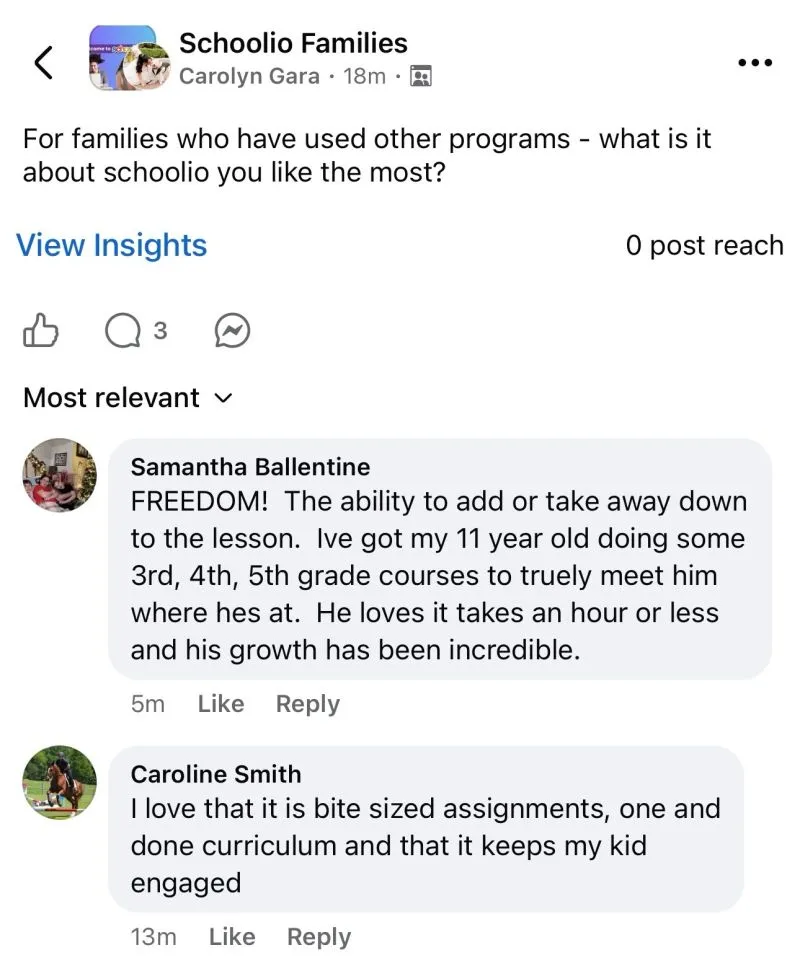
Freedom.

Not freedom from learning. Freedom inside learning.

One parent shared that her eleven year old moves between third, fourth, and fifth grade work depending on the subject. Not because he is behind. Not because he is ahead. Because that is where he is.

Another said she loves the bite sized, one and done lessons. Her child stays engaged. It takes less than an hour. Growth has been incredible.

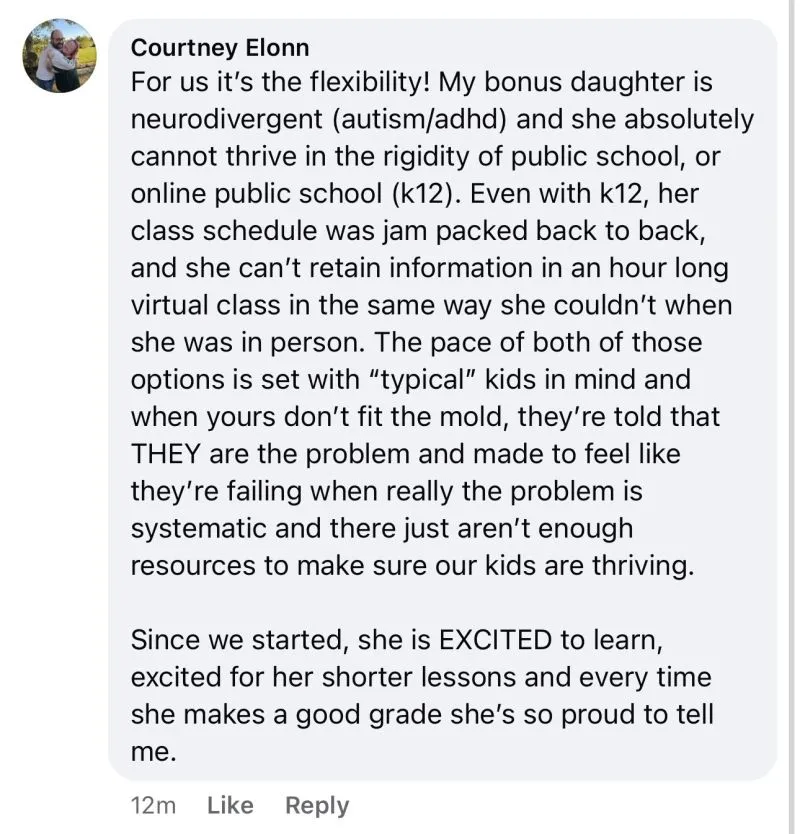
And then a mom of a neurodivergent daughter said something that hit hard. In public school and even online public school, the pace was built for typical kids. When her child could not keep up, she was made to feel like the problem.

Since switching, her daughter is excited to learn. Proud of her grades. Thriving.

This is why homeschooling is becoming more normal across the world.

It is not about escaping school. It is about building systems that adapt to kids instead of asking kids to adapt to systems.

When parents say freedom, what they mean is their child finally fits.


Sathish

still learning, still unlearning


The Most Overlooked Parts of Helping Homeschoolers

The Most Overlooked Parts of Helping Homeschoolers


This has been on my mind today…

When people ask how to help homeschoolers, they usually jump straight to curriculum, tools, or platforms. But most homeschooling families are not struggling because they lack resources. They are struggling because the weight of responsibility is heavy, constant, and invisible.

Helping homeschoolers starts by understanding that most parents did not choose this path because it was trendy. Many chose it because something was not working. A child was falling behind. A child was anxious. A child was labeled, rushed, or quietly pushed aside. Homeschooling often begins as an act of protection, not ambition.

The first real help homeschoolers need is less noise. Too many choices, too many opinions, too many voices telling parents what they should be doing. Decision fatigue is real. When everything feels urgent, nothing feels achievable. Support looks like clarity. What matters this week. What can wait. What is good enough for today.

The second thing homeschoolers need is permission to stop recreating school at home. Learning does not need bells, desks, or six subjects a day to be valid. Progress is rarely linear. Some weeks are full of curiosity. Some weeks are survival. That does not mean learning is failing. It means learning is human.

Many families homeschool because school broke confidence before it broke grades. That is why emotional safety matters more than pacing guides. If a child is overwhelmed, shut down, or anxious, no worksheet will fix that. Helping homeschoolers means supporting emotional regulation first and trusting that academics follow when safety returns.

Flexibility is also misunderstood. Total freedom sounds appealing, but it often turns into chaos. What families really need are gentle anchors. A rhythm. A loose plan. Clear moments where the day feels complete. Not perfection. Just enough structure to breathe.

It also matters that we stop assuming there is one reason families homeschool. Some do it for neurodivergent kids. Some for mental health. Some for travel. Some because they had no other option. Real support does not judge the why. It adapts to it.

The most overlooked part of helping homeschoolers is helping parents trust themselves again. Many come into homeschooling already doubting their instincts because a system told them they were wrong. The goal is not to replace parents with experts or platforms. The goal is to help parents feel capable, informed, and less alone.

Community helps too, but only when it is honest. Not highlight reels. Not comparison. Just spaces where families can say, this week was hard, and not feel behind.

And finally, we need to change how we measure success. Sometimes progress looks like a child choosing to read again. Or asking a question. Or feeling calm enough to try. Those moments matter, even if no test records them.

Helping homeschoolers is not about doing more. It is about doing what actually helps. Less pressure. More trust. And learning that fits the child, not the system.


Sathish

still learning, still unlearning

When My Daughter Hyperfocused on Dragons, This Is What I Did

When My Daughter Hyperfocused on Dragons, This Is What I Did

by Lindsey Casselman

From the moment I introduced 8-year-old Grace to the How to Train Your Dragon universe, she become OBSESSED with dragons. This wasn’t just an interest in the movies, it was a full-blown SPIN (special interest).

Dragons. Morning to night. Drawing them. Reading about them. Talking about them. Playing with the toys. Watching the movies. Wearing her dragon costume and sleeping with her dragon stuffies.

But dragons are not real, and not on the list of things to study in our homeschool. We were supposed to be learning about physical geography in Social Studies at that time, and frankly, no one was very excited about it.

Riveting stuff like landforms and regions of North America: plains vs. mountains, the Arctic vs. the Maritimes. The Schoolio course had an ongoing activity throughout where we were creating a booklet as we went through each region, one at a time. Learn the geography. Record the land features, water sources, vegetation, and animals for each.

She had zero interest.

To be honest? Neither did I.

But I’ve been at this long enough to know when it’s time to toss the plan and follow the spark instead. So one day, after reading the lesson to her aloud, I looked at her and said:

“What kind of dragon would live here?”

That was all it took.

Every lesson from that point on was golden. For each region, she studied the environment and designed a dragon that could survive there — down to the smallest detail.

The plains dragon was a dusty yellow and burrowed in wheat fields. It lived in underground dens and hunted at dusk, camouflaging in the tall grasses.

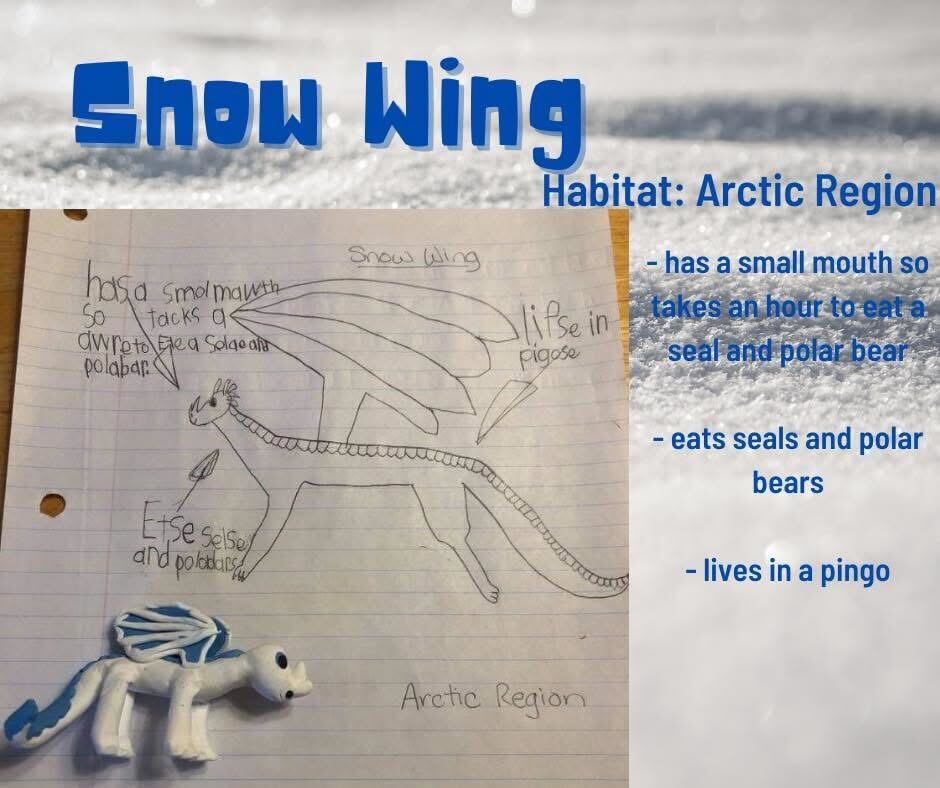
The Arctic dragon was brilliant white, blending into the snow and ice. It was slow-moving, conserving energy in the cold, and had thick scales to withstand frigid temperatures.

Snow wing
Snow Wing Dragon

The Maritime dragon? A shimmering blue sea serpent, waterbound and fast, feeding on fish and crustaceans, curled up in coastal caves during storms.

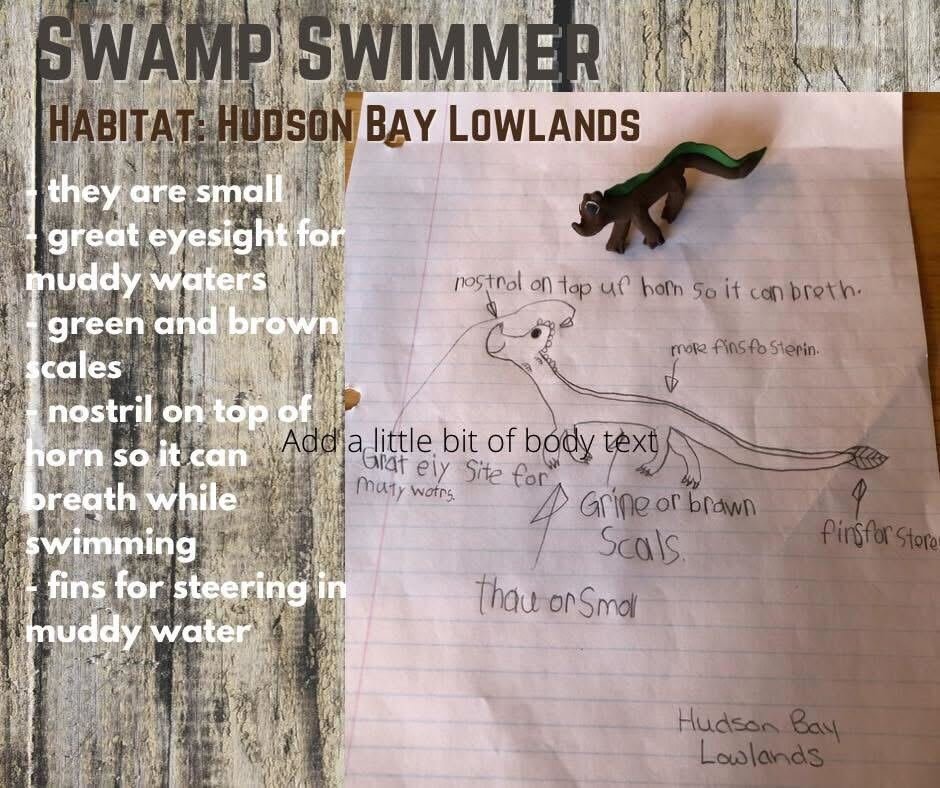
Swamp Swimmer
Swamp Swimmer Dragon

The mountain dragon was stone-grey and jagged, with thick claws that helped it cling to steep cliffs. She told me it would “echo-roar” through the valleys when it was angry.

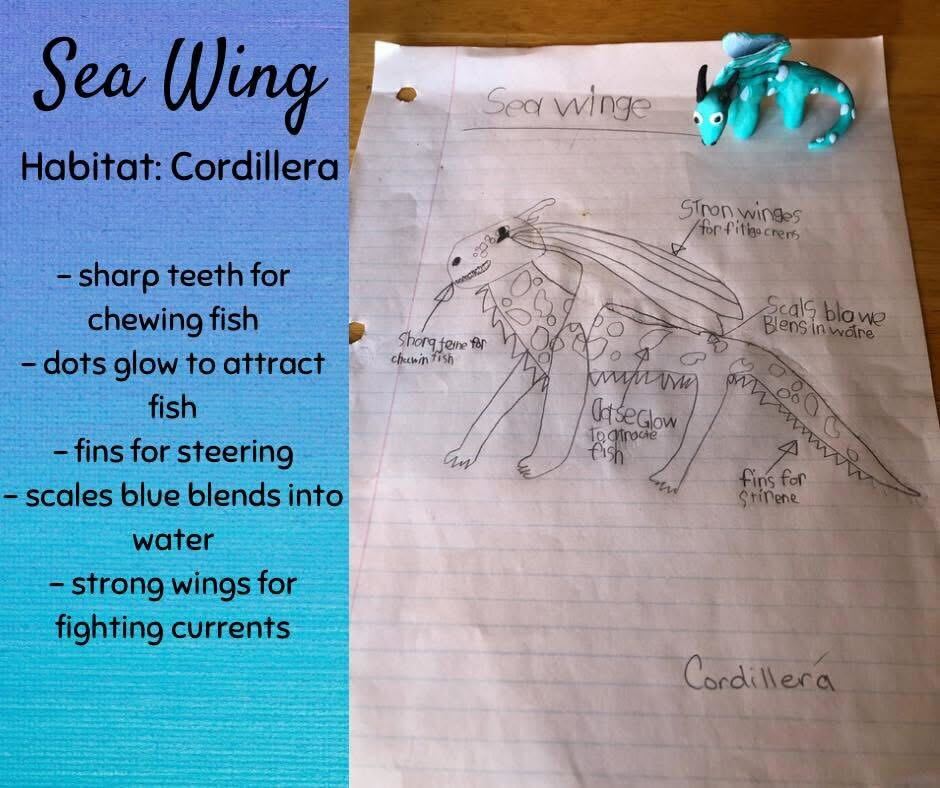
Sea Wing
Sea Wing Dragon

She even brought out the clay and sculpted each of them — every single one. We had an entire dragon ecosystem on our homeschool table by the end of the week.

And she remembered everything.

Not just the dragons — the geography. The climate. The vegetation. The animals. The features of each region. It stuck.

Because when learning is connected to something meaningful — even something mythical — it matters. It lands. It lives in their brains and bodies in a way a worksheet never could.

We didn’t abandon the curriculum. We just used it differently. And isn’t that the whole point of homeschooling?

To follow the spark. To shift when something’s not working. To take a kid’s hyperfocus and say, “Yeah, let’s go there.”

Dragons and all.

? Lindsey

certified special-ed educator & co-founder, Schoolio