Beyond Busy: Making Space for Boredom

Beyond Busy: Making Space for Boredom


This has been on my mind today…

When new homeschoolers start out, one of the first things I see them try to avoid is boredom.

They fill the schedule with academics. Add on some coding games. Sprinkle in art classes, science experiments, and extracurriculars.

All in the name of “keeping them busy.”

But here’s the thing…

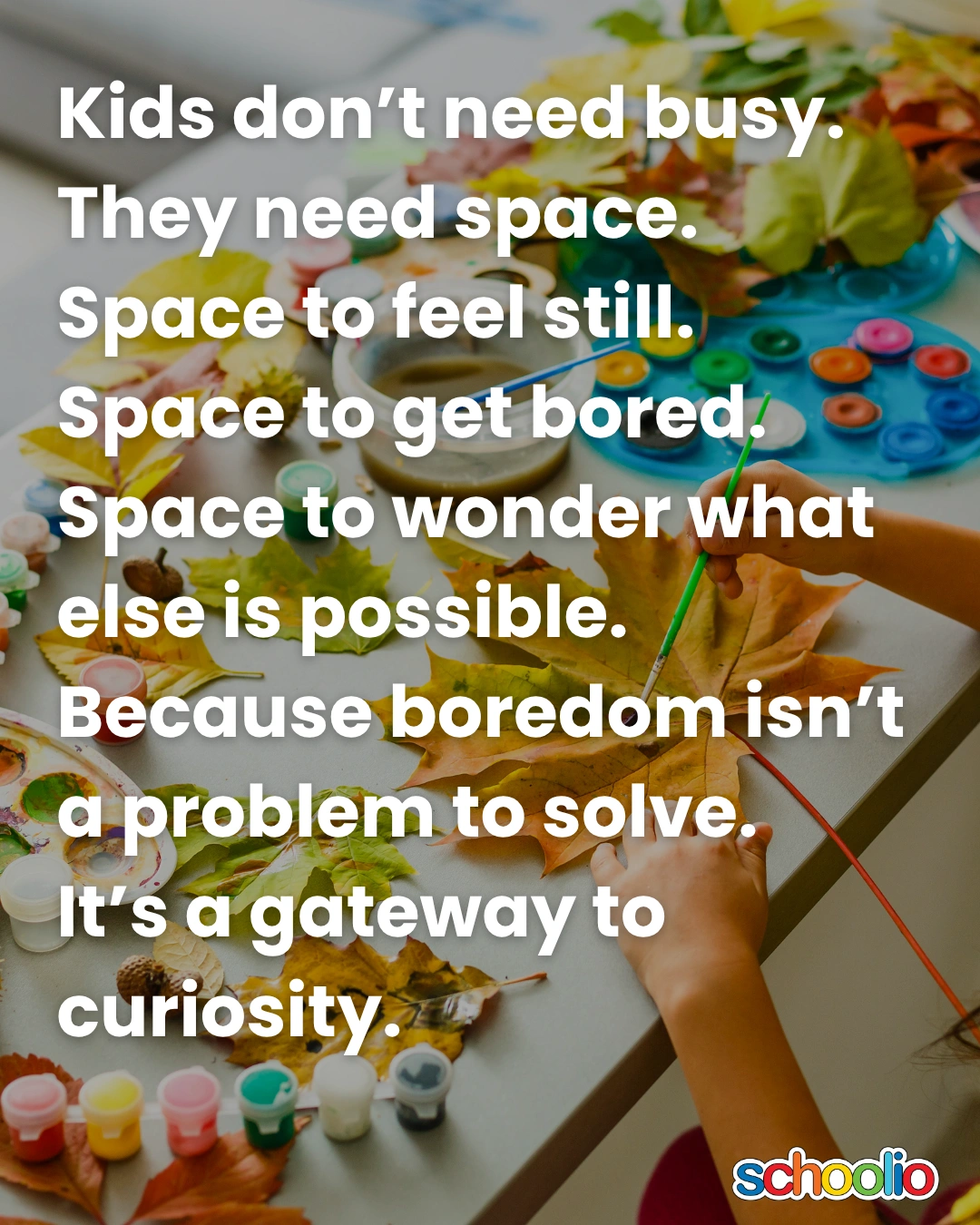
Kids don’t need busy.

They need space.

Space to feel still, to get bored and to wonder what else is possible.

Because boredom isn’t a problem to solve.

It’s a gateway to curiosity.

This weekend, I watched it play out in real life. It was around 7pm this past weekend. My kids were both on their phones, scrolling. Dinner was still an hour away, like it usually is in our house.

I looked over and thought, should I ask them to put it down?

Will it turn into a fight right before dinner? Will it be met with the usual eye rolls or sighs? Probably.

But I asked anyway.

“Take a break,” I said. “Do something else for a bit.”

They both put their phones down, reluctantly. And within a minute, I heard it. The phrase I knew was coming.

“I’m so bored.”

I said nothing. Just let it hang in the air. Ten minutes later, the three of us were at the kitchen table playing UNO. By the 45-minute mark, the game had turned competitive. We were laughing, shouting, teaming up, accusing each other of cheating. And just like that, they weren’t bored anymore.

After dinner, the phones stayed off.

My son pulled out his sketchbook and started drawing.

My daughter went to her room and practiced her DJ set.

No devices. No distractions. Just presence. All because they got bored.

I used to think boredom was something to fix.

Now I see it as a door. Because boredom is what comes before the magic.

Before the game, the drawing, the creativity, the music. And all we have to do is let it happen.

“I’m bored” is not a complaint. It’s a cue.

Let’s stop trying to fill it. Let’s let our kids feel it.

They’ll figure it out. And when they do, it’ll be better than anything on a screen.


Sathish

still learning, still unlearning

The Quiet Wins That Matter Most

The Quiet Wins That Matter Most


This has been on my mind today…

Some days, the work feels heavy. You’re building something that doesn’t yet exist. A platform that reimagines education, reshapes how kids learn, and gives power back to the people who’ve been left out of the conversation for too long—parents, students, and those who learn a little differently.

You push through meetings, plans, deadlines, product reviews. You tweak systems, question decisions, and hold the big vision in your mind like a lighthouse, even on foggy days. But once in a while, something cuts through all that noise. A comment. A thank-you. A message that reminds you why you started this in the first place.

That happened to me recently.

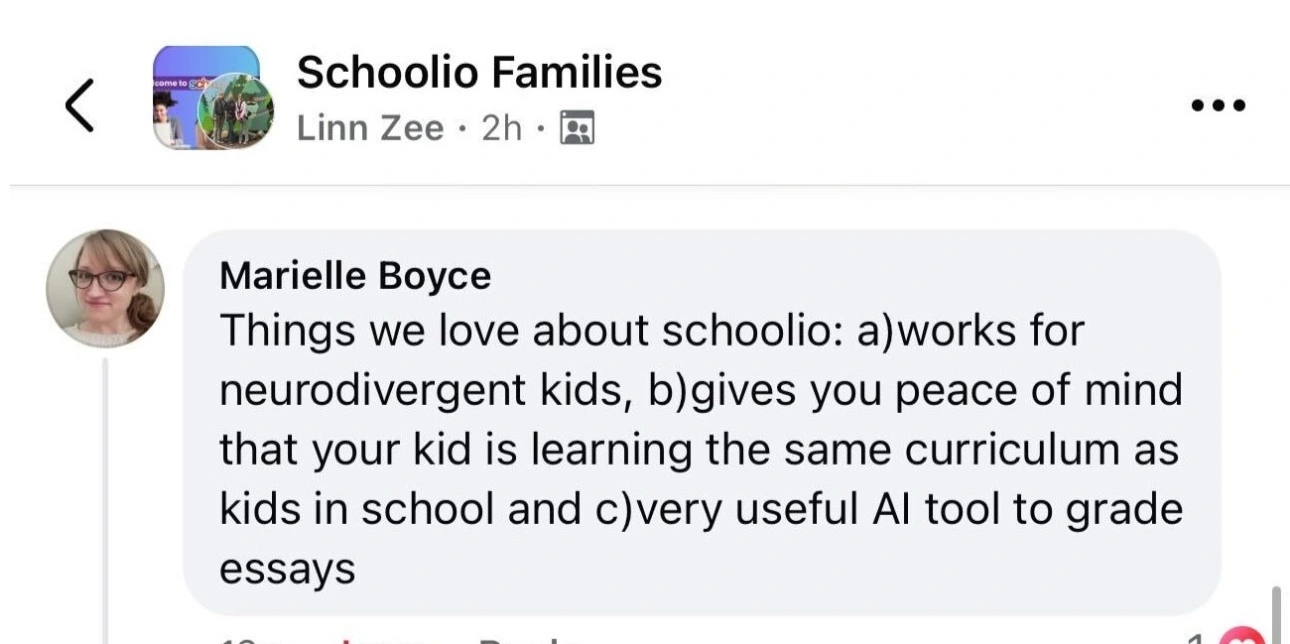
A parent shared a short post in our Schoolio Families group. Just a few lines. No hashtags. No fuss. Just truth.She said she loved Schoolio because it works for her neurodivergent child. Because it gives her peace of mind knowing her kid is learning the same curriculum as students in traditional school. And because the AI tools helped with grading essays.


Customer Testimonial

Simple. Direct. But when I read it, it stopped me.

Because that right there is the quiet win that matters.

She didn’t say we changed her life. She didn’t say we were perfect. What she shared was something more real. She shared relief. Confidence. Stability. The kind of stability every parent needs, but especially the ones who are walking a different path.


The truth is, a lot of the parents we serve never wanted to homeschool. They weren’t planning for it. It wasn’t on their vision board. But something shifted—maybe a bad experience at school, a child’s needs not being met, or just a gut feeling that things weren’t working.

And now they’re here, trying to do what’s best for their child, even when the world questions them for it.

This is what we built Schoolio for. For that parent who lies awake at night wondering if they’re doing enough, for the child who learns better with space and silence, for the families that don’t see themselves in glossy brochures or test scores and for the moments when a tool actually helps and no one has to fight for it.

You don’t always get to see the impact of your work. You don’t always hear how it lands. But every now and then, someone like Marielle speaks up and says, This helped. And for me, that’s everything.

Because this isn’t just about curriculum or platforms or AI tools. This is about building something that lets families breathe again. Something that says: you’re not alone. You’re not wrong. And yes, you can do this.

That’s the win I hold onto today.


Sathish

still learning, still unlearning

From Survival Mode to Success: How Homeschooling Helps Kids Recover from Public School Burnout

From Survival Mode to Success: How Homeschooling Helps Kids Recover from Public School Burnout

By Lindsey, certified special-ed educator and homeschooling parent


Let’s talk about burnout.

Not yours (although that’s real too), but your child’s.

We don’t always recognize it at first — that slow unraveling that happens when a child is pushed too hard, too fast, or in the wrong environment for too long. But once you’ve seen it, you know.

The spark is gone.

The joy is missing.

School becomes a trigger — not a place of growth.

And for many families, burnout is the reason they start homeschooling.

Not because they always planned to.

But because they needed suddenly needed to.

Their child needed saving.


What Burnout Looks Like in Kids

It doesn’t always look dramatic. Sometimes it looks like:

  • Refusing to do any schoolwork
  • Saying things like “I’m stupid” or “I hate school”
  • Meltdowns over math problems
  • Constant headaches or stomachaches
  • Feeling defeated before they even start

Often, these reactions aren’t about laziness or attitude.

They’re about exhaustion.

They’re about a nervous system that’s been in overdrive, sometimes for years.

When a child reaches that point, what they need isn’t more pressure.

They need a reset.

Maybe now you’ve taken the first step and pulled them out. You’re probably feeling like you don’t know what to do next.


Here’s where I recommend you focus your attention for the next few weeks:

1. Focus on Relationship

The first goal isn’t academics, it’s connection.

Use this time to listen, play, talk, and just be together.

Remind your child that they are safe. That learning is no longer tied to stress or punishment.


2. Focus on Regulation

What helps your child feel calm?

That might look like daily walks, sensory play, quiet reading time, or lots of movement breaks.

Build your days around those regulating activities first, then gently add in small moments of structured learning when they’re ready. Remember that a dysregulated person cannot learn. Don’t try to force it.


3. Keep Learning Gentle and Flexible

For now, avoid tight schedules or packed plans. Start with short lessons and engaging, hands-on topics.

Follow their interests. Bake together. Do science experiments in the kitchen. Read out loud. Keep it light and meaningful.

Build confidence. If you only do their favorite subjects for a little while that’s totally fine. If you bump them down a grade or two (or as many as you need) to find a spot where they’re experiencing regular success and building their confidence in their own abilities, that’s where you need to be right now.


4. Let Rest Be Part of the Plan

Your child may need more sleep. More down time. More freedom. That’s not slacking, that’s burnout recovery.

You’re not falling behind. You’re laying the foundation for real, lasting learning. Let them sleep. Let them play. Let them be outside. Mostly, just let them be.


5. Watch for Small Signs of Re-engagement

You may not get a big “aha” moment. But you might notice them asking more questions. Smiling during a lesson. Picking up a book on their own.

Celebrate those small steps- they’re signs the spark is coming back!


A Gentle Reminder

If your child is in survival mode right now, you might be seeing some behaviors that are hard to handle. Avoidant, angry, overwhelmed. Remember that it doesn’t mean you’ve made the wrong choice, it means your child feels safe in your presence to let their emotions out.

It means they need time.

And homeschooling gives you that time.

Time to rest.

Time to reconnect.

Time to slowly reintroduce learning, in ways that feel safe and meaningful.

Eventually, the spark comes back.

The light returns to their eyes.

And you’ll realize: this isn’t just about school.

It’s about giving your child a soft place to land when the world became too much.

And that? That’s success.


Lindsey

certified special-ed educator and homeschooling parent

Download our Free Guide “Deschooling: The First 30 Days After Leaving Public School” with coupon code DESCHOOL.

https://schoolio.com/product/schoolio-understanding-deschooling/?wmc-currency=USD

Why Schoolio Is a Better Choice Than MiAcademy for Most Homeschool Families

Why Schoolio Is a Better Choice Than MiAcademy for Most Homeschool Families

MiAcademy is a popular homeschool program that’s been around for more than 20 years. It’s familiar. It’s easy. And if you’re looking to replicate traditional school at home with a little fun and games mixed in, it has a straightforward setup, a full list of core subjects, and a digital interface that feels familiar to kids coming out of the classroom.

But most families don’t start homeschooling because they want to recreate the classroom. They do it because the classroom wasn’t working.

You want something better for your kids.

Something more flexible, more purposeful, more in tune with your child’s unique needs, and something that gives you, the parent, more control to design the perfect program for your unique child and your unique family, especially those raising neurodivergent, curious, or outside-the-box learners.

That’s where Schoolio stands apart.

Both Schoolio and MiAcademy are digital homeschool programs, but they have some important differences. MiAcademy is a solid choice for families who want to follow a school-at-home model and aren’t bothered by having to supplement with other programs where digital learning falls short.

Schoolio is different.

It’s a whole new way to homeschool, built from the ground up by real homeschoolers, with modern families and neurodivergent learners in mind.

If you’re looking for a truly complete program with real customization, neurodivergent-friendly content, offline learning options, and the kind of future-ready education that will help your child thrive in the future, Schoolio is the clear winner.

Here are the top 5 reasons why Schoolio is a better choice than MiAcademy:


1. MiAcademy Courses Mirror School. Schoolio Builds Future-Ready Kids.

MiAcademy keeps things fairly simple when it comes to course offerings. Their non-core options are limited to Music & Art, World Languages, Life Skills, and Biblical Studies. And that’s pretty much it.

Schoolio goes far beyond that and offers hundreds of courses across a much broader range of subjects. We also offer an entire library of Future Readiness content, our one-of-a-kind collection you won’t find anywhere else.

Our Future Readiness courses include:

  • Financial Literacy (because balancing a budget is more useful than memorizing Pythagorean theorem)
  • Emotional Intelligence (because kids who understand themselves and others do better in life)
  • Emerging Technologies (because our kids are growing up in an digital-first world, and they need to understand how it works)

These courses are built with real-world relevance in mind, helping your child develop both academic skills and practical, future-ready thinking. This isn’t filler content. It’s the future. And it’s only at Schoolio.


2. Schoolio Is Designed for Neurodivergent Learners

This one’s huge, and it’s where many online programs miss the mark entirely.

If you have an ADHD or Autistic child, you already know that most educational platforms weren’t built with them in mind. MiAcademy, while decent in terms of simplicity and structure, doesn’t offer any specialized support for neurodivergent learners.

Schoolio does.

In fact, we’re the only homeschool curriculum platform intentionally designed to support and accommodate neurodivergent students.

We built our content and platform to maximize short attention spans, reduce redundancy, limit cognitive overwhelm, and allow for the flexibility neurodivergent learners often need. We have multiple ways to engage, and allow parents to switch between Scheduling Mode (for routine and structure) and Exploration Mode (for flexibility and curiosity-driven learning).

Our goal? To help families find what works, without power struggles or meltdowns. When your child feels successful and supported, everything changes.


3. Schoolio Costs Less and Delivers Way More

Let’s talk money.

Homeschooling families are often working with tight budgets, we understand, we’ve been there. At the end of the day, cost matters. MiAcademy’s pricing at $42/month per child is higher than our complete digital package (including every Schoolio course and every grade level) at just $39.99/month. And we offer 30% off for siblings, and a military discount too. Want to save even more? We also have discounted annual plans.

More flexibility. More content. Less money. It’s a no-brainer.


4. Schoolio’s ELA Program Crushes MiAcademy’s Lightweight Approach

ELA (English Language Arts) is often where fully online programs fall short, and MiAcademy is no exception.

Yes, they cover the basics: vocabulary, some reading comprehension, and grammar. But let’s be honest, a few vocab games and short reading passages won’t help your child become a thoughtful, articulate writer.

At Schoolio, we believe a strong ELA program must include:

  • Real novel studies
  • Essay and research writing
  • Creative writing and structured reflection
  • Oral communication and presentation skills

Our ELA curriculum goes far beyond multiple choice and true or false questions. We help your child build the writing, reading, and critical thinking skills they need to express themselves clearly and powerfully while building a love of reading and writing.

Our ELA program has been praised by homeschool parents as being simultaneously robust in its coverage and easy to implement for resistant writers and neurodivergent kiddos.


5. The Adaptive Learning Model: Offline + Online = Smarter Homeschooling

MiAcademy offers optional printable PDFs, but they’re not designed to be part of the main program flow, more as an optional add-on, and they’re not annotatable or savable, you have to print or save them and use a different program to annotate, then keep those for your records somewhere else. In other words, they’re a nice-to-have, not a core feature.

At Schoolio, we do things differently.

Our [Adaptive Learning Model](https://schoolio.com/programdesign/?) blends the best of both worlds: online tools and offline learning. You and your child get all the benefits of digital education: interactive lessons, flexible scheduling, auto-grading, and a dashboard to track progress. But that’s just the beginning.

We believe screen time should support learning, not dominate it.

That’s why every Schoolio course includes offline activities that often include hands-on activities such as:

  • Science experiments
  • Art projects
  • Outdoor exploration
  • Critical thinking and reflection
  • Opinion writing and research
  • Speeches and oral presentations

These aren’t just extras, they’re built into the curriculum intentionally, because we know kids learn best when they can connect ideas to the real world.

MiAcademy gives you a browser tab and calls it a day.

Parents love the balance. Kids love the variety. And everyone gets a break from staring at screens all day.


The Bottom Line: MiAcademy Imitates. Schoolio Innovates.

If you want to recreate the classroom on a screen, MiAcademy will check the boxes.

But if you’re homeschooling because your child deserves something better — something more human, more flexible, more real — Schoolio is your answer.

  • More future-focused content
  • Built-in neurodivergent support
  • Comprehensive ELA
  • True hybrid learning
  • All for less money

And if that weren’t enough, Schoolio is now WASC accredited, supports microschools around the world, and continues to launch new courses and innovative features to serve today’s learners, not yesterday’s model.


Experience the difference for yourself.

? Learn About Schoolio’s Mission and Founders

? Start your 7-day free trial

Schoolio vs. IXL: Why Relentless Quizzing Isn’t Enough for a Real Homeschool Education

Schoolio vs. IXL: Why Relentless Quizzing Isn’t Enough for a Real Homeschool Education

IXL is a familiar name in education. It’s used in thousands of schools across North America as a diagnostic tool, helping teachers assess students, assign drills, and place them based on grade-level standards.

And it does that job well.

But , you’re not a school.

IXL was built for schools, not homeschoolers.

If you’re homeschooling, your needs, and your child’s needs, are completely different than a classroom. You’re not trying to sort your child into a percentile or optimize for standardized test scores. You’re trying to create a meaningful, personalized education that actually helps your child learn, grow, and be ready for their future.

Schoolio was built for that.

Schoolio a full curriculum made by real homeschoolers who know what works, especially for neurodivergent and outside-the-box learners.

If you’re using IXL right now and it’s working as a supplemental tool, that’s great. But if you’re trying to use it as your primary curriculum- or if you’re wondering what else is out there- here are the top five reasons why Schoolio is a better fit for most homeschool families:


1. Complete Curriculum vs. Just Practice

Let’s get this out in the open: IXL doesn’t actually teach. It drills.

What is curriculum? Curriculum is a program of learning. It’s different than a workbook of pages of practice or, in the case of IXL, endless quizzing on concepts. Real curriculum includes lessons that teach those concepts, along with activities to help solidify the knowledge. All of this happens before we can quiz a child on what they’ve learned (if we even want to quiz them, which lots of homeschoolers do not.)

IXL has no lessons, no step-by-step teaching content, no built-in scaffolding. It’s designed for review, not instruction, and that means you’re left to fill in the gaps yourself.

“It’s straight drill practice… no teaching.”

Parent on the Well-Trained Mind Forum

“We use IXL for practice and reinforcement, but it wouldn’t work as our only curriculum. It would be frustrating and boring.”

Reddit homeschooling parent

Schoolio gives you everything in one place. Each course includes online lessons, hands-on learning activities, and digital quizzing- the complete package. You’re not piecing things together with Schoolio, you’re following a creating a learning path that adapts to your family’s needs.


2. Deep Learning: Online + Offline, Not All Screen

IXL is entirely online. That might seem convenient at first, until your child is zoning out after an hour of endless question banks, losing motivation, or worse- feeling frustrated because they’re being drilled on concepts they weren’t taught.

Schoolio takes a blended model approach that blends interactive digital lessons with hands-on offline activities, so your child isn’t missing out on the joyful learning moments that come from science experiments, art projects, outdoor exploration, and critical thinking tasks.

It’s called the Adaptive Learning Model, and it was created to help kids:

  • Build digital literacy
  • Learn through experience
  • Avoid screen fatigue

Because when we talk to parents, most of them don’t actually want their entire homeschool day to happen on a screen.


3. An Actual ELA Program

English Language Arts is where the cracks in most online platforms really start to show, and IXL is no different.

Yes, IXL covers grammar and vocabulary. But that’s about it. There’s no deep literature studies, no writing instruction, and certainly no space for creativity or self-expression.

Schoolio’s ELA program is a different story. Your child won’t just memorize grammar rules and vocab words, they’ll learn to use and love reading and writing. We cover:

  • Novel studies that take them deeper into literature, forming opinions and connections and drawing ideas and conclusions,
  • Essays, narrative writing, persuasive writing, research projects, and more
  • Creative and reflective writing
  • Oral communication and presentation skills

We’re here to raise confident communicators, not just kids who know where the comma goes.


4. Future-Ready Education, Because the Future Is Coming Fast, and Our Kids Need to Be Ready

IXL sticks to traditional core subjects: math, language arts, science, and social studies.

That’s fine, but it’s not enough.

Our kids are growing up in a world that’s evolving fast. They need life skills, emotional awareness, and tech fluency to succeed.

Schoolio offers Future Readiness courses you won’t find anywhere else, including:

  • Financial Literacy
  • Social Skills & Emotional Intelligence
  • Emerging Technologies

This is real-world learning for real-world kids. No drill platform can do that.


5. Designed with Neurodivergent Learners in Mind

This might be the biggest one of all.

IXL is known to be frustrating for neurodivergent learners. The “smart score” system penalizes mistakes and can create intense anxiety for kids who don’t test well or who struggle with working memory or processing speed. There’s no option to adjust pacing, remove streaks, or present content differently.

“My kid was crying after getting one wrong and losing points. This is not how learning should feel.”

Reddit parent

Schoolio was intentionally designed to support ADHD and Autistic learners.

From our uncluttered layout and short lesson formats to our flexible learning modes (Scheduling Mode for routine, Exploration Mode for curiosity), everything is created to reduce overwhelm and increase success.

We also recognize that neurodivergent kids often have uneven skill profiles and can be advanced in one area and behind in another. Our platform makes it easy to mix and match grade levels across subjects, include subjects that are of interest to your child, and set your own schedule, pacing, and intensity.


Bonus: What About IXL as a Diagnostic Tool?

If you’re curious how your child compares to public school grade levels, IXL can be a helpful diagnostic tool. Some homeschool families use it for that reason.

But please be careful not to use public school as your gold standard, especially for neurodivergent learners, who often underperform on traditional tests despite having deep knowledge and insight in specific areas.

A better approach? Use IXL occasionally if it helps you feel anchored, but don’t let it replace a real curriculum, and please don’t let it make you feel inadequate in your homeschooling. If you’re worried about your child’s progress, book a one-on-one call with a Schoolio Teacher who has also homeschooled and get real advice and support on your journey.

Your child deserves more from their education, homeschool experience, and childhood than just a drill-and-score routine.


The Bottom Line: Drill vs. Depth

Feature IXL Schoolio
Full Curriculum
Teaching + Instruction
Offline Learning
Future-Readiness Courses
ND-Friendly Design

IXL was made for the classroom. Schoolio was made for you.

If you’re homeschooling because school wasn’t working, if you want something built for your child’s strengths, struggles, and future, then Schoolio is your better option.


Ready to experience the difference?

Start your free trial or explore our full library today:

? Explore the Program Design

? Start Free Trial

? See How We Support Neurodivergent Learners