
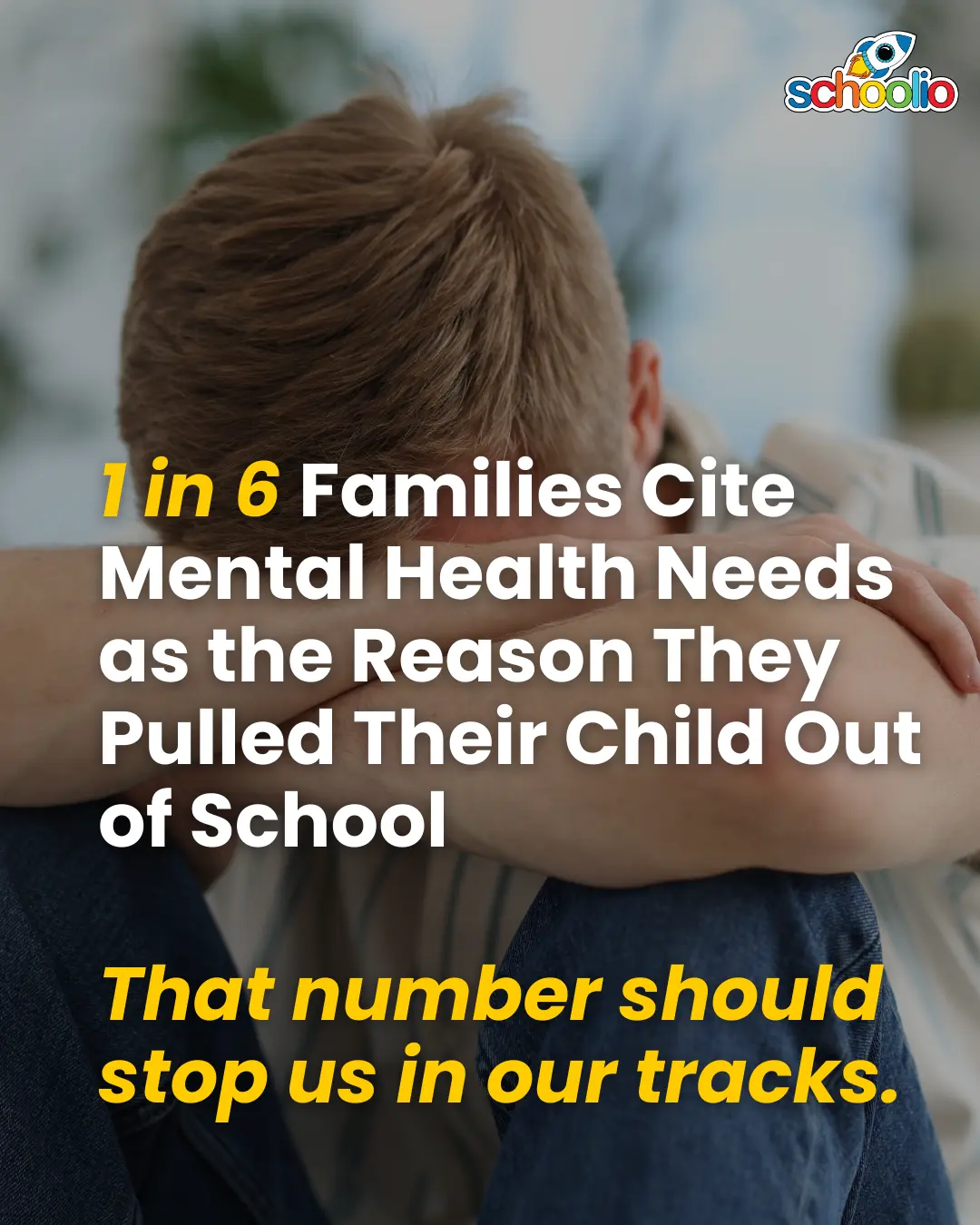
1 in 6 Families Cite Mental Health Needs as the Reason They Pulled Their Child Out of School

1 in 6 Families Cite Mental Health Needs as the Reason They Pulled Their Child Out of School


This has been on my mind today…

Mental health has quietly become the leading reason families are choosing homeschooling. Not ideology. Not religion. Not rebellion. Mental health.

According to new UK figures, more than 126,000 children were being taught at home last autumn, a 15 percent increase in a single year. One in six families cited psychological or mental health needs as the primary reason they pulled their child out of school.

That number should stop us in our tracks.

For years, homeschooling has been framed as a lifestyle choice. Something parents opt into because they want more flexibility or control. But this data tells a different story. For many families, homeschooling is a response.

A response to anxiety that does not fade.

A response to burnout in children who are barely ten.

A response to kids who once loved learning and now dread school mornings.

When parents say mental health, they are not talking about small discomforts. They are talking about panic before school. Emotional shutdown after class. Kids who are told they are fine because their grades look fine, even while they are struggling internally.

This is especially true for neurodivergent and highly sensitive kids. Children who feel the world more intensely. Noise. Pressure. Comparison. Speed. In systems designed for scale, these kids are often labeled difficult or behind. Over time, they internalize that message. The real loss is not academic. It is emotional.

One thing we see again and again is that children are rarely taught how to understand what is happening inside them. They are expected to manage big emotions without being given the language, tools, or space to do so. This is why emotional literacy matters just as much as reading or math.

When kids learn how to name their thoughts, understand their feelings, and recognize that emotions are information not failures, something shifts. Confidence starts to rebuild.

This is exactly why we created

Thoughts and Feelings

, a guided emotional learning book and curriculum at Schoolio. Not as therapy. Not as a fix. But as a way to help children slow down, reflect, and build self awareness in a world that keeps asking them to speed up. For many families, this kind of emotional groundwork becomes the bridge between surviving school and actually healing from it.

You can learn more about the Thoughts and Feelings program here:

https://schoolio.com/product/thoughtsfeelings/

Homeschooling, when done with care, is not hiding from the world. It is a pause. A reset. A chance to rebuild trust in learning and in oneself.

The rise in homeschooling should not be read as parents giving up on education. It should be read as parents stepping in when the system cannot meet their child where they are.

The real question is not why homeschooling is growing.

The real question is why so many children are struggling in silence.

Parent takeaway: If your child’s mental health is declining and you feel like you are constantly managing damage instead of supporting growth, you are not imagining it. Education should never come at the cost of emotional safety. Teaching kids how to understand their thoughts and feelings is not extra. It is foundational.

Source:
Sky News
https://news.sky.com/story/number-of-children-being-taught-at-home-increases-by-15-in-a-year-report-finds-13494608

Why More Parents Are Choosing Homeschooling for Mental Health—and What That Really Means

Why More Parents Are Choosing Homeschooling for Mental Health—and What That Really Means

by Sathish Bala, CEO

This has been on our mind today…

A recent article by Spark Sunderland explored a growing trend that hits close to home: families choosing homeschooling in response to mental health challenges. And while we’re glad to see more parents empowered to make choices that protect their kids, we also believe this conversation deserves more depth—because the rise in homeschooling isn’t just about leaving something behind. It’s about building something better.

More and more parents are reaching out to us with stories that begin the same way: a child overwhelmed by the school day, battling anxiety, isolation, or burnout. In many cases, parents make the call to homeschool out of urgency. Something’s not working. Their child is struggling. And the home becomes a sanctuary—a way to reclaim peace, safety, and time to heal.

We support that decision. In fact, we know it works. Homeschooling can absolutely provide a calmer, more emotionally supportive space for kids who are anxious, neurodivergent, or simply overstimulated in traditional classrooms. But at Schoolio, we also believe that the why of homeschooling matters just as much as the how.

And that leads to two honest questions we think every parent should consider.

First: Is homeschooling solving the problem—or just stepping away from it?

Pulling a child out of school to avoid bullying, peer pressure, or academic stress is often necessary. But long-term success means doing more than removing the trigger. It means rebuilding confidence, developing coping skills, and creating a foundation for healthy social-emotional growth. That’s why our curriculum includes lessons in empathy, emotional regulation, collaboration, and mental health awareness—woven right into the learning process, not added on.

Second: Are parents getting enough support?

This is a big one. When you homeschool, the responsibility doesn’t just shift—it multiplies. You’re the teacher, the guide, the emotional anchor. During the pandemic, researchers found that homeschooling parents often experienced increased stress, burnout, and feelings of isolation. We’ve seen it firsthand. That’s why we’ve built tools that support the entire family. From flexible pacing options to community spaces where parents can share, ask questions, and breathe a little—we want to make sure no one is doing this alone.

We believe in homeschool as a long-term wellness solution—not a last resort.

When mental health is part of the conversation, it changes everything. Families need structure, but they also need grace. Children need routine, but they also need room to rest, reset, and re-engage at their own pace. And parents need more than a workbook and a to-do list. They need real partnership.

That’s why we’ve built Schoolio to meet those needs—with curriculum that honors the emotional wellbeing of the learner, and tools that protect the emotional wellbeing of the parent too.

Because no one should have to choose between learning and healing.

Sathish

still learning, still unlearning


? Curious How Schoolio Supports Mental Health?

Explore our bookstore, check out our SEL program or join our 7-day trial to see how it feels in your home.

Is Your Child Emotionally Burnt Out?

5 Signs Your Child is Struggling Emotionally

As parents, we pride ourselves on knowing about our children: their likes and dislikes, friends, strengths and weaknesses, and interests. We want to ensure that we also keep an eye on our children’s emotional and mental health, is your child emotionally burnt out?

5 Signs Your Child Is Emotionally Burnt Out.

After 2+ years of a global pandemic, it feels like a long time for parents and children. But what represents 1% or less of our parent’s lifetimes has been 20% of a ten-year-old child’s lifetime. If your child is six or younger, they may not remember the “before times” of Covid-19, lockdowns, and school closures.

Our children (and even us as parents) are downright out of practice with many of the basic skills we all used to take for granted. Things like, social interactions, navigating through crowds, routine changes, and overcoming daily challenges have yet to be practiced much, by any of us, not only children, in the last few years. But this lack of practice has come during the social and emotional development for our children. As they are thrown back into a “full-speed” world, it may be a more challenging transition for children than anticipated.

Luckily, there are things parents can look for in children- behaviour clues- that will act as signs your child is struggling emotionally and allow parents to help children earlier, even before the child may be aware of a problem themselves or be able to verbalize it to parents.

So, is your child emotionally burnt out? Here are five indicators.

  1. Low Mood or Apathy

Parents know their children better than anyone else, and as a parent, you know what gets your child interested and excited. If you notice that your child isn’t enjoying what they used to or is apathetic about adventures that used to get them excited, it may be one of the five signs your child is struggling emotionally.

Sure, interests change over time, but if your child has been a gymnast for years and suddenly can’t be bothered to change for practice, or your child has a love of dinosaurs but would rather stay home than visit the museum, it could be a clue that something is up. Often when we think about depression, we think of sadness- crying and being unable to get out of bed. In reality, depression can manifest in different ways, and an early sign can be a lack of interest in activities one used to enjoy.

  1. Quick to Anger

Everyone gets angry, and we know that young children have less emotional control and regulation skills than older children and parents, but again, you know your child best! If you feel like you’re walking on eggshells with your child all the time, trying not to say or do the wrong thing because they seem so quick to anger lately, it could be one of the five signs your child is struggling emotionally.

The things that used to be par for the course, like asking your child to finish their chores or start their homework, are now suddenly throwing them into a grumpy mood. Or maybe you see your child getting angry over challenges they used to enjoy, like playing a video game. Instead of persisting in a difficult challenge, they throw the controller and get upset. These quick-to-anger moments can be one of the five signs your child struggles emotionally.

  1. End-of-Day Restraint Collapse

Also called After School Restraint Collapse, this happens when a child has been holding in their big emotions all day long to behave appropriately, and then when they get to the safety of their home and the comfort of their parent, they let it all out. Often this comes out as a “meltdown” or what some might call a “tantrum.” On the bright side, parents can take comfort when this happens in knowing that their child feels safe and loved with you, able to let their defences down and unload all their big feelings knowing that your love and support are a constant.

You’ve created a connected and emotionally supportive parent-child relationship- great job! But that aside, it sure doesn’t feel good as a parent to see your child completely lose control like that. Suppose this happens to your child often, particularly at the end of events, such as a day of school or any other significant stimulation day. In that case, it could be this third of the five signs your child is struggling emotionally. If your child feels like they can’t let their big feelings out in whatever situation they just came from, it may be time to assess that situation and ensure it’s serving your child as you want.

  1. Always-Never Statements

What are always-never statements? Always-Never statements are one of the “unhelpful thoughts” taught in Cognitive Behavioral Therapy- considered the “gold standard” in treating stress, anxiety, and depression. It is recognized and endorsed by organizations worldwide, including the World Health Organization (WHO), the National Institute of Mental Health, and national psychiatric and psychological associations in Canada, the US, Australia, and the UK.

Likewise, hundreds of well-designed research studies have demonstrated the effectiveness of CBT for thousands of children. CBT teaches strategies to recognize and combat negative thought patterns, understand how they relate to and affect emotions and behaviour, and help children and parents to reduce stress, anxiety, depression, and other negative self-talk and self-image. One of these negative thought patterns is Always-Never thinking. This is when your child sees a pattern that isn’t there and concludes that something “always” or “never” happens when it’s a little of both.

This is a typical negative thought pattern with children, and we hear it in phrases like, “You never let me stay up late.” or “You always take my sister’s side!” This is evidence that your child is forging neuropathways in negative thought patterns that can be difficult to break later. Hearing these statements often could be one of the five signs your child struggles emotionally.

  1. Fixed Mindset

You’ve probably heard the term Growth Mindset; a Fixed Mindset is the opposite. When a child has a growth mindset, they believe that they can learn as much as they want and that their mind can grow and strengthen by doing difficult things. A growth mindset also means that your child understands that mistakes are typical and essential in learning. A growth mindset also focuses children on the power of the word “yet.” Meaning there may be things your child can’t do… yet.

When children have a growth mindset, they know that it’s just a matter of time and practice, and yes, failure and mistakes before they learn the hard thing they were trying to learn. Evidence of a Fixed Mindset often comes in words and phrases when your child is working on something hard or trying to overcome an obstacle. If you constantly hear your child saying things like, “I can’t.” or “I don’t know how.” or your child is quick to give up, they may not understand the Growth Mindset. The defeatist attitude of a Fixed Mindset can be one of the five signs your child is struggling emotionally and possibly having self-esteem issues.

What do you do?

Is your child emotionally burnt out? Now that you know these five signs, what do you do?

The number one thing to do is be patient.

Remember that many of the things we, as parents, are excited to get back to like full-time in-person school, theme parks, concerts, and other significant events- are mere memories, at best, for our young children. These things can be overwhelming, and some social anxiety from your child during the adjustment period is expected. Be patient with them, take your time re-introducing these activities, keep them short, and space them out as much as possible.

Second, don’t overburden your child’s schedule.

It’s exciting to get back to the things we used to love. But a full day of school followed by sports, clubs, tutors, music lessons, etc., can do more harm than good, primarily if your child is exhibiting any of these five signs your child is struggling emotionally. Too much hustle and bustle can leave children feeling overwhelmed and holding in their emotions too tightly for too long. Give your child lots of breaks, and plan for quiet downtime at home regularly.

And third, don’t hesitate to ask for help if your child is struggling.

From your family doctor to a myriad of private therapists, classes, courses, and at-home workbooks, there is a lot of valuable help for children and adults alike who are struggling emotionally. Don’t hesitate to reach out for help when you need it, and remember that it’s always better to have done more than you needed to help your child than not to have done enough.

We’ve all been through a lot over the past two years, and a global pandemic is not a small or meaningless event in anyone’s life. If you or your child are struggling, don’t be embarrassed to ask for help, decline events that don’t bring you joy, or adjust your schedule as much as you may need.

It’s ok to ask for help.

If you’re seeing some of the five signs your child is struggling emotionally, consider looking for an at-home, learn-together approach to helping your child learn to manage their thoughts, feelings, and emotions. Check out the Schoolio Social-Emotional Learning unit, Thoughts & Feelings. This 10-lesson unit has scripted tools and fun activities that allow you and your child to learn the basics of Cognitive Behavioral Therapy and Social-Emotional Learning together. You do not have to be a parenting expert to do this unit with your child! You’ll learn and grow together, and you’ll be equipping your child with some concrete strategies they can use their whole lives whenever they are struggling emotionally.
Anxiety and School

Anxiety and School – Guest Blog by Meredith Blunt

I am so glad to be writing for Schoolio again. This time about something a little heavier than my last guest blog but a subject near and dear to me. I’m writing this with no expertise (not a doctor!) beyond my own experience as a parent and a human who has moved through the impacts and distortions of anxiety herself. Anxiety and mental health is a huge, personal, and potentially upsetting topic. Anxiety has a daily presence in my life. I am hoping to share some of the most insightful and effective knowledge I have gained from my own research and experience with anxiety and school, as well as from the experts I’ve met. 

Emotional and Mental Health.

Feeling anxious can be a normal reaction to events in our lives that make us feel pressured, stressed or challenged. This is okay. That anxious feeling teaches us to assess our perceptions quickly, make critical decisions and bolster our convictions. However, anxiety that is overtly and constantly present moves into the realm of a disorder. It feeds negative thought patterns. It pushes us to feel constant worry and fear. In these times of growing awareness and knowledge around mental and emotional health, we are gaining a better understanding that children can be just as affected by anxiety as anyone else. We are learning about the factors in their lives that can cause anxiety disorder. Unsurprisingly, school is one of those factors, which is why talking about anxiety and school is so important.  

Anxiety and school, what it can look like:

As parents we’re told to ‘trust our gut’ when it comes to our kids. This is good advice but tricky to follow. We are influenced by so much – our loved ones, social media, literature, news etc. It isn’t unusual for our internal voice, our own wisdom, to get drowned out. Parental intuition is further challenged by the role school plays in each child’s life. As the majority of their time is spent at school, it has an outsized impact on a child’s mental health. Teachers, conflicts with peers, being away from home, and expectations of family are all aspects of school that can be contributing factors to an anxiety disorder. 

“It started out as stomach aches and headaches…”

I noticed the beginnings of anxious behaviour in my youngest back when he was in grade one. It first started out as stomach aches and headaches every school morning but gradually progressed to withdrawal from some interests and sleep disruption. Fearing any lasting consequences of this situation and due to the complete absence of support from our school and his teacher at the time, my husband and I withdrew him from public school and began our first foray into homeschooling. 

Wisdom does come with experience, in our case we had crossed paths with school-based anxiety already and learned valuable information. Three years prior to my son’s grade one year, I didn’t have the confidence to trust what I was seeing and sensing with my eldest as anxiety disorders developed in her when she was around the same age. Everyone seemed to know better and worked to assuage my fears, so I put my trust in them. It’s hard to forgive yourself for mistakes you’ve made as a parent.

We can only do our best with the tools and knowledge we have at the time.

I didn’t know that what I was looking at was anxiety in my eldest. I would see her struggle to connect with peers and I would resort to the traditional well-meaning adages of ‘say hi!’ and ‘be friendly’. We battled over learning from mistakes, and I would feel lost when her reaction to an error or failure was immense defeat and crippling negative emotions. I’d try to get her excited about new things only to see her recoil almost in terror. The kids who sometimes can’t find the words to describe what they’re experiencing are the young people who may be susceptible to anxiety disorders. These kids can end up carrying heavy labels in school settings – difficult, shy, perfectionist, distracted, under-achiever, a weaker student. This is my daughter and not one of those labels was accurate. 

This isn’t a simple or easy topic to discuss. When we talk about anxiety in our children it hurts. When we give voice to these massive concerns for our kids – ranging from sleep deprivation and disruptive emotions to self-injurious behaviour and suicidal ideation – they become part of the world. The bigger, open, judging world. This is hard, really hard. We live in times where more pressure than ever is on families to be relentlessly picture-perfect at all times. If we pull back the curtain, what will people think of us! 

Here’s what people think – “Whaaaaat! That’s my kid too…that’s me too! I thought it was just us”. They really do. 

So what do we do as mums and dads? We get help. Help for our kids and help for ourselves. We learn how to listen, how to respond, and how to reach out when we feel overwhelmed. We adapt our parenting skills to the needs of our kids.

Here’s some favourites from my range of resources:

(I have no professional affiliation with these links they are just ones I like a lot). 

Books:

Helpful Apps that my family loves: 

Support groups:

It can be a wonderful, positive surprise, how generous and loving groups like Schoolio Families can be! 

 Therapy*:

  • Cognitive-behavioural therapy has been reliably successful in my experience. 

Learning the skills for when anxiety shows up:

I don’t know about you but I’m feeling a little worked up thinking and writing about anxiety and school so I’m going to regain some calm. This is the first suggestion I always make when talking to friends and other parents about anxiety in our families. Our kids need to know they are fully capable of being in control of their emotions. They are eager to learn the confidence and skills needed for anxiety when it shows up. Where those skills begin is awareness of the most basic of bodily functions – breathing. 

As anxiety builds, the more shallow and rapid we breathe. This is a prehistoric response from our brain, telling our body “There’s danger! Time to flood everything with oxygen and get the adrenaline going so we can get the heck outta here!”. There’s no sabretoothed cat stalking us but our body’s response is sufficient for us to cope as though there were. When we learn to identify this behaviour, the next step is to take control of the perceived threat by controlling our breath. 

Check your breathing.

Sometimes known as Paced Breathing, you inhale through your nose for 4-6 seconds, hold for 2-4 seconds, then a controlled exhale through your mouth for 6-8 seconds. It is totally cool if you can’t breathe for those exact seconds yet. The calming key is that longer exhale. With it you are releasing the excess oxygen and adrenaline which gives you control of the situation and yourself.

Another great one, especially for our little littles, is Box Breathing. Hold the image of a square in your mind. Each side of the square is equivalent to four seconds. We breath around the square. Inhale for 4 seconds, hold our lungs full for 4 seconds, exhale for 4 seconds, hold our lungs empty for 4 seconds. 

Putting in the practice of identifying the moments when we need to take that pause and breathe is worth it, whether you’re a kid or a grown up. 

It’s important to foster our mental well-being as caregivers because there are challenging emotions that come when your child is embattled with anxiety or any differences from the neurotypical. Guilt, doubt, resignation, disbelief, avoidance, anger, sadness to name a few. Those difficult feelings are valid and deserve reflection. 

A personal favourite expression regarding this is you have to put your own oxygen mask on before helping another. This doesn’t mean if a family member is in crisis you hold up a finger and say “Just a sec! I need 20 minutes for some *me* time then we’ll get to working on what’s happening with you ok?” …none of us would do that – it’s ridiculous. 

What it does mean is that every day we take space and time for ourselves.

What that space and time look like is dependent on you! For myself, my go-tos are walking and re-learning to run. The activity gives me the space and time to enjoy my own progress, and focus on it. Exercise isn’t the only activity that works, I encourage you to find the right activity for you that allows you to restock your emotional stores so you are better prepared to cope with whatever challenges the day brings. The singular purpose is to fill your happiness quotient. It’s also good behaviour to model, demonstrating that you find contentment and success in just being you and doing something for just you. 

I hope I have done some service to the impactful and encompassing topic of anxiety and school -age children. I would genuinely love to generate a supportive on-going discussion centred around advice, patience, familiarity, education and humour. Whether you and/or your child are experiencing what you suspect is anxiety or you are interested in mental wellness, remember we are not alone. 

*I fully acknowledge that financially viable and timely access to therapy is critically lacking in Canada. If you have the means, please consider advocating and supporting improved access to mental health professionals and programs in your region. Getting help should not be as difficult as it is.

Schoolio Guest Blog - Meredith Blunt

Emotional Health Management

How comfortable are you with talking about emotional health?

Every person big or small can become overwhelmed, frustrated, tired, anxious, and feel angry sometimes. Those are natural, human emotions that we all deal with. When our children become overwhelmed and begin expressing that overwhelm with bouts of anger, crying, and frustration it can become incredibly frustrating for parents.

From the time your child was born, your goal was to calm them. When they were crying from hunger, you quickly fed them. When they needed their diaper changed, you’d do that quick to avoid their discomfort. It’s human nature to want to stifle the cries and discomfort of our children. But as they get older, we need to do better than just hand them a tablet, or chips, when they’re frustrated. This isn’t a judgement, because we get it! Parenting is so hard; you just want your kids to be happy. You’d give them literally anything in the world if you could. Because seeing the smile on their adorable face is just so worth it.

When those angry feelings rise up in them, or the tears start welling up in their sweet eyes. It’s natural to want to find a quick, easy remedy that will solve this burst of emotion. Unfortunately, though, this doesn’t actually help them at all. I mean, yes, comforting your children is beneficial! But, is it good to tell them to “Stop!” when they’re whining about something they’re worried about? Or quickly hand them something to calm those feelings? If feels right in the moment, but it truly does nothing to solve the greater issue at hand. And, that greater issue is related to their emotional health.

Where do we start with our children’s emotional health?

When your child is overwhelmed, what could you do instead of offering quick fixes? Well, we can start by taking small steps to help our children recognize their big feelings and frustrations. We can teach our sweet kids how to take good care of their minds! We can help our kids learn important steps and tools that matter! Tools to help them navigate those thoughts and feelings that they will inevitably be faced with throughout their entire lives.

Can you imagine a world in which they put just as much importance on learning about how to take care of your mind, as they do math problems? Imagine a future for our kids where they feel safe to present their feelings. Imagine if they could learn the tools and strategies to recognize when their feelings are taking control? And then utilize peaceful coping tools!

Let’s work on emotional health together!

Teaching our kids to journal their thoughts and recognize those big, scary feelings can help them have a beautiful, bountiful, future! And wouldn’t we all agree, that’s what we want for our kids? For them to feel joy, and not be afraid of those scary thoughts that pop into their minds? It’s really recent that people have started talking about mental health, because as you are well aware, there has been a painful stigma attached to anyone that doesn’t appear to be the normal. So, people have buried those feelings deep in their minds and used other means to soothe the struggle that they just can’t seem to overcome, suppressing their emotional health has been the normal for too long.

Because unfortunately, the stigma has kept us from sharing how we feel. And in turn kept us from learning how to cope through those painful days. And, while mental health has become much less taboo in today’s fast paced society, whether we want to admit it or not, there is still stigma attached to mental health and well-being.

So, let’s change that!

Let’s change the world one child at a time. Let’s learn about emotional health together with our kids.  Let’s teach our kids that it’s ok to have bad moments and even bad days. It’s ok to have those big feelings, it’s ok to learn how to take care of your mental health. Have you ever been afraid to tell someone how you’re feeling? You don’t want that for your kids, you want them to feel peace when it comes to their mental health, and calm when it comes to their emotional health. So, let’s heal ourselves by helping the younger generations learn to take care of their minds, to recognize those unhelpful, unrealistic thoughts. Let’s help our kids learn positive, calming strategies to have a beautiful life.

Here at Schoolio we make it our mission to provide a holistic education for your children. And, that doesn’t stop with Math and Science. So, how could we possibly say education is holistic if we left out the importance of learning about our own minds. We want to help your children excel in every aspect of their lives, their whole self, which obviously includes their mental health.

Check out this Special Interest Unit about Managing Emotions by Schoolio. Let’s learn about emotional health and pick up some valuable skills together with our children to bring about a better future for us all. Let’s dive into this extremely important topic, let’s be the change, let’s start today!

Learn more about the new ‘Emotional Intelligence: Managing My Emotions’ mini unit now!

Find it here:

https://schoolio.io/product/managingemotions/

managing my emotions 1