What Is “Math Anxiety” — And How Can You Help Your Child Overcome It?

What Is “Math Anxiety” — And How Can You Help Your Child Overcome It?

If your child melts down at the sight of a math worksheet…

If they freeze when you ask them a basic fact…

If they suddenly “forget everything” during a quiz…

You might be looking at math anxiety.

And no — it’s not the same thing as “being bad at math.”


What Math Anxiety Actually Is

Math anxiety is a stress response.

Not a knowledge gap.

Not laziness.

Not a lack of intelligence.

It’s what happens when your child’s nervous system associates math with pressure, shame, embarrassment, or repeated failure.

When the brain senses threat, it shifts into survival mode.

And here’s the tricky part:

The same part of the brain used for problem-solving (working memory) is the part that shuts down under stress.

So when a child says,

“I don’t know how to do this!”

Sometimes what they really mean is,

“My brain is offline right now.”

The anxiety blocks access to the skills they may actually have.


Where It Comes From

Math anxiety can develop from:

  • Timed tests

• Public correction in class

• Repeated low scores

• Moving too quickly through concepts

• Comparing themselves to peers

• Being told they’re “not a math person”

For neurodivergent kids — especially those with dyscalculia, ADHD, processing delays, or perfectionism — math anxiety is even more common.

If numbers are already harder to process, and then you layer time pressure or shame on top?

The brain starts to brace for math like it’s a threat.

And once that association forms, even opening the book can trigger it.


Signs You Might Be Seeing Math Anxiety

It doesn’t always look dramatic.

Sometimes it looks like:

  • Avoidance

• “Bathroom breaks” during math

• Complaints of headaches or stomach aches

• Tears over “easy” problems

• Perfectionism and erasing constantly

• Rushing to get it over with

• Refusing to try at all

The child isn’t being dramatic.

Their nervous system is trying to protect them.


How to Help

The goal isn’t to make math wildly entertaining.

The goal is to make it feel safe.

1. Slow It Down

If a concept is supposed to take one day, let it take a week.

Mastery builds confidence.

Speed builds stress.

You are not on a clock.


2. Remove the Time Pressure

Timed drills are a huge trigger for many kids.

Accuracy matters more than speed.

You can build fluency gradually — without a stopwatch.


3. Make It Concrete

Abstract numbers on paper can feel overwhelming.

Use:

  • Lego

• Baking

• Measuring cups

• Money

• Cutting food into fractions

• Building arrays with blocks

Touching math reduces fear.


4. Normalize Struggle

Be careful with language like:

“You’re so smart!”

Because when they struggle, they’ll think,

“Then why can’t I do this?”

Instead try:

“This is hard — and you’re working through it.”

“Struggling means your brain is growing.”

“We can take this one step at a time.”

Effort over identity.


5. Separate Their Worth from the Score

A low score is information.

Not a verdict.

If your child works for 60 hard minutes and gets 50%, that effort matters — even if the system doesn’t reward it.

Math is a skill.

Not a measure of intelligence.


The Long Game

Most adults use calculators.

Most adults look things up.

Most adults don’t solve equations under time pressure.

What they do need is perseverance.

Confidence.

The belief that they can face something hard and figure it out.

That’s what you’re building.

And that doesn’t come from pushing harder.

It comes from lowering fear.

Math anxiety can absolutely improve.

But it improves when the nervous system feels safe enough to try.

And if you’re reading this because you’re worried?

That tells me something important.

You care.

And caring is the foundation of everything that works.

? Lindsey

certified special-ed educator & co-founder, Schoolio

What Non Homeschoolers Need to Understand

What Non Homeschoolers Need to Understand


This has been on my mind today…

I saw a post that said homeschooling ends bullying, pointless peer pressure, and the undermining of family values.

Strong statement.

Whether someone agrees or not, here is what I think non homeschoolers need to understand.

For many families, this decision is not ideological. It is protective.

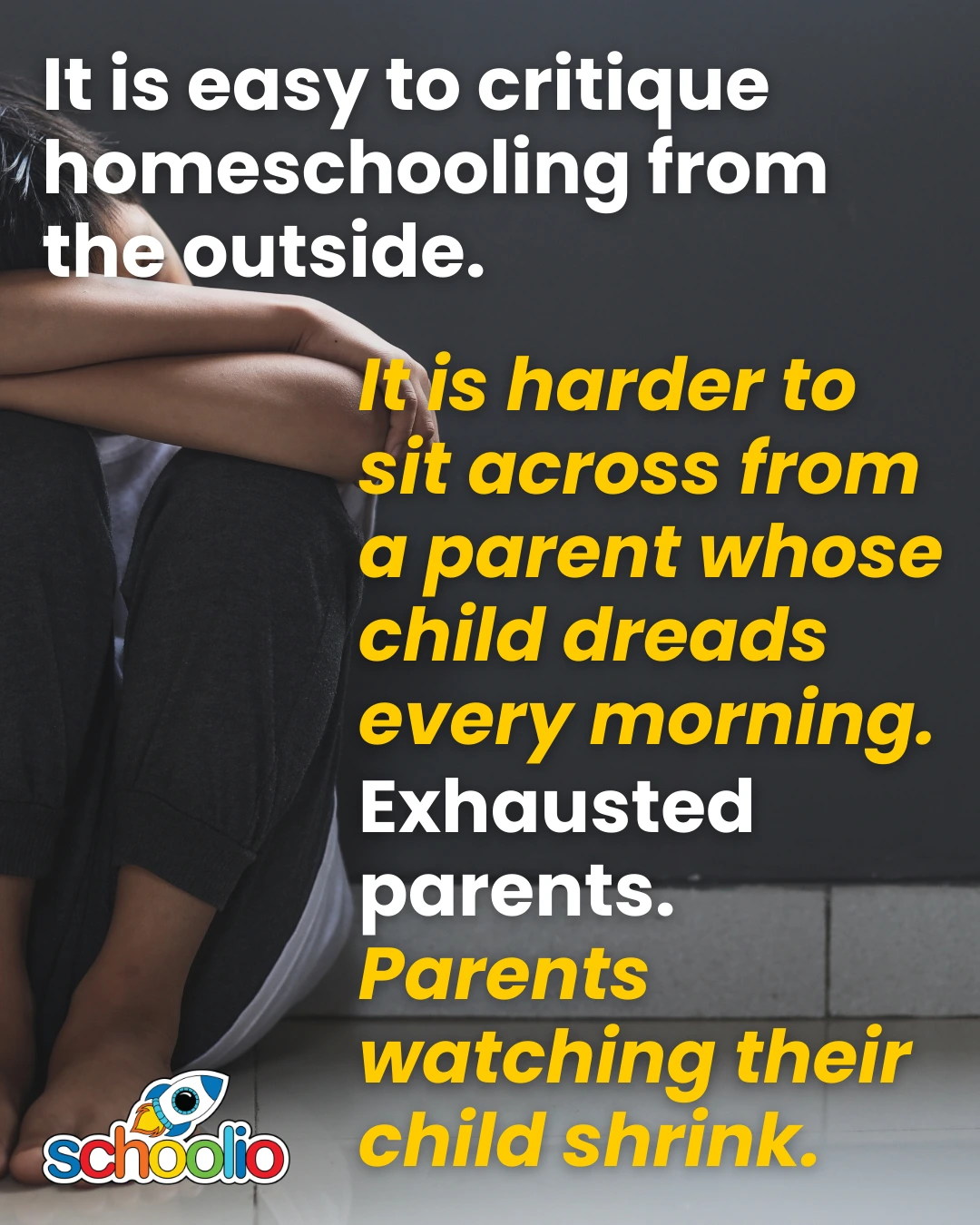
When I was growing Schoolio, I spoke to thousands of parents. Not angry parents. Not radical parents. Exhausted parents. Parents watching their child shrink. Parents watching anxiety spike. Parents watching confidence erode.

Bullying is real. Social pressure is real. Feeling misaligned with the environment is real.

Does homeschooling magically eliminate all of that? No.

But for some families, it changes the environment enough that their child can breathe again.

And that is what often gets missed in the debate.

It is easy to critique homeschooling from the outside. It is harder to sit across from a parent whose child dreads every morning.

You do not have to choose homeschooling to appreciate why someone else does.

At its best, it is not about escaping school.

It is about restoring stability, identity, and confidence in a child who was struggling inside a system that did not fit.

That deserves more understanding, even from those who would never choose it themselves.

Sathish

still learning, still unlearning

What Actually Helps PDA Kids Learn (And What Makes It Worse)

What Actually Helps PDA Kids Learn (And What Makes It Worse)


If you’re parenting a PDA kid, you already know this:

The more you push, the harder they push back.

And if you’re new to homeschooling a PDA or ADHD child, you might be thinking:

“If I just get the schedule right…”

“If I just stay consistent…”

“If I just hold firm…”

It should get easier.

But sometimes it doesn’t.

Sometimes it gets worse.

Because what looks like defiance is usually nervous system overwhelm.

And rigid structure — the kind we were taught is “good teaching” — can actually backfire.

Let me tell you what I’ve learned the hard way.


What Makes It Worse

Rigid scheduling.

“You do math at 9:00. Reading at 9:30. Writing at 10:00.”

For a PDA brain, that can feel like a trap.

Not a routine — a demand.

And when the nervous system perceives demand, it goes into threat mode.

Cue resistance.

Shutdown.

Negotiation.

Meltdowns.

It’s not laziness.

It’s not manipulation.

It’s autonomy panic.

The more tightly you grip, the more their brain fights for control.


What Actually Helps

Choice.

Not chaos. Not zero expectations.

Choice inside structure.

There’s a big difference.

Instead of:

“You have to do math right now.”

Try:

“Here are the three things that need to get done today. What would you like to do first?”

That one shift changes everything.

A to-do list feels very different from a command.

A list says:

“These things exist.”

A command says:

“You must.”

And for PDA kids, that distinction matters.


Why Order and Timing Matter Less Than Agency

One of the biggest mindset shifts for me was realizing this:

It doesn’t matter if math happens at 9am or 2pm.

It matters that it happens without a power struggle.

If unlocking lessons at midnight gives your child the ability to wake up and decide their own order? That’s not “spoiling” them.

That’s restoring autonomy.

If Open Exploration-style days — where they can choose what to work on — reduce anxiety and increase engagement? That’s not lowering standards.

That’s designing learning around a nervous system instead of against it.

And when you remove the demand, something surprising happens.

They often choose to do the work.

Not because they were forced.

Because they felt safe.


But Isn’t That Too Much Freedom?

This is the fear I hear all the time.

“If I give options, won’t they just avoid math forever?”

Maybe for a day.

Maybe even for a week.

But when learning isn’t wrapped in threat, resistance fades.

And when math is a concept-based lesson — not a 40-minute ordeal — it becomes approachable.

You can slow it down.

Break it apart.

Turn one writing lesson into four days.

Make one math concept last a week with hands-on work.

Completion matters more than speed.

Engagement matters more than compliance.


The Real Goal

The goal isn’t obedience.

It’s ownership.

When a child feels like learning is being done to them, resistance sets in.

When they feel like they are building something themselves, everything changes.

PDA kids especially need to feel like they are choosing — even inside non-negotiables.

We’re not removing expectations.

We’re removing the battle.

And that shift?

It changes the whole house.


If you’re in the thick of it right now, please hear this:

You’re not doing it wrong.

You’re parenting a brain that needs autonomy like oxygen.

Design around that.

And watch what happens.

? Lindsey

certified special-ed educator, homeschool mom, & co-founder of Schoolio

“My Kid Hates Writing.” Here’s What I Tell Every Parent.

“My Kid Hates Writing.” Here’s What I Tell Every Parent.


I see this in our community all the time:

“My child melts down when it’s time to write.”

“They say they hate writing.”

“It takes them an hour to write three sentences.”

“Writing is a battle every single day.”

And almost every time, the issue isn’t creativity.

It’s overload.

Here’s the shift that changes everything:

Separate creative thought from technical practice.


Why Writing Feels Like a Grind

When we ask a child to write a story, journal entry, or essay, we are actually asking them to do multiple complex tasks at once:

  • Generate ideas

• Organize thoughts

• Remember sentence structure

• Spell correctly

• Form letters

• Use punctuation

• Manage handwriting speed

• Regulate frustration

For neurodivergent kids — especially those with dyslexia, ADHD, dysgraphia, or motor challenges — that’s a traffic jam.

Their brain has a beautiful idea.

But their hand can’t keep up.

Or their spelling can’t keep up.

Or their working memory drops pieces of the sentence before it gets to the page.

And suddenly writing feels like:

GRIND.

Not because they hate stories.

Not because they aren’t smart.

Because their technical skills can’t keep pace with their thoughts.

That mismatch creates frustration.

And frustration turns into “I hate writing.”


Step One: Practice Technical Skills Separately

Technical writing skills are important.

But they don’t have to be practiced inside creative writing.

Grammar?

Worksheets or digital practice.

Spelling?

Targeted word lists.

Handwriting?

Copywork.

Copying quotes or passages from a favorite book is powerful because it removes the creative demand. The child can focus solely on:

  • Letter formation
  • Spacing
  • Neatness
  • Muscle memory

No thinking about what to say.

No worrying about ideas.

Just mechanics.

That’s much more manageable.


Step Two: Let Creative Flow Be Fast

When it’s time for your child to create something — let them use whatever tool allows their thoughts to move at the speed of their brain.

That might be:

  • Typing
  • Voice-to-text
  •  Speaking while you scribe
  • Recording themselves first

The goal is to let them experience:

The joy of storytelling.

The strategy of organizing ideas.

The power of expressing a thought fully.

Without getting stuck on spelling every third word.

If their brain is racing with ideas, don’t slow it down with letter formation practice.

Protect the flow.


You Can Combine — Without Overloading

For younger kids, you might:

  • Let them tell you a story while you scribe it in highlighter.
  • Later, have them trace over it for handwriting practice.
  • The creativity and the technical work happen — just not at the same time.
  • For older kids:
  • They might draft using voice-to-text.
  •  Then later go back to edit grammar and structure.

Still practicing technical skills.

Still building strong writing.

Just not forcing everything to happen simultaneously.


Why This Matters

When writing becomes a constant grind, kids start to believe:

“I’m bad at writing.”

“I’m not creative.”

“I hate school.”

But often, they don’t hate writing.

They hate bottlenecks.

They hate the feeling of their ideas being trapped behind slow mechanics.

When you separate the two, something beautiful happens:

They start enjoying thinking again.

They start taking creative risks.

They start seeing themselves as capable.

And once confidence builds?

Technical skill gets easier to practice.


If your child says they hate writing, try this shift:

Practice the mechanics separately.

Protect the creative flow.

Let their ideas move freely.

You’ll be amazed at how quickly the resistance softens when the traffic jam clears.


?

Lindsey

certified special-ed educator & co-founder, Schoolio

When a Mom in Our Community Answered a Simple Question with One Word.

When a Mom in Our Community Answered a Simple Question with One Word.


This has been on my mind today…

A mom in our community answered a simple question with one word.

Freedom.

Not freedom from learning. Freedom inside learning.

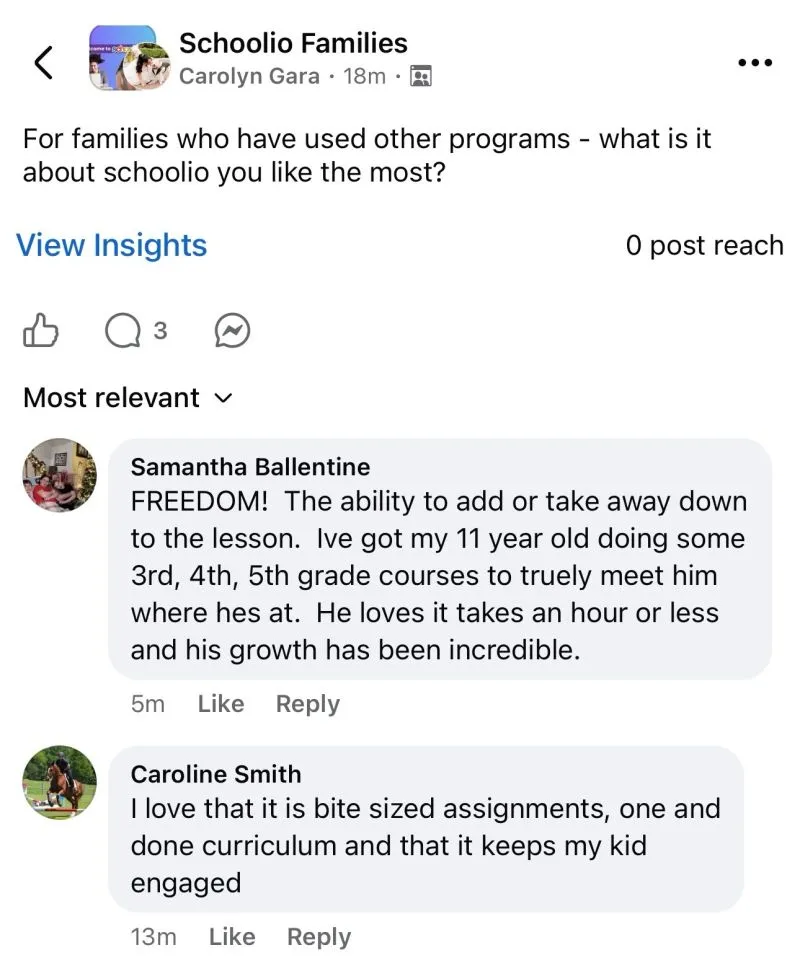
One parent shared that her eleven year old moves between third, fourth, and fifth grade work depending on the subject. Not because he is behind. Not because he is ahead. Because that is where he is.

Another said she loves the bite sized, one and done lessons. Her child stays engaged. It takes less than an hour. Growth has been incredible.

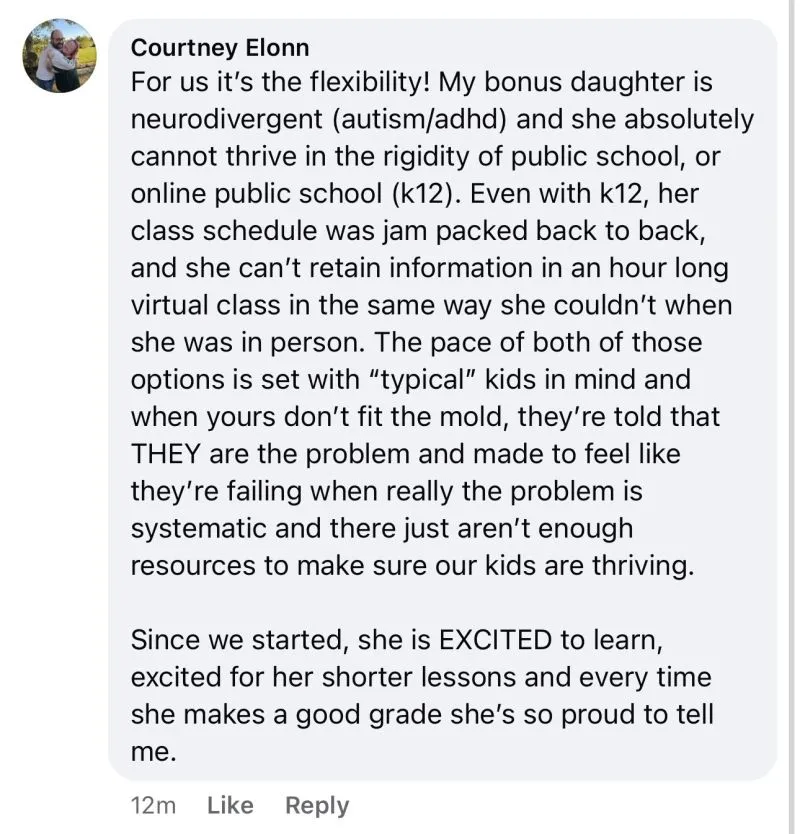
And then a mom of a neurodivergent daughter said something that hit hard. In public school and even online public school, the pace was built for typical kids. When her child could not keep up, she was made to feel like the problem.

Since switching, her daughter is excited to learn. Proud of her grades. Thriving.

This is why homeschooling is becoming more normal across the world.

It is not about escaping school. It is about building systems that adapt to kids instead of asking kids to adapt to systems.

When parents say freedom, what they mean is their child finally fits.


Sathish

still learning, still unlearning


When Homeschooling is Healing, Not “Fixing”

When Homeschooling is Healing, Not “Fixing”


This has been on my mind today…

There is a Japanese art form called kintsugi. When a bowl or cup breaks, it is not thrown away. The pieces are carefully put back together, and the cracks are filled with gold. The repair is not hidden. It is highlighted. The object becomes more valuable because it has been broken and repaired with care. The story becomes part of its beauty.

I think about that a lot when I reflect on my own life. I also think about it when I look at the families we support through homeschooling and the work we are building at Schoolio.

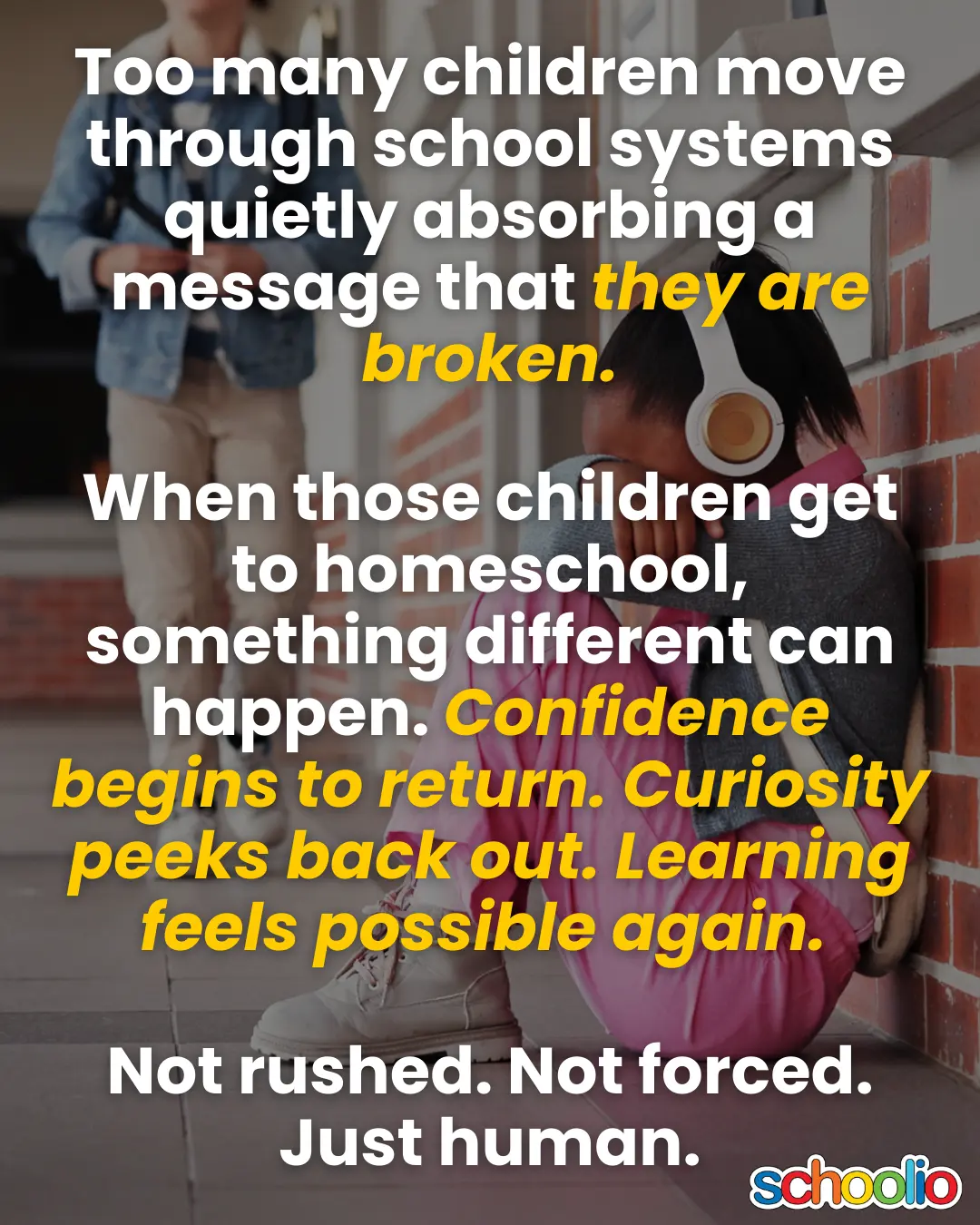
Too many children move through school systems quietly absorbing a message that they are broken. Not always through words, but through looks, labels, meetings, and expectations. They are told to sit still when their bodies want to move. To keep up when they need time. To fit into systems that were never designed for how they learn. Eventually, many of them begin to believe that something is wrong with them.

When those children come home, something different can happen. With patience, care, and attention, the pressure starts to lift. Confidence begins to return. Curiosity peeks back out. Learning feels possible again. Not rushed. Not forced. Just human.

But here is the part that matters most to me. Healing should never feel like hiding.

Homeschooling should not feel like punishment or retreat. It should not feel like we are sweeping children out of sight. It should feel like kintsugi. A celebration of the whole child. A recognition that learning differently does not mean learning less. It means learning in a way that honors who they are.

At schoolio, we see this every day. Children who were once labeled as struggling begin to thrive when the pressure is removed and the support is real. When learning adapts to them instead of asking them to adapt to it. When their cracks are not erased, but respected.

Every student who leaves a system that did not serve them carries an incredible story. Those cracks are not flaws. They are experiences. When they are filled with care, trust, and belief, something stronger is created. Something more meaningful than what existed before.

That is what homeschooling can be.

That is what schoolio is working toward.

Not fixing children, but honoring them.


Sathish

still learning, still unlearning

When Schools Punish Curiosity, Families Choose Freedom

When Schools Punish Curiosity, Families Choose Freedom


This has been on my mind today…

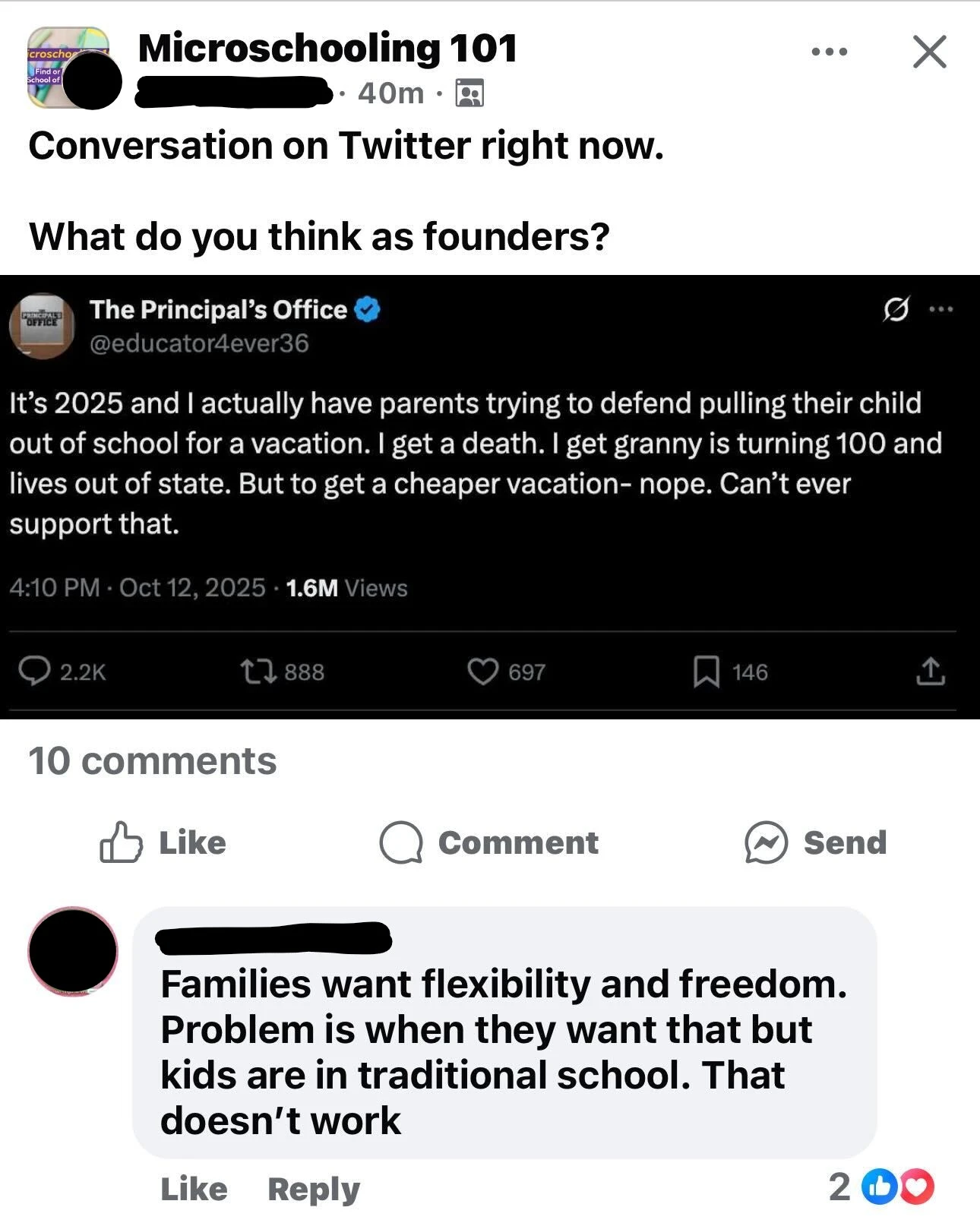
I saw a post today from a school administrator frustrated that parents take kids out of school for vacations. “I can understand a death or family emergency,” he said, “but a cheaper vacation? Nope.”

That comment says everything about why so many families are leaving the system.

We’ve built schools that treat learning like a fixed location — a desk, a bell, a schedule. But learning doesn’t stop when you leave the classroom. It happens in airports, in museums, in street markets, and in quiet conversations between parent and child while exploring a new city.

When schools shame families for traveling, they’re not protecting education — they’re limiting it.

Learning on the road is world learning. It’s exposure, perspective, adaptability. It’s the kind of real-life curriculum no textbook can teach.

Families aren’t looking for rebellion. They’re looking for flexibility.

They want their kids to see the world and still stay connected to structured learning.That’s why platforms like Schoolio exist — to make learning portable, digital, and continuous. Whether you’re in a classroom or on the road, learning doesn’t have to pause.

If schools truly want to prepare kids for the world, they should start by letting them experience it.


Sathish
Still learning, still unlearning

Why I’m Not Worried About “Sheltering” My Homeschooled Kids

Why I’m Not Worried About “Sheltering” My Homeschooled Kids


This has been on my mind today…

I used to brace myself every time someone said it. You know the line.

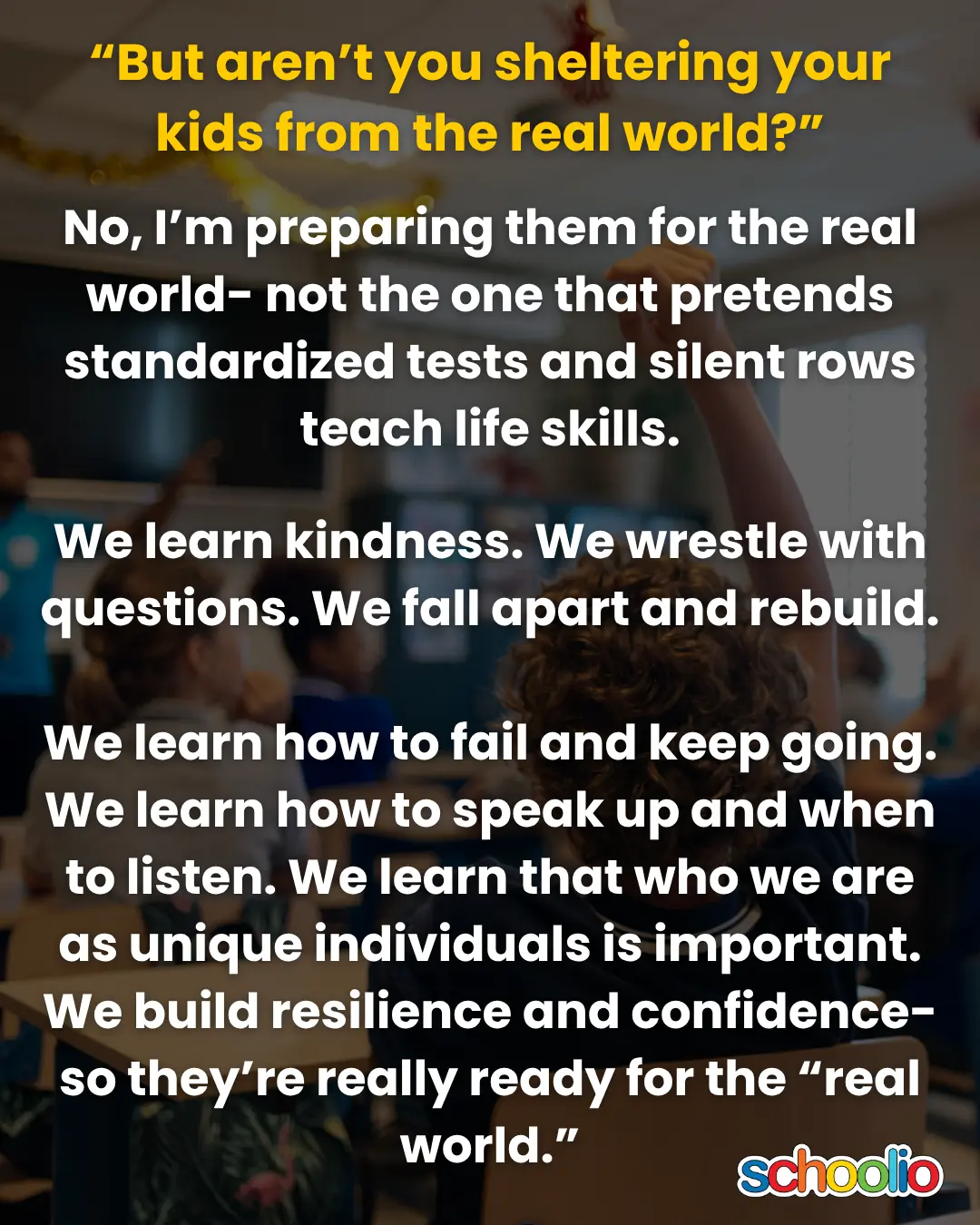
“But aren’t you sheltering your kids from the real world?”

At first, I tried to explain. Then I tried to debate. Now? I just smile — because the truth is, yes, I am.

I’m sheltering them from the pressure to fit in before they even know who they are.

From being teased in the cafeteria because they don’t wear the right shoes or laugh at the same jokes.

From classrooms that push every child through the same mold, at the same speed, regardless of how they learn best.

But I’m also preparing them for the world. For the real one — not the one that pretends standardized tests and silent rows teach life skills.

In our home, we talk about kindness. We wrestle with questions. We fall apart and rebuild.

We learn how to fail and keep going. We learn how to speak up and when to listen. We learn that who we are as unique individuals is important… and awesome. We build resilience and confidence- so they’re really ready for the “real world.”

They learn how to handle conflict, talk to cashiers and librarians, make friends of all ages, and advocate for themselves. They practice empathy daily because it’s not just a word on a poster — it’s part of our lessons.

Is that sheltering? Maybe. But it’s also strengthening.

Because when my child walks out into the world, I want them to know who they are.

Not just what they’ve memorized. Not just what other kids or teachers have told them they are.

I want them to feel confident enough to speak, not just raise their hand for permission.

I want them to see difference and not fear it — to question and not crumble.

So yes, we’re doing school differently. That doesn’t mean we’re hiding.

It means we’re building something deeper.

Not a bubble — but a bridge. And we’ll cross it together when it’s time.


With love,

Lindsey

Certified Special Ed Educator & Co-Founder, Schoolio

School Resistance and Refusal: Understanding Your Child’s Struggles

School Resistance and Refusal: Understanding Your Child’s Struggles


For many parents, the morning routine becomes an exhausting battle when their child simply refuses to go to school. While the occasional reluctance is common for most children, school resistance and refusal is a much deeper issue that impacts a significant number of families. When your child consistently resists going to school or experiences extreme anxiety at the idea of attending, it’s more than a phase; it’s a complex issue requiring careful consideration, understanding, and potential lifestyle changes.

In this blog, we’ll explore what school resistance and refusal is, why it’s more common in neurodivergent children, and why homeschooling could be a viable option for parents feeling the strain of daily school-related struggles.

What is School Resistance and Refusal?

School resistance and refusal occur when children avoid going to school due to intense feelings of fear, anxiety, or frustration. It’s not just a simple dislike of school or laziness. Children experiencing school refusal often feel an overwhelming sense of dread, and forcing them into school may exacerbate their emotional distress.

This behavior can manifest as physical symptoms like stomachaches, headaches, or even panic attacks on school days. It might also appear as sudden emotional meltdowns or refusal to leave the house. If your child resists going to school regularly, it’s crucial to recognize that something more significant is going on.

While this can happen with any child, it’s important to acknowledge that school resistance and refusal is more common in neurodivergent kids, including those with ADHD, autism, anxiety disorders, or sensory processing issues. The standard structure of traditional schools often conflicts with the needs of children who have different ways of processing information, interacting with their environment, or managing their emotions.

School Resistance and Neurodivergency

For neurodivergent kids, school environments can be overwhelming, uncomfortable, and even traumatic. Children with autism, ADHD, or anxiety often struggle with the rigidity of the school day, the social pressures of interacting with peers, and the sensory overload caused by noise, fluorescent lighting, and crowded spaces.

Neurodivergent children may have difficulties adhering to conventional behavior expectations, like sitting still, paying attention for long periods, or waiting their turn. This can lead to conflicts with teachers and peers, triggering feelings of inadequacy or shame. The school environment might feel like a place where they constantly fail, which, in turn, increases school resistance and refusal.

In some cases, the underlying issues may stem from sensory processing difficulties or executive dysfunction, both common in neurodivergent children. This could mean that certain aspects of the school environment feel unbearably intense for them, whether it’s the sound of the bell ringing, the texture of their clothes, or the constant demands for task initiation. Over time, these daily stressors add up and create an emotional block to attending school.

Trust Your Parental Instincts

When parents encounter school resistance and refusal, it’s easy to feel pressure to force their child to comply with school attendance. However, your parental instincts may be telling you something else. It’s important to listen to those instincts.

If your child is expressing extreme discomfort or distress about school, this is a signal that something is wrong. Forcing your child to attend school against their will might seem like the simplest solution in the short term, but it often worsens the underlying issues. Rather than pushing through, it’s vital to approach the situation with empathy, curiosity, and a desire to understand your child’s perspective.

Common Reasons for School Resistance in All Kids

While school resistance and refusal is more frequent among neurodivergent kids, it can happen with any child. Here are some common reasons children might resist school:

  1. Anxiety: School can be a source of significant stress for children, whether it’s due to academic pressure, social challenges, or fear of separation from their parents.
  2. Bullying: A common reason for children to refuse school is bullying or negative social interactions. This might be happening without the parent’s knowledge, so keeping an open line of communication with your child is essential.
  3. Learning Disabilities: Children who struggle academically due to undiagnosed learning disabilities may avoid school because they feel like they can’t keep up or fear being labeled as “stupid” by their peers or teachers.
  4. Separation Anxiety: For younger children, being away from their parents can cause overwhelming separation anxiety, leading to school resistance and refusal.
  5. Sensory Sensitivities: Even neurotypical children may struggle with sensory sensitivities, such as loud noises, bright lights, or certain textures, making the school environment a difficult place to spend extended periods.

Homeschooling: A Viable Option for School Resistance and Refusal

For parents dealing with school resistance and refusal, homeschooling can be a viable alternative to the traditional school environment. Homeschooling offers a flexible and personalized learning approach that can cater to your child’s unique needs, interests, and pace.

Here’s why homeschooling can be a great option for children who resist school:

  1. Individualized Learning Plans: In a homeschool setting, you can tailor the curriculum to your child’s specific strengths, needs, and interests. This allows for a more engaging and supportive educational experience.
  2. Reduced Pressure: Homeschooling removes the rigid time constraints and constant performance evaluations found in traditional schools. Without the pressure to meet arbitrary timelines, your child may feel less overwhelmed and more willing to engage in learning.
  3. A Sensory-Friendly Environment: You can modify the home learning environment to be more sensory-friendly, providing a comfortable space for your child to learn without the noise and distractions that come with a crowded classroom.
  4. Emotional Support: Homeschooling allows you to be there for your child during difficult emotional moments, offering immediate support and understanding that a teacher in a traditional setting might not have the time or capacity to provide.
  5. Flexible Scheduling: Homeschooling offers flexibility in scheduling, allowing you to plan learning around your child’s peak focus times and energy levels. If your child struggles to start their day early, you can adjust the schedule accordingly.

Addressing Concerns About Homeschooling

It’s normal for parents to feel unsure about homeschooling, especially if they’ve only experienced traditional schooling themselves. However, homeschooling has become increasingly mainstream, and there are vast resources available to support you in this journey.

Some common concerns parents have include socialization and academic progress. The reality is that homeschooling communities are thriving, with co-ops, group activities, and extracurriculars readily available to help your child socialize. Additionally, many parents find that homeschooled children often excel academically because they receive individualized attention and are able to learn in a way that suits their unique style.

Steps to Take if Your Child is Struggling

If your child is struggling with school resistance and refusal, here are some steps you can take:

  1. Open Communication: Talk to your child about their feelings toward school. Validate their emotions and try to understand the underlying reasons behind their resistance.
  2. Involve a Professional: If you suspect anxiety, depression, or neurodivergence is contributing to your child’s school refusal, consider seeking guidance from a mental health professional who specializes in working with children.
  3. Explore Educational Alternatives: Look into homeschooling or other alternative education options, such as online schooling or Montessori education, that may better suit your child’s needs.
  4. Create a Plan: Develop a collaborative plan with your child. Whether this involves gradually returning to school or transitioning to a new learning method, ensure your child feels heard and involved in the decision-making process.

Conclusion: Trusting Your Instincts

If your child is experiencing school resistance and refusal, it’s essential to trust your instincts and explore all available options. Forcing your child into a system that is clearly not working for them may do more harm than good. Instead, consider homeschooling as a way to provide the supportive, individualized learning environment your child needs to thrive. Remember, every child is different, and the goal is to help them learn in a way that makes them feel safe, capable, and understood.

By considering alternatives like homeschooling, you’re not only validating your child’s experience but also creating a path for their academic success and emotional well-being.

Fear Says “Fit In.” Values Say “Stay Firm.”

Fear Says “Fit In.” Values Say “Stay Firm.”

This has been on my mind today…

Most of us were raised with fear dressed up as discipline.

Fear of standing out.

Fear of falling behind.

Fear of being different — or being too much of something.

When I was growing up, that fear had a thousand voices:

“Don’t talk back.”

“Respect your elders.”

“Just do what you’re told.”

“Don’t embarrass the family.”

South Asian homes are particularly good at this — teaching you to blend in so well that, one day, you wake up and realize you don’t even know what you stand for. You’ve become a collage of other people’s expectations. You chase safety instead of passion. Approval instead of purpose.

That’s why, now as a father, I keep coming back to one truth:

Fear says “fit in.”

Values say “stay firm.”

And if I want my kids to stay firm — to know who they are, to know when to walk away, to know what matters even when it’s unpopular — then I have to show them how.

Not lecture them.

Not shame them.

Not compare them to anyone else.

Just live it.

That means letting them speak, even if I disagree.

Letting them dress how they want, even if I don’t get it.

Letting them explore paths I didn’t choose — or couldn’t.

It also means apologizing when I parent from fear instead of from values.

Because I still catch myself doing it.

If you’ve chosen to homeschool, to opt out of the system, to rewire how learning happens in your house — then you already know this feeling. The discomfort of not fitting in. The awkward pauses in family conversations. The well-meaning but judgmental stares from old friends.

Let them come.

Let fear have its moment.

But then let your values speak louder.

You didn’t choose this path because it was easy. You chose it because it was right.

And if your kids learn anything from you, let it be this:

The world doesn’t need more people who know how to fit in.

It needs more people brave enough to stay firm.

Sathish

still learning, still unlearning

Beyond Busy: Making Space for Boredom

Beyond Busy: Making Space for Boredom


This has been on my mind today…

When new homeschoolers start out, one of the first things I see them try to avoid is boredom.

They fill the schedule with academics. Add on some coding games. Sprinkle in art classes, science experiments, and extracurriculars.

All in the name of “keeping them busy.”

But here’s the thing…

Kids don’t need busy.

They need space.

Space to feel still, to get bored and to wonder what else is possible.

Because boredom isn’t a problem to solve.

It’s a gateway to curiosity.

This weekend, I watched it play out in real life. It was around 7pm this past weekend. My kids were both on their phones, scrolling. Dinner was still an hour away, like it usually is in our house.

I looked over and thought, should I ask them to put it down?

Will it turn into a fight right before dinner? Will it be met with the usual eye rolls or sighs? Probably.

But I asked anyway.

“Take a break,” I said. “Do something else for a bit.”

They both put their phones down, reluctantly. And within a minute, I heard it. The phrase I knew was coming.

“I’m so bored.”

I said nothing. Just let it hang in the air. Ten minutes later, the three of us were at the kitchen table playing UNO. By the 45-minute mark, the game had turned competitive. We were laughing, shouting, teaming up, accusing each other of cheating. And just like that, they weren’t bored anymore.

After dinner, the phones stayed off.

My son pulled out his sketchbook and started drawing.

My daughter went to her room and practiced her DJ set.

No devices. No distractions. Just presence. All because they got bored.

I used to think boredom was something to fix.

Now I see it as a door. Because boredom is what comes before the magic.

Before the game, the drawing, the creativity, the music. And all we have to do is let it happen.

“I’m bored” is not a complaint. It’s a cue.

Let’s stop trying to fill it. Let’s let our kids feel it.

They’ll figure it out. And when they do, it’ll be better than anything on a screen.


Sathish

still learning, still unlearning

Learning Area and Perimeter in Minecraft

Learning Area and Perimeter in Minecraft


Math can feel abstract sometimes. Numbers on a page. Formulas to memorize. Eyes glazing over.

That’s exactly where we were when we hit perimeter and area. My kids weren’t connecting with it — and honestly, I couldn’t blame them. Why does drawing rectangles on a worksheet feel so important when you’re seven?

So we switched it up.

We opened Minecraft.

Suddenly, it wasn’t about boxes on paper. It was about building.

  • Perimeter became the fence we needed around our animals. How much fencing did we need to keep the sheep in?
  • Area became the flooring for the rooms of a house. How many blocks would it take to fill in the kitchen or living room?

And just like that, the concept clicked.

Instead of “math problems,” it became their world. They cared about the outcome, because they had ownership in the project. They weren’t just solving for numbers — they were solving for sheep. For walls. For a house they were excited to design.

That’s the power of leaning into your child’s interests. When you connect learning to something they love, the barriers start to fall away.

It doesn’t mean every lesson becomes a video game (though sometimes that helps ?). It means you take the thing they’re already excited about and use it as a bridge into the learning.

Because here’s the truth: kids don’t resist learning. They resist learning that feels irrelevant.

And sometimes, all it takes is a fence for sheep to make the numbers finally make sense.


? Lindsey