Unpopular Opinion- Learning Shouldn’t Always Be Fun

Unpopular Opinion- Learning Shouldn’t Always Be Fun

By Lindsey, certified special-ed educator & co-founder, Schoolio


Does this sound familiar?

“How many questions do I have to do?”
“How much longer?”
“I’m bored!”
“Are we done yet?”

If your homeschool days feel like a marathon of sighs, tears, or endless negotiating, you are not alone. And it’s not because you’re a “bad teacher” or your child is “unmotivated.”

The real culprit?
You’re probably replicating school at home.

And the solution is simpler than it sounds: stop doing that.

At Schoolio, we talk a lot about our Philosophy of Learning. But here’s the gist of it: thriving in homeschool comes down to two big ideas—Relevancy and Responsibility.

Relevancy: The “Why” Behind Learning

Kids learn best when they understand why they’re learning something. And there are really only two powerful “whys”:

  • CuriosityI want to know this because it interests me.

  • PurposeI know why this is important for me to learn.

When kids have one of those reasons in mind, they’re naturally more engaged. That’s why Schoolio makes curiosity and purpose central, with our Future Readiness Library and electives that stretch way beyond the basics. Whether it’s learning all about cats, entrepreneurship, or the history of pirates, kids can find what they’re interested in, or see the value of- and often, they’re genuinely excited to learn.

Responsibility: Learning Isn’t Always Fun

Here’s the unpopular opinion: not all learning should be fun.

We love hands-on projects, electives that spark excitement, and letting kids explore their interests. But the truth is, some things in life simply just require effort. Some subjects take persistence. And not everything in life can, or should, be gamified or turned into an adventure.

And that’s not a bad thing. In fact, it’s one of the most valuable lessons homeschool can offer.

Real-world readiness means teaching kids:

✔ Some things you want or need to learn won’t come easily, but they’re worth the effort.
✔ Not everything is a game, but it still has to be done.
✔ Responsibility means following through, even when something isn’t fun.

Because in the end, building grit, self-discipline, and responsibility are just as important as mastering math facts or essay writing.

The Balance

Homeschool should not be all drudgery, but it doesn’t have to be all glitter and games either. The sweet spot is in teaching both: helping kids chase what excites them and showing them how to stick with the hard stuff when it matters.

So maybe the next time you hear “I’m bored!” or “How much longer?” you’ll remember: you’re not failing, you’re teaching real life.

? Lindsey

When I Realized My Child’s Learning Style Didn’t Match My Own

When I Realized My Child’s Learning Style Didn’t Match My Own

By Lindsey, certified special-ed educator & co-founder, Schoolio


This has been on my mind today…

When I first started homeschooling, I assumed my kids would learn the way I learn. That’s the default, right? We teach from our own perspective. But it didn’t take long for me to realize their learning styles—and their needs—were very different from mine.

I’m ADHD. I thrive on novelty, challenge, and curiosity. I love going out, seeing people, doing things. My brain comes alive when there’s energy in the room. Planning homeschool field trips, events, parties, and mom meet-ups? That gave me life. I thought it would do the same for my kids.

But my kids are autistic. They enjoy their friends, yes—but in small doses, one-on-one, in familiar settings. Big group outings didn’t energize them the way they did me. They drained them. Where I walked away buzzing with energy, they walked away needing quiet, calm, and time to recover.

It was the same in our learning space. I always wanted music playing, stimulation in the background. They wanted silence. I craved variety and spontaneity. They needed consistent, reliable routines. I thrived on the excitement of new challenges. They thrived on knowing what to expect.

At first, I resisted that difference. I kept thinking, but this is how I learn best—shouldn’t it work for them too? When it didn’t, I felt frustrated. But slowly, I realized I had it backwards. My job wasn’t to shape them into my rhythm. It was to honor theirs.

That shift changed everything.

I began planning fewer big events and focusing on more intentional one-on-one time with friends. Instead of background noise, I chose quiet. Our homeschool days gained more rhythm and held fewer surprises. Along the way, I learned how to stretch myself to meet their needs, and gently taught them to stretch a little too—tolerating small bits of novelty, practicing compromise, and knowing it was okay to ask for quiet whenever they needed it.

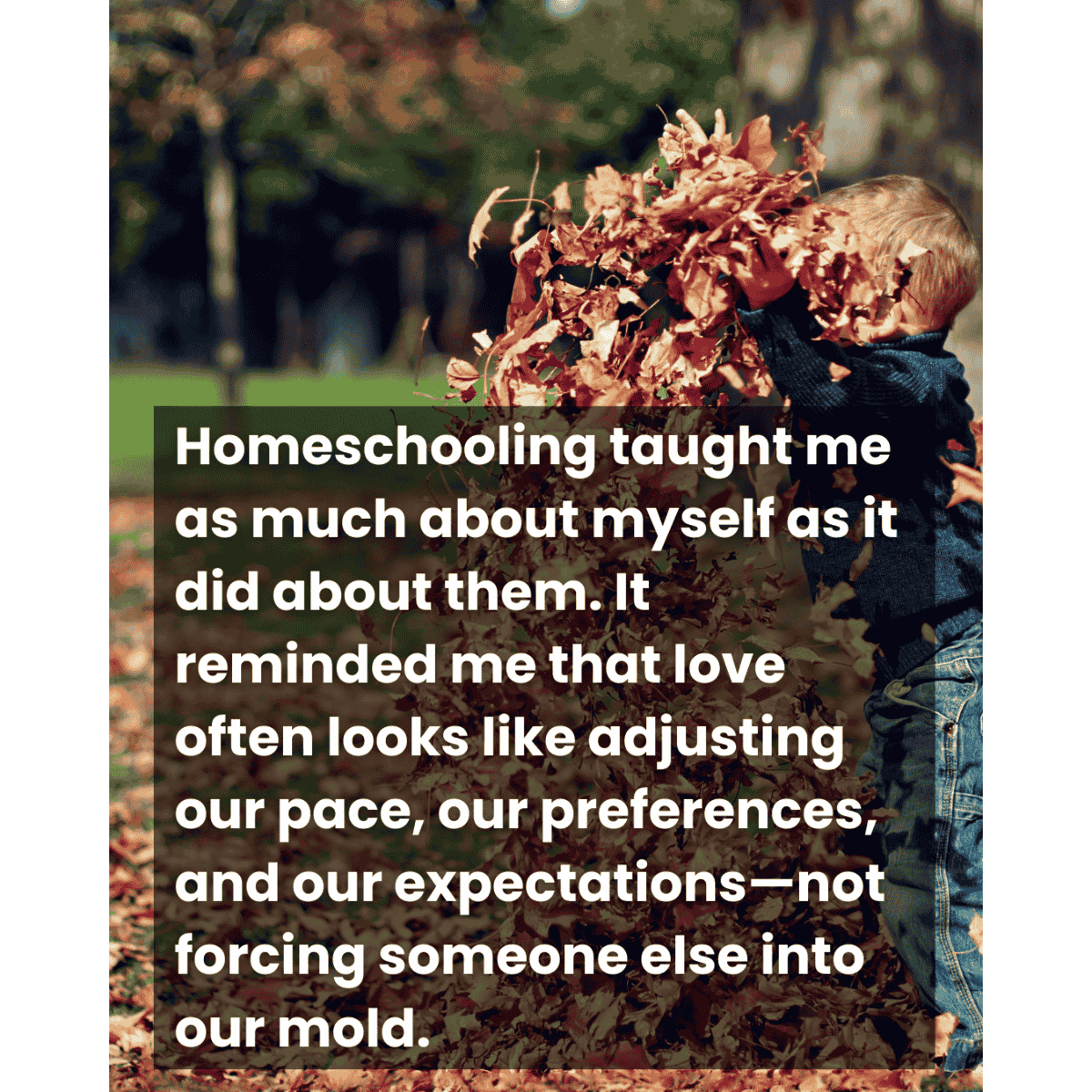
Homeschooling taught me as much about myself as it did about them. It reminded me that love often looks like adjusting our pace, our preferences, and our expectations—not forcing someone else into our mold.

And it gave me this truth:

We don’t have to learn the same way to learn together.

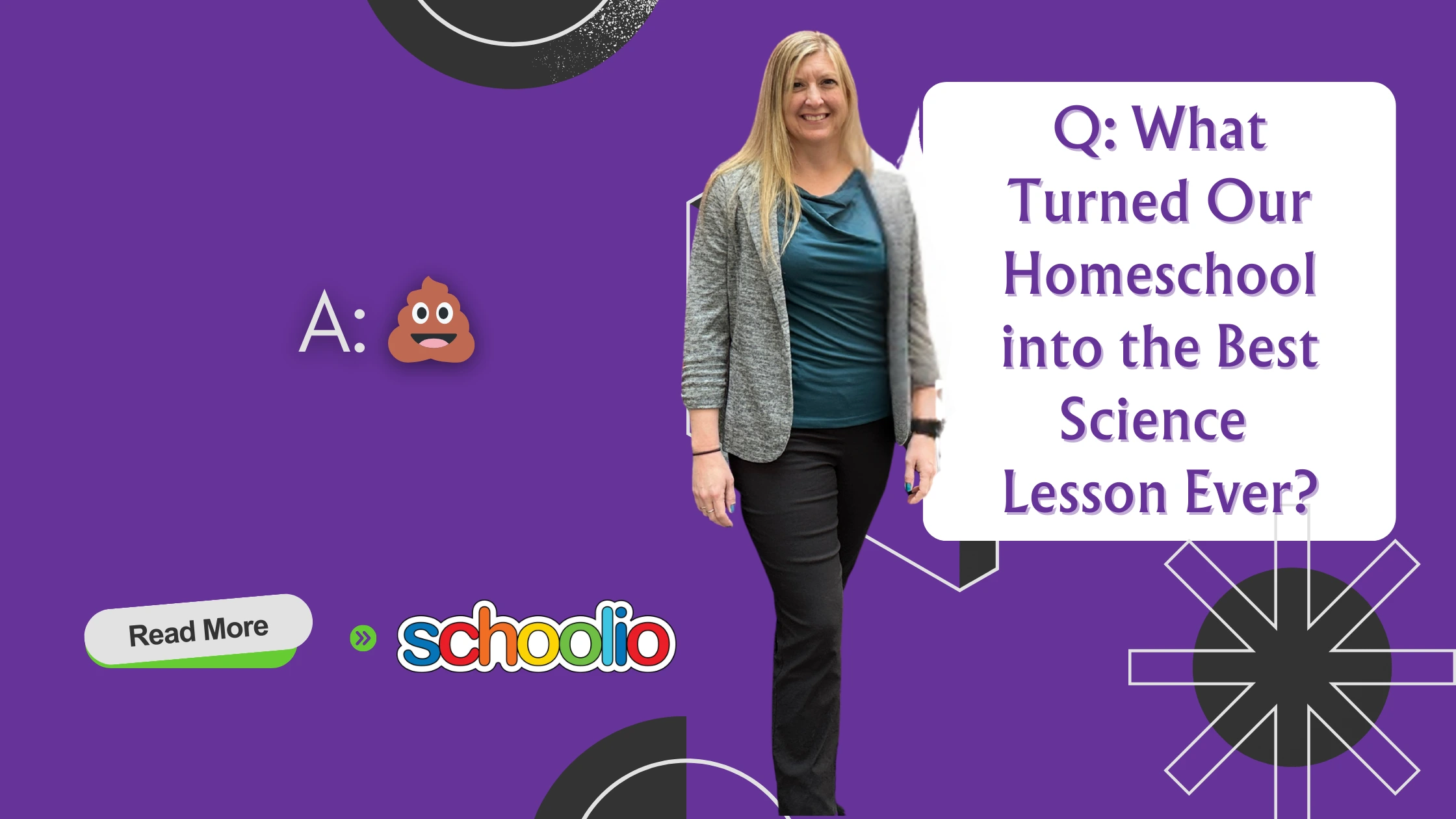
When Our Homeschool Turned to S**t

When Our Homeschool Turned to S**t


This has been on my mind today…

One winter morning, we set out on a nature walk. Nothing fancy, just some fresh air and a chance to stretch our legs. That’s when it happened. The kids stopped, pointed, and announced with total fascination:

“POOP!”

There it was on the path. Just sitting there, waiting to be discovered. And instead of me steering them back to the “lesson plan,” they had one question that became our curriculum for the whole week:

“What animal did this come from?”

We started guessing. Deer? Rabbit? Maybe raccoon? The curiosity snowballed. Back at home, we started researching. We found pictures of animal scat (yes, that’s the proper word) and compared them. We talked about the diets of different animals and how that shows up in their droppings. The kids wanted to make their own scavenger hunt checklist of “poops to find,” so we did. Suddenly every walk was a full-on investigation, magnifying glasses in hand, kids crouched down like little detectives.

And then nature gave us another gift — snow. Once they had learned about scat, the curiosity expanded:

“If we can tell an animal by its poop, can we tell it by its footprints too?”

That week turned into tracking lessons. We studied paw shapes, stride lengths, and patterns. We matched tracks to the animals in our region. Every walk became a treasure hunt. They weren’t just “getting exercise.” They were observing, comparing, classifying, and recording. In other words, science.

And here’s the thing: none of it was on my lesson plan. There was no worksheet waiting on the table that morning titled “Animal Scat and Tracks.” But it was real learning. Engaged, memorable, full of wonder.

The kids didn’t just learn about animals. They learned how to follow a question, how to investigate, how to let curiosity guide them. That’s the kind of learning you don’t forget — even if it started with poop.

So yes, sometimes school looks like math books at the table. Other times, it looks like poop on a trail. Both count. Both matter. And both are homeschooling.

? Lindsey

certified special-ed educator & co-founder, Schoolio

Discover Fearless Homeschooling with Sheree Lanette: A Journey into Educational Empowerment ? #InspiringParents

Embarking on the homeschooling journey can be a daunting decision for many parents, filled with uncertainties and questions. In the latest episode of Schoolio Learning‘s EdVenturers Podcast, Sheree Lanette shares her inspiring homeschooling journey, offering insights, wisdom, and a touch of humor.

Trusting Your Instincts: Sheree emphasizes the importance of trusting your instincts when considering homeschooling for the first time. She encourages parents to listen to that initial feeling of uncertainty and turn it into an opportunity for growth and exploration.

Building a Community in Texas: Contrary to the assumption of a thriving homeschooling community in Texas, Sheree reveals that she had no prior knowledge when she started in 2016. Living in an area with few homeschoolers, she navigated the challenge by actively seeking support through Facebook groups and attending homeschool days hosted by businesses, even if it meant traveling.

Family Ecosystem and Overcoming Doubts: Sheree opens up about her family ecosystem, discussing her son’s language delay and the initial concerns raised by her wife about homeschooling. Despite these concerns, Sheree and her husband, both former teachers, decided to take the plunge, realizing the need to provide a tailored education for their child.

Unlearning and Embracing the Journey: Addressing the common worry about not being a teacher, Sheree dispels the myth that formal teaching experience is a prerequisite for homeschooling success. She shares her own experience of unlearning traditional teaching methods, highlighting the flexibility and adaptability that homeschooling offers.

Looking to the Future: As the conversation segues into the future, Sheree briefly touches on her business. She underscores the importance of unlearning conventional approaches, emphasizing that lesson plans can be adapted, and curriculum can be purchased to suit individual needs.

Conclusion: Sheree Lanette’s homeschooling journey is a testament to the power of trusting one’s instincts, building a supportive community, and embracing the adventure of educating at home. Whether you’re a seasoned homeschooler or contemplating this educational path, Sheree’s story is a beacon of inspiration, proving that with dedication and flexibility, anyone can thrive on the homeschooling odyssey.

Listen to the full podcast episode here.

For Sheree’s Social Media Accounts, you can visit her
Facebook: www.facebook.com/shereelanette/
Instagram: www.instagram.com/shereelanette_/
Tiktok: www.tiktok.com/@shereelanette_
Email address: info@shereelanette.com

#Homeschooling #EdVenturersPodcast #Inspiration

Traveling with Kids: How to Do It Like a Homeschooler

Traveling with Kids: How to Do It Like a Homeschooler

Traveling with Kids: How to do it like a homeschooler

Traveling with kids can be a thrilling and enriching experience for the whole family. While it may seem intimidating at first, it can become an opportunity for incredible learning and growth with the right approach. In this blog, we’ll explore how you can embrace the homeschooling mindset while traveling with kids and provide you with some practical tips to make the journey easier and more enjoyable.’

Ready to Do It Like a Homeschooler when Traveling with Kids?

Traveling like a homeschooler opens up a world of possibilities for educational exploration and family bonding. Whether you homeschool your children or simply want to infuse learning into your travels, approaching your journeys with a homeschooling mindset can transform them into extraordinary experiences. By embracing hands-on learning, incorporating local culture, and fostering curiosity, you can embark on adventures that ignite your children’s curiosity and provide them with valuable knowledge beyond the confines of a traditional classroom.

Here are some various ways you can travel like a homeschooler, turning every trip into a captivating and enriching educational experience for the whole family.

1. Plan Ahead with Purpose:

One of the key aspects of homeschooling is planning with a purpose. Apply this approach to your travel itinerary by researching destinations that offer educational opportunities for your children. Look for museums, historical sites, science centers, and cultural events that align with their interests and the subjects you want to cover. This way, your trip becomes a hands-on learning experience.

2. Embrace Hands-on Experiences:

Children learn best through direct engagement, so seek out interactive activities wherever you go. Look for museums with hands-on exhibits, workshops, or guided tours that allow your kids to actively participate. Whether it’s a cooking class to learn about local cuisine or a nature walk to explore ecosystems, hands-on experiences make learning fun and memorable.

3. Make History Come Alive:

Traveling provides a unique opportunity to bring history lessons to life. Research historical sites and landmarks in the places you’ll be visiting, and encourage your children to read about them beforehand. When you’re there, let them absorb the atmosphere, explore the architecture, and imagine what life was like in that era. This immersive approach to history will deepen their understanding and appreciation.

Traveling with kids

4. Keep Learning On the Go:

Traveling itself can be a fantastic learning experience. Use the time spent on planes, trains, or in the car to engage your kids in educational activities. Pack age-appropriate books, puzzles, or educational games that relate to the places you’ll visit or the subjects you’re covering. This way, you can continue their education while on the move.

5. Encourage Journaling:

A travel journal is an excellent tool for children to reflect on their experiences and practice their writing skills. Provide each child with a journal where they can document their adventures, thoughts, and observations. Encourage them to write about the places they visit, the people they meet, and the new things they learn. Not only does journaling enhance their literacy skills, but it also creates a beautiful keepsake to remember the trip.

Encourage journaling

6. Integrate Math and Geography:

Traveling offers plenty of opportunities to incorporate math and geography into your children’s learning. Involve them in planning the routes, calculating distances, and estimating travel times. Encourage them to read maps, find landmarks, and understand geographical features. By doing so, you’ll enhance their spatial awareness and problem-solving skills.

7. Take Advantage of Local Culture:

Immerse your children in the local culture by trying traditional foods, attending cultural festivals, or exploring local markets. Encourage them to interact with locals, learn basic phrases in the local language, and gain a deeper appreciation for different customs and traditions.

8. Use Technology as a Learning Tool:

Utilize educational apps, podcasts, or online resources that align with your children’s interests and the destinations you’ll be visiting. These tools can provide additional information, quizzes, and interactive content to enhance their understanding and engagement.

9. Plan Breaks and Downtime:

Traveling can be tiring, especially for young children. Remember to schedule breaks and downtime to rest, recharge, and process the experiences. This allows them to absorb and reflect on what they’ve learned while maintaining their energy levels.

Plan breaks and downtime

10. Incorporate Physical Activity:

Traveling often involves exploring new environments and landscapes. Take advantage of this by incorporating physical activities such as hiking, swimming, or biking. Not only does it provide a healthy outlet for energy, but it also encourages a connection with nature and promotes overall well-being.

11. Connect with Other Traveling Families:

Look for opportunities to connect with other families who are traveling or homeschooling. Join online forums, attend meetups, or participate in group activities. This can provide a sense of community, valuable insights, and potential friendships for both children and parents.

12. Focus on Flexibility and Adaptability:

Traveling with kids requires flexibility and adaptability. Embrace unexpected changes or detours along the way and use them as teaching moments. Encourage your children to problem-solve, adjust their expectations, and find joy in the unexpected.

13. Foster Independence:

Give your children age-appropriate responsibilities during the trip. Whether it’s navigating, managing a budget, or planning an activity, empowering them to take charge fosters independence and cultivates valuable life skills.

14. Document the Journey:

Encourage your children to take photographs or create videos to document their travel experiences. This allows them to develop their creativity, storytelling skills, and visual documentation abilities. Plus, it creates a lasting memory of their adventures.

Document the journey

15. Reflect and Share:

Once your trip is over, set aside time to reflect on the experiences as a family. Have meaningful conversations, share favorite moments, and encourage your children to share what they’ve learned and how it has impacted them. This reflection promotes deeper learning and helps solidify memories.

Embrace the Homeschooling Mindset When Traveling With Kids.

Traveling with kids can be an exciting adventure that combines education and exploration. By adopting a homeschooling mindset, you can transform your family trips into invaluable learning experiences. Remember to plan with purpose, seek out hands-on activities, and encourage journaling. Embrace the opportunity to make history come alive and integrate subjects like math and geography along the way. With these tips, you’ll create unforgettable memories and instill a love for learning in your children that will last a lifetime. Happy travels!

Learn more about why parents are turning to homeschooling – Click here!

Home(schooling) for the Holidays: How and Why to Take a Break

Homeschooling and the holidays

Home(schooling) for the Holidays?: How and Why to Take a Break

By Chelsea McLeod

Just as Self-Care is essential to the homeschooling parent puzzle, so is taking breaks from the planned curriculum. Homeschooling offers many benefits, one of which is a flexible schedule. Homeschooling doesn’t often follow a traditional school day; you have break time during the day as the requirement of time spent schooling differs. As a homeschooler, you do not have to follow a traditional school calendar; you can choose your calendar, but taking breaks from your planned learning on your family’s schedule is essential.

Taking needed breaks is easier said than done for so many of us.

Homeschool Holiday

Home(schooling) for the holidays: How and why to take breaks from homeschooling.

We often feel guilty for taking time off or become overwhelmed by the concept that there is too much to do to take breaks. However, this is not the case, and on the contrary, it can be very healthy for you and your children to take breaks from traditional schooling. So first, you must allow yourself to make the mental space for holidays. You cannot worry about lessons and learning 24/7/365, or you will burn yourself and your children out.

There are many types of breaks, from planned, spontaneous mental health days or unplanned; permitting yourself to take those breaks, whether planned or unplanned, is crucial to the success of your homeschooling journey. But how? How to take these breaks is a different story. In the case of planned breaks, you can follow a traditional school calendar or even look at the work holidays of your spouse and friends.

This may include family or community commitments, events, or simply taking the summer off to allow your children to have a similar schedule to their friends, and you get some much-needed time off. Conversely, unplanned breaks can come from sicknesses, family deaths or unexpected hospitalizations. These things are unavoidable; however, sometimes we need to take a breath, make space for family connection and forget about the calendar for a short or even long while if necessary. The routine, plans and learning will be there waiting for us when we are ready and able to return to normalcy.

Why You Should Take Breaks. 

Why you should take breaks is easier to break down. Just because you have chosen to homeschool doesn’t mean you are not allowed to make space for some separation. You school from home, but you do not live in the school. This is an important distinction. I’m sure you know from experience that when you are doing too much of something, it can lead to burnout.

Well, the same applies to learning. You must care for yourself and make space for your interests and hobbies. In the same way, your kids need to have some time and space not connected to a learning outcome. On top of that, there are many reasons (we can only name a few here) why you should take breaks and direct the focus away from traditional learning.


Here Are Some Reasons Why Breaks Are Important: 

  1. You are in Charge. 

Like many, you chose to begin homeschooling in the first place to take charge of your time and calendar, right? So why not use that to your advantage and plan your break when it works for You? You make the plan; you know what to focus on and when. Could you make space in the plan for holiday breaks? So whether you celebrate Christmas, Hanukkah, Kwanzaa or the Winter Solstice, you can plan your days off from teaching and learning to best suit the schedule you set out. 

  1. Family First.

Similarly, being with and connecting with your kids is crucial to their emotional development. You are a parent first, and your children need you for more than just teaching them academics. Life skills and emotional development require an emotional connection. Taking the time to bake cookies together or read a Christmas story is okay because it will help your child build emotional intelligence. Family traditions, religious/non-religious holiday practices or time spent together are always more important than academic learning.

  1. Tomorrow is Not Guaranteed. 

This one sounds sad to say, but it is true. No one knows what tomorrow will bring, so take the time to make those memories. If you skip picking out a Christmas tree together or carolling with a relative to keep going with your curriculum, you risk losing your children. What if that relative isn’t around next Christmas? So take the time while you know it is here to create those memories and connections. 

  1. Homeschooling Requires Less Time. 

Most homeschooling families complete their lessons in less time than a traditional in-person school day. For this reason, you often get naturally occurring breaks during the day or only homeschool for part of the day. And, if you are a curriculum person who likes to follow that checklist, you will easily find and plan how to push through or make up for lost time at a later date. 

  1. Learning Isn’t Just Planned Lessons. 

Learning happens all the time, especially for children. Baking cookies with your kids can include measurement learning; volunteering can involve learning emotional maturity or gaining “subject area knowledge,” as well as early civic or community engagement lessons. So much “counts” as part of a well-rounded educational experience for your child, so worry less about planned lessons and take in some other types of learning while you spend time with your kids. 

  1. Everyone Needs A Break, and That’s OK. 

The holidays, no matter which ones you celebrate, often come with much busier schedules. So while you are running around with various get-togethers, holiday concerts or wherever else the season brings, take the time to enjoy it. Remember, you are making memories, and the change of routine often means occasional periods of downtime, rest, and relaxation. After the holidays, you will be able to start fresh. 

  1. A Break is A Good Time to Make Changes. 

Speaking of starting fresh, if things in your homeschool plan are going differently than you envisioned after a break is an excellent time to make changes. You can take the time during the holidays to explore other approaches or make new plans. Then, when you’re ready to return to it, you and the kids will have had a natural break, which can make the transition easier. 

  1. Other Relationships Are Important Too. 

Whether those relationships are with friends, mentors, extended family or activity leaders, the holidays are a great time to make space for these. So give your children the opportunities to connect with others outside the immediate family group. It can be problematic in your everyday routine to find time to do this, but holiday events often shift focus to spending time with important people to your child. 

  1. They will Grow Up; You Don’t Want to Miss It. 

That’s right, I said it! And no, I am not trying to “rush” you or make you cry, but the reality is that before you know it, your littles will be grown, and your traditions will have to adjust. Your holidays will no longer be entirely a time of downtime but could involve part-time jobs and studying for finals. Eventually, they will grow up, move out and get their apartment. They may be going off to university or work, and while they may have time off, they may not be able to get home on all their days off. So be intentional with the time you have now, and put down the lesson planner; the algebra problems or the poem unit you had planned isn’t as important as building relationships with your kids.

Homeschooling and the holidays

Summary: Home(schooling) for the holidays: How and why to take a break.

Amid the busy day-to-day of raising little ones, it is hard to imagine that it will ever be different; believe it or not, there will come a day when you will miss the “help” baking cookies, the constant questions (or screaming) and the stepping on toys at every turn. For now, take the time to enjoy your kids because your family won’t always be this easy to connect with; they won’t always be together under one roof. One day, they will be grown, possibly with a family of their own, and you want them to look back fondly, remembering their time at home with you and use those memories to create their traditions. After the holidays, a new year with new lessons will be waiting, but for now, embrace the change of routine and lean into the break for both yourself — and your kids.

Enjoy your family time.

Click Here to check out 15 ways to find joy during the holidays! 


Is Your Child Emotionally Burnt Out?

5 Signs Your Child is Struggling Emotionally

As parents, we pride ourselves on knowing about our children: their likes and dislikes, friends, strengths and weaknesses, and interests. We want to ensure that we also keep an eye on our children’s emotional and mental health, is your child emotionally burnt out?

5 Signs Your Child Is Emotionally Burnt Out.

After 2+ years of a global pandemic, it feels like a long time for parents and children. But what represents 1% or less of our parent’s lifetimes has been 20% of a ten-year-old child’s lifetime. If your child is six or younger, they may not remember the “before times” of Covid-19, lockdowns, and school closures.

Our children (and even us as parents) are downright out of practice with many of the basic skills we all used to take for granted. Things like, social interactions, navigating through crowds, routine changes, and overcoming daily challenges have yet to be practiced much, by any of us, not only children, in the last few years. But this lack of practice has come during the social and emotional development for our children. As they are thrown back into a “full-speed” world, it may be a more challenging transition for children than anticipated.

Luckily, there are things parents can look for in children- behaviour clues- that will act as signs your child is struggling emotionally and allow parents to help children earlier, even before the child may be aware of a problem themselves or be able to verbalize it to parents.

So, is your child emotionally burnt out? Here are five indicators.

  1. Low Mood or Apathy

Parents know their children better than anyone else, and as a parent, you know what gets your child interested and excited. If you notice that your child isn’t enjoying what they used to or is apathetic about adventures that used to get them excited, it may be one of the five signs your child is struggling emotionally.

Sure, interests change over time, but if your child has been a gymnast for years and suddenly can’t be bothered to change for practice, or your child has a love of dinosaurs but would rather stay home than visit the museum, it could be a clue that something is up. Often when we think about depression, we think of sadness- crying and being unable to get out of bed. In reality, depression can manifest in different ways, and an early sign can be a lack of interest in activities one used to enjoy.

  1. Quick to Anger

Everyone gets angry, and we know that young children have less emotional control and regulation skills than older children and parents, but again, you know your child best! If you feel like you’re walking on eggshells with your child all the time, trying not to say or do the wrong thing because they seem so quick to anger lately, it could be one of the five signs your child is struggling emotionally.

The things that used to be par for the course, like asking your child to finish their chores or start their homework, are now suddenly throwing them into a grumpy mood. Or maybe you see your child getting angry over challenges they used to enjoy, like playing a video game. Instead of persisting in a difficult challenge, they throw the controller and get upset. These quick-to-anger moments can be one of the five signs your child struggles emotionally.

  1. End-of-Day Restraint Collapse

Also called After School Restraint Collapse, this happens when a child has been holding in their big emotions all day long to behave appropriately, and then when they get to the safety of their home and the comfort of their parent, they let it all out. Often this comes out as a “meltdown” or what some might call a “tantrum.” On the bright side, parents can take comfort when this happens in knowing that their child feels safe and loved with you, able to let their defences down and unload all their big feelings knowing that your love and support are a constant.

You’ve created a connected and emotionally supportive parent-child relationship- great job! But that aside, it sure doesn’t feel good as a parent to see your child completely lose control like that. Suppose this happens to your child often, particularly at the end of events, such as a day of school or any other significant stimulation day. In that case, it could be this third of the five signs your child is struggling emotionally. If your child feels like they can’t let their big feelings out in whatever situation they just came from, it may be time to assess that situation and ensure it’s serving your child as you want.

  1. Always-Never Statements

What are always-never statements? Always-Never statements are one of the “unhelpful thoughts” taught in Cognitive Behavioral Therapy- considered the “gold standard” in treating stress, anxiety, and depression. It is recognized and endorsed by organizations worldwide, including the World Health Organization (WHO), the National Institute of Mental Health, and national psychiatric and psychological associations in Canada, the US, Australia, and the UK.

Likewise, hundreds of well-designed research studies have demonstrated the effectiveness of CBT for thousands of children. CBT teaches strategies to recognize and combat negative thought patterns, understand how they relate to and affect emotions and behaviour, and help children and parents to reduce stress, anxiety, depression, and other negative self-talk and self-image. One of these negative thought patterns is Always-Never thinking. This is when your child sees a pattern that isn’t there and concludes that something “always” or “never” happens when it’s a little of both.

This is a typical negative thought pattern with children, and we hear it in phrases like, “You never let me stay up late.” or “You always take my sister’s side!” This is evidence that your child is forging neuropathways in negative thought patterns that can be difficult to break later. Hearing these statements often could be one of the five signs your child struggles emotionally.

  1. Fixed Mindset

You’ve probably heard the term Growth Mindset; a Fixed Mindset is the opposite. When a child has a growth mindset, they believe that they can learn as much as they want and that their mind can grow and strengthen by doing difficult things. A growth mindset also means that your child understands that mistakes are typical and essential in learning. A growth mindset also focuses children on the power of the word “yet.” Meaning there may be things your child can’t do… yet.

When children have a growth mindset, they know that it’s just a matter of time and practice, and yes, failure and mistakes before they learn the hard thing they were trying to learn. Evidence of a Fixed Mindset often comes in words and phrases when your child is working on something hard or trying to overcome an obstacle. If you constantly hear your child saying things like, “I can’t.” or “I don’t know how.” or your child is quick to give up, they may not understand the Growth Mindset. The defeatist attitude of a Fixed Mindset can be one of the five signs your child is struggling emotionally and possibly having self-esteem issues.

What do you do?

Is your child emotionally burnt out? Now that you know these five signs, what do you do?

The number one thing to do is be patient.

Remember that many of the things we, as parents, are excited to get back to like full-time in-person school, theme parks, concerts, and other significant events- are mere memories, at best, for our young children. These things can be overwhelming, and some social anxiety from your child during the adjustment period is expected. Be patient with them, take your time re-introducing these activities, keep them short, and space them out as much as possible.

Second, don’t overburden your child’s schedule.

It’s exciting to get back to the things we used to love. But a full day of school followed by sports, clubs, tutors, music lessons, etc., can do more harm than good, primarily if your child is exhibiting any of these five signs your child is struggling emotionally. Too much hustle and bustle can leave children feeling overwhelmed and holding in their emotions too tightly for too long. Give your child lots of breaks, and plan for quiet downtime at home regularly.

And third, don’t hesitate to ask for help if your child is struggling.

From your family doctor to a myriad of private therapists, classes, courses, and at-home workbooks, there is a lot of valuable help for children and adults alike who are struggling emotionally. Don’t hesitate to reach out for help when you need it, and remember that it’s always better to have done more than you needed to help your child than not to have done enough.

We’ve all been through a lot over the past two years, and a global pandemic is not a small or meaningless event in anyone’s life. If you or your child are struggling, don’t be embarrassed to ask for help, decline events that don’t bring you joy, or adjust your schedule as much as you may need.

It’s ok to ask for help.

If you’re seeing some of the five signs your child is struggling emotionally, consider looking for an at-home, learn-together approach to helping your child learn to manage their thoughts, feelings, and emotions. Check out the Schoolio Social-Emotional Learning unit, Thoughts & Feelings. This 10-lesson unit has scripted tools and fun activities that allow you and your child to learn the basics of Cognitive Behavioral Therapy and Social-Emotional Learning together. You do not have to be a parenting expert to do this unit with your child! You’ll learn and grow together, and you’ll be equipping your child with some concrete strategies they can use their whole lives whenever they are struggling emotionally.

Why Are So Many Parents Homeschooling?

When most people think ‘homeschool,’ they think of the stereotypes attached to it, like the stereotype that people only homeschool for religious reasons. And while many do, statistics show that there is now a wide range of parents homeschooling their children worldwide. So why are so many parents homeschooling?

Why are so many parents homeschooling? 

Since homeschooling is becoming so popular, it’s no surprise that around 3.7 million children were homeschooled in the United States from 2020-2021, from kindergarten to grade 12. According to the National Home Education Research Institute, this translates to roughly 6% to 7% of school-aged children. In comparison, in the spring of 2019, 2.5 million children were homeschooled in the United States. Following the same trend, Canadian families have turned to homeschooling as their education choice. According to The Fraser Institute, an average growth rate of more than 5% per year.

So why are so many parents homeschooling? There are so many reasons, and each homeschooling family has their unique reason for homeschooling. But some of the most popular reasons include:

Homeschooling offers stability.

The pandemic was a staunch reminder that the education system is fragile and struggles to pivot when things get messy. Children need stability, especially when it comes to their education. While many may assume that homeschooling is the opposite of a stable educational choice, they’re mistaken. Throughout the pandemic learning chaos, homeschooling families continued to do what they had done all along: learn. While many traditionally schooled children were slipping through the cracks, homeschooling children continued to thrive with their education.

The pandemic aside, there are many other reasons traditional education isn’t the most stable choice. Let’s take a look at education in Ontario, Canada, in the school year 2019-2020 before the pandemic made things even messier. Many forget that a teacher strike saw children missing essential learning time. Compacted with the pandemic caused learning loss to affect children in momentous proportions.

Homeschooling offers safe learning. 

We have all seen the news and been traumatized by images of school shootings across the United States. Something so horrifying is, unfortunately, happening more and more. Many parents are fearful when they drop their children off for school, and many children face immense anxiety throughout the school day. As such, homeschooling offers safe learning, where children are safe in their own homes with the people they feel safest with, their parents.

Homeschooling is customizable. 

There is no such thing as one size fits all regarding education. Yet, traditional education is very much one size fits all. When we try to answer the question of ‘why are so many parents homeschooling?’ we cannot overlook that homeschooling is customizable to meet the student’s needs. Every child is unique, and so is their learning style.

Say your child is technically in grade 4 but understands math on a grade 5 level; their reading and writing are on a grade 3 level. Homeschooling allows you to help your child learn what they need to learn. Not forcing them to understand the same way everyone else is, because one size fits nobody.

Or if your child learns better with a hands-on approach vs. Sitting at a desk for hours. Homeschooling offers the opportunity for children to learn in the way that best suits them. 

Homeschooling offers different social opportunities.

When you think of homeschooling, you may assume that socialization isn’t a homeschooling family’s strong suit. But that’s false. Homeschooling offers children a fantastic opportunity to socialize in ways many traditional learning students do not have ready access to. 

Homeschooled children can volunteer with their families at community events, nursing homes, veteran halls, and more. These opportunities allow children to socialize with more than just their peers. They can socialize with a wide variety of people, which helps them to have better social connections and understanding of the people around them. 

Homeschooling helps children become self-reliant. 

Many homeschooled children are independent and self-reliant. This is because homeschooled children can learn at their own pace while also self-motivating themselves as they need to be accountable for their progress. The significant benefit is that it helps children by boosting their confidence and helping to shape a sense of responsibility. Additionally, homeschooled children have the chance to go deeper with their interests while learning. This benefits them as they continue to develop greater independence and self-direction.  

They also can develop their organizational and time-management skills better. As many older homeschooled, students can manage their schedules around extracurricular activities and studies. These wholesome benefits are confirmed by 87% of peer-reviewed studies. These studies demonstrated that statistically, homeschooled students score much better on emotional, social and psychological development metrics than their peers in traditional learning venues. 

Homeschooling is becoming a much more affordable option. 

There’s a misconception that you must be ‘rich’ to homeschool your children. The truth is that with homeschooling gaining popularity, many affordable curriculum options are becoming available to serve homeschooling families with all financial backgrounds. Schoolio Learning offers excellent rates for an all-in-one, open-and-go, inclusive homeschooling curriculum. Parents can homeschool easily, knowing they didn’t just break the bank to provide a quality homeschooling curriculum for their children. Concerned about homeschooling costs? Check out this blog on affordable homeschooling curricula. 

Homeschooling allows more one-on-one time. 

When you ask the question of why are so many parents homeschooling? You will likely get this response. Many parents only see their children for a couple of hours daily. Between rushing to school, coming home and rushing to sports, then off to bed as soon as they get home, many parents feel like their children are growing up without them getting to be present for a lot of it. Homeschooling offers families the opportunity to spend more time together. With a much more relaxed schedule, homeschooling families can embrace the valuable time learning together. Indeed, there are stressors and things that take from our time, but homeschooling offers parents the ability to spend more time with their children. 

Homeschooling offers a bully-free environment. 

Unfortunately, bullying seems to be a norm in school. According to PACER’s National Bullying Prevention Center, one out of every five (20.2%) students reports being bullied. 43% of students reported being bullied in the hallway/stairwell, 42% reported being bullied in the classroom, 27% reported being bullied in the cafeteria, 22% reported being bullied outside on school grounds, 12% reported being bullied in the bathroom or locker room, and 8% reported being bullied on the school bus. 

One of the big answers to the question of ‘why are so many parents homeschooling?’ is that homeschooling offers children the chance to learn and grow in a safe environment, away from bullies and peer pressure, which means that children are free to be themselves without the fear of being bullied. 

Homeschooling gives you the freedom to schedule your own time. 

Parents that are homeschooling report that their children get much better sleep. Because they can sleep until their body is ready to wake up, some days are rushed, but most homeschooling days are much more relaxed than traditional learning days. Homeschooling families also have the opportunity to partake in more fun extracurricular activities, field trips, and learning fun. 

Homeschooling keeps children from slipping through the cracks in the education system.

Unfortunately, many children are slipping through the cracks of a broken education system, even more so during and in the aftermath of pandemic learning. The sad reality is that many students are pushed onto the next grade level even though they don’t fully understand what they need to do. Thus many children are struggling now more than ever before. Yet, there is not enough time, money or resources available to help those children that are slipping through the cracks. Homeschooling meets the child where they are. Offering them the opportunity to learn what they need to and catch up on the areas they are struggling with. 

There are countless answers to the question ‘why are so many parents homeschooling?’ 

While we listed some of the most popular reasons to answer the question of why so many parents are homeschooling? There are hundreds of more reasons. Each family is unique, and so is their reason for homeschooling their children. The bottom line is that homeschooling is becoming much more popular and for the right cause. Because children deserve the chance to learn in the environment that best suits them, whether traditional learning or homeschooling, finding the learning avenue that helps your child thrive is essential. Take some time to evaluate the pros and cons of homeschooling with conventional learning, then make the right decision for your family. 


homeschooling curriculum
Look no further than Schoolio Learning for all your homeschooling needs.

Homeschooling and Socialization

Homeschooling and Socialization is a topic that makes many homeschool families cringe. And it’s not because their children are inadequately socialized; it’s because so many people ask them about socialization and voice their concerns. From something as simple as walking through the grocery store during the day with their children, a homeschooling parent will likely get grilled about their choices, and random strangers will ask questions about homeschooling and socialization.

Homeschooling and Socialization go hand in hand.

This might surprise you, but homeschooling and socialization go hand in hand. In fact, many homeschooled children have better social lives than their traditionally schooled peers. How could this be possible? Well, first, let’s look at the facts. According to Think Impact Homeschooling Statistics, recent federal data shows that 3% to 4% of the school-going population in the United States is homeschooled. There are 73 million children in the U.S., which means over 2.9 million children are homeschooled in the U.S.

With that many children being homeschooled, do we still believe that they are all not adequately socialized? Of course not! Homeschooling has been growing in popularity for the last ten years, especially since the beginning of the COVID-19 pandemic in 2020, when over 300 million students worldwide became homeschooled briefly.

Pandemic learning didn’t help stop the myth that homeschooled children aren’t socialized.

Unfortunately, when most parents and children were forced into remote learning through school boards during the pandemic, it did nothing to diminish the myth that homeschooled children aren’t socialized. Because children were being isolated with a makeshift version of online learning, parents also attempted to work from home simultaneously. This caused tremendous stress for parents and students alike and caused many parents and friends of the family to assume that what they were doing was homeschooling. Which they were not.

Recently I had a concerned citizen ask me why I would choose to homeschool my children, knowing that they wouldn’t get socialized and wouldn’t have as many opportunities in life—a shocking claim. Especially since statistics show that homeschooled children have a 67% College graduation rate compared to their public schooled peers at 59%, not to mention that my children have better social lives and many more friends than I do.

This person’s concern stemmed from watching their grandchild struggle through online/pandemic learning. And the isolation they felt. I kindly explained that homeschooling is 100% different from pandemic learning. And that my children have many opportunities to get out and socialize. Still, the person seemed bewildered.

A conversation with a homeschooled child.

As stated above, if over 2.9 million children in the United States are homeschooled, how could they all be isolated and live unsocialized lives? Have you ever had a conversation with a homeschooled child? They are usually the ones the explain in detail the project that they are working on. They are the ones that have unique interests and see the world through a much different lens than those around them.

Recently we had a family move to our neighbourhood that homeschools. While I was out for a walk with my kids, we stopped to say hello to two children playing catch. I welcomed them to the neighbourhood, and the one boy introduced himself, shook my hand and wished us a wonderful day. Why did this child interact so politely instead of ignoring our passing? Because many homeschooled children have opportunities to participate in socialization that other children don’t have access to. Let’s talk about that.

Socialization opportunities for homeschooled children:

There are so many opportunities available for homeschooling families to participate. Here are some of our favourites!

  1. Homeschooling Groups.

    Since there are so many homeschooling families, many families get together to plan fun activities and sports-related opportunities for their children. Most cities have such a large amount of homeschooling families that they have registered homeschooling groups. These groups offer support for homeschooling families, co-op learning, field trips, sports, and lessons.

    Are you looking for virtual socialization opportunities for parents? Check this out. 

  2. Sports.

    Our local homeschooling group comes with some fantastic perks, like gymnastics lessons, at a local gymnastics club, swimming lessons at the pool, track and field during the warm months, and gym/indoor pool rentals during the cold months, sledding, skiing, horseback riding and more.

  3. Park dates.

    During the summer months, when homeschooling activities are mostly paused, many homeschooling groups offer weekly meet-ups at parks in your location so homeschooling friends can get together to play and have fun!

  4. Community Service.

    Many homeschooling families understand the importance of the community. That’s why so many homeschooling families will volunteer at community events. Or care homes. Some homeschooling groups organize carolling and visits with local care homes during the holiday season. Other homeschooling families like to get involved in community gardens or soup kitchens. All of this community involvement helps children have budding and diverse social lives. They aren’t just socializing with their peers; they are also mingling with the community of people around them.

  5. Basking in the Arts.

    Since homeschooled children have more time during the day than traditional learning students, they have more time to get involved in the arts. This means they have more time to attend music lessons or art classes. Being able to develop those additional skills that will benefit them throughout their lives. This also means they will have more opportunities to meet people in the art community, which diversifies their socialization and opens their world to a new level of learning.

  6. More time for imaginative play.

    You can have homeschooling and socialization while still encouraging imaginative play. One of the top benefits of imaginative play is social development. When children engage in imaginative play, they can begin to understand relationships which help to improve their social skills and become more confident, connected, and self-reliant. And this results in children building better relationships with their peers.

  7. Good old fashion play.

    Just because your child is homeschooled doesn’t mean they can’t or shouldn’t partake in friendships in their neighbourhood. Most homeschooled children have ‘homeschooled’ friends and ‘neighbourhood friends.’ Just like a traditionally schooled child will have ‘school friends’ and ‘neighbourhood friends.’ Evenings, weekends, and summer days are perfect for neighbourhood mingling and budding friendships with peers.

All this to say, that yes, homeschooling and socialization are partners. This terrible stereotype of homeschooled children is that they are always alone, awkward, rude, and don’t know how to take social cues. The opposite is true. Homeschooled children are brilliant and capable of having successful friendships and positive social lives. So, the next time someone doubts your children’s social lives, go ahead and point them to The Schoolio Blog!

Interest-based learning Schoolio
Click Here for More Learning Fun!

Want to Homeschool More Efficiently? Try this!

Are you frustrated with your current homeschooling situation? Do you want to homeschool more efficiently? And does the circumstance below sound overly familiar?

It’s 2:00 pm, and your sink is full of dishes, goldfish and cheerios scattered all over the dining room and trailed into the living room like some odd trendy art studio. You dreamed of making a roast chicken and potato dish for dinner but forgot to pull the chicken out of the freezer to thaw.

There is a list of five hundred things you’d like to get done today, but you find yourself sitting at the table with your eight-year-old as he constantly avoids answering the math questions that appear before him. You feel like you are wasting 80% of your day trying to lesson plan and get your children to accomplish some curriculum.

Do you want to homeschool more efficiently? How can you accomplish this?

First, you need to simplify your learning materials. If you are using a homeschooling curriculum that is leaving you and your children frustrated and overwhelmed, you will never be successful.

Try a curriculum that is open-and-go.

What is an open-and-go homeschooling curriculum? It means you aren’t spending hours planning your homeschooling lessons. Schoolio’s open-and-go curriculum means you can simplify the prep and spend more time enjoying the process. If you couldn’t schedule prep time, the lessons are organized neatly so your child can stay on track without elaborate planning. They can open their books and go!

Use a curriculum that is easy to follow.

Have you used a homeschooling curriculum that had you check multiple books to ensure you covered all the bases adequately? The problem is that you are now overwhelmed by all these books, feel you’ve missed something, and your dining room table looks like a library that lacks a librarian?

The Schoolio curriculum has raving reviews from both seasoned homeschoolers and new homeschoolers. Both stated the same thing: We love the simplicity of the lessons. We don’t overcomplicate learning; we stick to the basics and make it easy for the student to understand and for the parent to teach.

Try a customizable curriculum.

Having a customizable curriculum is essential for your children’s learning needs. There’s this outdated misconception that children should all learn the same way and simultaneously. The opposite is true; kids thrive when their learning content is customized to meet their needs.

If your child needs help with concepts they haven’t yet mastered, you can customize the curriculum to help them master those skills. Alternatively, suppose your child finds their current level boring. In that case, you can customize their curriculum to reflect their interests by going more of an interest-based route with fun electives to keep them learning and intrigued.

Schoolio has received many positive reviews about our customizable curriculum options because we know that one size doesn’t fit all. Every child is unique, and therefore so should their learning journey. If your child is genuinely struggling with a specific subject like, for example, Math Grade 2 – remember they don’t need to stick with math grade 2. You can switch it up and dive back into a unit of Math Grade 1 to help them refresh and master the skill.

Use an affordable curriculum.

Many homeschooling families are single-income, so finding a good homeschooling curriculum can be tricky. Because let’s face it. Homeschooling curriculum can be expensive. Finding an affordable, quality homeschooling curriculum is so important. Compared to top homeschooling curriculum companies, Schoolio Learning is the #1 choice for affordable and quality content. Curious how the two compare? Check this out! 

That means you can get what you need for your child’s learning without breaking the bank.

Purchase a curriculum that has a reasonable amount of content.

There are many homeschool curriculums that are so full of content, you barely have time to think. The pressure of ensuring your child finishes everything before the end of the year can leave many parents feeling stressed and overwhelmed as they know that if they miss a day, they won’t be able to finish at the time they’d like to.

Schoolio curriculum is created with those needed breaks in mind. Life happens; sometimes we get sick, sometimes we like to go on field trips, sometimes no one feels like diving into a lesson, and sometimes we want to take a week off to reset. Our curriculum was created by homeschooling parents that know that those homeschooling breaks are just as important as the content that you purchase to teach.

Our full learning bundles are filled with excellent lessons in Math, Social Studies, Science and Language Arts, enough to encourage continuous learning but not overwhelm the family’s schedule and rhythm.

Want to homeschool more efficiently? Remember you don’t have to revolve around your homeschooling curriculum.

Homeschooling is a beautiful opportunity to educate your child from home and help them thrive on their learning journey. We have to be careful not to be blinded by this idea that you must make your homeschool ‘just like traditional school.’  Suppose you constantly fight with your kids to get them to complete assignments x, y, and z before the ‘next period’ of your day. By the end of the day, everyone is burnt out and even if your child completed assignments x, y, and z, they didn’t retain the knowledge because they were too stressed.

Your life doesn’t have to and shouldn’t revolve around your homeschool. Your homeschool should revolve around your life. If you want to take a fun field trip with the homeschool group to the museum but have a pile of Math to complete, it’s ok to pause the math work to enjoy the fun moments.

Because learning happens everywhere. It’s not just in books or classrooms; learning happens in the car, at the park, grocery store, the museum, and the art gallery. Learning is everywhere.

Do you need help choosing the right homeschooling curriculum for your family?

We’ve got you covered! This blog is by Lindsey Casselman, co-founder and head curriculum writer at Schoolio Learning. She walks you through essential steps to choosing the best curriculum for your family and lifestyle.

Help Your Child Excel With These 7 Tips

The other day I heard someone say, “Parents work so hard and sacrifice so much so that at the end of the day, our kids will be a little further ahead and have more opportunities than we did.” This isn’t specific to our generation, as generations of parents before us have wanted better or the best for their children. We all stress that our children aren’t getting the opportunities they deserve or that they’ll fall behind somehow. Is there some magical remedy that you can tap into to help your child excel?

Let’s take a look at why we want our children to excel.

“I want them to have a better life than I did.” This is a common phrase that many parents share. And while many can offer the better life in the younger years, there comes a time when your child will leave the nest and rely on their abilities. This is why many parents feel the intense need to pressure their children to excel. Because if we can guarantee their success while they’re young, perhaps that will spill over into their adult years.

Another reason some parents wish for their children to excel is that they are competitive. Before you gasp and brush this off, let’s understand that many parents who have already been raised in or even work in a more competitive environment find that ‘pushing’ their children to do their best comes naturally.

You may assume that a competitive parent is the one screaming from the stands at the basketball game. But, competitive parents come in all different forms. While sports parents are the most relatable when we talk about competitive parents, we must remember that parents can also be competitive in the academic portion of life. For example: “My child has the best grades in the class.” “Well, my child was reading at the age of three.” “Did you know my child got an award for the best voice in her school?” 

They’re our kids; we like to brag about them! But we must be cautious that that pride doesn’t put pressure on our children to excel. You might be thinking, ‘hold on, I thought this blog was about getting my child to excel?’ And it is. So, let’s jump to the first tip to help your child excel.

Help your child excel with these 7 tips.

1. Don’t place too much pressure on your child.

This tip is number one because it is the most important. As you read above, you’ll see that we as parents love to praise our children and brag about them for all their successes. But, you must be careful not to allow that bragging to pressure them always to do the best possible. Your child is exceptional, but you need to let them succeed and fail. When you only allow them to ‘do their best all the time,’ they will become overwhelmed and resent the idea of the success that you want for them.

Did your child have the best grade in their class or homeschool class during 7th grade, but their grades have declined in their 8th-grade year? That’s ok. Avoid saying things like, “I don’t understand what happened? You were doing so good.” That is unnecessary pressure that won’t lead them to success. In many cases, it will just lead them to the opposite.

2. Don’t push them.

Is this another confusing concept? Can your child excel without you pushing them to do so? Absolutely, and more so. Forcing your child to ‘do better, and be better without care and understanding will lead to frustration and overwhelm. You should aim for your child to trust you and know that your love for them comes before your desire for them to excel. Your child needs to know that you know what they need, what they can handle, and who they are. They don’t need us constantly reminding them of what they ‘can’ or ‘should’ accomplish.

While gentle nudges of love are acceptable, you have to be sure to keep those nudges peaceful, caring and loving.

3. Be sensitive to their needs.

Every child is unique in their way. One child might excel in sports but struggle with academics; another might excel in academics but struggle with sports. Some children may do well at everything they try, while others may work a little harder to accomplish what they need. Your child has needs, wants, hopes and dreams. Be sensitive to their thoughts and feelings. If you aren’t sure what your child ‘wants,’ then ask them. Talk to them. Could you help them?

Forget forcing your child to answer questions like “What do you want to be when you grow up?” instead, ask them, “what do you want to do right now?” Does your child have unique interests that they’d like to explore? Do they want to spend more time with you? Would they like to learn to cook with you? While you, as the parent, do have a good sense of what your child wants and needs, there is probably something you’re missing. Do you want to help your child excel? Then start a conversation.

4. Stop stressing so much.

This tip is significant for all parents but especially for our homeschooling parents. Are you stressed out that your child isn’t meeting the learning standards that they should? Do you worry that they aren’t doing enough in a day, so you essentially force them to sit and finish four pages of math, five pages of Language, and practice an instrument for a half hour?

Are you stressed and slightly annoyed when they don’t do all the things on the academic list? When parents are stressed, we tend to be less affectionate and responsive to our children. Parental stress can inadvertently spill into our parenting style, which has many adverse outcomes for our children. One particular concern is the feelings of failure and rejection that some children may experience when they feel as if they are the reason their parent is stressed.

If you want to help your child excel in any area of their life, being stressed about their success isn’t the answer.

5. Support their interests.

The outdated education system of measuring success based on grades is flawed. You should aim to support their interests because when your child can explore their interests, they will maintain much more learning than if they were forced to meet the standards of a broken education system.

What does this look like? If you want to know what your child is interested in, then clearly, as stated above, the first step is to talk to them. And if you and your child are still not getting a clear understanding as to what their interests might be, dive into some interest-based learning materials to help them find those things that make learning fun. You could explore Special Interest Units like our Unique Electives for more variety for interest-based learning.

Add electives for fun learning

Find a wide variety of unique electives to help with interest-based learning. 

6. Model a healthy and balanced lifestyle.

It’s no secret that children mirror what they see. Are you living a healthy and balanced life? Do you make sure you are ambitious regarding your health, nutrition, exercise, and rest? Does your child see you enjoying healthy hobbies and interests? When your child sees you modelling a healthy and balanced life, they will aim for that also.

Does this mean you must eat kale salad in front of them and run marathons on the weekend? No! There are two extremes when it comes to a healthy and unhealthy lifestyle. Aim for balance for yourself, and model that beautiful balance for your child.

7. Emphasize the importance of character.

Greek philosopher, Aristotle, said, “We are what we repeatedly do. Excellence, then, is not an act but a habit.” Excellence is a habit. Your child’s success in life is based on healthy habits. What are some fundamental habits that can lead to success? Listening, organization, sharing, timeliness, attention, good conduct and respect for adults, peers, and oneself. Just like it is essential to model a healthy and balanced lifestyle, it is as important to model a good character and help your child develop these fundamental habits for success.


Affordable Homeschooling Curriculum and Price Increases

Inflation is a word that makes many of us cringe as we watch the price of groceries, clothes, fuel, and everyday essentials rise. Finding ways to afford essential items has become a challenge for many people worldwide. Many people are concerned about their homeschooling curriculum needs as they continue to watch the cost of everything rise. How can they find an affordable homeschooling curriculum with these price increases?

Inflation is having a significant impact on everything.

According to the US inflation Calculator, “the annual inflation rate for the United States is 8.6% for the 12 months ended May 2022, the largest annual increase since December 1981.” Following suit, according to Statistics Canada, Canadian consumer prices rose 6.8% in April.

The price of groceries continues to increase and overwhelm many people as Canadians paid 9.7% more in April 2022 for food purchased when compared to April 2021. Worse, this increase exceeded 5% for the fifth month in a row, and much like the United States was the most significant increase since September 1981.

Groceries aren’t the only thing impacted by inflation. There are also substantial increases in gas prices, rent prices, general product prices, car prices and even school supplies.

Does inflation impact homeschooling?

The bitter answer is yes. Many homeschooling families are already single-income families struggling to find an affordable homeschooling curriculum. While some states/provinces offer financial support for homeschooling families, many states and provinces throughout North America do not provide any financial help for homeschooling families.

Unfortunately, many homeschooling families have been struggling to put food on the table, fuel in the car, a roof over their heads and an affordable homeschooling curriculum in front of their children.

So it’s with incredible frustration that many homeschooling families find that even the cost of a quality homeschool curriculum has increased.

How is a digital homeschooling curriculum affected by inflation and price increases?

You may have noticed that some of your favourite homeschooling curriculum companies have increased the prices of their products. While we cannot speak for all companies, we’d like to address the 15% increase you may have seen in our own Schoolio Curriculum network.

Since our beginnings in 2020, we at Schoolio Learning have been committed to offering you a secular, inclusive, open-and-go, affordable homeschooling curriculum. So, why have we increased our prices?

Why is there a price increase on our homeschooling curriculum?

There are two reasons you will see a 15% increase in our homeschooling curriculum.

Inflation affects our employees too.

Our team is growing to provide you and your child with the most up-to-date homeschooling curriculum to keep your homeschool running smoothly. As such, we need to take care of our team members. Inflation affects everyone; therefore, we must accommodate our team members and customers.

This slight price increase helps our team members to still provide for their families while writing and working on the best materials to keep your family learning at an affordable price.

We’ve enhanced our homeschooling curriculum to serve you better.

This is the most exciting news that we wanted to share with you. We have enhanced all of our curricula from Kindergarten to Grade 8!

What does that mean?

If you were a previous customer of Schoolio Learning, you would remember that we recommended you purchase the Canadian Curriculum workbooks or other practice workbooks to help your child get the essential practice work they needed? Extra workbooks are no longer required with our enhanced curriculum. It now includes all the necessary practice content to help your child learn and understand the concepts better.

To sum it up, why has Schoolio Learning Curriculum increased by 15%?

  • Inflation costs for our team members mean we must aim to meet their needs.
  • We have enhanced the curriculum, so you no longer need to search and spend money on additional practice workbooks.

Is Schoolio still an affordable homeschooling curriculum option? Let’s compare.

Before you jump to the conclusion of assuming you should find a cheaper homeschooling curriculum company because the 15% increase makes you cringe. Let’s look at another popular homeschooling curriculum company and its pricing compared to ours.

Schoolio Grade 3 Complete Bundle:

Our grade 3 bundle includes all the core subjects, Math, Social Studies, Science and Language Arts. With over 1,200 pages, lessons, teaching plans/discussions/ as well as countless activities.

The cost for the Schoolio full-year curriculum bundle: is $399.84 (digital) or $563 (books, printed and shipped).

Alternative homeschooling company Grade 3 Bundle:

A popular homeschooling curriculum company provides a complete kit much like our complete bundle for grade 3. A full kit includes the four core subjects, Math, Social Studies, Science and Language Arts, teaching instructions and lessons.

The cost for this homeschooling curriculum full-year: is $1,090.45.

As you can see, that’s a pretty huge price increase for comparable homeschool learning content.

Please don’t take our word for it; check it out yourself.

We want you to excel at homeschooling, which means finding the best option for your family and budget is essential. So, please research and compare our prices with other popular homeschooling curriculum companies.

We stand behind our price and will continue to provide an affordable homeschooling curriculum for all your learning needs.

Don’t forget our promotions.

Price increases and inflation can cause a lot of stress for families. We don’t want you to feel that you must stop homeschooling because you have to choose between a homeschool curriculum and groceries. So, please know that we periodically offer excellent promotions to help make our curriculum even more affordable for your homeschool. If you don’t see a promotion being advertised on the website, reach out to our customer service team members, and they will be happy to provide you with all the knowledge on current or upcoming promotions.

If you aren’t sure if we would be the best fit for your homeschool, check out our free sample packages to view just how authentic, simple and wholesome our curriculum is. We look forward to providing you with the best and most affordable homeschooling curriculum for all your homeschooling needs.

Check out our free sample packages today to find the perfect curriculum for your child’s grade and learning needs.

See for yourself:  


Click here for samples