Homeschooling Isn’t a Competition — It’s an Alignment

Homeschooling Isn’t a Competition — It’s an Alignment


I saw this passage today and it hit me hard.


Your life will change when you understand this


“You are only ever competing against one thing — your own self-doubt.”

When I think about homeschooling families, this couldn’t be more true.

So many parents start this journey filled with doubt. Am I enough? Am I doing it right? What if my child falls behind?
But the families who thrive — the ones I see at Schoolio every day — aren’t necessarily the most organized, experienced, or well-resourced.

They’re simply the ones who believe they can do this.

Who trust that learning at home, in their own rhythm, is enough.
They drop the competition mindset. They stop comparing their kids to traditional classrooms. They stop chasing grades and start building connection.

Homeschooling isn’t about outperforming anyone. It’s about aligning — with your child, your values, and the kind of life you want to build together.

When families stop trying to “fit in” and start trusting themselves, everything changes.
What you seek — confidence, peace, connection — is already seeking you.

Sathish
Still learning, still unlearning

Unpopular Opinion- Learning Shouldn’t Always Be Fun

Unpopular Opinion- Learning Shouldn’t Always Be Fun

By Lindsey, certified special-ed educator & co-founder, Schoolio


Does this sound familiar?

“How many questions do I have to do?”
“How much longer?”
“I’m bored!”
“Are we done yet?”

If your homeschool days feel like a marathon of sighs, tears, or endless negotiating, you are not alone. And it’s not because you’re a “bad teacher” or your child is “unmotivated.”

The real culprit?
You’re probably replicating school at home.

And the solution is simpler than it sounds: stop doing that.

At Schoolio, we talk a lot about our Philosophy of Learning. But here’s the gist of it: thriving in homeschool comes down to two big ideas—Relevancy and Responsibility.

Relevancy: The “Why” Behind Learning

Kids learn best when they understand why they’re learning something. And there are really only two powerful “whys”:

  • CuriosityI want to know this because it interests me.

  • PurposeI know why this is important for me to learn.

When kids have one of those reasons in mind, they’re naturally more engaged. That’s why Schoolio makes curiosity and purpose central, with our Future Readiness Library and electives that stretch way beyond the basics. Whether it’s learning all about cats, entrepreneurship, or the history of pirates, kids can find what they’re interested in, or see the value of- and often, they’re genuinely excited to learn.

Responsibility: Learning Isn’t Always Fun

Here’s the unpopular opinion: not all learning should be fun.

We love hands-on projects, electives that spark excitement, and letting kids explore their interests. But the truth is, some things in life simply just require effort. Some subjects take persistence. And not everything in life can, or should, be gamified or turned into an adventure.

And that’s not a bad thing. In fact, it’s one of the most valuable lessons homeschool can offer.

Real-world readiness means teaching kids:

✔ Some things you want or need to learn won’t come easily, but they’re worth the effort.
✔ Not everything is a game, but it still has to be done.
✔ Responsibility means following through, even when something isn’t fun.

Because in the end, building grit, self-discipline, and responsibility are just as important as mastering math facts or essay writing.

The Balance

Homeschool should not be all drudgery, but it doesn’t have to be all glitter and games either. The sweet spot is in teaching both: helping kids chase what excites them and showing them how to stick with the hard stuff when it matters.

So maybe the next time you hear “I’m bored!” or “How much longer?” you’ll remember: you’re not failing, you’re teaching real life.

? Lindsey

When I Realized My Child’s Learning Style Didn’t Match My Own

When I Realized My Child’s Learning Style Didn’t Match My Own

By Lindsey, certified special-ed educator & co-founder, Schoolio


This has been on my mind today…

When I first started homeschooling, I assumed my kids would learn the way I learn. That’s the default, right? We teach from our own perspective. But it didn’t take long for me to realize their learning styles—and their needs—were very different from mine.

I’m ADHD. I thrive on novelty, challenge, and curiosity. I love going out, seeing people, doing things. My brain comes alive when there’s energy in the room. Planning homeschool field trips, events, parties, and mom meet-ups? That gave me life. I thought it would do the same for my kids.

But my kids are autistic. They enjoy their friends, yes—but in small doses, one-on-one, in familiar settings. Big group outings didn’t energize them the way they did me. They drained them. Where I walked away buzzing with energy, they walked away needing quiet, calm, and time to recover.

It was the same in our learning space. I always wanted music playing, stimulation in the background. They wanted silence. I craved variety and spontaneity. They needed consistent, reliable routines. I thrived on the excitement of new challenges. They thrived on knowing what to expect.

At first, I resisted that difference. I kept thinking, but this is how I learn best—shouldn’t it work for them too? When it didn’t, I felt frustrated. But slowly, I realized I had it backwards. My job wasn’t to shape them into my rhythm. It was to honor theirs.

That shift changed everything.

I began planning fewer big events and focusing on more intentional one-on-one time with friends. Instead of background noise, I chose quiet. Our homeschool days gained more rhythm and held fewer surprises. Along the way, I learned how to stretch myself to meet their needs, and gently taught them to stretch a little too—tolerating small bits of novelty, practicing compromise, and knowing it was okay to ask for quiet whenever they needed it.

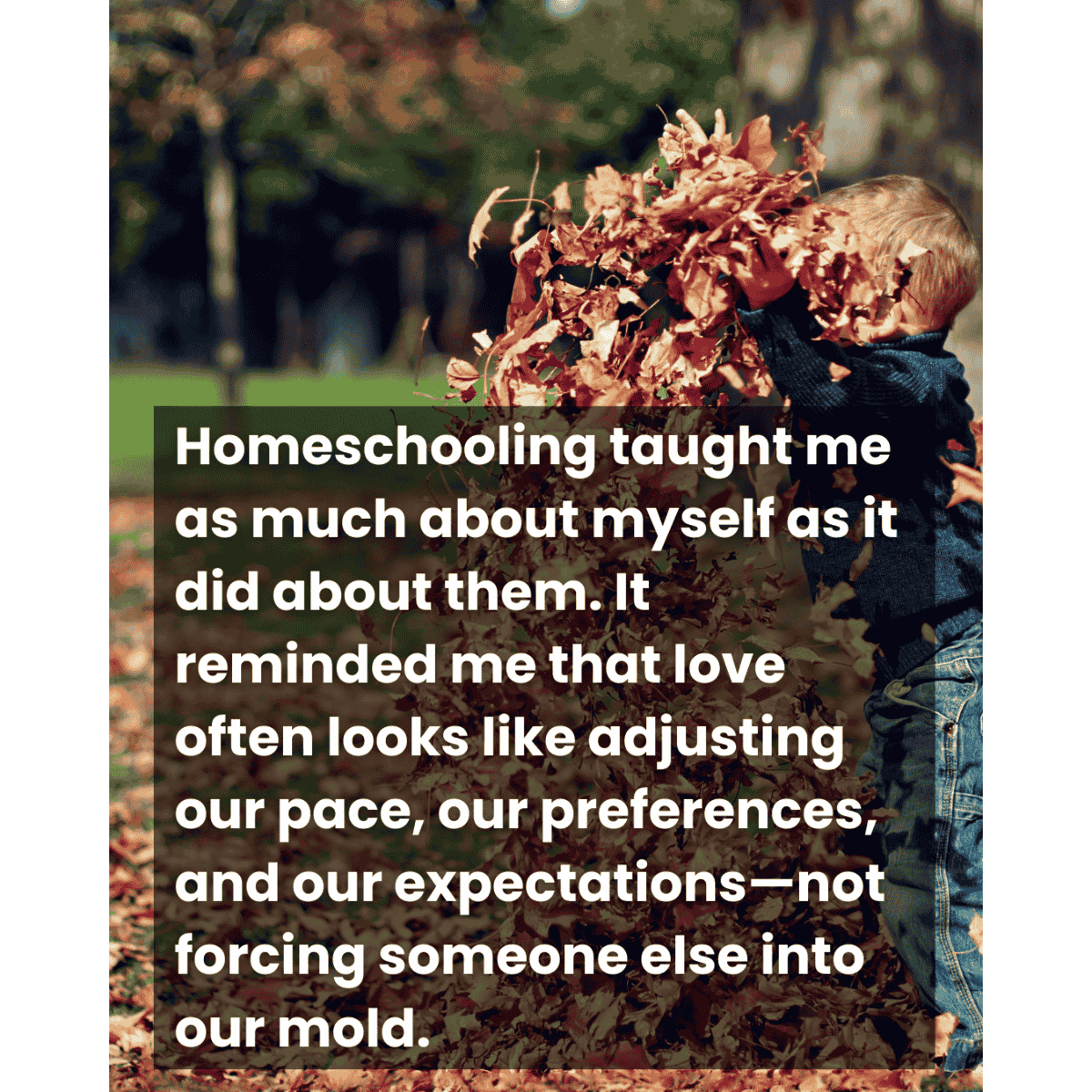
Homeschooling taught me as much about myself as it did about them. It reminded me that love often looks like adjusting our pace, our preferences, and our expectations—not forcing someone else into our mold.

And it gave me this truth:

We don’t have to learn the same way to learn together.

When Our Homeschool Turned to S**t

When Our Homeschool Turned to S**t


This has been on my mind today…

One winter morning, we set out on a nature walk. Nothing fancy, just some fresh air and a chance to stretch our legs. That’s when it happened. The kids stopped, pointed, and announced with total fascination:

“POOP!”

There it was on the path. Just sitting there, waiting to be discovered. And instead of me steering them back to the “lesson plan,” they had one question that became our curriculum for the whole week:

“What animal did this come from?”

We started guessing. Deer? Rabbit? Maybe raccoon? The curiosity snowballed. Back at home, we started researching. We found pictures of animal scat (yes, that’s the proper word) and compared them. We talked about the diets of different animals and how that shows up in their droppings. The kids wanted to make their own scavenger hunt checklist of “poops to find,” so we did. Suddenly every walk was a full-on investigation, magnifying glasses in hand, kids crouched down like little detectives.

And then nature gave us another gift — snow. Once they had learned about scat, the curiosity expanded:

“If we can tell an animal by its poop, can we tell it by its footprints too?”

That week turned into tracking lessons. We studied paw shapes, stride lengths, and patterns. We matched tracks to the animals in our region. Every walk became a treasure hunt. They weren’t just “getting exercise.” They were observing, comparing, classifying, and recording. In other words, science.

And here’s the thing: none of it was on my lesson plan. There was no worksheet waiting on the table that morning titled “Animal Scat and Tracks.” But it was real learning. Engaged, memorable, full of wonder.

The kids didn’t just learn about animals. They learned how to follow a question, how to investigate, how to let curiosity guide them. That’s the kind of learning you don’t forget — even if it started with poop.

So yes, sometimes school looks like math books at the table. Other times, it looks like poop on a trail. Both count. Both matter. And both are homeschooling.

? Lindsey

certified special-ed educator & co-founder, Schoolio

How I Learned to Stop Comparing My Homeschool to Public School

How I Learned to Stop Comparing My Homeschool to Public School

By Lindsey, certified special-ed educator & co-founder, Schoolio

When I think back on our homeschool journey, there’s one chapter I almost didn’t want to admit. It was the year Grace still couldn’t read.

She was nine. Nine years old, and reading hadn’t clicked. Every night, after she went to bed, I would lie awake spiraling. I thought I had ruined her or that I was the problem. Reading the benchmarks only made it worse. Public school laid out exactly what was expected by first grade. Yet there I was, years later, feeling like I had broken something in her by trying to do it all differently.

I tried everything. From phonics programs to full curriculum bundles, I spent money we didn’t really have on tools that promised results. Our printer groaned under the weight of all the worksheets. There were days I begged, bribed, and cried. And she hated all of it.

One day, after another tense battle over a workbook, Grace looked at me and said, “I hate reading. I hate books.”

It broke me.

I gave up. I stopped pushing. Honestly, I stopped trying. I said to myself, fine. She’ll be illiterate. We’ll figure it out later. But I couldn’t keep doing that to either of us.

A few months later, something unexpected happened. We downloaded a video game called Stardew Valley. It’s slow-paced, gentle, and deeply story-driven — but it has no spoken dialogue. Everything is written in captions. At first, she’d call me from the other room every few minutes to read something. I’d drop what I was doing and go help. Over and over.

Then, one day, the requests stopped. I realized she wasn’t calling anymore — she was reading it herself.

Within three weeks of playing that game daily, something had clicked. I watched my daughter — the one I thought I had failed — read fluently, joyfully, independently. And I cried again, but this time for a different reason.

It wasn’t that she couldn’t learn. It was that she didn’t learn the way I was taught to expect. She needed time, space, and motivation that was meaningful to her. She needed me to stop comparing her to arbitrary timelines built for someone else’s classroom.

Homeschooling gave her that chance.

Now, when I hear a parent panic because their kid isn’t “on grade level,” I get it. I really do. But I also want to gently offer: maybe the problem isn’t your child or your teaching. Maybe it’s the invisible comparison you’ve been carrying — the one that says there’s only one right way to learn, and it happens in a public school classroom, on someone else’s clock.

Grace taught me that’s not true. Learning is not linear. It’s not uniform. It’s not a race. Sometimes, letting go is the most loving, brave thing you can do — for both of you.

certified special-ed educator & co-founder, Schoolio

How to Start Homeschooling in Texas (2025 Guide)

How to Start Homeschooling in Texas (2025 Guide)

by Sathish

This has been on my mind today…

I’ve spoken with so many families lately who are thinking about making the jump to homeschooling—especially as we launched in Texas and met many of the local families who were ready to start but had never heard of Schoolio before. And while every story is different, the emotions are often the same. One parent told me, “I want to homeschool, but I’m scared I’ll mess it up.” Another said, “We feel like school isn’t working, but what if I can’t give them what they need at home?”

These aren’t small fears. They’re real. And deeply rooted in the way many of us were raised to believe that learning only happens inside a classroom, led by certified professionals with years of training. So to say, “I’m going to homeschool my child,” feels like breaking a rule we didn’t know we were allowed to question.

But here’s what’s been powerful to watch. I’ve seen those same parents a few months later—different posture, different voice, different mindset. One tells me her son is finally reading because he wasn’t forced into a pace that didn’t work for him. Another shares how her daughter stopped having stomachaches every morning now that learning happens at home. They’re not perfect. They’re not experts. But they’re doing it.

That’s the magic. Homeschooling isn’t about doing school at home. It’s about doing what works—for your child, your values, your rhythm as a family. And in Texas, the path to begin is surprisingly simple. The biggest step isn’t paperwork. It’s choosing to believe that you can guide your child’s education in a way that works for both of you.

So here’s what you need to know.

Texas is one of the most homeschool-friendly states in the country. There’s no registration process. No district approval. No testing requirements. You don’t need to submit plans or portfolios. You simply need to teach a few required subjects using a written curriculum. That’s it.

Here are the basics:

  • Homeschooling in Texas is legally recognized as “private education.”
  • You’re required to teach reading, spelling, grammar, math, and good citizenship.
  • There’s no formal notice of intent needed, unless your child is already enrolled in public school. In that case, you’ll just need to withdraw them by notifying the school.

That’s all.

Of course, just because it’s simple on paper doesn’t mean it feels simple emotionally. Starting is the hardest part—not because the laws are complicated, but because the fear is real. What curriculum do I choose? How do I make a schedule? What if I don’t cover everything?

That’s why we built Schoolio—to make it easier for families to get started and stay supported. Whether you want a complete curriculum bundle, an online homeschool program, or just a flexible homeschool planner to design your own flow, you’ll find tools that don’t add pressure, but help you feel capable.

Because that’s the real shift. Homeschooling works best not when you try to recreate the system at home, but when you create something new—something human, flexible, and designed around how your child learns best.

So if you’re in Texas and wondering how to start homeschooling, here’s the truth: you already have. That moment you paused and asked, “What’s best for my child?”—that’s where it begins.

Sathish

still learning, still unlearning

From Homeschooling to Public School: A Success Story

This is my daughter, Grace. This kid… let me tell you about how she CRUSHED it in her first year in public school…

Grace has been homeschooled since Kindergarten, using Schoolio for her academics of course! 

This year, she transitioned into public school for 7th grade. 

Homeschooling to Public School- Public school wasn’t our initial intention for this year, so she ended up starting mid-year, which is hard. It’s not easy to be the new kid arriving part way through the year. In addition, within two weeks of starting, her teacher went out on medical leave and her class had a series of subs. 

It was a busy classroom. 32 kids, only 8 girls, and several unique needs. 

New people. New routines. New world.

How Did She Do?

She finished yesterday, and here’s a recap:

? Won 1st place in a school-wide art contest (peer voting).

? Won 2nd place in the grade 7/8 stock market simulation contest for the year (thank you Schoolio Financial Literacy!).

? Won 1st place in the intermediate music competition.

? Straight A’s (except for French, which was a B+ despite having never taken it before when her peers started in 1st grade).

But there’s so much more to success than academics and accolades…

? She self-advocated in a busy classroom for her needs, even when it was hard.

? She worked her butt off and independently studied for tests, worked on projects, and brought things home when needed.

? She communicated and set boundaries despite being naturally shy.

? She sought help when she needed it from both school staff and her parents.

? She maintained her integrity and did not waver in the face of peer pressure or the treatment she is deserving of. She even said to me that she wished I could come to her school and teach her classmates all the Schoolio Social-Emotional Learning I’ve taught her! 

? She ran TWO petitions in an effort to improve the school environment. Despite being new, she immediately got involved and activated in the community. 

Y’all, she is a FORCE. I met with her teachers and the principal this week and they said not only is she one of the strongest academically, she’s also the most mature in the class.?

Homeschooling to Public School- THIS is homeschooling my friends. This is the result. Are they academically on-par with other kids their age? For sure. Is that even the most important thing? No! She’s well-adjusted, she knows who she is and what she stands for. She’s independent and hardworking. And she has a strong family foundation to help her when things are tough. 

The transition wasn’t always smooth. She had struggles. But she persevered and handled everything so well. 

If this is what a “weird“, “unsocialized“, and “uneducated” homeschooler looks like, then I’m #TeamWeird all day long.

I couldn’t be prouder of my girl. ❤️ I hope that you are all experiencing success, and I want you to know that even though you worry all the time about whether or not you’re doing “enough” (I worried too!), I promise you that you are. 

Congratulations to every homeschooling parent out there. The gift of the homeschooling experience is worth so much more than just the academics you cover every day. You’re doing amazing.

Assessing Homeschool Success: How to Determine if Your Homeschool Year Went Well

Assessing Homeschool Success: How to Determine if Your Homeschool Year Went Well

How to determine if your homeschool year went well

Homeschooling offers unique opportunities for personalized education, allowing parents and students to tailor their learning experiences to individual needs and interests. As a homeschooling parent, it’s natural to wonder whether your academic year has been successful. Evaluating the effectiveness of your homeschooling journey can be valuable for identifying strengths, areas for improvement, and ensuring your child’s educational progress. In this blog, we will discuss assessing homeschool success: how to determine if your homeschool year went well.

Is assessing homeschool success important?

Many homeschoolers employ various methods to assess the academic year. Some parents keep detailed portfolios of their child’s work. This includes samples, assignments, and tests. Which they review to gauge academic progress. Others may use standardized tests or benchmark assessments to measure their child’s proficiency in core subjects.

Additionally, some homeschooling families engage in regular discussions and reflection sessions with their children to evaluate their learning experiences and set goals for the upcoming year. By examining these examples, we can gain insights into effective assessment strategies and adapt them to our own homeschooling journeys.

was my homeschool successful

What do the experts say about assessing homeschool success?

Lindsey Casselman, co-founder and Chief Curriculum Officer (CCO) of Schoolio Learning, shares her thoughts on how to determine if your homeschool year went well. “How do the kids feel? Forget marks. Or how many worksheets you completed or how many books you read. Forget how many experiments you did. Are they happy? Has your relationship grown closer? Have they grown as humans? Are they kind? Are they curious?”

She continued: “These are the benchmarks for successful education. Education isn’t about stuffing as much content as you can into their learning time. It’s about building a whole little human, that includes their emotions, their mental health, their eagerness to learn, they’re fulfillment and their understanding of their place in the world and who they might want to become in the future.”

What are some key indicators that your homeschool year went well?

1. Academic Progress:

One of the primary goals of homeschooling is to facilitate academic growth. Assess your child’s progress by reviewing their work samples, assignments, and tests throughout the year. Have they made noticeable improvements in subjects like math, science, language arts, or social studies? Are they achieving the learning objectives you set at the beginning of the year? Assessing academic progress will help you gauge the effectiveness of your teaching methods and curriculum choices.

2. Learning Engagement:

Successful homeschooling fosters a love for learning. Consider your child’s level of engagement throughout the year. Do they actively participate in discussions and activities? Are they curious and enthusiastic about exploring new topics? Genuine interest and enthusiasm are indicators of a successful homeschool year. If your child is actively involved in their education, it suggests that you have created a nurturing and stimulating learning environment.

Learning engagement

3. Personal Development:

Education encompasses more than just academics. Homeschooling provides an ideal environment to nurture personal growth and character development. Reflect on your child’s personal development over the course of the year. Have they demonstrated improvements in self-discipline, time management, and organizational skills? Do they show greater resilience, independence, or a positive attitude towards challenges? Evaluating these aspects helps determine the overall success of your homeschooling efforts.

4. Individualized Learning:

One of the significant advantages of homeschooling is the ability to tailor education to your child’s unique needs and learning style. Assess if your homeschool year was successful by considering how well you have personalized the learning experience. Have you provided resources and activities that cater to their individual strengths and weaknesses? Are you adapting teaching methods to suit their preferred learning style? Individualized learning contributes to academic success and ensures your child feels supported and valued.

Individualized learning

5. Social and Emotional Well-being:

Socialization is often a concern for homeschooling families. While it’s essential to provide opportunities for social interaction, consider your child’s overall social and emotional well-being. Do they have healthy relationships with peers, siblings, or other community members? Are they able to communicate effectively and express their emotions? A successful homeschool year should focus on fostering emotional intelligence, empathy, and the development of social skills.
Pick up Schoolio’s Social Emotional Learning materials to help your child with these important skills.

6. Life Skills and Practical Application:

Education extends beyond textbooks and assignments. Reflect on whether your homeschool year has successfully incorporated practical life skills into the curriculum. Have you provided opportunities for your child to develop skills such as critical thinking, problem-solving, communication, and financial literacy? The ability to apply knowledge in real-life situations is a valuable indicator of homeschooling success.

Life skills and homeschooling

The ultimate success.

Evaluating the success of your homeschool year involves assessing multiple factors. These include academic progress, learning engagement, personal development, individualized learning, social and emotional well-being, and life skills acquisition. Remember that homeschooling is a dynamic and evolving process. If you identify areas that need improvement, view them as opportunities for growth and adaptation. Ultimately, the success of your homeschool year lies in creating an environment that supports your child’s holistic development and instills a lifelong love for learning.

Emotional Health Management

How comfortable are you with talking about emotional health?

Every person big or small can become overwhelmed, frustrated, tired, anxious, and feel angry sometimes. Those are natural, human emotions that we all deal with. When our children become overwhelmed and begin expressing that overwhelm with bouts of anger, crying, and frustration it can become incredibly frustrating for parents.

From the time your child was born, your goal was to calm them. When they were crying from hunger, you quickly fed them. When they needed their diaper changed, you’d do that quick to avoid their discomfort. It’s human nature to want to stifle the cries and discomfort of our children. But as they get older, we need to do better than just hand them a tablet, or chips, when they’re frustrated. This isn’t a judgement, because we get it! Parenting is so hard; you just want your kids to be happy. You’d give them literally anything in the world if you could. Because seeing the smile on their adorable face is just so worth it.

When those angry feelings rise up in them, or the tears start welling up in their sweet eyes. It’s natural to want to find a quick, easy remedy that will solve this burst of emotion. Unfortunately, though, this doesn’t actually help them at all. I mean, yes, comforting your children is beneficial! But, is it good to tell them to “Stop!” when they’re whining about something they’re worried about? Or quickly hand them something to calm those feelings? If feels right in the moment, but it truly does nothing to solve the greater issue at hand. And, that greater issue is related to their emotional health.

Where do we start with our children’s emotional health?

When your child is overwhelmed, what could you do instead of offering quick fixes? Well, we can start by taking small steps to help our children recognize their big feelings and frustrations. We can teach our sweet kids how to take good care of their minds! We can help our kids learn important steps and tools that matter! Tools to help them navigate those thoughts and feelings that they will inevitably be faced with throughout their entire lives.

Can you imagine a world in which they put just as much importance on learning about how to take care of your mind, as they do math problems? Imagine a future for our kids where they feel safe to present their feelings. Imagine if they could learn the tools and strategies to recognize when their feelings are taking control? And then utilize peaceful coping tools!

Let’s work on emotional health together!

Teaching our kids to journal their thoughts and recognize those big, scary feelings can help them have a beautiful, bountiful, future! And wouldn’t we all agree, that’s what we want for our kids? For them to feel joy, and not be afraid of those scary thoughts that pop into their minds? It’s really recent that people have started talking about mental health, because as you are well aware, there has been a painful stigma attached to anyone that doesn’t appear to be the normal. So, people have buried those feelings deep in their minds and used other means to soothe the struggle that they just can’t seem to overcome, suppressing their emotional health has been the normal for too long.

Because unfortunately, the stigma has kept us from sharing how we feel. And in turn kept us from learning how to cope through those painful days. And, while mental health has become much less taboo in today’s fast paced society, whether we want to admit it or not, there is still stigma attached to mental health and well-being.

So, let’s change that!

Let’s change the world one child at a time. Let’s learn about emotional health together with our kids.  Let’s teach our kids that it’s ok to have bad moments and even bad days. It’s ok to have those big feelings, it’s ok to learn how to take care of your mental health. Have you ever been afraid to tell someone how you’re feeling? You don’t want that for your kids, you want them to feel peace when it comes to their mental health, and calm when it comes to their emotional health. So, let’s heal ourselves by helping the younger generations learn to take care of their minds, to recognize those unhelpful, unrealistic thoughts. Let’s help our kids learn positive, calming strategies to have a beautiful life.

Here at Schoolio we make it our mission to provide a holistic education for your children. And, that doesn’t stop with Math and Science. So, how could we possibly say education is holistic if we left out the importance of learning about our own minds. We want to help your children excel in every aspect of their lives, their whole self, which obviously includes their mental health.

Check out this Special Interest Unit about Managing Emotions by Schoolio. Let’s learn about emotional health and pick up some valuable skills together with our children to bring about a better future for us all. Let’s dive into this extremely important topic, let’s be the change, let’s start today!

Learn more about the new ‘Emotional Intelligence: Managing My Emotions’ mini unit now!

Find it here:

https://schoolio.io/product/managingemotions/

managing my emotions 1

5 Tips To Avoiding Homeschool Burnout | How To Avoid Homeschooling Burnout

How To Avoid Homeschooling Burnout

You probably already know that parenting is not easy! It was tough, long before the year 2020. However, this year has taught many parents how to be more adaptable, homeschool, and how to keep your kid calm when you feel like you’re going to freak out at any given second. This year has been a bust on many different levels. If you are having a difficult time with COVID and feel like you are struggling to maintain sanity at home, we have a few tips to share from our experience. 

Since we won’t be entering the new year with a solution to all our problems, let’s start it off with some excellent tips for giving ourselves an adequate dose of self-care. What does self-care look like anyway? When I hear those words, I think of a person with a mint face mask, cucumbers on their eyes, hair in a towel, wearing a white house robe and being too pampered. I’ve never actually had this happen to me, but it’s where my mind goes when I think of ‘self-care’. What does self-care look like for a homeschooling parent? You may try to lock your door and hide from your kids for a few minutes. But does that help?  

For some people, self-care and self-love look like: Laying on the couch, watching a movie while your kids mess up the basement. Or cleaning and organizing all the cupboards in your kitchen. For some, it’s painting the dining room so that when you walk in the room, the burst of fresh colour helps lift your spirits. For some, it’s a bath with Epsom salt and lavender. Maybe for you, it’s taking a walk or a long run. Or locking yourself in the bathroom with a box of chocolate to soothe the anxiety you’re feeling. There’re many different ways that people medicate with Self-care and love. How do you? 

Top Tips

Let’s start with the symptoms. These indicators are warning signs; please pay attention to them.

· Crying randomly
· Lack of patience with daily tasks
· Overeating or no appetite
· Overreacting
· Irrational decisions

· Crying randomly
· Lack of patience with daily tasks
· Overeating or no appetite
· Overreacting
· Irrational decisions

A few tips,
· Lower your expectation. You cannot be the parent, the teacher, the wife/husband and the other ten roles you need to play. It is ok to lower your expectations and underperform.
· Build a community. Create a small circle of strangers with whom you can share and be transparent outside of your family. Sometimes, it is hard to communicate with the ones you love and having this outlet will help you share the burden.
· Create a schedule and get the family to involve in all aspects of running the house. Please don’t do it all yourself.
· Get out of the house. Take a walk, go for a drive – something.
· Do ‘your’ thing. What is the one activity that you can do by yourself that makes you happy? Reading? Painting? – find something that gives you alone time and some mental break

On the newest episode of The Schoolio Podcast, we discuss how different self-care and love can look for many of us. Laughter being a huge one, have you ever thought of laughter as a way to remedy the blues? Have you ever heard of writing letters to yourself? Today we talk about both these interesting self-care ideas and so much more. 

The laughter in this episode is contagious, so beware! And please, share with us your go-to self-care tips! We would love to hear them.

Listen to episode 11 of The Schoolio Podcast now on your favourite podcast streaming app, or listen on Spotify.

Let us offer you a slice of peace of mind. We know that right now, many kids are bored from the lack of routine that they’re experiencing. So, we have a brand new FREE mini unit about New Year’s for your sweet kids to do when they’re ‘bored’. 

You can pick up your FREE Mini Unit here: https://schoolio.io/newyear/

P.S are you on the fence about homeschooling? Have the newest lockdowns made you frustrated that your child’s education has been interrupted yet again? Maybe you really aren’t a fan of virtual learning but you aren’t sure where to start, or how? 

We have all the tools you need to start your homeschooling journey at: https://schoolio.io  

Finding Joy During the Holidays

What does Homeschooling during the holidays look like? Many new homeschooling parents are wondering the same thing. Do you take a two-week break like the school-boards do? Or you do take the full month of December? Should you homeschool right up until Christmas and then take a day or two off? What’s the best way to approach the holidays? 

This year is especially weird. Normal holidays during a global pandemic – that’s just not going to happen. How can you keep things fun and light for your kids despite the fact that there’s no Christmas plays, visits to grandma and grandpas house, and holiday parties with friends? 

Our best advice: Make little things fun. Put huge hype into things like ‘Pizza night’, driving around looking at Christmas lights, baking Christmas cookies together (unless baking with your kids stresses you out – no judgement here). Spend time reading Christmas books together, watching Christmas movies and talking about the plot of each story. On the latest podcast Lindsey and I talk about just that. Because, just like you, we are homeschooling moms living through a global pandemic and trying to find some semblance of balance through all the chaos around us. 

Whether you celebrate Diwali, Hannukah, Lunar New year, Kwanzaa, Winter Solstice or Christmas, I’m sure you want it to be a special time for your children and you. So, let me remind you, that just because life is vastly different now, and things are unreservedly different than they were before, it doesn’t mean that you can’t still enjoy the holidays and cater to your children’s sense of magical peace. 

Light a few candles, make some hot chocolate, snuggle up close and enjoy this special time with your children. Yes, things are not the same. But in everything and every situation, there is something positive. Like the fact that this holiday season, the lack of business translates into more time spent in a peaceful state with your family. The hustle and the bustle are on the back burner, and peace and quality time are front and centre. 

So, enjoy it. Enjoy these little moments, enjoy the sound of your child reading. Enjoy the glow of the candles or Christmas lights. Enjoy the stories, enjoy the time. Because time is something that is taken from us all too quickly. My hope is that despite the difficulties of 2020, and the changes that have been brought as a result of it. You and your children will look back at this year with fond memories of all the time that you got to spend together. Lindsey and I truly believe that this holiday season is one that you both will always remember. 

Listen to this week’s podcast to hear Lindsey and my best advice when it comes to homeschooling and the holiday season. We talk about things like when you should take a break, what you can do to keep your kids up to date with their learning skills, fun things you can do together and more. 

We genuinely hope that you will enjoy this week’s podcast and find a sense of wonder in the mundane. And happiness in the crazy.


Find The Schoolio Podcast Episode 9 ‘Homeschooling and the Holidays’ on your favourite podcast streaming app.

Or click the link below to listen directly on Spotify.

https://open.spotify.com/episode/2vTUFzvaejHB9bYc0uCA1n


The Canadian Homeschooler

You aren’t the only one who feels like they just aren’t mastering this homeschooling gig. In fact, there’s hundreds of parents who are second guessing themselves and feeling super low. It’s really hard to manage life, work and homeschool on top of all of that. Thankfully for you, there are amazing people who know that you might be struggling and want to help you through it. One such person is Lisa Marie Fletcher, founder of The Canadian Homeschooler. Lisa Marie Fletcher is a homeschooling mom of 5 kids ranging from preschool to high school. When her homeschooling journey began, she searched for Canadian homeschooling resources and started to share them online. That was the beginning of The Canadian Homeschooler – whose mission today is to connect Canadian homeschoolers with each other and with resources to help them on their journey. She knows how you feel, and she doesn’t want you to get stuck in those feelings of inadequacy, overwhelm and frustration. She instead wants you to feel all the good feelings that you truly should be feeling.

During our recent podcast interview, Lisa Marie talks about ‘Backwards planning’ which is a really cool concept! You write down what you did, after you did it. Rather than writing a list of things you need to accomplish for each day and then feeling guilty when you don’t get to all of them, you instead will just jump to your morning, accomplish the things that need to be done and write them down. Talk about a stress reliever. Lisa Marie also shares her 6 steps for starting homeschooling. Because she understands just how overwhelming it can be to start homeschooling. She aims to keep you from feeling overwhelmed and to instead have a direct plan to help you get through the first few months of homeschooling.

During the episode Sathish Bala (CEO of Schoolio) asks, how a partner can be more involved with homeschooling, or be more involved at home to help the parent that is taking the brunt of homeschooling on. Both Lisa Marie and Jaymee help him with this question. Giving advice to help him and others find ways to help their partner during this new homeschooling chapter. It’s our mission at Schoolio to bring you the best, content which is relevant to your Canadian Homeschooling journey which is why The Schoolio Podcast episode 7 is dedicated to helping you have the best homeschooling journey, here in Canada.

To listen to The Schoolio Podcast Episode 7 click on the link: https://open.spotify.com/episode/7I41lZAzh0Ik6Bf5xYaoI0

Or find it on your favourite podcast streaming app.

To learn more about Lisa Marie Fletcher and The Canadian Homeschooler, check out her website: https://thecanadianhomeschooler.com you’ll find an amazing blog, tons of resources and more about The Canadian Homeschooling Conference.