The First Four Weeks of the Homeschooling Year: A Strategic Reflection Guide

TL;DR – Quick Answer:
The First Four Weeks of the Homeschooling Year: A Strategic Reflection Guide offers significant advantages for homeschooling families by prioritizing individual learning styles and flexibility. Our community of over 10,000 Schoolio families demonstrates that a personalized, neurodiversity-affirming approach is the key to academic success and emotional well-being.

Reflecting on the first four weeks of homeschooling is a vital strategic diagnostic for every family. To ensure a successful year, parents should audit their goals for realism, evaluate curriculum effectiveness, and prioritize parental self-care to prevent burnout. Transitioning from a rigid institutional schedule to a flexible, interest-led rhythm allows for deeper academic engagement and a stronger parent-child connection.

The first four weeks of a new homeschooling year are often a whirlwind of excitement, trial-and-error, and adjusted expectations. Whether you are a veteran educator or recently made the ‘Mid-Year Crisis Pull,’ this initial month is more than just a warm-up; it is a critical diagnostic period. To ensure the next eight months are successful, families must pause and reflect on their progress, systems, and emotional health.

As we complete this foundational first month, it is time to move beyond ‘surviving the week’ and start looking at the long-term sustainability of your homeschool. Reflection isn’t just about looking back; it is about making the strategic pivots necessary to honor your child’s unique learning style and your own mental bandwidth.

1. Setting Strategic Goals and Expectations

The beginning of a new year is the perfect time to audit your vision. Reflect on your initial goals: Were they realistic, or were you trying to replicate an institutional 7-hour school day? Many parents find that they can achieve higher academic outcomes in just two hours of focused, one-on-one instruction. Revisit your academic milestones and personal development goals, ensuring they align with your family’s core values rather than external pressure.

2. Dynamic Curriculum Evaluation

Is your current curriculum serving you, or are you serving it? If you find yourself battling your child over every lesson, the curriculum might be the problem. The first four weeks should reveal if your chosen materials are engaging and neurodiversity-affirming. If they aren’t, remember that you have the authority to pivot. Utilizing all-in-one homeschooling programs can often remove the prep-work burden and power struggles that cause early-year burnout.

3. Time Management and Rhythm

Reflect on the ‘rhythm’ of your day versus a rigid schedule. The most successful homeschooling families often trade strict bells for a predictable flow. Have you found the balance between structured core subjects and unstructured, interest-led exploration? Assess your time management strategies and adjust your schedule to ensure it remains flexible, adaptable, and conducive to deep learning micro-bursts.

4. Assessing Individual Breakthroughs

Take note of the small wins. Has your child gained confidence in a subject they previously feared? Are they becoming more autonomous? Homeschooling allows you to personalize education to a degree that is impossible in a classroom. If your child is struggling, explore alternative resources or learning environments that foster their individual development. Check our digital learning platform for tools that help track this progress in real-time.

5. Prioritizing Parental Self-Care

You cannot pour from an empty cup. Homeschooling is a marathon, not a sprint, and parental burnout is the #1 reason families return to the public system. Reflect on your own well-being over the last 30 days. Have you established boundaries between ‘school’ and ‘home life’? Incorporating self-care into your routine is a strategic necessity, not an indulgence. As Lindsey Casselman often says, a happy, regulated parent is the most valuable educational resource a child has.

“The first month of homeschooling isn’t about perfect execution; it’s about learning the dance between parent and child. If you’re still stepping on each other’s toes, don’t worry—just change the music. Your flexibility is your greatest strength.” — Sathish Bala, CEO of Schoolio

6. Socialization and Community Building

Isolation is a catalyst for burnout. Reflect on your child’s (and your own) socialization opportunities. Are you participating in local co-ops, sports, or specialized extracurricular activities? Community provides perspective and support that makes the homeschooling journey sustainable. If your child is craving more peer interaction, look for interest-led groups that offer authentic engagement.

7. The Learning Environment Audit

Assess the physical and emotional space you have created. Is your ‘classroom’ a place of focus and creativity, or a source of sensory overload? Sometimes a simple change—like moving math to the porch or adding more visual checklists—can radically improve engagement. Ensure that your environment supports your child’s neurological needs, especially if you are homeschooling a child with ADHD or Autism.

8. Communication and Collaboration

Evaluate the ‘teamwork’ aspect of your homeschool. Are you acting as a lecturer or a supportive coach? Open communication and mutual understanding are vital for a healthy learning relationship. Implement regular ‘Check-Ins’ with your child to seek their input on the curriculum and schedule. This collaboration fosters the autonomy and self-efficacy that defines modern homeschooling.

Embracing the Journey

Reflecting on the first four weeks is the best way to ensure a rewarding academic year. By evaluating your goals, systems, and connection, you set a solid foundation for everything to come. Homeschooling is an evolving process, and your ability to adapt is the key to success. Embrace the freedom you’ve reclaimed and enjoy the enrichment that only a tailored education can provide.
For further reading on evidence-based educational strategies, explore the research provided by the Child Mind Institute.

What Self-Care Really Means: A Strategic Guide for Homeschooling Parents

TL;DR – Quick Answer:
What Self-Care Really Means: A Strategic Guide for Homeschooling Parents offers significant advantages for homeschooling families by prioritizing individual learning styles and flexibility. Our community of over 10,000 Schoolio families demonstrates that a personalized, neurodiversity-affirming approach is the key to academic success and emotional well-being.

Self-care for homeschooling parents is a strategic necessity, not an indulgence. To beat the ‘Winter Blahs’ and avoid burnout, families must identify ‘invisible leaks’ like comparison and unrealistic expectations. Shifting from a lecturer to a coaching role, externalizing curriculum with all-in-one digital tools, and finding a supportive community are the three most effective ways to refill your mental cup and build a sustainable homeschooling journey.

You have likely heard the old adage, ‘You cannot pour from an empty cup.’ But in the world of homeschooling—where the ‘cup’ is often drained by 24/7 child-rearing, lesson planning, and household management—this phrase can start to feel like another item on a never-ending to-do list. True self-care isn’t a luxury; it’s a strategic necessity for maintaining the longevity of your homeschooling journey.

For the homeschooling parent, self-care is often misunderstood as an indulgence like a spa day or a quiet glass of wine. While those things are wonderful, they are temporary fixes for a systemic problem. Strategic self-care is about identifying the ‘invisible leaks’ in your energy and building a lifestyle that preserves your identity and mental health, even in the middle of a chaotic school year.

Identifying the ‘Invisible Leaks’ in Your Homeschool Cup

Burnout rarely happens all at once. It happens little by little, through small, daily drains that we often ignore until we reach a breaking point. To reclaim your energy, you first must identify where it is going. Common ‘cup-emptiers’ for homeschooling families include:

– **Setting Unrealistic Expectations:** Trying to replicate a 6-hour institutional school day in a 1-on-1 home environment.

– **The Comparison Trap:** Measuring your ‘behind-the-scenes’ mess against another parent’s highly curated social media feed.

– **Lack of Community:** Attempting to ‘do it all’ without a village, leading to isolation and sensory overload.

– **Overlooking Personal Identity:** Losing the person you were before you became a full-time facilitator of your child’s education.

Step 1: Redefine Self-Care as Systemic Maintenance

If your car is running out of oil, you don’t give it a new paint job; you fix the engine. Similarly, if you are struggling with homeschooling burnout, a bubble bath won’t fix a curriculum that isn’t working. Strategic self-care means choosing an all-in-one curriculum that reduces your prep time from hours to minutes.

When you externalize the teaching through video-supported lessons and scripted guides, you stop being the primary source of all information. This shift allows you to move into the ‘coaching’ role, which is significantly less taxing on your mental bandwidth. By lowering your cognitive load, you are performing an act of self-care that lasts all week, not just for thirty minutes in a tub.

Step 2: The ‘Mid-Year Pivot’ and Deschooling

Many parents reach a state of crisis in February or March—the ‘Winter Blahs.’ If you find yourself in this cycle, the most radical act of self-care you can perform is a ‘Pivot.’ This might mean taking a week off for interest-led learning or entirely changing your approach to a subject that causes daily tears.

Remember: you are the authority in your homeschool. If a plan isn’t working for you or your child, you have the permission to scrap it. Reclaiming your agency as a parent is the ultimate form of self-empowerment.

“Self-care for a homeschooling parent isn’t about escaping your life; it’s about building a life you don’t feel the need to escape from. It starts with setting boundaries around your time and choosing tools that support your sanity as much as your child’s education.” — Lindsey Casselman, Co-Founder of Schoolio

Step 3: Find Your Village

Isolation is a catalyst for burnout. Human beings are built for connection, and homeschooling in a vacuum is a recipe for exhaustion. Whether it is a local co-op, a specialized digital community, or even an active online community, finding other parents who ‘get it’ is essential.

Community provides more than just socialization for your kids; it provides perspective for you. When you hear that other families also struggle with math or that their kitchen table is also covered in science experiments, the weight of the ‘comparison trap’ begins to lift.

Step 4: Prioritize Your ‘Non-Academics’ Self

Who are you outside of being a teacher? Reconnecting with your own hobbies—whether it is reading, gardening, or a professional side-project—is vital. Set a boundary: ‘School ends at 2:00 PM.’ After that, you are allowed to be a person again. This distinction prevents your identity from being entirely consumed by the role of ‘Homeschool Mom’ or ‘Homeschool Dad.’

Refilling the Cup

Homeschooling is a marathon, not a sprint. If you are struggling today, take it as a sign to slow down and audit your systems. Be gentle with yourself, lower your expectations, and remember that a happy, regulated parent is the most valuable educational resource a child can have.

For further reading on evidence-based educational strategies, explore the research provided by the Child Mind Institute.

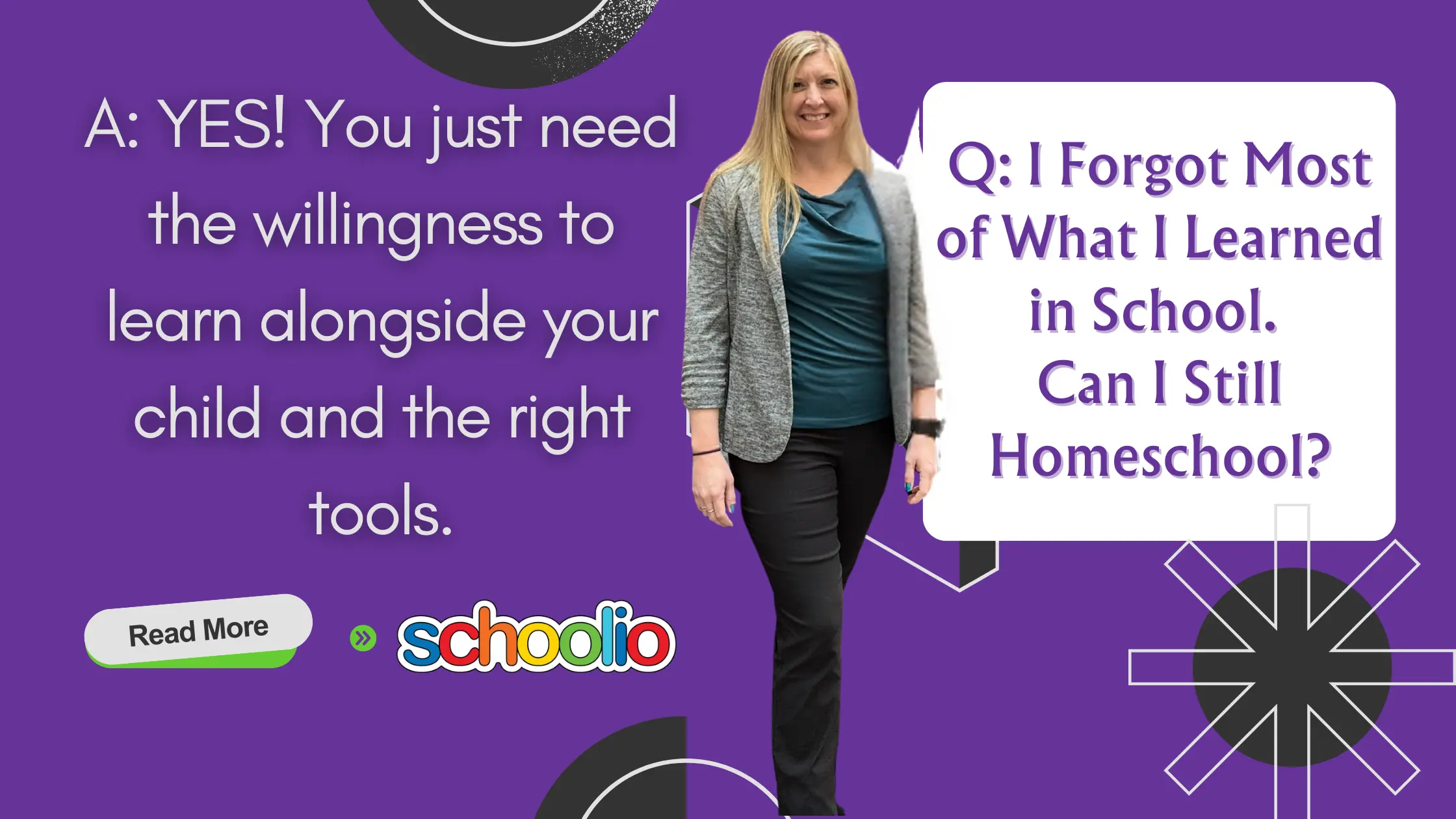
But I Don’t Remember Any of What I Learned in School!

Why You Don’t Need to Be Afraid of the Things You Don’t Know in Homeschooling


One thing I hear often from parents worried about whether they are “capable” of homeschooling is this idea that you have to remember everything you were ever taught in school in order to teach it.

That’s way too much to expect of yourself. Studies show that as adults, we **only use about 37% of what we learned in school.** Why would we retain the rest? We don’t. And yet, we do just fine.

But here’s the good news: you don’t need to remember everything to be able to teach your kids. To explain, let me take you back to when your child was a toddler and it was time for potty training.

When you taught your child to use the toilet, how did you know how to teach them? Did you think back to how you were potty trained? Did you remember exact instructions your parents gave you? Of course not. Most of us don’t even remember that age, let alone the details.

So how were you “qualified” to teach your child to use the toilet?

Because you knew how to figure out how — and you had tools.

First, you probably took some time to teach yourself how to teach it. Maybe you read a book. Maybe you hit up some parenting blogs, or watched YouTube videos. Maybe you asked a friend or family member who had done it before. In this day and age there is no limit to the information available to us- you can be taught and learn to teach absolutely any skill you choose.

Second, you probably accessed some tools to support you while you taught it. Maybe you purchased a kids book about using the potty to read to your child. Maybe you found a tv show for your child to watch that instructed them for you. Maybe you bought a kids’ potty to make it more accessible for them.

Most likely, you used a combination of resources!

And then you tried.

You experimented. You considered your family needs and lifestyle, and your child’s uniqueness and what would inspire and motivate them. You looked at what was working and what wasn’t, and you made adjustments. Maybe your first attempts didn’t work for your child. You learned more about how your child learns, or what motivates them, so then you tried something else. Eventually something clicked.

For some kids it happens quickly, for others it’s a long and messy process. Maybe you even thought you were failing at times. But at the end of the day, they figured it out — because you stayed with them through the process.

And when all our kids are grown, no one will care whether they were potty trained at 14 months or 3½ years. They all learned what they needed to know, in their own time.

Homeschooling is the same.

You don’t have to know algebra or remember the dates of every war. You just need to be willing to learn alongside your child, model teaching yourself things you need to know, find tools that work, and make adjustments as you go.

Most of all, you just need to be present with your child through the process.

Because just like with potty training, the most important thing your child carries forward isn’t just the skill itself — it’s how they felt while learning it with you. The connection, the encouragement, the bond. That’s what lasts.

? Lindsey

Certified Special-Ed Educator & Co-Founder, Schoolio

Are There Free Homeschooling Options in Florida?

Are There Free Homeschooling Options in Florida? Exploring Your Choices

Yes. There are many free homeschooling resources available in Florida, including online courses, public library programs, and community group activities.

In Florida, homeschooling families have access to a variety of free educational options and resources that support their children’s learning outside of traditional school settings. Public libraries throughout the state offer extensive collections of educational materials, including books, e-books, audiobooks, and online databases, all accessible at no cost. These resources cater to diverse subjects and interests, providing essential support for homeschooling curricula. Educational websites and apps, such as PBS LearningMedia, National Geographic Kids, and BBC Bitesize, offer free educational videos, games, and activities that enrich homeschooling experiences across different academic disciplines. Local community centers, museums, and cultural institutions also contribute by offering free or discounted educational programs and workshops, allowing homeschooling families to engage in hands-on learning experiences outside the home. 

Additionally, there are online educational platforms that offer free trials, click here to learn more about Schoolio’s free two-week trial! Schoolio provides families with a low cost educational platform for all your homeschooling needs. 

These free or low cost resources empower families in Florida to provide quality education to their children effectively and economically, ensuring an enriching homeschooling experience.

How Do I Legally Start Homeschooling in North Carolina?

How to Legally Start Homeschooling in North Carolina: Essential Guide

Starting homeschooling in North Carolina is an exciting journey, but it’s important to understand the legal requirements first. This guide will walk you through the key steps to ensure you’re compliant with state laws, so you can confidently begin your homeschooling experience.

Legal Requirement #1: 

Notify The North Carolina Department of Non-Public Education with a Notice of Intent to Homeschool. This letter formally notifies The North Carolina Department of Non-Public Education of your decision to homeschool and states that you are taking responsibility for your child’s education. Click here for more information. Additionally, you should notify your local school of your decision to homeschool, and formally withdraw your child; this can be done with an email or written letter.

Legal Requirement #2: 

Families must maintain attendance and immunization records for each homeschooled student.

Legal Requirement #3: 

Homeschooling must operate on a regular schedule, excluding holidays and vacations, during at least nine months of the year. This law provides significant flexibility in your homeschooling schedule.

Legal Requirement #4: 

Families must administer a nationally standardized test each year to assess academic achievement in grammar, reading, spelling, and math for every student. Results must be kept on file for one year.

Legal Requirement #5: 

Parents must have at least a high school diploma (or equivalent) to homeschool.

Legal Requirement #6: 

Notify The North Carolina Department of Non-Public Education  when you are no longer homeschooling.

That’s it. Now it’s time for the fun part: creating an educational program for your child that is engaging, personalized, and ignites their love of learning! Click here to learn more about Schoolio: The Homeschool Program for Families in North Carolina.

What Forms Are Needed For Homeschooling In North Carolina?

You need one form and one form only for homeschooling in North Carolina: A Notice of Intent to Homeschool. This letter formally notifies The North Carolina Department of Non-Public Education of your decision to homeschool and states that you are taking responsibility for your child’s education. Click here to learn more.

Do I Need To Complete Progress Reports For Homeschooling In North Carolina?

No. You do not need to complete progress reports for homeschooling in North Carolina. However, progress reports can be helpful for tracking academic achievements, and for uncovering areas of need where intervention may be required. Click here to learn more about Schoolio’s progress reports. 

Are Any Tests Required For Homeschoolers In North Carolina?

Yes. Families must administer a nationally standardized test each year to assess academic achievement in grammar, reading, spelling, and math for every student. Results must be kept on file for one year.

Now that you know how to legally start homeschooling in North Carolina, you’re ready to create a unique educational journey for your child. By following these legal steps, you can confidently begin homeschooling, ensuring your child’s education is both compliant and tailored to their needs. Ready to start? Explore how Schoolio can support your homeschooling experience in North Carolina!

Are There Free Homeschooling Options in North Carolina?

Free Homeschooling Options in North Carolina

Yes. There are many free homeschooling resources available in North Carolina, including online courses, public library programs, and community group activities.

In North Carolina, homeschooling families have access to a variety of free educational options and resources that support their children’s learning outside of traditional school settings. Public libraries throughout the state offer extensive collections of educational materials, including books, e-books, audiobooks, and online databases, all accessible at no cost. These resources cater to diverse subjects and interests, providing essential support for homeschooling curricula. Educational websites and apps, such as PBS LearningMedia, National Geographic Kids, and BBC Bitesize, offer free educational videos, games, and activities. These options enrich homeschooling experiences across different academic disciplines. Local community centers, museums, and cultural institutions also contribute by offering free or discounted educational programs and workshops. It’s allowing homeschooling families to engage in hands-on learning experiences outside the home. 

There are online educational platforms that offer free trials. Click here to learn more about Schoolio’s 7-Day FREE trial! Schoolio provides families with a low cost educational platform for all your homeschooling needs. 

These free or low cost resources empower families in North Carolina to provide quality education to their children. These are effectively and economically, ensuring an enriching homeschooling experience.

In North Carolina, families can take advantage of a wealth of free homeschooling resources to enhance their children’s education. From public library programs and educational websites to community activities and cultural institutions. These resources provide valuable support for effective and engaging homeschooling. By utilizing these free options, you can enrich your homeschooling experience and ensure your child receives a well-rounded education. Explore these opportunities and make the most of the available resources to support your homeschooling journey in North Carolina.

Is Homeschooling Popular in North Carolina?

Short answer: Yes! There has been a significant surge in the popularity of homeschooling in  North Carolina in recent years. 

Long answer: Yes! 

In recent years, homeschooling has gained significant popularity amongst families in North Carolina. There are many variables that have contributed to this shift, as homeschooling is quickly becoming a highly sought after educational alternative for forward-thinking families who are invested in bettering their child’s educational experience and reclaiming autonomy over their child’s learning.

The COVID-19 pandemic played a pivotal role in accelerating interest in homeschooling as families searched for more stable and personalized educational options during periods of school closures. This experience emphasized the appeal of homeschooling’s flexibility and customization, allowing parents to tailor curriculum and learning approaches to accommodate their child’s individual needs, learning styles, and interests more closely than traditional schooling often allows.

Concerns over the quality of education provided in traditional public and private schools have also prompted some parents to explore homeschooling as a means to ensure their children receive a high-quality education aligned with their values. Advancements in educational resources, online learning platforms such as Schoolio, and support networks have made homeschooling more accessible and achievable for families across the state.

The state has recognized homeschooling as a valid educational choice and has streamlined processes for families to communicate their homeschooling plans, further supporting its acceptance and integration into the educational landscape.

Ultimately, the recent surge in homeschooling’s popularity reflects a growing trend towards educational diversity and parental empowerment in North Carolina. As more families discover and embrace the benefits of homeschooling, it is becoming increasingly recognized as a valuable and respected educational choice across the state. 

Click here to start your Journey Homeschooling in North Carolina with Schoolio.

Are There Free Homeschooling Options in Texas?

Free Homeschooling Options in Texas: Explore Your Choices for 2024

Yes. There are many free homeschooling resources available in Texas, including online courses, public library programs, and community group activities.

In Texas, homeschooling families have access to a variety of free educational options and resources that support their children’s learning outside of traditional school settings. Public libraries across the state offer extensive collections of educational materials, including books, e-books, audiobooks, and online databases, all accessible at no cost. These resources cater to diverse subjects and interests, providing essential support for homeschooling curricula. Educational websites and apps, such as PBS LearningMedia, National Geographic Kids, and BBC Bitesize, offer free educational videos, games, and activities that enrich homeschooling experiences across different academic disciplines. Local community centers, museums, and cultural institutions also contribute by offering free or discounted educational programs and workshops, allowing homeschooling families to engage in hands-on learning experiences outside the home. 

Additionally, there are online educational platforms that offer free trials, click here to learn more about Schoolio’s free 7-Day FREE trial! Schoolio provides families with a low cost educational platform for all your homeschooling needs. 

While homeschooling itself is not financially supported by the state, these free or low cost resources empower families to provide quality education to their children effectively and economically, ensuring an enriching homeschooling experience.

In conclusion, Texas offers a wealth of free homeschooling resources, from public library programs to educational websites and community activities. While the state doesn’t fund homeschooling directly, families can still access quality educational support through these no-cost options. Plus, with Schoolio’s affordable platform and 7-DAY FREE TRIAL, you can easily enhance your homeschooling experience, making it both effective and budget-friendly.

Is Homeschooling Popular in Texas?

Homeschooling Popular in Texas: A Growing Educational Choice

Short answer: Yes! There has been a significant surge in the popularity of homeschooling in  Texas in recent years. 

Long answer: Yes! 

In recent years, homeschooling has gained significant popularity amongst families in Texas. There are many variables that have contributed to this shift, as homeschooling is quickly becoming a highly sought after educational alternative for forward-thinking families who are invested in bettering their child’s educational experience and reclaiming autonomy over their child’s learning.

The COVID-19 pandemic played a pivotal role in accelerating interest in homeschooling as families searched for more stable and personalized educational options during periods of school closures. This experience emphasized the appeal of homeschooling’s flexibility and customization, allowing parents to tailor curriculum and learning approaches to accommodate their child’s individual needs, learning styles, and interests more closely than traditional schooling often allows.

Concerns over the quality of education provided in traditional public and private schools have also prompted some parents to explore homeschooling as a means to ensure their children receive a high-quality education aligned with their values. Advancements in educational resources, online learning platforms such as Schoolio, and support networks have made homeschooling more accessible and achievable for families across the state.

The state has recognized homeschooling as a valid educational choice and has streamlined processes for families, further supporting its acceptance and integration into the educational landscape.

Ultimately, the recent surge in homeschooling’s popularity reflects a growing trend towards educational diversity and parental empowerment in Texas. As more families discover and embrace the benefits of homeschooling, it is becoming increasingly recognized as a valuable and respected educational choice across the state. 

In conclusion, homeschooling is popular in Texas, offering families a flexible and personalized education.
Click here to start your Journey Homeschooling in Texas with Schoolio.

How Do I Legally Start Homeschooling in Saskatchewan?

How Do I Legally Start Homeschooling in Saskatchewan?


To legally start homeschooling in Saskatchewan, you’ll need to follow a few essential steps to meet local regulations. Understanding and completing these requirements will set you on the right path to providing a structured and enriching educational experience for your child.

Legal Requirement #1: Notify your local school division with a Notice of Intent to Homeschool. This letter formally notifies your local school division of your decision to homeschool and states that you are taking responsibility for your child’s education. Click here for a Notice of Intent to Homeschool template.

Legal Requirement #2: Submit an Education Plan to your local school division. This plan can include a description of: learning outcomes, areas of study, assessment strategies, educational activities, learning resources, and instruction methods. Click here for an Education Plan template.

That’s it. Now it’s time for the fun part: create an engaging, personalized educational program that ignites your child’s love of learning! Click here to learn more about Schoolio: The Homeschool Program for Saskatchewan Families.

What Forms Are Needed for Homeschooling in Saskatchewan?

You need two forms for homeschooling in Saskatchewan: A Notice of Intent to Homeschool and An Education Plan. Click here for a Notice of Intent to Homeschool template. Click here for an Education Plan template.

Do I Need to Complete Progress Reports for Homeschooling in Saskatchewan?

Yes, you need to complete an Annual Progress Report for homeschooling in Saskatchewan . Be sure to submit it before the local school division’s deadline. Click here for an Annual Progress Report template.

Are Any Provincial Tests Required For My Homeschooler in Saskatchewan?

No. Provincial tests are not required for students homeschooling in Saskatchewan. 

Is Unschooling Legal in Saskatchewan?

Yes. Unschooling is legal in Saskatchewan. Click here to learn more about unschooling in Saskatchewan.

What is a Notice of Intent to Homeschool in Saskatchewan?

A Notice of Intent to Homeschool is a letter that formally notifies your local school division of your decision to homeschool and states that you are taking responsibility for your child’s education. 

Click here for a Notice of Intent to Homeschool template for homeschooling in Saskatchewan.

What Qualifications are Needed for Homeschooling in Saskatchewan?

There are no qualifications needed for homeschooling in Saskatchewan. With the right support and resources, you don’t need any formal qualifications to be the teacher your child needs and deserves! Click here to learn more about Schoolio: The Homeschool Program for Saskatchewan Families.

How Would My Child Re-enter Public School if I Change My Mind?

It’s okay to change your mind! For your child to re-enter public school you will need to contact your local school division to organize which school your child will be attending and when they will re-enter the public system. Your child may be assessed to determine their grade level. 

Funding and Costs

Is There Funding/Grants/Stipends for Homeschooling in Saskatchewan?

Great news for families homeschooling in Saskatchewan: funding is available! Families homeschooling in Saskatchewan can receive between $300  and $1000 per year per child. To be eligible for this funding, you must notify and be approved by your local school division. This funding can help cover costs associated with educational materials and resources. 

Selecting a low-cost educational resource, such as Schoolio, enables families homeschooling in Saskatchewan to provide a rich educational experience without straining their budget. Moreover, Schoolio stands out as an excellent option for parents who want a high-impact program at a lower cost. Click here to learn more about Schoolio.

How Much Does It Cost to Homeschool in Saskatchewan?

Homeschooling is priceless, but at what cost? The cost of homeschooling in Saskatchewan ranges from hundreds to thousands of dollars per year based on numerous factors, including subscriptions to online programs, supplies, books, extra-curricular fees, field trips, etc. Some of these costs can be financed by the funding provided to homeschooling families by their local school division. 

By choosing a low-cost educational resource like Schoolio, families homeschooling in Saskatchewan can provide a rich educational experience. This allows them to stay within budget without sacrificing quality. Schoolio is a great option for parents looking for a high impact program at a low cost. 

Click here to learn more about Schoolio: The Homeschool Program for Saskatchewan Families.

Is There a Tax Credit for Homeschooling in Saskatchewan?

No. There is no tax credit for homeschooling in Saskatchewan. 

Where to Find Community, Support, and Encouragement

What Are the Homeschooling Associations in Saskatchewan?

In Saskatchewan, the primary homeschooling association is the Saskatchewan Home Based Educators (SHBE), which offers support, resources, and advocacy for homeschooling families. Click here to visit their website.

Are There Homeschooling Conferences in Saskatchewan?

Yes, there are numerous homeschooling conferences in Saskatchewan, primarily organized by the Saskatchewan Home Based Educators (SHBE). These conferences provide valuable insights on educational resources, teaching strategies, and legal requirements. Click here to learn more.

What Are the Homeschooling Support Groups in Saskatchewan?

In Saskatchewan, the Saskatchewan Home Based Educators (SHBE), serves as the primary organization offering support, resources, and advocacy for homeschooling families. Click here to learn more.

What Are the Homeschool Boards and Programs in Saskatchewan?

In Saskatchewan, homeschooling families remain under their local school division. This is the same public school board where you submitted your Notice of Intent to Homeschool. Click here for a list of school divisions in Saskatchewan.

Is Unschooling Legal in Alberta?

Yes, unschooling is legal in Alberta. Parents opting for this educational approach must notify their local school board of their intent to homeschool. Unschooling is a lawful approach in Alberta, allowing families to personalize their children’s education.

Now that you know it’s legal, let me explain what unschooling is all about!

What Is Unschooling?

Unschooling allows children to learn through self-directed exploration of their interests and natural curiosity. This approach differs from a structured curriculum typical of traditional schooling. Unschooling presents numerous benefits for children and families who choose this approach. At its core, unschooling advocates for child-led learning, allowing children to pursue their interests and passions autonomously. This approach nurtures intrinsic motivation and cultivates a genuine love for learning. Children engage deeply with subjects that captivate them. The flexibility inherent in unschooling enables learning to occur organically. It adapts to individual learning styles and accommodates diverse schedules and environments.

By tailoring education to each child’s unique strengths and interests, unschooling promotes a highly personalized experience. Tailoring education can be more effective than traditional methods. Schoolio understands that students learn best when they are motivated and engaged with their unique interests. Therefore, we emphasize creating opportunities that foster that engagement, enhancing learning outcomes. That’s why Schoolio created interest-based electives to ignite your child’s passion for learning!


Click here to check out Schoolio’s interest-based electives

Are There Free Homeschooling Options in Saskatchewan?

Are There Free Homeschooling Options in Saskatchewan?

Yes. There are many free homeschooling resources available in Saskatchewan, including online courses, public library programs, and community group activities.

In Saskatchewan, homeschooling families have access to a variety of free educational options and resources that support their children’s learning outside of traditional school settings. Public libraries throughout the province offer extensive collections of educational materials, including books, e-books, audiobooks, and online databases, all accessible at no cost. These resources cater to diverse subjects and interests, providing essential support for homeschooling curricula. Educational websites and apps, such as PBS LearningMedia, National Geographic Kids, and BBC Bitesize, offer free educational videos, games, and activities that enrich homeschooling experiences across different academic disciplines. Local community centres, museums, and cultural institutions also contribute by offering free or discounted educational programs and workshops, allowing homeschooling families to engage in hands-on learning experiences outside the home. The government of Saskatchewan also provides many free academic resources and materials for homeschooling families. 

Additionally, there are online educational platforms that offer free trials, click here to learn more about Schoolio’s free 7-day trial! Schoolio provides families with a low cost educational platform for all your homeschooling needs. 

These free or low cost resources empower families in Saskatchewan to provide quality education to their children effectively and economically, ensuring an enriching homeschooling experience.