What (and Why) to Teach in Social Studies in K–8

What (and Why) to Teach in Social Studies in K–8


When most parents hear “Social Studies,” they think:

History.

Geography.

Maybe a few maps.

And then they wonder…

How much does this really matter in elementary school?

But Social Studies is so much bigger than memorizing dates and capitals.

It’s not just about the past.

It’s about people.

It’s about identity.

It’s about belonging.

And when we teach it well in the early years, we aren’t just building knowledge — we’re building citizens.


Social Studies Is More Than History and Maps

In K–8, Social Studies is an umbrella.

And under that umbrella, we’re teaching multiple big ideas:

  • History and Geography, yes.

But also,

  • People
  • Communities
  • Cultures
  • Heritage
  • Identity
  • Citizenship

Let’s break that down.


Geography: People, Communities, and Cultures

Yes, geography includes landforms and continents.

But in the early grades, it starts much closer to home.

A kindergartener doesn’t need to memorize world capitals.

They need to understand:

Who are the people in my community?

What jobs do they do?

How do we help one another?

A first grader can learn:

What is a community?

Why do we have libraries, fire stations, parks?

Who makes our town function?

As they grow, geography expands:

How do people live in different parts of the world?

What do families look like in different cultures?

What traditions do people celebrate?

When kids learn about different family structures, religions, foods, and customs, they are building empathy.

They are learning tolerance.

They are widening their worldview.

And that matters just as much as knowing where France is on a map.


History: Story Before Timeline

History in the early years isn’t about memorizing wars.

It’s about story.

It starts with:

What is “the past”?

What was my family like before I was born?

Where did my grandparents grow up?

Children can explore their own heritage:

Where did our family come from?

Why did they immigrate?

What traditions have we kept?

Understanding personal history builds identity.

Later, that expands into:

Major events.

Important figures.

How societies changed over time.

But when we start with personal connection, history feels human — not just a list of facts.


Heritage and Identity

When kids explore their heritage, they begin to see themselves as part of a bigger story.

That’s powerful.

It gives them roots.

It gives them context.

It teaches them that their family’s journey — whether recent immigration or generations in one place — is part of the fabric of society.

And when they understand their own story, they’re more open to respecting someone else’s.


Citizenship: It Starts So Small

Citizenship doesn’t begin in middle school with a textbook on government.

It begins in first grade.

It begins when a child learns to:

Pick up trash in the park.

Hold the door open.

Follow shared rules at the library.

Understand fairness.

Those small acts are the foundation of civic responsibility.

By grade 5 or 6, we can expand into:

What is local government?

What does a mayor do?

What are the levels of government?

Why do we vote?

But those bigger ideas only land when kids understand that they are part of a community.

Citizenship is belonging plus responsibility.

And it builds year by year.


Why This Matters in K–8

If we reduce Social Studies to “history and geography facts,” we miss the point.

Social Studies is where we teach kids:

How to see others.

How to understand systems.

How to think critically about fairness.

How to participate in their community.

How to value diversity.

How to understand where they come from.

In a world that feels increasingly divided, those skills are not optional.

They are foundational.


It’s Not Extra — It’s Essential

In the early years especially, Social Studies isn’t separate from real life.

It is real life.

It’s conversations at the dinner table.

It’s noticing the helpers in your town.

It’s asking where your family’s traditions came from.

It’s learning why we follow rules.

It’s understanding that different doesn’t mean wrong.

From a first grader learning to care for their local park…

to a sixth grader learning how government works…

It all builds.

And when we teach Social Studies with intention, we aren’t just raising students.

We’re raising thoughtful, informed, empathetic humans.

?

Lindsey

certified special-ed educator, homeschooling mom, & co-founder of Schoolio
Curiosity Cannot Be Forced. It Has To Be Sparked.

Curiosity Cannot Be Forced. It Has To Be Sparked.


This has been on my mind today…

I think about curiosity all the time.

As a dad. As a CEO at Schoolio.

Academics can be taught. With enough repetition, most kids can memorize what they need to pass a test. The system is built for that.

But curiosity is different.

Curiosity cannot be forced. It cannot be assigned. It cannot be graded into existence.

It has to be sparked. And once it is sparked, it has to be protected.

Growing up South Asian, curiosity was not exactly encouraged. The path was clear. Study hard. Choose the right career. Do not wander. Wandering looked risky. Distracting. Like falling behind.

Curiosity pulls you sideways. The system pulls you forward.

That tension shapes a lot of childhoods.

We designed Schoolio to spark curiosity. Short lessons. Flexible pacing. Space to explore. Room to ask why.

But here is the real tension.

If parents do not embrace curiosity as the goal, we drift back to measuring the wrong thing. We focus on the grade. The percentage. The transcript.

Grades are easy to track. Curiosity is not.

And yet, as adults, it is curiosity that drives innovation. It builds companies. It fuels reinvention. It is what pushes someone to keep learning long after school is over.

No one asks what your grade was in middle school science.

But the ability to ask better questions. That follows you for life.

At Schoolio, academics matter. Mastery matters.

But curiosity is the engine.

Our job is not just to help kids pass.

It is to help them stay curious long enough to build something meaningful with what they learn.


Sathish

still learning, still unlearning

Focus on Emotional Readiness Before Academics

Focus on Emotional Readiness Before Academics

This has been on my mind today…


I read about a mom in Queen Creek homeschooling her four kids using what she calls a more progressive approach. What stayed with me was not the label. It was the quiet confidence in how she trusted her children instead of managing them.

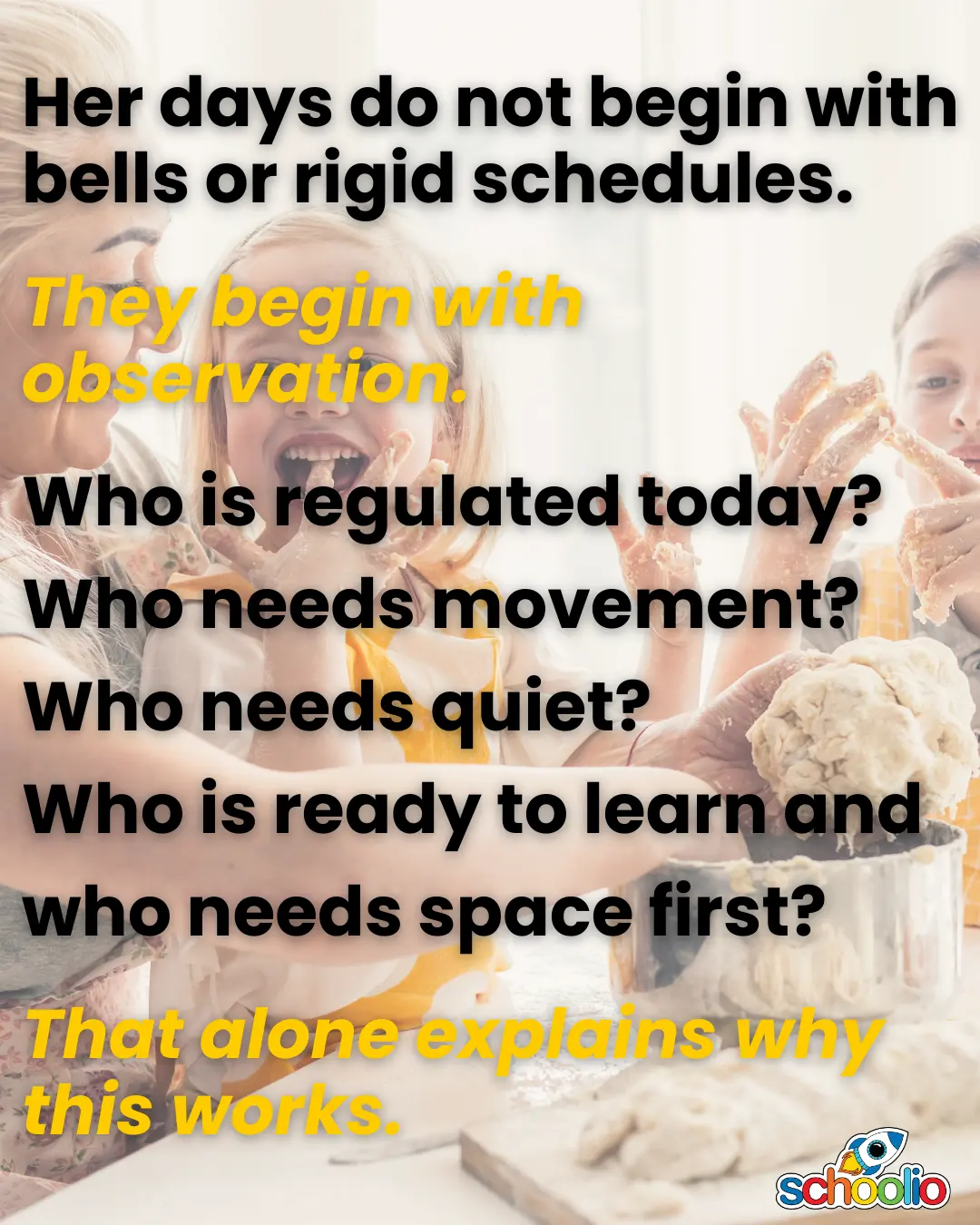
Her days do not begin with bells or rigid schedules. They begin with observation. Who is regulated today. Who needs movement. Who needs quiet. Who is ready to learn and who needs space first. That alone explains why this works.

She uses curriculum, but it is not the authority. It is a tool. Math might happen early for one child and later for another. Reading might be independent one day and shared the next. If something is not landing, she does not push harder. She pivots.

That is the part most systems struggle with. They confuse consistency with rigidity. They confuse pressure with progress.

What stood out most was her focus on emotional readiness before academics. She noticed that when her kids felt safe and calm, learning followed naturally. When they felt rushed or judged, everything shut down. Any parent of a neurodivergent or sensitive child knows this truth deeply, even if they have been told to ignore it.

This approach gives kids permission to go deep instead of wide. One child can stay with science longer without being rushed to keep pace. Another can take extra time with reading without being labeled behind. There is no artificial race. There is only progress that matches the child.

This is not chaos. It is intentional flexibility. It is structure that bends instead of breaks.

For neurodivergent kids especially, this matters. Many of them are not incapable. They are overwhelmed. They are not behind. They are overstimulated. When the environment adapts to them instead of forcing compliance, something powerful happens. Confidence returns. Curiosity comes back. Learning becomes possible again.

And here is where I get more opinionated.

Too many children are being pushed through systems that were never designed for how they think, feel, or regulate. When they struggle, the system calls them broken. This mom did the opposite. She changed the system around her kids instead of asking her kids to change who they are.

The result was not just better learning. It was a healthier home. Fewer battles. More willingness to try hard things. Less fear around mistakes. School stopped being something to survive and became something they could participate in.

That is the part we do not talk about enough.

For parents reading this and wondering what the takeaway is, it is not that you need to homeschool. It is that learning works best when your child feels seen first. Whether you are supplementing, transitioning, or rethinking school entirely, the question to ask is simple.

Is this environment helping my child feel capable or constantly reminding them they are not.

We see families arrive at schoolio from this exact moment. Not angry. Not anti school. Just deeply aware that their child needs something more responsive and more human. Especially neurodivergent kids who have spent years being told to try harder in systems that refuse to adapt.

Stories like this remind me that homeschooling does not have to be extreme or reactive. It can be thoughtful. Calm. Grounded in trust. Built around the child you have, not the one a system expects.

And when education starts there, kids do not just learn more. They believe more in themselves.


Sathish

still learning, still unlearning


Source:

Queen Creek mom of 4 takes a more progressive approach to homeschooling

KJZZ Phoenix

https://www.kjzz.org/the-show/2026-01-13/queen-creek-mom-of-4-takes-a-more-progressive-approach-to-homeschooling

Why I’m Not Worried About “Sheltering” My Homeschooled Kids

Why I’m Not Worried About “Sheltering” My Homeschooled Kids


This has been on my mind today…

I used to brace myself every time someone said it. You know the line.

“But aren’t you sheltering your kids from the real world?”

At first, I tried to explain. Then I tried to debate. Now? I just smile — because the truth is, yes, I am.

I’m sheltering them from the pressure to fit in before they even know who they are.

From being teased in the cafeteria because they don’t wear the right shoes or laugh at the same jokes.

From classrooms that push every child through the same mold, at the same speed, regardless of how they learn best.

But I’m also preparing them for the world. For the real one — not the one that pretends standardized tests and silent rows teach life skills.

In our home, we talk about kindness. We wrestle with questions. We fall apart and rebuild.

We learn how to fail and keep going. We learn how to speak up and when to listen. We learn that who we are as unique individuals is important… and awesome. We build resilience and confidence- so they’re really ready for the “real world.”

They learn how to handle conflict, talk to cashiers and librarians, make friends of all ages, and advocate for themselves. They practice empathy daily because it’s not just a word on a poster — it’s part of our lessons.

Is that sheltering? Maybe. But it’s also strengthening.

Because when my child walks out into the world, I want them to know who they are.

Not just what they’ve memorized. Not just what other kids or teachers have told them they are.

I want them to feel confident enough to speak, not just raise their hand for permission.

I want them to see difference and not fear it — to question and not crumble.

So yes, we’re doing school differently. That doesn’t mean we’re hiding.

It means we’re building something deeper.

Not a bubble — but a bridge. And we’ll cross it together when it’s time.


With love,

Lindsey

Certified Special Ed Educator & Co-Founder, Schoolio

“Not Educable”? Or Just Not Understood?

“Not Educable”? Or Just Not Understood?


This has been on my mind today…


I was in a private “teachers only” Facebook group recently — don’t ask me how I got in ? — and one comment stopped me cold.

“Some of these kids just aren’t educable.”

It triggered me. Deeply.

Because I’ve been that kid.

Because I’ve raised a child labeled “lazy” for not learning the way others expected.

Because I’ve built a company, Schoolio, for the very kids traditional systems are too quick to write off.

When a teacher — someone trained to unlock potential — says a child can’t be educated, what they’re really saying is: “I don’t know how. And I’m not willing to try.” But no child is uneducable. Some are misunderstood.

Some are neurodivergent.

Some are traumatized.

Some are learning in a way you weren’t trained to see.

Education is a relationship, not a one-way delivery service. It’s not just about curriculum — it’s about care, creativity, and compassion.

What we can’t do is confuse a system’s failure with a child’s inability. The system was never designed to serve every child — especially those who learn differently.

And that’s why Schoolio exists.

We don’t believe in “bad kids.”

We believe in bad assumptions, outdated frameworks, and a desperate need for empathy in education. Because when you tell a child they’re uneducable, you’re not describing them — you’re indicting yourself.

So the next time a student struggles… pause.

Ask what’s missing.

Ask how you can adapt.

Ask what support might unlock their potential.

Because learning isn’t a light switch. It’s a spark. You just have to be willing to see it.


Sathish
Still learning, still unlearning


Schoolio Comprehensive Report Card for Holistic Growth

Discover the Schoolio Comprehensive Report Card: A Holistic Homeschooling Tool

Homeschooling is a journey that transcends traditional academics, aiming to nurture a child’s overall development. At Schoolio, we recognize this multifaceted approach and have designed a tool that reflects it perfectly – the Schoolio Comprehensive Report Card. This free template is a fantastic resource for homeschooling parents who wish to capture the full spectrum of their child’s growth, from academic achievements to life skills and personal development.

Why Choose the Schoolio Comprehensive Report Card?

Homeschooling is not just about mastering math and reading; it’s about fostering qualities like responsibility, creativity, resiliency, and essential life skills. The Report Card is tailored to provide a holistic view of a student’s development, ensuring that every aspect of their growth is acknowledged and celebrated.

Key Features of the Schoolio Comprehensive Report Card

Holistic Development Areas

The Report Card template goes beyond traditional academic assessments. It includes sections to evaluate a student’s progress in responsibility, resiliency, creativity, life skills, physical education, attitude, and work habits. This comprehensive approach ensures that you have a complete picture of your child’s development.

Customizable for Individual Needs

Every child is unique, and their education should reflect that. The Report Card template is designed to adapt to the specific requirements of students from grades 1-8. Whether your child excels in certain areas or needs more support in others, this report card can be customized to suit their individual needs.

Easy-to-Use Format

We understand that homeschooling parents and educators have a lot on their plates. That’s why this Report Card features an easy-to-use format that simplifies the assessment process. With clear sections and straightforward criteria, you can efficiently track and document your child’s progress.

Encourages Positive Growth

One of the standout features of the Schoolio Comprehensive Report Card is its emphasis on areas beyond academics. It highlights emotional regulation, healthy choices, acts of kindness, social skills, and mental education. By recognizing and encouraging these aspects, we aim to foster positive growth in every child.

How to Use the Schoolio Comprehensive Report Card

Using the Schoolio Comprehensive Report Card is simple and intuitive. Here’s a step-by-step guide to help you get started:

  1. Download the Template: Access the free Report Card template from our website.
  2. Customize for Your Child: Tailor the report card to fit your child’s grade level and specific needs. You can adjust the criteria and sections to best reflect their development.
  3. Track Progress: Throughout the school year, use the report card to regularly assess and document your child’s progress in various areas. Be sure to include observations and examples to provide a complete picture.
  4. Review and Reflect: At the end of each term, review the report card with your child. Celebrate their achievements and discuss areas for improvement. This reflection helps in setting goals and fostering a growth mindset.

Benefits of the Schoolio Comprehensive Report Card

The Schoolio Comprehensive Report Card offers numerous benefits for both students and parents:

  • Balanced Evaluation: Provides a well-rounded assessment that includes both academic and personal development.
  • Enhanced Communication: Facilitates meaningful conversations between parents and children about their progress and goals.
  • Personalized Learning: Helps in tailoring the homeschooling approach to meet the child’s unique needs and strengths.
  • Motivation and Encouragement: Recognizes and celebrates achievements in all areas, boosting the child’s confidence and motivation.

Why Holistic Education Matters

In today’s world, education extends far beyond textbooks and exams. Holistic education emphasizes the importance of nurturing every aspect of a child’s growth, preparing them for success in all areas of life. The Report Card template is designed with this philosophy in mind, ensuring that your homeschooling journey is enriching and rewarding.

Testimonials from Homeschooling Families

Don’t just take our word for it! Here’s what some homeschooling families have to say about the Report Card Template:

  • Emily S.: “The Schoolio Comprehensive Report Card has been a game-changer for our family. It allows us to track our children’s progress in all areas, not just academics. We’re so grateful for this valuable tool!”
  • Michael R.: “I love how the report card highlights my kids’ strengths and areas for improvement in a balanced way. It’s easy to use and customize, making our homeschooling journey smoother and more organized.”

Get Your Free Schoolio Comprehensive Report Card Today!

Ready to embrace a broader perspective on education? Download the FREE Schoolio Report Card template today and start tracking your child’s holistic development. Celebrate their achievements, set meaningful goals, and support their growth in every facet of life.

Visit our website to get your Schoolio Report Card and discover how it can transform your homeschooling experience. At Schoolio, we’re committed to providing the tools and resources you need to ensure your child’s success – academically, personally, and beyond.