What Actually Helps PDA Kids Learn (And What Makes It Worse)

What Actually Helps PDA Kids Learn (And What Makes It Worse)


If you’re parenting a PDA kid, you already know this:

The more you push, the harder they push back.

And if you’re new to homeschooling a PDA or ADHD child, you might be thinking:

“If I just get the schedule right…”

“If I just stay consistent…”

“If I just hold firm…”

It should get easier.

But sometimes it doesn’t.

Sometimes it gets worse.

Because what looks like defiance is usually nervous system overwhelm.

And rigid structure — the kind we were taught is “good teaching” — can actually backfire.

Let me tell you what I’ve learned the hard way.


What Makes It Worse

Rigid scheduling.

“You do math at 9:00. Reading at 9:30. Writing at 10:00.”

For a PDA brain, that can feel like a trap.

Not a routine — a demand.

And when the nervous system perceives demand, it goes into threat mode.

Cue resistance.

Shutdown.

Negotiation.

Meltdowns.

It’s not laziness.

It’s not manipulation.

It’s autonomy panic.

The more tightly you grip, the more their brain fights for control.


What Actually Helps

Choice.

Not chaos. Not zero expectations.

Choice inside structure.

There’s a big difference.

Instead of:

“You have to do math right now.”

Try:

“Here are the three things that need to get done today. What would you like to do first?”

That one shift changes everything.

A to-do list feels very different from a command.

A list says:

“These things exist.”

A command says:

“You must.”

And for PDA kids, that distinction matters.


Why Order and Timing Matter Less Than Agency

One of the biggest mindset shifts for me was realizing this:

It doesn’t matter if math happens at 9am or 2pm.

It matters that it happens without a power struggle.

If unlocking lessons at midnight gives your child the ability to wake up and decide their own order? That’s not “spoiling” them.

That’s restoring autonomy.

If Open Exploration-style days — where they can choose what to work on — reduce anxiety and increase engagement? That’s not lowering standards.

That’s designing learning around a nervous system instead of against it.

And when you remove the demand, something surprising happens.

They often choose to do the work.

Not because they were forced.

Because they felt safe.


But Isn’t That Too Much Freedom?

This is the fear I hear all the time.

“If I give options, won’t they just avoid math forever?”

Maybe for a day.

Maybe even for a week.

But when learning isn’t wrapped in threat, resistance fades.

And when math is a concept-based lesson — not a 40-minute ordeal — it becomes approachable.

You can slow it down.

Break it apart.

Turn one writing lesson into four days.

Make one math concept last a week with hands-on work.

Completion matters more than speed.

Engagement matters more than compliance.


The Real Goal

The goal isn’t obedience.

It’s ownership.

When a child feels like learning is being done to them, resistance sets in.

When they feel like they are building something themselves, everything changes.

PDA kids especially need to feel like they are choosing — even inside non-negotiables.

We’re not removing expectations.

We’re removing the battle.

And that shift?

It changes the whole house.


If you’re in the thick of it right now, please hear this:

You’re not doing it wrong.

You’re parenting a brain that needs autonomy like oxygen.

Design around that.

And watch what happens.

? Lindsey

certified special-ed educator, homeschool mom, & co-founder of Schoolio

Once a Crime, Now a Cornerstone

Once a Crime, Now a Cornerstone


This has been on my mind today…

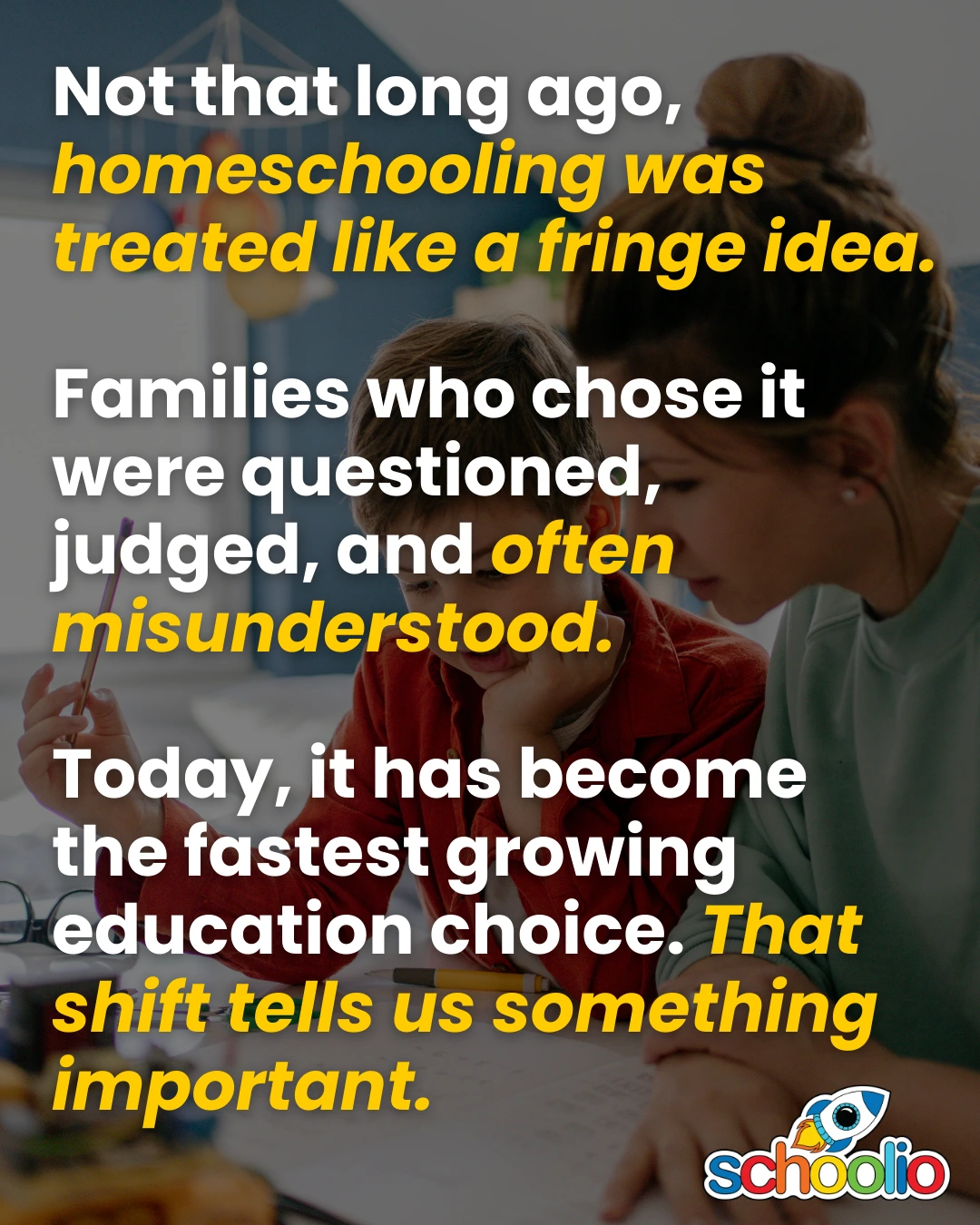
Not that long ago, homeschooling in Georgia was treated like a fringe idea. In some cases, it was outright illegal. Families who chose it were questioned, judged, and often misunderstood. Today, it has become one of the fastest growing education choices in the state. That shift tells us something important. Not just about Georgia, but about where education is heading everywhere.

The Atlanta Magazine story lays it out clearly. Georgia’s homeschooling boom did not come from one moment or one policy. It grew slowly, family by family, as parents watched their kids struggle in systems that were never designed for how they actually learn. Some were burned out. Some were anxious. Some were bored. Some were quietly disappearing in classrooms that moved too fast or not fast enough.

What changed was not just permission. It was trust. Trust that parents could make thoughtful decisions. Trust that learning does not need to look the same for every child. And trust that education can happen outside a building without losing its value.

Many of the families featured did not start out wanting to homeschool. This matters. Homeschooling is rarely the first choice. It is often the response to a moment where something feels off. A child stops asking questions. A once curious learner becomes withdrawn. School becomes a daily negotiation instead of a place of growth. Parents notice these signals long before report cards do.

What stands out is how diverse today’s homeschoolers are. They are not one type of family. They include working parents, single parents, military families, neurodivergent kids, gifted kids, and kids who just needed a different pace. Homeschooling in Georgia is no longer about opting out. It is about opting into something more intentional.

This is where the conversation gets interesting. The rise of homeschooling is not a rejection of education. It is a critique of rigidity. Parents are not saying learning does not matter. They are saying the current model is not flexible enough to meet real human needs.

At Schoolio, we see the same pattern across North America. Families come to homeschooling because their child needs time to breathe, space to think, and learning that adapts instead of demands. Especially for sensitive and neurodivergent kids, the traditional classroom can feel overwhelming. Noise, pace, pressure, and comparison all pile up. When those kids are given a calmer environment and lessons that meet them where they are, something shifts.

The Georgia story also shows how infrastructure is catching up. Co ops, hybrid programs, online platforms, and community groups are making homeschooling less isolating and more sustainable. Parents are not doing this alone anymore. They are building ecosystems around their kids.

This is the part many people miss. Homeschooling today is not about recreating school at home. It is about redesigning learning around the child. Academics still matter. But so does emotional safety. So does confidence. So does the ability to learn how to learn.

For parents reading this, the takeaway is simple. If your child is struggling in school, it does not mean they are broken. It means the environment might not fit. Georgia’s homeschooling boom is proof that when families are given options, they choose what works for their kids.

Education is changing because families are changing it. Not through protest, but through choice. And once a choice becomes a cornerstone, there is no going back.


Sathish

still learning, still unlearning

Source: Atlanta Magazine

https://www.atlantamagazine.com/news-culture-articles/once-a-crime-now-a-cornerstone-inside-georgias-homeschooling-boom/

To the Weak, Everything Feels Like a Threat

To the Weak, Everything Feels Like a Threat


This has been on my mind today…


Every time education shifts forward, fear gets louder.

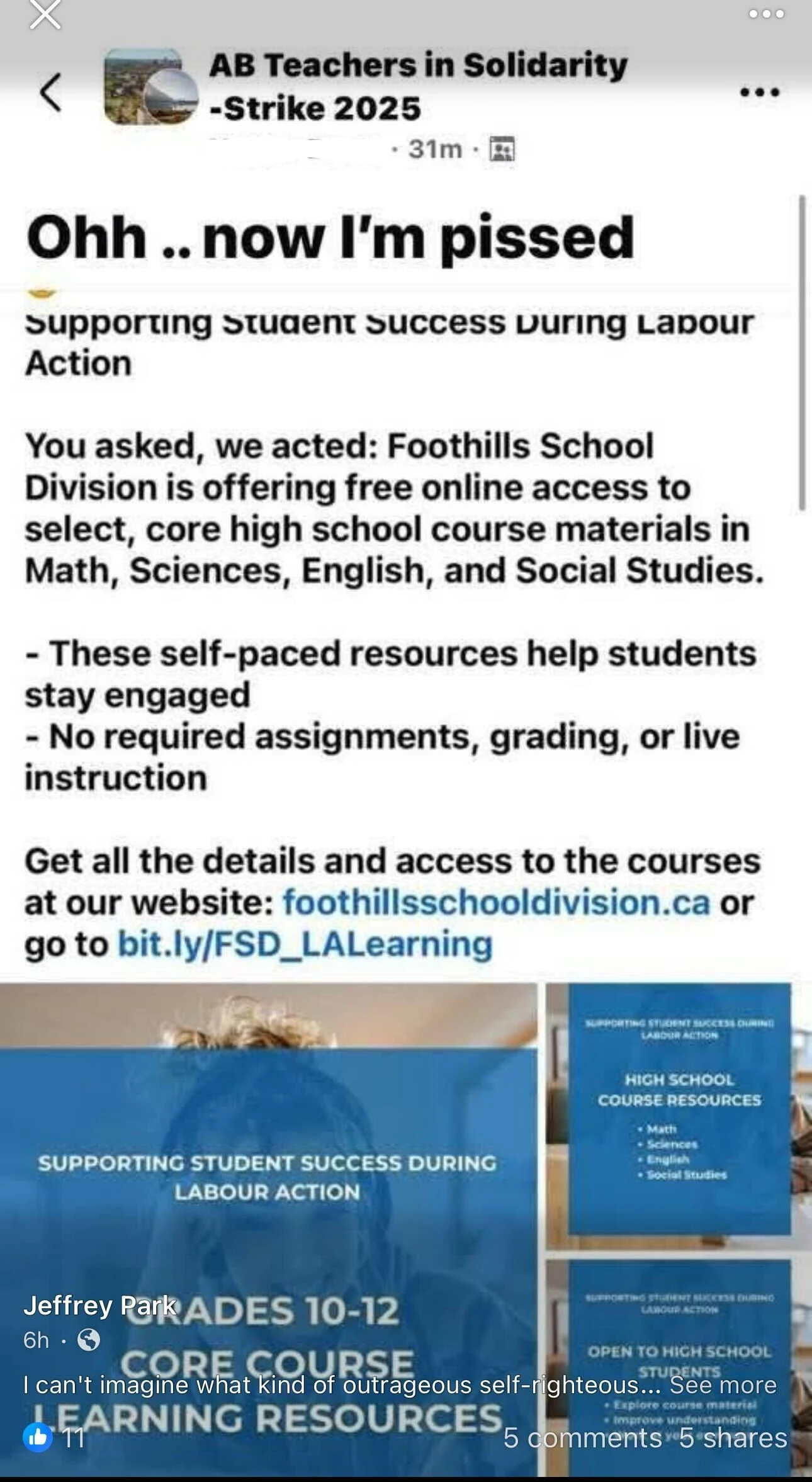
Teachers are angry that families are exploring alternatives during the Alberta strike. Some are even calling parents “disloyal” for turning to online resources. But let’s be honest — what else are families supposed to do when the system stops working?

The truth is, teachers are afraid. And I get it. They’ve been handed an impossible job inside a system that hasn’t evolved in 150 years. A system built for industrial workers, not creative thinkers. For compliance, not curiosity.

AI. Homeschooling. Microschools. Digital curriculum.

All of it is growing — fast.

And instead of seeing these tools as extensions of learning, too many educators see them as enemies.

Here’s the reality:

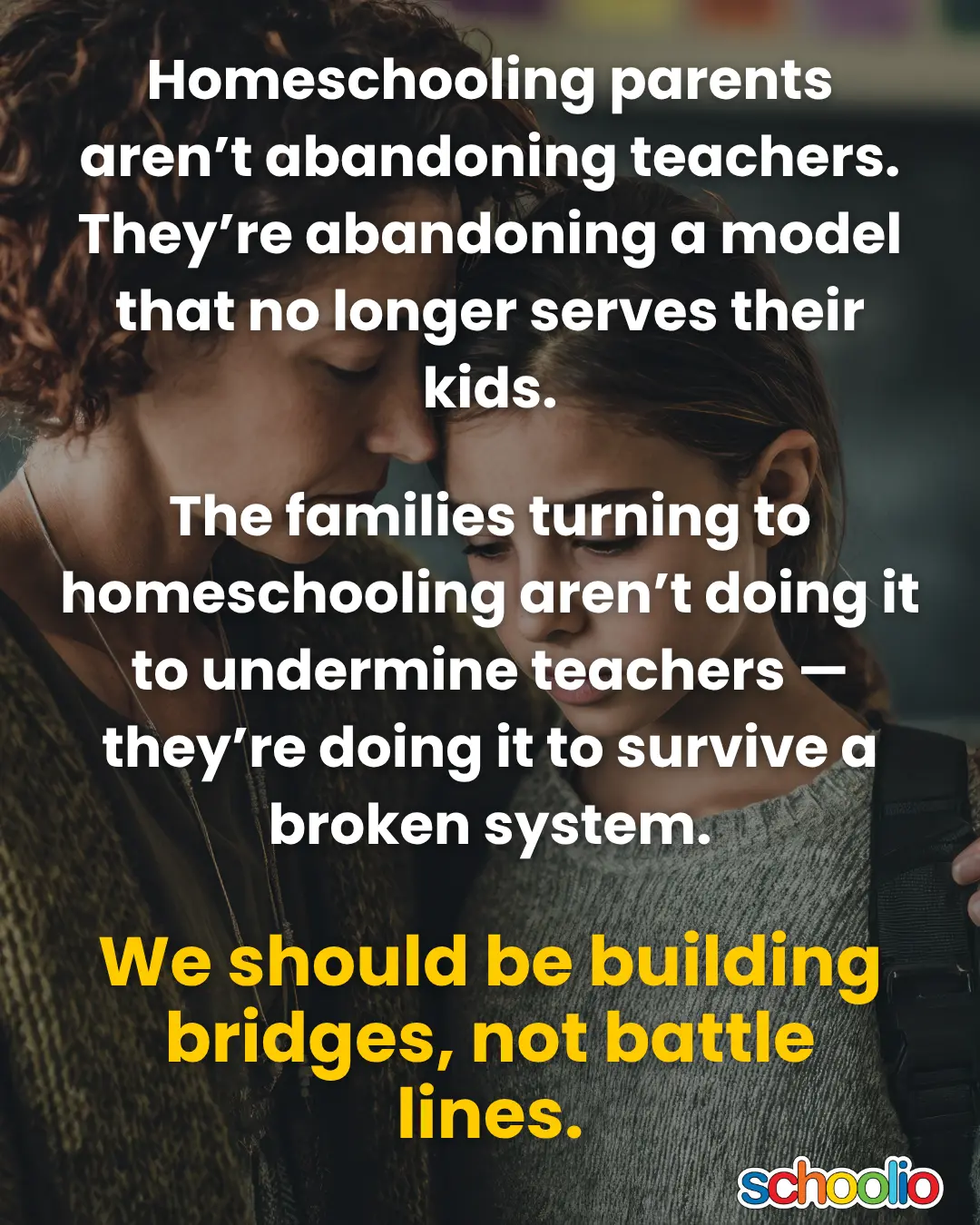
Parents aren’t abandoning teachers. They’re abandoning a model that no longer serves their kids.

Innovation in education isn’t an attack. It’s an answer.

The families turning to homeschooling or digital learning aren’t doing it to undermine teachers — they’re doing it to survive a broken system.

We should be building bridges, not battle lines.

Technology and teachers can coexist. But that requires courage — the kind that looks at change and says, “Let’s learn from it.”

Because the future of education won’t be built by those defending the old ways. It’ll be built by the ones bold enough to imagine new ones.

Alberta


Sathish
Still learning, still unlearning

You Don’t Have to “Be the Teacher”

You Don’t Have to “Be the Teacher”


One of the things I hear most often from new homeschooling parents is:

“I’m worried about how to be the teacher.”

“How do I switch between being Mom and being Teacher?”

And I get it — that’s the model we were raised in. School was one thing. Home was another. Learning happened in a classroom, not the kitchen, and teachers were “official” in a way parents weren’t.

But that separation? It’s something we were taught.

And it’s one of the first things to unlearn when you start homeschooling.

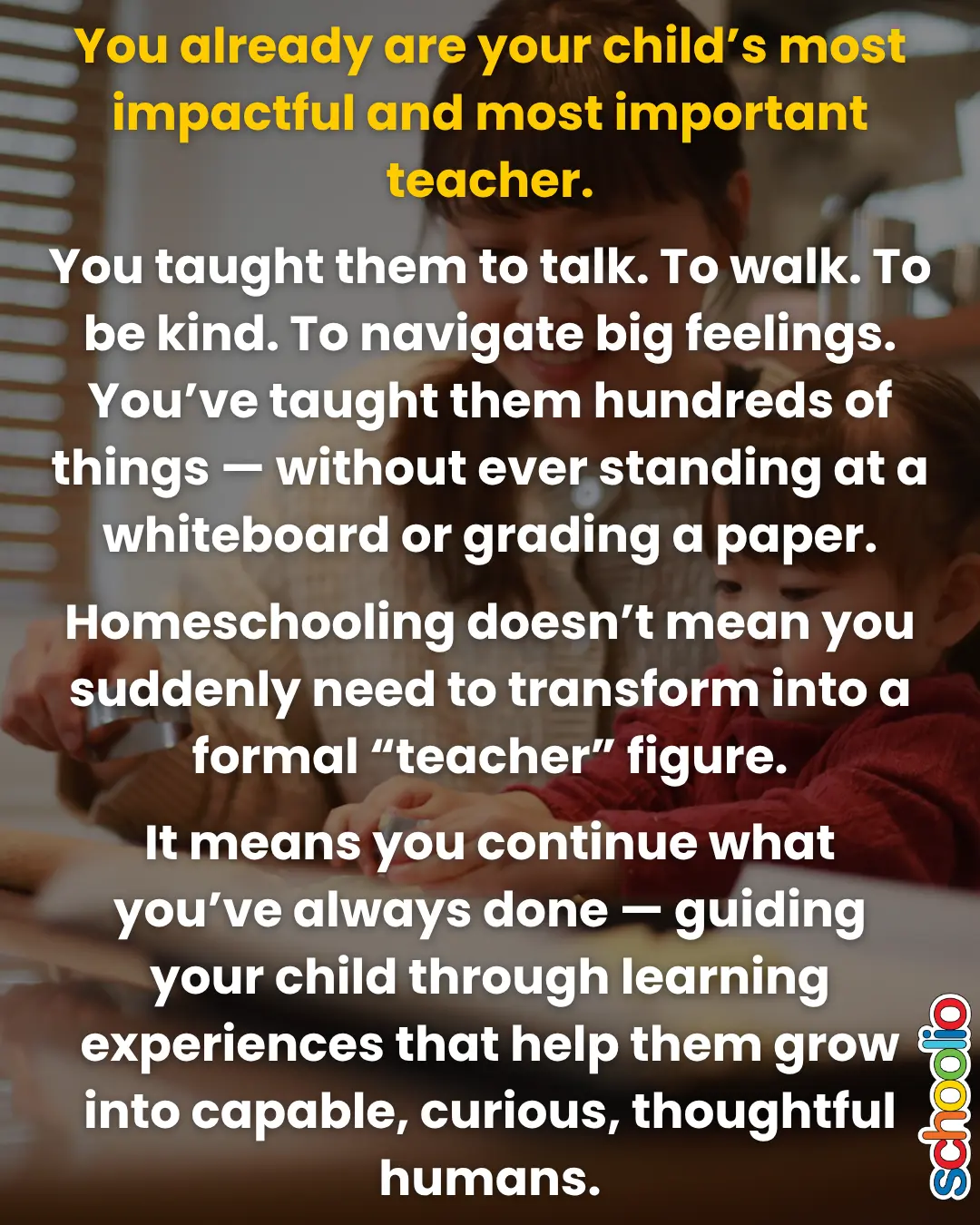
The truth is, you already are your child’s most impactful and most important teacher.

You taught them to talk. To walk. To be kind. To navigate big feelings. You’ve taught them hundreds of things — without ever standing at a whiteboard or grading a paper.

Homeschooling doesn’t mean you suddenly need to transform into a formal “teacher” figure with a desk, a whistle, and a lesson plan binder.

It means you continue what you’ve always done — guiding your child through learning experiences that help them grow into capable, curious, thoughtful humans.

Let go of the image of kids sitting in desks while you lecture at the front. That’s not homeschooling. That’s school-at-home — and that’s not what your kids need.

Kids aren’t empty vessels waiting to be filled with facts. They’re active participants in their own learning.

When you give your child autonomy and ownership, everything changes.

You stop being “the enforcer,” and start being their guide. Their mentor. Their teammate.

You’re not switching between roles — you’re expanding the one you’ve always had.

In real life, learning doesn’t have boundaries. It doesn’t only happen between 9 and 3, or only from someone with a degree. It happens everywhere, all the time, through curiosity and connection.

Your homeschool doesn’t need to mirror school.

It needs to mirror life.


? Lindsey

Certified Special Ed Educator & Co-Founder, Schoolio

Why Your ADHD Child Can’t Sit Still- What is Vestibular Input?

Why Your ADHD Child Can’t Sit Still- What is Vestibular Input?


If you have an ADHD child, you’ve probably said one of these phrases at least once (or, let’s be honest, many times):
“Sit properly, please.”
“Feet down.”
“Stop spinning that chair.”


“Why are you upside down right now?”

And yet, no matter how many times you say it… they just can’t seem to stop.

It’s easy to see this as misbehavior or lack of focus. But in reality, what you’re seeing might be something deeper — your child’s nervous system doing its best to get the vestibular input it needs to feel regulated, alert, and ready to learn.

vestibular input

What Is Vestibular Input?

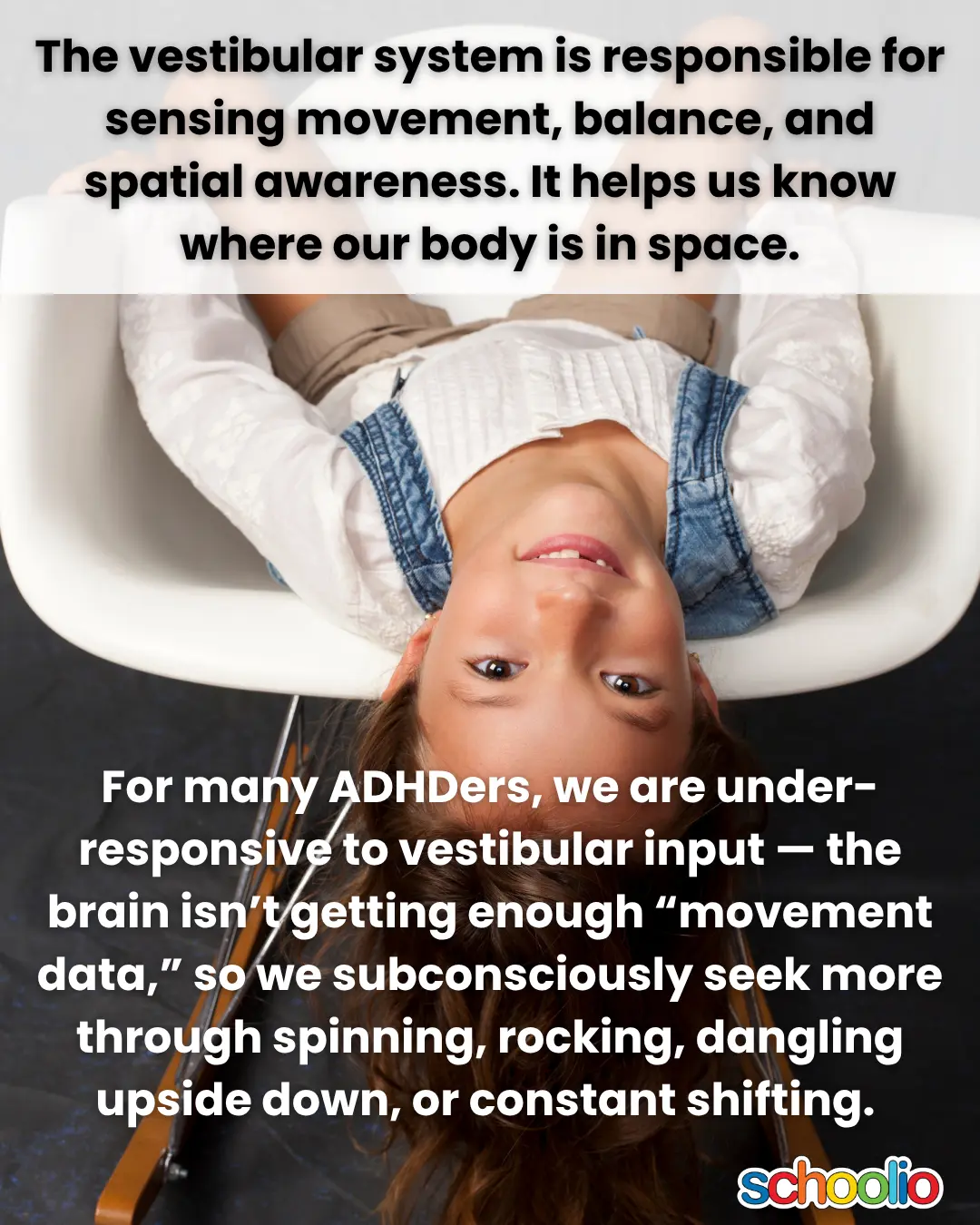
The vestibular system lives in the inner ear, and it’s responsible for sensing movement, balance, and spatial awareness. It helps us know where our body is in space — like whether we’re sitting upright, moving fast, or tilting our head.

For neurotypical people, this system runs quietly in the background, keeping them centered. But for many ADHDers, it doesn’t process quite the same way.

Some ADHD kids are under-responsive to vestibular input — their brain isn’t getting enough “movement data,” so they subconsciously seek more through spinning, rocking, dangling upside down, or constant shifting. Others may be over-responsive, finding certain motions overwhelming or dizzying.

Both patterns are common — and both are the body’s way of saying, “I need help regulating.”

? Science Note: The Vestibular–Dopamine Connection

The vestibular system doesn’t work alone — it’s closely tied to the dopamine pathways in the brain that control motivation, focus, and emotional regulation.

When your child moves — spinning, jumping, rocking — those physical sensations activate parts of the brainstem and cerebellum that help regulate dopamine and norepinephrine, both of which are often low in ADHD brains.

That’s why movement helps ADHD kids “wake up” their brains:

  • It boosts alertness and attention.
  • It improves emotional regulation.
  • It supports executive function — planning, memory, and self-control.

So when your child is fidgeting or in constant motion, they’re not being disruptive — they’re literally helping their brain function better.


What “Dopamine Seeking” Looks Like in the Body

We often talk about ADHD as dopamine-driven, but the vestibular system plays a huge role, too. Movement actually helps stimulate dopamine release — which is why your ADHD child may suddenly start pacing, swinging their legs, or balancing on the edge of a chair right when you need them to concentrate.

These “weird” positions aren’t defiance. They’re your child’s nervous system self-medicating through movement.

They might:

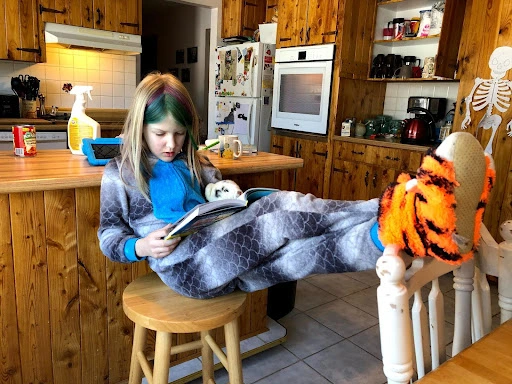
  • Sit with one leg over the arm of a chair
  • Hang off the couch upside down
  • Constantly rock, bounce, or sway
  • Spin in circles for “fun” (and never seem dizzy)
  • Climb furniture or balance on unstable surfaces

It can look chaotic — but for them, it’s regulating.


What It Feels Like for ADHD Kids

For a child whose vestibular system isn’t getting enough input, sitting still can feel physically uncomfortable — like trying to focus with an itch you can’t scratch. Their brain is searching for balance signals, and until it gets them, it’s hard to settle down.

You might see:

  • Fidgeting during reading or lessons
  • Difficulty maintaining posture
  • Restlessness or frustration during quiet tasks
  • Frequent “breaks” to move or reposition

The movement isn’t the problem — it’s the coping mechanism for an unmet sensory need.

How This Impacts Learning

When a child’s body is unregulated, their brain can’t prioritize learning. The vestibular system connects directly to areas of the brain that control attention, emotion regulation, and executive function — meaning movement needs aren’t separate from learning needs.

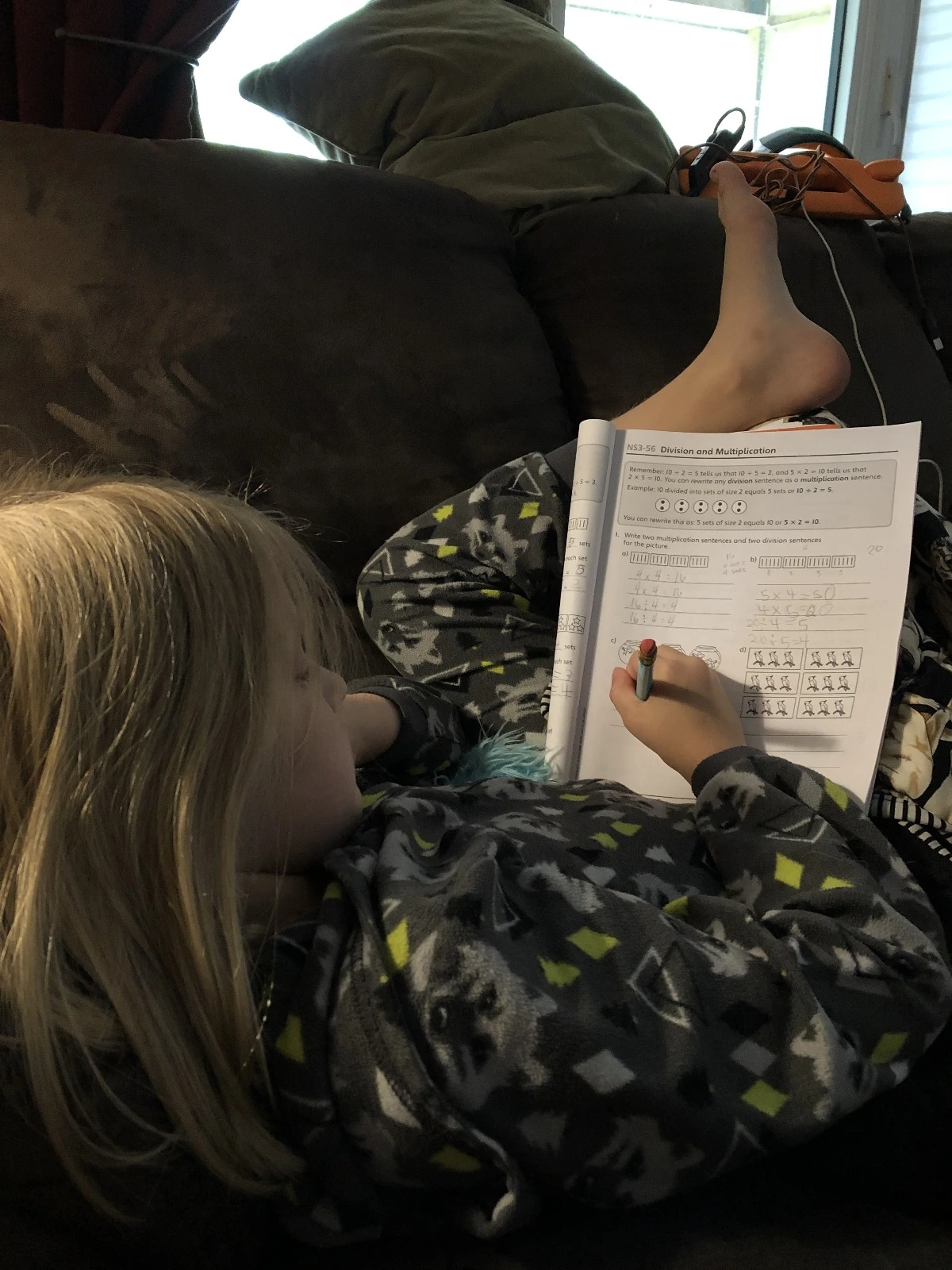
So when your ADHD child spins in their chair, lies on the floor to do math, or wiggles constantly through read-alouds… that’s not distraction. It’s adaptation.

Supporting Your Child’s Vestibular Needs at Home

Instead of trying to eliminate movement, think about channeling it. Here are some strategies to support vestibular regulation in your homeschool:

1. Build Movement Into the Day

  • Use active learning breaks between subjects.
  • Try standing desks, wobble stools, or yoga balls.
  • Let your child read or write while pacing, swinging, or lying down.activity

2. Offer “Heavy Work”

Proprioceptive input (like pushing, pulling, or lifting) helps calm the vestibular system. Try:

  • Carrying laundry or groceries
  • Wall push-ups or wheelbarrow walks
  • Building with weighted materials like LEGO or clay

3. Use Safe Spinning or Swinging

If your child seeks spinning, consider safe options like:

  • Swivel chairs
  • Therapy swings
  • Hanging pods or hammocks

4. Respect Their Positions

If your child learns best while lying on the floor or sitting cross-legged on a chair, that’s okay. Focus on engagement, not posture.

5. Schedule Movement Intentionally

Start the day with movement-rich activities: walking the dog, dancing, yoga, or playground time. Meeting those vestibular needs early can make focused work easier later.

The Homeschooling Advantage

Traditional classrooms often punish movement — “sit still,” “stop rocking,” “stay in your seat.” But at home, you have the flexibility to do the opposite: to embrace movement as part of learning.

When you let your ADHD child learn in the way their body needs — rocking, fidgeting, or balancing — you’re not giving in to bad habits. You’re helping their nervous system regulate so their brain can focus, absorb, and thrive.

Movement isn’t a distraction. For ADHDers, movement is medicine.

“Effects of stochastic vestibular stimulation on cognitive functions in children with ADHD” — PMC article discussing vestibular stimulation and cognition for ADHD. https://pmc.ncbi.nlm.nih.gov/articles/PMC10635964


“Vestibular Rehabilitation for ADHD” — article from Neurologic Wellness Institute referencing the regulation of dopamine via vestibular input. https://neurologicwellnessinstitute.com/vestibular-rehabilitation-for-adhd/


“Vestibular therapy improved motor planning, attention, and balance in children with Attention-Deficit Hyperactivity Disorders – A RCT” — study showing improved attention and response control following vestibular intervention in children with ADHD. https://www.oatext.com/vestibular-therapy-improved-motor-planning-attention-and-balance-in-children-with-attention-deficit-hyperactivity-disorders-a-randomized-controlled-trial.php


The Real Scorecard Isn’t Grades — It’s Humanity

The Real Scorecard Isn’t Grades — It’s Humanity


This has been on my mind today…

My daughter is starting college. A new lifestyle. A new rhythm. A new version of independence. And as I watch her step into it with grace, confidence, and heart, I find myself reflecting—not just on her growth, but on mine as a parent.

In the early years, I thought my role was to prepare her academically. Get her ready for the tests. The projects. The milestones. The classic definition of “success.” But somewhere along the way, that definition shifted.

Because life had other plans.

Because she had questions school didn’t answer.

Because I realized my real job was never about the grades. It was about something bigger.

We tried to raise a daughter who could walk into any room, look people in the eye, and see them—not for their titles or their background, but for their shared humanity. We talked about what it means to be kind when no one’s watching. To question with curiosity, not criticism. To love first, even when the world makes it hard.

We didn’t always get it right. I came from a childhood where discipline meant violence. Where falling behind in school wasn’t a symptom of struggle, but a sign of laziness that had to be “beaten out” of you. That trauma doesn’t just disappear—it echoes. And it took years to unlearn.

But we knew we had to break the cycle. We didn’t ground our kids. We didn’t reach for fear as our first parenting tool. We took away iPads. We paused and talked. We treated mistakes as data, not disgrace. Because the world they’re inheriting is complicated enough without adding guilt and shame to the mix.

Whether you homeschool, send your child to public school, or choose a private path—it doesn’t really matter. What matters is how you’re preparing them for the world outside the classroom. Because it’s moving fast. It’s emotionally volatile. And it’s filled with both beauty and brokenness.

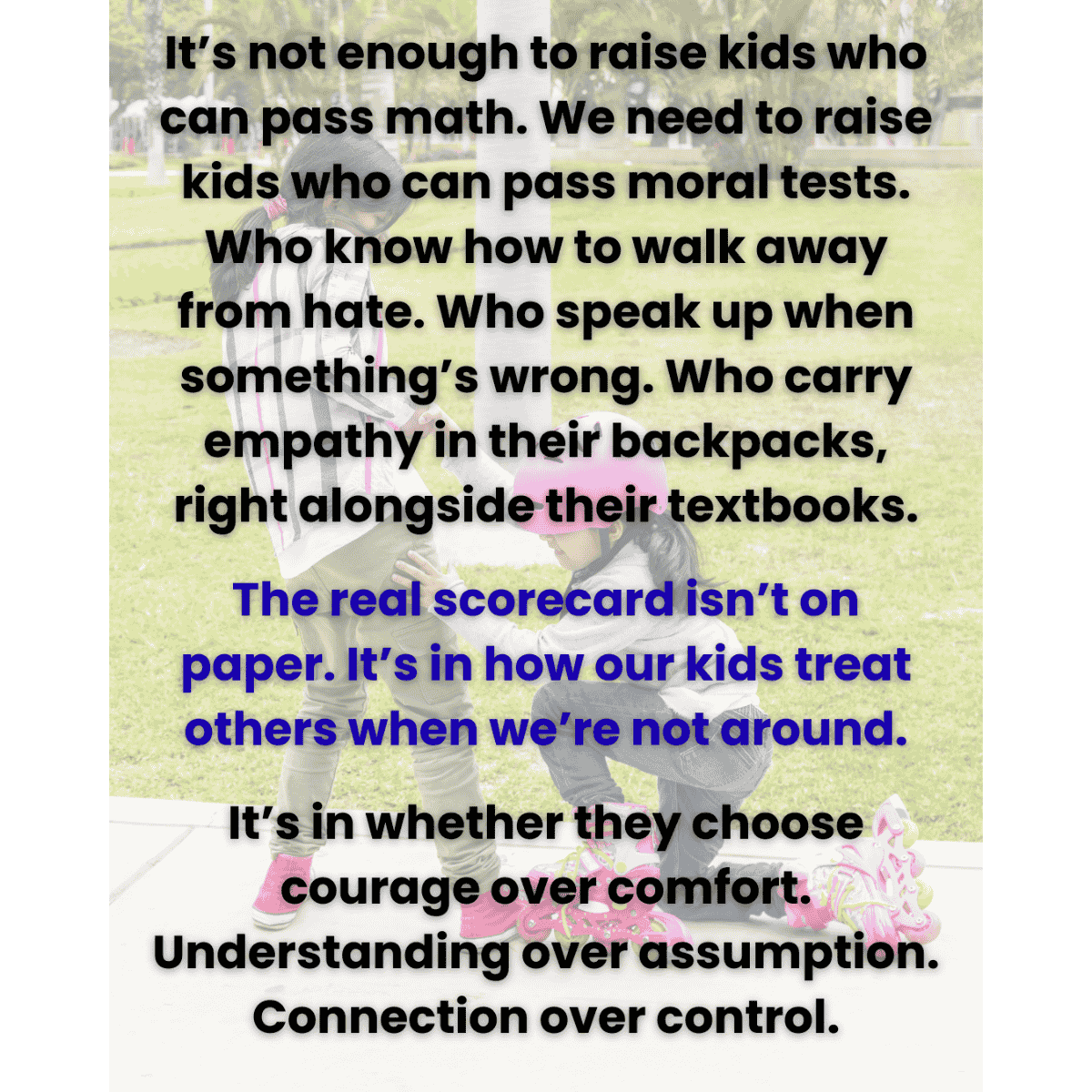
It’s not enough to raise kids who can pass math. We need to raise kids who can pass moral tests. Who know how to walk away from hate. Who speak up when something’s wrong. Who carry empathy in their backpacks, right alongside their textbooks.

The real scorecard isn’t on paper. It’s in how our kids treat others when we’re not around.

It’s in whether they choose courage over comfort. Understanding over assumption. Connection over control.

And those values? They’re not taught once. They’re modeled over time.

That’s why this company—Schoolio—is a personal mission for me. It’s why we build tools and content that don’t just cover curriculum, but embrace character. I don’t believe learning should be weaponized or used to judge. I believe it’s a lifelong, imperfect, beautiful process. A work in progress, just like all of us.

This week, I’m not just sending my daughter to college. I’m celebrating a milestone that started long before the acceptance letter. I’m watching her walk out into the world with her own voice. And I’m quietly reminding myself: That’s the legacy that matters.

—Sathish

still learning, still unlearning

When Does Learning End? For Me, It Was When My Father Went to Sleep

When Does Learning End? For Me, It Was When My Father Went to Sleep


This has been on my mind today…

I saw a post that simply said, “My son’s done with homeschooling in two hours.”

And just like that, I was back in Singapore — racing home from school, not for fun, but out of fear.

See, school for me ended close to 4pm.


school


My parents knew exactly how long it should take for me to get from the gates of the school to the door of our apartment.

If I was late, it wasn’t a missed bus or a slow walk — it was disrespect.

And there were consequences.

But the real weight?

School didn’t end when the bell rang.

It ended when my father went to sleep.

Usually around 6pm, he’d be home — and by then, we had to be seated, heads down, already into our homework or the next stack of extra workbooks.

Every day.

For years.

Twelve to fifteen hours a day spent studying.

Almost no play.

Very little conversation that wasn’t about performance, progress, or punishment.

That was childhood.

And even though I sent my own kids to public school, I made a quiet promise to do things differently.

School ended the minute they walked out of the building.

Evenings were for play.

For laughter.

For sitting together at the dinner table without a pencil in hand.

For movie nights and bike rides and not having to earn joy.

And yet — I see so many of my friends, especially fellow South Indian parents, unknowingly continuing the cycle.

Evenings and weekends filled with more learning.

Catch-up. Push ahead. Get into the best school. Stay ahead of the curve.

But the curve keeps shifting.

The truth is, the world our kids are stepping into will not reward them for how fast they finished a textbook.

It will reward them for their ideas.

For their empathy.

For how well they adapt and connect and create.

Jobs we know today won’t be around by the time they graduate.

Learning styles have changed.

Grades don’t mean what they used to.

Trade skills and entrepreneurship are on the rise.

And I’ll say it — homeschooling is where I’m seeing the balance emerge.

Not because it’s easier.

But because it’s more human.

It’s where a child can complete their day in two focused hours and spend the rest of their time living.

It’s where parents no longer feel the need to steal youth from their kids in the name of preparation.

It’s where play becomes part of the plan, not an afterthought.

And it’s where I’m learning — still learning — how to unlearn the things I was taught to fear.

If your evenings feel like an extension of school instead of a return to family, maybe it’s time for a new way.

Maybe it’s time to put the joy back into childhood.


Sathish

still learning, still unlearning

Why I Stopped Worrying About Learning Gaps

Why I Stopped Worrying About Learning Gaps

By Lindsey, certified special-ed educator & co-founder, Schoolio

This has been on my mind today…

The weight of comparison. It sneaks in quietly. A friend tells you what their child is learning in school. A neighbor asks about your homeschool “schedule.” You catch a glimpse of someone’s color-coded curriculum plan on Instagram. Suddenly your confidence starts to unravel.

I remember this feeling most clearly when my oldest was around eight or nine. We were deep into homeschooling, but I was constantly looking over my shoulder at what public school kids were doing. Were we covering the same content? Were we behind? Was I doing enough?

It became exhausting. I was trying to replicate school at home—not because it worked for us, but because I thought that’s what “real” education looked like.

Here’s the truth I had to learn the hard way: homeschool doesn’t need to imitate public school to be valid. In fact, the whole point is that it doesn’t.

I kept coming back to a simple question. If I can’t remember what I learned in third grade, why was I putting so much pressure on myself to make sure my child retained every single concept in the third grade curriculum? I realized I was clinging to a system I didn’t even believe in—one I had left behind for a reason.

When kids are in school, they’re taught for a set number of days, then tested. If they get a 60%, that means they missed 40%—and the class moves on. No one loops back. No one stops the train. That’s a gap. A big one. But it’s accepted.

In our homeschool, if my child gets sick or we need to pause for emotional rest, schoolwork pauses. School doesn’t go on without them on sick days, it waits for them. We don’t pretend 60% is good enough. The beauty of this lifestyle is that learning pauses with the child and picks up again when they’re ready.

That alone makes a massive difference.

And the truth is, we all have learning gaps. Adults included. Because humans only retain what they find meaningful. You can make a child memorize facts for a test, but they’ll likely forget most of it after. If something isn’t relevant to their lives, it doesn’t stick. So whether you never cover it, or they forget it, the result is the same.

That realization gave me freedom.

I stopped obsessing over whether we had checked every box. I started asking better questions: Was my child curious today? Did we connect? Did they ask questions that mattered to them? Those were my new benchmarks.

And wouldn’t you know—it made everything easier. They were learning more, not less. And I was enjoying it more, too.

So if you’re caught in that loop of comparison, wondering if your homeschool is “real” enough, let me gently offer this: your homeschool is enough because it’s yours. Because it fits your child. Because it’s rooted in love, flexibility, and intention.

That’s not falling behind. That’s choosing to lead.

certified special-ed educator & co-founder, Schoolio


? Need help trusting your homeschool rhythm?

Start with our free homeschool planner, explore flexible curriculum bundles, or try our 7-day trial to see how it can work in your home.

Rise in Number of Home Schooled Children – Council

Rise in Number of Home Schooled Children – Council

Rise of Homeschooling: Empowering Families Amid Changing Educational Needs

In recent years, the homeschooling movement has gained remarkable momentum. Across regions like Rotherham, South Yorkshire, where the number of home-educated children has increased by over 300% since 2015. Families are increasingly choosing home education to address diverse challenges. The shift toward homeschooling is often driven by mental health concerns, exam pressures, or dissatisfaction with traditional schooling. This trend reflects a growing desire for education tailored to each child’s unique needs.

At Schoolio, we see this trend as part of a larger movement. This is to decentralize education, empower families, and offer children personalized learning experiences. With our innovative K-8 digital curriculum, we’re committed to supporting families navigating the rewarding but challenging journey of homeschooling.


Why Families Are Turning to Homeschooling

The reasons for the rise in homeschooling are as varied as the families choosing this path. In Rotherham, council data reveals that mental health struggles and academic pressures are among the key drivers. Traditional school environments often fail to provide the flexibility and emotional support many children need, particularly as they approach critical academic milestones like GCSEs.

Homeschooling offers an alternative—one that prioritizes the well-being and individual pace of the student. By allowing families to tailor education to their children’s needs, home education provides a sense of agency and freedom that’s hard to replicate in conventional systems.

This trend is not unique to the UK. Across North America, parents are also opting for home education as they seek greater control over what and how their children learn. With platforms like Schoolio, families can access resources that make homeschooling accessible, flexible, and aligned with their educational values.


The Role of Support in Effective Homeschooling

Choosing to homeschool is a significant decision that comes with its challenges. In Rotherham, the local council has implemented programs to support families in providing suitable education at home. Early intervention teams and guidance resources have helped hundreds of children remain in traditional schools while also aiding those transitioning to homeschooling.

At Schoolio, we believe that support is the cornerstone of successful homeschooling. Our platform is designed to offer parents comprehensive tools, including core curricula, engaging electives, and future-readiness programs. By empowering families with structured resources and clear guidance, we aim to alleviate the stress that often accompanies the decision to homeschool.

Homeschooling doesn’t have to be a solitary endeavor. Communities of homeschoolers, both online and offline, provide invaluable support, offering parents a space to share ideas, experiences, and encouragement. At Schoolio, we actively foster such communities, recognizing their critical role in making home education a viable and rewarding option for families everywhere.


Challenges and Opportunities in Homeschooling

As homeschooling becomes more widespread, it also faces scrutiny. The Rotherham report highlighted cases where home education was deemed unsuitable due to a lack of adequate planning or resources. These instances underscore the importance of equipping families with the right tools and information to ensure a high-quality educational experience.

Platforms like Schoolio are part of the solution. By providing structured yet flexible curriculums, we help parents ensure that their children are meeting educational benchmarks while also embracing the freedom that homeschooling offers. Our programs are specifically designed to adapt to the diverse needs of learners, from neurodivergent students to those seeking advanced enrichment opportunities.

In addition to addressing these challenges, homeschooling presents immense opportunities for innovation in education. Families can explore alternative teaching methods, incorporate real-world learning experiences, and nurture their children’s passions in ways that traditional schools often can’t accommodate.


Homeschooling: A Path to Resilience and Personalization

One of the most compelling aspects of homeschooling is its potential to foster resilience. In Rotherham, many families have turned to home education after their children struggled to cope with the demands of traditional schooling. Homeschooling allows these students to rebuild their confidence and rediscover the joy of learning in a supportive, pressure-free environment.

Schoolio embraces this philosophy by offering curricula that not only cover academic fundamentals but also focus on personal growth and future readiness. Our electives are designed to spark curiosity and creativity, while our core programs ensure a strong foundation in essential subjects like math, science, and language arts.

Moreover, homeschooling provides families with the flexibility to address their children’s mental health needs. By creating a safe, nurturing learning environment at home, parents can help their children develop the skills and resilience needed to navigate life’s challenges.


The Global Perspective: Homeschooling in North America and Beyond

While the rise of homeschooling in Rotherham reflects local challenges, it’s part of a global movement. In North America, homeschooling is growing rapidly, fueled by a desire for greater educational freedom and the flexibility to adapt learning to individual needs.

Schoolio is proud to be at the forefront of this movement. By decentralizing education and placing control in the hands of parents, we’re helping families across the continent embrace a personalized approach to learning. Our mission aligns with the values that underpin the homeschooling movement: flexibility, inclusivity, and a commitment to meeting each child’s unique potential.

The parallels between Rotherham’s experience and the broader trends in North America highlight the universal appeal of homeschooling. Parents everywhere are seeking alternatives to rigid, one-size-fits-all systems, and the rise of digital platforms like Schoolio is making this transition more accessible than ever.


Looking Ahead: The Future of Homeschooling

As more families choose home education, the need for resources, support, and advocacy will continue to grow. The Rotherham council’s efforts to provide guidance and early intervention are commendable, but they also highlight the gaps that still exist in ensuring all families have access to effective homeschooling solutions.

At Schoolio, we’re committed to filling these gaps. By providing high-quality, affordable educational resources, we empower parents to take charge of their children’s learning journeys. Our platform is more than a curriculum provider—it’s a partner in creating meaningful, personalized educational experiences.

The rise of homeschooling represents a shift toward a more flexible, student-centered approach to education. It’s a movement driven by families who recognize the importance of choice, agency, and individuality in learning. With the right tools and support, homeschooling has the potential to redefine what education can be—not just in Rotherham, but around the world.


Join the Movement with Schoolio

Whether you’re new to homeschooling or looking to enhance your current approach, Schoolio is here to support you every step of the way. With our comprehensive K-8 digital curriculum, engaging electives, and future-ready programs, we provide everything you need to create a tailored educational experience for your child.

As homeschooling continues to grow globally, platforms like Schoolio are shaping the future of education by putting families first. Together, we can build a world where every child has the opportunity to thrive, learn, and succeed—on their own terms.

Let’s embrace the power of homeschooling and create a brighter future for children everywhere.


Source article,

https://www.bbc.com/news/articles/c7458d9nvdko

Author: Sathish Bala