Rethinking Homework with ChatGPT

Rethinking Homework with ChatGPT

Rethinking Homework with ChatGPT

As students, the burdensome nature of traditional homework is an experience we all share. The struggle to complete assignments outside of class hours, often without teacher or peer support, can be a source of frustration. Fortunately, with innovations like ChatGPT and the Schoolio Learning Platform, a paradigm shift in the way we approach homework is on the horizon. Let’s start by rethinking homework with ChatGPT.

The Drawbacks of Traditional Homework

Homework, a long-standing educational practice, has been both a cornerstone and a source of stress for students. Completing assignments at home, detached from teacher guidance and peer interaction, often leads to confusion and frustration. Additionally, traditional homework can be time-consuming, leaving little room for students to explore other interests or hobbies.

Moreover, it perpetuates inequality, with students from disadvantaged backgrounds lacking the resources and support needed to excel. This contributes to a widening achievement gap among students from different socioeconomic backgrounds.

Schoolio Family Plan

ChatGPT and In-Class Homework on the Schoolio Learning Platform

Enter ChatGPT, an AI-powered chatbot, specifically designed to assist students with their homework. What sets ChatGPT apart is its real-time ability to generate unique questions and solutions.

Utilizing ChatGPT in this manner ensures that all students have the opportunity to complete assignments and seek clarification during class, rendering traditional homework obsolete. This approach not only alleviates the stress associated with homework but also enables teachers to offer immediate feedback and support.

The Advantages of In-Class Homework with ChatGPT

In-class homework, facilitated by the Schoolio Learning Platform, brings forth numerous benefits. The presence of teacher and peer support increases the likelihood of assignment completion. Fostering better learning outcomes and heightened engagement. Real-time assessment of student learning provides valuable insights for teachers to adapt their teaching approaches.

Schoolio e-books

Furthermore, in-class homework becomes a powerful tool for differentiation. Using ChatGPT, teachers can generate questions of varying difficulty levels, catering to both advanced and struggling students. This ensures that all students are actively engaged and appropriately challenged, regardless of their ability level.

Embracing the Future of Education

ChatGPT, coupled with the Schoolio Learning Platform, has the potential to revolutionize our approach to homework. By replacing traditional homework with in-class assignments, we create a more engaging and supportive learning environment for students. This transformative shift levels the playing field for learners from diverse backgrounds, eliminating the struggle with homework and providing equal access to support and resources.

The integration of ChatGPT in classrooms not only transforms the learning experience but also enhances teacher-student relationships. Immediate feedback and support foster stronger connections, contributing to a positive and encouraging educational atmosphere. It’s time for educators to embrace the transformative potential of ChatGPT and the Schoolio Learning Platform, ushering in a new era in education.

Schoolio Learning Resources

The Metaverse and AI: What Parents Need to Know

The Metaverse and AI: What Parents Need to Know

The Metaverse and AI: What parents need to know

The Metaverse, a virtual world where people interact using digital avatars, and Artificial Intelligence (AI) are two powerful technologies transforming businesses’ operations and innovation. As parents, it’s essential to understand how these developments might impact the future job market and the skills your children need to succeed. Let’s discuss the Metaverse and AI: What parents need to know. 

Combining the Metaverse and AI opens new business growth, collaboration, and innovation possibilities. Companies can leverage these technologies to create immersive customer experiences. While also streamlining operations, and develop innovative products and services. As the business landscape evolves, the demand for professionals with expertise in the Metaverse, AI, and related technologies will grow.

The impact of these technologies on education.

Sathish Bala, CEO of Schoolio.com, emphasizes the impact of these technologies on education: “Today’s children are already exploring the limitless potential of AI through platforms like Roblox. As schools integrate these technologies over the next decade, the boundaries between play and learning will blur, unlocking new and exciting possibilities. In the next ten years, we’ll witness the emergence of entirely new careers that we can’t even imagine yet, and it’s our responsibility to prepare our children for this incredible future.”

For parents, this means preparing their children for a future where the Metaverse and AI play a significant role in the job market. Encouraging your children to develop technology, programming, and creative problem-solving skills will be vital to their future success. In addition, nurturing their curiosity and adaptability can help them thrive in a rapidly changing world.

Artificial Intelligence: What parents need to know

Encouraging children to develop technology and problem-solving skills can be done in several ways. Here are some suggestions:

1. Provide access to technology:

Ensure that your children have access to age-appropriate technology devices. Such as computers, tablets, or coding toys. Encourage them to explore different digital tools, apps, and software that promote problem-solving and critical thinking.

2. Introduce coding and programming:

Introduce your children to coding and programming concepts early on. There are various resources available. Such as coding games, online tutorials, and programming languages specifically designed for children, like Scratch or Blockly. These platforms make learning to code fun and interactive.

3. Engage in hands-on projects:

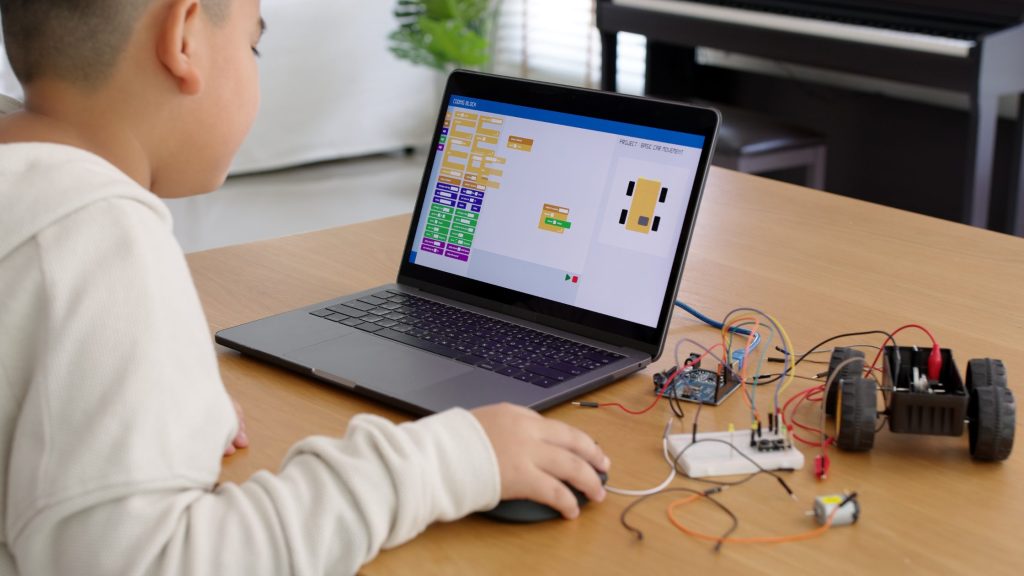
Encourage your children to engage in hands-on projects that require problem-solving. This can involve building and programming robots, creating circuits, or working on DIY electronics kits. Such activities foster creativity, logical thinking, and problem-solving skills.

4. Support their curiosity:

Cultivate your children’s curiosity about technology by answering their questions. While also discussing new technologies, and exposing them to inspiring stories of inventors and innovators. It’s also important to foster an environment where they feel comfortable exploring, experimenting, and asking questions.

5. Encourage critical thinking and problem-solving:

Guiding your children to think critically and approach problems analytically. While also helping them to break down complex problems into smaller, manageable parts and brainstorm potential solutions. And support them in developing problem-solving strategies. Then guide them through the process when they encounter difficulties.

Critical thinking for kids

6. Promote collaboration and teamwork:

Encourage your children to work on technology-related projects with their peers or siblings. Collaboration and teamwork help develop communication skills, foster creativity, and provide opportunities for learning from others.

7. Attend technology-focused events and workshops:

Look for technology-related events, workshops, or camps in your community or online. These can provide your children with exposure to new technologies, opportunities to learn from experts, and chances to interact with like-minded peers.

8. Be a role model:

Demonstrate your own enthusiasm for technology and problem-solving by sharing your own experiences and projects. While also engaging in discussions with your children about technological advancements. And show them how you use technology to solve problems or pursue your own interests.

Remember, it’s essential to strike a balance between technology and other activities. Such as physical play, social interactions, and creative pursuits. Encouraging a well-rounded approach to learning and development will help your children cultivate a broad range of skills and interests.

What parents need to know about ChatGPT

Understanding the responsibility of using these technologies.

As the Metaverse and AI become more prevalent in the business world. It is also essential to be mindful of the potential ethical and societal implications. This is why parents should discuss the importance of data privacy, responsible AI development, and digital citizenship with their children. Doing so to ensure they understand the responsibilities of using these technologies.

The Metaverse and AI are powerful tools that reshape the business landscape. By offering new opportunities for growth and innovation. Parents should be aware of these developments and help their children develop the skills and knowledge necessary to succeed in a world increasingly influenced by these technologies.

How do you teach your child about ChatGPT?

ChatGPT is an exciting tool for anyone interested in natural language processing and AI. But where does ChatGPT fit with education? And how can you teach your child about ChatGPT and this new advancement in technology?

Pick up the Introduction to ChatGPT & Natural Language Processing unit.

Are you ready to show your learner the latest innovative tools? Do you want your learner prepared for a future that may look very different than today? The Schoolio Introduction to ChatGPT & Natural Language Processing course is for you! This unit is perfect for learning together, so don’t be intimidated if the topic is new to you as a teacher!

Introduction to ChatGPT
How to teach ChatGPT to students

Can ChatGPT Do Your Child’s Homework?

Can ChatGPT Do Your Child’s Homework?

Can ChatGPT do your child's homework?

As technology advances, it has become easier for students to complete their homework with the help of artificial intelligence. ChatGPT is a language model that uses deep learning techniques to generate human-like text. It has assisted students in completing their assignments, making homework more accessible than ever. So, can ChatGPT do your child’s homework? 

What is ChatGPT?

ChatGPT is an artificial intelligence language model that uses deep learning techniques to generate human-like text. It was created by OpenAI and is based on the GPT (Generative Pre-trained Transformer) architecture. The model has been pre-trained on a large corpus of text. ChatGPT can generate coherent and contextually appropriate text responding to a given prompt. This has made it a popular tool for natural language processing tasks. Such as language translation, question answering, and text generation. With the help of ChatGPT, students can quickly complete their homework and assignments.

How does ChatGPT work? 

ChatGPT is based on the GPT (Generative Pre-trained Transformer) architecture. It uses a deep learning technique called a transformer network to generate text. The model has been pre-trained on a large corpus of text and can generate coherent and contextually appropriate text in response to a given prompt.

The model works by predicting the next word in a sequence of text based on the previous words. It uses a multi-head attention mechanism to weigh the importance of different parts of the input sequence and a feedforward neural network to process the information. This allows the model to generate grammatically correct and semantically meaningful text.

ChatGPT can be fine-tuned on specific tasks by training it on a smaller dataset of examples. This allows it to generate text tailored to a specific domain or task. For example, it could be trained to generate summaries of scientific articles or to answer questions about a particular topic. With its ability to generate human-like text, ChatGPT has the potential to revolutionize the way students complete their homework and assignments.

What the experts are saying.

LifeWire did a series of interviews with educators and tech entrepreneurs about using ChatGPT in education. Founder of Schoolio Learning, Sathish Bala, shared that “Over-reliance on AI may prevent students from developing critical thinking and research skills. Which are crucial for academic success.” Bala continued, “Therefore, it is crucial to provide students with homework that encourages them to keep honing these skills. While also teaching them how to use AI tools effectively.” in his interview with Lifewire.

Marnix Broer, CEO of Studocu, an online resource centre for children. Shared with Lifewire that “AI can help students learn and complete homework faster. So they can focus more on knowledge-building tasks, like studying, than on data search or organization,” Broer said. “AI can also prevent students from getting ‘stuck’ when working through problems at home. Since they don’t have the help of a teacher close by. Students can use AI to find the answers they need. This extra support can also help even the playing field for students that might not have as much access to parental help as others.”

Read the full article here

How can ChatGPT help students? 

ChatGPT can help students in many ways. One of the most significant benefits is that it can generate grammatically correct and contextually appropriate text. Students can use ChatGPT to complete their homework and assignments quickly and easily. Students struggling to write an essay on a particular topic can use ChatGPT to generate a starting point or complete the entire essay.

Another benefit of ChatGPT is that it can be fine-tuned on specific tasks by training it on a smaller dataset of examples. This allows it to generate text tailored to a specific domain or task. For example, it could be trained to generate summaries of scientific articles or to answer questions about a particular topic.

Ultimately, ChatGPT has the potential to revolutionize the way students complete their homework and assignments. With its ability to generate human-like text, students can use ChatGPT to learn more effectively and efficiently.

What are the cons of using ChatGPT?

While ChatGPT can be a helpful tool for students, there are also potential downsides to using it. One concern is that students may become too reliant on the tool and not develop their writing skills. Additionally, plagiarism is risky if students use ChatGPT to generate entire assignments without adequately citing their sources. It’s also important to note that ChatGPT may not always generate accurate or appropriate responses. It is still an artificial intelligence model, not a human.

How should educators and students use ChatGPT?

Teachers and ChatGPT

There are several ways that students and educators can use ChatGPT effectively.

First, it can help students generate ideas or starting points for assignments. For example, a student struggling to develop a thesis statement for an essay could input their topic into ChatGPT and generate a few options to consider.

Second, ChatGPT can be used to help students learn how to write more effectively. By inputting their writing into ChatGPT, students can receive feedback. This includes feedback on their writing style and grammar, helping them improve their skills.

Finally, educators can use ChatGPT to help students learn how to identify and avoid plagiarism. By inputting passages from existing texts into ChatGPT, students can identify whether their writing is too similar to existing texts and how to cite their sources properly.

Overall, ChatGPT has the potential to be a valuable tool for both students and educators. But it is essential to use it responsibly and in conjunction with other learning resources.

Rethinking homeschool with ChatGPT?