Homeschool Curriculum in Canada: A Comprehensive Guide

Choosing the right homeschool curriculum can feel overwhelming, especially when you’re trying to align it with the educational standards of Canada. Many parents find themselves stuck between wanting a comprehensive program and needing something flexible enough to fit their unique family dynamics. If you’re in this boat, you’re not alone, and there’s a way to navigate this with confidence.

Understanding Homeschool Curriculum in Canada

When it comes to selecting a homeschool curriculum in Canada, the first thing to understand is the provincial guidelines. Each province has its own educational standards, and while homeschooling allows for customization, it’s essential to ensure your curriculum aligns with these standards. This not only helps keep your children on track with their peers but also eases transitions should they ever enter or re-enter the public school system.

For instance, in Ontario, the curriculum guidelines emphasize language arts, mathematics, science, and social studies, while British Columbia includes a focus on indigenous education and environmental stewardship. Understanding these nuances can help tailor your homeschool curriculum to meet provincial expectations.

Several resources, like Schoolio’s Canadian curriculum, offer detailed guides to help you match your homeschooling efforts with provincial expectations. This is a great starting point for parents who want to feel confident in their educational approach.

Benefits of a Canadian-Focused Homeschool Curriculum

Opting for a Canadian-focused homeschool curriculum brings numerous benefits. Firstly, it ensures that your child learns about Canada’s history, geography, and cultural heritage in a way that’s relevant and meaningful. This is particularly important for social studies and history lessons, which can vary significantly from American curricula.

For example, a Canadian curriculum might include detailed studies of the Canadian Confederation, the role of the fur trade in Canadian history, and the significance of the Charter of Rights and Freedoms. These topics not only educate but also instill a sense of national identity and pride.

A Canadian curriculum also incorporates local currency, measurement systems, and environmental studies, making practical applications much easier for children to grasp. These relatable examples help children understand their world better and apply their learning to everyday situations. Imagine your child calculating change using Canadian coins or measuring ingredients for a recipe using metric units—these are practical skills that a Canadian curriculum can enhance.

Customizing Your Curriculum for Family Needs

One of the greatest advantages of homeschooling is the ability to tailor the curriculum to fit your family’s needs. Whether your child is a visual learner or thrives with hands-on activities, you can customize lessons to suit their learning style. This flexibility is particularly beneficial for families with children at different educational levels, allowing each child to progress at their own pace.

To start customizing your homeschool curriculum, consider these steps:

  • Identify your child’s learning style (visual, auditory, kinesthetic). For example, if your child is a visual learner, incorporate more diagrams, videos, and visual aids into their lessons.

  • Choose subjects that interest your child to boost engagement. If your child loves animals, consider including a unit on Canadian wildlife in your science curriculum.

  • Incorporate real-world learning experiences, like field trips and experiments. A trip to a local museum or a nature walk can bring lessons to life.

  • Adjust the pace according to your child’s comprehension and interest. If your child excels in math, allow them to advance quickly, while providing more time for subjects they find challenging.

Resources like Schoolio’s blog offer additional tips and ideas for customizing your curriculum.

Overcoming Common Homeschooling Challenges

Homeschooling presents its own set of challenges, but with the right mindset and resources, they are manageable. One common struggle is maintaining a structured schedule. It’s important to establish a routine that balances academic learning with breaks and extracurricular activities. This helps prevent burnout and keeps learning fresh and engaging.

Another challenge is finding a community. Connecting with other homeschooling families can provide support, ideas, and social interaction for your children. Many cities in Canada have homeschool groups that meet regularly, and online communities are also available. These groups can offer advice, organize group activities, and provide a sense of belonging.

Evaluating Your Child’s Progress

Assessing your child’s progress is fundamental in ensuring the effectiveness of your homeschool curriculum. Unlike traditional schools, where testing is often standardized, homeschooling allows for more personalized assessment methods. Consider using a mix of evaluations such as quizzes, projects, and oral presentations to gauge understanding.

It’s also important to have regular check-ins with your child about their learning experiences. This not only helps you understand their progress but also builds their self-assessment skills, which are valuable for lifelong learning. Encourage your child to reflect on what they’ve learned and discuss any challenges they face.

Choosing a solid homeschool curriculum in Canada doesn’t have to be overwhelming. With resources like Schoolio, you can craft an educational plan that’s both comprehensive and adaptable to your family’s needs. Check out Schoolio’s offerings to see how they can support your homeschooling journey with confidence.

Suggested internal links:

What Is “Math Anxiety” — And How Can You Help Your Child Overcome It?

What Is “Math Anxiety” — And How Can You Help Your Child Overcome It?

If your child melts down at the sight of a math worksheet…

If they freeze when you ask them a basic fact…

If they suddenly “forget everything” during a quiz…

You might be looking at math anxiety.

And no — it’s not the same thing as “being bad at math.”


What Math Anxiety Actually Is

Math anxiety is a stress response.

Not a knowledge gap.

Not laziness.

Not a lack of intelligence.

It’s what happens when your child’s nervous system associates math with pressure, shame, embarrassment, or repeated failure.

When the brain senses threat, it shifts into survival mode.

And here’s the tricky part:

The same part of the brain used for problem-solving (working memory) is the part that shuts down under stress.

So when a child says,

“I don’t know how to do this!”

Sometimes what they really mean is,

“My brain is offline right now.”

The anxiety blocks access to the skills they may actually have.


Where It Comes From

Math anxiety can develop from:

  • Timed tests

• Public correction in class

• Repeated low scores

• Moving too quickly through concepts

• Comparing themselves to peers

• Being told they’re “not a math person”

For neurodivergent kids — especially those with dyscalculia, ADHD, processing delays, or perfectionism — math anxiety is even more common.

If numbers are already harder to process, and then you layer time pressure or shame on top?

The brain starts to brace for math like it’s a threat.

And once that association forms, even opening the book can trigger it.


Signs You Might Be Seeing Math Anxiety

It doesn’t always look dramatic.

Sometimes it looks like:

  • Avoidance

• “Bathroom breaks” during math

• Complaints of headaches or stomach aches

• Tears over “easy” problems

• Perfectionism and erasing constantly

• Rushing to get it over with

• Refusing to try at all

The child isn’t being dramatic.

Their nervous system is trying to protect them.


How to Help

The goal isn’t to make math wildly entertaining.

The goal is to make it feel safe.

1. Slow It Down

If a concept is supposed to take one day, let it take a week.

Mastery builds confidence.

Speed builds stress.

You are not on a clock.


2. Remove the Time Pressure

Timed drills are a huge trigger for many kids.

Accuracy matters more than speed.

You can build fluency gradually — without a stopwatch.


3. Make It Concrete

Abstract numbers on paper can feel overwhelming.

Use:

  • Lego

• Baking

• Measuring cups

• Money

• Cutting food into fractions

• Building arrays with blocks

Touching math reduces fear.


4. Normalize Struggle

Be careful with language like:

“You’re so smart!”

Because when they struggle, they’ll think,

“Then why can’t I do this?”

Instead try:

“This is hard — and you’re working through it.”

“Struggling means your brain is growing.”

“We can take this one step at a time.”

Effort over identity.


5. Separate Their Worth from the Score

A low score is information.

Not a verdict.

If your child works for 60 hard minutes and gets 50%, that effort matters — even if the system doesn’t reward it.

Math is a skill.

Not a measure of intelligence.


The Long Game

Most adults use calculators.

Most adults look things up.

Most adults don’t solve equations under time pressure.

What they do need is perseverance.

Confidence.

The belief that they can face something hard and figure it out.

That’s what you’re building.

And that doesn’t come from pushing harder.

It comes from lowering fear.

Math anxiety can absolutely improve.

But it improves when the nervous system feels safe enough to try.

And if you’re reading this because you’re worried?

That tells me something important.

You care.

And caring is the foundation of everything that works.

? Lindsey

certified special-ed educator & co-founder, Schoolio

What Non Homeschoolers Need to Understand

What Non Homeschoolers Need to Understand


This has been on my mind today…

I saw a post that said homeschooling ends bullying, pointless peer pressure, and the undermining of family values.

Strong statement.

Whether someone agrees or not, here is what I think non homeschoolers need to understand.

For many families, this decision is not ideological. It is protective.

When I was growing Schoolio, I spoke to thousands of parents. Not angry parents. Not radical parents. Exhausted parents. Parents watching their child shrink. Parents watching anxiety spike. Parents watching confidence erode.

Bullying is real. Social pressure is real. Feeling misaligned with the environment is real.

Does homeschooling magically eliminate all of that? No.

But for some families, it changes the environment enough that their child can breathe again.

And that is what often gets missed in the debate.

It is easy to critique homeschooling from the outside. It is harder to sit across from a parent whose child dreads every morning.

You do not have to choose homeschooling to appreciate why someone else does.

At its best, it is not about escaping school.

It is about restoring stability, identity, and confidence in a child who was struggling inside a system that did not fit.

That deserves more understanding, even from those who would never choose it themselves.

Sathish

still learning, still unlearning

How We Took the Fear Out of Math (Without Making It a Game Show)

How We Took the Fear Out of Math (Without Making It a Game Show)

Math has a reputation in a lot of neurodivergent households.
 
Tears.
Avoidance.
Stomach aches.
Instant shutdown.
 
And I get it.
 
When numbers don’t click easily — especially with dyscalculia, ADHD, processing differences, or math anxiety layered on top — math can feel like a daily threat instead of a skill.
 
For a long time, I thought the solution was to make math “fun.”
 
More games.
More flashy activities.
More attempts to disguise it.
 
But here’s what I learned: Math doesn’t need to be a circus.
 
It needs to feel safe.
 
The Week We Slowed Fractions Way Down
 
One year, we were working on fractions. We were struggling. The kids didn’t get it. I don’t blame them, I’m not great at it either.
 
Instead of continuing to push at that one lesson, I decided we needed to slow everything down and turn one Schoolio lesson and a worksheet, into a full week of understanding.
 
Monday:
We watched the lesson video. Just the concept. No pressure to perform.
 
Tuesday:
We made mini pizzas in the kitchen.
Cut them into halves. Quarters. Eighths.
 
We talked about which pieces were bigger. Which were smaller. Added pieces together.
 
We ate the evidence.
 
Wednesday:
We did the printable worksheet.
Nothing fancy. Low pressure. On the couch. Just gentle practice.
 
Thursday:
We pulled out the Lego.
Built wholes. Broke them into parts. Compared pieces.
 
Friday:
We went back to the original lesson and did the quiz.
Not as a threat — but as a check-in.
 
Did it stick?
Sometimes yes.
Sometimes we needed another week.
And that was okay.
 
Concrete First. Abstract Later.
 
For a lot of neurodivergent kids, abstract math feels slippery.
Numbers on a page don’t mean much.
 
But pizza does.
Lego does.
Cutting something real into real pieces makes fractions tangible.
And once something is tangible, it’s less scary.
 
Less scary means less resistance.
Less resistance means more learning.
 
Predictability Lowers Anxiety
 
The other thing that helped?
Predictability.
 
Math wasn’t a surprise attack.
 
It wasn’t:
“Quick, do this worksheet before you melt down.”
 
It had rhythm.
 
Concept → hands-on → practice → reinforce → assess.
 
That pattern lowered anxiety because they knew what was coming.
 
When the nervous system isn’t bracing for impact, the brain has space to think.
 
It Doesn’t Have to Be Entertaining to Be Gentle
 
Here’s something important:
We didn’t turn math into a game show.
There were no prizes. No countdown clocks. No glitter explosions.
 
We just slowed it down.
We made it concrete.
We made it predictable.
And we removed the pressure to rush.
 
Math doesn’t need to be constantly “fun.” It’s ok to teach our kids that some things in life are hard, but still worth doing.
 
But it should never feel like trauma.
 
There’s a huge difference between effort and fear.
 
I’m okay with effort.
I’m not okay with fear.
 
The Goal Isn’t Speed
 
In traditional classrooms, math often moves fast.
 
New concept. Practice. Test. Move on.
 
But when a child struggles with numbers, speed becomes the enemy.
 
So we changed the metric.
Not: “How fast can you get this done?”
But: “Do you understand it?”
 
And if the answer was no?
 
We stayed.
No shame.
No panic.
No race.
Just peaceful.
 
Because confidence in math doesn’t come from getting everything right.
 
It comes from surviving hard concepts and realizing you can figure them out. Even if it takes time. Even if it’s hard. It’s learning that slowing down isn’t an enemy of progress.
 
If math feels heavy in your house, try this:
 
Stretch one concept across a week.
Touch it. Build it. Eat it. Break it apart.
 
Lower the pace before you try to raise engagement.
 
Sometimes the fear leaves first.
And learning follows.
 
? Lindsey
 
certified special-ed educator, homeschool mom, & co-founder of Schoolio


Slow Is Not Falling Behind — Especially for Neurodivergent Kids

Slow Is Not Falling Behind — Especially for Neurodivergent Kids


This is something I wish someone had told me in my first year of homeschooling:

Finishing fast is not the goal.

Especially not for neurodivergent kids.

Somewhere along the way, we absorbed this idea that productivity equals progress. That if we aren’t moving quickly through curriculum, checking off lessons, advancing units, we must be falling behind.

Behind who?

Behind what?

Behind a system we left?

When you’re homeschooling an autistic, ADHD, dyslexic, AuDHD, or otherwise neurodivergent child, pace is not a moral issue. It’s a nervous system issue.

And slow is not a flaw.


When “Four Lessons” Becomes Ten Days

Our writing courses, for example, are typically structured in four parts:

Lesson One: Brainstorming

Lesson Two: Writing day one

Lesson 3: Writing day two

Lesson 4: Editing

On paper, that’s four days.

In real life?

It might be ten.

And that’s okay.

If your child can only focus for fifteen solid minutes before their brain taps out, stretching one writing lesson across multiple days isn’t lowering the bar.

It’s protecting their capacity.

It’s teaching them that writing doesn’t have to feel like drowning.

I would rather see one writing assignment completed thoughtfully, with pride and confidence, than three rushed through with frustration and shutdown.

One done well is more valuable than three done miserably.

Every single time.


Productivity Culture Sneaks Into Homeschooling

Even when we leave traditional school, we bring its pace with us.

We feel pressure to “stay on track.”

We worry about being “behind.”

We compare how much we’ve covered.

But coverage is not comprehension.

Speed is not mastery.

And volume is not engagement.

Neurodivergent kids often need:

  • More repetition (or less redundancy!)
  • More breaks
  • More sensory regulation
  • More autonomy
  • More recovery time
  • More learning time dedicated to Social Skills and Emotional Intelligence

If we measure success by how much we completed, we miss the more important questions:

Did it stick?

Do they feel confident?

Are they emotionally regulated?


Engagement Beats Volume

When a child works at a sustainable pace, something powerful happens.

They stay willing.

They don’t start to hate the subject.

They don’t associate learning with shame or overwhelm.

They build confidence instead of resistance.

That’s not falling behind.

That’s building foundation.

And foundation matters more than speed.


Pace Is a Tool — Not a Rule

Curriculum pacing guides are suggestions.

Not contracts.

Not deadlines.

Not moral benchmarks.

If your child needs:

  • Three days for one math concept
  • Three weeks for a writing assignment
  • To read one chapter a day instead of three
  • A full pause during a hard life season

That is not failure.

That is responsive parenting.

That is adaptive education.

That is you paying attention to the human in front of you.


What Actually Matters

At the end of the year, I don’t ask:

“How many units did we finish?”

I ask:

Is my child still curious?

Do they feel capable?

Are they willing to try again tomorrow?

Because a happy, engaged child who trusts themselves as a learner will always outpace a burned-out child who learned to rush for approval.

Mastery beats completion.

Engagement beats volume.

Joy beats speed.

Slow is not behind.

Slow is intentional.

Slow is sustainable.

Slow is often exactly what neurodivergent kids need.


? Lindsey

certified special-ed educator, homeschool mom, & co-founder of Schoolio

Why More Parents Are Choosing Homeschooling Even When It Was Never the Plan

Why More Parents Are Choosing Homeschooling Even When It Was Never the Plan


This has been on my mind today…

I read a story recently about a parent who never planned to homeschool. It was not ideological. It was not a protest. It was not about rejecting school. It was simply about responding to a child who was struggling in ways that could no longer be ignored.

That story keeps echoing because it sounds like so many families I speak to.

The decision to homeschool is often framed as a bold choice or a radical one. In reality, for many parents, it is a quiet pivot. A moment where they realize that what is supposed to be working simply is not. Their child is anxious. Or exhausted. Or shutting down. Or falling behind while being told they are doing fine.

What struck me most was how ordinary the story was. No dramatic failure. No single breaking point. Just a slow accumulation of signs that school was costing more than it was giving.

This is something we do not talk about enough.

We talk about grades. We talk about outcomes. We talk about standards. But we rarely talk about the emotional tax school can take on a child who learns differently or feels out of place. We rarely talk about how long parents sit with doubt before making a change. Or how much guilt comes with admitting that the default path might not be the right one for your child.

Homeschooling, in these stories, is not about pulling kids away from the world. It is about bringing learning closer to who they are. It is about restoring confidence. It is about slowing things down long enough for curiosity to return.

Many of these parents still value structure. They still value rigor. They still care deeply about education. They are not opting out. They are opting in differently.

What keeps coming up is this idea of safety. Not physical safety, but emotional safety. The freedom to ask questions without fear. The space to make mistakes without labels. The ability to learn at a pace that does not constantly signal failure.

This is where homeschooling becomes less about location and more about intention.

At schoolio, we see this pattern over and over. Families who did not start out wanting to homeschool. Families who simply wanted their child to feel capable again. Families who wanted learning to stop being a daily battle.

Homeschooling is not a punishment. It is not giving up. It is not settling for less. For many families, it is a way to rebuild trust in learning itself.

Every child has a relationship with education. When that relationship is damaged, it needs care. Sometimes that care looks like staying and advocating. Sometimes it looks like stepping back and rebuilding at home.

What matters most is that we stop pretending there is only one right way.

Homeschooling is not for everyone. But for the families who choose it, often unexpectedly, it is not about escaping school. It is about choosing their child.


Sathish

still learning, still unlearning

Kintsugi

Kintsugi


This has been on my mind today…

There is a Japanese art form called Kintsugi. When a bowl or cup breaks, it is not thrown away. The pieces are carefully put back together, and the cracks are filled with gold. The repair is not hidden. It is highlighted. The object becomes more valuable because it has been broken and repaired with care. The story becomes part of its beauty.

I think about that a lot when I reflect on my own life. I also think about it when I look at the families we support through homeschooling and the work we are building at Schoolio.

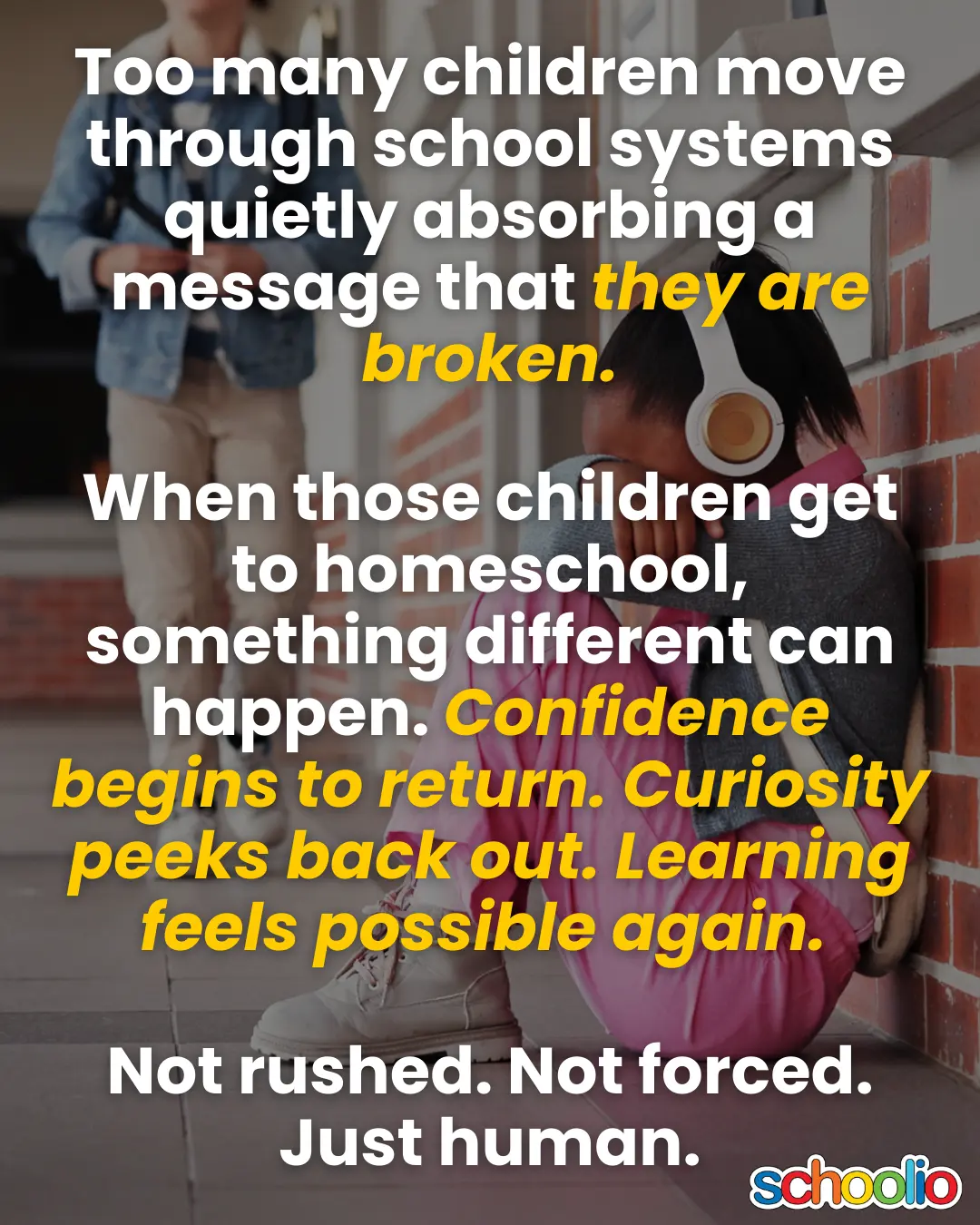
Too many children move through school systems quietly absorbing a message that they are broken. Not always through words, but through looks, labels, meetings, and expectations. They are told to sit still when their bodies want to move. To keep up when they need time. To fit into systems that were never designed for how they learn. Eventually, many of them begin to believe that something is wrong with them.

When those children come home, something different can happen. With patience, care, and attention, the pressure starts to lift. Confidence begins to return. Curiosity peeks back out. Learning feels possible again. Not rushed. Not forced. Just human.

But here is the part that matters most to me. Healing should never feel like hiding.

Homeschooling should not feel like punishment or retreat. It should not feel like we are sweeping children out of sight. It should feel like kintsugi. A celebration of the whole child. A recognition that learning differently does not mean learning less. It means learning in a way that honors who they are.

At Schoolio, we see this every day. Children who were once labeled as struggling begin to thrive when the pressure is removed and the support is real. When learning adapts to them instead of asking them to adapt to it. When their cracks are not erased, but respected.

Every student who leaves a system that did not serve them carries an incredible story. Those cracks are not flaws. They are experiences. When they are filled with care, trust, and belief, something stronger is created. Something more meaningful than what existed before.

That is what homeschooling can be.

That is what Schoolio is working toward.

Not fixing children, but honoring them.


Sathish

still learning, still unlearning

When Homeschooling is Healing, Not “Fixing”

When Homeschooling is Healing, Not “Fixing”


This has been on my mind today…

There is a Japanese art form called kintsugi. When a bowl or cup breaks, it is not thrown away. The pieces are carefully put back together, and the cracks are filled with gold. The repair is not hidden. It is highlighted. The object becomes more valuable because it has been broken and repaired with care. The story becomes part of its beauty.

I think about that a lot when I reflect on my own life. I also think about it when I look at the families we support through homeschooling and the work we are building at Schoolio.

Too many children move through school systems quietly absorbing a message that they are broken. Not always through words, but through looks, labels, meetings, and expectations. They are told to sit still when their bodies want to move. To keep up when they need time. To fit into systems that were never designed for how they learn. Eventually, many of them begin to believe that something is wrong with them.

When those children come home, something different can happen. With patience, care, and attention, the pressure starts to lift. Confidence begins to return. Curiosity peeks back out. Learning feels possible again. Not rushed. Not forced. Just human.

But here is the part that matters most to me. Healing should never feel like hiding.

Homeschooling should not feel like punishment or retreat. It should not feel like we are sweeping children out of sight. It should feel like kintsugi. A celebration of the whole child. A recognition that learning differently does not mean learning less. It means learning in a way that honors who they are.

At schoolio, we see this every day. Children who were once labeled as struggling begin to thrive when the pressure is removed and the support is real. When learning adapts to them instead of asking them to adapt to it. When their cracks are not erased, but respected.

Every student who leaves a system that did not serve them carries an incredible story. Those cracks are not flaws. They are experiences. When they are filled with care, trust, and belief, something stronger is created. Something more meaningful than what existed before.

That is what homeschooling can be.

That is what schoolio is working toward.

Not fixing children, but honoring them.


Sathish

still learning, still unlearning

Homeschooling Isn’t a Competition — It’s an Alignment

Homeschooling Isn’t a Competition — It’s an Alignment


I saw this passage today and it hit me hard.


Your life will change when you understand this


“You are only ever competing against one thing — your own self-doubt.”

When I think about homeschooling families, this couldn’t be more true.

So many parents start this journey filled with doubt. Am I enough? Am I doing it right? What if my child falls behind?
But the families who thrive — the ones I see at Schoolio every day — aren’t necessarily the most organized, experienced, or well-resourced.

They’re simply the ones who believe they can do this.

Who trust that learning at home, in their own rhythm, is enough.
They drop the competition mindset. They stop comparing their kids to traditional classrooms. They stop chasing grades and start building connection.

Homeschooling isn’t about outperforming anyone. It’s about aligning — with your child, your values, and the kind of life you want to build together.

When families stop trying to “fit in” and start trusting themselves, everything changes.
What you seek — confidence, peace, connection — is already seeking you.

Sathish
Still learning, still unlearning

The Night-Time Spiral

The Night-Time Spiral


It’s always at night, isn’t it? The house is quiet. Everyone’s asleep.

Except you.

The worrying… it creeps in so easily when you’re homeschooling. You start wondering…

Are we doing enough?

Are we behind?

Are they really learning?

What if they’d be better off in school?

Before you know it, you’re spiraling.

I know those nights too well.

So many nights, I’d lie awake, scrolling through Pinterest activities and curriculum reviews at 1 a.m., wondering if maybe this one will be the fix we need to make me feel confident we were “on track”. Replaying the day in my head- the math lesson that ended in tears, the half-finished writing assignment, the forgotten science experiment-  and convincing myself I was failing.

We’d never catch up.

I’d ruined their lives by homeschooling them.

Why had I ever thought that I could do this?

The self-talk… it gets bad in the still of the night, doesn’t it?

But here’s something I’ve learned after years of homeschooling and many of my own late-night spirals:

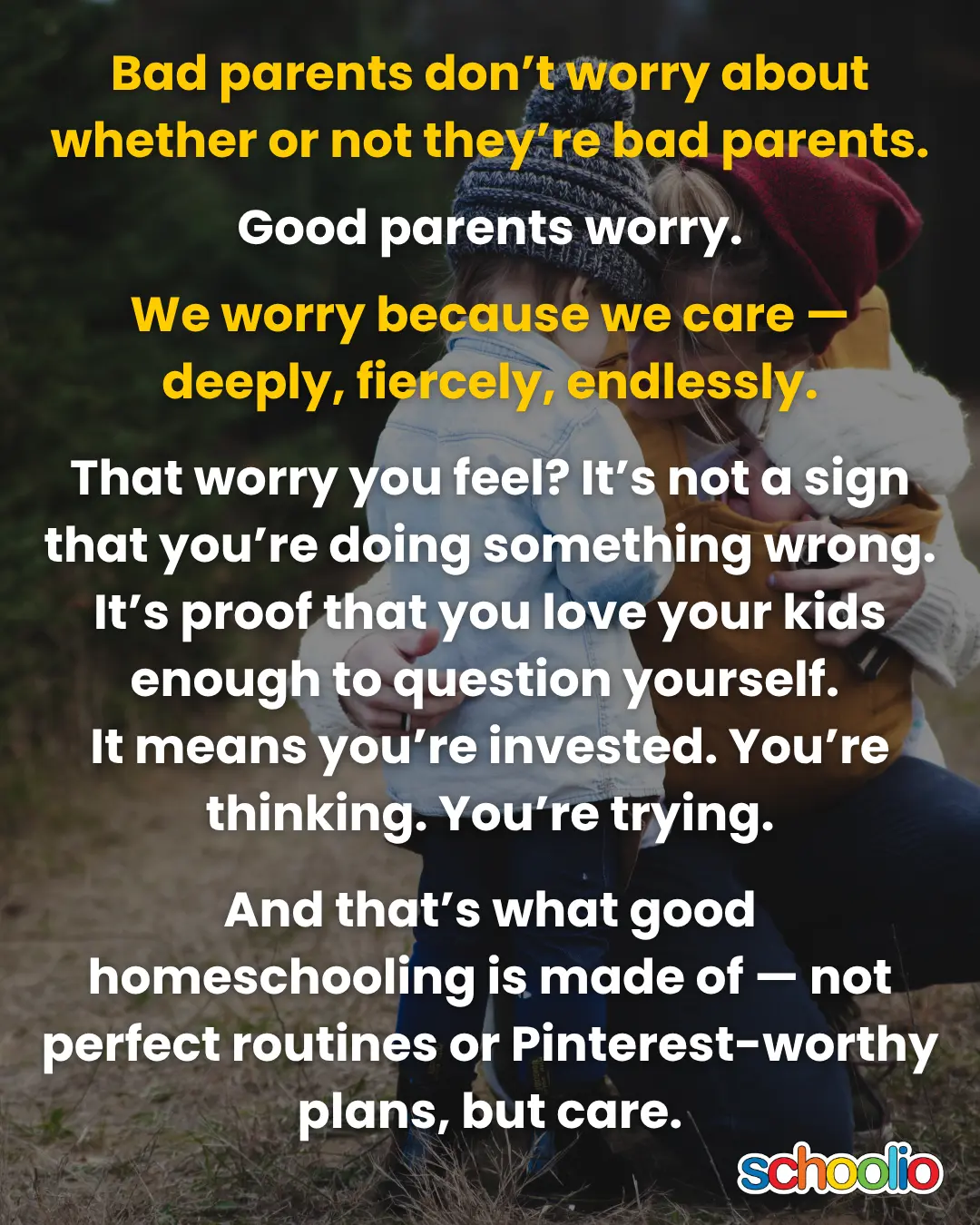
Bad parents don’t worry about whether or not they’re bad parents.

Good parents worry.

We worry because we care — deeply, fiercely, endlessly.

That worry you feel? It’s not a sign that you’re doing something wrong. It’s proof that you love your kids enough to question yourself. It means you’re invested. You’re thinking. You’re trying.

And that’s what good homeschooling is made of — not perfect routines or Pinterest-worthy plans, but care.

Every good parent I know worries about whether they’re doing it right.

Every good homeschooler I know questions if they’re doing “enough”.

It’s part of the process.

But try to reframe that worry the next time it sneaks up on you in the quiet hours. Instead of letting it spiral into fear, remind yourself what it really means:

You care enough to notice.

You care enough to show up.

You care enough to want the best for your kids.

And caring that much — that’s the heart of everything that matters.

So take a breath.

You’re not failing. You’re loving.

And that’s exactly what they need most.

Lindsey
Certified Special Ed Educator & Co-Founder, Schoolio

The Quiet Wins That Matter Most

The Quiet Wins That Matter Most


This has been on my mind today…

Some days, the work feels heavy. You’re building something that doesn’t yet exist. A platform that reimagines education, reshapes how kids learn, and gives power back to the people who’ve been left out of the conversation for too long—parents, students, and those who learn a little differently.

You push through meetings, plans, deadlines, product reviews. You tweak systems, question decisions, and hold the big vision in your mind like a lighthouse, even on foggy days. But once in a while, something cuts through all that noise. A comment. A thank-you. A message that reminds you why you started this in the first place.

That happened to me recently.

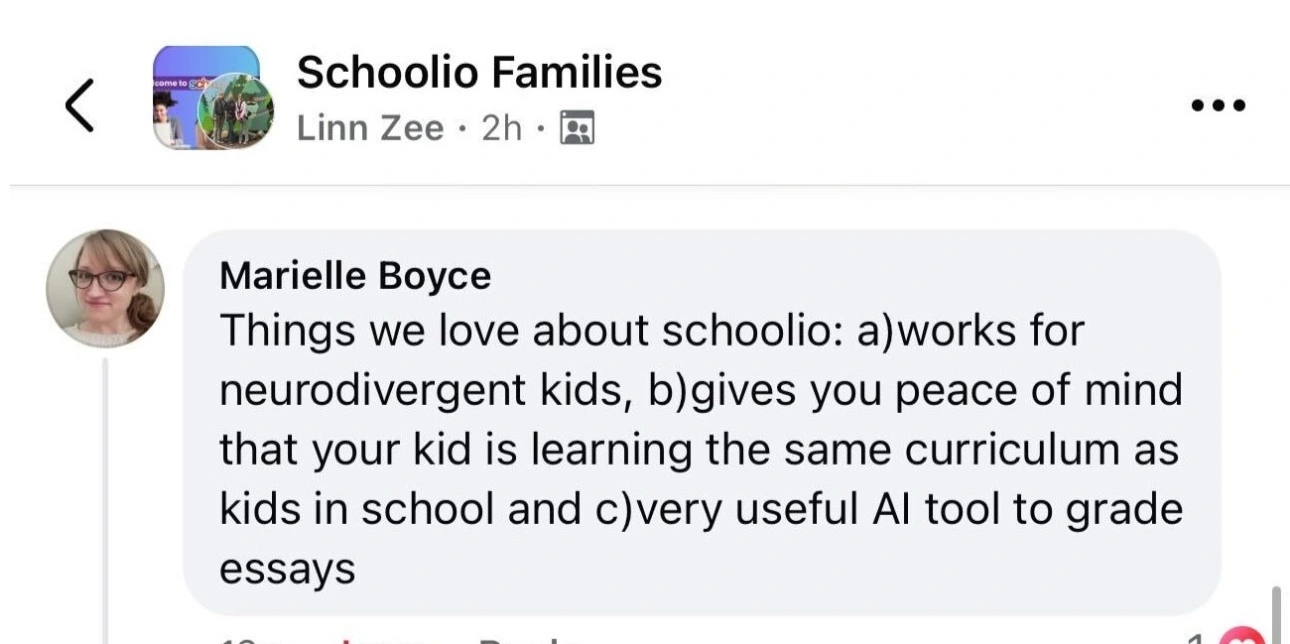
A parent shared a short post in our Schoolio Families group. Just a few lines. No hashtags. No fuss. Just truth.She said she loved Schoolio because it works for her neurodivergent child. Because it gives her peace of mind knowing her kid is learning the same curriculum as students in traditional school. And because the AI tools helped with grading essays.


Customer Testimonial

Simple. Direct. But when I read it, it stopped me.

Because that right there is the quiet win that matters.

She didn’t say we changed her life. She didn’t say we were perfect. What she shared was something more real. She shared relief. Confidence. Stability. The kind of stability every parent needs, but especially the ones who are walking a different path.


The truth is, a lot of the parents we serve never wanted to homeschool. They weren’t planning for it. It wasn’t on their vision board. But something shifted—maybe a bad experience at school, a child’s needs not being met, or just a gut feeling that things weren’t working.

And now they’re here, trying to do what’s best for their child, even when the world questions them for it.

This is what we built Schoolio for. For that parent who lies awake at night wondering if they’re doing enough, for the child who learns better with space and silence, for the families that don’t see themselves in glossy brochures or test scores and for the moments when a tool actually helps and no one has to fight for it.

You don’t always get to see the impact of your work. You don’t always hear how it lands. But every now and then, someone like Marielle speaks up and says, This helped. And for me, that’s everything.

Because this isn’t just about curriculum or platforms or AI tools. This is about building something that lets families breathe again. Something that says: you’re not alone. You’re not wrong. And yes, you can do this.

That’s the win I hold onto today.


Sathish

still learning, still unlearning

Fostering Confidence: A Learning Platform’s Role

Fostering Confidence: A Learning Platform’s Role

Fostering Confidence: A Learning Platform’s Role

In the growing-up journey, one attribute holds immeasurable significance: self-confidence. From the earliest years of childhood to the critical stages of adolescence, building self-confidence becomes pivotal in shaping a child’s future. It is the pillar upon which their dreams and aspirations rest, playing a critical role in their academic and life success. The importance of self-confidence is evident, as its absence can lead to myriad challenges, especially in education. Let’s discuss fostering confidence: a learning platform’s role.

The Crucial Link Between Grades and Self-Confidence

Academic performance is often intertwined with self-esteem for children and young learners. Lower grades and learning gaps can severely affect a child’s self-confidence. When students face difficulties grasping academic concepts, they might experience self-doubt and frustration, which, if left unaddressed, can lead to a negative self-image. A lack of self-confidence can hold them back, making them reluctant to participate in class, ask questions, or even take on new challenges.

This is where digital learning platforms like the Schoolio Digital Platform come into play, offering a lifeline to bolster self-confidence in young learners.

Fostering Confidence: A Learning Platform’s Role

1. Personalized Learning Plans:

Personalized Learning

Digital learning platforms like Schoolio, IXL, Prodigy, Time4Learning adapt to individual learning needs. By tailoring content to each student’s level and pace, it ensures that learners receive the right challenges and support, boosting their confidence as they progress at their own rate.

2. Immediate Feedback:

Immediate feedback

Digital platforms offer instant feedback, highlighting areas of improvement. This real-time guidance helps students promptly identify and address their weaknesses, preventing self-esteem from plummeting due to prolonged struggles.

3. Interactive Learning:

Interactive learning

Learning through digital platforms can be highly engaging. Interactive lessons, quizzes, and games make learning enjoyable, which can help students feel more confident and enthusiastic about their studies.

4. Progress Tracking:

These platforms provide tools for tracking one’s progress. Seeing tangible improvement can boost students’ self-esteem by providing evidence of their growth and mastery of various subjects.

5. Safe and Supportive Environment:

Digital learning can be less intimidating than traditional classroom settings. It allows children to learn at their own comfort levels, free from the fear of judgment or comparison with their peers.

6. Access to Resources:

Access to Resources

Digital learning platforms offer a vast library of resources and materials, ensuring students can access comprehensive educational content. This availability empowers students to explore topics they are passionate about, further boosting their confidence.

7. Independence and Autonomy:

Digital learning encourages self-directed learning. As students take control of their learning journeys, they develop a sense of independence and autonomy, strengthening their self-confidence in their ability to take charge of their education.

Schoolio Digital Platform: Bridging Learning Gaps and Boosting Confidence

The Schoolio Digital Platform stands out as a game-changer in today’s educational landscape. It excels in bridging learning gaps and nurturing self-confidence in young learners. Through personalized learning plans, immediate feedback, interactive lessons, and a wealth of resources, Schoolio empowers students to take control of their education, building their self-confidence. By addressing individual needs, providing ongoing support, and creating a safe and engaging learning environment, Schoolio enables students to grow academically and personally.

Schoolio Digital

Digital learning platforms like Schoolio play a crucial role in fostering confidence in children. They provide the tools and support for students to overcome learning gaps and thrive in their educational pursuits. With the proper foundation and a boost in self-confidence, young learners are better equipped to face the challenges, ensuring a brighter future and a stronger sense of self-worth.