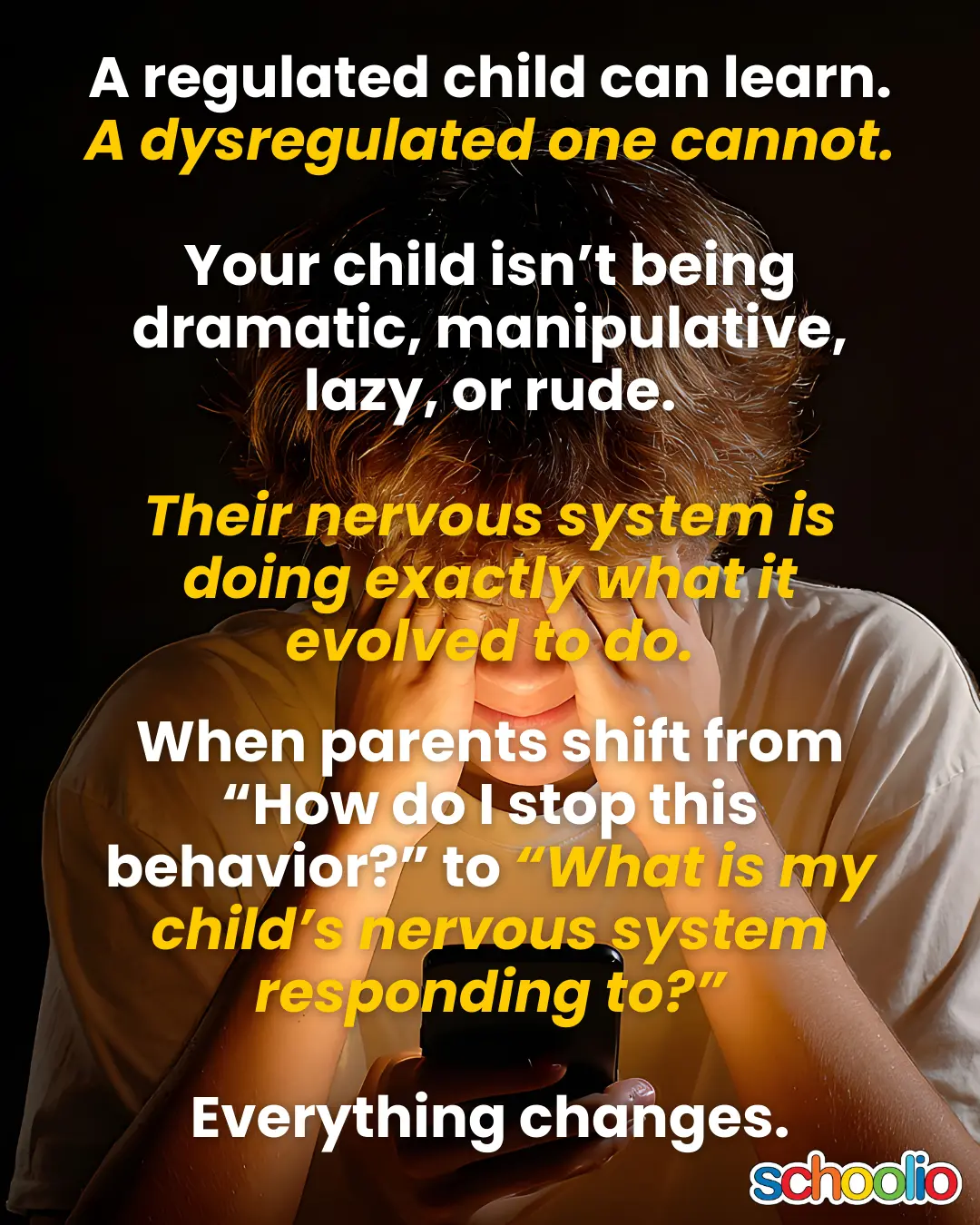
Is school giving your child anxiety? Read the following short story and decide.
It’s morning, and you just spilled your coffee all over the counter because you forgot to put a mug underneath the coffee spout. You finally got the coffee disaster cleaned up, only for your youngest child to spill their cheerios all over the floor. The dog has started to devour all the cheerios off the floor, then promptly begins to vomit it all up.
All the while your oldest child has been following you around because she wants to tell you about how her friend stole her idea for a robot that serves ice cream in their imagination world. With all the chaos going on around you, you glance over at your middle child who is dressed, hair brushed, eaten her breakfast and put her bowl in the sink. You love that your middle child is so self-efficient because on days like this, it’s just so helpful.
Then you look at the clock and realize that your kids are officially late for school drop off.
So, you quickly rush them out the door, yelling “We’re late, we’re late, we’re late!” You hustle everyone to the van like some sort of weird celebratory parade that you do every morning. Finally, you get to the school and say the famous mom words “Love you! Have a good day!” Off goes your oldest child and your youngest. You glance in the very back of your van to notice that your middle child appears to be glued to her seat. “You better go honey, you’re already late.” But she doesn’t move.
You mumble in frustration as you head to the side door to open it to get her out. “Come on, this isn’t like you! Let’s go!” Still she seems frozen in place. “What’s wrong? Are you sick?” You ask in confusion. “I think I am mommy. My tummy is hurting so bad.” You encourage your child that she’s ok and that she needs to go to school. Still your sweet little one appears to be uneasy, and afraid.
Finally, she gets out of the van.
Cars behind you in the drop-off line are now honking their horns in impatience. “Ok! You need to go now!” But still, she is holding onto your hand as if there’s a terrifying monster standing in front of her. ‘What is happening?’ You ask yourself. She was fine this morning, she’s always the one that seems to just do what she needs to. Why is she acting like this? You then decide to just take her home with the assumption that she’s experiencing a tummy bug. Then when you get her home, she’s fine. The next day repeats itself, only this time she’s crying in the backseat, shaking with fear. Unfortunately, you feel that you must be tough on her and get her to go. Because, well, it’s school! She can’t miss it.
What’s going on in this situation?
Anxiety. Although we like to think that our children won’t be affected by anxiety and depression, that’s simply not the truth. In fact, children are just as vulnerable as adults to suffer from anxiety. In fact, according to the CDC: “7.1% of children aged 3-17 (approximately 4.4 million) have been diagnosed with anxiety.” CDC – Children’s Mental Health
“70% of mental health problems have their onset during childhood or adolescence.” – Youth Mental Health Canada.
In Canada it is estimated that 1.2 million children and youth in Canada are affected by mental illness. View Youth Mental Health Canada. According to the Canadian Mental Health Association – British Columbia Division – The most common illness to affect children and youth is anxiety. In Canada it’s estimated that 6% of kids will experience an anxiety disorder at some point. Mental Illnesses in Children and Youth – Canadian Mental Health Association.
The number of children struggling with their mental health is alarming, but what’s more so alarming? The fact that despite these high volumes, less than 20 percent will be able to receive the right treatment for them.
Is school giving your child anxiety?
Some children have been known to struggle with anxiety that is related to school. Some triggers include: Bullying or conflicts with other students, test anxiety, academic pressures, a new teacher, riding the school bus, a specific class or subject. There are many different factors that can trigger anxiety when it comes to school.
Many families are able to identify the very reason why their child is facing a heavy weight of anxiety when it comes to school. However, some children are able to hide their anxiety. Or act out in other ways, causing families to assume there is something else that is affecting their child. In some cases, children really can’t identify the concern or fears that they have around school.
If your child is struggling with anxiety and school, or is refusing to go to school. It’s really important that you find out if your child is being bullied, if they have other medical problems, pain or some other serious issue. Whatever you suspect, it’s always important to meet with the school, and a family physician to be sure. When you’re questioning ‘Is school giving my child anxiety?’
What are some signs and symptoms of school anxiety?
Emotional Symptoms can include:
- Anxiety/fear/excessive worry
- Irritability
- Anger
- Embarrassment
- Loneliness
- Sadness
Physical Symptoms can include:
- Frequent Urination or diarrhoea
- Headaches
- Muscle tension/pain
- Dizziness/light headedness
- Pounding/Racing Heart
- Shaking or trembling
- Feeling short on breath
- Stomach-aches or a painful abdomen
- Vomiting
Behavioural Symptoms can include:
- Being overly clingy, not wanting to separate from their parent.
- Crying and tantrums.
- Incessant complaining.
- Not turning in their homework.
- Frequent calls or texts to parents.
- Skipping class or even cutting school.
- Lying about circumstances or feelings.
- Trouble concentrating.
- Isolation from others.
Some thoughts that your child might be thinking:
‘What if the other kids laugh at me?’
‘Why do I have to go to school anyway?’
‘I’m not good at school. I fail.’
‘What if daddy forgets to pick me up?’
‘If I fail this test my mom will be mad at me.’
‘What if I throw up in class?’
‘I don’t like recess, it’s cold and I get scared of a thunderstorm.’
‘I just want to be home in my room.’
Are you asking yourself how this happened?
‘My child was fine and suddenly just started to not be ok at school. What did I do wrong?’ First of all, don’t blame yourself. Parental guilt will only make you and your child feel worse. Is school giving your child anxiety? Was it something else? The important thing is, to find healthy steps to move forward from here.
Let’s take some solid steps to help your child that is struggling with anxiety and school.
The first step is to identify any potential triggers.
Look for the triggers that might’ve started this decline with anxiety and school. Is your child being bullied or struggling with peers? Did your child just get a new teacher or has a harsh teacher? Does your child struggle with tests? Have you noticed your child’s anxiety to be much worse since covid? Perhaps the fear of catching the disease, or wearing masks, or lockdowns, has caused them to feel a large amount of fear? Find out what could potentially be triggering these feelings.
Second, notice if they’ve been trying to tell you about their anxiety in other ways.
Anxiety can be really scary, especially for a little person who doesn’t understand what they’re feeling. Has your child previously said phrases like: “The work is too hard!” “I can’t concentrate in class.” “It’s so tiring, I hate it.” “I’m going to fail the test.” “I don’t fit in.” “I saw someone getting bullied.” “Joey keeps making fun of my clothes.” These phrases and concerns aren’t just complaints. Sometimes they can be cries for help. If your child brings any of these complaints to you, always dig a little deeper to see what the root cause is.
Third, ask more questions.
If your child has brought up concerns like those above, ask lots of questions! Even if your child is rolling their eyes at you. While pretending that you’re annoying them, you aren’t. Most kids actually enjoy your interest in them and in their day. If your child hasn’t brought up any concerns, but you can just tell that they are feeling off – ask questions. Even if your child seems totally normal, ask questions. Dig deeper. Teaching your kids that it’s good to talk, and that it’s good to bring up their concerns – is so healthy.
Fourth, reach out to their school.
If your child is struggling in any area with school. Then reaching out to their school is imperative as working with their educational team is so important. Most schools and teachers are more than accommodating when it comes to mental health. So if you are wondering ‘is school giving your child anxiety?’ then this is an excellent step to take.
Fifth, give your kid a ‘Worry Journal’.
What’s a worry journal? It’s a place where they can write down all of those big, scary, feelings, that are causing their struggles. In the worry journal, they can write, draw, or doodle. Really, whatever they want. It’s their journal, and they can utilize it to express their feelings in whatever way seems best for them.
Sixth, find helpful coping strategies to help your child.
There are so many amazing programs out there that are fully capable of helping your child navigate on those tough days. Including our very own Emotional Intelligence: Managing My Emotions special interest unit. With this special interest unit your child will learn about why it’s just as important to take care of our minds as it is to care for our bodies.
What else will they learn?
They will also learn ways to name and describe common “unhelpful thoughts” that lead them down thought paths which make them less happy. And lessons on the S.T.O.P.P. strategy for regaining control and assessing the situation when their emotions are high. Along with management tools for runaway thoughts, and how to control their reactions. They’ll also learn lessons about calming strategies, for when they need to gather themselves and regain control of their emotions.
Click here to learn more about the Emotional Intelligence: Managing My Emotions Special Interest Unit
Seventh, help your child understand that they don’t need to be afraid of their feelings.
When we don’t understand what we are feeling it can make it seem much more scary. Helping your child understand that they don’t need to fight those scary feelings can be very helpful. Along with helping them learn the important steps to cope through those big feelings. Above all, telling your kids that you’re there for them no matter what is of the utmost importance.
Eighth, consider switching up their education.
Is school giving your child anxiety? If you know that school is the main culprit of their anxiety, and you’ve tried to work with their school to help them. But nothing appears to be working. You can try to switch up their education, at least for the short term. A lot of children have been experiencing anxiety around school because of the uncertainties that the pandemic have caused.
As a result, there has been a significant amount of parents pulling their children from school to homeschool them.
And many parents have stated that online school/homeschool has actually been good for their child’s mental health. Obviously, there’s no scientific data to back up their claims. But the parents who are with their children full time, should have a pretty accurate view point. Homeschooling is obviously not going to be the best alternative for every child that is struggling with mental health concerns. However, homeschooling has proven to be beneficial for many.
Benefits of homeschooling.
Some obvious benefits of homeschooling include: More one on one time with the parent. Minimizing stress and anxiety. No bullies or peer pressure. And in some cases homeschooling has been known to minimize depression that many students experience because of traditional schooling.
There are many more benefits of homeschooling, including the freedom for your child to embrace who they really are. While also allowing you and your child to create a schedule that fits the needs of you both. Additionally, having a flexible schedule can give your child more time to play sports, go to social events, and have day time opportunities that they wouldn’t have otherwise.
Is school giving your child anxiety?
There are many ways to help your child overcome the anxiety about school that they are facing. Just remember that this often takes time and a large amount of patience on your part. Showing your child that you are there for them, patient with them, and on their team will help immensely.
Giving them options so that they don’t feel stuck is another excellent way to help them overcome the anxiety that is pulling them down.
For a first hand look at a mama who had her child struggle with anxiety and school, check out this awesome blog with Meredith Blunt.
Read her story and what she did to help her child with school anxiety.
Disclaimer: We are not licensed therapists or mental health professionals. If your child is struggling with a mental health condition and you are not sure what to do, please see your doctor for the proper steps to help them.
Additional Resources for this blog:
School Refusal – Anxiety Canada
How Does Anxiety Affect Kids in School? – Child Mind Institute
Anxiety in Kids – Anxiety in the Classroom
Data and Statistics on Children’s Mental Health – CDC
Global Student Network – Is Homeschooling Good For Your Child’s Mental Health?
Youth Mental Health Statistics in Canada – YMHC
Mental Illnesses in Child and Youth – Canadian Mental Health Association