Priming: Helping Your Neurodivergent Child Handle Something New (Without Meltdowns)

Priming: Helping Your Neurodivergent Child Handle Something New (Without Meltdowns)


Have you ever sprung something “small” on your child and watched it become very not small?

“By the way, we’re stopping at the store after this.”

“Surprise! Grandma’s coming over.”

“Actually, your lesson is different today.”

And suddenly the reaction feels disproportionate.

Tears.

Anger.

Shutting down.

Refusal.

From the outside, it looks like overreacting.

From the inside, it’s usually nervous system shock.

This is where priming becomes one of the most powerful tools you can use as a parent of a neurodivergent child.


What Is Priming?

Priming is simply preparing your child in advance for something new, different, or potentially challenging.

It means giving their brain time to adjust before the experience happens.

Not in the moment.

Not while they’re already overwhelmed.

Before.

Priming might sound like:

“Tomorrow we’re going to the dentist. It will be bright and loud, but it will be quick.”

“After lunch, we’re trying a new math game. It’s different than what we usually do.”

“In five minutes, we’re going to leave the park.”

It’s not lecturing.

It’s previewing.

And for neurodivergent kids, previewing can make the difference between flexibility and collapse.


Why Neurodivergent Kids Struggle With Sudden Change

Many ADHD and autistic kids don’t transition easily — not because they’re stubborn, but because their brains need time to shift gears.

Autistic nervous systems often rely on predictability for safety. Sudden change feels like instability.

ADHD brains can struggle with task-switching and cognitive flexibility. A surprise transition requires executive function energy they may not have readily available.

Add in anxiety, sensory sensitivity, or PDA tendencies, and a small shift can feel like a loss of control.

When something unexpected happens, the brain can interpret it as threat.

And when the brain senses threat, it moves into fight, flight, freeze, or fawn.

Priming reduces the threat response by increasing predictability.

Predictability equals safety.


What Priming Actually Does in the Brain

When you prime a child, you’re giving their nervous system time to rehearse.

Their brain gets to:

Picture it.

Ask questions.

Process sensory expectations.

Adjust emotionally.

Grieve the previous plan if needed.

Without priming, the brain has to do all of that in real time.

And real-time processing under stress is much harder.

Priming stretches that processing window out.

It turns shock into preparation.


Priming Is Not Over-Explaining

This is important.

Priming is not giving your child a 30-minute speech about everything that could possibly happen.

It’s not catastrophizing.

It’s not overwhelming them with detail.

It’s simply giving enough information so the change doesn’t feel like an ambush.

For some kids, that might mean telling them the day before.

For others, it might mean 10 minutes’ notice.

For some, visual schedules help.

For others, walking through it verbally is enough.

The key question is:

“How much time does my child need to emotionally adjust?”


Priming and Anxiety

If your child tends to worry, you might fear that priming will make anxiety worse.

Sometimes it can — if the information is delivered in a way that feels heavy or loaded.

But when done gently, priming usually lowers anxiety.

It says:

“There will be something different.”

“You won’t be surprised.”

“I will help you through it.”

It builds trust.

And over time, that trust increases flexibility.


Priming in Homeschool Life

Homeschooling gives you a unique advantage here.

You can prime before:

  • starting a new unit
  • introducing a harder subject
  • changing routines
  • inviting people over
  • trying a new extracurricular
  • shifting wake-up times
  • traveling
  • even taking a rest week

Instead of:

“Surprise! We’re doing something different.”

You can say:

“Next week, we’re going to try something new. Let’s talk about what that might look like.”

That one sentence can prevent days of dysregulation.


What Priming Is Not

Priming is not giving your child control over whether something happens.

It’s giving them emotional preparation for when it does.

It doesn’t mean avoiding hard things.

It means supporting the nervous system through them.

It doesn’t mean your child will never react.

It means the reaction may be smaller.

And sometimes that’s the win.


When Priming Is Especially Important

Priming is especially powerful for:

  • kids with PDA profiles
  • kids with high anxiety
  • kids who struggle with interoception
  • kids who need routine for regulation
  • kids who tend to meltdown at transitions

If your child frequently says, “You didn’t tell me!” or “I wasn’t ready!” — priming might be the missing piece.


The Bigger Picture

At its core, priming communicates something very simple:

“I respect your nervous system.”

It tells your child that change isn’t something done to them without warning.

It tells them you’re not trying to catch them off guard.

And that builds safety.

Safety builds flexibility.

Flexibility builds resilience.

And resilience is what we’re actually aiming for — not compliance.

How We Took the Fear Out of Math (Without Making It a Game Show)

How We Took the Fear Out of Math (Without Making It a Game Show)

Math has a reputation in a lot of neurodivergent households.
 
Tears.
Avoidance.
Stomach aches.
Instant shutdown.
 
And I get it.
 
When numbers don’t click easily — especially with dyscalculia, ADHD, processing differences, or math anxiety layered on top — math can feel like a daily threat instead of a skill.
 
For a long time, I thought the solution was to make math “fun.”
 
More games.
More flashy activities.
More attempts to disguise it.
 
But here’s what I learned: Math doesn’t need to be a circus.
 
It needs to feel safe.
 
The Week We Slowed Fractions Way Down
 
One year, we were working on fractions. We were struggling. The kids didn’t get it. I don’t blame them, I’m not great at it either.
 
Instead of continuing to push at that one lesson, I decided we needed to slow everything down and turn one Schoolio lesson and a worksheet, into a full week of understanding.
 
Monday:
We watched the lesson video. Just the concept. No pressure to perform.
 
Tuesday:
We made mini pizzas in the kitchen.
Cut them into halves. Quarters. Eighths.
 
We talked about which pieces were bigger. Which were smaller. Added pieces together.
 
We ate the evidence.
 
Wednesday:
We did the printable worksheet.
Nothing fancy. Low pressure. On the couch. Just gentle practice.
 
Thursday:
We pulled out the Lego.
Built wholes. Broke them into parts. Compared pieces.
 
Friday:
We went back to the original lesson and did the quiz.
Not as a threat — but as a check-in.
 
Did it stick?
Sometimes yes.
Sometimes we needed another week.
And that was okay.
 
Concrete First. Abstract Later.
 
For a lot of neurodivergent kids, abstract math feels slippery.
Numbers on a page don’t mean much.
 
But pizza does.
Lego does.
Cutting something real into real pieces makes fractions tangible.
And once something is tangible, it’s less scary.
 
Less scary means less resistance.
Less resistance means more learning.
 
Predictability Lowers Anxiety
 
The other thing that helped?
Predictability.
 
Math wasn’t a surprise attack.
 
It wasn’t:
“Quick, do this worksheet before you melt down.”
 
It had rhythm.
 
Concept → hands-on → practice → reinforce → assess.
 
That pattern lowered anxiety because they knew what was coming.
 
When the nervous system isn’t bracing for impact, the brain has space to think.
 
It Doesn’t Have to Be Entertaining to Be Gentle
 
Here’s something important:
We didn’t turn math into a game show.
There were no prizes. No countdown clocks. No glitter explosions.
 
We just slowed it down.
We made it concrete.
We made it predictable.
And we removed the pressure to rush.
 
Math doesn’t need to be constantly “fun.” It’s ok to teach our kids that some things in life are hard, but still worth doing.
 
But it should never feel like trauma.
 
There’s a huge difference between effort and fear.
 
I’m okay with effort.
I’m not okay with fear.
 
The Goal Isn’t Speed
 
In traditional classrooms, math often moves fast.
 
New concept. Practice. Test. Move on.
 
But when a child struggles with numbers, speed becomes the enemy.
 
So we changed the metric.
Not: “How fast can you get this done?”
But: “Do you understand it?”
 
And if the answer was no?
 
We stayed.
No shame.
No panic.
No race.
Just peaceful.
 
Because confidence in math doesn’t come from getting everything right.
 
It comes from surviving hard concepts and realizing you can figure them out. Even if it takes time. Even if it’s hard. It’s learning that slowing down isn’t an enemy of progress.
 
If math feels heavy in your house, try this:
 
Stretch one concept across a week.
Touch it. Build it. Eat it. Break it apart.
 
Lower the pace before you try to raise engagement.
 
Sometimes the fear leaves first.
And learning follows.
 
? Lindsey
 
certified special-ed educator, homeschool mom, & co-founder of Schoolio


Anxiety in Neurodivergent Kids: When Behavior Is Really a Nervous System Response

Anxiety in Neurodivergent Kids: When Behavior Is Really a Nervous System Response


Anxiety in neurodivergent kids doesn’t always look like worry, tears, or saying “I’m anxious.”

More often, it looks like:

  • Arguing over small requests
  • Avoiding work until the very last minute
  • Staring off into space when asked a question
  • Melting down over something that seems minor
  • Saying “sorry” over and over again

And because it doesn’t look like anxiety, it’s often misunderstood as defiance, laziness, disinterest, or immaturity.

But for ADHDers and autistic kids, anxiety is frequently a body response, not a thought problem. Their nervous system is reacting to perceived threat — even when there’s no obvious danger.

To understand this, we need to talk about the four stress responses.

The Four “F” Responses: How Anxiety Shows Up in ND Kids

When the nervous system detects a threat, it doesn’t stop to ask whether the threat is logical. It reacts automatically. For neurodivergent kids — whose brains already process the world more intensely — everyday situations can trigger these responses more easily.

These aren’t signs of dysfunction.

They are adaptive survival responses.

1. Fight

What parents often see:

  • Verbal outbursts
  • Argumentative or oppositional behavior
  • Clenched jaw or fists
  • Explosive reactions to small requests

What’s actually happening:

The child’s body feels under attack — by pressure, overwhelm, sensory overload, or loss of control. The nervous system shifts into defense mode.

Fight isn’t about wanting conflict.

It’s about protecting oneself when escape doesn’t feel possible.

Common triggers for ND kids:

  • Being rushed
  • Feeling misunderstood
  • Too many demands at once
  • Sensory overload (noise, light, touch)

2. Flight

What parents often see:

  • Leaving the room
  • Avoiding tasks
  • Procrastination
  • Excessive bathroom breaks
  • Daydreaming or “checking out”

What’s actually happening:

The nervous system has decided, I need to get away from this.

Flight doesn’t always mean physically running. It often shows up as mental escape — zoning out, scrolling, disappearing into imagination, or putting tasks off indefinitely.

For ND kids, flight is common when:

  • A task feels too big or unclear
  • Failure feels likely
  • The environment feels overwhelming

Avoidance isn’t laziness.

It’s anxiety trying to reduce harm.


3. Freeze

What parents often see:

  • Blank stares
  • Non-responsiveness
  • “I don’t know” repeated over and over
  • Difficulty starting tasks
  • Seeming shut down or slow

What’s actually happening:

The nervous system is overloaded and hits pause.

Freeze happens when fight and flight both feel unsafe or unavailable. The brain goes offline to protect itself.

This is especially common in neurodivergent kids with:

  • Executive dysfunction
  • Auditory processing challenges
  • High emotional sensitivity

To a parent, it may look like refusal.

To the child, it feels like their brain just… stopped.


4. Fawn

What parents often see:

  • Over-accommodating behavior
  • Difficulty setting boundaries
  • Excessive apologizing
  • People-pleasing
  • Fear of disappointing others

What’s actually happening:

The nervous system believes safety comes from keeping others happy.

Fawn responses often develop in ND kids who have learned — consciously or unconsciously — that being “easy,” compliant, or agreeable reduces conflict or criticism.

This response is frequently seen in:

  • Girls and AFAB neurodivergent kids
  • Kids who mask heavily
  • Kids with rejection-sensitive dysphoria

It looks calm on the outside, but it’s often driven by deep anxiety.


Why Neurodivergent Kids Are More Vulnerable to Anxiety

Neurodivergent kids experience the world as louder, faster, brighter, and more demanding.

Their anxiety is often triggered by:

  • Sensory overload (noise, lighting, textures)
  • Social pressure (expectations to behave “normally”)
  • Environmental mismatch (settings not designed for their brain)
  • Constant correction or criticism
  • Unclear expectations or sudden changes

When a child’s nervous system is constantly bracing for overwhelm, anxiety becomes a baseline — not an occasional emotion.


Reframing Behavior Through a Nervous System Lens

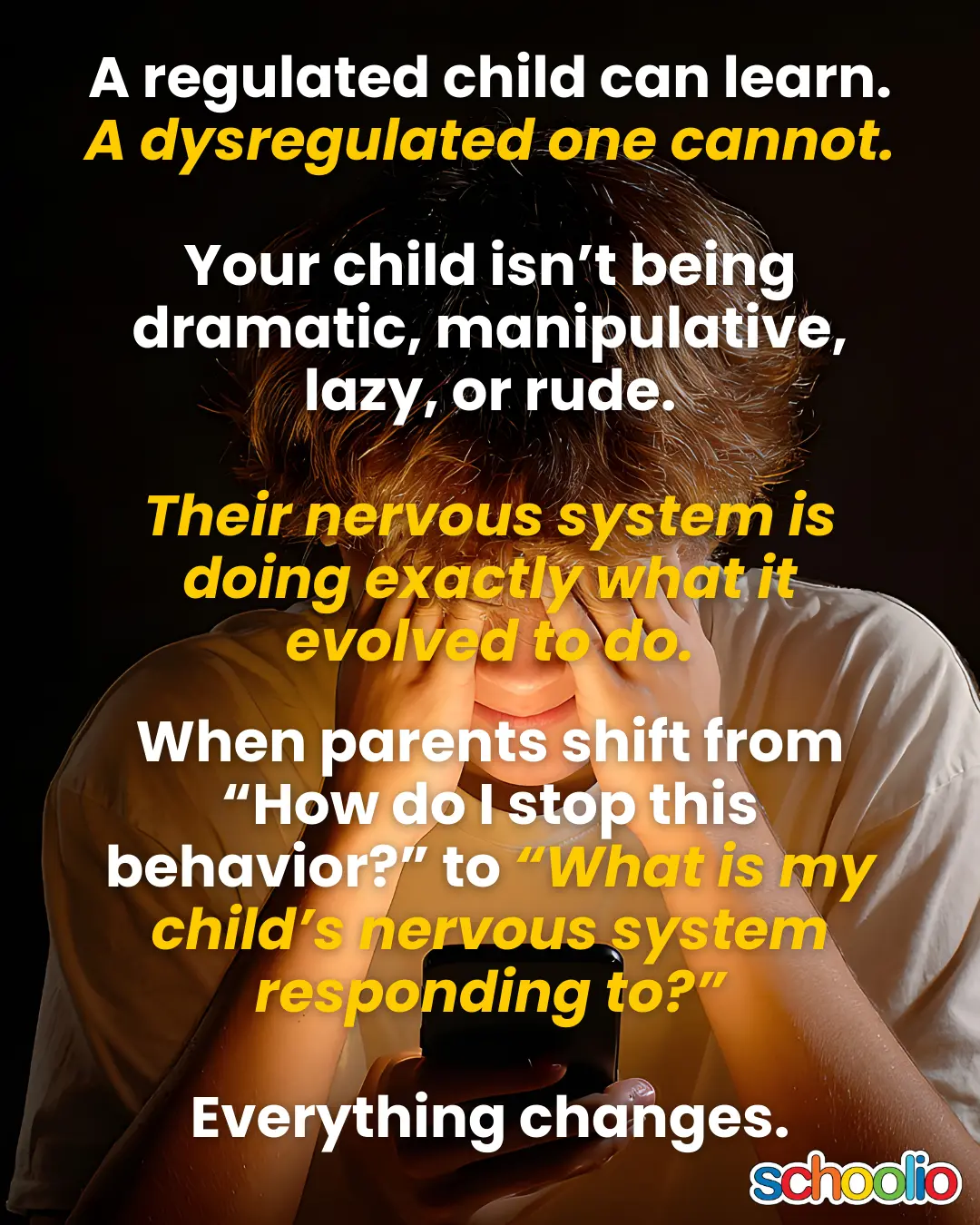
When parents shift from “How do I stop this behavior?” to “What is my child’s nervous system responding to?”

Everything changes.

Instead of punishment, we move toward regulation.

Instead of control, we build safety.

Instead of power struggles, we create connection.


How Parents Can Support Anxiety in ND Kids

1. Reduce Perceived Threat

Lower the emotional intensity around tasks.

  • Fewer words
  • Softer tone
  • More time

Pressure escalates anxiety. Safety reduces it.


2. Name What You See

“You’re not in trouble. I think your body feels overwhelmed right now.”

Naming the response helps kids feel understood instead of ashamed.


3. Offer Regulation Before Expectation

A regulated child can learn.

A dysregulated one cannot.

Movement, quiet time, deep pressure, or sensory breaks often need to come before problem-solving.


4. Build Predictability

Consistency lowers anxiety for ND kids.

  • Clear routines
  • Visual schedules
  • Advance warning for changes

Predictability tells the nervous system: you’re safe here.


5. Avoid Moralizing Anxiety Responses

These responses are not choices.

They are reflexes.

Your child isn’t being dramatic, manipulative, lazy, or rude.

Their nervous system is doing exactly what it evolved to do.


The Takeaway

Fight, flight, freeze, and fawn aren’t flaws.

They’re signals.

When we recognize anxiety behaviors in neurodivergent kids as adaptive responses to perceived threat, we stop trying to fix the child — and start fixing the environment.

And that’s where real healing begins.

Understanding and Managing Anxiety in Neurodivergent Kids

Anxiety in Neurodivergent Kids

Raising a neurodivergent child comes with its own set of unique joys and challenges. One common challenge many parents face is helping their child manage anxiety. Anxiety in neurodivergent kids, including those who are autistic, ADHD, or have other developmental differences, often manifests more intensely than in their neurotypical peers. Understanding the roots of this anxiety and finding effective ways to manage it can significantly improve your child’s quality of life.

What Causes Anxiety in Neurodivergent Kids?

  1. Sensory Overload: Many neurodivergent children are highly sensitive to their environments. Bright lights, loud noises, and even certain textures can overwhelm them, leading to heightened anxiety.
  2. Routine Changes: A sudden change in routine can be extremely distressing for neurodivergent kids. They often find comfort in predictability, and any disruption can trigger anxiety.
  3. Social Interactions: Navigating social situations can be daunting. Misunderstanding social cues or worrying about fitting in can cause significant anxiety.
  4. Performance Pressure: Academic and extracurricular expectations can be a source of stress. The fear of not meeting these expectations can exacerbate anxiety.

Recognizing Anxiety Symptoms

Identifying anxiety in neurodivergent kids can sometimes be challenging as it may manifest differently. Common signs include:

  • Physical Symptoms: Headaches, stomachaches, or fatigue.
  • Behavioral Changes: Increased irritability, restlessness, or meltdowns.
  • Emotional Indicators: Excessive worry, fearfulness, or mood swings.
  • Avoidance: Reluctance to engage in certain activities or go to specific places.

Practical Strategies for Managing Anxiety

  1. Create a Safe Space: Designate a quiet, calm area at home where your child can retreat to when feeling overwhelmed. This space should be free from sensory triggers and filled with comforting items. It should never be used as a punishment- the child chooses to go there, they aren’t sent there as a reaction to behavior.
  2. Establish Routines: Consistent routines can provide a sense of security. Use visual schedules to help your child understand what to expect throughout the day. Let your child be involved as much as possible in creating the schedule.
  3. Teach Relaxation Techniques: Deep breathing, progressive muscle relaxation, and mindfulness exercises can help your child manage anxiety. Practice these techniques together to make them more effective.
  4. Use Social Stories: Social stories are a great tool to help neurodivergent kids prepare for new or challenging situations. They provide a clear narrative of what to expect and how to respond.
  5. Positive Reinforcement: Celebrate your child’s successes, no matter how small. Positive reinforcement can build confidence and reduce anxiety.
  6. Add a Social-Emotional Learning program to your homeschool: SEL programs like Schoolio offers help children learn to emotionally regulate, manage their thoughts and feelings, and cope better with stress and anxiety.
  7. Professional Support: Sometimes, professional intervention is necessary. Therapists, counselors, and support groups can provide additional strategies and support tailored to your child’s needs.

Schoolio’s Program is Neurodivergent-Friendly

Schoolio offers a homeschool program designed with neurodivergent kids in mind. Here are some features that make it a great choice for your child:

  • Unitization: Allows you to mix and match grade levels to fit your child’s unique learning pace and needs.
  • Bite-Sized Learning Sessions: Short, engaging lessons to keep your child’s attention and prevent overwhelm.
  • Alternative Learning Strategies: Various methods to cater to different learning styles and preferences.
  • Custom-Designed Student Success Plans: Personalized plans to ensure your child’s educational success.
  • Interest-Based Learning: Selections that align with your child’s interests to make learning more enjoyable.

Encouraging Open Communication

One of the most powerful tools in managing anxiety is fostering open communication. Encourage your child to express their feelings and fears without judgment. Let them know it’s okay to feel anxious and that you are there to support them.

Conclusion

Helping a neurodivergent child manage anxiety is an ongoing process that requires patience, understanding, and a lot of love. By creating a supportive environment, establishing routines, and teaching coping strategies, you can empower your child to navigate their world with greater confidence and less anxiety. Remember, you are not alone on this journey – there are numerous resources and communities ready to support you and your child every step of the way. Schoolio’s neurodivergent-friendly program can be a valuable part of your toolkit, offering the flexibility and support your child needs to thrive.

Is School Giving Your Child Anxiety?

Is school giving your child anxiety? Read the following short story and decide.

It’s morning, and you just spilled your coffee all over the counter because you forgot to put a mug underneath the coffee spout. You finally got the coffee disaster cleaned up, only for your youngest child to spill their cheerios all over the floor. The dog has started to devour all the cheerios off the floor, then promptly begins to vomit it all up.

All the while your oldest child has been following you around because she wants to tell you about how her friend stole her idea for a robot that serves ice cream in their imagination world. With all the chaos going on around you, you glance over at your middle child who is dressed, hair brushed, eaten her breakfast and put her bowl in the sink. You love that your middle child is so self-efficient because on days like this, it’s just so helpful. 

Then you look at the clock and realize that your kids are officially late for school drop off.

So, you quickly rush them out the door, yelling “We’re late, we’re late, we’re late!” You hustle everyone to the van like some sort of weird celebratory parade that you do every morning. Finally, you get to the school and say the famous mom words “Love you! Have a good day!” Off goes your oldest child and your youngest. You glance in the very back of your van to notice that your middle child appears to be glued to her seat. “You better go honey, you’re already late.” But she doesn’t move.

You mumble in frustration as you head to the side door to open it to get her out. “Come on, this isn’t like you! Let’s go!” Still she seems frozen in place. “What’s wrong? Are you sick?” You ask in confusion. “I think I am mommy. My tummy is hurting so bad.” You encourage your child that she’s ok and that she needs to go to school. Still your sweet little one appears to be uneasy, and afraid. 

Finally, she gets out of the van.

Cars behind you in the drop-off line are now honking their horns in impatience. “Ok! You need to go now!” But still, she is holding onto your hand as if there’s a terrifying monster standing in front of her. ‘What is happening?’ You ask yourself. She was fine this morning, she’s always the one that seems to just do what she needs to. Why is she acting like this? You then decide to just take her home with the assumption that she’s experiencing a tummy bug. Then when you get her home, she’s fine. The next day repeats itself, only this time she’s crying in the backseat, shaking with fear. Unfortunately, you feel that you must be tough on her and get her to go. Because, well, it’s school! She can’t miss it. 

What’s going on in this situation?

Anxiety. Although we like to think that our children won’t be affected by anxiety and depression, that’s simply not the truth. In fact, children are just as vulnerable as adults to suffer from anxiety. In fact, according to the CDC: “7.1% of children aged 3-17 (approximately 4.4 million) have been diagnosed with anxiety.” CDC – Children’s Mental Health 

“70% of mental health problems have their onset during childhood or adolescence.” – Youth Mental Health Canada.

In Canada it is estimated that 1.2 million children and youth in Canada are affected by mental illness. View Youth Mental Health Canada. According to the Canadian Mental Health Association – British Columbia Division – The most common illness to affect children and youth is anxiety. In Canada it’s estimated that 6% of kids will experience an anxiety disorder at some point. Mental Illnesses in Children and Youth – Canadian Mental Health Association. 

The number of children struggling with their mental health is alarming, but what’s more so alarming? The fact that despite these high volumes, less than 20 percent will be able to receive the right treatment for them. 

Is school giving your child anxiety?

Some children have been known to struggle with anxiety that is related to school. Some triggers include: Bullying or conflicts with other students, test anxiety, academic pressures, a new teacher, riding the school bus, a specific class or subject. There are many different factors that can trigger anxiety when it comes to school.  

Many families are able to identify the very reason why their child is facing a heavy weight of anxiety when it comes to school. However, some children are able to hide their anxiety. Or act out in other ways, causing families to assume there is something else that is affecting their child. In some cases, children really can’t identify the concern or fears that they have around school. 

If your child is struggling with anxiety and school,  or is refusing to go to school. It’s really important that you find out if your child is being bullied, if they have other medical problems, pain or some other serious issue. Whatever you suspect, it’s always important to meet with the school, and a family physician to be sure. When you’re questioning ‘Is school giving my child anxiety?’ 

What are some signs and symptoms of school anxiety? 

Emotional Symptoms can include: 

  • Anxiety/fear/excessive worry 
  • Irritability
  • Anger
  • Embarrassment 
  • Loneliness 
  • Sadness

Physical Symptoms can include: 

  • Frequent Urination or diarrhoea  
  • Headaches
  • Muscle tension/pain 
  • Dizziness/light headedness
  • Pounding/Racing Heart
  • Shaking or trembling 
  • Feeling short on breath 
  • Stomach-aches or a painful abdomen 
  • Vomiting 

Behavioural Symptoms can include: 

  • Being overly clingy, not wanting to separate from their parent. 
  • Crying and tantrums. 
  • Incessant complaining. 
  • Not turning in their homework. 
  • Frequent calls or texts to parents. 
  • Skipping class or even cutting school. 
  • Lying about circumstances or feelings. 
  • Trouble concentrating. 
  • Isolation from others. 

Some thoughts that your child might be thinking: 

‘What if the other kids laugh at me?’ 

‘Why do I have to go to school anyway?’ 

‘I’m not good at school. I fail.’ 

‘What if daddy forgets to pick me up?’ 

‘If I fail this test my mom will be mad at me.’ 

‘What if I throw up in class?’ 

‘I don’t like recess, it’s cold and I get scared of a thunderstorm.’ 

‘I just want to be home in my room.’ 


Are you asking yourself how this happened?

‘My child was fine and suddenly just started to not be ok at school. What did I do wrong?’ First of all, don’t blame yourself. Parental guilt will only make you and your child feel worse. Is school giving your child anxiety? Was it something else? The important thing is, to find healthy steps to move forward from here.

Let’s take some solid steps to help your child that is struggling with anxiety and school. 


The first step is to identify any potential triggers.

Look for the triggers that might’ve started this decline with anxiety and school. Is your child being bullied or struggling with peers? Did your child just get a new teacher or has a harsh teacher? Does your child struggle with tests? Have you noticed your child’s anxiety to be much worse since covid? Perhaps the fear of catching the disease, or wearing masks, or lockdowns, has caused them to feel a large amount of fear? Find out what could potentially be triggering these feelings. 

Second, notice if they’ve been trying to tell you about their anxiety in other ways. 

Anxiety can be really scary, especially for a little person who doesn’t understand what they’re feeling. Has your child previously said phrases like: “The work is too hard!” “I can’t concentrate in class.” “It’s so tiring, I hate it.” “I’m going to fail the test.” “I don’t fit in.” “I saw someone getting bullied.” “Joey keeps making fun of my clothes.” These phrases and concerns aren’t just complaints. Sometimes they can be cries for help. If your child brings any of these complaints to you, always dig a little deeper to see what the root cause is.

Third, ask more questions.

If your child has brought up concerns like those above, ask lots of questions! Even if your child is rolling their eyes at you. While pretending that you’re annoying them, you aren’t. Most kids actually enjoy your interest in them and in their day. If your child hasn’t brought up any concerns, but you can just tell that they are feeling off – ask questions. Even if your child seems totally normal, ask questions. Dig deeper.  Teaching your kids that it’s good to talk, and that it’s good to bring up their concerns – is so healthy. 

Fourth, reach out to their school. 

If your child is struggling in any area with school. Then reaching out to their school is imperative as working with their educational team is so important. Most schools and teachers are more than accommodating when it comes to mental health. So if you are wondering ‘is school giving your child anxiety?’ then this is an excellent step to take. 

Fifth, give your kid a ‘Worry Journal’. 

What’s a worry journal? It’s a place where they can write down all of those big, scary, feelings, that are causing their struggles. In the worry journal, they can write, draw, or doodle. Really, whatever they want. It’s their journal, and they can utilize it to express their feelings in whatever way seems best for them. 

Sixth, find helpful coping strategies to help your child. 

There are so many amazing programs out there that are fully capable of helping your child navigate on those tough days. Including our very own Emotional Intelligence: Managing My Emotions special interest unit. With this special interest unit your child will learn about why it’s just as important to take care of our minds as it is to care for our bodies.

What else will they learn?

They will also learn ways to name and describe common “unhelpful thoughts” that lead them down thought paths which make them less happy. And lessons on the S.T.O.P.P. strategy for regaining control and assessing the situation when their emotions are high. Along with management tools for runaway thoughts, and how to control their reactions. They’ll also learn lessons about calming strategies, for when they need to gather themselves and regain control of their emotions. 

Click here to learn more about the Emotional Intelligence: Managing My Emotions Special Interest Unit


Seventh, help your child understand that they don’t need to be afraid of their feelings. 

When we don’t understand what we are feeling it can make it seem much more scary. Helping your child understand that they don’t need to fight those scary feelings can be very helpful. Along with helping them learn the important steps to cope through those big feelings. Above all, telling your kids that you’re there for them no matter what is of the utmost importance. 

Eighth, consider switching up their education. 

Is school giving your child anxiety? If you know that school is the main culprit of their anxiety, and you’ve tried to work with their school to help them. But nothing appears to be working. You can try to switch up their education, at least for the short term. A lot of children have been experiencing anxiety around school because of the uncertainties that the pandemic have caused.

As a result, there has been a significant amount of parents pulling their children from school to homeschool them.

And many parents have stated that online school/homeschool has actually been good for their child’s mental health. Obviously, there’s no scientific data to back up their claims. But the parents who are with their children full time, should have a pretty accurate view point. Homeschooling is obviously not going to be the best alternative for every child that is struggling with mental health concerns. However, homeschooling has proven to be beneficial for many. 

Benefits of homeschooling.

Some obvious benefits of homeschooling include: More one on one time with the parent. Minimizing stress and anxiety. No bullies or peer pressure. And in some cases homeschooling has been known to minimize depression that many students experience because of traditional schooling. 

There are many more benefits of homeschooling, including the freedom for your child to embrace who they really are. While also allowing you and your child to create a schedule that fits the needs of you both. Additionally, having a flexible schedule can give your child more time to play sports, go to social events, and have day time opportunities that they wouldn’t have otherwise. 

Is school giving your child anxiety?

There are many ways to help your child overcome the anxiety about school that they are facing. Just remember that this often takes time and a large amount of patience on your part. Showing your child that you are there for them, patient with them, and on their team will help immensely. 

Giving them options so that they don’t feel stuck is another excellent way to help them overcome the anxiety that is pulling them down. 

For a first hand look at a mama who had her child struggle with anxiety and school, check out this awesome blog with Meredith Blunt.

 Read her story and what she did to help her child with school anxiety.


Disclaimer: We are not licensed therapists or mental health professionals. If your child is struggling with a mental health condition and you are not sure what to do, please see your doctor for the proper steps to help them.


Additional Resources for this blog:

School Refusal – Anxiety Canada 

How Does Anxiety Affect Kids in School? – Child Mind Institute 

Anxiety in Kids – Anxiety in the Classroom 

Data and Statistics on Children’s Mental Health – CDC 

Global Student Network – Is Homeschooling Good For Your Child’s Mental Health? 

Youth Mental Health Statistics in Canada – YMHC 

Mental Illnesses in Child and Youth – Canadian Mental Health Association