When “Grade-Level” Tests Make Homeschool Parents Feel Like Failures

When “Grade-Level” Tests Make Homeschool Parents Feel Like Failures


This has been on my mind today…

I talk to so many homeschooling parents who have had this moment:

They run a school-based diagnostic test to see if their child is “on grade level”.

They see a score they weren’t expecting.

And suddenly, their confidence collapses.

“I think my kids have fallen behind.”

“I feel like I’ve failed them.”

“Did homeschooling make them lose skills?”

Let me say this clearly, as both a former teacher and a homeschooling mom:

School-based testing does not measure your child’s intelligence.

And it absolutely does not measure the value of your homeschool.

Most of these assessments — especially the popular ones families use to “check grade level” — were designed for traditional classrooms. They measure a very specific thing: a child’s ability to memorize and recall the exact skills schools have decided are important, in the exact format they expect.

That’s it.

They usually test math and language.

They don’t test problem-solving.

They don’t test creativity.

They don’t test if your child is happier, more confident, or less anxious than they were in school.

They don’t test emotional regulation skills.

They don’t test adaptability, curiosity, persistence, or resilience.

And yet those are the very skills that matter most once school is over.

Here’s something else most parents don’t realize:

The human brain only retains information for two reasons.

  1. Intrinsic interest — the learner genuinely cares about the topic.
  2. Perceived usefulness — the learner understands why this information matters in their real life.

Everything else? The brain offloads.

This is why retention in public school is so low. It’s why every fall, teachers spend weeks “reviewing” material kids supposedly learned the year before — and most students swear they were never taught it. They were. Their brains just didn’t keep it.

We adults are no different.

If most of us took a grade 7 math test today, we’d struggle — unless we’re naturally “math people” (intrinsic interest) or use it regularly in our work (perceived usefulness). That doesn’t make us less intelligent than a seventh grader. It just means we’ve let go of information we don’t need.

Kids do the same thing.

So when a homeschool parent sees a test score and panics, what they’re often seeing isn’t “lost intelligence.”

They’re seeing a mismatch between how the brain actually learns and how schools measure learning.

Homeschooling offers something radically different — and far more valuable. It teaches kids how to learn. How to ask questions. How to find information when they need it. How to notice what interests them and pursue it deeply. How to persist through challenges without shame.

Those skills don’t show up on standardized diagnostics.

But they show up everywhere else in life.

Now, if it’s important to you that your child aligns closely with public school benchmarks, that’s okay. Homeschooling isn’t one thing — it’s yours to shape. You can absolutely use test results as information, identify gaps, and choose to work on specific skills.

What I don’t want you to do is let those numbers define your child — or yourself.

Your kids are not checkboxes.

Your homeschool is not a failure because it doesn’t mirror school.

And you are not doing this wrong because your child’s brain didn’t perform on demand for a system you intentionally stepped away from.

Please take school-based tests for what they are: limited tools, not verdicts.

You are building something bigger than scores.

Something more human.

And that matters far more than any diagnostic ever will.


? Lindsey

Certified Special-Ed Educator & Co-Founder, Schoolio

Kintsugi

Kintsugi


This has been on my mind today…

There is a Japanese art form called Kintsugi. When a bowl or cup breaks, it is not thrown away. The pieces are carefully put back together, and the cracks are filled with gold. The repair is not hidden. It is highlighted. The object becomes more valuable because it has been broken and repaired with care. The story becomes part of its beauty.

I think about that a lot when I reflect on my own life. I also think about it when I look at the families we support through homeschooling and the work we are building at Schoolio.

Too many children move through school systems quietly absorbing a message that they are broken. Not always through words, but through looks, labels, meetings, and expectations. They are told to sit still when their bodies want to move. To keep up when they need time. To fit into systems that were never designed for how they learn. Eventually, many of them begin to believe that something is wrong with them.

When those children come home, something different can happen. With patience, care, and attention, the pressure starts to lift. Confidence begins to return. Curiosity peeks back out. Learning feels possible again. Not rushed. Not forced. Just human.

But here is the part that matters most to me. Healing should never feel like hiding.

Homeschooling should not feel like punishment or retreat. It should not feel like we are sweeping children out of sight. It should feel like kintsugi. A celebration of the whole child. A recognition that learning differently does not mean learning less. It means learning in a way that honors who they are.

At Schoolio, we see this every day. Children who were once labeled as struggling begin to thrive when the pressure is removed and the support is real. When learning adapts to them instead of asking them to adapt to it. When their cracks are not erased, but respected.

Every student who leaves a system that did not serve them carries an incredible story. Those cracks are not flaws. They are experiences. When they are filled with care, trust, and belief, something stronger is created. Something more meaningful than what existed before.

That is what homeschooling can be.

That is what Schoolio is working toward.

Not fixing children, but honoring them.


Sathish

still learning, still unlearning
The Magic in the Daily

The Magic in the Daily


This has been on my mind today…

“Why?” he would ask.

And I’d answer.

“Why?” he’d ask again.

And I’d stop whatever I was doing to explain another thing that caught his attention. He was five. Curious about everything. I loved answering his million questions a day.

As we get older, we forget that feeling. We take the everyday things for granted. But through the eyes of a five-year-old, everything is magical. The TV remote is magical. The spoon is magical. The window light feels magical.

I miss that. The magic in the daily.

There’s so much noise now. So much to focus on, worry about, manage. And for parents who have taken on the incredible task of homeschooling, I see you. You are some of the most courageous people I’ve met through Schoolio. You are re-learning curiosity alongside your kids, rebuilding connection in the middle of chaos.

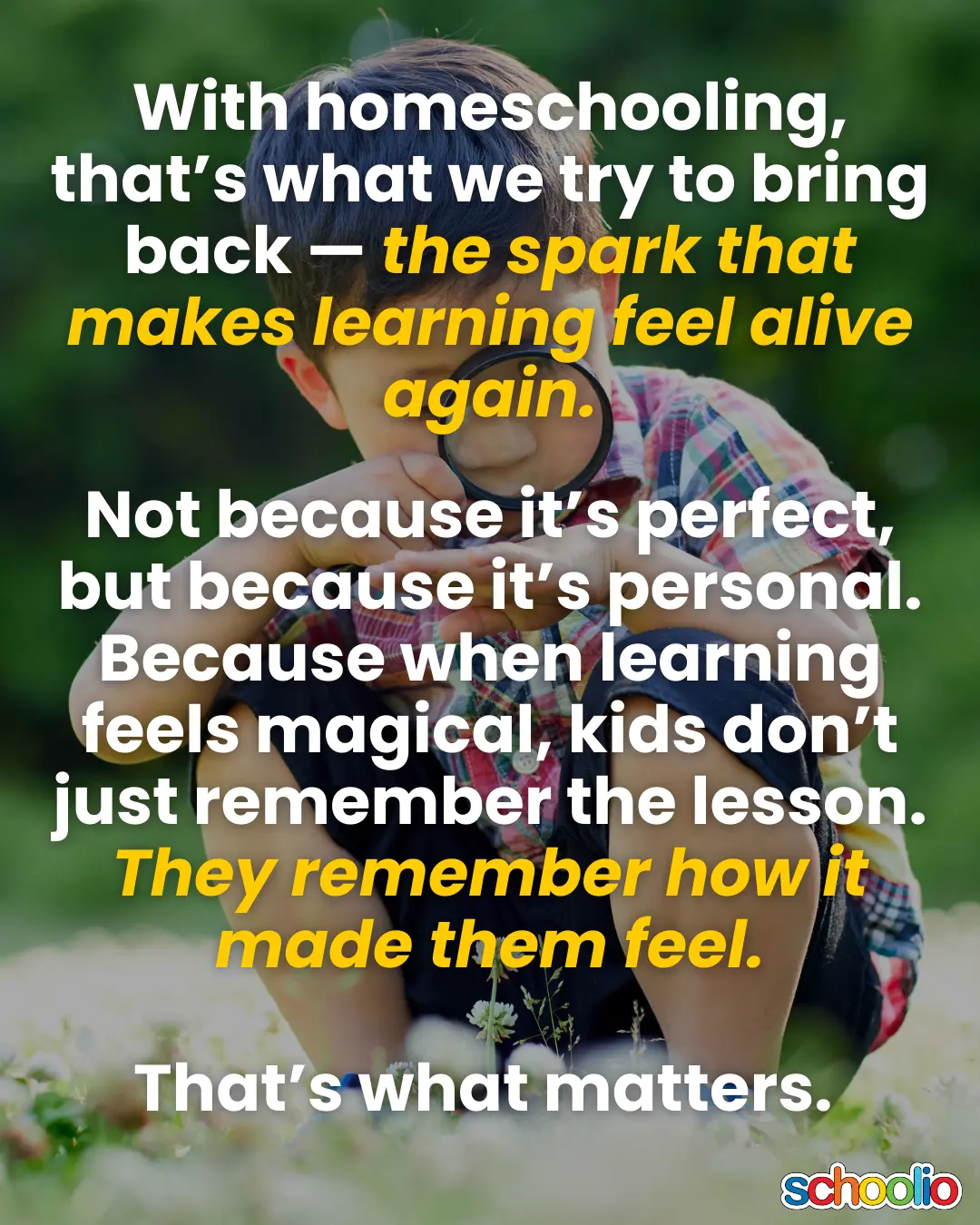
At Schoolio, that’s what we try to bring back — the why. The spark that makes learning feel alive again. Not because it’s perfect, but because it’s personal. Because when learning feels magical, kids don’t just remember the lesson. They remember how it made them feel.

That’s what matters. That’s what we’re building.


Sathish
still learning, still unlearning

Worried Homeschooling Is Too Expensive? Here’s Your Defense Over the Costs

Worried Homeschooling Is Too Expensive? Here’s Your Defense Over the Costs


Yes, homeschooling has costs — but so does public school. The difference? You control what you spend and why.

I hear from parents considering homeschooling all the time…

“I want to start homeschooling… but what if I just can’t afford it?”

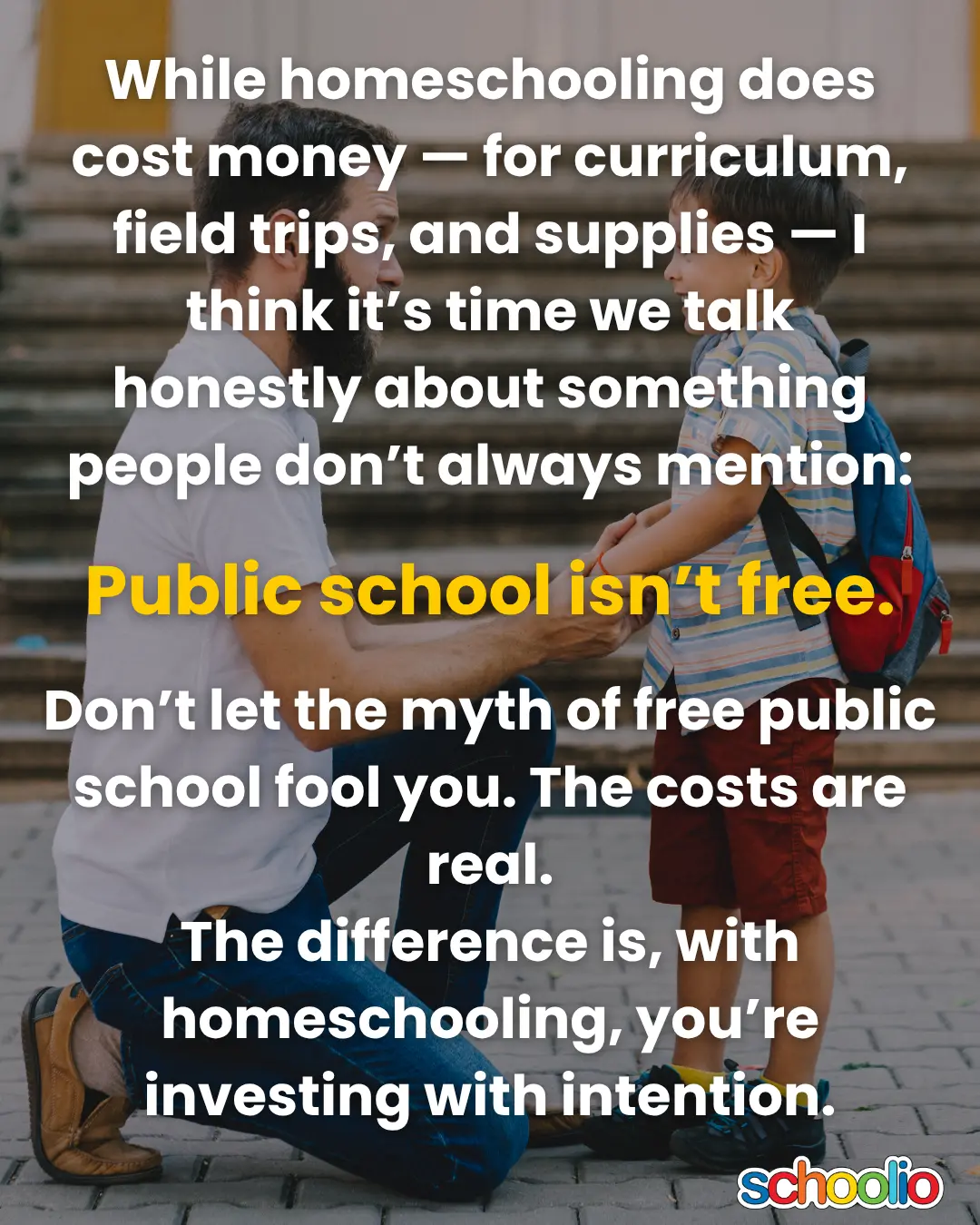
It’s a fair question. And while homeschooling does cost money — for curriculum, field trips, and supplies — I think it’s time we talk honestly about something people don’t always mention:

? Public school isn’t free.

The truth is, both paths have costs. But with homeschooling, you get to decide what you buy and how much you spend, based on your values and your child’s needs — not what’s written on a school form or fundraiser sheet.

Let’s break it down.


? How Much We Spend on Homeschooling

If you’ve met me, and a lot of you have, you probably know I’m an incurable Type-A planner. We also homeschooled our two kids on one income, as I know many of you are as well. For several years I tracked everything that was homeschool related, so I knew exactly how much we were spending on:

  • Curriculum
  • Field trips
  • Supplies
  • Anything we wouldn’t have spent otherwise if they were in school

But here’s the kicker…


vs. What We Spent in Public School (Hint: It Was More)

This spending tracking didn’t begin with homeschooling though- back when my kids were in public school, I also tracked our spending. Those years?

We spent almost $100 more per childfor free public school.

Here’s where that money went:

  • Back-to-school supplies (the specific ones required)
  • Indoor shoes, gym clothes, weather gear – and clothing replacements when they are lost and stolen
  • School events: BBQs, fairs, pizza day, candy cane day, milkshake day…
  • Valentines, classroom parties, book fairs, teacher gifts
  • Hot lunches and fundraiser purchases
  • Fad items and brand names your kids have to have in order to not be bullied

We weren’t even high-participation parents! We did just enough that our kids didn’t feel left out, but not every event or lunch or fundraiser.

And still? It added up.


? The Big Difference with Homeschooling: You’re in Control Now

Homeschooling gives you something public school doesn’t:

Control over what you spend — and what you get for it.

You decide:

  • Which curriculum to invest in (or whether to build your own)
  • How often you take field trips
  • Whether you spend more time or more money — whichever fits your family
  • What supplies, tools, or extras actually matter in your homeschool

You’re not just handing money over for a pizza party you didn’t ask for.

You’re choosing what best supports your child’s growth — and your family’s goals.


? Homeschooling Can Work on a Budget

You’ll spend either money or time — or some combination of both.

The beauty is: you get to choose what’s worth it.

Whether you’re middle-of-the-road spenders, doing things ultra-minimally with free resources and DIY everything, or have some room to buy back more time — there’s no one “right” budget for homeschooling.

But don’t let the myth of free public school fool you. The costs are real.

The difference is, with homeschooling, you’re investing with intention.

Lindsey

Certified Special Ed Educator & Co-Founder, Schoolio

You Don’t Have to “Be the Teacher”

You Don’t Have to “Be the Teacher”


One of the things I hear most often from new homeschooling parents is:

“I’m worried about how to be the teacher.”

“How do I switch between being Mom and being Teacher?”

And I get it — that’s the model we were raised in. School was one thing. Home was another. Learning happened in a classroom, not the kitchen, and teachers were “official” in a way parents weren’t.

But that separation? It’s something we were taught.

And it’s one of the first things to unlearn when you start homeschooling.

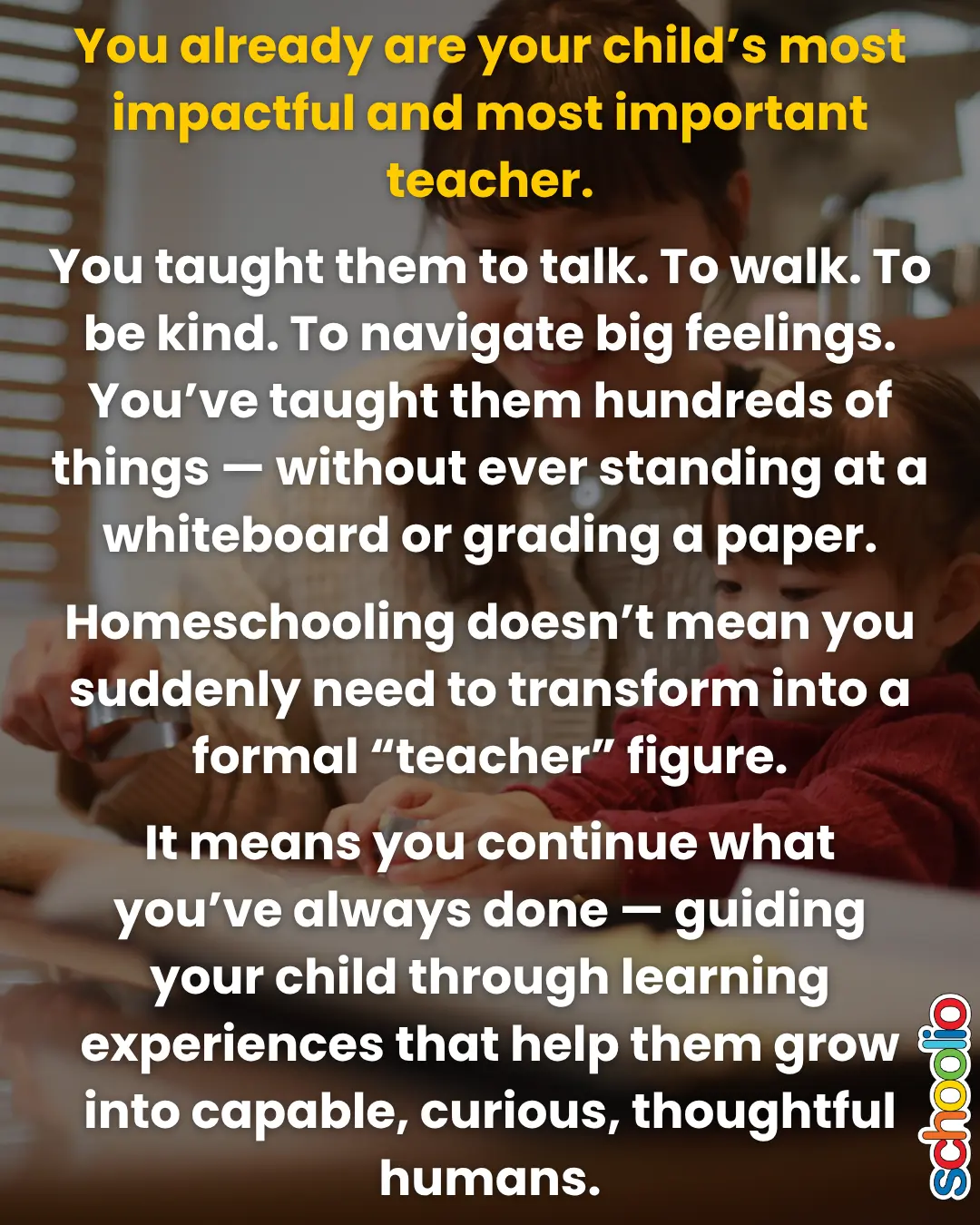
The truth is, you already are your child’s most impactful and most important teacher.

You taught them to talk. To walk. To be kind. To navigate big feelings. You’ve taught them hundreds of things — without ever standing at a whiteboard or grading a paper.

Homeschooling doesn’t mean you suddenly need to transform into a formal “teacher” figure with a desk, a whistle, and a lesson plan binder.

It means you continue what you’ve always done — guiding your child through learning experiences that help them grow into capable, curious, thoughtful humans.

Let go of the image of kids sitting in desks while you lecture at the front. That’s not homeschooling. That’s school-at-home — and that’s not what your kids need.

Kids aren’t empty vessels waiting to be filled with facts. They’re active participants in their own learning.

When you give your child autonomy and ownership, everything changes.

You stop being “the enforcer,” and start being their guide. Their mentor. Their teammate.

You’re not switching between roles — you’re expanding the one you’ve always had.

In real life, learning doesn’t have boundaries. It doesn’t only happen between 9 and 3, or only from someone with a degree. It happens everywhere, all the time, through curiosity and connection.

Your homeschool doesn’t need to mirror school.

It needs to mirror life.


? Lindsey

Certified Special Ed Educator & Co-Founder, Schoolio

When Learning Becomes Theirs

When Learning Becomes Theirs


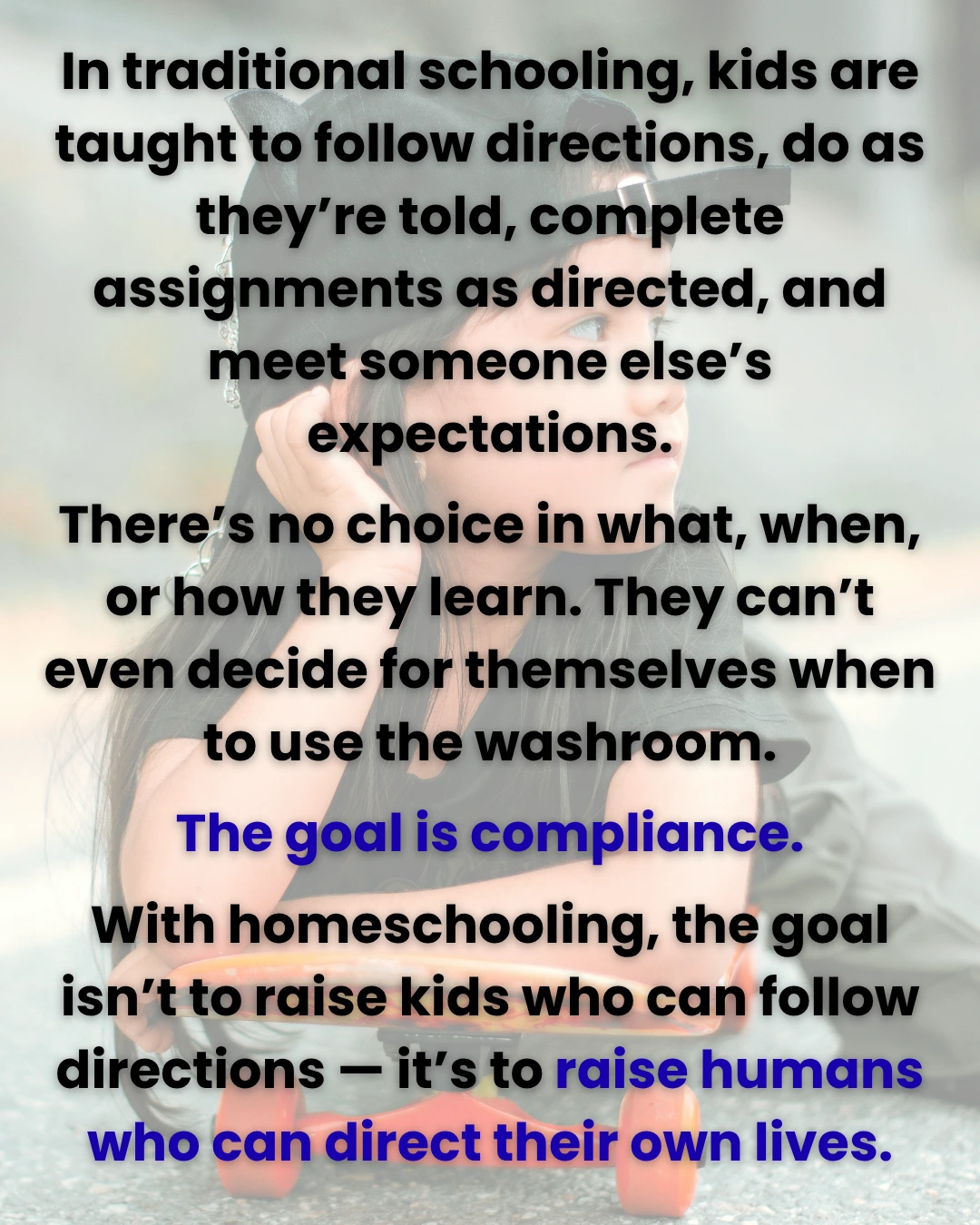
In traditional schooling, kids are taught to follow directions, do as they’re told, complete assignments as directed, and meet someone else’s expectations.

There’s no choice in what, when, or how they learn. They can’t even decide for themselves when to use the washroom.

And that’s a way of learning — but it’s not the same as learning how to:

  • Set personal goals
  • Reflect on growth
  • Ask great questions
  • Navigate challenges with persistence
  • Make choices about what (and how) they want to learn

That’s the difference between compliance and ownership.

When kids feel like school is something being done to them, resistance sets in.

When they feel like it’s something they’re actively building, everything changes.

I’ve seen this shift happen over and over in homeschooling. When you give kids a voice in their learning — whether it’s choosing which subject to start with, setting a goal for the week, or diving deep into something they’re curious about — they start to care differently.

They ask better questions. They push through challenges. They learn because they want to, not because they have to.

It’s not about giving up structure — it’s about sharing the steering wheel.

When we invite kids into the process of shaping their education, we’re not just teaching academics. We’re teaching self-awareness, confidence, and lifelong learning skills that reach far beyond any test score.

Because the ultimate goal isn’t to raise kids who can follow directions — it’s to raise humans who can direct their own lives.

? Lindsey

Certified Special-Ed Educator & Co-Founder, Schoolio

Learning Area and Perimeter in Minecraft

Learning Area and Perimeter in Minecraft


Math can feel abstract sometimes. Numbers on a page. Formulas to memorize. Eyes glazing over.

That’s exactly where we were when we hit perimeter and area. My kids weren’t connecting with it — and honestly, I couldn’t blame them. Why does drawing rectangles on a worksheet feel so important when you’re seven?

So we switched it up.

We opened Minecraft.

Suddenly, it wasn’t about boxes on paper. It was about building.

  • Perimeter became the fence we needed around our animals. How much fencing did we need to keep the sheep in?
  • Area became the flooring for the rooms of a house. How many blocks would it take to fill in the kitchen or living room?

And just like that, the concept clicked.

Instead of “math problems,” it became their world. They cared about the outcome, because they had ownership in the project. They weren’t just solving for numbers — they were solving for sheep. For walls. For a house they were excited to design.

That’s the power of leaning into your child’s interests. When you connect learning to something they love, the barriers start to fall away.

It doesn’t mean every lesson becomes a video game (though sometimes that helps ?). It means you take the thing they’re already excited about and use it as a bridge into the learning.

Because here’s the truth: kids don’t resist learning. They resist learning that feels irrelevant.

And sometimes, all it takes is a fence for sheep to make the numbers finally make sense.


? Lindsey

One Size Doesn’t Fit All: How My Two Kids Taught Me to Rethink Homeschool Goals

One Size Doesn’t Fit All: How My Two Kids Taught Me to Rethink Homeschool Goals


This has been on my mind today…

When I first started homeschooling, I thought my kids would more or less need the same kind of structure. Same curriculum, same goals, same “system.” What I learned very quickly is that no two brains work the same way — even when they’re siblings.

My son, Gavin, has always been a dawdler and a daydreamer. He’ll happily sit with a math page for an hour — but not because he’s focused. He might be staring at a butterfly out the window or lost in his thoughts about the Lego project waiting for him in the other room. For him, saying “Do 20 minutes of math” was a recipe for wasted time. His strength was that once he actually did the work, he could get through it. So instead of giving him time-based goals, I gave him task-based ones: “Do 8 math questions.” If he worked steadily, that took about 20 minutes. If he dawdled, it might take an hour. But either way, the goal was clear and doable.

Grace, on the other hand, is wired completely differently. She has dyslexia and dyscalculia, which make reading and math both more difficult and much more tiring. For her, telling her “Do 8 math questions” was overwhelming. It felt like a mountain. What worked for her was time. If I said, “Do 20 minutes,” she’d buckle down and focus — because she wanted to finish and move on with her day. Sometimes she’d get through 8 questions, sometimes only 2. But I knew she’d be working hard the whole time, and by the end of that 20 minutes, she’d be at her limit.

That’s the beauty of homeschooling. I didn’t have to nag Gavin to hurry up, and I didn’t have to push Grace to burnout. They each got a plan that fit their brain. The goals were different, but the value was the same: honoring their process while still moving forward.

There is no one-size-fits-all way to learn. And as parents, when we shift from “making school fit the child” to “making learning fit the child,” everything changes.

? Lindsey

Certified Special-Ed Educator & Co-Founder, Schoolio

When Grief Stopped Our Homeschool, and Yet the Kids Didn’t End Up “Behind”

When Grief Stopped Our Homeschool, and Yet the Kids Didn’t End Up “Behind”

This has been on my mind today…

In the fall of 2020, we had a death in the family. The kids were struggling. I was wrecked. And academic learning came to a screeching halt.

I want to be clear: learning never really stops—kids are always learning. But “schoolwork”? That stopped completely. Instead, the kids played with toys. We read books before bed. They watched a lot of TV. We just… existed together.

By February, the fog of grief had lifted only enough for me to feel the heavy weight of guilt. I felt like I had failed my kids that year. I knew I should restart, but I couldn’t find the energy. That guilt eventually pushed me toward my first experiences with online learning. I signed up for a math program, a typing platform, a science video subscription. None of it was structured or connected—I just needed to feel like the kids were doing something. To be honest, I wasn’t really paying attention.

Fast forward to the next year. We started a new grade. I had no idea what they had learned—or not learned—the year before. So I thought, let’s just start fresh and see what happens. And wouldn’t you know it? They were fine. We backfilled here and there, but there wasn’t the gaping hole in their knowledge that I’d been bracing for.

I once read a story from someone who had grown up as a refugee. They had missed three years of formal schooling. When they came to America, they were placed in the grade that matched their age, not their transcripts. And you know what? They did just fine.

That stuck with me. Because the truth is: kids in school aren’t learning as much as we assume. And our kids at home are learning so much more than we realize—even when we think we aren’t “teaching.”

Looking back, I really believe that the space homeschooling gave us to grieve properly—as a family, at our own pace—helped us heal faster and carry less long-term pain. If we had been tied to public school’s “back to normal” timeline, I think the scars would have run deeper.

So if you’re in the middle of a big life change—grief, divorce, a move, a season that shakes your family—please don’t stress about schoolwork. Take care of yourselves. Focus on healing. The academics can wait. And I promise: your kids will be just fine.

Lindsey
certified special-ed educator & co-founder, Schoolio

Crafting a Personalized Learning Journey: Customizing Your Homeschool Curriculum

Personalized Learning Journey- As a homeschooling family, one of the greatest advantages you have is the ability to craft a truly customized homeschool curriculum tailored to your child’s unique needs, interests, and learning style. This level of personalization allows you to create an educational experience that ignites your child’s curiosity, nurtures their strengths, and supports their areas for growth.

At Schoolio, we understand that a one-size-fits-all approach to education rarely works, especially in the homeschooling environment. That’s why we believe in empowering families like yours to customize and curate a curriculum that aligns perfectly with your child’s individual journey.

Personalized Learning Journey- Embracing Your Child’s Learning Style

Every child learns differently, and a customized homeschool curriculum allows you to cater to your child’s preferred learning style. Whether your child is a visual learner who thrives with infographics and videos, an auditory learner who absorbs information best through discussions and podcasts, or a kinesthetic learner who excels with hands-on activities, you can tailor the curriculum to their unique strengths.

Schoolio’s extensive resource library offers a wide range of multimedia content, interactive activities, and project-based learning opportunities, enabling you to create a multi-sensory learning experience that engages your child’s preferred learning modalities.

Nurturing Interests and Passions

One of the greatest joys of homeschooling is the ability to nurture your child’s unique interests and passions. By customizing your homeschool curriculum, you can delve deeper into subjects that truly captivate your child’s attention, fostering a love for learning that extends far beyond the classroom.

Whether your child is fascinated by astronomy, enthralled by ancient civilizations, or passionate about coding, Schoolio’s customizable curriculum options and enrichment resources allow you to tailor their educational journey to their specific areas of interest, igniting their natural curiosity and encouraging lifelong learning.

Addressing Learning Differences and Special Needs

For families with children who have learning differences or special needs, a customized homeschool curriculum can be a game-changer. By breaking free from the constraints of traditional classroom settings, you can create an educational environment that accommodates your child’s unique challenges and celebrates their strengths.

Schoolio’s customizable curriculum options, assistive technology tools, and access to educational consultants empower you to design a tailored learning experience that addresses your child’s specific needs, whether they are dyslexic, autistic, ADHD, or have any other learning difference.

Seamless Integration of Core Subjects and Electives

As you craft your customized homeschool curriculum, you’ll have the flexibility to seamlessly integrate core subjects like math, science, language arts, and social studies with a wide range of electives and enrichment activities. This holistic approach not only ensures a well-rounded education but also allows your child to explore their diverse interests and talents.

Schoolio’s comprehensive curriculum offerings, online courses, and virtual field trips provide a wealth of resources to weave together core academics with electives like art, music, coding, foreign languages, and more, creating a rich and engaging educational tapestry.

Continuous Adaptation and Flexibility

One of the beauties of a customized homeschool curriculum is its ability to adapt and evolve as your child grows and their needs change. With Schoolio’s flexible platform, you can easily adjust and modify your curriculum, incorporating new resources, adjusting pacing, or introducing new subjects as your child’s interests and abilities develop.

This continuous adaptation ensures that your child’s educational journey remains tailored to their ever-changing needs, fostering a love for learning that transcends grade levels and subject matter.

At Schoolio, we believe that every child deserves an educational experience that celebrates their uniqueness and empowers them to reach their full potential. By customizing your homeschool curriculum, you’re embarking on a journey of personalized learning that nurtures your child’s strengths, supports their challenges, and ignites a lifelong passion for knowledge and growth.

So, embrace the freedom and flexibility of homeschooling, and let Schoolio be your trusted partner in crafting a truly customized homeschool curriculum that puts your child’s needs and aspirations at the forefront of their educational journey.