Oral Stims, Echolalia, Song Loops, and Counting: What Your Neurodivergent Child Is Actually Doing
Last week my daughter asked me something that stopped me mid-laundry.
“What’s the difference between an oral stim and echolalia?”
Then she added, almost as an afterthought:
“And why do I get a little piece of a song stuck in my head when I’m stressed? Is that a stim too?”
If you’re parenting a neurodivergent child, you’ve probably seen versions of all of this.
The humming.
The repeating lines from shows.
The constant chewing.
The whispering under their breath.
The same five seconds of a song looping again and again.
Maybe you’ve wondered if you should stop it.
Maybe someone has told you it’s “annoying.”
Maybe you’ve corrected it without even thinking.
Before we decide what to do about it, we need to understand what it is.
Because most of the time?
It’s regulation.
What Is a Stim, Really?
Stimming is short for self-stimulatory behavior.
That sounds clinical. But in real life, it just means this:
The nervous system doing something to help itself stay balanced.
Everyone stims.
Some people bounce their leg.
Some twirl their hair.
Some chew ice.
Some scroll when they’re overwhelmed.
Neurodivergent kids often stim more visibly — or more frequently — because their nervous systems require more input to stay regulated.
Stims can be physical.
They can be verbal.
They can be oral.
They can be completely internal.
They are not “bad habits.”
They are tools.
Oral Stims: The Mouth as a Regulation Tool
An oral stim involves the mouth.
Chewing hoodie strings, sleeves, lips, even hair.
Biting pencils. Biting nails.
Humming.
Clicking their tongue.
Needing gum constantly. Needing a snack to emotionally settle.
The mouth has a high density of nerve endings. Oral input can calm the nervous system. It can increase alertness. It can improve focus. For many ADHDers especially, oral input provides a small dopamine boost — and dopamine is often in short supply in ADHD brains.
What looks like “why are you chewing again?” might actually be the brain saying:
“I need input to stay steady.”
It isn’t random.
It isn’t defiant.
It’s neurological.
Echolalia: Repeating Words Is Not Meaningless
Echolalia is the repetition of words, phrases, or sounds.
It can be immediate — repeating what you just said or a sound they just heard.
Or delayed — quoting a line from a show hours later, sometimes in a completely different context.
Echolalia is most commonly associated with autism, but ADHDers can also repeat language for regulation or processing.
And here’s the important part:
It’s often communication.
Echolalia can be:
- language processing
- rehearsal
- self-soothing
- emotional expression
- nervous system regulation
Sometimes a child repeats a phrase not because they’re “stuck,” but because that phrase carries a feeling they don’t yet have the words for.
It overlaps with scripting. Scripting involves mentally preparing or replaying conversations for safety. Echolalia can serve a similar purpose. It gives structure to social language that otherwise feels unpredictable.
It isn’t empty repetition.
It’s scaffolding.
The Song That Won’t Leave: Musical Looping
Now let’s talk about the tiny piece of music that won’t stop playing.
That five-second line.
Over and over.
This is sometimes called musical looping. You might also hear it described as auditory stimming or cognitive stimming. Outside neurodivergent spaces, people casually call them “earworms,” but that word often dismisses what’s actually happening.
For many neurodivergent kids, that looping music can function as a mental stim.
When stress rises, the nervous system looks for predictability.
Music is predictable.
It has rhythm.
It has repetition.
It doesn’t suddenly criticize or overwhelm.
So the brain grabs something familiar and plays it again.
Not because it’s broken.
Because it’s building stability.
Sometimes the loop stays internal.
Sometimes it turns into humming.
Either way, it can be regulation — not distraction.
What About Counting in Your Head?
Sometimes it isn’t a song.
Sometimes it’s counting.
Counting steps.
Counting ceiling tiles.
Counting backwards from 100.
Counting in patterns.
Parents often ask, “Is that an auditory stim?”
It can be.
But more specifically, counting in your head is usually what we’d call a cognitive stim or an internal verbal stim.
If your child “hears” the numbers in their mind, it’s engaging the verbal/auditory system. If they see the numbers visually, it may lean more cognitive or visual.
But the function is often the same.
Counting creates rhythm.
And rhythm stabilizes the nervous system.
When emotions feel chaotic, numbers move in order. They don’t judge. They don’t escalate. They don’t surprise.
So the brain uses them.
And here’s where we stay curious.
If counting helps your child calm down or focus, it’s serving them.
If counting feels urgent, rigid, or distressing when interrupted, that may point toward anxiety underneath it.
The behavior isn’t the whole story.
The nervous system underneath it is.
Why This Matters So Much
Neurodivergent kids are corrected constantly.
“Stop making that noise.”
“Why do you keep repeating that?”
“That’s annoying.”
“Just sit normally.”
But what if the humming is preventing a meltdown?
What if the repetition is organizing language?
What if the counting is blocking intrusive thoughts?
What if the song loop is holding back a wave of overwhelm?
By age 12, ADHD kids have often heard tens of thousands more negative comments than their neurotypical peers.
What if we stopped correcting regulation?
What if we started understanding it instead?
When we shift from:
“What’s wrong with this behavior?”
to
“What is this behavior helping them manage?”
Everything changes.
You Don’t Have to Eliminate Every Stim
Of course, if a stim is physically harmful or significantly interfering, we gently redirect.
But redirection is different from shame.
Instead of “Stop that,” we might say:
“It looks like your body needs input. Let’s find something that helps.”
Chewelry instead of hoodie strings or hair.
Quiet humming instead of loud repetition.
A fidget during lessons instead of suppression.
The goal isn’t silence.
The goal is regulation.
The Bigger Picture
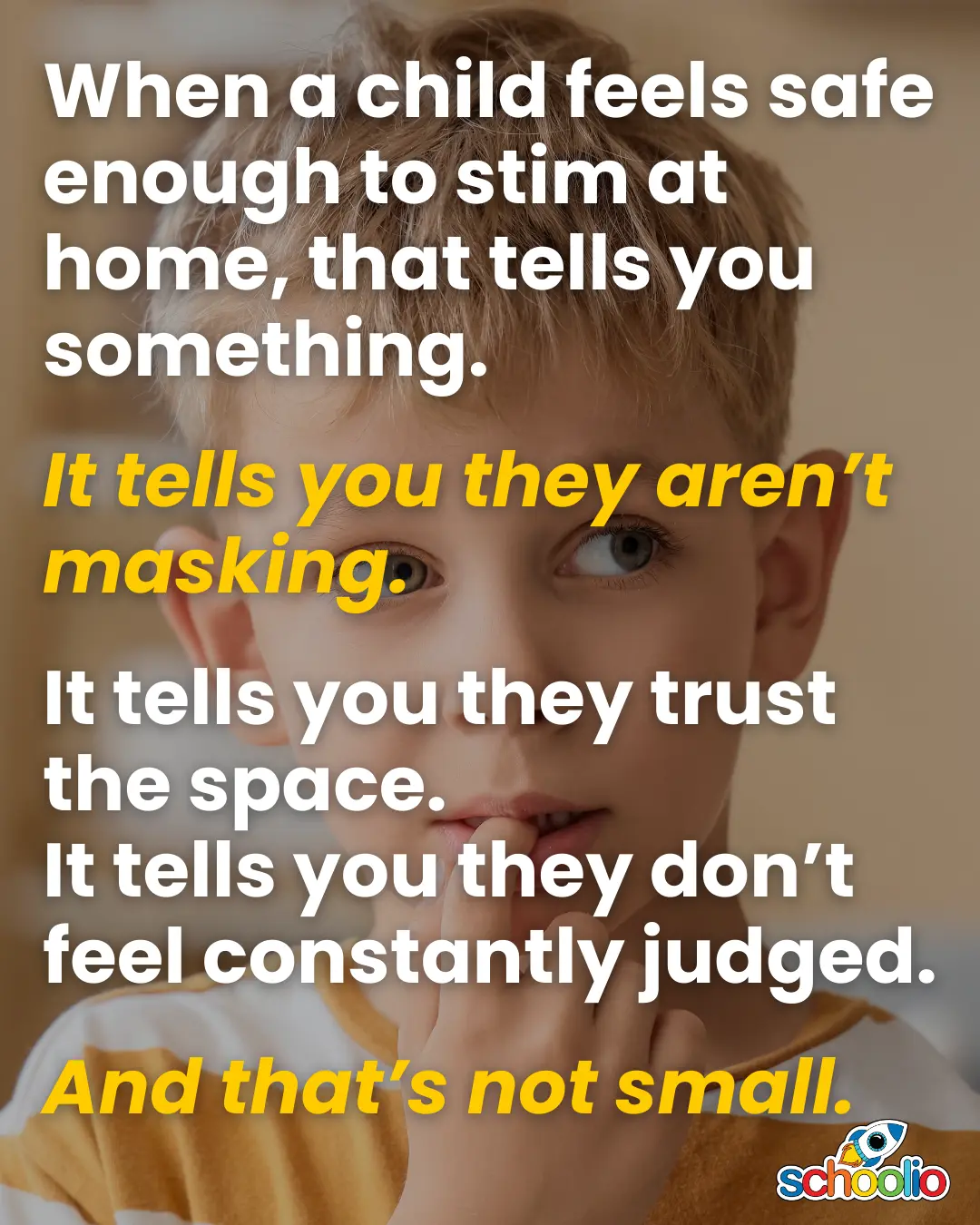
When a child feels safe enough to stim at home, that tells you something.
It tells you they aren’t masking.
It tells you they trust the space.
It tells you they don’t feel constantly judged.
And that’s not small.
Sometimes the most powerful thing we can do isn’t teaching our kids how to stop stimming.
It’s helping them understand why they do it.
Because when a child understands their nervous system, they stop feeling broken.
And when they stop feeling broken, they start building regulation from the inside out.