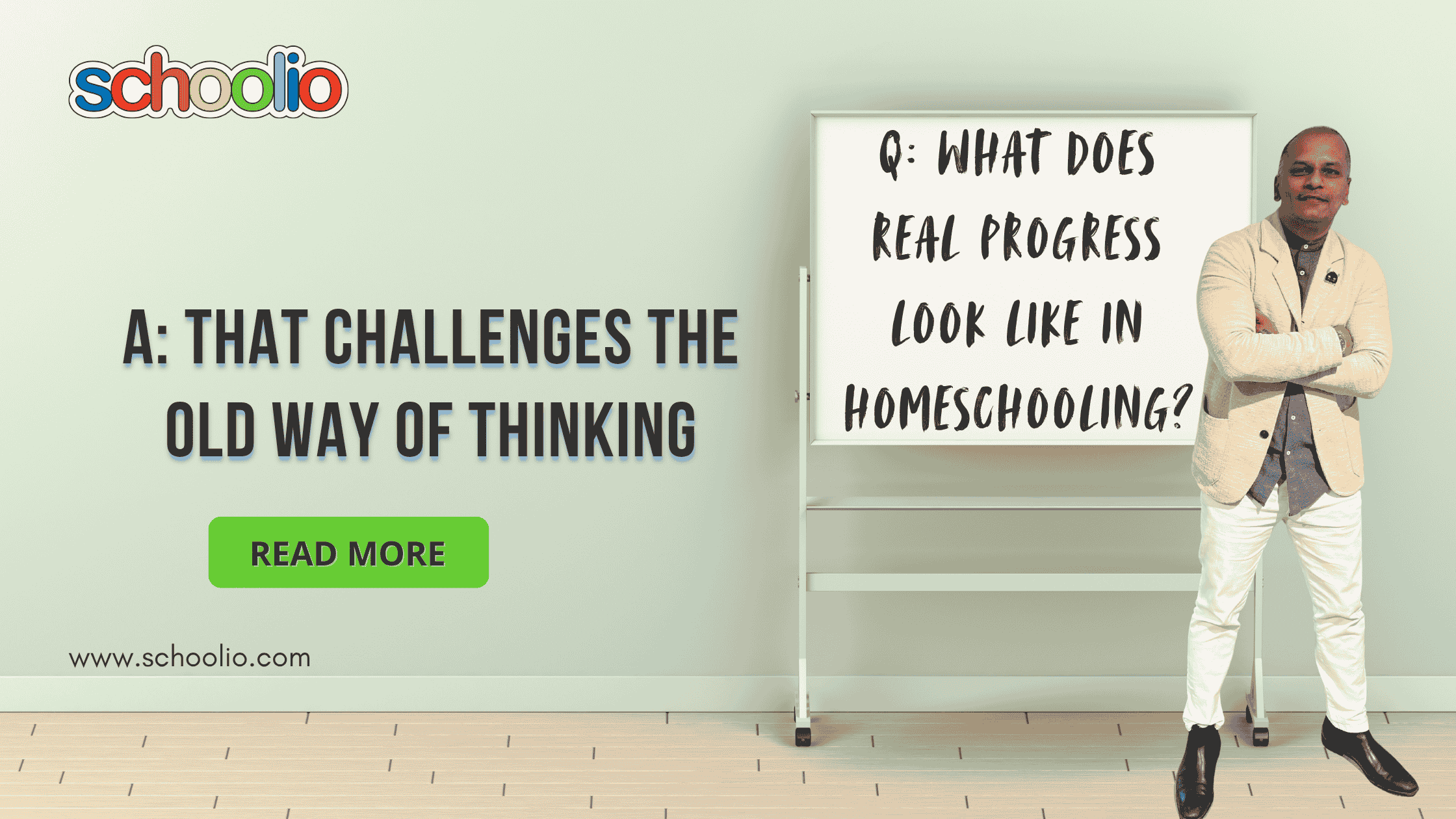
When a Mom in Our Community Answered a Simple Question with One Word.

When a Mom in Our Community Answered a Simple Question with One Word.


This has been on my mind today…

A mom in our community answered a simple question with one word.

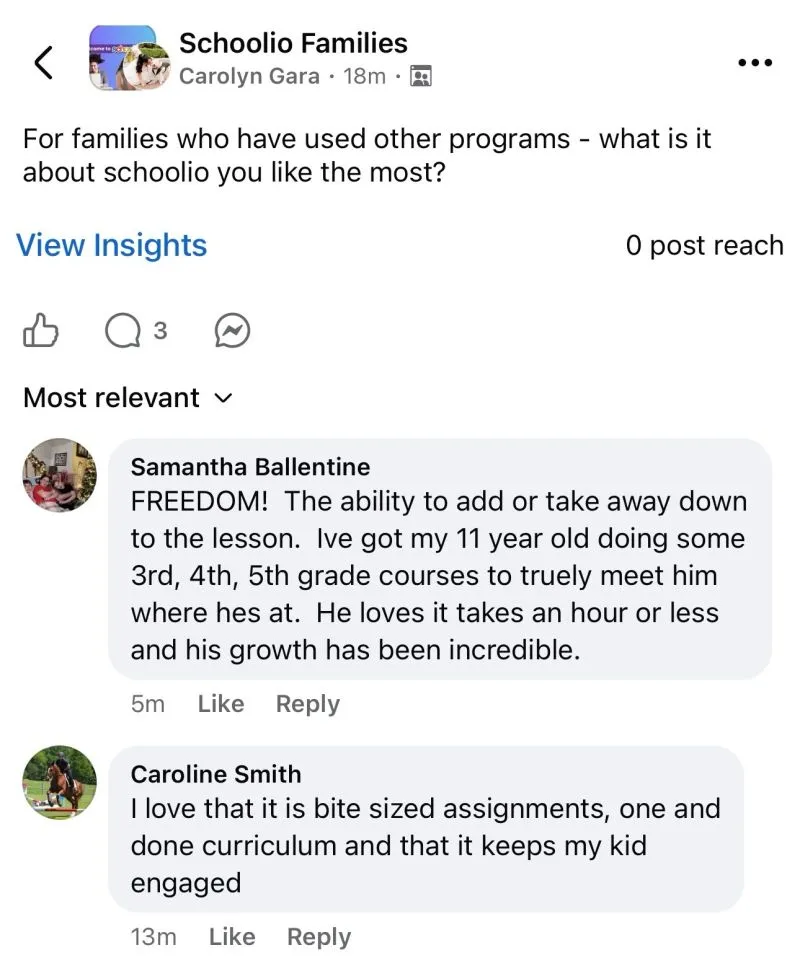
Freedom.

Not freedom from learning. Freedom inside learning.

One parent shared that her eleven year old moves between third, fourth, and fifth grade work depending on the subject. Not because he is behind. Not because he is ahead. Because that is where he is.

Another said she loves the bite sized, one and done lessons. Her child stays engaged. It takes less than an hour. Growth has been incredible.

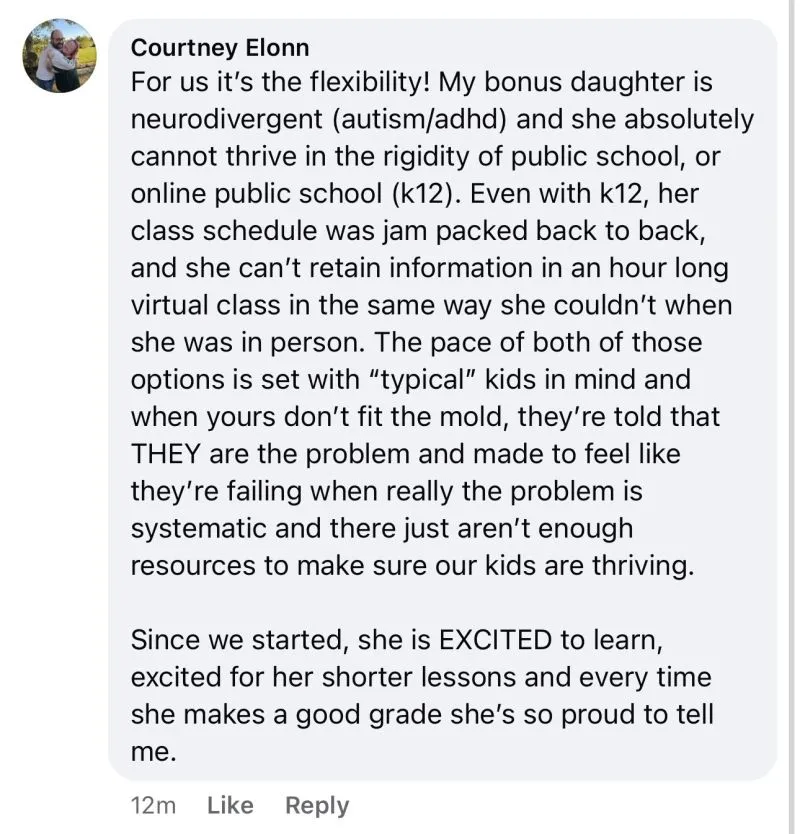
And then a mom of a neurodivergent daughter said something that hit hard. In public school and even online public school, the pace was built for typical kids. When her child could not keep up, she was made to feel like the problem.

Since switching, her daughter is excited to learn. Proud of her grades. Thriving.

This is why homeschooling is becoming more normal across the world.

It is not about escaping school. It is about building systems that adapt to kids instead of asking kids to adapt to systems.

When parents say freedom, what they mean is their child finally fits.


Sathish

still learning, still unlearning


The Quiet Wins That Matter Most

The Quiet Wins That Matter Most


This has been on my mind today…

Some days, the work feels heavy. You’re building something that doesn’t yet exist. A platform that reimagines education, reshapes how kids learn, and gives power back to the people who’ve been left out of the conversation for too long—parents, students, and those who learn a little differently.

You push through meetings, plans, deadlines, product reviews. You tweak systems, question decisions, and hold the big vision in your mind like a lighthouse, even on foggy days. But once in a while, something cuts through all that noise. A comment. A thank-you. A message that reminds you why you started this in the first place.

That happened to me recently.

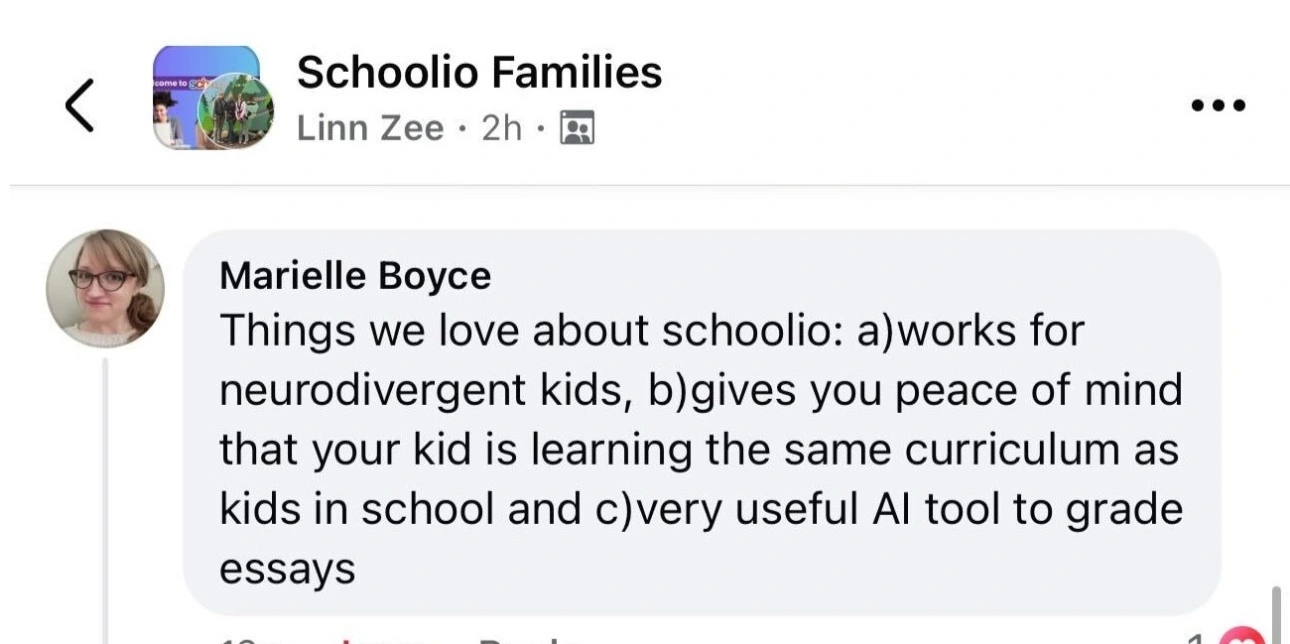
A parent shared a short post in our Schoolio Families group. Just a few lines. No hashtags. No fuss. Just truth.She said she loved Schoolio because it works for her neurodivergent child. Because it gives her peace of mind knowing her kid is learning the same curriculum as students in traditional school. And because the AI tools helped with grading essays.


Customer Testimonial

Simple. Direct. But when I read it, it stopped me.

Because that right there is the quiet win that matters.

She didn’t say we changed her life. She didn’t say we were perfect. What she shared was something more real. She shared relief. Confidence. Stability. The kind of stability every parent needs, but especially the ones who are walking a different path.


The truth is, a lot of the parents we serve never wanted to homeschool. They weren’t planning for it. It wasn’t on their vision board. But something shifted—maybe a bad experience at school, a child’s needs not being met, or just a gut feeling that things weren’t working.

And now they’re here, trying to do what’s best for their child, even when the world questions them for it.

This is what we built Schoolio for. For that parent who lies awake at night wondering if they’re doing enough, for the child who learns better with space and silence, for the families that don’t see themselves in glossy brochures or test scores and for the moments when a tool actually helps and no one has to fight for it.

You don’t always get to see the impact of your work. You don’t always hear how it lands. But every now and then, someone like Marielle speaks up and says, This helped. And for me, that’s everything.

Because this isn’t just about curriculum or platforms or AI tools. This is about building something that lets families breathe again. Something that says: you’re not alone. You’re not wrong. And yes, you can do this.

That’s the win I hold onto today.


Sathish

still learning, still unlearning

One of Homeschooling Quietest Strengths

One of Homeschooling Quietest Strengths


By Lindsey Casselman, special-ed teacher & homeschooling mom


When I first started homeschooling, I thought a “good homeschooler” had a tidy schedule. Wake up at 8, lessons by 9, neat little blocks of math, reading, and science lined up like ducks in a row.

But then reality stepped in: my kids aren’t ducks, and neither am I.

What I learned over time — and what research keeps confirming — is that one of the most powerful tools we have in homeschooling is also the simplest: sleep.

In traditional school, kids are often shaken awake by alarms, rushed through breakfast, dressed half-asleep, and hustled out the door before their brains have even had a chance to fully wake up. I remember my own school mornings feeling like chaos in fast-forward. But homeschooling gave us the freedom to slow down, and that’s when I noticed something life-changing.

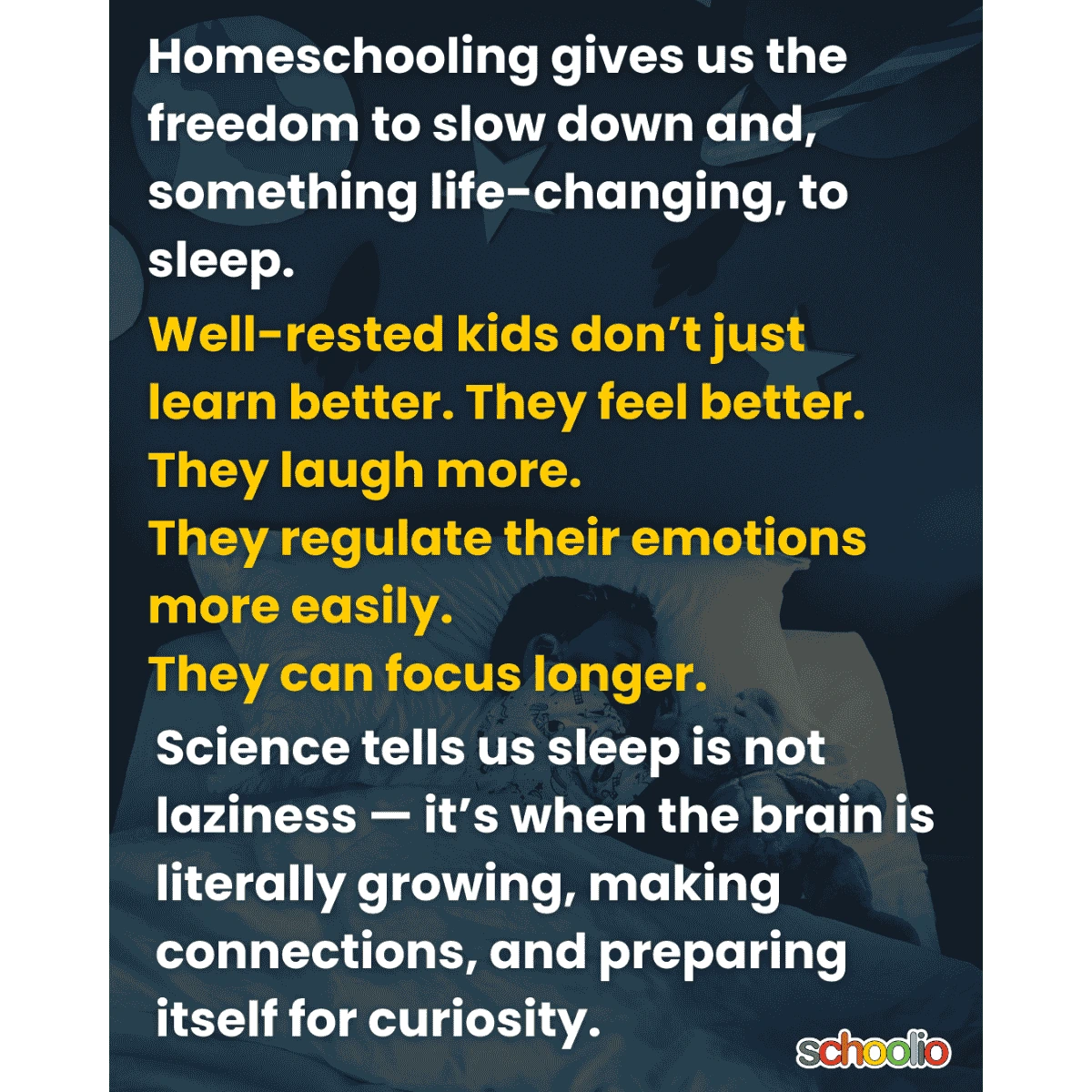
Well-rested kids don’t just learn better. They feel better. They laugh more. They regulate their emotions more easily. They can focus longer, without the constant battle against exhaustion. Science tells us sleep is not laziness — it’s learning in disguise. It’s when the brain is literally growing, making connections, and preparing itself for curiosity.


Here’s what that looked like in our homeschool:

  • Starting the day when my kids naturally woke up, not when a bus schedule dictated.
  • Protecting rest days after big field trips, instead of pushing through.
  • Building gentle morning and bedtime rhythms so transitions felt calming, not chaotic.
  • Letting rest be part of the curriculum, because restoration fuels curiosity.

And here’s the best part: this isn’t “falling behind.” It’s moving forward in a way that honors kids as whole humans — body, mind, and spirit.

So maybe the question isn’t, “Am I doing enough school hours?”

Maybe it’s, “Am I giving my child enough rest to flourish?”

Because the truth is, flexible sleep schedules aren’t a weakness of homeschooling. They’re one of its greatest strengths.


? Lindsey

Certified Special-Ed Educator & Co-Founder, Schoolio

The Real Scorecard Isn’t Grades — It’s Humanity

The Real Scorecard Isn’t Grades — It’s Humanity


This has been on my mind today…

My daughter is starting college. A new lifestyle. A new rhythm. A new version of independence. And as I watch her step into it with grace, confidence, and heart, I find myself reflecting—not just on her growth, but on mine as a parent.

In the early years, I thought my role was to prepare her academically. Get her ready for the tests. The projects. The milestones. The classic definition of “success.” But somewhere along the way, that definition shifted.

Because life had other plans.

Because she had questions school didn’t answer.

Because I realized my real job was never about the grades. It was about something bigger.

We tried to raise a daughter who could walk into any room, look people in the eye, and see them—not for their titles or their background, but for their shared humanity. We talked about what it means to be kind when no one’s watching. To question with curiosity, not criticism. To love first, even when the world makes it hard.

We didn’t always get it right. I came from a childhood where discipline meant violence. Where falling behind in school wasn’t a symptom of struggle, but a sign of laziness that had to be “beaten out” of you. That trauma doesn’t just disappear—it echoes. And it took years to unlearn.

But we knew we had to break the cycle. We didn’t ground our kids. We didn’t reach for fear as our first parenting tool. We took away iPads. We paused and talked. We treated mistakes as data, not disgrace. Because the world they’re inheriting is complicated enough without adding guilt and shame to the mix.

Whether you homeschool, send your child to public school, or choose a private path—it doesn’t really matter. What matters is how you’re preparing them for the world outside the classroom. Because it’s moving fast. It’s emotionally volatile. And it’s filled with both beauty and brokenness.

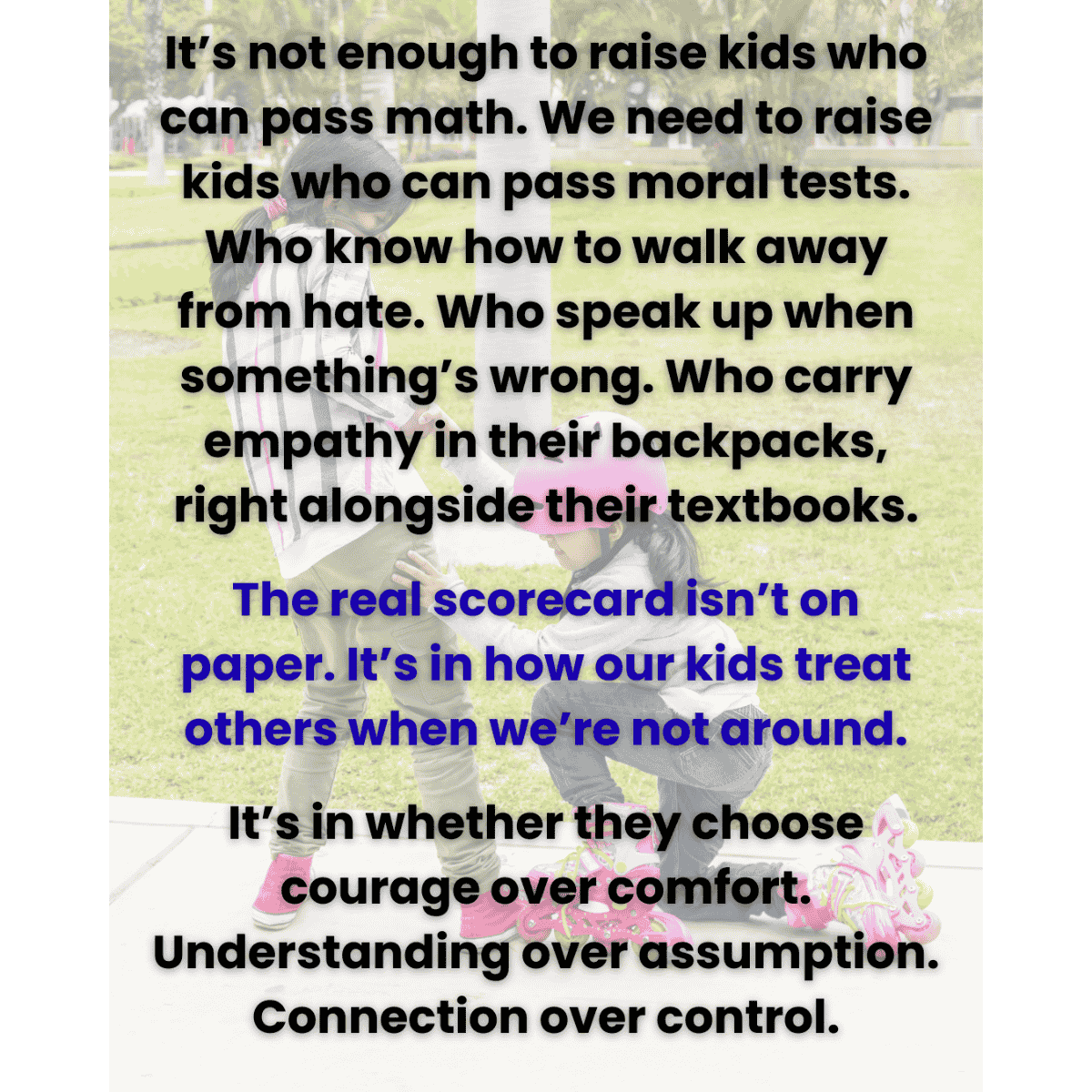
It’s not enough to raise kids who can pass math. We need to raise kids who can pass moral tests. Who know how to walk away from hate. Who speak up when something’s wrong. Who carry empathy in their backpacks, right alongside their textbooks.

The real scorecard isn’t on paper. It’s in how our kids treat others when we’re not around.

It’s in whether they choose courage over comfort. Understanding over assumption. Connection over control.

And those values? They’re not taught once. They’re modeled over time.

That’s why this company—Schoolio—is a personal mission for me. It’s why we build tools and content that don’t just cover curriculum, but embrace character. I don’t believe learning should be weaponized or used to judge. I believe it’s a lifelong, imperfect, beautiful process. A work in progress, just like all of us.

This week, I’m not just sending my daughter to college. I’m celebrating a milestone that started long before the acceptance letter. I’m watching her walk out into the world with her own voice. And I’m quietly reminding myself: That’s the legacy that matters.

—Sathish

still learning, still unlearning

When Science Turned Into a Betta Fish

When Science Turned Into a Betta Fish


By Lindsey Casselman, special-ed teacher & homeschooling mom


One of the things I love most about homeschooling is how easily learning can connect to real life. Sometimes the best projects don’t come from a curriculum guide — they come from your child’s heart.

When my daughter was seven, she desperately wanted a Betta fish. Like many parents, my first instinct was to say, “That’s a lot of responsibility — are you sure you’re ready for that?” But instead of just saying no, I turned it into an opportunity for learning.

We made it her science project. She had to create the classic tri-board presentation — research, write, and present — all about Betta fish. She learned where they live in the wild, what they eat, how to set up the right tank environment, and common mistakes people make in caring for them. But the project didn’t stop at facts. She also had to make the case for why she was ready to take care of one.

I’ll never forget watching her stand in front of that board, confidently explaining filtration systems, water temperatures, and feeding schedules. This wasn’t just a science lesson anymore. It was research skills. Public speaking. Persuasive writing. Responsibility.

And it was driven entirely by her motivation. Because she wanted that fish, she owned the project. She went deeper than she would have if I had assigned “Chapter 3: Aquatic Life.” She wasn’t just doing school — she was preparing for real life.

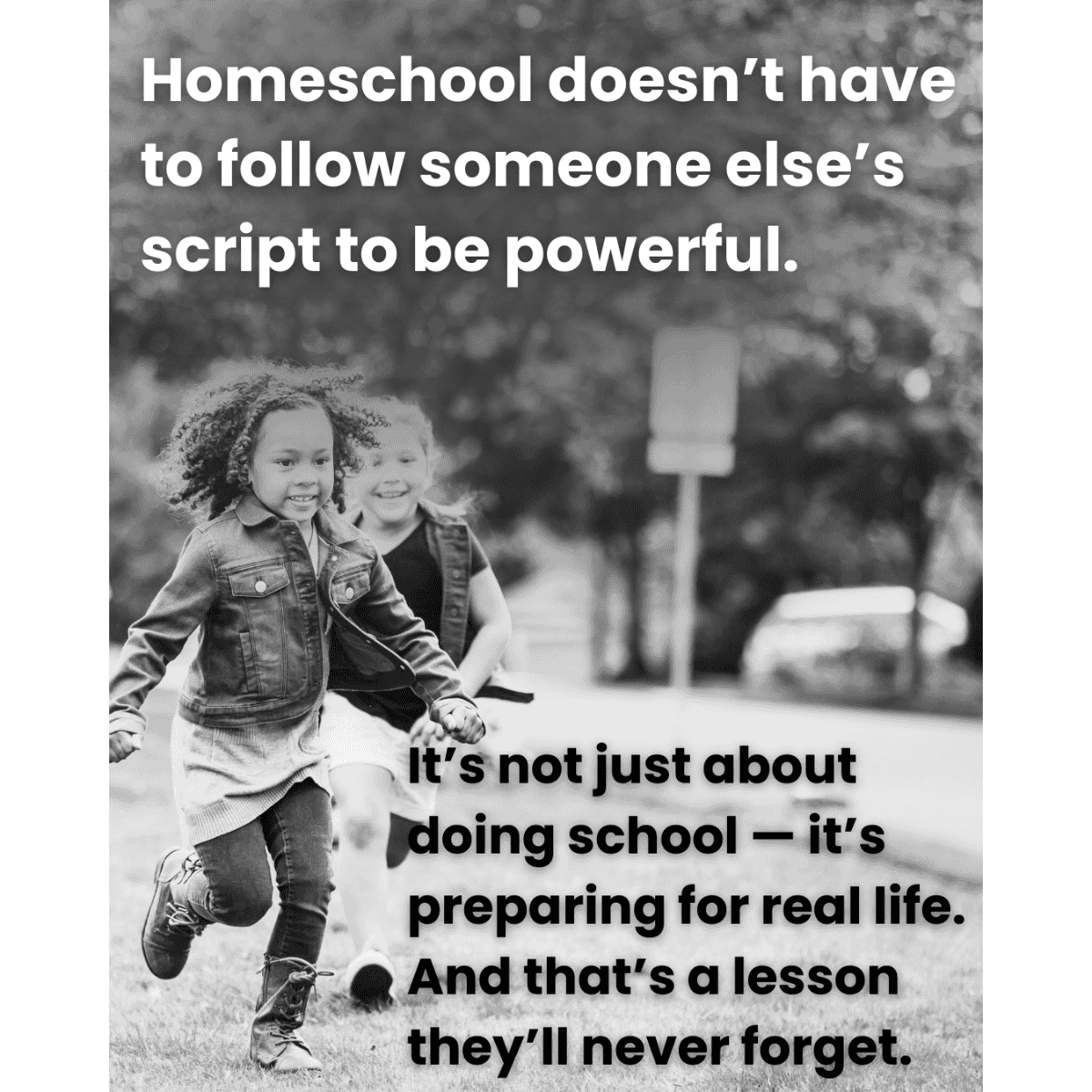
In the end, she did get her Betta fish. But honestly, the project itself was the real win. She learned that with research and preparation, she could rise to a challenge. And I learned (again) that homeschool doesn’t have to follow someone else’s script to be powerful.

And apparently, I also set a precedent in our house without realizing it. Fast forward a few years, and Grace — now 13 — wanted a new pet. Out of nowhere, I found myself sitting on the couch watching a full PowerPoint presentation on why she should be allowed to get a snake. I hadn’t asked for it, and I hadn’t suggested it. She just knew she needed to convince me in a smart and prepared way.

So fair warning: this approach works beautifully for learning… but it may also get you into more pets than you imagined! ?

? Lindsey

Certified Special-Ed Educator & Co-Founder, Schoolio

Why I Stopped Worrying About Learning Gaps

Why I Stopped Worrying About Learning Gaps

By Lindsey, certified special-ed educator & co-founder, Schoolio

This has been on my mind today…

The weight of comparison. It sneaks in quietly. A friend tells you what their child is learning in school. A neighbor asks about your homeschool “schedule.” You catch a glimpse of someone’s color-coded curriculum plan on Instagram. Suddenly your confidence starts to unravel.

I remember this feeling most clearly when my oldest was around eight or nine. We were deep into homeschooling, but I was constantly looking over my shoulder at what public school kids were doing. Were we covering the same content? Were we behind? Was I doing enough?

It became exhausting. I was trying to replicate school at home—not because it worked for us, but because I thought that’s what “real” education looked like.

Here’s the truth I had to learn the hard way: homeschool doesn’t need to imitate public school to be valid. In fact, the whole point is that it doesn’t.

I kept coming back to a simple question. If I can’t remember what I learned in third grade, why was I putting so much pressure on myself to make sure my child retained every single concept in the third grade curriculum? I realized I was clinging to a system I didn’t even believe in—one I had left behind for a reason.

When kids are in school, they’re taught for a set number of days, then tested. If they get a 60%, that means they missed 40%—and the class moves on. No one loops back. No one stops the train. That’s a gap. A big one. But it’s accepted.

In our homeschool, if my child gets sick or we need to pause for emotional rest, schoolwork pauses. School doesn’t go on without them on sick days, it waits for them. We don’t pretend 60% is good enough. The beauty of this lifestyle is that learning pauses with the child and picks up again when they’re ready.

That alone makes a massive difference.

And the truth is, we all have learning gaps. Adults included. Because humans only retain what they find meaningful. You can make a child memorize facts for a test, but they’ll likely forget most of it after. If something isn’t relevant to their lives, it doesn’t stick. So whether you never cover it, or they forget it, the result is the same.

That realization gave me freedom.

I stopped obsessing over whether we had checked every box. I started asking better questions: Was my child curious today? Did we connect? Did they ask questions that mattered to them? Those were my new benchmarks.

And wouldn’t you know—it made everything easier. They were learning more, not less. And I was enjoying it more, too.

So if you’re caught in that loop of comparison, wondering if your homeschool is “real” enough, let me gently offer this: your homeschool is enough because it’s yours. Because it fits your child. Because it’s rooted in love, flexibility, and intention.

That’s not falling behind. That’s choosing to lead.

certified special-ed educator & co-founder, Schoolio


? Need help trusting your homeschool rhythm?

Start with our free homeschool planner, explore flexible curriculum bundles, or try our 7-day trial to see how it can work in your home.
Why Pausing Ontario’s Curriculum Overhaul Might Be the Best Thing That Could Happen

Why Pausing Ontario’s Curriculum Overhaul Might Be the Best Thing That Could Happen

by Lindsey Casselman

When I think back on our homeschool journey — and honestly, even my time as a classroom teacher — one thing that always struck me was how often we tried to fix learning by changing the curriculum.

I’ve been watching the news about Ontario’s decision to pause its major curriculum reforms, especially the overhaul to kindergarten, and I’ll be honest — it felt familiar. Not because change is bad, but because too often, we mistake activity for progress.

As someone who’s both taught in public school and built curriculum from the ground up here at Schoolio, I’ve seen how these sweeping changes tend to go. New documents, new standards, new language — but very little impact on what really matters to kids and teachers. A few years later, we do it all over again.

It’s not reform. It’s spinning.

Somewhere along the way, we started treating education like a business — always marketing, rebranding, looking for the next system-wide breakthrough. But kids aren’t products. And learning isn’t a marketing strategy.

The truth is, what drives real learning is rarely found in a government PDF. Students thrive when their curiosity is sparked. When their teacher has the freedom and energy to explore a topic from a new angle. When lessons connect to the real world — to questions they actually ask.

But most curriculum overhauls don’t get at any of that. They shuffle standards. They update timelines. They insert buzzwords. But they rarely ignite joy — in students or teachers.

If you’ve ever sat at the kitchen table with your child, trying to make sense of a lesson that feels totally disconnected from real life, you know exactly what I mean. That glazed look. The frustration. The deep feeling of “why are we even doing this?”

That’s not a learning problem. That’s a relevance problem.

What we need isn’t a brand new curriculum every few years. What we need is a mindset shift.

Instead of building everything from the top down, what if we started from the ground up? What if we trusted teachers to lead the way, using their experience and insight to shape lessons that actually land? What if we listened — really listened — to the kids?

That’s how we design our units at Schoolio. We start with questions students already have. We build flexibility in, so families can pause or pivot. We make space for creativity, discussion, and the moments that stick.

And we don’t pretend that a perfect curriculum will solve everything. What we offer is structure, yes — but with enough room for learning to feel alive again.

So while the pause in Ontario’s reforms might seem like a step back, I see it differently. It’s a chance to stop the spinning. To ask better questions. To start designing for joy, not compliance.

Because if we’re really serious about helping kids learn — we have to remember why they learn in the first place.

Lindsey,

Certified Special-Ed Educator & Co-Founder, Schoolio


? Want curriculum that’s built around real questions, flexible structure, and student joy?

Explore our project-based bundles, download our free samples or start a 7-day trial to see what modern learning can look like at home.

How to Homeschool Multiple Kids Without Losing Your Mind

How to Homeschool Multiple Kids Without Losing Your Mind

by Lindsey, Head of Curriculum at Schoolio

This has been on my mind today…

Homeschooling even one child is a full-time emotional and mental job. Homeschooling two or three? That’s a whole circus. And if they’re at different grade levels? Let’s just say it took me a while to stop waking up already overwhelmed.

I remember those early years when I felt like I had to mimic a real school day. Everyone had to be at the table at the same time, working on math at 9, reading at 10, science after lunch. It was rigid, exhausting, and full of frustration. Someone always needed help, someone else was bored or acting out. There were tantrums. Sometimes theirs. Sometimes mine.

What saved us was realizing that homeschooling doesn’t have to look anything like public school. And honestly, it probably shouldn’t.

One of the biggest mindset shifts we had was dropping the idea that everyone had to do the same subject at the same time. That’s not how real life works, and it’s not how learning naturally happens. So I started calling the kids to me one at a time. When one was off playing, I could work through a new math concept with the other. Once they had the hang of it, I’d set them up with independent work and call the next one in for reading time. It wasn’t about multitasking anymore. It was about focused, calm, short bursts of one-on-one time.

The second big shift came when I stopped letting grade levels rule our world. At first I was clinging to the public school timeline — this topic in science at this age, this history chapter in third grade, and so on. But it didn’t make sense anymore. Why teach something just because the curriculum says it’s “time,” if they’re not curious or ready? So we started learning science and social studies as a team — everyone at the same time, just at different depths. We’d dive into volcanoes or ancient Egypt or the weather together, and I’d tweak the activities up or down depending on the child. They started helping each other, sharing facts, building projects side by side. The learning stuck. And I wasn’t exhausted.

I used to feel guilty every day. Guilty that one child got more of my attention. Guilty we didn’t finish the lesson plan. Guilty I wasn’t following the school’s rhythm. But I’ve learned that flexibility is not a failure. In homeschooling, it’s a strength.

We use our homeschool planner loosely now — more like a compass than a stopwatch. And the beauty of online homeschool programs is that they let you set your own pace. With Schoolio, I can see where each kid is, pick the lessons that matter most for them right now, and let go of the rest.

So if you’re in the thick of trying to homeschool multiple kids and feeling like you’re falling apart, I promise you’re not alone. The magic isn’t in doing it all at once. The magic is in tuning into your children, one by one, moment by moment — and building a life that works for your family.

And guess what? That’s more than enough.

Lindsey

certified special-ed educator & co-founder, Schoolio


Curious how Schoolio helps families balance learning for multiple kids? Start a 7-day free trial or explore our all-in-one planner built for real homeschool life.

Start your FREE TRIAL.

If It Doesn’t Look Like School… Good.

If It Doesn’t Look Like School… Good.

“Homeschooling doesn’t look like public school. That’s the point.”

This has been on my mind today…

When I first started homeschooling, I tried to make our home look like a classroom. Desks lined up, a daily schedule on the wall, a bell for transitions — I even printed out attendance sheets.

It lasted about three days.

What followed was frustration, tears, and a lot of self-doubt. I thought something was wrong with me. I couldn’t keep up the structure. My kids weren’t responding the way I expected. I wondered if I had made a huge mistake.

But the truth was simpler: I was trying to replicate a system that didn’t actually work for us.

Homeschooling doesn’t look like school. That’s the point.

School is designed for groups. For efficiency. For managing dozens of kids with one adult. It’s built on uniformity and compliancy. But I don’t want my kids to be uniform or compliant.

Homeschooling is built on flexibility. On freedom. On honoring your child’s pace, your family’s values, and your real life.

Some days, math happens at 8am. Other days, it doesn’t happen at all.

Some weeks, we read and entire novel. Other weeks, we’re outside chasing butterflies and calling it science.

Some subjects take root quickly. Others simmer quietly until the spark hits.

And through it all, learning is happening.

It just doesn’t look like it used to. And that’s okay. Actually, it’s better than okay.

It means your homeschool is becoming yours.

There’s no attendance sheet for curiosity. No standardized test for joy. No report card that measures the deep, steady growth happening when a child feels safe, loved, and free to learn in their own way.

So if your homeschool doesn’t look like school — good. That’s the point.

With love,

Lindsey

Certified Special Ed Educator & Co-Founder, Schoolio

My Child Is Not an Adult in Training

My Child Is Not an Adult in Training


A home educator dares to imagine an education that matters to the child as a child, not just as an adult in training.” — Julie Bogart


This has been on my mind today…

Somewhere along the way, education stopped being about childhood. It became about adulthood. Test scores. GPAs. College readiness. Career prep.

But what about being ready to be a child?

When I started homeschooling, I thought I was just taking on a different method of schooling. What I didn’t expect was how quickly my kids began to reclaim parts of themselves that had been rushed, quieted, or overlooked.

They became more playful. More curious. They asked more questions. They stopped trying to always be “on” or “perfect” or older than they were.

And I realized something. So much of traditional education is focused on preparing kids for a future life that it forgets they are living one right now.

School culture pushes kids to grow up faster than they’re ready to. To give up play for “coolness” or “serious work”.

They are not adults in training. They are kids. With real thoughts. Real emotions. Real learning rhythms that don’t always fit neat timelines.

Homeschooling gives us the chance to slow it all down.

To build a world around them that says “you matter” without needing to add “when you grow up”, let them rest when they’re tired, and let them chase the weird, wild ideas they can’t stop thinking about.

To let them enjoy learning instead of fearing it.

Let them play.

This doesn’t mean we don’t care about their futures. It means we believe that honoring their present is part of preparing them for it.

I want my kids to grow into capable, wise, thoughtful adults. But I also want them to have a childhood they can look back on with joy — not burnout.

That’s the gift homeschooling gave us. And I’ll never regret choosing it.

With love,

Lindsey

Certified Special Ed Educator & Co-Founder, Schoolio

Why We Need to Redefine What ‘Progress’ Looks Like in Homeschooling

Why We Need to Redefine What ‘Progress’ Looks Like in Homeschooling

Voice: Sathish

This has been on my mind today…

The word “progress” shows up a lot when we talk about education. Are they on grade level? Are they reading at the right age? Are they behind? Ahead? Caught up? We use these markers like a ruler held up against our kids — even when we know, deep down, that learning doesn’t work that way.

I’ve spoken to so many families who felt pressure to make their homeschool look like school. If their child wasn’t hitting the same pace or benchmarks, something must be wrong. But more and more I’m hearing stories from parents that flip that narrative completely.

Like Suzanne. Her son is autistic and in grade 6. They were searching for something — anything — that would actually work for him. She called finding Schoolio a “game changer.” For the first time, her son is doing really well. Not just keeping up — thriving. Not because someone pushed him through a one-size-fits-all curriculum, but because they finally found a platform that met him where he was.

Or Holly, who told us her daughter was developmentally behind and struggling to understand things. Public school left her confused and overwhelmed. But now? With Schoolio lessons, she’s finally understanding. She’s gaining confidence. She’s calm and learning. And Holly said, “I couldn’t be happier.”

These stories remind me that real progress isn’t always loud. It doesn’t always show up on a test score. Sometimes progress is your child smiling during a lesson instead of crying. Sometimes it’s the first time they ask to keep going. Or the first time they feel safe enough to say, “I don’t get it,” and actually get the support they need.

We have to unlearn the idea that speed equals success. Learning isn’t a race. If your child needs more time to grasp a concept, that’s not failure — that’s human. Especially for neurodivergent learners or kids recovering from years of being overwhelmed by noise, rules, and fast-paced instruction.

Progress can be your child doing less… but doing it with joy. It can be fewer meltdowns. More calm. Asking questions again. Finding confidence. Progress might not be a straight line. But when we build learning around the child — not the system — it shows up in ways that actually matter.

So if you’re homeschooling and worried that your child is “behind,” take a breath. Ask yourself — are they more curious? More relaxed? Starting to enjoy learning again?

That might be the most important kind of progress there is.

Sathish

still learning, still unlearning


Unlearning School: What Homeschooling Helped Me See Differently About Education

Unlearning School: What Homeschooling Helped Me See Differently About Education

By Sathish Bala

This has been on my mind today…

When I look back at my own schooling in Singapore during the 1980s, I realize how much of it was built around conformity. A student’s worth was tied to a test score. Our futures were determined by how well we followed instructions, memorized content, and stayed in our seats. That system didn’t see who we were. It only saw what we could produce.

So much of homeschooling — for me, and for the thousands of families I’ve now spoken with — is really about unlearning that model.

At first, most parents try to recreate school at home. Schedules. Desks. Checklists. But slowly, over time, the shift happens. We stop asking, “Am I doing enough?” and start asking, “Is my child curious? Are they feeling safe enough to learn at their own pace?”

We realize that learning doesn’t have to look like sitting still. It can be messy, playful, deeply personal. Sometimes that realization comes from the chaos — the days when nothing goes according to plan, and you see your child learning anyway. Sometimes it comes from joy.

One mom who just started her free trial with Schoolio shared this incredible moment with us:

“I just signed up for a free trial and had my neurodivergent son test out a lesson in Social Studies, a subject he has not previously enjoyed. Until now! He enjoyed the lesson so much he was asking me to please print the PDFs for him to work on, which he also never does. I think this is a very good sign and look forward to him completing other lessons!”

This is the kind of learning traditional school often misses. For many kids, especially neurodivergent learners, subjects like Social Studies or Language Arts become walls instead of doors. But when the format changes — when they get space to go at their pace, explore topics through different modalities, or simply feel like they’re being listened to — everything opens up.

Homeschooling has helped me see that education isn’t about information delivery. It’s about connection. It’s about nurturing curiosity and self-awareness. It’s about teaching kids how to learn, not just what to memorize.

And that’s what public school often forgets — it’s not just the curriculum that needs change. It’s the entire culture. At Schoolio, we believe deeply in giving families the tools to break that culture, and build something better.

Because when we unlearn school, we begin to see learning everywhere.

Sathish

still learning, still unlearning